
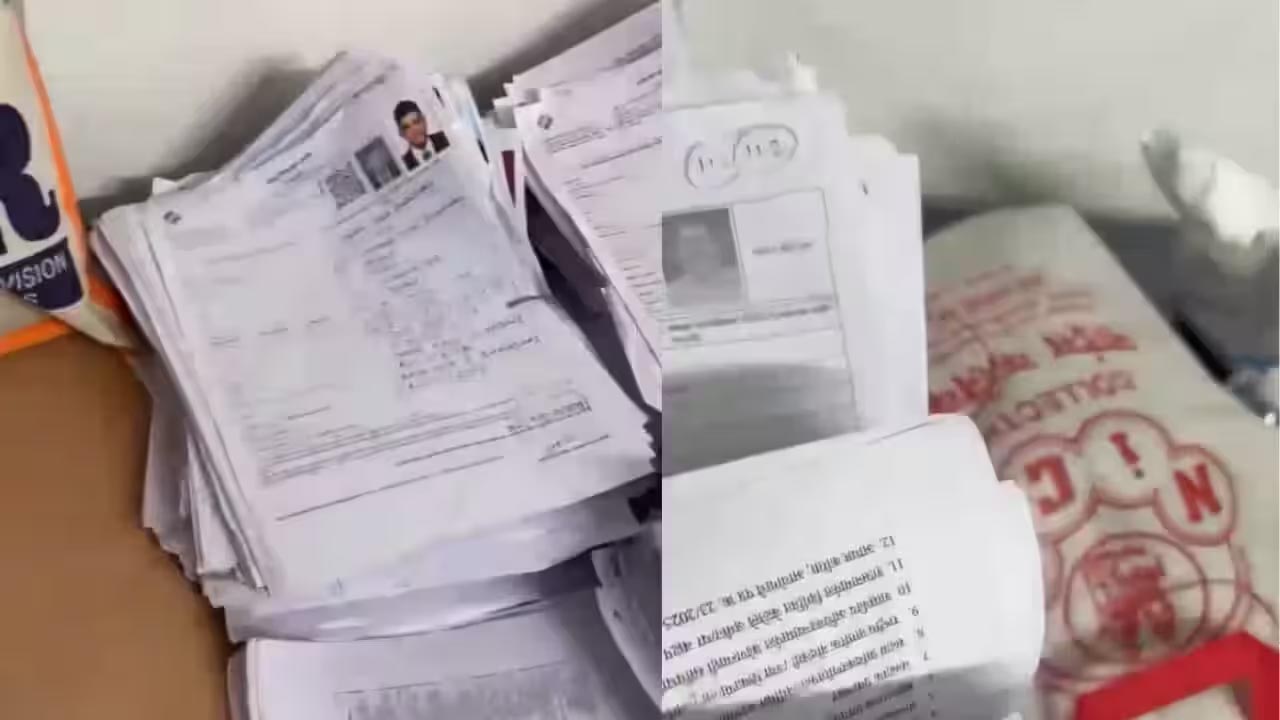
Citizens for Justice and Peace (CJP), Vote for Democracy (VFD) and Bombay Catholic Sabha (BCS) have written to Maharashtra Chief Electoral Officer S. Chockalingam seeking urgent intervention into the discovery of 3,404 original Special Intensive Revision (SIR) Enumeration Forms at a private photocopying centre in Kharghar.
In its memorandum dated September 2, the organisations have collectively argued that the incident cannot be dismissed as an isolated administrative lapse. The memorandum has called for a comprehensive investigation into how thousands of original election documents came to be outside official custody, why they were being reproduced at a commercial establishment and whether the breach points to wider vulnerabilities in the handling of voter information during the SIR exercise.
The Kharghar incident assumes added significance because of the scale of the ongoing revision process. According to figures cited by the Chief Electoral Officer, around 2.07 crore Enumeration Forms have been classified as uncollectable in Maharashtra at the draft stage. While the Election Commission has clarified that being classified as uncollectable does not automatically mean that an elector has been permanently excluded from the electoral roll, CJP has argued that the sheer magnitude of the figure makes the integrity of every stage of the verification process a matter of exceptional public importance.
3,404 original forms found at private photocopying centre
The controversy emerged on August 27, when election-related forms were reportedly found at a photocopying centre in Sector 19, Kharghar. According to reports cited in the memorandum, the recovered documents were original SIR Enumeration Forms relating to multiple polling stations under the 188-Panvel Assembly Constituency. A revenue team subsequently examined the documents, and election authorities reportedly confirmed that they were genuine election forms. Reports have stated that the forms related to 11 polling stations.
The incident reportedly came to light following a complaint concerning the photocopying of the forms. A person identified in media reports as Suraj Patil, described as a BJP functionary, was allegedly found handling the forms. The police subsequently seized the documents and an FIR was registered. Five Booth Level Officers associated with the forms were also suspended, with a departmental inquiry initiated into how the documents reached the private premises.
In the memorandum, the groups state that culpability must be established through an impartial investigation. At the same time, the memorandum argues that the reported political connection makes it particularly important for the State Election Commission to establish whether access to the forms was authorised and, if not, how such access was facilitated. The central question, according to CJP, is therefore not simply who was found with the forms, but how the forms travelled from the official election machinery to a private establishment in the first place.
Where did the documents leave the official chain of custody?
The memorandum places particular emphasis on the chain of custody (chain of command in law) of the Enumeration Forms. SIR forms are part of an official electoral exercise and contain voter-related information. Their handling therefore requires safeguards that ensure that the documents remain accessible only to persons authorised to use them for election-related purposes.
The discovery of thousands of original forms at a commercial photocopying centre raises questions about every stage of their movement. CJP and others has therefore called for the reconstruction of the entire chain of custody, beginning with the collection of the forms from electors and continuing through their storage, transportation, access and eventual recovery.
The organisation has also stressed that the inquiry should not automatically end with the suspension of the five BLOs. If the evidence points towards supervisory, administrative or other responsibility, those aspects too must be investigated. The issue is particularly significant because of the sheer number of documents involved. The presence of 3,404 forms cannot be explained simply as an isolated document inadvertently carried outside an office. The authorities must establish who had access to them, who authorised their movement and why they were taken to a private photocopying facility.
A voter-data security concern, not merely a paperwork lapse
The memorandum has also raised concerns about what may have happened to the information contained in the forms. The organisation has urged the authorities to determine whether the documents were merely photocopied or whether they were also scanned, photographed, digitally stored, transmitted or reproduced in any other manner.
This is an important distinction. Physical recovery of the original forms does not necessarily establish that no copies remain elsewhere. CJP, VFD and BCS have therefore called for relevant CCTV footage, electronic records and equipment used in the photocopying process to be preserved and examined as part of the investigation.
The memorandum argues that once voter-level information leaves the controlled environment of the election machinery, the potential risk extends beyond the physical documents. Copies could potentially be retained or disseminated without the knowledge of election authorities.
For CJP, VFD and BCS, citizens who provide information to the State as part of the electoral process are entitled to an assurance that such information will be used only for legitimate electoral purposes and handled through secure procedures.
The 2.07 crore figure makes the breach more consequential
The memorandum has linked the Kharghar incident to the wider concerns surrounding the SIR exercise in Maharashtra. The Chief Electoral Officer has stated that approximately 2.07 crore Enumeration Forms have been classified as uncollectable, comprising categories including voters who were absent or not found, those who had permanently shifted, deceased persons, duplicates or persons already enrolled elsewhere.
The Election Commission has emphasised that these classifications are provisional and that the draft electoral roll is not the final roll. Eligible voters whose names are missing can participate in the claims and objections process and seek inclusion or correction. The memorandum has acknowledged this position but has argued that the availability of a remedy does not, by itself, eliminate concerns arising from the scale of exclusion. An elector who does not know that their name has disappeared from the draft roll may not necessarily approach the authorities. Similarly, an elector incorrectly classified as shifted, deceased, duplicated or absent may face a significant administrative burden in establishing that they remain eligible.
In this context, the Kharghar incident raises a broader question: can the public have confidence in the accuracy of the electoral roll if the documents on which that roll is being prepared are not demonstrably secure? For CJP, this is why the Kharghar episode cannot be treated merely as a local dispute.
CJP and others seeks statewide audit
The organisation has called for the Kharghar incident to trigger a statewide audit of the custody and handling of SIR Enumeration Forms. Such an audit, CJP argues, should establish whether similar instances of unauthorised possession, removal, reproduction or mishandling have occurred elsewhere in Maharashtra.
The memorandum also calls for the Election Commission to strengthen and publicly disclose uniform safeguards governing the custody, movement, reproduction, storage and disposal of SIR documents. This, CJP says, is necessary not only to identify wrongdoing after it occurs but to prevent vulnerabilities in the system from being repeated.
Transparency is essential to restoring public confidence
The memorandum has also called for the findings of the Kharghar inquiry to be made public, subject to legitimate restrictions relating to personal information or an ongoing criminal investigation. The organisation argues that the public should not be left to choose between competing political claims about what happened. The State Election Commission, as the institution responsible for the electoral process, must establish the facts and communicate them transparently. For CJP, the issue ultimately extends beyond the Kharghar photocopying centre.
An electoral roll determines who is recognised by the State as entitled to participate in an election. Its preparation therefore forms part of the foundation of the democratic process itself. The discovery of thousands of original SIR forms outside the expected chain of custody, followed by the suspension of five BLOs and the registration of an FIR, has already exposed a serious administrative vulnerability. When viewed alongside the 2.07 crore forms classified as uncollectable, that vulnerability assumes greater significance.
The memorandum therefore calls upon the Election Commission to treat the episode as an institutional matter rather than merely an isolated breach. Its demand is ultimately for something fundamental to any electoral exercise: that every eligible citizen’s place on the electoral roll be determined through a process that is secure, transparent, impartial and capable of independent scrutiny.
The credibility of an election does not begin on polling day. It begins with the integrity of the electoral roll—and with public confidence that the machinery preparing that roll is not vulnerable to unauthorised access, administrative failures or partisan interference.
The complete memorandum may be on the CJP website here.
Related:
Maharashtra SIR extension keeps teachers away from classrooms as unit tests face delays
SIR and the Making of a Stateless Citizen? | R. Rajagopal Speaks Out | Teesta Setalvad