
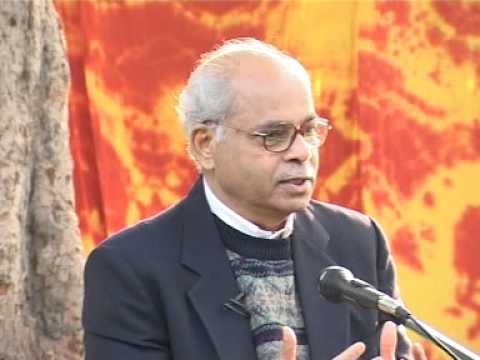
Widely read and recognised historian K N Panikkar, who critiqued colonial historiography’s simplistic view of culture and highlighted how indigenous intellectuals offered an alternative paradigm of modernity, passed away at a private hospital in Thiruvananthapuram on Monday. He would have turned 90 next month, April 26. An author and editor of several books, KN Panikkar’s A Concerned Indian’s Guide to Communalism and the ICHR’s Volume on Towards Freedom, 1940: A Documentary History of the Freedom Struggle are widely read and recognised,
Panikkar, affectionately called KN by his colleagues, was one among a select group of historians such as Bipan Chandra, Sabyasachi Bhattacharya and S Gopal who created a strong department of modern Indian history at JNU’s Centre for Historical Studies. Among other achievements, his course on the history of ideas in India in the 19th century was pioneering.
The Indian History Congress, has, in a statement expressed its deep sorrow and loss upon the demise of K.N. Panikkar, an esteemed historian and public intellectual of India, whose profound impact on historical scholarship and advocacy for secularism has left a lasting legacy. The Indian History Congress has expressed its heartfelt condolences to his family, colleagues, students, and admirers. His scholarship and example are poised to continue inspiring future generations of historians.
As a member of a remarkable generation of historians, Professor Panikkar significantly influenced the study of modern Indian history in the post-independence era. Through meticulous research, pedagogical endeavours, and consistent public discourse, he exemplified the manner in which historical inquiry could elucidate the intricate dynamics of colonialism, culture, and ideology that have shaped Indian society. His scholarly work was distinguished by rigorous archival investigation complemented by a nuanced understanding of the intellectual and cultural facets of historical transformation.
KN was one among the legendary historians who was accessible to students, activists and academia alike, firm in the belief that history and its methods—historiography—must and should be understood by the citizenry. At a time in the early 1990s when history was the contested site for the extreme, far right—Hindu ‘nationalist’—take-over of the public discourse KN’s contributions through lectures and workshops went a long way in ensuring a more nuanced and mature understanding of both past and present.
His work, including books like Against Lord and State: Religion and Peasant Uprisings in Malabar; Culture and Consciousness in Modern India; Culture, Ideology and Hegemony – Intellectuals and Social Consciousness in Colonial India, and Before the Night Falls were the subject matter of wide study and debate. He was also appointed by the government of Kerala as chairman of an Expert Committee that looked into the complaints raised from various quarters concerning new textbooks introduced to state-supported schools. The committee submitted its report in October 2008.
Trained in Kerala and subsequently affiliated with Jawaharlal Nehru University, Professor Panikkar played a pivotal role in fostering a thriving academic community. His seminal writings on colonialism, social movements, and the cultural politics of nationalism introduced novel perspectives on the interplay between power, ideology, and popular consciousness. Notably, his influential studies on peasant resistance in Malabar and the cultural underpinnings of colonial dominance remain crucial for scholars of modern India.
However, far beyond his academic contributions, Professor Panikkar was esteemed as a public intellectual known for his articulate and courageous stance on issues concerning historical interpretation and the role of historians. Amidst the increasing politicisation of historical narratives, he steadfastly championed the autonomy of historical scholarship and the imperative of evidence-based historiography, thereby contributing significantly to the preservation of India’s plural and secular historical narrative.
Professor Panikkar also made substantial contributions to Indian academia through various institutional roles, including his tenure as Vice-Chancellor of Sree Sankaracharya University of Sanskrit, where he endeavoured to enhance research and teaching in the humanities. His dedication to intellectual discourse, academic freedom, and the societal relevance of scholarship garnered him widespread admiration.
The demise of Professor Panikkar is a profound loss to the community of historians, who benefited from his intellectual rigor and moral integrity during a formative period in the discipline’s development. His work and legacy continue to inspire historians committed to rigorous inquiry, intellectual openness, and the defense of secular historiography.
For us at Sabrang and especially KHOJ—Education for a Plural India¸ K.N. Panikkar was among those rare breed of historians who were always available for workshops for school teachers and activists. In 1997, at a work organised in Mumbai’s National College, Bandra, four historians participated and among them, on Modern India, was KN Panikkar. The others included Romila Thapar on early India, Keshavan Velluthat on the Early Medieval period and Anirudha Ray on the Medieval Period.
At this workshop, the theme of KN Panikkar’s lecture was “Grown of Hindu and Muslim Communalisms was a parallel process.” Excerpts from the texts of all the lectures may be read here.
Other in-depth writing on the communalisation of education during the NDA government under Atal Bihari Vajpayee (1999-2004) may be read here, here and here. All these explorations were as a result of the intense research carried on by the KHOJ team under its director, Teesta Setalvad.
We reproduce, in tribute, the text of KN Panikkar’s lecture below as a tribute:
Khoj (Archived from Communalism Combat, March 1997 – Cover Story)-Growth of Hindu and Muslim communalisms was a parallel process
— Prof K. N. Panikkar, Jawahar Lal Nehru University, New Delhi
In 1997, Khoj education for a plural India programme held a workshop that enabled interaction
between in India’s leading historians and school teachers in Mumbai. This article is the edited transcript of the lecture by professor K. N Panikkar.
Modern India
For the British, as rulers trying to understand and control Indian society, it was important to develop an understanding of what Indian society is. It was through this process that the category of a community of Hindus and a community of Muslims began to be widely and increasingly used.
This use of community terminology became part of our scholastics and analysis. What we need to ask ourselves is: does this category as a category of analysis give us the whole picture?
Conversion, both as a continuing and a historical phenomenon is an important facet that is constantly brought to bear on communal discourse. The most important aspect to remember when we look at the issue of conversion historically is that the largest concentrations of Muslim population are not in states where there was a Muslim ruler or dynasty; quite the contrary. What does this tell us?
For example, in the Malabar Coast in Kerala, large scale conversions to Islam did not take place during the invasion by Tipu Sultan. The largest conversions to Islam on the Malabar Coast were during the period 1843-1890 and were directly linked to the fact that in 1843 slavery was abolished in this region. As a result, large numbers of formerly oppressed castes bonded in slavery by upper caste Hindus moved over to Islam which they perceived, rightly or wrongly, as a religion of equality and justice.
Religious stigmatisation also, unfortunately affects our reading and interpretation of the reigns of specific historical rulers like say Tipu Sultan or Shivaji. Do we know, that it was during the reign of Tipu Sultan that a Maratha Sardar, a good believing Hindu, invaded Mysore several times and during one such attack plundered and destroyed the Sringeri Math.
Who was responsible for the reconstruction of the math and the pooja that was performed before the reconstruction? Tipu Sultan. We need to ask ourselves what a “good, secular Hindu Sardar” was doing destroying the Math and how come a “fanatical Muslim ruler” restored it?
During the invasion of the same Tipu Sultan of Kerala, there were hundreds killed, not because they were Hindus but because the people of Kerala resisted his invasion.
There are hundreds of such examples in history. We need to search them out and examine in the right perspective what were the motives of the rulers of those times for such actions. What were the politics and the historical processes behind the destruction and plunder of temples, the invasion of new territories and kingdoms and the conversion to a different faith?
Another aspect critical to the study of Modern Indian History is the counter positions of communalisms, Hindu Communalism and Muslim communalism that have so dramatically affected the politics of the subcontinent. We must be very conscious when we read and interpret this period to understand that the development of both communalisms was a parallel process that is not rooted in the second or third decades of the 20th century (the birth of the Muslim League or the Hindu Mahasabha) but must be traced back to the middle of the 19th century.
This critical juncture in the communalisation process (mid-19th century) has to be more closely examined by us: it will reveal how these processes occurred in parallel, how the Arya Samaj that began as a reform movement turned communal and similarly the Aligarh movement that began as a movement for internal reform also became communal.
Another critical aspect to a non-communal approach to the study of modern Indian history is rooted in understanding the development of the concept of Indian nationalism that was always characterised by its anti-colonial thrust.
We have through the early part of this century distinct trends visible that go beyond the anti-colonial, negative thrust, and moving towards a positive understanding of Indian nationalism. One is Anantakumar Swamy’s ‘Essays on Nationalist Idealism’ that explores the real essence of a nation as being not politics but culture. The other is Gandhi’s ‘Hind Swaraj’ which explains the essence of nationalism as civilizational. Both these thinkers did not link the concept of nationalism with religion.
Yet another contribution in this area was by Radhakumar Mukherjee who in his works, ‘Fundamental Unity of India’ and ‘Culture and Nationalism’ tried to conceptually trace the relationship of nationalism to the ancient period of history. He sought to link culture with religion.
In 1924, Veer Savarkar’s ‘Hindutva’ forcefully pushed this link, between culture and religion. The compositeness and plurality of Indian tradition was overlooked completely when Savarkar explained how the Indian nation evolved. In his chapter ‘The Six Glorious Epochs of India’ where his key questions were: How did India become a nation? How did Hindus become a nation? The book, forcefully written, is based on an erroneous interpretation of facts.
But the important thing for us to understand is why Savarkar did this given his own history of being a revolutionary. In his earlier work written some years earlier, ‘National War of Independence’ the same Savarkar describes the 1857 War of Indian Independence as the combined efforts of Hindus and Muslims and the rule of Bahadur Shah Zafar in New Delhi as its culmination as “five glorious days of Indian history.”
Related:
Batra’s Textbook Project: Undoing Democratic-Secular India, the RSS Way
Again, Gujarat State Board Class IX Hindi textbook calls Jesus demon
Resisting Saffronisation of Textbooks: Karnataka’s Success Story