
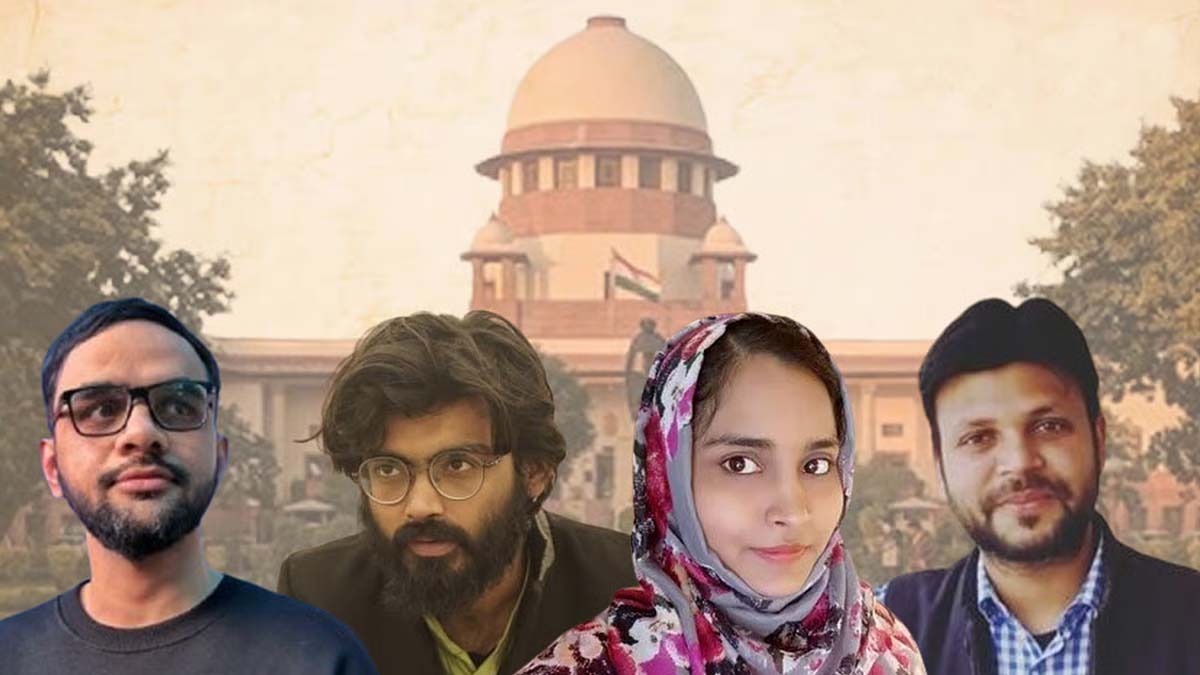
In a judgment that once again underscores the formidable barriers to liberty under India’s anti-terror law, the Supreme Court on Monday, January 5, denied bail to Umar Khalid and Sharjeel Imam in the 2020 Delhi riots “larger conspiracy” case under the Unlawful Activities (Prevention) Act, 1967 (UAPA), while granting bail to five other accused — Gulfisha Fatima, Meeran Haider, Shifa Ur Rehman, Mohd. Saleem Khan and Shadab Ahmed — subject to twelve conditions.
The verdict was delivered by a Bench of Justice Aravind Kumar and Justice N.V. Anjaria, which held that although prolonged incarceration demands constitutional scrutiny, the statutory embargo under Section 43D(5) of the UAPA continued to operate against Khalid and Imam, as the prosecution material disclosed a prima facie case against them.
At the same time, the Court stressed that all accused are not on the same footing, and that a role-specific, accused-specific analysis was constitutionally necessary even in conspiracy cases — a principle that led to bail being granted to the remaining five appellants.
The judgment was reserved on December 10, 2025, and arises from appeals challenging the September 2, 2025 judgment of the Delhi High Court, which had denied bail to all seven accused.
‘Qualitatively Different Footing’: Why bail was denied to Khalid and Imam
Reading from the operative portion of the judgment, the Bench made it clear that it had “consciously avoided adopting a collective or unified approach”, instead undertaking an independent examination of the role attributed to each accused.
According to LiveLaw, the Court recorded its satisfaction that the prosecution material, if taken at face value as required at the bail stage, disclosed a “central and formative role” played by Umar Khalid and Sharjeel Imam in the alleged conspiracy behind the February 2020 violence in Northeast Delhi.
“The material suggests involvement at the level of planning, mobilisation and strategic direction, extending beyond episodic or localised acts,” the Court observed.
On this basis, the Bench concluded: “This Court is satisfied that the prosecution material discloses a prima facie allegation against the appellants Umar Khalid and Sharjeel Imam. The statutory threshold under Section 43D(5) stands attracted qua these appellants. This stage of the proceedings does not justify their enlargement on bail.”
As reported by Bar & Bench, the Court cautioned that to disregard the distinction between central roles and facilitatory roles would itself result in arbitrariness, even in cases alleging a common conspiracy.
However, the Court clarified that Khalid and Imam may apply for bail afresh either:
- after the examination of protected witnesses, or
- after the completion of one year from the present order.
Both accused have now been in custody for over five years, without the trial reaching the stage of recording evidence.
Arguments raised by the defence
- Umar Khalid: ‘No violence, no presence, no terrorist act’
During the hearings, Senior Advocate Kapil Sibal, appearing for Umar Khalid, mounted a sustained challenge to both the factual foundation and the legal characterisation of the allegations.
As reported by LiveLaw, Sibal had argued that there was no evidence linking Khalid to any act of violence, and emphasised that Khalid was not even present in Delhi when the riots broke out. According to the defence, this fact alone fatally undermined the allegation that Khalid played any operational role.
A central plank of the prosecution case rested on a speech delivered by Khalid in Amravati, Maharashtra. Sibal read out portions of the speech to demonstrate that Khalid had expressly called for non-violent, Gandhian methods of protest.
“We will not answer violence with violence… We will meet violence with non-violence,” Sibal quoted from the speech.
Sibal argued that calls for “chakka jams” or road blockades are legitimate forms of civil disobedience in a democracy, and that such methods have historically been employed across political movements, including the farmers’ protests, without being labelled as terrorism.
Specifically challenging the invocation of the UAPA, Sibal submitted that Section 15 cannot be stretched to criminalise protest activity, and that even highway or rail blockades do not amount to “terrorist acts” unless accompanied by a clear intent to threaten the country’s economic security or sovereignty. To do otherwise, he warned, would dangerously collapse the distinction between dissent and terrorism.
Despite these submissions, the Supreme Court held that at the bail stage, it could not weigh defence rebuttals, and confined its enquiry to whether the prosecution material, taken at face value, crossed the statutory threshold.
- Sharjeel Imam: ‘In custody during riots, speech is not violence’
Appearing for Sharjeel Imam, Senior Advocate Siddharth Dave similarly argued that the prosecution’s case was built on attribution and inference rather than direct evidence.
According to Bar & Bench, Dave pointed out that Imam was already in custody in other cases at the time the riots occurred, making it impossible for him to have participated in any on-ground violence or mobilisation.
Dave acknowledged that Imam’s speeches may have been controversial or unpalatable, but argued that political speech, however provocative, does not automatically amount to incitement to violence. He cautioned against equating dissenting or radical speech with terrorist intent.
He also flagged the danger of pre-trial stigmatisation, noting that Imam had been branded an “intellectual terrorist” by the State despite there being no conviction or completed trial.
The prosecution, however, relied heavily on video clips of Imam’s speeches, particularly those in which he spoke about cutting off the “Chicken Neck” or Siliguri corridor, the narrow passage connecting the Northeast to the rest of India.
As reported by LiveLaw, the Delhi Police alleged that these speeches showed an intent to:
- paralyse the functioning of the State, and
- attract international attention during the visit of then US President Donald Trump in February 2020.
The Supreme Court accepted that these allegations, taken at face value, were sufficient at the bail stage to constitute a prima facie case, while clarifying that it was not expressing any final opinion on guilt.
Bail Granted to Five Accused: Liberty with stringent conditions
In contrast, the Supreme Court granted bail to Gulfisha Fatima, Meeran Haider, Shifa Ur Rehman, Mohd. Saleem Khan and Shadab Ahmed, holding that their continued incarceration could not be justified on parity with Khalid and Imam.
For Gulfisha Fatima, Senior Advocate Abhishek Manu Singhvi made a pointed submission, reported by LiveLaw, that keeping students and young activists in jail for over five years without the trial even beginning makes a “caricature of our criminal justice system”.
Singhvi highlighted that co-accused Devangana Kalita, Natasha Narwal and Asif Iqbal Tanha were granted bail in 2021 on similar allegations, yet Fatima continued to remain incarcerated.
While granting bail, the Court clarified that the relief does not dilute the allegations. According to LiveLaw, the Bench imposed twelve stringent bail conditions, warning that any misuse of liberty would permit the trial court to cancel bail after hearing the accused.
Details of the judgment pronouncement
- UAPA and Bail: Delay is not a ‘trump card’, says Court
One of the most closely analysed portions of the judgment concerns the relationship between prolonged incarceration and bail under UAPA. Justice Aravind Kumar observed, as reported by LiveLaw, that in prosecutions under special statutes like the UAPA:
- delay in trial cannot function as a “trump card” that automatically overrides statutory restrictions on bail.
However, the Court simultaneously acknowledged that:
- delay serves as a trigger for heightened judicial scrutiny, especially where incarceration is prolonged.
The Bench clarified that Section 43D(5) does not completely oust judicial scrutiny, and courts must conduct a structured enquiry, limited to:
- whether the prosecution material, if accepted at face value, discloses a prima facie offence;
- whether the role attributed to the accused has a reasonable nexus with the alleged offence; and
- whether the statutory threshold for denial of bail is crossed.
Crucially, the Court reiterated that defence arguments and rebuttals cannot be examined at the bail stage, reinforcing the asymmetrical nature of bail adjudication under the UAPA.
- Article 21, speedy trial and the limits of judicial intervention
The judgment repeatedly returns to Article 21 of the Constitution, which guarantees the right to life and personal liberty.
Justice Kumar noted that:
- pre-trial incarceration cannot be equated with punishment, and
- the right to a speedy trial is an integral facet of Article 21.
At the same time, the Bench held that in UAPA cases, Article 21 must operate within the statutory framework, and that the Court cannot substitute legislative judgment merely because detention is prolonged.
As reported by Bar & Bench, the Court stated that: “The UAPA as a special statute represents a legislative judgment as to the conditions on which bail may be granted at the pre-trial stage.”
This formulation, while doctrinally consistent with prior UAPA rulings, has been read by legal observers as reinforcing the exceptional nature of liberty under anti-terror laws, even where trials remain stalled for years.
- Broad reading of ‘terrorist act’ under Section 15
The Supreme Court also rejected a narrow interpretation of Section 15 of the UAPA, holding that “terrorist acts” are not confined to physical violence or loss of life.
According to LiveLaw, the Court held that the provision also covers acts that:
- disrupt essential services, or
- threaten economic stability.
The statutory scheme, the Court noted, extends culpability even to preparatory and organisational acts, significantly broadening the scope of UAPA prosecutions.
Directions to expedite trial
Recognising the constitutional implications of prolonged incarceration, the Supreme Court directed the trial court to ensure that the examination of protected witnesses proceeds without delay, and that the trial is not unnecessarily prolonged. However, the Court did not fix any outer time limit for completion of the trial.
Context: Five years of incarceration
The case arises from the February 2020 communal violence in Northeast Delhi, which left 53 people dead, hundreds injured, and large-scale destruction of property.
Over the last five years, the Delhi Police has pursued a “larger conspiracy” theory, focusing largely on student activists and organisers of anti-CAA protests — an approach that has drawn sustained criticism from civil liberties groups.
Notably, as reported in Indian and international media, a group of US lawmakers recently wrote to Indian Ambassador Vinay Mohan Kwatra, expressing concern over Umar Khalid’s prolonged pre-trial detention, highlighting the growing global scrutiny of the case.
Today’s ruling reinforces a consistent judicial position that while individual differentiation among accused is constitutionally necessary, the UAPA’s elevated bail threshold continues to operate as a near-insurmountable barrier for those alleged to occupy “central” roles — even after half a decade of incarceration without trial.
It leaves unresolved the deeper constitutional question that continues to haunt UAPA prosecutions: at what point does prolonged pre-trial detention itself become punishment?
Related:
The Word is the World: How the Delhi riots conspiracy case ritualises silence
How the Delhi riots case remains stagnant with close to a dozen student leaders incarcerated
5 Years of Delhi Riots: Some Punished, Some Rewarded!
Delhi Riots 2020: Umar Khalid withdraws plea from Supreme Court citing “change in circumstances”