
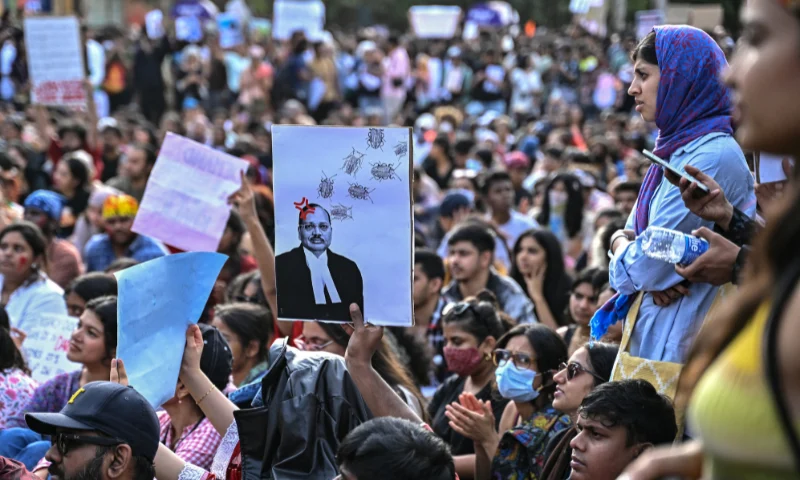
The NEET-UG 2026 protests may have formally ended after the resignation of Union Education Minister Dharmendra Pradhan and assurances from the government on examination reforms, but the conflict surrounding the movement did not disappear. Instead, the focus shifted from the original demand for accountability over the alleged paper leak to the protesters themselves — particularly young women who became visible faces of the agitation.
In the days after the Cockroach Janata Party (CJP)-led protests concluded, several women protesters alleged that they became targets of coordinated online harassment, rape threats, doxing campaigns, morphed images, character attacks and demands for their arrest. What began as a debate over slogans raised during demonstrations transformed into a larger controversy over whether women participating in public dissent were being punished not only for their political expression but also for refusing traditional expectations of silence and conformity.
The aftermath of the protests saw several women participants alleging that their visibility as protesters made them targets of coordinated online attacks, with personal information being circulated, threats issued and attempts made to undermine their credibility and character. The developments that followed also brought several legal questions before the Supreme Court, with petitions challenging alleged police excesses during the protests, seeking clarity on the withdrawal of FIRs against students, raising concerns over surveillance practices and demanding accountability for the use of force against demonstrators.
Detailed reports on the withdrawal of FIRs may be read here, here and here.
The protests that triggered a national confrontation
The NEET-UG 2026 protests began after allegations of a question paper leak and irregularities in the medical entrance examination created widespread anger among students. The movement, initially amplified through social media under the banner of the satirical Cockroach Janata Party (CJP), eventually grew into a nationwide student mobilisation.
The protests gained momentum after three student activists associated with the All India Students’ Association (AISA), namely Neha, Manish and Aameen and activist Sonam Wangchuk joined the agitation and observed a prolonged hunger strike at Delhi’s Jantar Mantar. Student organisations and youth groups demanded accountability, reforms in examination systems and action against those responsible for compromising the integrity of competitive examinations.
The movement reached its peak during the July 20 “Chalo Sansad” march, when clashes broke out between protesters and police in New Delhi. Student groups and civil liberties advocates alleged that security forces responded with excessive force, including the use of tear gas, pellet guns and repeated baton charges to disperse demonstrators. Petitioners before the Supreme Court alleged that several students suffered pellet injuries, while videos circulating on social media appeared to show protesters with bleeding head wounds allegedly caused by lathi blows. Protesters also alleged that some batons used during the operation had metal nails or studs attached, an allegation that has since been raised before the Supreme Court and is part of the ongoing proceedings. Similar allegations emerged from Bihar, where student activists claimed that police resorted to firing during demonstrations. One incident in Siwan drew particular attention after a police constable allegedly fired an AK-47 rifle towards protesters; the constable was subsequently suspended, although protesters have continued to demand accountability from senior officers. Police authorities have maintained that force was used only after demonstrators attempted to breach security arrangements and denied allegations of unlawful or excessive action.
Detailed reports may be read here, here, here and here.
The agitation eventually concluded after the Union government accepted several key demands, including the resignation of Education Minister Dharmendra Pradhan on July 25. The government also announced that criminal cases registered against many student protesters during the demonstrations would be reviewed, with FIRs against students who had not been accused of serious acts of violence proposed to be withdrawn. However, the selective withdrawal of cases became another point of contention, with petitioners arguing that the criminal process had been used to deter participation in the protests and demanding greater transparency and accountability in the registration and withdrawal of FIRs.
Meanwhile, the end of the protest did not end the controversy. Instead, a new battle emerged — over the treatment of protesters after the demonstrations.
Women protesters become the centre of backlash
One of the most striking features of the aftermath was the disproportionate targeting of women who had participated in the protests. Several women who became recognisable faces of the movement alleged that they were subjected to misogynistic attacks, including rape threats, sexualised comments, fabricated allegations and attempts to publicly shame them.
A report by ThePrint noted that women protesters across Delhi, Mumbai and Kolkata became targets of social media campaigns after the protests ended. Images of women were allegedly cropped, altered or circulated with calls to identify them and take action against them. The report highlighted that although protesters of different genders participated in raising slogans during demonstrations, women were specifically singled out afterwards.
The pattern, activists argued, reflected a familiar method of discrediting women in public movements — shifting attention from their political arguments to their appearance, morality, personal lives and character. Women protesters said that rather than addressing the issues raised by the movement, online campaigns focused on portraying them as irresponsible, immoral or deserving of punishment.
Rhiya Ahir: From protest symbol to target of online attacks
One of the most visible examples was Rhiya Ahir, a Mumbai-based actor and model whose image of standing in front of a police vehicle carrying detained protesters went viral during the demonstrations. The photograph turned her into one of the recognisable faces of the movement. However, according to Rhiya, the public attention soon transformed into online abuse.
Speaking to ANI, as reported by LiveMint, Rhiya said she approached the Maharashtra Police cyber cell after allegedly facing harassment and defamatory content online. She stated that while criticism was part of democratic expression, attacks targeting her dignity and personal reputation crossed the line.
“Everyone has the right to express their opinion, but no one has the right to degrade someone, malign their reputation, attack their dignity publicly, or make statements suggesting that a person does not have the right to live,” she said.
Rhiya also clarified that the movement was not organised for any political party, religion or individual but was about issues affecting students.
A detailed report by ThePrint described how women protesters became targets of online campaigns involving alleged fake images, sexualised misinformation and calls for police action. The report quoted Rhiya alleging that fabricated images of her were circulated along with false claims about her personal life and profession. She argued that when critics could not challenge the substance of the protest, they shifted towards attacking the character of women participants.
“If you cannot attack the cause, attack the character”
The backlash against women protesters was described by many activists as part of a broader pattern seen during previous movements, including the protests against the Citizenship Amendment Act and the farmers’ agitation. Alt News co-founder Mohammed Zubair, speaking to ThePrint, pointed out that similar tactics had been used earlier — including spreading misleading videos, manipulated images and personal attacks to delegitimise protesters.
The focus on women, activists argued, was not accidental. Women participating in political protests often face a different form of scrutiny. Their clothing, language, relationships and personal choices become subjects of public debate in ways that male protesters frequently do not experience.
A protester quoted by ThePrint said: “Patriarchy becomes a rather perfect tool when it comes to attacking women, because if you cannot attack the cause, you attack the character.”
This raised a larger question: whether women’s participation in democratic protest continues to be judged through expectations of “acceptable” behaviour rather than constitutional rights.
The apology controversy: A minor protester caught between forgiveness and criminal action
The moral policing and attacks on women for using abusive slogans against Prime Minister Narendra Modi further intensified the backlash against women protesters. On July 31, Prime Minister Modi posted a video message saying he had forgiven students who had used abusive language against him during the protests. He described them as “misled children” and said the focus should be on guiding them rather than punishing them.
The Prime Minister’s remarks also betrayed a deeply paternalistic view of women’s place in political protest. Declaring that he could forgive youngsters for abusing him, Narendra Modi nevertheless singled out women, saying it was a “culture shock” that they had used abusive language. The outrage, then, was not directed at the abuse itself but at the fact that women had dared to express anger in a manner that defied conventional expectations of femininity. Such framing reduces women protesters to custodians of culture, holding them to standards of civility and respectability that are rarely imposed on men. Rather than confronting the grievances that drove thousands of students to the streets, the remarks shifted the conversation to whether women had behaved as society expects them to. That distinction is not incidental—it reflects the persistence of gendered expectations in India’s political discourse, where women are often judged less for what they demand than for how they choose to demand it. Predictably, according to The News Minute, several women protesters said that online abuse against them continued despite the Prime Minister’s message.
The case of the 15-year-old protester who was accused of using abusive language against Prime Minister Narendra Modi became one of the most distasteful examples. During the protest, a video surfaced showing the teenager at the protest site shouting and repeating vulgar profanities directed at PM Modi while expressing her frustration. Once it went viral, the video took a life of its own.
A Zero FIR against her was initially registered in Noida and later transferred to Delhi. The allegations invoked provisions of the Bharatiya Nyaya Sanhita (BNS), including sections relating to intentional insult, statements allegedly causing public mischief and defamation.
Even after there came a video of the teenager apologising publicly went viral after Prime Minister Modi’s remarks urging society to forgive young protesters. In the video, the girl expressed regret for her comments, said she had been influenced by the atmosphere around her and described the incident as her “first and last mistake”.
Only a 15-year-old minor girl, she said that she continued receiving rape threats and sexually explicit messages from unknown accounts and phone numbers. The teenager told IANS that people threatened her with rape and continued targeting her even after her apology. She also alleged that police continued searching for her despite the apology. However, the controversy did not end with her apology.
According to The News Minute, the teenager alleged that she continued receiving rape threats and abusive messages despite publicly apologising. She said unknown accounts sent sexually explicit material and threatened violence against her. As per the report of The Print, the child had to stop going to school, and had to shift out of her house along with her single mother.
The episode highlighted a contradiction at the centre of the debate: while public discussions focused heavily on the language used by protesters, there was comparatively less attention on the gendered abuse directed towards young women who participated in the movement.
On August 5, Hindustan Times reported that the complainant in the case against the teenager withdrew the complaint, stating that she no longer wished to pursue the matter after the Prime Minister had forgiven the protesters. Lawyer Smriti Singh, who had filed the complaint, said that the FIR was initially registered against multiple girls and that she decided not to continue the matter.
When gender meets religion
Beyond the cases involving slogans and online criticism, several women activists alleged that their participation itself had triggered police scrutiny. One such case involved JNU Students’ Union leader Danish Ali.
According to Maktoob Media, Danish alleged that Madhya Pradesh Police visited her family home after her participation in the NEET protests and questioned her relatives despite no FIR being registered against her. She said police contacted her father and advised him to ask her to focus on studies instead of activism. Danish alleged that she was singled out because of her Muslim identity.
“Coming from a Muslim community, with the peak Islamophobia in the country, my family is concerned,” she told Maktoob. She questioned why police action was directed towards her when several other activists had participated in the same protest.
A similar concern was raised by Amreen Shaikh, an organiser of the NEET protest in Goa. According to Maktoob Media, Shaikh was summoned by Goa Police for questioning after helping organise a demonstration that had received official permission. She alleged that during questioning, police asked whether she would take responsibility if a “bomb blast” occurred during the protest.
She said officers also questioned her about her father, his business and foreign travel history. Shaikh said she struggled to understand why questions unrelated to the education protest were raised. She alleged that her identity as a Muslim woman had contributed to the scrutiny she faced.
Although she was not named as an accused, she said the police action and online harassment caused significant mental distress. The FIRs associated with the protest invoked provisions of the Bharatiya Nyaya Sanhita relating to unlawful assembly and related offences.
Vismaya Mohanlal and dissent
The backlash against protesters also extended to celebrities and public figures who expressed support for student demonstrators. Actor Vismaya Mohanlal, daughter of Malayalam superstar Mohanlal, faced online criticism after expressing support for students protesting over the NEET paper leak. According to Indulge Express, Vismaya responded to criticism by saying she stood by her views and believed democracy required citizens to question those in power.
She stated: “We should always be allowed to question and be heard. We should always have dialogue instead of force, and I don’t think your politics should ever supersede your humanity.”
She clarified that her position was not aligned with any political party and that her concern was based on humanitarian principles. Her comments triggered online backlash, with some social media users calling for a boycott of her debut film. Filmmaker Major Ravi defended her position, saying her comments reflected concern for students rather than political affiliation.
Shradha Singh: Online misogyny after becoming a face of the movement
Another woman who became a target after the protests was content creator Shradha Singh. According to The News Minute, Singh’s seven-second Instagram video recorded alongside Rapid Action Force personnel became a subject of controversy after it was amplified by television channels and social media accounts.
She alleged that she was invited to participate in a television discussion under the impression that she would be allowed to explain her position, but instead found herself in a confrontational debate where she faced criticism. Speaking to BBC Hindi, as reported by TNM, Singh said she felt humiliated during the programme but chose not to react emotionally because millions of people were watching. She later spoke about the sexualised abuse directed at her online.
She said comments under her social media posts included degrading remarks targeting her dignity and character. Singh contrasted this experience with her time at the protest site, saying she had stood among hundreds of men without facing harassment but had experienced severe abuse from people online. She appealed for greater attention towards misogynistic online attacks against women protesters.
Gendered backlash: When women become the issue
If the protests challenged the government’s handling of the NEET crisis, the backlash exposed the deeply gendered nature of political dissent in India. Women who stood at the forefront of the movement were not merely criticised for their politics—they were punished for their visibility. Instead of engaging with their demands, detractors sought to discredit them through misogyny. Their clothing was dissected, their professions questioned, their morality policed, sexual rumours manufactured, morphed images circulated, rape threats issued and calls made for their arrest. The objective was unmistakable: to shift the conversation from what women were saying to whether they deserved to be heard at all.
This is a familiar script in Indian protest politics. When a movement proves difficult to defeat on its merits, its women are turned into the battleground. Their political agency is recast as moral transgression; their dissent reduced to questions of character and respectability. The message is clear—women may participate in public life, but only so long as they remain within the boundaries of acceptable femininity. The moment they speak too loudly, lead too visibly or challenge authority too forcefully, they cease to be citizens exercising constitutional rights and become subjects of public moral scrutiny.
The outrage over abusive slogans exemplified this selective moralism. For weeks, public debate fixated on the language used by a handful of protesters, while allegations of excessive police force—including pellet guns fired at students, lathi blows to the heads of demonstrators, and reports of live ammunition being used against protesters in Bihar—struggled to command comparable attention. The disproportionate focus on slogans effectively displaced the central questions the movement had raised: whether the state had responded lawfully and proportionately, and whether those responsible for violence against students would ever be held accountable.
The Prime Minister’s response only reinforced that imbalance. While PM Modi declared that he could forgive youngsters for abusing him, he singled out women, saying it was a “culture shock” that women had used abusive language. The implication was difficult to ignore. Abuse itself was not the singular concern; it became uniquely shocking when it came from women. By holding women protesters to a higher standard of civility than men, the remarks echoed a deeply paternalistic expectation that women must remain composed, respectful and restrained—even when confronting injustice. In doing so, the country’s highest political office did not simply comment on the protests; it reinforced the patriarchal logic that women in politics are judged less by the legitimacy of their demands than by whether they conform to society’s expectations of femininity. In the end, the conduct of women became a bigger controversy than the conduct of the state.
From online abuse to institutional response: Legal aid emerges as protesters seek protection
As allegations of harassment, intimidation and threats against student protesters continued to emerge, political organisations and civil society groups began creating support mechanisms for those facing legal and online challenges.
The Indian Youth Congress (IYC)v launched a nationwide legal helpline under its “Chhatron Ki Goonj” campaign to assist students who claimed they were facing threats, intimidation and online abuse following their participation in the NEET protests. According to The New Indian Express, the helpline was created to receive complaints from students alleging harassment connected with their participation in demonstrations. The organisation said complaints would be reviewed and that legal and organisational assistance would be provided wherever required.
IYC president Uday Bhanu Chib said young Indians had a constitutional right to question the government and raise their voices without fear. The organisation specifically referred to cases involving women protesters, including Rhiya Yadav and Shradha Singh, who had spoken publicly about online abuse. The launch of the helpline highlighted a growing concern: that the consequences of participating in a public protest were extending beyond the protest sites into private lives, families and digital spaces.
A broader crackdown narrative: arrests, FIRs and continuing protests
While the Jantar Mantar protest ended after assurances from the government, several state-level demonstrations continued. In Bihar, students returned to the streets demanding the release of protesters arrested during earlier demonstrations.
According to The Times of India, hundreds of students and youth activists gathered in Patna demanding that the government honour its promise to withdraw cases and release detained students. The protesters alleged that many students had not returned home despite government assurances.
They demanded:
- a verified list of released and detained protesters;
- withdrawal of criminal cases;
- accountability for alleged police excesses.
The demonstrations were dispersed by police using water cannons after protesters attempted to march towards the Chief Minister’s residence. The police maintained that action was taken only after protesters attempted to enter restricted areas.
Supreme Court intervenes: FIRs, surveillance and police action under scrutiny
The aftermath of the NEET protests reached the Supreme Court, where multiple petitions challenged alleged police excesses during the July 20 “Chalo Sansad” march and subsequent demonstrations.
The petitions raised serious allegations, including:
- use of excessive force against protesters;
- alleged use of pellet guns;
- baton charges;
- injuries suffered by students;
- alleged assault of journalists and lawyers;
- detention of minors;
- surveillance and collection of protesters’ personal data.
The Supreme Court bench comprising Chief Justice of India Surya Kant, Justice Joymalya Bagchi and Justice V Mohana clarified that States were free to withdraw FIRs against student protesters if permitted under law. The clarification came after petitioners pointed out that the Court’s earlier order allowing investigations to continue could affect the government’s commitment to withdraw cases against protesters.
The Court also clarified that the phrase “criminal antecedents” used in its earlier order would refer only to serious and heinous offences, after concerns were raised that students with minor cases could face difficulties. According to LiveLaw, Solicitor General Tushar Mehta informed the Court that the government remained committed to addressing cases against student protesters but that criminal law procedures did not provide a simple mechanism for “withdrawing FIRs”.
Possible legal routes included filing closure reports, seeking withdrawal of prosecution or approaching courts for quashing proceedings. Senior Advocate Vrinda Grover argued that withdrawing cases individually would be complicated, particularly where FIRs involved large numbers of unidentified persons. One Patna FIR, she pointed out, named thousands of unidentified individuals, raising concerns that such broad FIRs could potentially be used against students.
The Supreme Court also examined allegations of excessive police action during the protests. Petitioners alleged that security forces used disproportionate force against demonstrators, including pellet guns and other crowd-control measures.
Senior Advocate Gopal Sankaranarayanan argued that accountability must extend to senior officials responsible for authorising police action. He urged the Court to examine how security forces were permitted to use such methods against civilian protesters.
The petitioners also alleged the use of:
- pellet guns;
- shock batons;
- sticks with nails;
- force against women protesters;
- detention of minors.
The Court directed authorities to preserve relevant evidence, including:
- CCTV footage;
- drone recordings;
- body camera footage;
- videography;
- wireless communication records;
- PCR logs.
The Court also directed authorities not to disclose protesters’ personal information and digital data while the matter remained under consideration. Chief Justice Surya Kant observed that police officers responsible for excessive force should not receive undue protection. At the same time, the Court noted that genuine criminal acts committed during protests could not be ignored merely because they occurred in the context of demonstrations. The matter was listed for further hearing on August 18.
Detailed report on the proceedings before the Supreme Court may be read here.
Tamil Nadu keeps the anti-NEET movement alive
Although the nationwide agitation lost momentum after the resignation of the Union Education Minister, resistance to NEET remained alive in Tamil Nadu, where opposition to the examination has long been rooted in questions of social justice and federalism rather than administrative reform alone. As reported by The News Minute, Members of the Ban NEET Movement under the Anti-NEET Federation launched an indefinite hunger strike in Chennai, demanding the complete abolition of the examination. Protesters argued that NEET continues to privilege students with access to costly coaching while placing first-generation learners, rural students and those from economically weaker backgrounds at a structural disadvantage. They also renewed demands for education to be shifted from the Concurrent List to the State List, contending that states should have greater autonomy over admissions and education policy. The movement once again invoked the memory of S. Anitha, whose death in 2017 transformed the anti-NEET campaign into a larger struggle against educational inequality and the centralisation of policy.
Beyond NEET: The democratic questions remain
What began as a demand for accountability over an examination leak ultimately evolved into a far broader test of India’s democratic institutions. The movement forced difficult questions that remain unanswered: How far can the state go in policing dissent? When does crowd control become excessive force? Can criminal law be used to discourage political participation? Why are women who protest subjected to uniquely gendered abuse? And who is held accountable when constitutional rights are allegedly violated in the name of maintaining public order?
The legal battle is far from over. The Supreme Court’s scrutiny of police action, FIRs, surveillance and the preservation of evidence signal that the questions raised by the protests have outlived the demonstrations themselves. Whether those proceedings result in meaningful accountability will shape not only the legacy of the NEET movement but also the boundaries of the right to protest in the New India.
Equally enduring is the lesson the protests offered about gender and dissent. For many women, participation in the movement meant confronting not only the coercive power of the state but also orchestrated campaigns of misogyny, intimidation and character assassination. Their experiences underscored a troubling reality: in India, women who claim political space are still expected to defend their morality before their message is heard.
The NEET protests may have ended, but the questions they raised continue to reverberate. The movement is no longer only about a competitive examination or an alleged paper leak. It has become a referendum on the state’s response to dissent, the shrinking space for democratic protest, and whether young citizens can challenge authority without being met with criminal prosecution, excessive force or targeted harassment.
Related:
The Supreme Court’s Uneasy Middle Path on Protest Policing
Law fraternity rallies behind student protesters, condemns Delhi police crackdown
Permission to Protest? Why the right to dissent needs no licence
Ken-Betwa protest exposes the cost of state-led displacement