
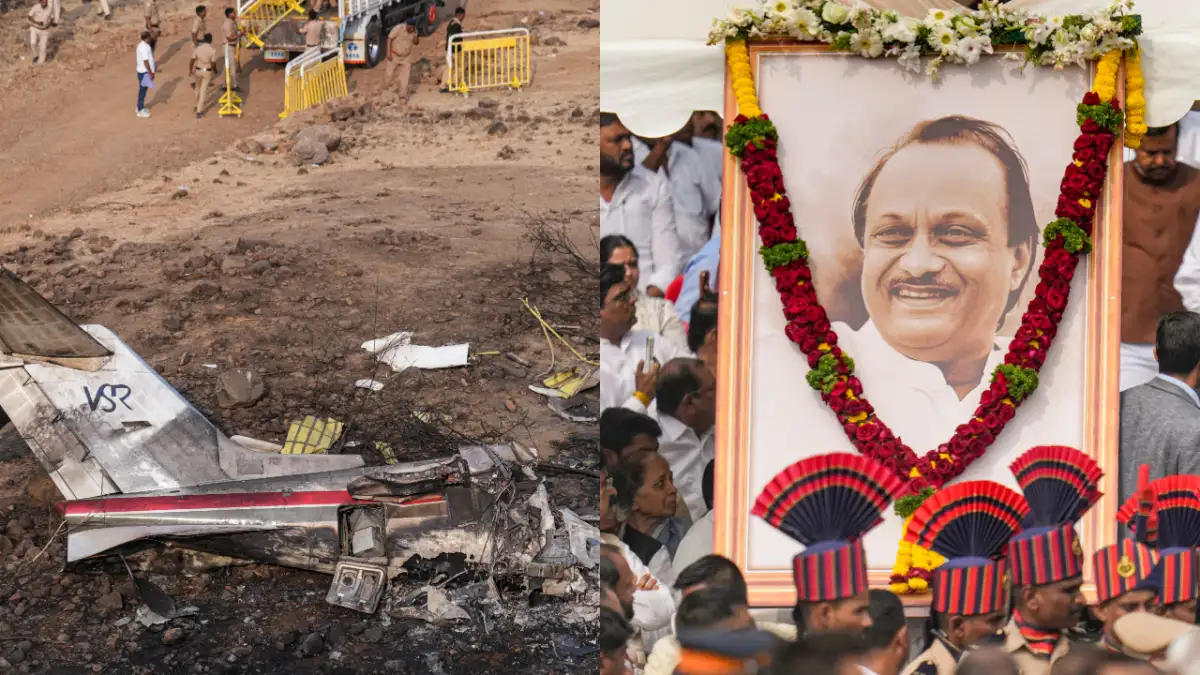
The death of Ajit Pawar, Maharashtra’s deputy chief minister, in a crash on the airfield of his hometown Baramati in Pune district on January 28 should raise serious questions. True there were problems of air safety but the more important question that is not raised is why there is such gross discrimination against common people when it comes to transport.
His tragic death has been widely mourned but it should also lead to soul searching beyond improving VIP travel modes. They get all the attention, they choose to spend huge amounts chartering aircraft even when there is no urgency for travel, they build airports in their areas leaving State bus transport in a shambles, the bus stations are dirty, basic amenities are lacking.
Similar neglect of a train travel long distance as well travel in urban areas. In Mumbai 3,000 people fall from overcrowded trains each year, three days before Ajit Pawar’s death, a college lecturer was murdered in a local train in Mumbai due to tension caused by overcrowding.
On roads in the country over 100,000 are killed in crashes, many more are injured every year and the numbers keep rising. But there is little media attention, little discussion on TV channels which spend hours on deaths of people like Ajit Pawar or when there was the Indigo air disruption. Far more disruption is caused to millions on a daily basis to ordinary people which never gets the focus.
Our ecosystem now exists largely to serve political, corporate and VVIP clients — an ecosystem where aircraft are booked at short notice, routes change rapidly and operators compete to provide speed and reliability. This demand structure means aircraft are often flying multiple sectors in a single day, crews are working tight rotations, and planning windows are compressed. While none of this automatically implies unsafe operations, it creates an environment where margins are thinner and the system relies heavily on strict procedural discipline to compensate for Even during investigations into the Baramati crash, VSR aircraft were used to ferry politicians for funeral-related travel, underscoring the company’s continued role in high-profile political transport, points out Shreedhar Rathi, aviation writer.
Santosh Desai said in response to the Indigo, disruption, mismanagement. When airports were being built and modernised in the 1990s and 2000s, railway stations were also there, also serving millions. The choice to pour resources into airport infrastructure while leaving railway infrastructure as it was did not arise from abstract economic reasoning. It reflected a clear judgment about whose comfort mattered, whose complaints would be heard and which spaces needed to perform India’s modernity to the world.
Even when stations are redesigned, the aesthetic choices tell their own story. They gain glass facades, retail units and food courts. They are remade to resemble consumption spaces rather than transportation hubs.
What is being modernised is not only travel but the traveller. The aim is to turn them into a new category of person, someone who buys a latte, a fancy coffee cup, rather than someone who sits on a platform eating from a tiffin. It is a prefab vision of modernity often unconcerned with what railway users actually need.
When passengers complained that airports looked like railway stations, they were not merely pointing out operational failures. They were confronting the fear of category collapse, the discovery that their status as air travellers rested on fragile foundations and that a system breakdown could render them ordinary again. They had paid for elevation but found themselves in conditions they recognised from the category they believed they had left behind. Without the confirming architecture, they became just people in a crowded building, shouting to be heard.
When IndiGo flight cancellations caused massive chaos, newsrooms called in panels to discuss the ‘crisis’. But delays on trains, including the Rajdhani whose fares now match those of a budget flight, feels ‘normal’. Over 23 million people take trains every day, which is 51 times the number of air passengers, and an estimated 20% of long-distance trains experience delays of several hours.
Passengers inconvenienced by the flight crisis were described as the ‘stranded middle class’, officially numbering 4.5 lakh daily flyers according to the Directorate General of Civil Aviation. But what about the beedi-roller in Bihar rushing to a clinic or the daily wage worker from Patna standing for 12 hours in a general compartment? As the sociologist, Ashis Nandy, points out in The Intimate Enemy, the post-colonial elite’s sense of time favours the clock of capital over the rhythms of the struggling classes. This makes waiting seem like a normal part of life for the impoverished.
daily wage worker from Patna standing for 12 hours in a general compartment, pointed out Ankita Jain in an article in the Telegraph earlier this month.
Ajit was also known as Ajitdada
The original Dada in Maharashtra’s politics was Vasantdada Patil, former chief minister, whose government was toppled by Mr Sharad Pawar through defections and alliances in 1978. SP (Sharad Pawar) was then a young man, I was recently looking at all the names in his ministry, all are gone, he remains but clearly now he has really aged.
Vasantdada came to acquire the respectful way of address (Vasantdada) through love: he was a freedom fighter, knew difficult days, there were times when he travelled second class by train to attend Congress meetings.
Sharad Pawar never acquired the title dada, he remained Sharad Pawar in the media, at best during personal meetings people would call him, saheb, Sharad rao, sir etc. He never instilled fear.
Ajitdada grew in entirely different circumstances, he acquired power at a very young age becoming a minister in SP’s ministry when I met him a few times, never later. His becoming a dada is relatively a later phenomenon.
Politics has changed so much in the last few weeks. I saw Supriya Sule in a jovial mood at the inauguration of the golden jubilee of Stree Mukti Sanghatana at Y.B. Chavan Centre last month.
She cracked jokes about there being both Pawar and Shinde in her family, her mother is originally a Shinde (the daughter of cricketer Sadu Shinde.). She was referring to the two deputy c.ms, Pawar and Shinde. She said people should not draw any conclusions from what she was saying.
Subsequently there were reports that she may be drafted into the ministry at the Centre following the alliance with the AP (Ajit Pawar) faction.
Sanjay Raut of the Uddhav Sena made a valid point in a news conference that top ministers should not exert too much, should not travel too much by air, they should leave decisions to other leaders, they themselves need not campaign in every lower level election. All this was taking toll of their health.
After all these years in the profession, I get a feeling that journalists can be too liberal in their understanding of politicians, even naïve. They get easily carried away with all the hospitality they enjoy, they must realise that the politician treats you well because you have clout, you are from the media. They may give you a scoop, but in that also they have a motive, else they would just keep their mouth shut. The question is how the politician treats common people, that is the real test.
These journalists praise some politicians for working hard, the question is working hard for whom? They are busy enriching themselves, average politicians with some standing now have assets running into crores of rupees.
If the politicians were so competent, why are their constituencies getting, worse, unliveable?
(The author is a senior journalist and commentator; the present text is from his post on Facebook on January 31, 2026 that may be read here)
Related:
Government and automobile lobby are in a cosy affair while public transport is treated like filth