
One month after the July 20 “Chalo Sansad” march led by the Cockroach Janata Party (CJP), Amnesty International has published a detailed digital investigation into the police response, alleging that Indian security forces used unlawful and, in some instances, potentially lethal force against protesters.
The investigation, released on August 26, draws on witness testimony as well as video and photographic material examined and verified by Amnesty International’s Evidence Lab. According to the organisation, its findings show the use of pellet-firing shotguns, tear gas launchers and grenades, batons, electric shock devices and firearms against protesters between July 20 and July 24 in Delhi and Siwan, Bihar. Amnesty says the manner in which these weapons were deployed breached international human rights standards as well as domestic policing guidelines.
The findings directly challenge the Delhi Police’s public account of the crackdown. Delhi Police had denied allegations of disproportionate force and described its handling of the protest as “professional”, including before the Supreme Court. Amnesty, however, says the evidence it verified contradicts that version of events.
For Amnesty International India Chair Aakar Patel, the episode represents something more serious than a conventional crowd-control operation. He described the authorities’ response as beginning with restrictions on communication, movement and assembly before escalating into what he called unnecessary or excessive force against peaceful protesters, including children. The organisation has characterised the response as “state-sanctioned violence masked as crowd control” and has pointed to the absence of accountability a month later as evidence of continuing impunity.
Evidence of pellet firing

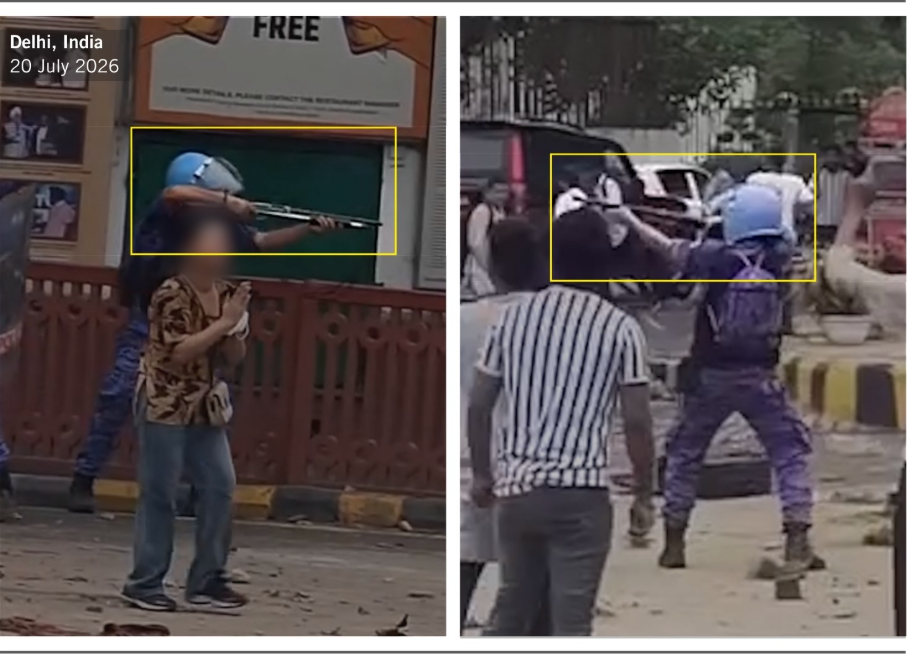
One of the most serious findings concerns the use of shotguns capable of firing pellet ammunition. Amnesty’s Evidence Lab verified 17 videos filmed in central Delhi on July 20, covering areas around Jantar Mantar, Sansad Marg and Connaught Place, as well as two videos from Siwan in Bihar recorded on July 24. The Delhi footage was found to show personnel belonging to the Delhi Police, Rapid Action Force (RAF) and Central Reserve Police Force (CRPF).
Two videos verified by Amnesty show an RAF officer firing a shotgun into a crowd at the Connaught Place–Sansad Marg intersection. Two other verified videos show protesters near the same location with injuries consistent with birdshot wounds. Amnesty also verified CCTV footage showing two RAF officers carrying shotguns elsewhere in the area.
The significance of the finding lies in the nature of the ammunition. Birdshot consists of multiple small metal pellets and is inherently inaccurate, Amnesty says, creating a serious risk not only to the intended target but also to bystanders. The organisation states that birdshot has been associated with deaths and blindness in other contexts and argues that it has no legitimate place in law enforcement.
A protester interviewed by Amnesty described being struck from behind while attempting to flee. According to the testimony, the individual sustained approximately 25 to 30 pellet wounds and required hospital treatment. The protester said doctors confirmed that the injuries were caused by pellets and that the incident had left extensive scarring.
The alleged absence of a warning is also significant. India’s Bureau for Police Research and Development guidelines recommend that security forces warn protesters before deploying less-lethal or lethal force. International standards similarly require law-enforcement agencies to exhaust non-violent means wherever possible and issue a clear warning before resorting to force when circumstances permit. Amnesty says the protester it interviewed reported receiving no warning before the pellet firing.
The allegations had previously been rejected by Delhi Police, which described reports of pellet injuries as “Fake News” and called them “completely false and misleading”. The police also warned that legal action could be taken against those allegedly spreading rumours.
However, the Amnesty investigation comes alongside other reporting cited in the organisation’s findings. The Hindu reported that an RAF unit fired two ballistic cartridges loaded with plastic pellets on the evening of July 20 on the orders of a Deputy Commissioner of Police. An internal CRPF inquiry reportedly found that RAF personnel had fired at least seven rounds containing metal pellets. An RTI response cited by The Hindu indicated that at least ten people were injured by pellets during the protests.
Tear gas used against protesters

Amnesty’s investigation also raises concerns about how tear gas was deployed. One verified video shows a tear gas grenade landing close to a group of protesters and exploding with a heavy blast. Amnesty says another verified sequence showed the grenade exploding immediately after landing near protesters, with one person attempting to escape before being thrown to the ground.
Eyewitnesses told Amnesty that tear gas grenades were fired directly towards protesters rather than being launched at an angle above their heads. The organisation says this is inconsistent with UN guidance on less-lethal weapons. More fundamentally, Amnesty argues that the use of tear gas should be restricted to situations involving widespread and serious violence. While acknowledging that there were isolated incidents of protesters throwing stones, it says the available evidence does not indicate violence on a scale that would meet that threshold.
This distinction is crucial. Crowd-control powers are not unlimited simply because a protest becomes difficult to manage. The question is whether the force used is necessary and proportionate to the threat actually posed. Amnesty’s findings suggest that, in several instances, the authorities crossed that line.
Lathis, including against peaceful protesters

The investigation further documents what Amnesty describes as frequent misuse of long, flexible batons, or lathis. The organisation verified eight videos showing Delhi Police and RAF personnel striking protesters, including a young boy who, according to Amnesty, offered no provocation or resistance. In some instances, officers allegedly struck people indiscriminately across different parts of their bodies. One verified video shows a man who had been knocked to the ground being repeatedly struck while he was unable to move or pose an apparent threat.
Amnesty notes that the UN Special Rapporteur on Torture has described such long flexible batons as inherently cruel, inhuman or degrading because they can deliver greater kinetic force than conventional batons, increasing the risk of serious injury. The investigation also identifies another accountability concern: the presence of plain-clothes men participating in beatings.
In at least two verified videos, men in plain clothes—including some wearing black helmets marked “Delhi Police”—are seen beating protesters with lathis. Uniformed officers appear to escort them towards the crowd but do not intervene, according to Amnesty. The organisation also points to the apparent absence of visible identification such as name tags or badge numbers, which it says violates the principle that law-enforcement officials must be identifiable during encounters involving the use of force.
Electric shock weapons under scrutiny
Amnesty also verified a video showing an RAF officer using an electric shock baton against a peaceful protester. The organisation argues that direct-contact electric shock devices cause severe pain without necessarily incapacitating a person and that there are less harmful alternatives available to law enforcement. Amnesty, together with the UN Special Rapporteur on Torture, has called for their complete prohibition because of the risks of severe suffering, psychological harm, lasting disability and, in cases of prolonged use, death.
The finding therefore adds another layer to the concerns raised by the report: the issue is not simply the quantity of force used, but the choice of weapons and methods deployed against people participating in an assembly.
An assault rifle in Siwan
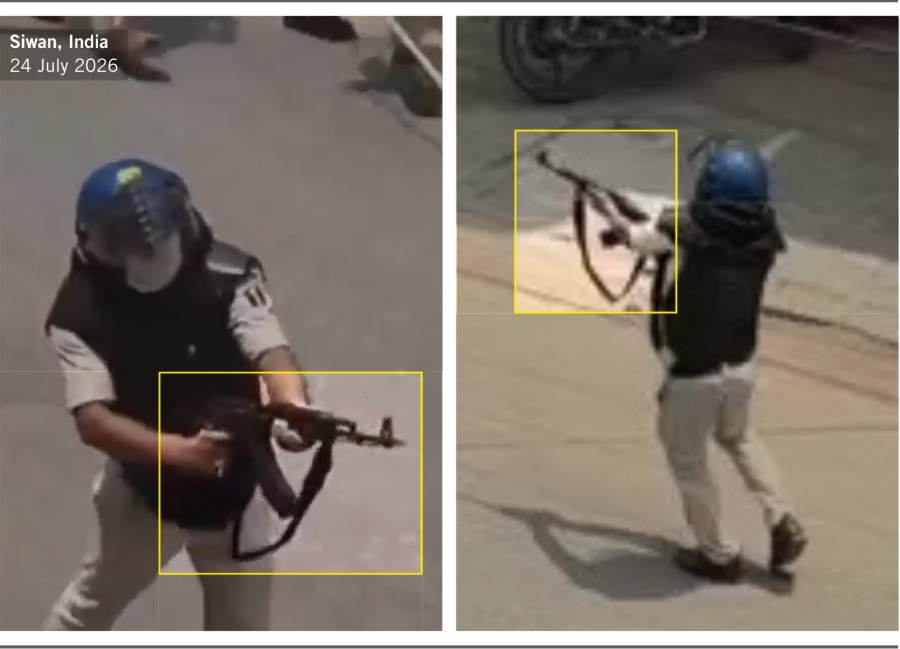
Perhaps the most alarming footage examined by Amnesty comes not from Delhi but from Siwan, Bihar. Two videos filmed on July 24 and verified by Amnesty show a state police officer firing an AK-type assault rifle towards protesters. Amnesty notes that such firearms are designed to kill and, under international standards governing assemblies, may only be used where there is an imminent threat of death or serious injury to a specific individual and only as an absolute last resort. The organisation says it found no evidence that such a threat existed in the incident examined.
The report says authorities have made no public commitment to investigate or prosecute officers involved in the alleged use of firearms, birdshot, tear gas, lathis and electric shock weapons. Amnesty is calling for a prompt, impartial and effective investigation, with the findings made public. It has specifically demanded an immediate end to the deployment of birdshot ammunition and direct-contact electric shock devices.
The crackdown began before the first baton was raised
The Amnesty investigation also places the use of force within the wider restrictions imposed on the “Chalo Sansad” march. Authorities denied permission for the march, imposed an internet shutdown around the proposed protest areas, prohibited gatherings of more than five people, closed several Delhi Metro stations and erected barricades across central Delhi.
Amnesty argues that these measures themselves raise serious freedom-of-assembly concerns. Under international human rights law, peaceful assemblies are not supposed to depend on prior permission. Where notification requirements exist, their purpose should be to allow authorities to facilitate an assembly rather than provide a mechanism for restricting it. The organisation further argues that the prohibitory orders effectively amounted to a blanket ban on the march and failed the requirements of legality, necessity and proportionality. It reaches a similar conclusion regarding the blanket internet shutdown imposed around the protest.
This is an important aspect of Amnesty’s findings. The report does not examine the July 20 violence simply as an isolated confrontation between protesters and police. It places the physical use of force within a broader sequence of restrictions—communication blackouts, movement restrictions, barricading, transport disruption and prohibitory orders—that had already narrowed the space for protest.
More than 400 injured
The scale of the confrontation was substantial. According to Delhi Police, more than 400 people, including police personnel and protesters, were injured. Amnesty also notes that at least three people were injured in Siwan, including a bystander who was shot and sustained a bullet wound to the neck. The report’s findings therefore raise questions extending beyond individual incidents captured on camera. If hundreds were injured during the police response, and if independently verified footage shows the deployment of weapons in circumstances Amnesty considers unlawful, the central question becomes one of institutional accountability: who authorised the force, who carried it out, who monitored it, and who is responsible for investigating it? A month after the events, Amnesty says there has been no public commitment from the authorities to investigate or prosecute officers involved.
Amnesty places the July events against the longer history of pellet-gun use by Indian authorities. The organisation has previously documented extensive injuries, including blindness and deaths, linked to the use of birdshot-loaded shotguns for crowd control in Jammu and Kashmir. A committee established by the Ministry of Home Affairs in 2016 to consider alternatives recommended restricting the use of such weapons to the “rarest of rare cases”, although it did not recommend a complete prohibition.
In 2018, the UN Office of the High Commissioner for Human Rights called on India to end the use of pellet-firing shotguns for crowd control in Jammu and Kashmir. A petition seeking to decommission the use of pellet-firing shotguns by law-enforcement agencies for policing assemblies was also filed before the Supreme Court in July 2026. The Delhi allegations therefore revive a longstanding question about whether weapons that have caused severe and sometimes permanent injuries in crowd-control situations should be used at all.
From “crowd control” to accountability
The central thrust of Amnesty International’s investigation is ultimately about the limits of state power. The State unquestionably has a responsibility to protect people, maintain public order and respond to violence. But policing a protest does not give authorities an unrestricted licence to use force. International standards require force to be lawful, necessary and proportionate, with lethal force reserved for exceptional circumstances involving an imminent threat to life or serious injury.
Amnesty’s evidence raises questions on each of those fronts. Its investigation alleges pellet firing into crowds, tear gas deployed directly at protesters, repeated baton strikes against people who were not resisting, the use of an electric shock device against a peaceful protester and the firing of an assault rifle in Siwan. It also documents restrictions on communication and assembly before and during the protest.
The significance of the report lies not merely in its catalogue of weapons. It is the combination of restriction, force and apparent absence of accountability that makes the findings particularly troubling. The Delhi Police has maintained that its handling of the protest was professional. Amnesty’s investigation reaches a sharply different conclusion, backed by 19 videos it says its Evidence Lab verified across Delhi and Siwan, alongside witness testimony and photographic evidence.
The complete report may be viewed here.
Related:
‘Wherever You Go, We are watching’: Second threat letter to Kashmiri Pandits