Here’s the ‘Ripley’s Believe it or Not’ story of the day in the Times of India ‘Muslim dressed as Hanuman booked for impersonation in Bareilly‘

BLASPHEMOUS in ‘New India’ ? No doubt about it. Indian ? unquestionably yes.

BLASPHEMOUS in ‘New India’ ? No doubt about it. Indian ? unquestionably yes.

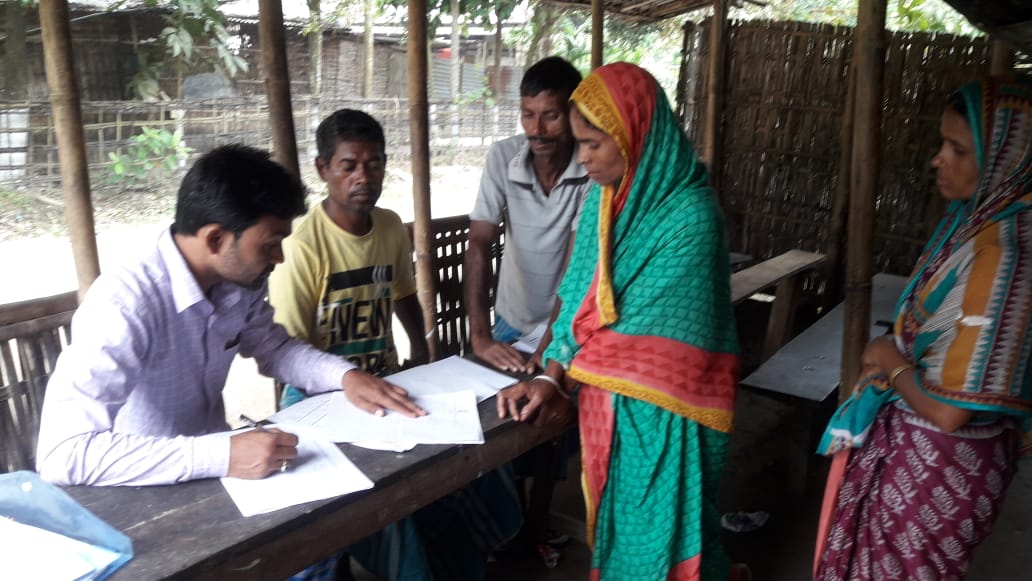
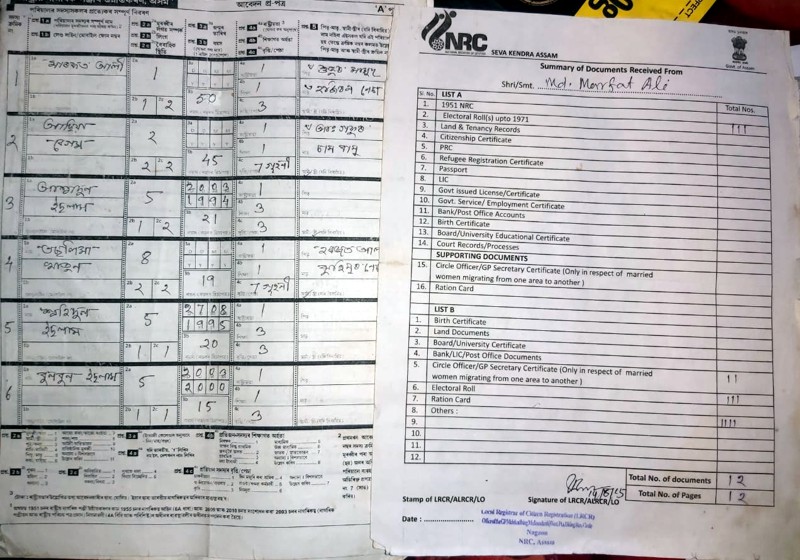
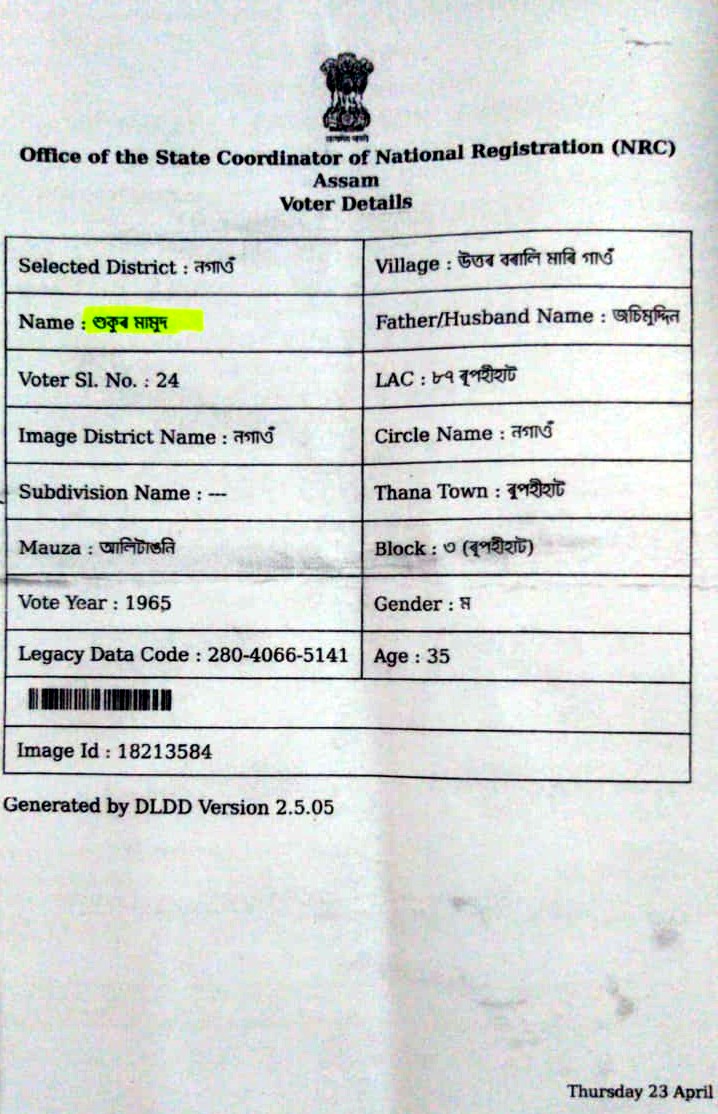
The Gauhati High Court, while entertaining a Writ petition against a Foreigners Tribunal order, observed in its order dated October 31 that the petitioner, Phuljan Nessa was declared a foreigner by the Tribunal but her name appeared in the final draft of the National Register of Citizens (NRC). Therefore, the High Court has sought information from the State Co-ordinator of NRC, Assam regarding this obvious contradiction and posted the matter for November 5.
The order can be read here.
Phuljan Nessa was declared foreigner of post 1971 stream by the Foreigners Tribunal through its order dated October 25, 2017. Phuljan had then filed the writ petition before the Gauhati High Court in November 2017. October 31 was only the second hearing of the case where information of this contradiction came to light and was pointed out to the High Court.
Citing this order of the HC, local media reports in newspapers like the Assam-based Sangbad Pratidin sensationalised the issue. In response to this, the NRC posted an announcement issued in the “public interest” on its Facebook page:

Before the next date of hearing, just two days away, crucial questions remain:
—Was the declared foreigner’s name really included in the NRC? If yes then what lead to this blunder?
—Why did the NRC make the above announcement? If थे NRC’s announcement on FB is based on facts, then how did the High Court make such an observation?
Such an anomaly, if there exists one at all, is not the is first of its kind.
Not long back, there was the similar case of AhmedAliwho was a “declared foreigner“. Yet, his name was included in the first draft of the NRC. At that time the State co-ordinator for NRC, Prateek Hajela had admitted NRC’s fault and attributed it to the receipt of incomplete information from border branch of Assam police.
It is when such incongruities come to light that both the competence and fairness of the NRC are brought into question. Today, 19,06,657 people of Assam who have been excluded from the final draft of the NRC are now struggling to deal with the process of standing before the Foreigners Tribunals to prove their citizenship. There is more than a distinct possibility that many of these people are genuine Indian citizens, made victims of a manipulated and callous bureaucratic-political exercise. Will they ever get justice? The road ahead for them is full of hurdles which will take years to cross.
Related articles:
Assam: Man declared foreigner by court enlisted in NRC first draft
Lives shattered by NRC, CJP reaches out and intervenes
Bengali Hindu couple falsely accused of using fake legacy person
EXCLUSIVE! Assam FT declares 282 people foreigner: Signed orders MISSING or full of errors
People’s Tribunal: NRC and its Constitutional Process and Human Cost

Movie still from film Aise Hee
There are a million things that divide religions, but most do have a common thread- a rigid code of conduct and moral righteousness assigned to women. Be it regulations of how they should dress, or how they take their place in society, religion can play a vital role in controlling women.
The German film ‘A regular woman’ showcased in MAMI Film Festival 2019, portrays the real-life fate of Hatun Ayhnur Sürücü, a Muslim woman of Turkish descent, and her struggle for a free, self-determined life after escaping an abusive child-marriage. Her conservative family members refused to accept her new lifestyle; insults and threats continued to escalate. Ayhnur, however, still bound by familial emotion wanted to mend fences. Even though she moved out, started training for a job and cared for her child on her own, she kept in touch with her family believing they would someday accept her. Instead, she was ultimately subjected to an honour killing by her brother.
Is that what happens when a woman decides to do something as innocuous as expose her hair, or get a job? In India, most honour killings are linked to notions of caste purity and controlling women’s sexuality. The family honour seems to reside in women’s vaginas, their hair, their clothes, their fraternization with men, in effect- women are treated like a possession that needs to behave in a certain way, “or else”.
Over 200 women are killed in the name of “honour” every year in India. In 2006, a Supreme Court judgement called such incidences “barbaric”. Ironically, no separate law exists to punish those found guilty of such murders, and prosecutions are usually among various sections of the Indian Penal Code for homicide and culpable homicide not amounting to murder.
For so many women, it is difficult to imagine that their own family members could want to kill them. Most don’t see it coming. But even if they do, is the system on their side? Ayhnur had reported the threats she received from her brothers to the police. No one intervened, no action was taken. Ayhnur was killed in 2005. Almost 15 years later, the same story would repeat because nothing has changed. Would Ayhnur have escaped to a far-off land and cut all ties with her family if she had known they were capable of killing her? Maybe we’re too emotional where family is concerned. We forget that the so called ‘family honour’ is bigger than women’s lives.
Ayhnur’s story weighed so heavy on me and I was pleasantly surprised by my next watch, an Indian movie called “Aise Hee” which was also about a woman’s self-determination, but had a positive outcome in the end. Aise Hee is also the winner of this year’s Film Critics Guild Award and is a must watch. There are so many amazing moments this movie where the audience couldn’t help but burst into loud applause and cheers. One of these moments comes when the leading woman, a Hindu widow, saves a Muslim tailor she has befriended from a potentially dangerous group of Gaurakshaks. The way she uses her position and privilege to protect her Muslim friend is genius and hilarious at the same time.
As an elderly widow, she’s expected to behave in a certain way- wear ‘sober’ clothes, go to Yoga, visit temples, and also empty out her portion of the house so that her son can lease it out for rent. Through the course of the movie, she defies each and every one of these expectations. She takes midnight walks at the riverbank, goes to a mall alone to eat ice-cream, refuses to hand over her husband’s pension to her son, gets a beauty treatment, and allows herself to breathe freely. Obviously this aggravates not just her family but the entire neighbourhood.How dare an upper caste Hindu woman spend her days with a Muslim man learning embroidery?How dare a ‘husband-less’ woman nearing her 70s enjoy her life?
She refuses to be manipulated by anyone and does what she pleases. Ultimately, she quietly leaves the judgemental people in her life behind. The wonderfully sensitive portrayal of the lead by actor Mohini Sharma has won her the Special Jury Mention for Best Female Actor at MAMI 2019.
The two movies “A Regular Woman” and “Aise Hee” stand in contrast with respect to what happens to the woman defying societal and religious norms, yet they have so much in common. It makes one wonder why society is so concerned with what women do in their lives. It runs deeper than ‘family honour’; moral policing extends to any and all women. Random men feel the need to comment on women’s clothing, as witnessed in the case of the Bengaluru man who stopped a woman on the road to yell at her for wearing shorts because they do not conform to ‘Indian rules’.Social media is overflowing with strange men commenting on women’s characters and issuing rape threats to women for simply existing. The misogyny has been passed down for generations to uphold patriarchy and ‘social order’.
So what happens when women manage shake up the foundations of systematic subjugation with small acts of freedom? They add up and amplify, they inspire and validate, they build something new, something better. The question is, will you build with them?
Year after year, people in Kolkata, Delhi, Mumbai and major cities wonder what exactly is Chhatt Puja when they witness so many lakhs and lakhs of men and women from Bihar out on the streets, heading towards the river or the sea. They see them push cartloads of bananas and other fruits or carry them on their heads, but few outsiders understand anything more. The main festival is just six days after Diwali, which explains why it goes by the colloquial name for the ‘sixth’, chhatt, that is also called Surya-shasthi.
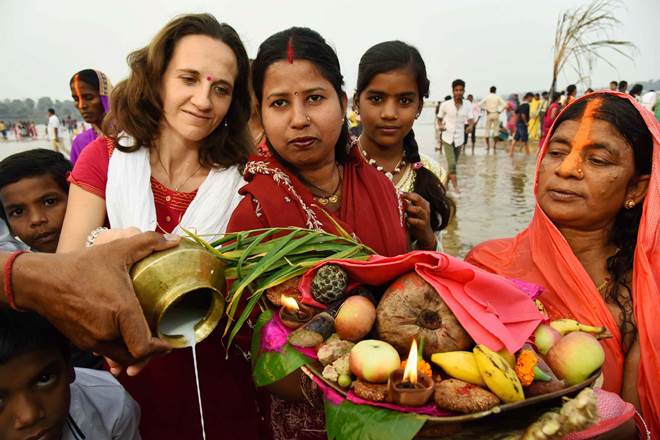
Image Courtesy: PTI
Interestingly, it was and remains essentially a very vibrant folk festival, like Bhai Dooj, that has no role for the priest and no compulsion to visit temples. Since it yielded no grants to either, Brahmans usually stayed away from this economically unviable festival. It was thus not linked with some convenient legend taken from the vast repertoire of the Vedas, Upanishads, Mahabharata or Ramayana. Because it was never ‘mainstreamed’ outsiders hardly know much about it.
There is a weak link, however, that not many are aware of and the story goes that Draupadi was advised by the sage, Dhaumya to perform Chhatt puja to Suryadev, to help the Pandavas. There is another legend that Rama and Sita also offered this puja to the sun god during this period of the year when they returned from exile to Ayodhya. Though most Rama worshippers do not perform this puja, Rama may will have listened to his wife, like all of us do. Sita’s origins were in Janakpur of Mithila, which is really the epicentre of this worship. The tradition is, however observed all over in Bihar-Jharkhand and adjoining regions, the Madhesh tract of Nepal, as well as in far off Fiji, West Indies and Mauritius: wherever Biharis went.
Nowadays, however, hordes of priests have started occupying vantage points in the water and worshippers have, willy nilly, to shell out some dakshina for compulsory mantras and short courses in sanskritisation.
It is my submission that Chhatt is the first celebration of bright light and the sun, after the blackest night of the year, ie, Kartik amavasya when Indians light billions of lamps to dispel the dark. But Bengalis, who just have to be different, however welcome this amavasya to worship their dark goddess Kali and her ghoulish companions of the night. Chhatt Puja was originally a women’s festival to thank the sun god for all the munificence and the bounty conferred, but it is interesting to note how the menfolk joined later on. They also worship a goddess called Chhatti Maiya, who is equally important and invoked for her boons. She is sought to be identified with Usha, the Vedic goddess of dawn — but these are just weak attempts to sanskritise a popular utsav.
The unique character of this festival is that it worships both dawn and dusk, the rising sun as well as setting sun. It is actually a four day festival that starts on the fourth lunar day after the dark amavasya of Kartik, namely, Chaturthi, Panchami, Shasthi or Chhatt and finally Saptami. Chhatt Puja is the occasion for the most colourful dresses to come out and there is a lot of folk songs and dancing as well. Even in distant Mauritius, for instance, Chhatt songs and dances are an integral part of the nation’s culture that was brought in by labourers from Bihar. As fasting is mandatory, people take anticipatory steps by consuming a lot of freshly reaped rice, puris, bananas, coconuts and grapefruits before beginning their rituals.
The first day is actually popular as Nahay Khay and the holy dip in water body is taken on this day, preferably in the river Ganga. Womenfolk, who observe this festival, take only a single meal on this day and among many this consists of just lau or lauki boiled with rice. They get into the water upto their knees or waist and pray in the direction of the sun. This is followed by an ancient custom for married women to smear each other’s forehead with ochre vermillion, right along the line of the nose to the tip. It is likely that the sindoor khela among the married women of Bengal on Vijaya Dashami may have originated from this. After all, our sarbajanin Durga pujas are just a century old. The second day of Chhatt is called Kharna, on which total fasting is observed without a drop of water, from sunrise to the sunset. Devotees have their food only after offering it first to the sun god at sunset. This is a rich repast consisting of ‘payasam’ or ‘kheer’ made rice and milk, ‘puris,’ hard baked wheat flour cakes called thekuas and bananas, which are distributed to one and all. On the third and main Chhatt day, fasting without water is again observed and the evening offerings or sandhya arghya is an elaborate ritual when oblations are made to the setting sun. Bamboo trays are held in its direction containing the much favoured thekuas, coconuts, bananas and other fruits. This is followed by the ‘Kosi’ ritual in homes when lamps are lit to honour the sun, but are kept under cover of five cane sticks. The fourth day of Chhatt is considered the most auspicious and worshippers gather in large numbers on the banks of rivers with their family and friends for the final morning ritual of offering ‘arghyas’ to the rising sun. The fast is then broken with a bite of ginger with sugar, thus marking the end of the rituals. A volcano of joy, feasting and merriment then bursts all over.
What benefits does this puja confer? Many believe in it as a fertility rite for both humans and harvests, while other swear by its curative powers. There is also a theory that ancient yogis and rishis obtained energy directly from the sun’s rays by exposing their bodies to the sun, while on fast. When one observes how when other events and pujas damage or destroy the environment with chemical paints and other poisonous substances, that include firecrackers, Chhatt stands out as a really commendable environment-friendly worship that uses only bio degradable items. I hope we now understand the significance of this wonderful celebration by Biharis a little better.
Author is Chairman of Board of Governors, Centre For Studies In Social Sciences, February 2017 to present · Kolkata

The Whatsapp Snoopgate issue that spread like wildfire, not only had the general public under its attack, but lawyers defending the human rights activists arrested under the controversial Bhima Koregaon case have also confirmed that their phones were being targeted by Pegasus, a the surveillance software developed by Israeli company NSO group that came to be in question, The Huffington Post report.
The surveillance revelations come after the messaging platform sued Israeli surveillance firm NSO Group on Tuesday, accusing it of helping government spies break into the phones of roughly 1,400 users across four continents including diplomats, political dissidents, journalists and government officials. NSO denied the allegations.
The malware attack, according to Whatsapp, exploited its video calling system to send malware to the mobile devices of a number of users. The malware would allow NSO’s clients – said to be governments and intelligence organisations – to secretly spy on a phone’s owner, opening their digital lives up to scrutiny, the Economic Times reported.
WhatsApp sued the NSO Group in a federal court in San Francisco on Tuesday, accusing it of using WhatsApp servers in the United States and elsewhere “to send malware to approximately 1,400 mobile phones and devices (‘Target Devices’)… for the purpose of conducting surveillance of specific WhatsApp users (‘Target Users’)”. It had later sent out a privacy alert message to people it detected to be targeted by Pegasus.
The NSO has said that it sells its software to governments around the world. However, the Ministry of Home Affairs’ Cyber and Information Security division in response to an RTI query said that there was no information on any order being given to purchase the Israeli spyware Pegasus.
Why the spying on Bhima-Koregaon lawyers is a significant revelation
The spyware attack that shocked users had high-profile targets. Right from Former Union Minister Praful Patel and former Lok Sabha MP Santosh Bharatiya, the spyware attacked the phones of lawyers, journalists and human rights activists.
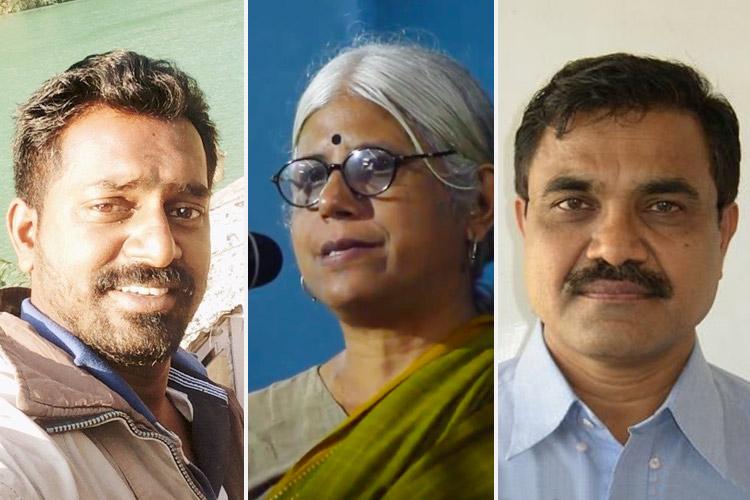
Among those who may have been targeted are Chhattisgarh-based activist Shalini Gera, Nagpur-based lawyer Nihalsing Rathod, Adivasi rights activist Bela Bhatia, academic and writer on Dalit issues Anand Teltumbde, former BBC journalist Shubhranshu Choudhary, and Chandigarh-based lawyer, associated with the Bhima Koregaon case, Ankit Grewal.
India has been notorious for spying on citizens without warrants, but the use of Pegasus in the Bhima-Koregaon case is particularly alarming for it makes use of files illegally obtained from the computers and phones of the accused, who have been charged with waging war against the state.
In June 2018, the Pune police had launched a series of country-wide raids on activists and lawyers involved in fighting Dalit issues, Adivasi rights, and those accused of supporting the Communist Party of India (Maoist).
Civil liberty activists SudhaBharadwaj, Arun Ferreira, Vernon Gonsalves, Gautam Navlakha, Varavara Rao and Anand Teltumbde were arrested during the raids. Termed ‘Urban Naxals’ the Pune police produced ostensibly incriminating correspondence that they claimed was drawn from the computers of these activists. Now, lawyers representing the accused say the Pegasus hack proves that this correspondence was planted on their computers.
Nihalsingh Rathod, who is one of the lawyers in the team of Surendra Gadling, a popular Dailt rights lawyer, is now joining the dots saying he now knows how the so-called ‘letters’ that the police had obtained because they were planted on the hard-drives of activists.

Surendra Gadling was among those who had been arrested and booked under several activities of the Unlawful Activities (Prevention) Act and the Indian Penal Code.
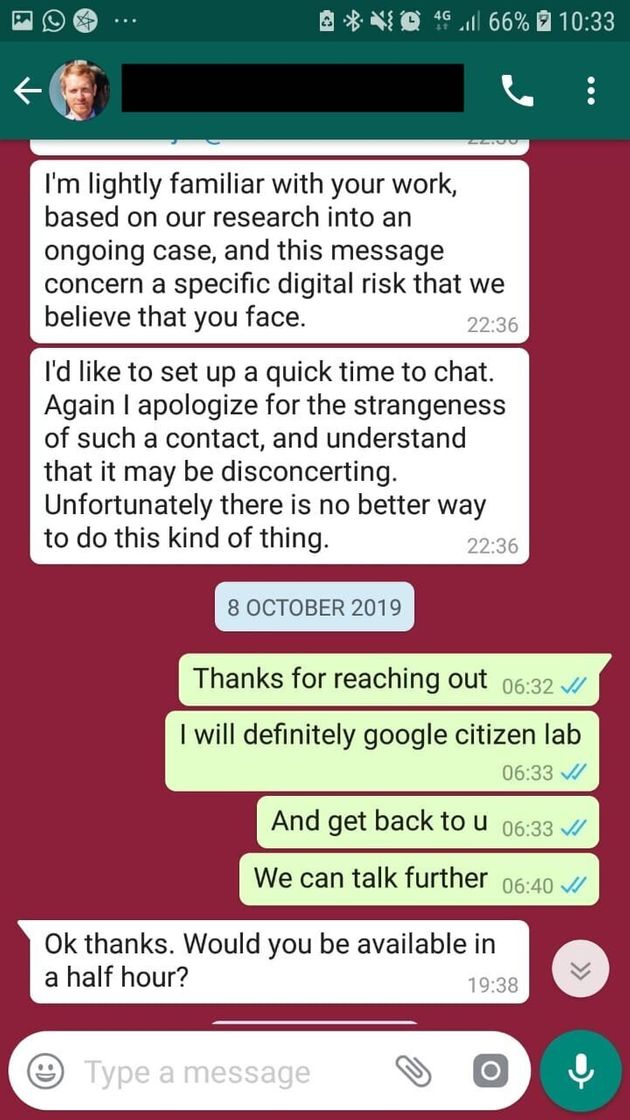
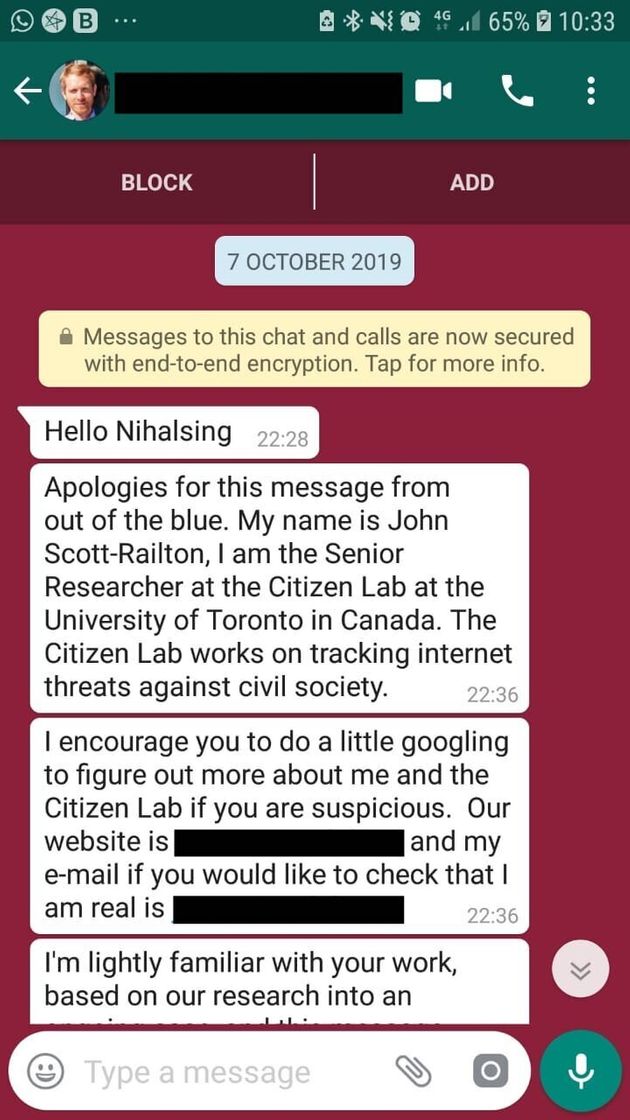
He told Huff Post India, he learnt he was a target when he was contacted by a researcher from the University of Toronto’s Citizen Lab on October 7 2019.
On October 7, 2019 he was contacted by a senior researcher John Scot-Railton from the Toronto University’s ‘Citizen Lab’ informing him that he faced a “specific digital risk”.
“The researcher told me that he suspected that my phone had been targeted by malware and compromised,” Rathod told HuffPost India. “The researcher didn’t tell me that the malware was sold exclusively to national governments, and so I did not suspect that the Indian government was behind the attack.”
“Before his arrest, similar things happened to Surendra Gadling’s phone and computer. He asked me about it. I thought it was just spam.”
Rathod said he was now planning legal action against the Indian state.
“The senior researcher told me that his lab had followed my work and during their research had found out that my profile was under a surveillance attack. All those calls made to me for two years suddenly began to make sense,” Rathod told The Wire.
The Citizen Lab was one of the first research organizations to examine how Pegasus operated.
“We have always maintained that the letters police claim to have found on Gadling’s computer were planted,” Rathod said. “As defenders of human rights and the constitution, we feel helpless and hopeless.”
However, Rathod nor Gadling are the only ones to have received such messages and calls.
Two days ago, Rupali Jadhav, a 33-year-old cultural and anti-caste activist from Pune shared screenshots of messages she had received from WhatsApp and Citizen Lab.
The reason Jadhav said her profile was compromised because she had been associated with an anti-caste cultural group called the Kabir Kala Manch and has been handling social media movements in the state. She is the official administrator of the WhatsApp and Facebook pages of Kabir Kala Manch, Bhima Koregaon Shaurya Din Prerana Abhiyan, Elgaar Parishad, and the political party Vanchit Bahujan Aghadi, she told The Wire.
Degree Prasad Chouhan, a Dailt rights activist and lawyer too received a similar chain of messages as did Shalini Gera, Bela Bhatia, AnandTeltumbde and Saroj Giri.
Gera, who has been a part of the lawyers collective Jag Lag, has faced a severe backlash from several right-wing organisations and Chhattisgarh police for the work she and her colleagues had been doing in the state.
Bela Bhatia is a Bastar-based academic, researcher and human rights defender. She has participated in the preparation of many fact-finding reports and served on a Planning Commission-appointed panel to examine challenges to governance in areas of the Maoist rebellion.
Saroj Giriis a lecturer in Political Science, University of Delhi, Delhi. He writes on contemporary social and political issues and is an activist.
Anand Teltumbde is an Indian professor, scholar, writer, and civil rights activist. He has written extensively about the caste system in India and advocated for the rights of Dalits.
Speaking about the calls and messages from Citizen Lab and WhatsApp Anand Teltumbde said, “[The researcher] explained to me what the spyware is all about. He sent me a text message first. Then I enquired about Citizen Lab’s credibility and spoke to its representative. The NSO group has said that it has given Pegasus licenses only to governments across the world. So, it is clear that the India’s government used the spyware against us, citizens.”
The espionage attempt has not spared research scholars too. Ajmal Khan, a 29-year-old Delhi based research scholar was approached by Citizen Lab too. He is well-known among students’ group in Mumbai and apart from being part of several anti-caste movements and civil rights movements, he has been active in students’ struggles including the agitation following Ph.D. scholar Rohith Vemula’s death in 2016.
It is clear that even after the denial of the Ministry of Home Affairs, the spyware attacks on the phones of these activists were not random, but were part of a carefully orchestrated plan to silence dissent and rebellion.
Condemning the development that has come to light, Amnesty International has cited this attack on activists to be a grave violation of their right to privacy and has pledged its legal support to get the Israeli ministry to stop the manufacturing of NSO’s products.
Sources – The Wire, Huffington Post.
Related:
The UK government spied on human rights groups – now they’re taking it to court
HC directs police to file report on SambhajiBhide’s role in violence: Bhima-Koregaon Case
BhimaKoregaon case: Bail Applications of three social activists rejected by Bombay High Court
Bhima-Koregaon Case: HC Refuses to Quash Case AgainstGautamNavlakha
Years of hard work taken away: DU Professor on Pune police raids without search warrant

In concern with the matter of many people in Majuli and a few villages along the Assam-Meghalaya border converting to Christianity, the Asom Sattra Mahasabha launched a massive awareness campaign and motivational programme called ‘Samannay Yatra’ (The Unity March) among the residents of the village, reported The Sentinel.
Talking to The Sentinel, Asom Sattra Mahasabha general secretary Kusum Kumar Mahanta said, “We’ve noticed with concern that some indigenous people have been getting converted to Christianity. This is happening among the Mising community in Majuli — one of the epicenters of neo-Vaishnavite culture — as well as among the Rabha people in several villages along the Assam-Meghalaya boundary.
“To stem the tide, we visited the residents of 20 villages in Majuli from October 19 to 22. During the course of ‘Samannay Yatra’, we urged them to preserve our religion and culture; and not go after a foreign religion.”
Declaring that they would carry out more such motivational campaigns in Majuli towards the latter part of the year, he said, “We got a positive response from almost all of them except a few in Jengrai, who told us that some xattras look down upon them as a community.
“We tried to make them understand that such alleged attitude has been noticeable among the xattras that fall within the ‘Udashin’ fold.“Their followers follow the ‘Brahmacharya’rule and remain bachelors for life. We also informed the villagers that members of the ‘Udashin’ fold treat many other communities that way, and not necessarily only the Mising community.”
With reference to conversions allegedly taking place along the Assam-Meghalaya boundary, the Mahasabha general secretary stated, “Such conversions are taking place among villagers of the Rabha community along the interstate boundary. We’ll carry out motivational drives among the indigenous Rabha-inhabited hamlets from Rani (near Guwahati) up to Goalpara. It will be a continuous process.”
In September this year, Xatradhikar Janardhan Deva Goswami was earlier booked under the Subdivisional Judicial Magistrate Court case no. 35/19 under Sections 447, 295, 298, 294, 427, 507 of 5/35 RW 357 of the CRPC for allegedly demolishing a church in the Jengraimukh area.
This was the first time a head priest of a satra at the hub of Vaishnavite culture was facing criminal charges in court. In his defense he had said, “It is very unfortunate that I have been charged for my work done for the protection of my culture and religion. I believe it is my duty to protect my culture and religion at this ancient seat of Vaishnavite culture.”
Even in Arunachal Pradesh, where the locals hail Christianity, missionaries have had to face protests by Hindu-nationalists.
In 2017, a report by the Economic Times read, The Christian population — largely Roman Catholics —incontrast has surged from 0.79% in 1971 to 31% by 2011, in the process becoming the largest religion. Hindus come in at 29%, unimaginable for the Hindu nationalists, and for many within the BJP and the RSS. “The Hindu population is reducing in India because Hindus never convert people,” Union Minister for State for Home Affairs Kiren Rijuju had famously said on his home turf in February.
The Rashtriya Swayam Sevak Sangh (RSS) had in the past flagged issues regarding coercive conversions in Manipur and Assam.
It is now the Centre’s plan to introduce the Anti-Conversion bill named the ‘Freedom of Religion Act’, in the Parliament. If passed, it would be in contradiction of the secular ethos established by the Constitution which says no one can meddle in an individual’s choice of faith. Article 25 of the Constitution bestows upon citizens of India the “freedom of conscience and the right to freely profess, practice, and propagate religion subject to public order, morality and health.”
Currently, Arunachal Pradesh, Odisha, Madhya Pradesh, Chhattisgarh, Gujarat, Himachal Pradesh and Jharkhand have an anti-conversion law but a similar kind of legislation does not exist on the national level. Penalties for breaching the law under this act could range from monetary fines to imprisonment.
The Asom Sattra Mahasabha has previously backed the BJP with regards to the Citizenship Amendment Bill (CAB). BJP MP Bijoya Chakraborty has reportedly come out in support of the Mahasabha, saying that Bangladeshi Muslims pose a bigger threat to Assam than the Bangladeshi Hindus.
The RSS presence in Assam has slowly been increasing. With an incident where people woke up to find posters on trees with ‘Rama’ written on them, to the Mahasabha being in complicit support of the CAB, is this what ‘gharwapasi’ looks like?
Related:
Church divided, faces internal issues, as anti-Christian crimes rise under Modi: Report
“Conditions for religious minorities deteriorated due to Hindu-nationalist groups”: US Religious Freedom Report, 2018
Religious freedom conditions in India on a downward trend in 2018: US Commission on International Religious Freedom
Karavan-e-Mohabbat :Fifht Day of Compassion & Atonement
NRC+CAB: Another Divisive Weapon of the SanghParivar
NRC and CAB: The cauldron boils over in the NE

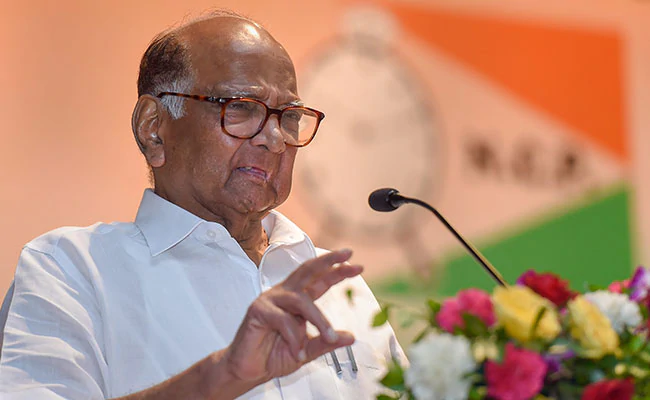
Serving an ultimatum to Devendra Fadnavis, Nationalist Congress Party (NCP) chief SharadPawar asked him to focus on the government formation in Maharashtra, which has taken a backseat following a wrangle between the BharatiyaJanata Party (BJP) and Shiv Sena over ’50-50’ power sharing.
Speaking to CNN News 18, Pawar insisted that the government be formed before the Ayodhya verdict – the hearings for which concluded recently. He said, “Everyone knows what happened in Mumbai last time over Ayodhya”. “For a peaceful Maharashtra, a new government should be put in place.”
He was referring to the gruesome Bombay riots which took place 25 years ago in 1992, after the demolition of the Babri mosque in Ayodhya. More than 900 lives were lost in the incident.
The BJP and Shiv Sena, for the past week have been embroiled in a prolonged battle, with the UddhavThackerey led party demanding the chief minister’s post after they dipped the BJP’s share with a striking performance in the elections.
The Sena on Thursday indicated that it had not given up its claim to the post of chief minister, saying that equal sharing of power must mean sharing of the top post as well. Adopting a harsh tone, it accused the BJP of enacting a “second act” of the “use and throw” policy while dealing with its ally.
After Shiv Sena leader Sanjay Raut met Pawar on Thursday, speculations were rife that the party could take the opposition’s support and settle for an alternative arrangement.
But, Pawar denied having a talk with Raut, while also confirming that his party would not support the BJP to enable a stable state government. He said, “The mandate in Maharashtra is not fractured. It is the responsibility of the BJP-Sena to form the government.”
Yet, he showed hos continued support for Sena citing that the BJP had promised to reach an understanding with its ally before the elections. He added, “BJP had said there will be an understanding on equal basis. This was prior to assembly elections. That statement shows what Sena has said has some truth.”
This year, BJP ended with fewer seats in the elections that it did in 2014. The Sena believes it deserves an equal timeshare in power, which means two-and-a-half years for a Chief Minister from each party.
As did Sanjay Raut on Twitter, Pawar too called Fadnavis ‘arrogant’ and ‘overconfident’. Also taking a dig at Union Home Minister Amit Shah he said he wasn’t sure if Shah was the Home Minister because he seemed to be working only for the BJP “full-time”.
Related:
Saffron Fades: Maharashtra State Elections 2019
VadaPav Stall to VidhanSabha: Meet Vinod Nikole, Maharashtra’s lone communist MLA
Uneventful Dance of Democracy
The Adivasi communist who made it to the Maha assembly
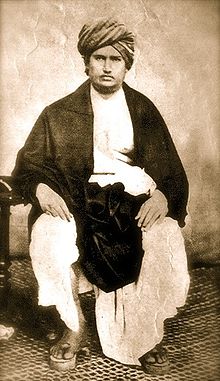
On the Diwali day of 1883, Maharishi Dayanand, the undying spiritual light of the Arya Samaj, became a martyr. Those who could not put out the fire of purity and truth in him, poisoned him to death. He who endeavoured to take away the poison of superstition and obscurantism from religion, and make it luminescent with spiritual truth, was poisoned.
Like Socrates was, some 24 centuries before him (399 BC). The ‘gall of Athens’ was forced to drink poison, so that the voice that challenged people to think and emerge from the slavery of customs and irrationalities would not gall the keepers of religious and political orthodoxy.
Diwali is the festival of light. It is an annual commemoration, a cyclical reassurance, of the victory of light over darkness. But the fact that we celebrate this festival does not prove, in itself, that we are on the side of light and not of darkness.
Celebrating Diwali in a way that causes atmospheric pollution, for example, and undermines the health of children and the elderly cannot be an undertaking of light. The key to who we are rests not in ‘what’ we celebrate, but ‘how’ we celebrate.
Maximum road accident deaths and cot-deaths (children dying in their cots neglected by their parents who are busy celebrating) happen in Christian countries on the eve of Christmas. But, Jesus came in the service of life. He did so, because he found that human nature was oriented to death, not life. Everyone wants to live long, but the choices people make are harmful to life.
In Kerala, for example, the consumption of liquor peaks in the Christmas season. Doesn’t it mock the meaning of the birth of Jesus, who came to set people free from all sorts of slavery? Slavery to alcohol is one of the most perverse forms of slavery; it is the slavery not only of individuals, but also of families.
Though born and raised in an orthodox Brahmin family, I was deeply influenced by the teachings of Maharishi Dayanand. To me, his insights came as a breath of unprecedented freshness, sweeping away the miasma of religious malodour that had begun to suffocate my soul.
The Maharishi did not spiritualize truth, as is done by hypocritical religious busybodies in order to dodge practical responsibilities and remedial actions that could be costly. He, on the contrary, incarnated truth. Truth emits light only when it is ‘earthed’. If truth is kept isolated from lived realities, it remains abstract, powerless and irrelevant.
To incarnate truth is to make it prevail in the warp and woof of life. It will be a fitting tribute to the Maharishi, if we dedicate ourselves to making the light of truth visible and beneficial to the people in all walks of life. We shall honour Swami Dayanand best by making Diwali a ‘festival of truth’. Truth is light; and light, truth. It is when truth becomes light for humankind that a spiritual festival is born. Anything less is a counterfeit; apretense without substance.
For Maharishi Dayanand, truth in its shining, social avatar is a caste-free society. He deemed caste as a pernicious aberration imposed on the Hindu society by Brahminical hegemony, which had proved inimical also to Brahmins; for what worse self-insult can there be than thriving on falsehoods?
Caste is plain, downright untruth. A person’s worth cannot be based on, or limited by, his birth. Birth-based privileges and advantages – as also disabilities and degradations- are indefensible. Caste is also social darkness; for it institutionalizes inequality, injustice and human degradation.
Ravan needs to be seen also as a caste symbol. Rather than burn his effigies and pollute the air, we can make our Diwali celebration meaningful by burning caste system out of our midst. I cannot help feeling that those who still advocate the inherent, fate-ordained superiority of Brahmins and their divine right to rule, are children of Ravan, not of Lord Ram.
Those who advocate the inherent, fate-ordained superiority of Brahmins and their divine right to rule, are children of Ravan, not of Lord Ram
Diwali of spiritual light must have an unwavering commitment to truth. Truth, when incarnated amidst injustice and inequality, becomes commitment to justice. For the down-trodden millions in our country, justice is the avatar of God they have been waiting for, for decades.
Sadly, the giant systems we have erected in the name of progress and modernity, for all their other benefits, are deaf and blind to the plight of the poor and the powerless. The truth about India, as Gandhiji has taught us, is poverty. His insight that the poor are the children of God — Daridra Narayan — and that truth is God, mark a revolution in our spiritual thought that is in harmony with the spiritual vision of Maharishi Dayanand.
Poverty, in hierarchical societies like ours, has a necessary gender-discriminative character. Even socially and economically emancipated women suffer injustices of diverse sorts. The Modi government limits the practice of justice to women to the airing of amouth-filling slogan.
“Beti bachao, beti padhao”, does not add up to anything on the ground. And if the Supreme Court grants equality of treatment to women in respect of temple entry in Sabarimala, it is opposed tooth and nail. This very hypocrisy is a demonic Diwali of darkness, presided over by a beaming Ravan whose mirth on Diwali days knows no limits, given how blind and stupid we are in celebrating it!
Poverty is the mother of darkness. Poverty in India is eminently avoidable. It is the darkness of inordinate greed on the part of a few that keeps the vast majority of our people poor and destitute. Celebrating ‘light’ — ironically, in physical darkness in order that Ravan may burn brighter! — in the face of their destitution despite their sweat and blood that fattens a privileged, parasitic minority, is a mockery of light.
It is not my case here that Diwali should not be celebrated. It needs to be; but, at the same time, its meaning needs to be heeded and its mandate upheld. Those who claim to be followers of Maharishi Dayanand have a special duty to ensure that this is done.
—
Contact: agnivesh70@gmail.com
Courtesy: https://www.counterview.net/
Join our mailing list to get the latest human rights news that matters, straight to your mailbox.
© Sabrang | All Rights Reserved