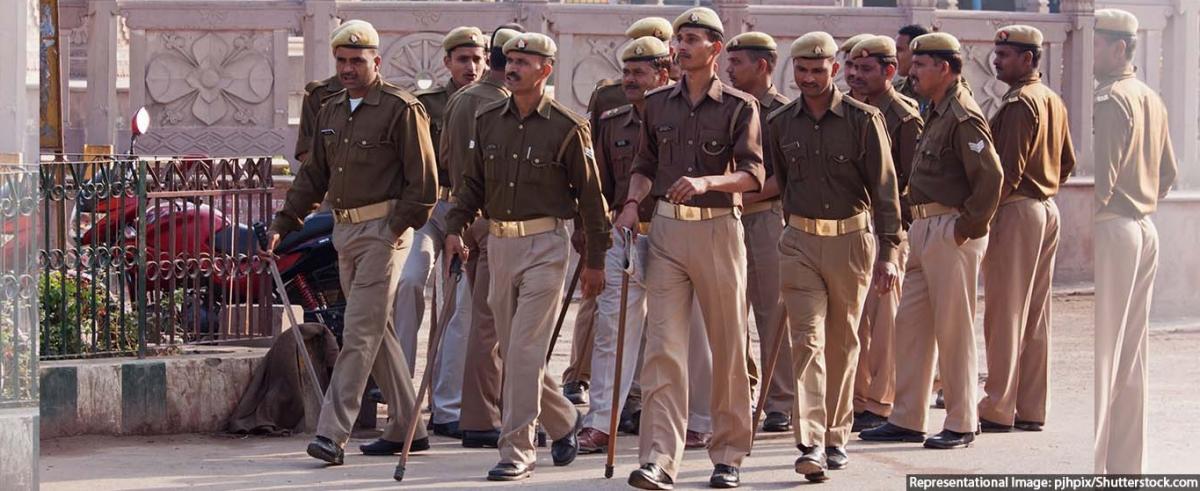
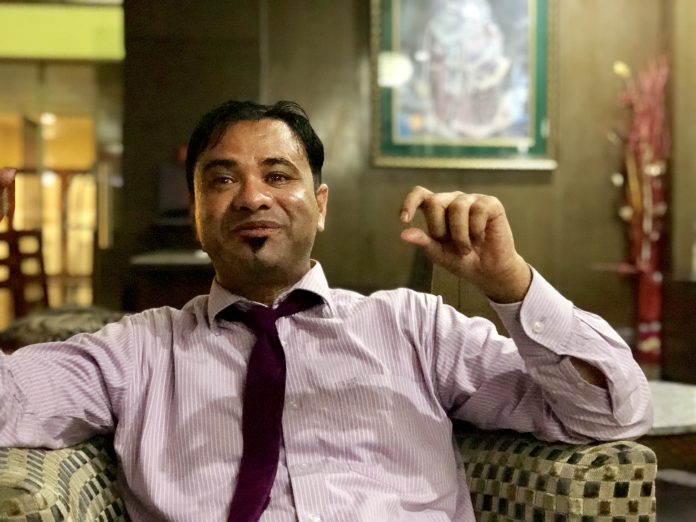
Assam’s dreaded Foreigners Tribunals have achieved yet another impossible feat – they have declared a serving BSF officer a foreigner!

Image Courtesy: latestlaws.com


Image Courtesy: Deccan Herald
He invited Mr Bhagwat to inaugurate a ‘historic national consultation or a round table conference on reservation’ on September 24, the Poona Pact day, or on any date of his choice in the month of October at Bengaluru . According to him, constitutional experts, legal luminaries, social thinkers, experts from different fields and leaders from various organizations and political parties will also be invited to this consultation programme.
He also claimed that ‘dalit thinkers are always having an open minded approach towards all types of criticism on all policies and thoughts’ and that ‘In spite of sharp reaction given by eminent political leaders like Mayavathi, Ram Vilas Paswan, Ramdas Athawale, P L Punia and others, the dalit thinkers and activists are always ready to have a conversation, in a harmonious atmosphere, with anti-reservationists’
Many Dalit leaders including Chandrasekhar Azad have challenged Mohan Bhagwat for a debate on reservation ever since he brought up the contentious topic during a talk August 19, saying “that there should be open-hearted debate pertaining to reservation given to SC/ST/OBCs” , leading many to wonder if the abrogation of reservations was on the cards.

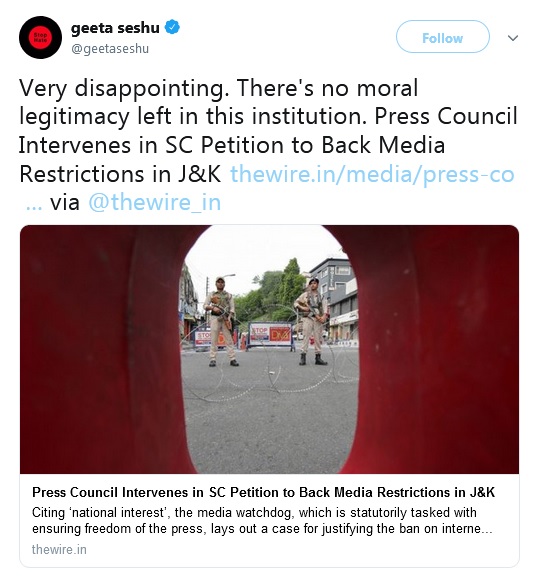
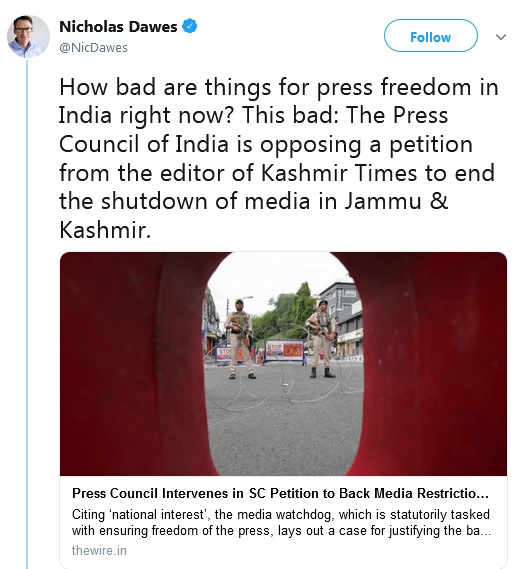
The Wire quoted some members saying that the decision was taken unilaterally by the chairman without consulting anybody else in the PCI, as is the norm. If that is indeed the case then we may as well assume that yet another democratic institution has been sabotaged from the inside by the BJP government in the name of national security no less. The question therefore is – If the PCI chooses to become spokespersons of the government, then who will stand up in defense of journalists who dare speak out ? The answer is at best, blowing in the wind.

What is happening to democracies across the globe? Neoliberalism and the rise of authoritarianism are moving together and, by dismantling social harmonies and states, are threatening democracy’s very existence. In fact they are combining and consolidating in different forms, of which three look more remarkable.
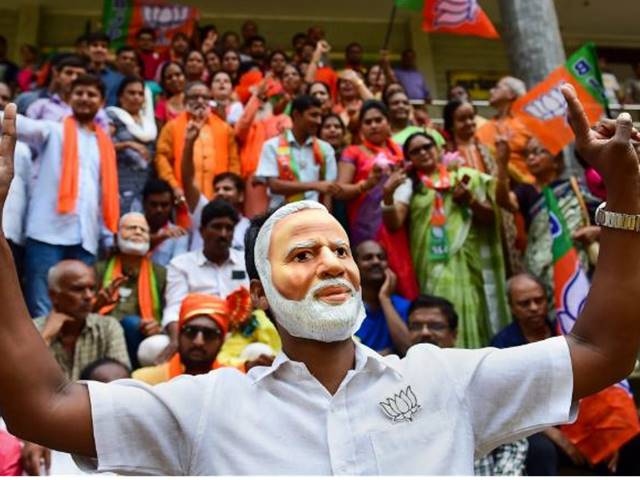
First, there is the rise of nationalist populism. The success of Donald Trump in the USA, Narendra Modi in India, Boris Johnson in Britain, Recep Tayyip Erdoğan in Turkey, Jair Messias Bolsonaro in Brazil and many others is not only an example of the symptoms but also the result of a democratic deficit in the present world. Old political forces are losing ground (for instance traditional conservative, liberal, and social democratic parties) and, following Gramsci, “the field is open for violent solutions, for the activities of unknown forces, represented by charismatic ‘men of destiny’[1].” Local, national and international politics is increasingly driven by ethnic, racial and religious conflicts in Asia, Africa, the Americas, Europe, and the Middle East; examples are the wars in Kashmir and Myanmar, or the ‘proxy’ wars between Saudi Arabia and Iran. The populist upheavals have not changed the old-world order; they are rather reinforcing it more vigorously, by imposing a harsher neoliberalism and creating an illusion of welfare only for the national/religious/ethnic community of choice[2]. Religious fundamentalism, national glory, lawlessness, vulgar wealth and huge inequalities are five common features between old and modern world. They have laid the foundations for reactionary nationalism and authoritarian capitalism across the globe;democracy and states have become tools of such a dangerous worldwide process.
Together with nationalist populism, the world has witnessed the rise of two other types of authoritarian political form. In Europe, the continental union has increasingly imposed its rules as a technocratic infrastructure mainly aimed at incorporating Eastern and later Southern European countries into a neoliberal (more specifically, or do liberal) system in which democratic choices are marginalised in the name of a repressive ideology of austerity masked as ‘technocracy.’ Far from being a neutral instrument for the common good, rule by experts has proved instrumental to the wishes and interests of Western European corporations, their supporters in ‘core’ countries (especially Germany), and their allies in the so-called ‘periphery.’ The third type of authoritarian neoliberalism has emerged in countries where authoritarianism was already a reality (for example, China, Russia, Central Asian states), and in which it has taken on more nationalist, protectionist, and repressive features, mostly as a response to pressure coming from the neoliberalising West. Russia and the various ex-Soviet -stan have embraced more authoritarian forms after being catapulted to neoliberalism in the 1990s. China has become more authoritarian in reaction to its growing engagement with the global economy, and also to defend the economic benefits, if limited, its hundreds of millions of citizens have earned over the last four decades.
Authoritarianism, in short, is spreading in a variety of forms.
The pioneers of globalisation and lovers of free market argued that they would bring peace and prosperity by ending war and conflicts. They also argued that it would help in the growth and establishment of vibrant and multicultural democracies, and even put an end to history itself. In reality, globalisation has expanded the conflicts and old world inequalities. The rich have become richer and the poor, poorer. The class, gender, race, caste and regional fault lines continue to grow. The neoliberal capitalist project has out manoeuvred the ideal alternatives of the October and French revolutions and the promises of anti-colonial struggles. All idealisms are in a downward spiral. How do we analyse these upheavals? Is it a sign of the Westphalian nation state’s end?
It is impossible to offer alternatives for a better tomorrow without understanding the present predicaments and their history.
Lineages and transformations of the state
The democratic deficit of the state is embedded within the history of the capitalist and Westphalian nation state. The peace Treaty of Westphalia in 1648 set the conditions for the emergence of capitalist forces by establishing states based on the idea of territorial sovereignty. It helped to end thirty years of savage war in Europe and complemented the changes leading to the industrial revolution in Britain[3]. Together with later peace treaties (for example, Utrecht in 1713), it also helped Europe plunder other continents with colonial rule in different parts of the world. The resources of the colonies were used to establish different institutions of economic development and democratic governance in Europe.
Therefore, ‘Westphalian’ states are innately colonial, capitalistic and authoritarian by nature but dressed up as democracies. Their democratic deepening depended to a large extent on the exploitation of vast regions of the world, clearly a non-democratic process. The referendum results and debates over Britain leaving the European Union (EU) are a classic example of democratic deficit and its relationship with European capitalism as embodied by the EU.
The post-colonial states emerged after the success of anticolonial struggles. The post-colonial states promised democratic governance based on ideals of liberty, equality, justice and welfare of all their citizens. Nehru’s India or Nkrumah’s Ghana are just two examples of a variety of new political forms that attempted to combine liberty and equality, national unity and non-Western ideas of cosmopolitanism. The anticolonial struggle had positive influence on European states. It transformed the nature of the states in Europe by making them more democratic, secular and multicultural in terms of citizenship rights with welfare orientations. Similar processes occurred in the USA, where the 1960s where the age of the ‘Great Society’ and witnessed the struggle and emancipation of women, African-Americans, and other minorities. Yet since the late 1970s the neoliberal Washington consensus has led to the universalisation of neoliberalism by ending ideals of democratic welfare state. The centralisation and securitisation of state became the order of the day to uphold the interests of the private capital which has grown enormously since the implementation of neoliberal policies of liberalisation, privatisation and globalisation.
We live in a world where Vox Populi, Vox Dei (the voice of the people is the voice of God) is replaced by the order of capitalism where market and money dominate the social, economic, political, cultural and even religious sphere. It is within this context that democracy and the state face challenges. Neoliberal authoritarianism emanates from a political and economic project that creates a culture of democratic deficit and a privatised state. The legitimacy crisis of the state creates the vacuums where ruling and non-ruling elites control the masses and all the resources with the help of securitised, centralised and authoritarian states. The ideological narrative of neoliberalism was based on individual freedom but in reality, we live in a society where people are in free prisons of market where prices are independent and free. It means the dead capital is free and lively labour in chains.
The quest for an alternative manifesto
The crisis created by democratic deficit, neoliberal authoritarianism and rise of reactionary right wing politics is a global phenomenon. Local and national contexts are important in the search for alternatives, even if the current political and economic crisis needs international solutions. It is imperative to develop a pluriversal praxis that is applicable to the world today. With this aim, four steps are particularly important.
The first step is to dismantle the structures of the Westphalian capitalist state system and all its affiliated supranational and international organisations. This is only possible by creating a solidarity of all grassroot movements for alternative democracy, for peace, the environment, development and prosperity as inalienable citizenship rights. International institutions should become fully democratic and inclusory, starting with those dealing with peace and development such as the United Nations and the European Union. It is also important to have a continuous solidarity of struggles to develop conditions for non-discriminatory, pluriversal and inalienable rights based on progressive and scientific ideas.
The second step is to develop conditions where local communities can control and manage their local resources based on their needs and desires with egalitarian distributive mechanisms. For example, Kurdish communities in Northern and Eastern Syria are currently at the heart of a system in which private property serves the needs of communities and is complemented by strong elements of cooperation and egalitarianism.
The third step is to develop local, national and international struggles against all conflicts, wars and industries affiliated with them including nuclear weapons. The defence industry (the ‘military-industrial complex’, still existent despite the end of the Cold War thirty years ago) creates wars to expand its profits. According to SIPRI, the USA spends on the military a staggering 649 billion dollars annually, more than the sum of the other nine top spenders. At the same time, the USA ranks 35 out of 37 OECD countries in terms of poverty and inequality.
The fourth one is a continuous struggle against all forms of authoritarianism and all forms of discrimination in every sphere of life. Racism, gender-based discrimination, persecution of LGBT groups, and disrespect for any diversity have regained ground in the West and much beyond it. International institutions should fight them more effectively and promote inclusion at all levels.
[1]Gramsci A (1971) Selections from the Prison Notebooks. London: International Publishers.
[2]Nordensvard J and Ketola M (2015) Nationalist Reframing of the Finnish and Swedish Welfare States – The Nexus of Nationalism and Social Policy in Far-right Populist Parties. Social Policy & Administration 49(3): 356-375.
[3]Teschke B (2003)The Myth of 1648. Class, Geopolitics, and the Making of Modern International Relations. London: Verso.
Bhabani Shankar Nayak, Coventry University, UK
Ernesto Gallo, Regents University, London
Courtesy: Counter Current

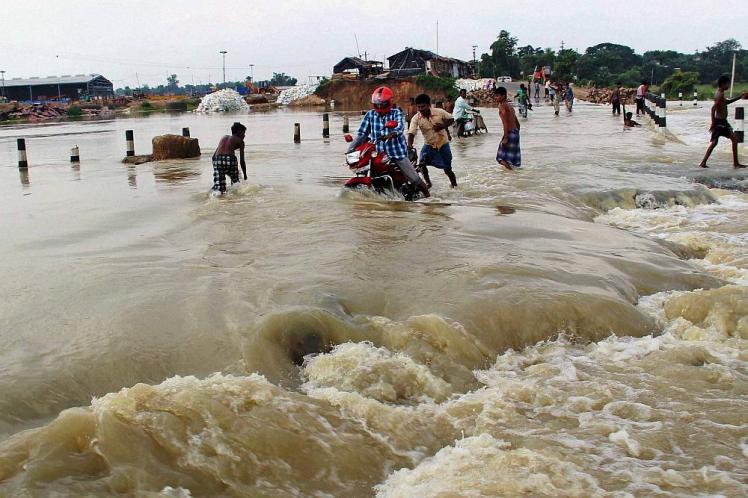
In mid-August, floods hit the southern and western states of Kerala, Karnataka, Maharashtra and Gujarat. Several hundred people died. Floodwaters damaged property and roads, and destroyed thousands of hectares of summer crops.
Kerala was particularly badly affected. Reeling under a rainfall deficit of 27% till August 7, the next day the state received 368% more rainfall than average, triggering widespread floods and displacing close to two million people. By August 13, incessant downpours sliced the seasonal deficit to 3%, a massive 24 percentage points difference. The state was still recovering from last year’s floods, the worst in a century.
In Maharashtra, two weeks of heavy rainfall flooded many western districts of the state such as Pune, Kolhapur, Satara and Sangli, killing 50 and displacing half a million. And all this while the monsoon rain shadow areas of Marathwada and Vidarbha remained drought hit.
Karnataka swung between a monsoon deficit of 13% to an excess of 10% on a week’s heavy rainfall. On August 8, some districts received up to 32 times their normal rainfall. Floodwaters rushed into 12 districts, mostly in the northern and central parts. Monuments in the World Heritage Site Hampi were submerged by the swollen Tungabhadra river.
If this wasn’t enough, there were cloudbursts in the Himalayan states of Himachal Pradesh and Uttarakhand. Extreme rainfall on August 18 wreaked havoc in Uttarkashi district of Uttarakhand, washing away dozens of houses in several villages. Heavy rains over the weekend in Himachal Pradesh poured enormous quantities of water in many parts of the state, causing floods and landslides. The India Meteorological Department (IMD) said on Sunday that Himachal Pradesh received the highest-ever rainfall for 24 hours since records began some 70 years back.
The rain in the uplands saw floods spilling over the plains of Punjab, Haryana and Uttar Pradesh, where massive relief work is in progress. The headwaters of the Ganga in Uttarakhand are in spate, with the river crossing the danger mark in Haridwar. The water of the Yamuna has risen alarmingly, triggering a flood warning in the national capital.
A disaster foretold
This kind of sudden and heavy rainfall is not unexpected. Scientists have long warned that extreme weather events brought on by manmade climate change is inevitable, and such weather extremes have arrived in India. The trend of extraordinary precipitation over shorter periods of time has been well documented.
“Although prediction of such extreme weather events is still fraught with uncertainties, a proper assessment of likely future trends would help in setting up infrastructure for disaster preparedness,” said a 2006 study led by B.N. Goswami of Indian Institute of Tropical Meteorology. The study of rainfall data of the southwest monsoon, the study found that there is an increase in the number of extreme monsoon weather events over India over the past half century, although the seasonal mean monsoon rainfall remains stable for the same period.
“There is a 10% increase per decade in the level of heavy rainfall activity since the early 1950s, whereas the number of very heavy events has more than doubled, indicating a large increase in disaster potential,” the study found. “These findings are in tune with model projections and some observations that indicate an increase in heavy rain events and a decrease in weak events under global warming scenarios.”
In 2011, P. Guhathakurta, O.P. Sreejith and P.A. Menon of the India Meteorological Department investigated the occurrence of exceptionally heavy rainfall events and associated flash floods in many areas in recent years. They found that extreme rainfall and flood risk are increasing significantly in the country. The frequency of very heavy rainfall events and risk of floods is likely to increase over India, said a 2008 study led by M. Rajeevan of the National Atmospheric Research Laboratory.
Although for some two decades the scientific evidence has been pointing to more such calamities occurring more frequently, such scenarios were mostly ignored by policymakers. As a result, this year’s cloudbursts have caught the authorities unprepared.
Worsening the disaster
At a time when extreme rainfall is more likely, experts are saying that the resulting floods, loss of property and human displacement and suffering are made worse by wrong-headed development and poor water management.
For instance, the extensive floods in Kolhapur, Sangli and Satara in the upper Krishna river basin in Maharashtra could have been somewhat mitigated had the dam operators in the region acted wisely, alleged the South Asia Network of Dams, Rivers and People (SANDRP), a research and advocacy group. Poor management of dams has worsened the floods instead of mitigating them, it said in a report.
“In the same period when these districts were getting high rainfall, the dams in these districts started releasing large quantities of water, which played a major role in creating the flood disaster,” the SANDRP report said. “The dam operators are likely to turn around and say that but the dams were full and we had no option but to release water. The question is: why were the dams full when monsoon is just about halfway through and IMD has predicted much higher rainfall in the remaining part of the monsoon compared to the first half?” the report questioned.
The opening of sluice gates of reservoirs, such as the Bhakra Dam on the Sutlej River in Himachal Pradesh and the Kota Barrage in the Chambal River valley, caused much of the floods in northern India. If India has to mitigate the impacts of extreme rainfall, it has to devise ways to manage its dams.
The first step towards a course correction is to recognise the problem. But the government seems to be in denial. “The climate in various parts of the world is changing, but it would be wrong and unscientific to attribute the current flood situation to climate change,” India’s Environment Minister Prakash Javadekar said at a media briefing in Pune.
It’s true that climate scientists are wary of attributing a particular extreme weather event to climate change. However, it is also undeniable that scientific evidence points clearly to an increase in such occurrences due to global warming.
Reckless development
Besides faulty water management, the frenzy of ill thought out development has also worsened the impacts of the intense rainfall. In the western Himalayas, for instance, there has been a massive thrust in building infrastructure that has put enormous pressure on the region’s natural environment. Environmentalists and experts have cautioned against the massive road and tunnel-building projects in Himachal Pradesh and Uttarakhand.
In 2013, heavy rainfall and unprecedented floods had devastated Uttarakhand. At that time, the federal home ministry had blamed deforestation, building of roads that cut through mountains, construction of hydropower projects, and tourism-related construction on floodplains and mountain slopes for worsening the scale of the disaster.
But the lessons of 2013 have remained unheeded. In fact, the government has embarked on the contentious Char Dham highway project to connect four Hindu shrines in the state, though local residents and environmentalists say that it endangers the fragile mountain ecosystem.
In the south, the floods and landslides in Kerala have again focused attention on the 2011 report by the Western Ghats Ecology Experts Panel led by Madhav Gadgil. The Gadgil report had warned that cultivation of commercial crops on steep slopes was leading to rapid erosion and increased run-off.
It had also said there was a need to control the massive encroachment and deforestation in the catchment of major rivers such as the Godavari, Krishna and Cauvery. It also spoke against building large dams in the ecologically sensitive area.
The warning and recommendations of the Gadgil report were actively opposed and ignored. The terrible results of that became evident when there was unprecedented rainfall in Kerala last year. Scientists said the impacts of the Kerala deluge was made worse by massive deforestation over the years, unrestrained construction, and most of all, stone quarrying that destabilised hill slopes.
This intense rain in the southern state again this year could just be one in a string of such events occurring in the future elsewhere in the country as well. Unless there is a change in the way development is carried out in India, the damage from extreme weather events will only be magnified.
Courtesy: Counter View

‘Modernisation’ includes upgradation of weapons, communications systems including wireless devices and satellite networks, and the development of forensic infrastructure including labs and training of manpower, among other matters. Altogether, the utilisation of police forces’ modernisation budget was less than half (48%) of the funding available, according to an IndiaSpend analysis of government data.
“The central government releases grants for modernisation, which the state has to match. States don’t always release modernisation funds. This needs to be changed,” M N Singh, former Police Commissioner of Mumbai, told IndiaSpend.
Meanwhile, in this year’s budget, the allocation for ‘police infrastructure’–distinct from the modernisation allocation, and including such heads as maintenance of existing vehicles, basic weapons and telephones–actually declined by 2%.
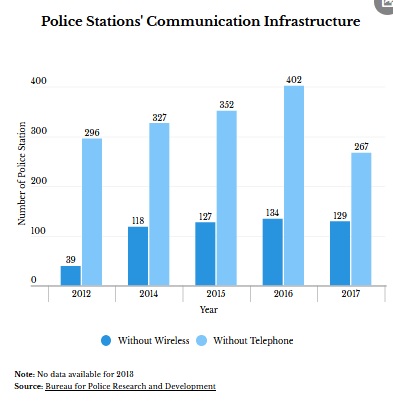
As a result, police forces across India lack weapons and fundamental communications and transport infrastructure–267 police stations had no telephones and 129 had no wireless communication devices as of January 2017, as per the latest available data from the Bureau of Police Research and Development (BPRD). There were eight vehicles for every 100 police personnel for responding to distress calls, patrolling and maintaining law and order in their jurisdictions.
The number of police stations functioning without wireless communication devices across India increased 231% from 39 in 2012 to 129 by the end of 2016. At the beginning of 2017, 273 police stations across the country did not possess a single transportation vehicle.
Communications infrastructure
More than half of the police stations without wireless communication devices were in Manipur (30), Jharkhand (22) and Meghalaya (18). Manipur ranked 28th among all states and union territories in terms of crime rate (121.9 per 100,000 people), when the worst possible rank was the 36th; Meghalaya ranked 29th (crime rate 120.4), and Jharkhand 30th (120.9).
Meanwhile, the number of police stations functioning without telephones declined 10% from 296 in 2012 to 269 in 2017.
More than 45% of the stations without telephones were in Uttar Pradesh (51), Bihar (41) and Punjab (30). Uttar Pradesh ranked 26th among all states and UTs with a crime rate of 128.7, Bihar 22nd with a crime rate of 157.4, and Punjab 24th with a crime rate of 137.
At the start of 2017, 51 police stations across the country had neither telephones nor wireless communication devices–down from 100 stations in 2012. More than half of these were located in the northeastern states of Manipur (15) and Meghalaya (12).
“With greater transport and communication equipment, the police can patrol a greater area more efficiently,” Singh said. “Wireless communication devices, mobiles, and vehicles are imperatives today. If anything happens, the police needs to be able to communicate well to address the issue. With better communication and transportation, one policeman can do as much work as ten policemen.”

Transport infrastructure
At the end of 2016, Indian police forces had, on average, one transport vehicle for 12.38 police personnel–an improvement from 15 per vehicle at the end of 2011.
Availability of transport infrastructure per 100 police personnel rose 19% from 6.78 by the end of 2011 to 8.08 in by the end of 2016, due largely to a 500% increase in the number of vehicles such as mine-proof vehicles, forensic vans, prison trucks and water tankers from 1,255 in 2011 to 7,536 in 2016.
The number of medium and light vehicles such as cars and jeeps increased only 21% from 76,088 in 2012 to 92,043 in 2016.
Yet, 273 police stations across the country had no transportation facilities by the end of 2016. Almost 90% of these were located in insurgency-hit Chhattisgarh (126), neighbouring Telangana (91), and Manipur (25), which also experiences internal conflict.
Uttar Pradesh, with 30 police personnel per vehicle, Mizoram with 22, and Himachal Pradesh with 18 had the fewest transport facilities per 100 police personnel in 2017.
Weapons shortage
Meanwhile, several state police forces operate with subpar weapons and communications infrastructure, as the Comptroller and Auditor General (CAG) found after examining five states from 2014 to 2018.
In Uttar Pradesh, in particular, of the initial demand of Rs 69.91 crore under the Modernisation of State Police Forces (MPF) scheme, only 55% or Rs 38.31 crore was allocated, and only Rs 32.99 crore (47% of the initial demand) was utilised, as per CAG’s 2017 audit of the state. Nearly half (48%) the police force was using weaponry that the home ministry had declared outdated over 20 years ago.
In Rajasthan, the CAG reported a 75% paucity of weapons in 2015 compared to the recommended quantum between 2009 and 2014. The state police required 15,884 weapons, of which they had received 3,962 (25%) at the time of the audit. Of these, 2,350, or 59% weapons were in storage and not distributed to the police stations.
Therefore, police stations in Rajasthan received only 14.7% of the requisite weapons, and faced a shortage of more than 85%.
The audit in West Bengal found a 71% weapons shortfall; Karnataka and Gujarat had a shortfall of 37% and 36%, respectively.
Erratic utilisation of modernisation budget
The modernisation budget, according to the BPRD, helps to upgrade police infrastructure–constructing people-friendly police stations and posts, and improving mobility, weaponry and communication equipment.
However, states’ utilisation of these funds has been erratic. Across India, over five years to 2017, less than half (48%) or Rs 13,720 crore ($1.9 billion) of the overall modernisation budget of Rs 28,703 crore ($4 billion) was utilised.
From 87% utilisation in 2014, all-India utilisation of modernisation funds fell to 14% in 2016, only to rise again to 75% in 2017.
Among states, Nagaland alone used all of its allocation for modernisation of Rs 1,172 crore through the financial year 2015-16, BPRD data show. Jammu and Kashmir spent around 45% of its modernisation budget, Rs 40 crore out of Rs 89.59 crore. Uttar Pradesh used 23% (Rs 26.31 crore) of its Rs 116.66 crore.

The modernisation of communications infrastructure is also incomplete in several states.
Uttar Pradesh spent 28% or Rs 56 crore of its budgetary allocation of Rs 137 crore to enhance its communications infrastructure during 2011-12 to 2015-16, CAG said.
In Karnataka, from 2013-14 to 2016-17, only Rs 6.93 crore was released against the initial demand of Rs 15.93 crore for the procurement of updated communications equipment, of which none were utilised as of 2018, another CAG report found. In 2018, all of the 43,636 communication sets (wireless devices, walkie-talkies, etc.) with the state police were past their recommended life-span.
“Policing now has become technology-centric. The police must modernise and expand its capabilities with respect to cyber-crime, currency flight, international trafficking, and other such crimes of enormous dimensions. We must also improve our capabilities with regard to cyber forensics, which is important today,” Singh said.
In 2002, India set up a satellite-based communication network called Police Telecommunication Network (POLNET) to enable faster communication between the police and paramilitary forces.
As of 2016, only 38 of 75 (51%) districts in Uttar Pradesh had functional POLNET infrastructure, CAG found.
In Gujarat, the entire POLNET system was either out of order or absent in October 2015, CAG found, and observed a 32% deficit in trained manpower to operate the relevant equipment, as of March 2015.
Gujarat spent none of the Rs 31.81 crore it received in 2013 and 2014 to upgrade its urban policing infrastructure. From 2009-10 to 2014-15, 73% of the funds Gujarat received for this purpose remained unspent.
(Mehta, a second-year undergraduate at the University of Chicago, is an intern with IndiaSpend.)
Courtesy: India Spend

The following are excerpts from the Epilogue to the book.

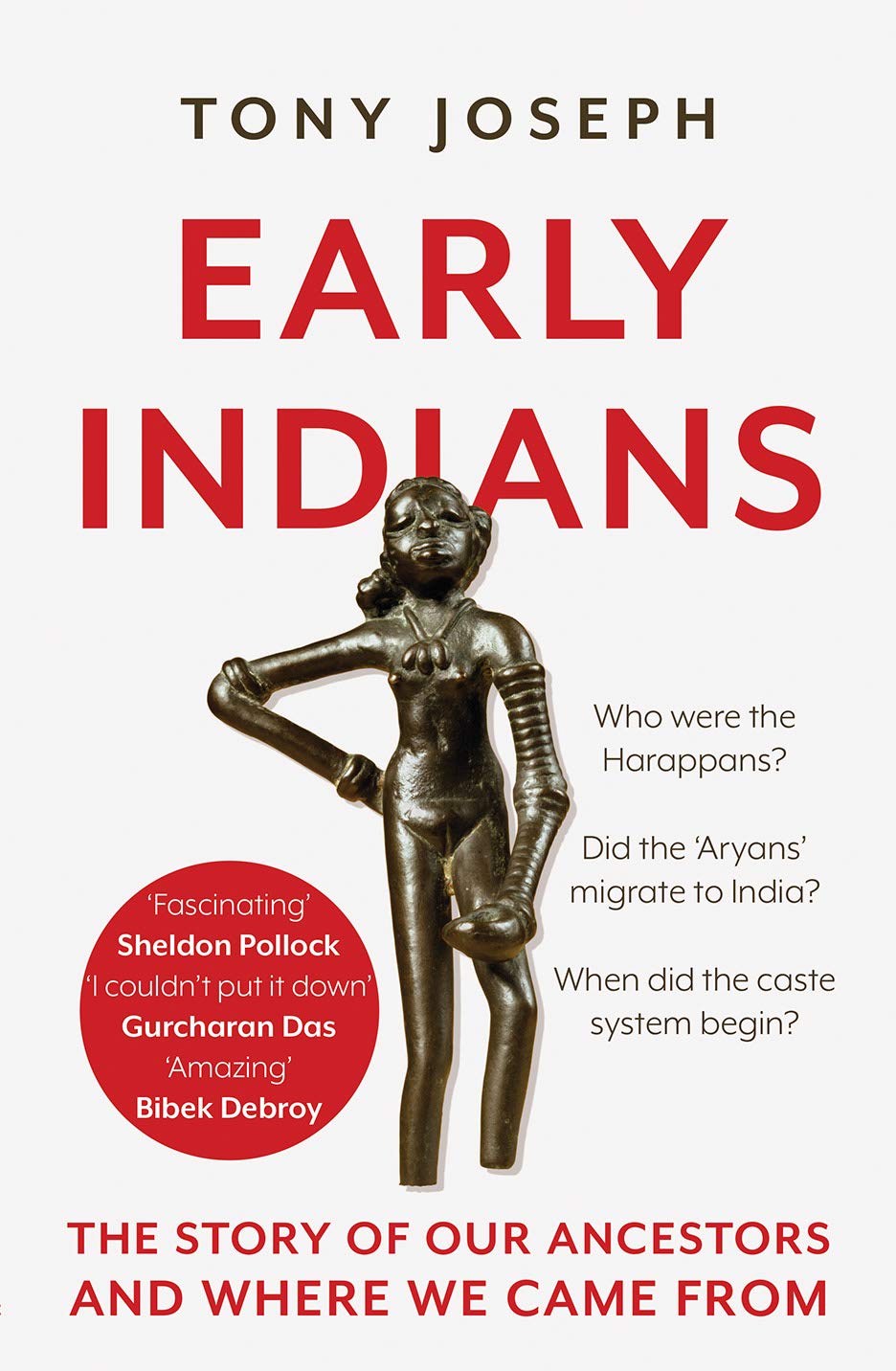
Image courtesy Juggernaut
Many of us believe our ancestors have lived in South Asia since “time immemorial”. But, as it turns out, “time immemorial” may not have been all that long ago. Tony Joseph’s Early Indians: The Story of Our Ancestors and Where We Came From goes 65,000 years into the past–when a band of modern humans, or Homo sapiens, first made their way from Afrcia into the Indian subcontinent. Citing recent DNA evidence, Joseph traces the subsequent large migrations of modern humans into India. The book not only shows us how the modern Indian population came to be composed as it is but also reveals an undeniable and important truth about who we are: we are all migrants. And we are all mixed.
Over the four chapters of this book, we saw how the Indian ‘pizza’ got made, with the base or the foundation being laid about 65,000 years ago, when the Out of Africa migrants reached India. The sauce began to be made when the Zagrosian herders reached Balochistan after 7000 BCE, mixed with the First Indians, and then together went on to build the Harappan Civilization. When the civilization fell apart, the sauce spread all over the subcontinent. Then came the ‘Aryans’ after 2000 BCE, and cheese was sprinkled all over the pizza, but a lot more in the north than in the south. Around the same time arrived the major toppings which we see today in different regions in different amounts – the Austroasiatic and Tibeto-Burman-language speakers. And then, much later, of course, came the Greeks, the Jews, the Huns, the Sakas, the Parsis, the Syrians, the Mughals, the Portuguese, the British, the Siddis – all of whom have left small marks all over the Indian pizza.
Like all metaphors this is a silly oversimplification, of course, but is useful to the extent that it helps correct deeply embedded and problematic misconceptions about who we are. It is commonly thought that the ‘adivasis’ or ‘original inhabitants’ or ‘tribals’, who form about 8 per cent of the population, are very distant and very different from the rest of the Indian population – a perception that has led to them being looked down upon, not just as people who have chosen to continue a particular lifestyle, but as people who are ‘not us’. Now we know this is baseless. The tribals are ‘us’.
The tribals share much with the rest of the population genetically since they carry the ancestry of the First Indians and they ought to be seen as the foundational population of India as it is today. As we have seen, 50 to 65 per cent of whole genome ancestry of the Indian population comes from the descendant lineages of the First Indians. And there is no population group in India today that does not carry First Indian ancestry, no matter what language it speaks or where in the caste hierarchy it falls. How appropriate it is then that the most recognizable image of the Harappan Civilization is the ‘dancing girl’ (cover image) who could very well be a tribal girl. As we saw in chapters 2 and 3, First Indians were a part of that first urban revolution. (Aside: We do not know, of course, whether the girl was ‘dancing’; what we do know is that she has a powerfully attractive, insouciant stance that denotes energy and authenticity even today.)
The disdain towards tribals and scheduled castes comes from an inbuilt belief system that ‘others’ them and now we know why this othering needs to go. This attitude also reflects in the general unconcern for our own prehistorical sites. From Jwalapuram to Bhimbetka to Dholavira, the lack of interest in and identification with these sites is almost as palpable as in the case of our western neighbour’s similar indifference to historical sites that predate the arrival of Islam in the subcontinent. We will know that we have matured and owned our past in the full sense when prehistorical sites in India start attracting enough visitors who are excited and thrilled to see what their ancestors did and how they lived.
[…]
The theory that incoming ‘Aryans’ imposed the caste system on the population when they arrived in the subcontinent has been proved wrong by a genetic study published in 2013 titled ‘Genetic Evidence for Recent Population Mixture in India’. It was co-authored by Priya Moorjani, Kumarasamy Thangaraj, Lalji Singh, David Reich and others.
The results of the study that these scientists had conducted, based on genome-wide data from seventy-three population groups in the Indian subcontinent, were stunning. The study showed that between 2200 BCE and 100 CE, there was extensive admixture between the different Indian populations with the result that almost all Indians had acquired First Indian, Harappan and Steppe ancestries, though, of course, to varying degrees. The paper says, ‘India experienced a demographic transformation several thousands of years ago, from a region in which major population mixture was common to one in which mixture even between closely related groups became rare because of a shift to endogamy [marrying within the community].’
We have already seen how, when the Harappan Civilization began declining, as a consequence of the long drought and the arrival of new migrants, there were large-scale population movements from the north-west to both south and east, and much intermixing. So that is not surprising, even though the study reveals that the mixing was quite deep-going: ‘nearly all groups experienced major mixture in the last few thousand years, including tribal groups like Bhil, Chamar and Kallar that might be expected to be more isolated’. What is surprising, because it is counter-intuitive, is that the mixing came to an end sometime around 100 CE. One can imagine two separate groups who had maintained their genetic distance for a long time suddenly deciding that enough was enough and starting to mix. But it is more difficult to visualize groups that had already been mixing waking up one day and deciding to put a stop to it, and creating barriers to continued intermixing. The genetic study says that this is exactly what happened. It was as if around 100 CE a new ideology, which had gained ground and power, imposed on the society new social restrictions and a new way of life. It was social engineering on a scale never attempted before or after, and it succeeded wildly, going by the results of genetic research.
The study links the sudden downing of the shutters on intermixing to the beginning of the caste system: ‘The four-class (varna) system, comprised of Brahmanas, Kshatriyas, Vaisyas, and Sudras, is mentioned only in the part of the Rigveda that was likely to have been composed later. The caste (jati) system of endogamous groups having specific social or occupational roles is not mentioned in the Rigveda at all and is referred to only in texts composed centuries after the Rigveda.’ Could the end of the Maurya empire in the closing centuries of the first millennium BCE have had anything to do with this change in ideology? Did the defeat of the Mauryas also presage the eventual disappearance of Buddhism from the subcontinent and the decline of Jainism? Could the orthodox traditions of Aryavarta – with a more rigid view of social hierarchy and opposition towards ‘varnasankalana’, or mixing between different classes or races – have defeated the more open, freewheeling, progressive and anti-ritualistic ideologies of Magadha that had posed a challenge to it?
Did the rapid expansion of the Maurya empire into the heartland of Aryavarta between the fourth and second centuries BCE threaten the Brahmanical ideology based on sacrifices, the supremacy of Brahmins and their special relationship with rulers, and did Aryavarta strike back in response? Did they, then, over time, manage to impose their own long-held ideals of ‘purity’ and strong endogamy on the rest of society, including the Indo-European-language speakers of eastern India, who did not share those ideals, though they called themselves ‘Aryans’ too? Bronkhorst addresses some of these questions in his book.
A few things follow from this discussion. The caste system in India is not coterminous with the arrival of the ‘Aryans’ in the subcontinent. It fell in place around the ankles of Indian society only about two millennia later. And by the time it came about, intermixing had already taken place to varying degrees. So Ambedkar was right when he stated that the Sudras were not genetically different from the rest of Indian caste society. But perhaps he did not go far enough – he seems to have still considered the tribals to be different from everyone else. We now know that this is not correct – because their genes run through everyone, no matter where in the caste hierarchy one is.
Ambedkar was also wrong in denying ‘Aryan’ migrations altogether, though he cannot be blamed for the mistake since he did not have the genome data that we have today.
The cultural effervescence in eastern India or Magadha began in the centuries before the flowering of the Maurya empire and can be seen in such things as urbanization, new religions and philosophies and the rising affluence and prominence of the trading classes. It had already spread its influence and ideas across the subcontinent and far outside of it too, before the gates of the caste system were installed and closed, perhaps over several generations and centuries, thus turning the country inward in many ways.
A period of achievements and adventures
The five or six centuries before the beginning of the Common Era and a couple of centuries after it would rank as one of the most creative and progressive periods in the history of India. The composition of the Upanishads, the insights and philosophy of which have inspired millions across the world and influenced much of the thought of the Indian subcontinent; the rise of the world’s first missionary religions, Jainism and Buddhism, that took the teachings of their founders as well as new linguistic ideas and literary forms to all corners of India and, in the case of Buddhism, to many corners of the then known world; the bringing of east Asia under the spell of Indian cultural ideas; the mesmerizing of China . . . the list is as long as it is exciting. Most of the overseas overtures, outreaches and adventures would have begun either from the eastern or southern parts of India, which would have been without the kind of restrictions on intermixing and voyages across the seas that Aryavarta found necessary to impose.
The momentum of these strong cultural currents carried on for many centuries after a new social hierarchy and a new way of living became common in the subcontinent and mixing between groups of the kind that was seen earlier had become taboo. Sanskrit, as the new language of the elite and the medium of intellectual discourse, probably became more influential than any other language in ancient history, with the possible exception of Latin – and Sanskrit spread more by persuasion and buy-in rather than military invasions as in the case of Latin, as explained beautifully by Sheldon Pollock in his majestic book The Language of the Gods in the World of Men. Kings and aspiring kings all over the subcontinent and across the seas in south-east Asia wanted the prestige and comfort that Sanskrit offered, along with its theory of kingship and social structure that seemed to find a ready market among elites everywhere. A powerful body of literature including the two mega epics, the Ramayana and the Mahabharata, which remain unrivalled in their ability to enthrall and inspire, carried in its sinews the new theory of power and social relationships that was perhaps as convincing for those at the receiving end of it as for those at the giving end of it.
This was not inevitable
But there was also a huge social cost to the new social construct, as indicated by genetics, again, as David Reich explains it in Who We Are and How We Got Here:
People tend to think India with its more than 1.3 billion people as having a tremendously large population, and indeed many Indians as well as foreigners see it this way. But genetically, this is an incorrect way to view the situation. The Han Chinese are truly a large population. They have been mixing freely for thousands of years. In contrast, there are few if any Indian groups that are demographically very large, and the degree of genetic differentiation among Indian jati groups living side by side in the same village is typically two or three times higher than the genetic differentiation between northern and southern Europeans. The truth is that India is composed of a large number of small populations.
In essence, the social structure that was imposed in the second century CE has cut the country into ‘tukde, tukde’ (pieces), to use the vocabulary of television news channel discussions in 2018. When you divide up a people like that, a society’s ability to maximize the potential of its individuals is severely affected and, equally importantly, fellow feeling even among people who live in the same locality is dampened, thus aborting the possibility of common actions that would benefit everyone. To what extent this has hampered India, as a nation, is perhaps a question that only sociologists will be able to answer, hopefully quantitatively, some day.
What we know now is that this was not inevitable. This was not the direction in which India was heading till around 100 CE when we seem to have halted suddenly, and turned back on an issue of crucial social importance. It would be wrong to think, though, that the ideological confrontation between what Aryavarta represented – or perhaps what an elite group within it represented and preferred – and what Magadha or eastern India represented and practised came to an abrupt halt. Buddhism kept going for centuries after its defeat in the land of its birth, though its position grew weaker and weaker.
That some of these battles were still being fought seven centuries after the arrival of the caste system in 100 CE we know from the work of Adi Shankara who took on the philosophies of Buddhism and Jainism. We also know this from archaeological and literary sources that have recorded continuing disputation, both intellectual and physical, and from theological movements like Bhakti that gave voice to the voiceless. That Bhimrao Ambedkar chose Buddhism for himself and his followers when he wanted to challenge still existing inequities in the twentieth century shows how the historical threads of a difference of opinion on the way a society ought to be constructed have continued to this day. In this sense, the spectacular ideological confrontation between Mohandas Karamchand Gandhi and Bhimrao Ambedkar too can be seen as a contest between the best of the philosophy of life and society that the conservative Aryavarta had to offer and the best of the rationality and progressivism that Magadha had to offer.
To quote the historian Romila Thapar:
When we assess our cultural heritage, we often tend to forget or we downplay the fact that rationality and scepticism were very much a part of early Indian thought. This was not limited to the Carvaka/Lokayata thinkers but is also clear from some other schools of philosophy, as indeed it is noticeable in Buddhist and Jaina thought. We have inherited a tradition of questioning, which was not limited to philosophical thought but is apparent in popular literature as well. It would be as well to nurture that tradition.
Tony Joseph, former editor of Businessworld, has been a columnist and contributor to leading newspapers and magazines. He has written many impactful articles on India’s prehistory.
These are excerpts from Early Indians written by Tony Joseph and published by Juggernaut books. Republished here with permission from the publisher.
Courtesy: Indian Cultural Forum

Representational image. | Image Courtesy: Deccan Herald
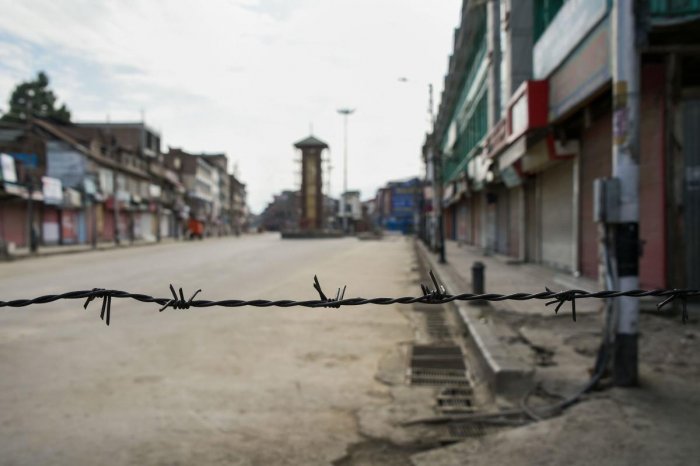
Hundreds of shops at the city centre, Lal Chowk, remain shut. In residential areas, however, the shops open early morning and late evening. It is during this time that people buy household essentials.
Even if the curfew is lifted by the government, the shopkeepers say they are keeping their shops closed as a mark of protest. “We are following a civil curfew against the government and it’s important we register our protest this time,” a shopkeeper in Jawahar Nagar said.
With all shops and business establishments across the Valley closed, the losses incurred by people are ‘enormous.’
For Asif, a cloth merchant in Lal Chowk’s HSH Street, summer is peak season. “Most weddings happen during August and September and that’s the main time for business, but this year it’s over,” he says.
This year, the situation for businessmen became a little more difficult when the government directive came asking tourists and Amarnath Yatris to leave the restive Valley. The advisories scared hundreds of skilled labourers who worked in the state’s informal sector as tailors, painters, goldsmith, hairdressers and so on.
“I have a massive backlog because most of my workers left but since my clients can’t reach me, I think weddings have either been cancelled or postponed,” another shopkeeper in Lal Chowk’s Bund says.
A non-Kashmiri hairdresser, who decided to stay back in Nowgam’s Wanbal locality, is witnessing a huge rush these days. His friend from Bihar has a tyre-repairing shop in the same locality. Both follow the same work timings – early morning till 9 a.m and then after 6 pm.
All the wedding invitations for August have been either cancelled or postponed or are being conducted as low-key affairs. Residents says it is usually difficult to attend weddings and ‘often dangerous.’
Travelling with his wife and brother, an invitee coming from Srinagar’s outskirts of Soura managed to travel nearly eight km in his car, but another one km to Nowhatta was not that easy. It is a wedding ceremony of a close family member which is why, he says, he must reach there.
“Even attending weddings is a task. I left my car midway in the vicinity of a college hoping to reach there on foot,” the person in his mid-40s told NewsClick.
Most weddings have gone austere as the single largest highlight of a Kashmiri wedding– Wazwan — which costs in lakhs for an average lunch for 200-300 people, stands cancelled. People say they have taken measures to avoid extravagance during weddings or other functions in solidarity with the community.
Saalim, a young entrepreneur, is getting get married this month. “I think I am left with a pair of jeans only,” he said. “The trouble is preparations were made for grand celebrations and then all of a sudden, you can’t celebrate,” he adds.
The people are as angry about the abrogation of Article 370 and bifurcation of the state as they are about government’s enforced communication blockade and the sudden crackdown on August 5.
Hundreds of parents wait for their turn to call their children from the landline inside the DC office in Srinagar. Some of them allege the process of waiting inside the facilitation centre is ‘extremely humiliating’.
“We have come as early as 7 in the morning and its 1 p.m and I still I haven’t made the call. The administration is using our longing for our children against us. This is blackmail,” a resident of old Srinagar, waiting to call his son, says.
Some landlines in several civil line areas have started working, bringing some respite to some families, while some others are rushing to the BSNL exchange offices either to pay their longstanding bills or to get their old landline connections restored.
“We are witnessing a huge rush. In four Srinagar exchanges, we have restored connections to civil line areas only. People are turning up here in huge numbers,” a BSNL employee in Barzullah exchange says.
According to a government spokesperson, as many as 63,000 landline connections have been restored across the state, but Lal Chowk and most Srinagar areas, including the Downtown, still await restoration. And, many schools are located in this vicinity.
Even as the government claims that schools have started to function, almost all schools in Srinagar remain shut. “Given the ongoing situation, how can you think we will send our children to school. The government is talking irrationally,” Tasaduq, a father of two, told Newsclick.
“No one comes here, no teachers or students, only a few persons from the caretaker staff are inside,” the doorkeeper at Oasis International School in Gojgi Bagh says.
“It’s not about the education, we won’t send our kids to school to be used as a sign of fake normalcy,” Tasaduq adds.
Many other schools are completely locked. Not just the schools, due to restrictions, school children are unable to attend private tuition classes as well.
Courtesy: News Click
Join our mailing list to get the latest human rights news that matters, straight to your mailbox.
© Sabrang | All Rights Reserved