New Delhi: The proportion of Indian sex workers with HIV/AIDS declined over four years to 2017, more use condoms than ever before and funding to control the disease rose 21% over the period, according to an IndiaSpend analysis of national health data.

But there appears to be little change in violence, stigma and discrimination against sex workers, how Indian states treat them varies, and funding and drugs are not always available when and where they should be.
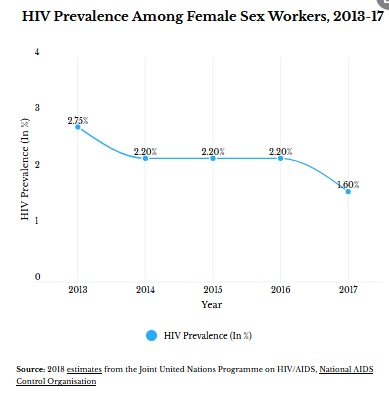
Over 91% of Indian sex workers used condoms in 2018, and no more than 1.6% of female sex workers had HIV (human immunodeficieny virus) and AIDS (acquired immunodeficiency syndrome) in 2017, down from 2.75% in 2013, mirroring a decline reflected among the general population, according to the latest available data.
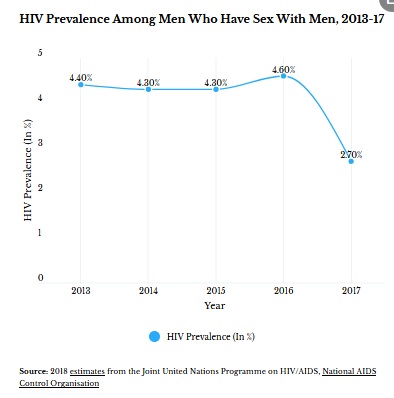
Over four years to 2017, the “HIV prevalence rate”, the percentage of people tested and found infected, among men who have sex with men also dropped from 4.4% to 2.7%, said a 2018 report from UNAIDS, a United Nations organisation, and India’s National AIDS Control Organisation (NACO).
As of 2017, India had a total of 2.17 million people living with HIV. New infections dropped 27% over seven years to 2017–from 120,000 to 88,000.
“This indicates that HIV prevalence is reducing among sex workers,” said a NACO representative, speaking on condition of anonymity.
Female and transgender sex workers and men who have sex with men are considered high-risk groups in determining HIV/AIDS prevalence.
“Globally, sex workers are 13 times more at risk of contracting HIV, when compared to the general population, because they are economically vulnerable, unable to negotiate consistent condom use, and experience violence, criminalisation and marginalisation,” said a 2018 study by UNAIDS.
The new data do not mean that sex workers now lead better lives.
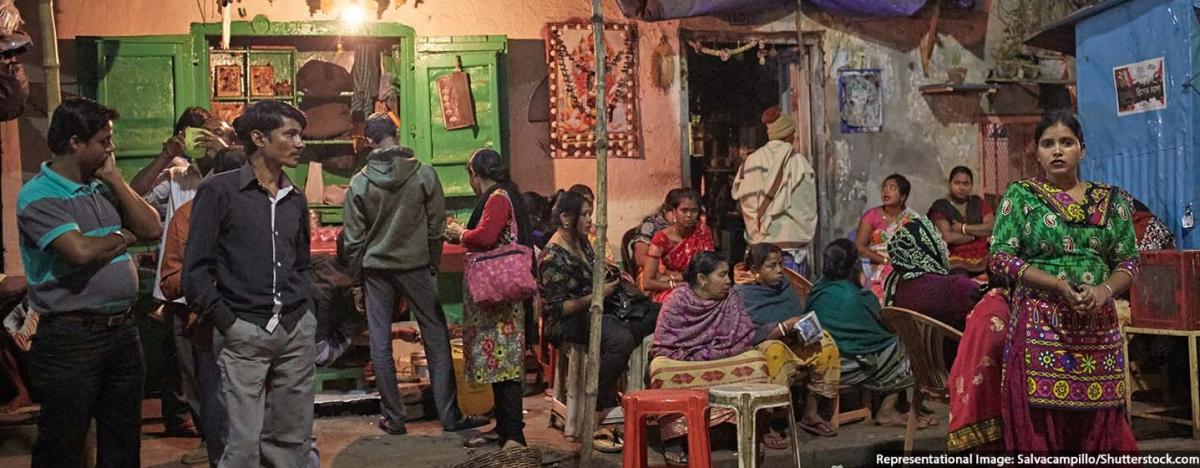
Adorned with red lipstick and dressed in a long skirt with shiny earrings, Ramkali Kumar, 26, a transgender sex worker from the western Uttar Pradesh city of Noida, spoke about violent clients.
“Many times when I agreed to go with a client, I found out that there were multiple men waiting to be pleasured,” she said. She was ostracised and abandoned by her family nine years ago. Her only family now is Basera, which provides shelter to sex workers of all genders.
Police brutality, abusive and violent middlemen and clients are common, said Shamnu Rao, programme officer with the India-HIV Alliance, an advocacy. “Violence and stigma against sex workers depends upon the involvement of gatekeepers in the sex work,” said Rao. Gatekeepers include brothel owners, and pimps or middlemen.
“When sex workers are independently approaching clients, the chances of police brutality increases whereas the involvement of middlemen entails another kind of structural violence,” said Rao.
While violence and abuse continue, and the HIV/AIDS infection rate is falling, many Indian states are worse off than others.
HIV prevalence and vulnerability
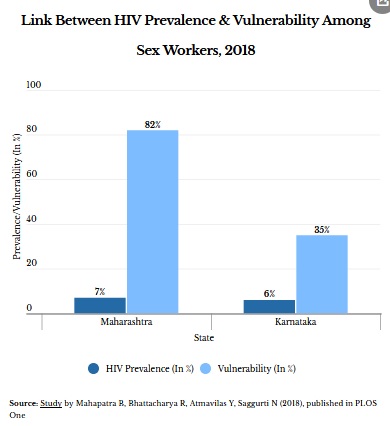
About 82% of female sex workers are vulnerable to “stigma, financial insecurity, and lack of social support” in Maharashtra, compared to 35% in Karnataka, according to the 2018 study. This vulnerability is linked to living conditions, healthcare and security of sex workers rather than HIV estimates among sex workers.
Maharashtra, Karnataka, Tamil Nadu, Telangana and Andhra Pradesh have a high prevalence of HIV among sex workers. Maharashtra has 7% HIV prevalence rate, Karnataka has 6%, and Tamil Nadu has 1%. Around 31% sex workers living in these states remain financially insecure, making them vulnerable to disease.
Half of Maharashtra’s sex workers depend only on sex work for survival, and do not have insurance. In Tamil Nadu, two-fifths and in Karnataka a fifth of sex workers face similar issues. This makes sex workers vulnerable to clients who insist on unprotected sex.
Violence and discrimination boost disease
Violence, abuse and discrimination against sex workers increased the risk of disease among sex workers, as IndiaSpend reported in August 2016.
NACO does not have a programme to eradicate the stigma against sex workers. “The stigma that sex workers face is usually covered under the programme for people living with HIV/AIDS,” said the NACO representative quoted previously.
Men who have sex with men, and transgenders are key populations in checking the spread of HIV, as we said, and are more vulnerable because their dress and body language makes them more visible.
Various state governments have labeled sex workers as “oppressed”, instead of seeing them as citizens in charge of their own lives. “In Karnataka, the government often labels sex workers as dananitha mahila or oppressed woman,” said Rajesh Umadevei, 30, who works with the National Network of Sex Workers, an advocacy.
The stigma against sex workers makes social security services inaccessible. “Sex workers are discriminated against by their landlords who do not give them bills or sufficient address proof needed to get Aadhaar cards made,” said Amit Kumar, a coordinator at the All India Network of Sex Workers.
Despite the discrimination and job risks that sex workers face, risky sexual behaviour is reducing, as the data indicate.
Free condoms are not the solution
How is risky sexual behaviour reducing?
The answer may lie in a government programme that appears to be working. Under a NACO programme, condoms are supplied free to organisations that work with high-risk groups.
“Peer to peer sex-education, and awareness about sexual health has increased among sex workers,” said Rao of the India-HIV Alliance. Many sex workers were now aware of safe sex and were getting themselves tested every six months, said the NACO representative.
However, Ramkali, the transgender sex worker, said the risks continue because clients are willing to pay more for unprotected sex.
“The data show one side, (but) there is an immediate need for targeted interventions to focus on new hotspots and locate the reason of new HIV infections,” said Rao. Older sex workers do not insist on condoms as much as their younger counterparts because they get fewer clients, she said.
In 2008, NACO started its Condom Promotion Programme in 15 states. Such programmes focus on markeing condoms rather than creating awareness about safe sex, said experts
“During my research, I observed that NGOs and community-based organisations had targets to meet,” said a Mumbai-based researcher on condition on anonymity because of the sensitivity of the subject. “In an effort to encourage condom use among sex workers, the emphasis was on selling and corporate marketing, rather than making them conscious about their sexual health.”
However, Meena Seshu, founder of Sangram, an advocacy, said that selling condoms was not more important than making sex workers aware about sexual health. She described condoms as “life-saving equipment for sex workers”.
Needed: a plan
The budget for the National AIDS and sexualy transmitted disease (STD) control programmes rose 21% over four years to 2017. But this does not mean the money comes when it is needed and is used as it should be.
“Since last year the funding for the HIV/AIDS programme came late,” said Seshu of Sangram. “We carried out the programme with our own money.”
Antiretroviral therapy (ART) drugs, used to treat HIV, are often difficult to find, even in high HIV prevalence states.
However, NACO has disagreed with experts about the shortage of ART drugs. “We do not have information about (a) shortage of ART drugs,” said the NACO representative. “Even if it is happening, it could be at the distribution level.”
Another problem is that sex workers do not know what they should about HIV/AIDS. Less than a quarter of sex workers in Karnataka, for instance, knew how to prevent the virus being transmitted from them to their children, according to a 2018 report.
“A comprehensive approach would be to address if sex workers have stigma-free access to sexual and reproductive health services,” said Rao of India-HIV alliance.
Community action
NACO has shifted the responsibility of tackling stigma and violence against sex workers to their communities, which have indeed sensitised medical staff and started programmes on sexual and reproductive health.
Community workers have helped sex workers talk about their problems and linked them to police and government resources. For instance, the National Legal Services Authority provides para-legal training to selected sex workers.
“Paralegal trainers help sex workers set up social-security service camps,” said Kumar of the All India Network of Sex Workers. “These include camps to provide access to a ration card, bus pass, Aadhaar card, regular testing for STDs and sensitise healthcare workers in the field.”
Sex workers are now trying to sensitise medical practitioners, but they find it difficult to make headway. “Doctors often ask us how many clients we take,” said Kusum, 38, who uses only her first name, President of the All India Network of Sex Workers, a collective. “They are not sensitive towards us.”
There has been some improvement in the sexual-reproductive health plan, said Kusum, explaining how many female sex workers carry a kit with condoms and a pregnancy test kit. Her colleagues counsel workers on sexually transmitted infections, reproductive health and safe abortion periods.
This story was first published here on Healthcheck.
(Chachra is a PhD Student at Delhi’s Jawaharlal Nehru University.)
Courtesy: India Spend