Srinagar: Violent protests in Kashmir are quelled using what the Ministry of Home Affairs (MHA) describes as ‘non-lethal’ crowd-control measures. These include pellet guns, tear gas and chilli-filled shells (containing PAVA or pelargonic acid vanillyl amide, found in chillies).

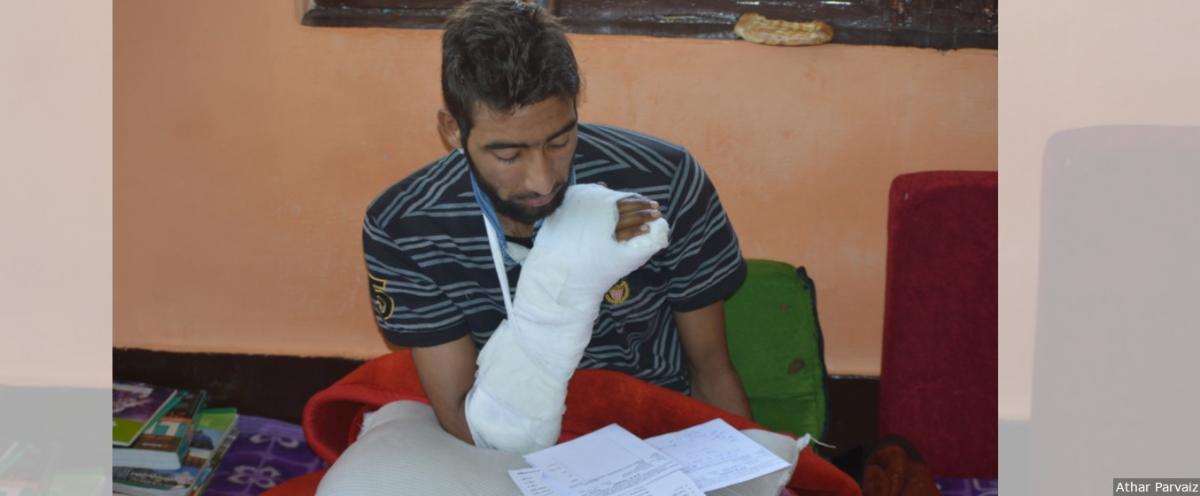
Tanveer Ahmad, a second-year undergraduate student at Srinagar’s Amar Singh College, was hit by a tear gas shell during a protest against the rape of a minor girl in Sumbal in Baramulla district.
But these munitions are far from non-lethal, according to an IndiaSpend analysis of MHA data and Srinagar hospital records.
We found that:
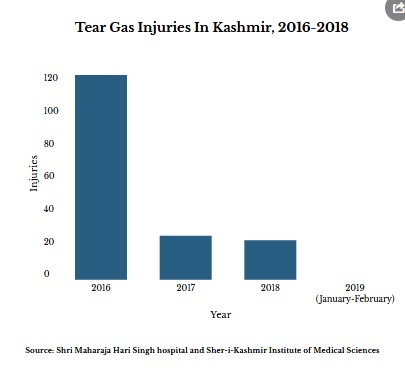
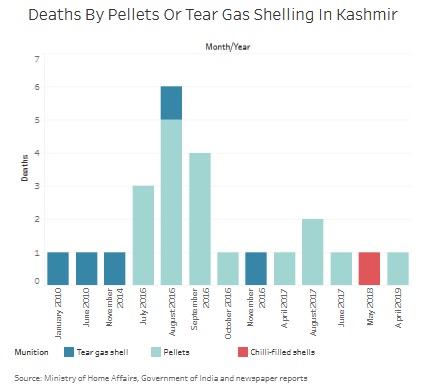
- Tear-gas shells killed five between January 2010 and May 2019, and injured 176 between July 2016 and February 2019.
- Chilli-filled shells killed one and caused respiratory problems in 51 of 294 respondents (non-combatants) surveyed for a medical study in downtown Srinagar. Of them, 97% developed cough and irritation within few seconds of breathing the gas.
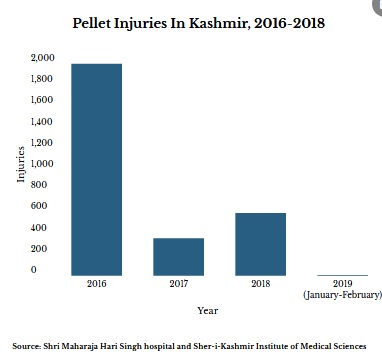
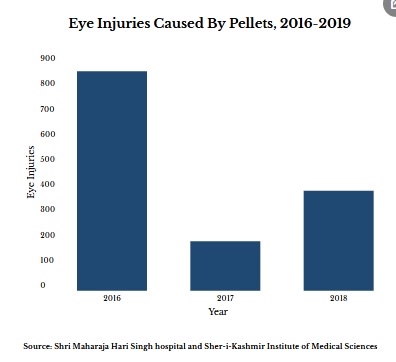
- Metal pellets have killed 18, blinded 139, injured 2,942 and caused eye injuries to 1,459 between July 2016 and February 2019.
These munitions killed 24 persons between January 2010 and May 2019, and injured 4,577 and blinded 139 between July 2016 and February 2019.
Over 100,000 tear gas canisters and almost 50,000 rounds of chilli spray have been used in over 4,000 incidents of stone-pelting in different parts of Kashmir since 2010, a senior security official who did not wish to be named told IndiaSpend. This situation worsened after July 2016 when militant commander, Burhan Wani, was shot dead by forces. There are no figures available on the use of pellets.
Human rights organisations such as Amnesty International have expressed outrage over the crowd control methods used in Kashmir and demanded a ban on these, especially pellets, which have blinded victims.
While the impact of pellets on victims has been documented extensively, there are few reports available on the effects of tear gas and chilli spray. We found in our investigations that these gases, which spread quickly, cause widespread damage to the health of those exposed. Those affected are not just those targeted by the forces but also passersby and those at home in the vicinity of the protest. Inhaling these gases causes paroxysms of cough and burning in the eyes, victims told us.
These accounts were confirmed by a May 2014 study published by Parvaiz Koul, professor and head of department, internal medicine at the Sher-i-Kashmir Institute of Medical Sciences (SKIMS) in Srinagar, and his colleagues at the department of internal and pulmonary medicine.
The researchers at SKIMS surveyed 294 bystanders exposed to pepper gas (as chilli-filled shells are referred to in the study) used against stone-pelters in Kashmir. Around 97% had developed cough and irritation of the throat within a few seconds of breathing the pungent gas as we mentioned earlier.
Exacerbation of lung diseases
“Among our interviewees, 16 developed exacerbation of their underlying respiratory disorders and one patient with chronic obstructive pulmonary disease (COPD) developed a severe exacerbation of COPD immediately following exposure (She died in the hospital, three days later),” the SKIMS study said. “Symptoms lasted for one day to a week (median 24 hours), and in 94 percent of re-exposed individuals, symptoms recurred with similar severity on re-exposure.”
Exposure to tear gas and pepper gas is dangerous for human health both in the long and the short run, said S Balamurugan, principal investigator at the Chennai Chest Research Institute. Those exposed to them could become vulnerable to lung disease earlier in life, he warned.
“If there are asthma and COPD patients in a locality where these gases are used, they are bound to suffer and have exacerbations,” he said. “There is a 100% chance that children and elderly people will get affected. It can cause long-term effects, especially in a high-altitude place like Kashmir. Used frequently in a certain locality, it will cause problems for healthy people as well.”
Despite these documented effects, the Jammu and Kashmir police have issued a tender for fresh supplies of tear gas munitions.
Ages of some killed: 13, 17, 76
In 2010 the unrest in the Valley turned particularly violent, with the massive involvement of people in protests including stone-pelting. Since then, residents of Srinagar and other towns like Anantnag, Baramulla, Pulwama and Shopian have been witnessing regular use of metal pellets, tear gas and chilli sprays to quell protests and stone-pelters. The security situation in some south Kashmir towns has been particularly fragile in recent years.
One of the most widely discussed cases was of tear-gas victim Tufail Mattoo, 17, of Saida Kadal, Srinagar, who was killed after he was hit by a shell while government forces were dispersing protesters on June 11, 2010 at nearby Rajori Kadal. Mattoo was on his way to his coaching class when he was hit, newspapers had reported.
Another victim was the 13-year-old Wamiq Farooq, who was killed on January 31, 2010 when a tear gas shell, fired at point-blank range, hit his head. These killings triggered a series of protests which later resulted in agitations all across Kashmir.
There were two other tear gas deaths during protests: Gowhar Nazir of Zainakote HMT, on the outskirts of Srinagar in November 2014 and Irfan Ahmad, 18, in August 2016 in Malarata in the Nowhatta area of Srinagar. A 76-year-old man, Ghulam Muhammad Khan, was killed in November 2016 at Elahi Bagh when he was hit by a tear gas shell.
‘My wife was going to a hospital when she was hit’
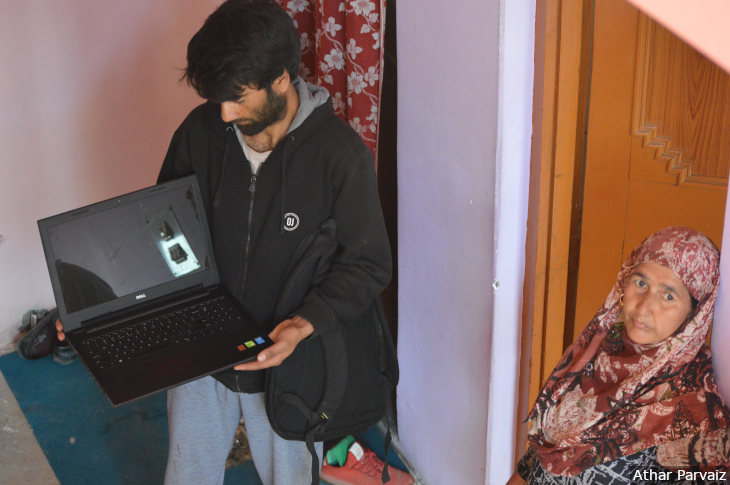
Gowhar Nazir Dar’s brother, Shahzad Nazir Dar, a gaunt youngster with sunken eyes, sat in his home in the Omarabad HMT area of western Srinagar, recalling his loss. “I was not like this when my brother was alive–I was physically very fit,” said Dar, who stopped studying after his second year in BA. “When I look at Gowhar’s laptop, I get very emotional. He had hardly used it when he got killed.”
“When I look at Gowhar’s laptop, I get very emotional,” says Shahzad Nazir Dar of his brother, an engineering student, who had been killed when a crowd was tear-gassed at a protest on the outskirts of Srinagar. “He had hardly used it when he got killed.”
Gowhar was a computer-applications engineering student who had nearly completed his degree when he was killed.
“My younger brother, Farnosh has developed a cardiac problem, while my mother is in depression,” said Shahzad. “Doctors have told us that we should never leave her alone.” Their father, Nazir Ahmad Dar, has been told that his son, Shahzad, will be given a government job as compensation but the offer is yet to arrive.
“Despite CID (Criminal Investigation Department) police and CIK (Counter Intelligence Kashmir) verification, my son is not being given employment under SRO 43 (statutory rules and order which guarantees employment to the next of kin of the innocent killed),” said Nazir.
“Instead, they recently offered us Rs 4 lakh in cash which we refused.”
Arsalan Bhat, 19, of Dangarpora, Pulwama, was hit by a tear gas shell causing severe facial injuries in April 2018. He has already undergone two plastic surgeries at SKIMS and is waiting for the third.
“Doctors told us that he has to go through another surgery after six months and have advised against exposure to sunlight,” said Rayees Ahmad, Bhat’s cousin. “He is a student and has lost many weeks of studies because of the surgeries. It has cost his family Rs 60,000 so far and they don’t know how much the third surgery will cost.”
Tanveer Ahmad of Zainakote, Srinagar, a second-year undergraduate student at Srinagar’s Amar Singh College, was hit by a tear gas shell outside his college while he and his fellow students were protesting against the rape of a minor girl in Sumbal, in Baramulla district, an incident which evoked massive protests in May 2019.
“The government calls them non-lethal weapons for dispersing protesters but how are they not lethal if they are doing this to people?” asked Ahmad.
For Zahoor Ahmad Bhat of Shalteng in Srinagar district, the spring and summer of 2017 have been traumatic. His wife, Nighat, had to undergo several facial surgeries after she was hit by a tear gas shell when women were protesting against the lack of power supply in their area.
“She was not even part of the protest when women had blocked the main road outside our locality,” he said. “She had to go to the hospital for a check-up. But police fired tear gas shells indiscriminately and one of the shells hit her in the face. Thank God, the plastic surgeries gave her back her face. But, she has turned somewhat temperamental after that incident. She was very shy but now she loses her temper with the children and other family members.”
The young and old suffer the most
People with respiratory diseases such as asthma and chronic obstructive pulmonary disease (COPD), the elderly and very young suffer the most when tear gas and pepper gas are used, said a report in Greater Kashmir published in October 2016, quoting senior physicians.
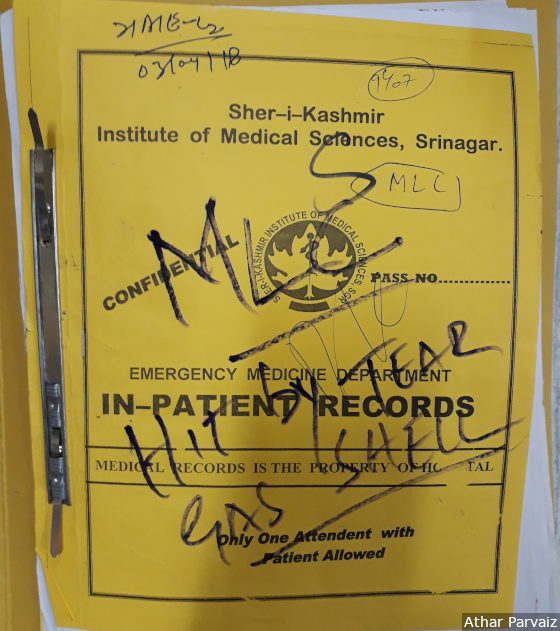
The medical file of a tear gas shell victim at a Srinagar hospital. Upto 97% of those exposed to tear gas and chilli spray complained of cough and throat irritation, found a study conducted by doctors at SKIMS.
Tear gas is poisonous, Sundeep Salvi, director of Pune-based Chest Research Foundation, said. “It is meant to kill a person; it is meant to cause harm,” he pointed out. “But how much harm it is causing in Kashmir, I have no knowledge. I need to study cases before I comment on that.”
“Tear gas under the Geneva Convention is characterized as a chemical warfare agent, and so it is precluded for use in warfare, but it is used very frequently against civilians,” Sven-Eric Jordt, a nerve gas expert at Yale University School of Medicine, told National Geographic on June 12, 2013 in an interview. “That’s very illogical.”
Incidents of exacerbation of COPD and asthma, and the number of patients suffering from these arrive in larger numbers from areas which report more tear gas and pepper gas use, said doctors at Srinagar’s Chest Diseases Hospital (CDH) and Shri Maharaja Hari Singh (SMHS) Hospital. There are no data available to back this statement but the number of patients goes up every time a violent protest is dealt with using gas, the doctors said.
Sound cannons next? No, says govt
Despite this, media reports on June 24, 2019 claimed, the Central Reserve Police Force (CRPF) is now considering using sound cannons for crowd control in Kashmir instead of pellet guns. The use of long range acoustic devices (LRAD) could cause hearing damage, concluded a study by the Bureau of Police Research & Development (BPRD), published in March 2017.
“High-intensity directed acoustic devices (HIDA) devices such as LRAD are designed to deliver audible warning messages over long ranges (up to 1km),” the study said. “However, at closer distances it is considerably more incapacitating and can produce 120 db (decibles) of sound at 60m and peak levels of 130db at 4 meters. Hearing damage can occur at levels as low as 80 db, if exposure is over a long period.” These are high decibel levels–120 db is equivalent to the noise made by a thunderclap.
The media reports followed a notification or request for information put out by the CRPF on its website, asking manufacturers to submit details of long-range acoustic devices, or sound cannons, by June 30, 2019.
But these reports were denied by Sanjay Kumar, the CRPF spokesperson. “We have no information that CRPF is now going to use any sound cannons in Kashmir,” he told IndiaSpend. “In the first place, let me inform you that stone-pelting incidents have considerably declined. We don’t feel the need of using force anymore. We observe utmost restraint. But if the need arises, we resort to tear gas or pepper gas shelling in a responsible manner.”
Kashmir Police too denied the reports. “I don’t procure the supplies (the authentic information can be had from police headquarters),” said Swayam Prakash Pani, the inspector general of police.
The state had conducted trials in 2010 in Sopore and old Srinagar city and found the use of sound cannons unfeasible, said senior superintendent of police, armoury, Gulzar Ahmad. “So, I don’t think there is any probability of using sound cannons in Kashmir,” Ahmad told IndiaSpend.
The report could have been planted by “some munitions manufacturers for business opportunities”, a top official of Jammu & Kashmir police, who did not wish to be named, alleged. “Surprisingly, these reports have come at a time when the security situation in Kashmir is much better as compared to the past two-three years: Stone-pelting is now witnessed quite occasionally.”
A June 26, 2019, ministry of home affairs statement backed the claim that there has been a sharp decrease in number of stone-pelting incidents across Kashmir. “The Government [has] constituted a Joint Monitoring Committee involving all concerned agencies at the central level and a Multi-Disciplinary Terror Monitoring Group (TMG) at the State level for sustained action against terror funding,” it said. “This has, inter-alia, resulted in a significant decline in the incidents of stone pelting in 2019 so far, compared to the number of incidents during the corresponding period last year.”
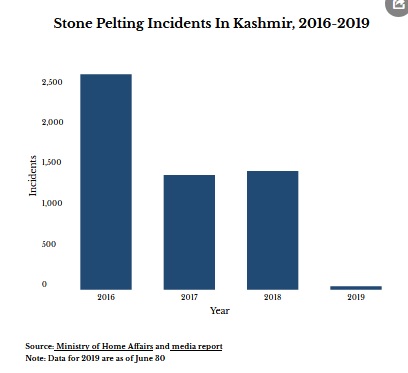
Only 40 incidents of stone-pelting have been reported in the first six months of 2019 against 1,458 incidents in 2018 and 2,653 in 2016, a media report on July 14, 2019 stated, quoting figures from the union home ministry.
Solutions Box
Crowd control should not end up maiming and killing people. I think alternative methods of crowd control such as water cannons, baton charges and rubber bullets should be deployed to avoid injuries and casualties among protesters and prevent collateral damage.
Parvaiz Koul, Professor and Head of Department of Internal & Pulmonary Medicine, Sher-i-Kashmir Institute of Medical Sciences, Srinagar.
The government should not treat the stone-throwing mobs and innocent citizens alike. Tear gas and pepper gas don’t distinguish between innocent people and those involved in rioting. The government should either stop using such methods or provide protection to innocent citizens.
S Balamurugan, Principal Investigator, Chennai Chest Research Institute.
(Parvaiz is a Srinagar-based journalist.)
Courtesy: India Spend