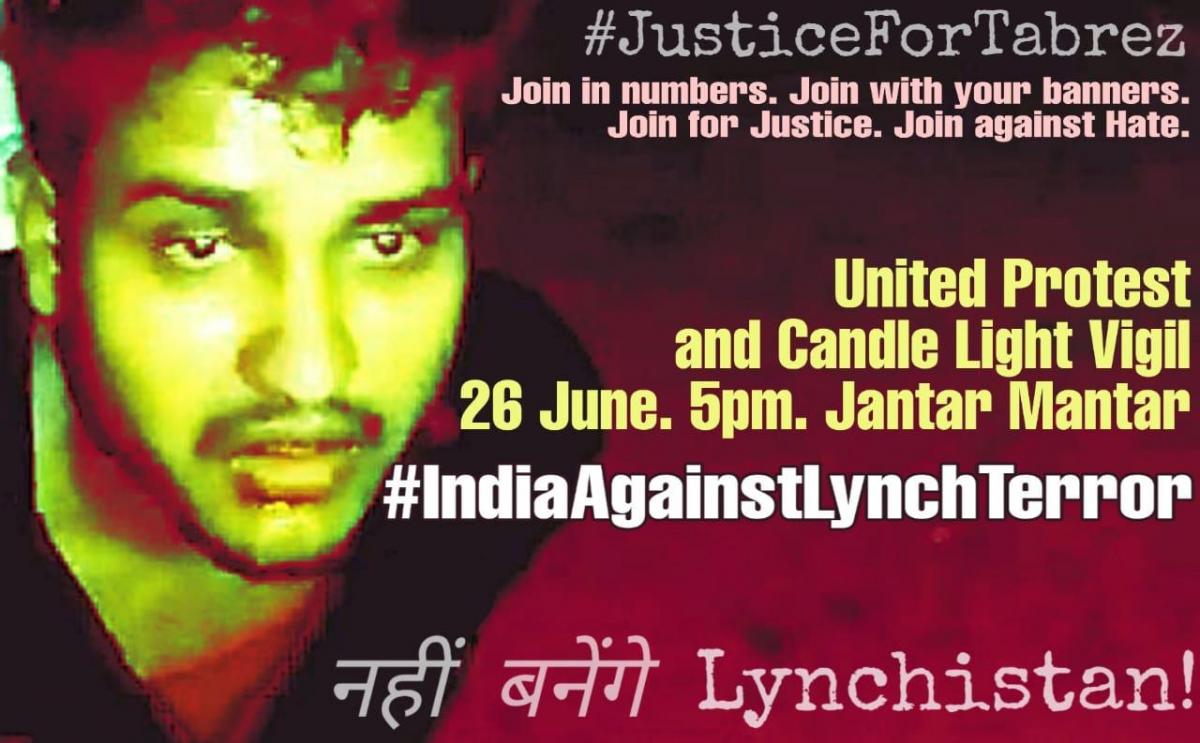
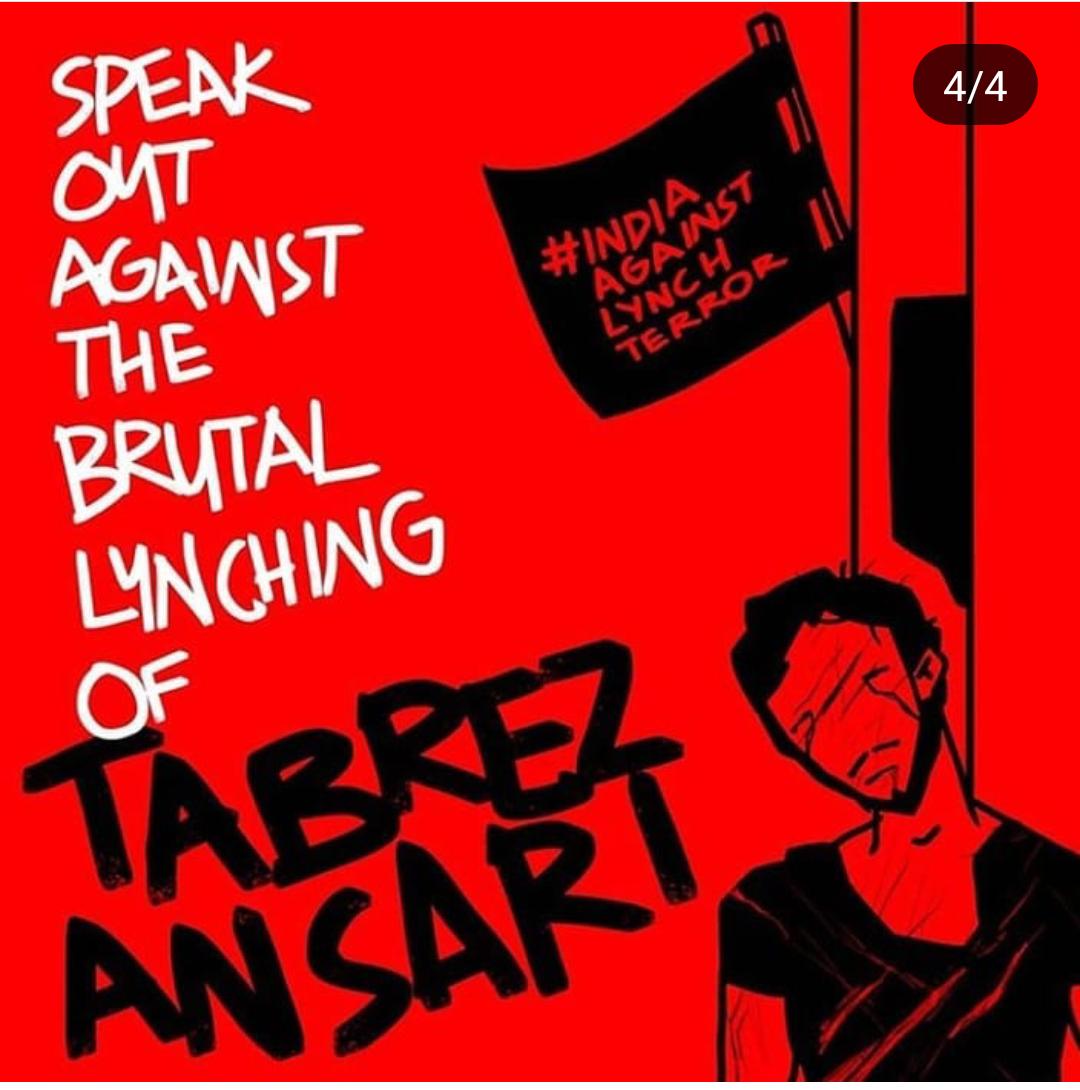
Protests will be organised in different parts of the country on the brutal mob lynching of the 24 year old Muslim youth, Tabrez Ansari. Tabrez, a welder by profession, had come to Jharkhand to celebrate Eid with his family. Ironically, he was lynched on the same day as Prime Minister Narendra Modi was visiting Jharkhand’s capital Ranchi for a Yoga day event.
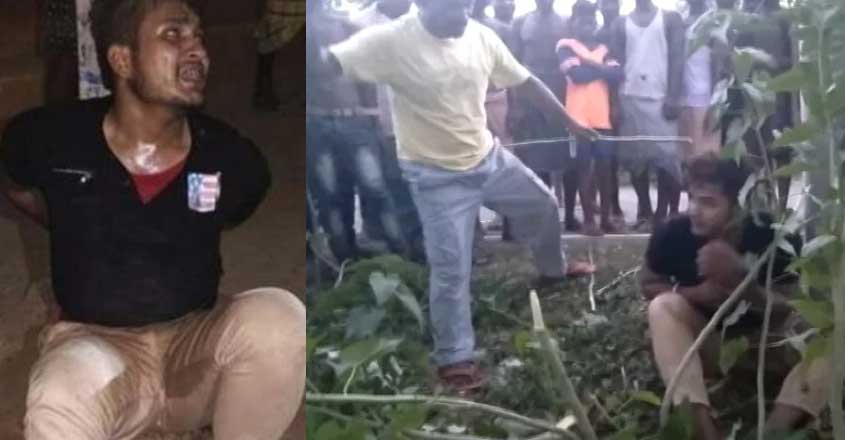
A mob got hold of Tabrez alias Sonu as he was going home, Saraikela-Kharaswan on a motorcycle. He was attacked merely at a distance of five kilometres from his residence. The attackers tied him to an electric pole. The video of the incident showed that when the mob asked his name and he replied, “Sonu”, they abused him and demanded to know his actual name. Terrified, he replied saying “Tabrez”. Immediately, the mob began chanting “Jai Sri Ram”, pounced on him, and beat him up, brutally. They tried to force him to chant “Jai Sri Ram”. Later, they left him, badly injured. When he was brought to hospital, Tabrez succumbed to his injuries during treatment.
His brutal killing has left social media users in a state of total shock and dismay.
Reacting on the incident, youth leader Umar Khalid updated the following as his Facebook status, “Can we organise simultaneous protests across the country this Wednesday against the brutal lynching of Tabrez Ansari and the continuing incidents of mob violence? Any platform, any banner, any organisation, any place…but just one demand #JusticeForTabrez and an end to mob violence? Citizens can take the initiative in their galis, mohallas, anywhere. Dont just like the post, give your opinion in the comments section and take responsibility in your respective areas.”
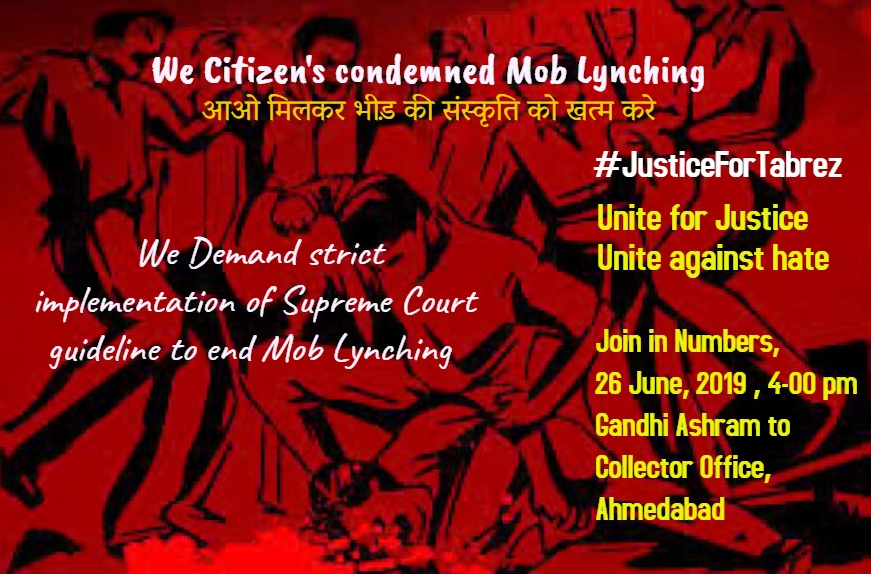
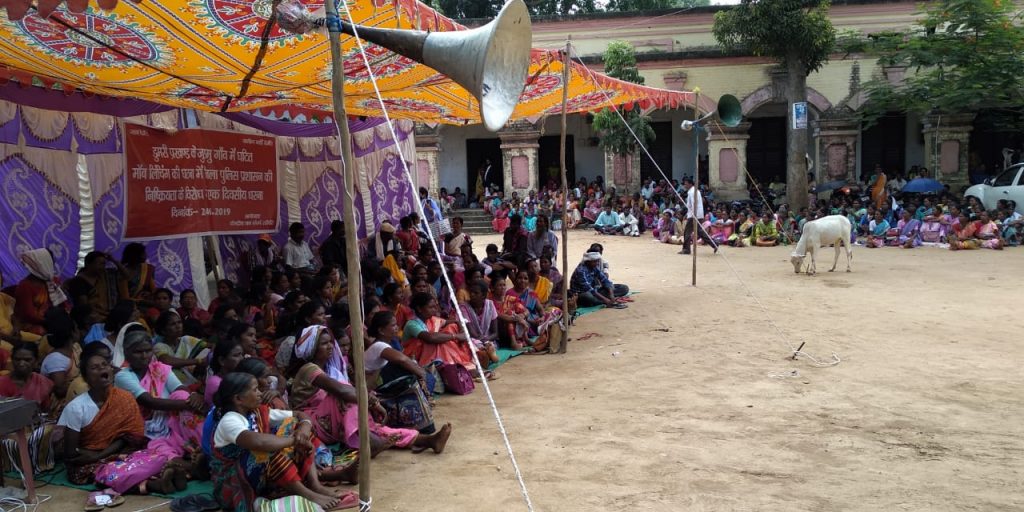
Now, many organisations from different parts of the country have responded to this incident of mob lynching. Protests are being organised in Delhi, Varanasi, Ahmedabad and other areas.
Ansari’s recently wed wife, Shaista Parveen approached the police with the videos of the incident, which have now spread on social media and generated shock and condemnation.
As per the latest reports, 11 men have been arrested. Two police officers have also been suspended. A Special Investigation Team (SIT) is supposed to submit a report to the Home Secretary and the Chief Secretary by Wednesday.
Tabrez’s family alleged that despite several appeals, police didn’t arrange for proper treatment and family members weren’t allowed to meet him. The family also alleges that he died long before he was taken to a hospital. The family has demanded action against all concerned, including the police and the doctor; the latter has yet to be questioned.
Due to widespread rage across the country, the police have admitted to lapses and formed the SIT. Two officers, Chandramohan Oraon and Bipin Bihari, have been suspended for “not reporting the seriousness of the issue to the higher authorities” and “register a case of lynching on the very same day”, a government statement said.
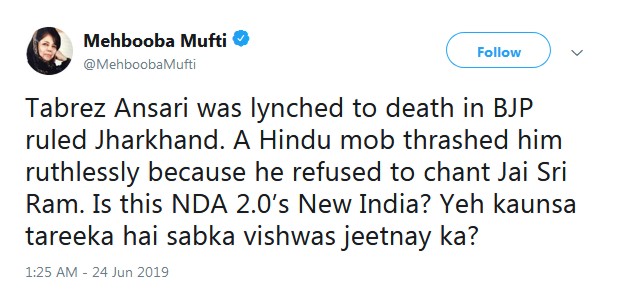
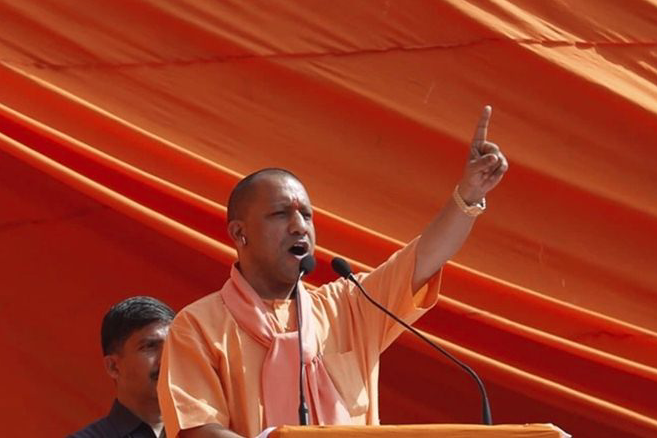
Minister CP Singh in Jharkhand said that it was “wrong to politicise mob killings.” He added that the “trend” these days, was to “associate such incidents with the BJP, RSS, VHP and Bajrang Dal. It is a time of ‘cut and paste’ – who fits what words where is difficult to say”. Former Jammu and Kashmir Chief Minister Mehbooba Mufti tweeted:
“Tabrez Ansari was lynched to death in BJP ruled Jharkhand. A Hindu mob thrashed him ruthlessly because he refused to chant Jai Sri Ram. Is this NDA 2.0’s New India? Yeh kaunsa tareeka hai sabka vishwas jeetnay ka?”
Hyderabad politician Asaduddin Owaisi tweeted: “This is the pattern with almost all lynchings. First, a Muslim is murdered by cow lovers. Then the most ridiculous excuses begin: a ‘suspicion’ of beef possession, theft, smuggling & love jihad. So much for sabka vishwas when we can be killed over mere ‘suspicions’.”
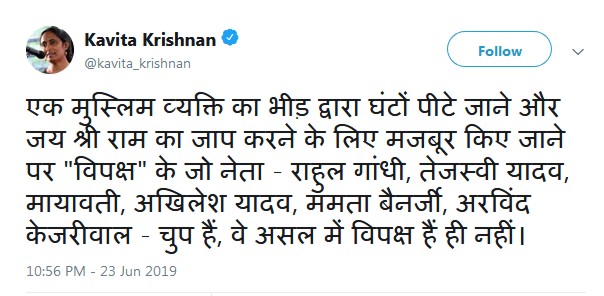
Most others from mainstream parties such as Congress, SP and BSP have not spoken on the issue. On this, AIPWA secretary and CPI (ML) polit bureau member Kavita Krishnan said,
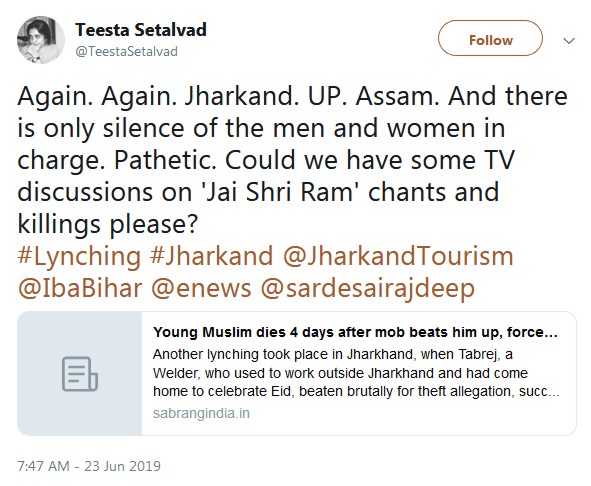
Noted human rights activist Teesta Setalvad said,
Data from the fact-checking website FactChecker.in shows that the attack on Tabrez Ansari was the eleventh such incident of hate crime this year. In 59 per cent of the cases, the victims have been Muslims and 28 per cent of the incidents have been over cow-related issues.
Since 2016, as many as 13 people have been killed in various incident of mob lynching In Jharkhand. On April 10, a tribal man Prakash Lakra was beaten to death allegedly for skinning dead Ox.
Rumours on whatsapp of alleged incidents of beef eating and cow smuggling spread like wildfire leading to many such deaths. Victims’ families dispute such allegations. Since 2015, a large number of lynching cases have taken place in BJP ruled state particularly in Uttar Pradesh, Rajasthan, Haryana and Jharkhand.
In another horrific incident in March 2016, cow vigilantes had abducted cattle trader Majloom Ansari and schoolboy Imtiaz Khan in Latehar district while they were on their way to a cattle fair in a neighbouring district. They lynched the two and hanged them from a tree. In December 2018, a local court sentenced eight convicts to life for their involvement in the incident.
To stop lynching cases, Supreme Court has also issued orders, but the incidents continue. Nodal officers are required to be appointed by state governments to prevent this new form of violence.
In what could be a major relief for the renowned Indian documentary filmmaker Anand Patwardhan and the upholding of the freedom of speech and expression by an independent Judiciary, the Kerala High Court (HC) today permitted the screening of Patwardhan’s documentary ‘Reason/Vivek’ in the ongoing International Documentary and Short Film Festival at Thiruvananthapuram on the grounds that “apprehension that the documentary might affect law and order was not a valid reason to withhold sanction.”
Image Courtesy:patwardhan.com
The two writ petitioners, Kerala State Chalachitra Academy, the organizer of the festival and the filmmaker Patwardhan, approached the HC after the Ministry of Information and Broadcasting (I&B) rejected its application seeking permission for the screening of the documentary on the grounds that “the theme of the documentary was sensitive in nature and may have law and order ramifications.”
The four-hour documentary is based on the rise of religious fundamentalism in India in the backdrop of murder of rationalists such as Narendra Dabholkar, Govind Pansare, M.M.Kalburgi, Gauri Lankesh among others. The film begins by looking into the murders these rationalists and the role of the Sanatan Sanstha in spreading right-wing extremist violence. It then goes on to Dalit protests and the rise of Dalit leaders in recent years, and ends in Dadri, Mohammad Akhlaq’s village. The film has won a number of awards across the world, including the award for the Best Feature-Length Documentary at the 31st International Documentary Film Festival, Amsterdam.
According to section 9 of the Cinematograph Act, 1952, the films which are not certified by the Central Board of Film Certification requires special exemption from the Central government for public exhibition. Thus, the organizing academy had on May 27 submitted an application to the I&B Ministry seeking exemption for 161 documentaries, that were to be screened in the festival. Notably, on June 17 the Ministry sent back a list of documentaries which received exemption but Patwardhan’s film was absent from that list. After repeated attempts of finding out the reason for rejection, the Ministry finally responded yesterday stating that the film’s subject is sensitive which may cause law and order problems.
Consequently, the petitioners filed a writ petition under Article 226 of the Constitution in the HC today stating that the “mere apprehension of law and order breakdown is not a valid ground to suppress free speech.” The matter was heard by a single judge bench comprising of Justice Shaji P. Chaly.
The petitioners, represented by Advocate Sudhi Vasudevan and Jose Jones Joseph, cited the 2017 judgement of the Kerala HC which had quashed the Centre’s denial of sanction to screen the documentaries ‘March, March, March’ and ‘The Unbearable Lightness of Being’ in the same festival on the grounds that “freedom of speech and expression guaranteed by the Constitution includes the right to express one’s political views as well. Film is a legitimate and effective medium..” The two films were based on protests in JNU and suicide of Rohit Vemula respectively.
Granting the screening permission, Justice Chaly stated that the “apprehension that the documentary might affect law and order was not a valid reason to withhold sanction. Even as per the guidelines framed by the I&B Ministry in this regard, the screening of the documentary is permissible.” However, the Judge clearly stated that the documentary should not be screened elsewhere except in the festival.
Festival director Kamal told the New Indian Express that since the film is already available on YouTube and has been viewed many times, it does not make sense for the Centre to deny permission straight off the bat.
Anand Patwardhan is known for his socio-political, human rights-oriented films and has been a winner of several national and international awards. His films have sparked multiple controversies in the past as well, due to their strong and sometimes unpalatable messages (for the government). His films like ‘Ram ke Naam’ (on Babri Masjid demolition), ‘Father, Sun and Holy War’ (on post Babri riots), ‘A Narmada Diary’ etc led to protests from radical elements.
The documentary and short film festival is being held from June 21 to June 26.
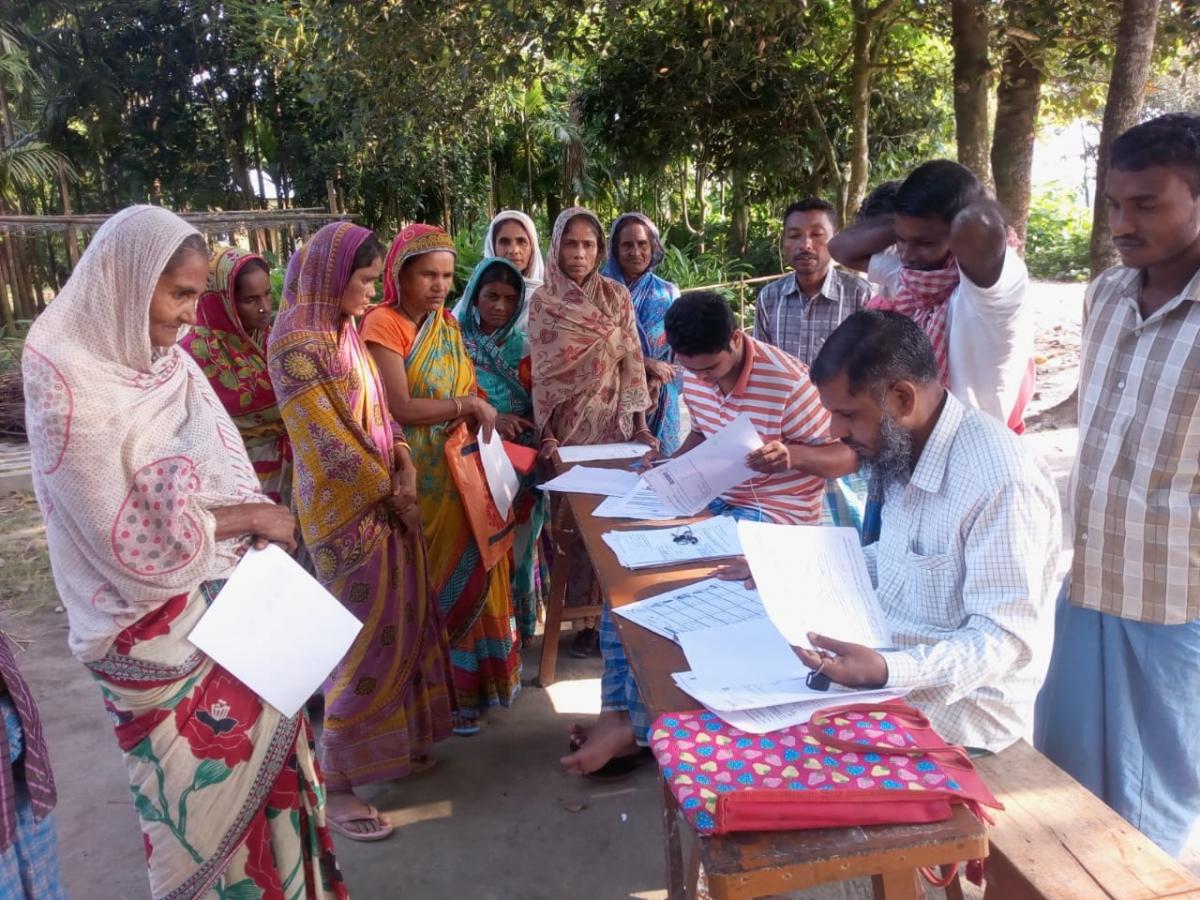
In a fresh body blow to people battling citizenship related anxiety in Assam, the National Register of Citizens (NRC) authority is all set to release an additional list of people who have not been included in the final NRC. While the final NRC will be published by July 31, 2019, this additional list of exclusions will be published on June 26. The NRC authority has now released Standard Operating Procedure (SOP) for how this additional list is to be made public.
Image Courtsy: cjp.org.in
In a circular addressed to all District Registrars of Citizen Registration (DRCR), NRC State Coordinator Prateek Hajela lays down 20 guidelines as to how to go about displaying the list at various Nagrik Seva Kendras (NSK) and how to deal with the public in wake of the list being released. Bearing in mind that this new list could lead to emotional and possibly violent reactions, the guidelines say, “The DRCR will be required to put in place adequate security arrangements for handling the public.”
Also given how the hearings for Claims and Objections process are still underway and there could be confusion about a possible overlap, the circular clarifies and directs, “Local publicity needs to be done to the effect that results of Claims and Objections are not included in the Additional List,” and that, “Those persons whose names are included in the Additional List to be informed that they can submit Claims.”
But this is only going to add to people’s troubles with this last minute surprise being sprung on them, not to mention the forthcoming hassles of filing Claims and appearing for hearings. The SOPs state that every person whose name is on the list is to be informed via a Letter of Information (LOI) about the reasons for the inclusion of their names in the Additional List. The LOI should also state the details of the Disposing Officer before whom the Claim has to be filed and hearing held including the date, time and venue.
But in what can be considered outright harassment, the SOPs state, “Local publicity needs to be done that while attending the hearing for disposal of their Claim, the Claimants have to bring with them all the descendants of the Legacy Person.” This means if you are appearing for a hearing, you must take all your siblings for it too. This is not only harassment, but also makes the other descendants an easy mark given how if the Claimant is not successful, the citizenship of siblings and family members also becomes suspect. This way all of them will be present together at one spot.
All eyes are now on the Additional List that will be published and displayed from 10 AM onwards on June 26, 2019. The circular detailing SOPs may be viewed here:
Tabrej Ansari, a young man of 24 years, accused of theft was killed by a blood thirsty mob in Jharkhand last week. It is deeply painful how as a society this feeling of “us” versus them has penetrated among us. The system is encouraging this by refusing to act..
Whether Tabrez had stolen the motorcycle or not is immaterial here. No one, save the state under a due process of law, has the authority to kill him. When mobs dispense justice, then the society starts sliding towards anarchy, chaos and lawlessness. In this condition, we will not need an enemy to defeat us, we will be our own enemy.
We have an enlightened and written Constitution in the country, which should be followed by everyone. Even the Prime Minister said in his speech in Parliament, where he bowed before the Constitution, that it should be considered as the ultimate authority in India. However, the political class does not want to educate the people about the need to follow the Constitution and the law because a majority of the lawmakers have criminal cases against them. This lawlessness and brazen disregard for constitutional provisions has happened because these lawmakers have encouraged this anarchy and chaos to carry out their hate agenda in order to reap the rich harvest of political gains.
Just a few days back, the 2018 US Report on International Religious Freedom talked about violence against minorities in India. The External Affairs Ministry rejected it, saying that India remains a ‘secular’ country. However, the facts state otherwise. Tabrez is the 18th case of mob lynching in Jharkhand in the last three years. And yet, there is no hue and cry, no political protest, not a single word from the IAS or other civil services association. The parties which espouse the cause of the Dalits and OBCs under different names are also busy playing the blame games. It is, indeed, sad and disappointing that when they needed to unite, they are openly displaying opportunism of the worst kind instead of taking political action against such things.
One does not need to be an extraordinary thinker or analyst to understand that India is fast becoming the playground for the dominant castes, who are using the bogey of nationalism to promote their economic interests, aided by a deeply entrenched control of the political power structure. This is being strengthened daily with the direct entry of Savarna elite at the higher levels of our civil services.
The lynching of Muslims or Dalits or Adivasis and the direct entry of individuals into civil services at higher level has one thing is common, namely that the Savarna hegemony is now complete. In politics, it is being played in the name of nationalism and violence against Muslims while in the power structure, it is strengthened through ensuring that reservation becomes redundant. In such a scenario, then, why should the savarna parties and their association oppose these changes and mob lynching? The irony and tragedy is those who claim that their rights are being threatened and Muslims, adivasis are their natural allies, are also quiet. Why is there no political protest?
Tabrez’s killing demonstrates how vulnerable Muslims have become in India under the fake propaganda.Tabrez fell to hate crime and itis time that we bring a strong law against Hate Crime. As citizens, we need to protect all and condemn all forms of violence. We must allow our institutions to work free from political interference, ask them to act impartially and remain faithful to Constitution of India. Just chest thumping and comparisons with Pakistan will not take us anywhere. Indian society, political leaders and socialthinkers need to come out of this Pakistan phobia and think big.
India is a big nation, with a great history of democratic movement and is a working example of people of so many diverse faithsliving together peacefully. We need to retain our India, the India as our constitutional forefathers had visualised. We need an inclusive India where no Tabrez is punished without getting full opportunity to defend himself in a due court of law.
We need an India where laws and policies are not selectively used and stated to humiliate a community and get political benefit. We also need to send strong guidelines to electronic media how to debate and report such things. Many paid trolls are vitiating communal harmony by regularly spewing venom against the minorities in general and Muslims in particular. This must stop. You cannot abuse and doubt our fellow citizens just because they might not have not voted to your leaders or because they donot belong to the faith you practice. All citizens, irrespective of their castes and religious identities, are Indian first and need protection as Indians. I repeat this because I think the message must go to all. Those who violate the law of the land must be made accountable and should be brought before the law.
Why should a state like Jharkhand, where the presence of Muslims is so minuscule, become the lynching ground for Hindutvamobs.The answer lies in simple. The state goes to polls in the coming months. Modi is not contesting there and the state government is highly unpopular. In a state, which is essentially related to Adivasi assertion and identity, BJP imposed a non Adivasiperson. It is now playing a game to get Adivasi votes because, at the end of the day, it plays identity politics better than any other party. Fear of Muslims and blaming them for all your failures and non-implementation of promises has given rich dividend to the party elsewhere.
I hope that, now with this massive mandate, the Central leadership will act and direct the state government to nottolerate such things. Tabrez needs justice and the coming days will demonstrate the intentions of the government and how serious it is about tackling this issue. The supremacy of the constitution should be restored everywhere. An unambiguous message should be sent to the defaulters and all those who take the law unto their own handsunder whatever pretext, that they will be dealt with seriously. India cannot afford to allow its citizens to be lynched by a mob. The day it becomes a norm, the idea of India will disappear. It is our duty to protect this idea of India, which has ensured the supremacy of the constitution and kept the country united.
Korea (Chhattisgarh), Keonjhar (Odisha): One day in the summer of 2016—Babulal Salaam does not recall the exact date—workers arrived at this Gond tribal’s farm in Thaggaon village of northwestern Chhattisgarh’s Korea district. They began marking boundaries in limestone around his land and pounding in roughly hewn, lemon-yellow cement pillars. “I asked them what were they doing on my land, but they spoke in a language not from here,” Salaam recalled to IndiaSpend. The labourers marked the farmlands of 35-40 households in all, without explanation, according to the village sarpanch, Ashok Kumar.
Conflict simmers between Adivasi communities and the state, as authorities have earmarked more than 4,000 acres of farms and common property lands—an area larger than 3,000 football fields—for a tree plantation project in 16 villages of Korea district in the mineral-rich state of Chhattisgarh. The project will undertake ‘compensatory afforestation’ for the forests that will be cleared for the Parsa coal block in neighbouring Sarguja district, for which the environment ministry gave permission in February 2019.
In the adjoining village of Chhote Salhi, villagers narrated similar accounts. Pannalal Sai recalled the labourers arriving on his land: “’Paudha lagega’ bolay. Kya paudha? Kyon lagega? Rajasthan side ke labour lag rahay thay. Humko aur kuch nahi bataaye. (Trees would be planted, they said. [We asked] what trees, and why? They seemed like workers from Rajasthan. They didn’t tell us anything).”
Salaam, Sai and other villagers eventually gathered that the labourers were marking out their lands on the orders of the district forest department, who planned to fence these in for plantations.
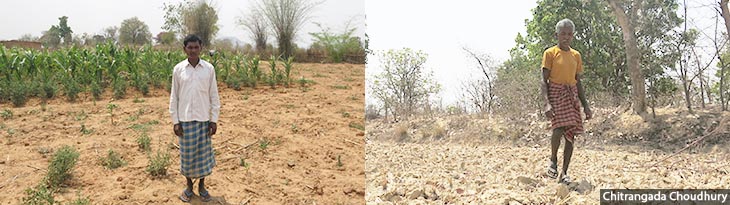
A fierce late-April sun beat down as Sai, a diminutive, soft-spoken man clad in a white shirt and blue-checked lungi, led us out of the family’s cool mud-and-tile home to their land, a rectangular plot of mixed cropping surrounded by a few mahua trees, on which the family grows corn, paddy, sesame, pulses and vegetables through the year. “Land is the basis of our survival,” Sai said, “If the government takes it away for plantations, how will we survive?”
Pannalal Sai and Babulal Salaam are among the scores of villagers who found their lands being forcibly earmarked for compensatory tree plantation in lieu of forests to be stripped for the Parsa coal block. More than 4,000 acres in 16 villages have been earmarked for this plantation project.
In India, projects that necessitate the use of forest areas for non-forest purposes, such as mining and infrastructure projects, are required by law to undertake ‘compensatory afforestation’ (CA) on an equivalent piece of non-forest land, or double the expanse of ‘degraded forest’ land. In the past, forest departments have largely created monoculture plantations of non-indigenous, commercial species such as eucalyptus, acacia and teak under compensatory afforestation projects. The government counts such plantations as forests. The plantation scheme is a component by which the government maintains that it is increasing forests, thus fulfilling a key commitment under the 2015 Paris Climate agreement to counter climate change by creating carbon sinks.
The compensatory afforestation project pitched in Thaggaon, Chhote Salhi and as many as 14 other villages in the area is related to the recent forest ‘clearance’ (permission) awarded by the environment ministry this February to the Parsa coal block in the adjoining Sarguja district’s dense Hasdeo Arand forests, one of India’s finest.
In all, the project is to sweep across more than 4,000 acres, an area larger than 3,000 football fields, in the 16 villages, impacting hundreds of residents–predominantly Adivasis, or indigenous communities, also called scheduled tribes.
Forest and revenue officials have crafted this project despite the fact that most of the lands in question are being used by the village communities for farming, common property usage such as for grazing livestock, gathering mahua, tendu leaf (used to roll thin cigarettes), chaar (chironji, or Cuddapah almond) and other lucrative forest produce. The land also includes parcels that are rocky (“chattan-waali zameen”), where, villagers pointed out, saplings would not survive.
Table: Compensatory Afforestation Plan For Parsa Coal Block
Village
Land Earmarked for Plantations (Acres)
Thaggaon
497
Chhote Salhi
121
Baday Salhi
657
Baday Kalwa
275
Dhanpur
291
Pendri
194
Bodemuda
269
Jilda
237
Majhouli
101
Bari
560
Mugum
639
Chopan
76
Bharda
50
Khadgawa
50
Salka
57.00
Gidmudi
82
Total
4161 acres
Source: Forest clearance documents for the Parsa coal block, Korea District Office
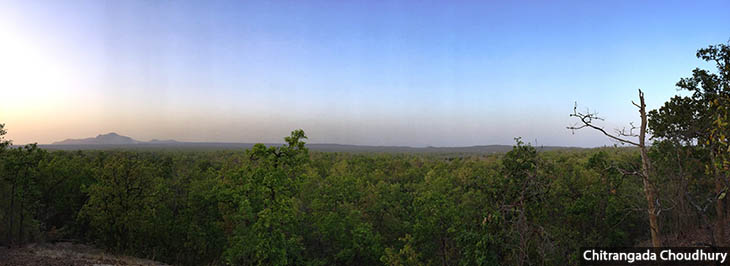
A questionable offset A tale of two ‘forests’: In Sarguja district’s Hasdeo Arand, authorities have awarded preliminary clearance for 1,600 acres of dense forests to be stripped for coal mining. ‘Compensatory afforestation’ for this destruction is to take the form of plantations by the forest department in adjoining Korea district.
In Korea district in Chhattisgarh, a forest department plantation of 22,000 trees forms a desolate expanse. The government counts such plantations as forests, and has made them a key component of its international commitments of increasing forest cover to mitigate climate change.
Compensatory afforestation purportedly offsets the loss of forests cleared for industrial, infrastructure or other non-forest projects.
To the dismay of Adivasi and other forest-dwelling communities, forest rights groups and opposition political parties, the government brushed aside repeated appeals that the new law be made compliant with the land reforms and decentralised forest governance structures laid down by the landmark Forest Rights Act of 2006, and to ensure that communities in whose villages CAF funds would be deployed would have the right of consent.
In the coming weeks, a fund of Rs 56,000 crore ($8 billion) is set to flow under the CAF Act to state governments’ forest departments. This is money accumulated over the years, based on two components paid into the fund by those who are awarded forest clearance permits: the ‘net present value’ (NPV), or a monetary value put by forest departments to the diverted forest, and the cost of raising plantations on alternative land. Such payments are determined by forest officials, and range from Rs 5,00,000-11,00,000 per hectare, depending on the type and condition of the forest being stripped.
“These huge sums of money are nothing to feel happy about,” a senior Indian Forest Service officer told IndiaSpend, requesting anonymity. “I would call it a kind of blood money – since it reflects how much forests we have lost. And you can never recreate what is being destroyed.”
The challenge, however, is not merely of adequately offsetting loss of forest cover. On the ground, the CAF Act will unleash land conflicts and undermine the resource rights and food security of vulnerable rural communities, particularly Adivasis, our reporting on unfolding projects in Korea, Chhattisgarh and Keonjhar, Odisha shows. These two states are among those that will receive the largest proportion of allocations from the CAF.
A search for land
Over 2014-18, the central environment ministry issued permits to clear 1.24 lakh hectares of forests, according to an analysis by the Centre for Science & Environment. On paper, an equivalent amount of area, or more, has been earmarked for compensatory afforestation. Yet, “Land on such a large scale is hardly lying around just like that,” said Madhu Sarin, a development planner specialising in forest policy and rural communities. “It is all under some use or the other.”
In this land-stressed country, how are the forest departments finding thousands of hectares of land to create plantations? Forest and tribal rights grassroots groups argue that the land is being siphoned off from marginal rural communities, more often than not Adivasis, whose very survival depends on such land.
In November 2017, the environment ministry issued a direction asking states to “create landbanks for compensatory afforestation projects for the speedy disposal of forest clearance proposals.” On May 22, 2019, the ministry further said that in states with over 70% forest cover, compensatory afforestation projects against forest permits need not take place in the same state, but can be housed anywhere in the country, using land banks.
Rural communities say they experience the state’s bid to bank land as a land grab, as IndiaSpendreported on September 19, 2017, in the weeks before the environment ministry issued its 2017 directive.
“Land banks are serving to invisible-ise Adivasi communities,” Gladson Dungdung, an Adivasi author who has written extensively on land banks and forest rights, told IndiaSpend. “In Jharkhand, over 20 lakh acres have been listed in land banks, including common lands, sacred groves and forest lands. People have no clue, and they suddenly find their land and forests being fenced away, cutting off life-giving access for them and their livestock.”
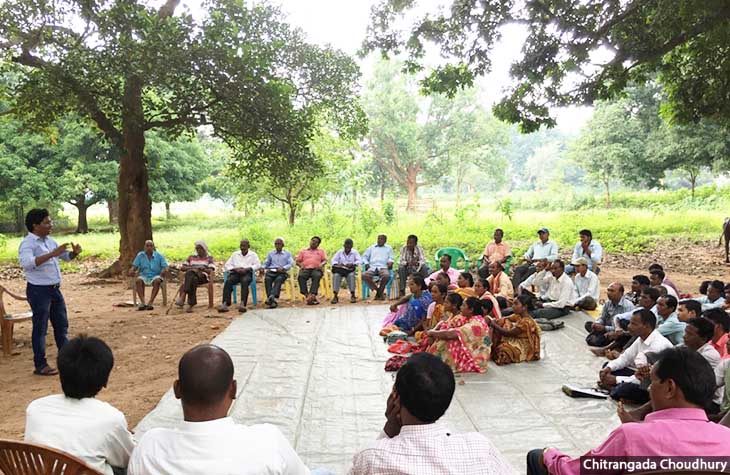
Gladson Dundung (left) during a village meeting on land and forest policies in Khunti, Jharkhand.
The result is “a double displacement”, said Sarin–first for forest clearance, and then for compensatory afforestation.
Parsa coal block’s compensatory afforestation project, which has unfolded over 2016-18, the precise time when the CAF Act and its rules were formed, is a telling example.
“Mahaul garam tha… hungama ho gaya”
In January 2019, the ministry of environment, forests and climate change controversially awarded the Parsa coal block a Stage-I (preliminary or in-principle) forest clearance or permit, setting the ground for stripping 1,600 acres of lush forests for coal mining. The mine has been allotted to the Rajasthan Rajya Vidyut Nigam, a state-owned power utility, which in turn has appointed Adani Enterprises Ltd as mine developer and operator, in a move some commentators have criticised as opaque.
The clearance was awarded because the state government showed that a mandatory condition had been met: more than 4,000 acres of non-forest land had been identified for compensatory afforestation in 16 villages in the adjoining district of Korea. This created the impression that forest loss in one site would be made up by planting trees in another.
According to a February 2017 letter by the Korea district collector, submitted as part of the forest clearance application, 1,684 hectares (or 4161 acres) of land which were “free of encroachment” had been identified in 16 villages of Korea. The department, the letter continued, had “no objection” to the land being given to the forest department for CA plantations in lieu of the forest being destroyed for the Parsa coal block. IndiaSpend travelled to eight out of the 16 villages, and heard a common narrative: villagers said that officials had neither formally informed nor consulted them about the afforestation project. And that they were opposed to such a project, since the lands marked for plantations were privately held or common property land, largely their means of survival and food security.
Despite protests by villagers over 2016-18, officials continued with the plan, which became the basis on which the Parsa coal block eventually secured forest clearance.
A half-an-hour drive from Chhote Salhi is Baday Salhi village, where authorities have marked out 657 acres of land for compensatory afforestation. Residents gathering at sarpanch Ruplata Singh’s home recalled to IndiaSpend how attempts by the forest department to put pillars on farms across the village last year had ended in a skirmish. “Mahaul garam tha.. hungama ho gaya (Things heatened up and it turned into a big fight). We eventually chased them out,” the sarpanch said.
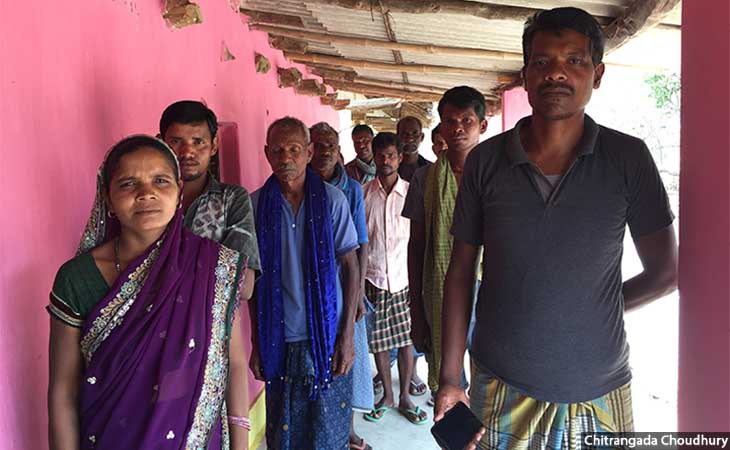
Villagers in Baday Salhi said they chased away labourers and officials who tried to put pillars on their lands for the plantation project.
“They put pillars on our land, right where we do our farming, without asking us, without giving us any information,” said Amar Singh, a villager, “Would we not stop them?” Others in the crowd piped in, “When we asked why here, why not elsewhere, they said they have orders and have to put it where the satellite says so.”
Within days, the villagers uprooted the pillars, threw them away, and resumed farming on the lands. Official documents, land maps and GIS depictions, meanwhile, neatly plot the lands earmarked for compensatory afforestation, giving no indication of these ground contests, or how the land is being used currently.
Korea is a ‘scheduled area’ i.e. a tribal-majority area enjoying constitutional protections, and special laws such as the Panchayats (Extension to Scheduled Areas) Act. The law states that gram sabhas (village assemblies) have the power to manage their natural resources, and must be consulted on any plans regarding these. However, in every village IndiaSpend visited, residents reported that officials had not presented any details of the compensatory afforestation proposal to the gram sabhas for their approval or inputs. “Sab manmani se kiya (The officials did it arbitrarily),” said Thaggaon sarpanch Ashok Kumar of the plantation project in his village.
In Bodemuda and Dhanpur villages, where the forest department has marked out 558 acres of land for compensatory afforestation, sarpanch Shiv Kumar Singh said villagers had a vague idea of what was going on. “The local forester and patwari [land revenue official] came and told me that trees would be planted on our village’s lands as bharpai (compensation) for the forest that would be destroyed by Adani’s Parsa mine in Hasdeo [Arand] on Sarguja side.”
Kumar said he told the foresters that there was very little fallow land available in the village. Of what was fallow, most of it was rocky, and would not be suitable for plantations. “I told the officials that tree planting is a good thing. But it should happen after proper meetings with our gram sabha, so that we as a village can tell them where appropriate land is available, and what species of trees would be suitable,” he said.
Echoing accounts in multiple villages, Shiv Kumar Singh, sarpanch of Dhanpur, says officials have earmarked agricultural land of villagers for compensatory plantations for the Parsa coal block without informing residents.
In Gidmudi village, former sarpanch and current zila panchayat member Gurujlal Neti said the local patwari and forest beat guard had come to him saying they wanted specific lands in the village for afforestation. “I told them that villagers have been cultivating these lands since a long time, and without their permission, how could authorities take it for plantations?” Neti said, “They needed to approach the villagers formally.” The officials left, Neti said, and he thought the matter had ended.
Neti and other villagers were unaware that despite their opposition, officials had gone ahead with the compensatory afforestation plans. In Bari, sarpanch Jaipal Singh similarly said the local forester, Nirmal Netam, had come to him and said trees would be planted in the village under a project linked to the Parsa coal block. “He gave me some documents in English, and asked me to sign. I did so, trusting him,” Singh said, adding that he thought the trees would make the village greener. It was only subsequently, when labourers came and began digging pillars on villagers’ farms, that the exact plan revealed itself. “Villagers started to oppose it and threw all the pillars away,” Singh said.
On paper, however, district officials have finalised 560 acres of land in Bari for compensatory afforestation. Singh was unaware that this had happened despite the opposition. “When officials tell us something, we tend to believe them in good faith,” he said. “But actually they should be coming and doing proper meetings with the gram sabha, and sharing all details of any proposal with us formally, and in a language we can understand.”
The plan was unlikely to be implemented smoothly unless the villagers cooperated, Singh said: “They [the officials] did not involve us when they should have, and villagers will hardly give up their agricultural land like this for plantations. Jamke virodh hoga (There will be strong opposition)!” In fact, according to Dhanpur sarpanch Singh, residents were so troubled by the pillars on their lands that sarpanches from several of the 16 villages got together to meet the then legislator, Shyam Bihari Jaiswal, in December 2016 to lodge a protest. This meeting was covered by the local media. Yet, over 2017-18, ignoring what the local communities were saying, the forest clearance file for the Parsa coal block kept moving ahead in the state government and ministry offices in Korea, Raipur and Delhi.
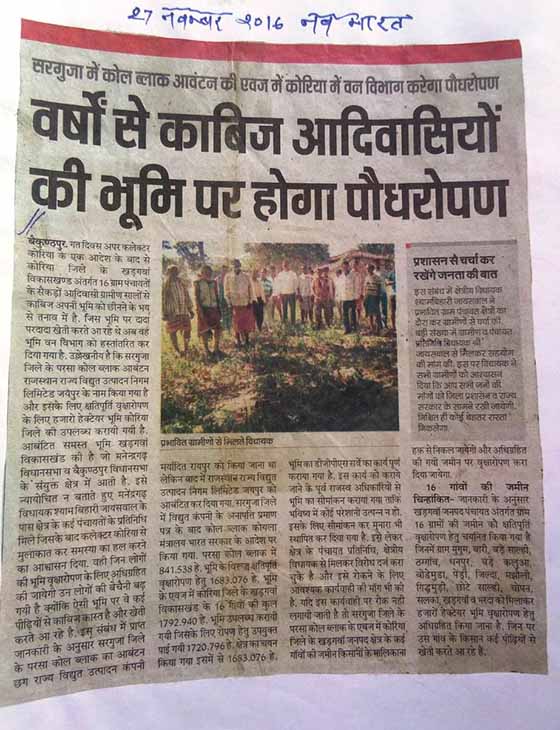
A December 2016 news report in a local Hindi newspaper reports the villagers’ meeting with the local legislator Shyam Bihari Jaiswal to protest against the compensatory afforestation project on their land.
Renewing a historic injustice
The FRA was enacted to redress a “historical injustice”–to recognise through individual and community titles the customary rights of communities that have traditionally depended on forestlands, but whose ties were denied, and even criminalised, by colonial and post-colonial policies. The CAF Act’s letter and design put it in direct conflict with the Forest Rights Act, activists say, shutting out communities and undermining democracy all over again.
Although enacted more than a decade ago, the FRA remains under-implemented to the extent that a 2017 assessment by the US-based Rights & Resources Initiative showed that just 3% of the minimum potential community forest rights area had been settled through the award of formal titles. Officials have rejected more than 50% of individual and community forest rights (CFR) claims filed by Adivasis and other forest-dwellers. Activists have repeatedly opposed these rejections and even challenged them in court.
“Given that a majority of the land which comes under the Forest Rights Act is yet to be settled, a legislation like CAF poses a serious threat to the pending recognition of people’s rights,” said Tushar Dash, a Bhubaneshwar-based researcher who worked on the RRI study.
The Parsa case demonstrates this. For example, according to the February 2017 ‘no-objection’ letter from the Korea district collector, the over 4,000 acres of land being earmarked for Parsa’s compensatory afforestation project are ‘rajasva van bhumi–chhote baday jhaad ka jungle’, or ‘revenue forest lands, with small and big trees’.
The contradictory nomenclature—i.e., land categorised simultaneously as ‘revenue’ (or under the jurisdiction of the revenue department) as well as ‘forest’ (under the ambit of the forest department)—reflects a deeper mess in the land records of the state revenue and forest departments, as well as outdated land survey settlements. However, the Forest Rights Act applies to all lands categorised as ‘rajasva van bhumi’, officials in Chhattisgarh told IndiaSpend, and communities in possession of such lands and drawing their livelihood from it were entitled to FRA deeds.
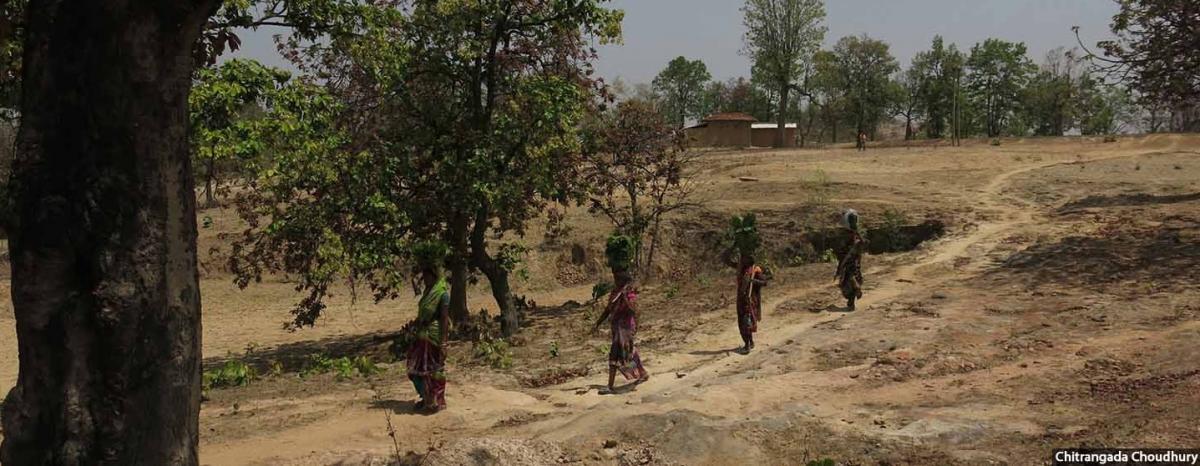
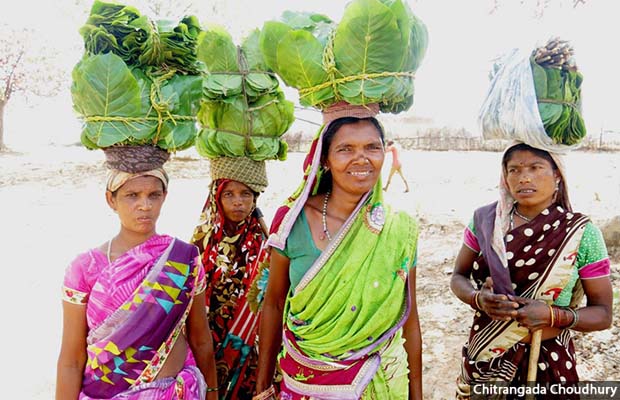
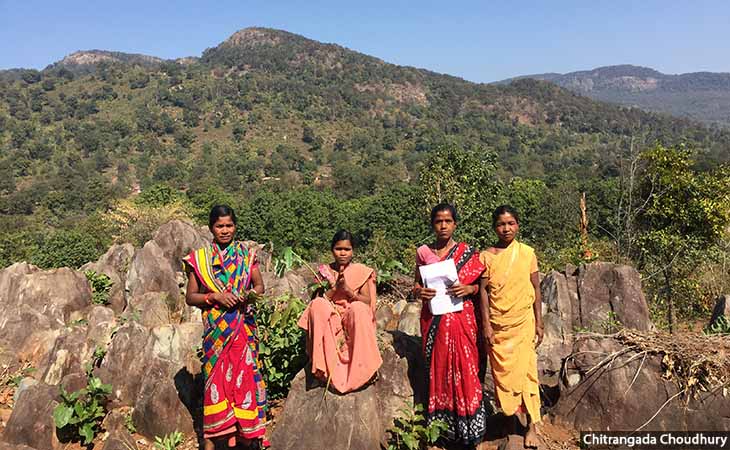
Residents of Thaggaon village, Samudribai Salaam, Sonmati Orkera, Sampatiya Salaam and Indukunwar Orkera (left to right), return home after gathering forest produce from the village’s forested commons. While Thaggaon is yet to get recognition under the Forest Rights Act for such community forest rights, officials have earmarked 500 acres of land in the village for compensatory plantations.
In all of the eight villages IndiaSpend visited, villagers decried the poor implementation of the Forest Rights Act, and the daunting process of filing claims. “We submit our claims, but it goes up [to officials] and they just sit on it,” said Singh, the Dhanpur sarpanch. “Most of the claims filed are pending or have got rejected.”
In Gidmudi, the zila panchayat member Neti echoed this, saying, “Most villagers are still not fully aware of their rights, and if they are not accompanied by someone assertive, patwaris and foresters find it easy to brush them away, saying this land belongs to the government, and they cannot get FRA titles.” In Thaggaon village, Rameshwar Das, a member of the village Forest Rights Committee, said, “I help so many Adivasi villagers fill up the forms and provide the required documentation. Their claims get rejected on grounds that some document or the other is missing.”
None of the 16 villages have received community forest rights or titles to the forested commons in their villages.
In contrast to the villagers’ accounts, the official documents earmarking land in the 16 villages for compensatory afforestation say there are no pending FRA claims on the land in question. The document notes that FRA titles had been given on 44 acres in the earmarked land–on average, under three acres in each village. By contrast, more than 4,000 acres have been allotted for compensatory afforestation to facilitate the clearance for the mine.
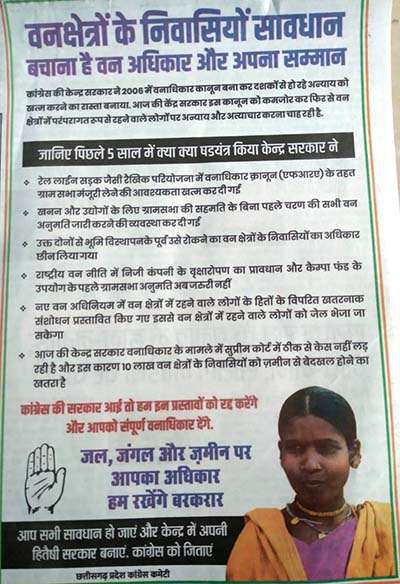
The Congress party was elected to power in Chhattisgarh in December 2018 with a key campaign promise of implementing the Forest Rights Act. This is likely to intensify the CAF-FRA land contests. In the wake of a controversial February 2018 order of the Supreme Court to evict forest dwellers, which is currently on hold, Congress president Rahul Gandhi asked Chief Minister Bhupesh Baghel to ensure the law would be properly implemented. He wrote that rights to land, water and forests were integral to the right to life for millions of Adivasis and other forest-dwellers.
Congress president Rahul Gandhi’s letter in February 2019 to Chhattisgarh Chief Minister Bhupesh Baghel seeking implementation of the FRA.
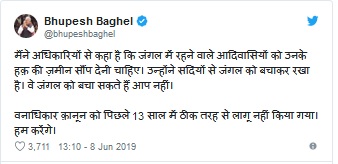
Days ago, Baghel tweeted that he had asked forest officials to ensure that Adivasis and forest-dwellers receive their rights to forestlands under FRA. “Such communities can better protect forests, not forest departments,” Baghel wrote, adding, “The Forest Rights Act has not been implemented properly in the last 13 years. We will do it.”
In recent months, the Chhattisgarh government has embarked on a state-wide review of the FRA’s implementation. In Korea district, for example, official figures show that as many as 11,691 or 44% of the forest rights claims have been rejected. Where titles have been given, they have been for a miniscule area–the average size of the holding being 1.1 acres.
When IndiaSpend met Korea’s then district collector Vilas Sandeepan Bhoskar in end-April 2019, he said land for compensatory afforestation for the Parsa mine had been allotted in 2017, well before he had taken charge as collector. He confirmed, however, that the forest department had written to him a few days back asking for a transfer of the land. He asked us to check back with him after he had studied the case.
The high rate of FRA claims rejection was worrying, Bhoskar said, adding that the administration was reviewing all rejected claims and helping vulnerable communities file claims to ensure that no one was deprived of their rights. “Often claims get rejected on technical grounds, or the absence of some document or proof, or because people are not aware,” he said. “But Adivasis and forest-dwellers have been on these lands since ages. We know that. The forest department knows that. Such people are entitled to getting FRA pattas (titles).”
A Congress party advertisement during the recent elections promised forest rights for Adivasi and forest-dweller communities.
When IndiaSpend spoke to him a few days later, Bhoskar said he had written to the state revenue department on May 9, 2019, to seek guidance as he had “limited power as a collector to transfer the land” earmarked for plantations to the forest department. “This is a very large area of land… more than 4,000 acres. If this goes to the forest department, as per the conditions in the forest clearance, its status is to change to ‘Reserve Forest’ or ‘Protected Forest’,” said Bhoskar. He was referring to the standard conditions in forest clearance (permit) documents that the ownership and control of lands earmarked for compensatory afforestation projects must be transferred to the forest department, and their status changed to ‘reserve forests’ or ‘protected forests’.
“Village boundaries, the gram panchayat area… all that will change. FRA claims might also be pending on it since we are reviewing all rejected claims. Keeping all these things in mind, I have written for guidance,” Bhoskar said.
In early June, after just four months in the post, Bhoskar was transferred out of the district.
A conflict foretold
The land tussles playing out in cases such as Parsa were foreshadowed through 2015-18, in public and parliamentary debates before the CAF bill was approved into law in July 2016, as well as during the subsequent drafting of the rules by which the legislation will be implemented.
Adivasi groups expressed fears to Prime Minister Narendra Modi about the impact of the draft law. Voices within the government raised these issues, too.
For example, documents accessed by IndiaSpend under the Right to Information Act show that the environment ministry received repeated letters from the ministry of tribal affairs asking it to ensure that the new CAF law should not undermine the Forest Rights Act, and that it should provide a just deal to forest-dwelling communities.
In March 2015, in comments sent to the environment ministry on its draft CAF bill, the tribal affairs ministry had pointed out that the bill made no mention of the Forest Rights Act and gram sabha consent for afforestation and utilisation of funds, and showed no commitment to spending CAF funds to compensate those affected by forest diversions. These funds, the tribal affairs ministry said, should be shared with the affected gram sabhas. And at least 50% of the net present value (the monetary value of the forest destroyed as determined by the forest department) component of CAF funds should be spent on Adivasi and forest-dwelling communities. A big problem, the tribal affairs ministry added, was “the non availability of land” to carry out compensatory afforestation on.
However, the bill was passed without taking any of the above concerns into account. In parliament, the then environment minister Anil Dave brushed off criticism that the act posed a threat to Adivasi and rural communities’ rights. He instead assured the house that “the CAF rules would provide for adequate consultation with the gram sabha”.
Subsequently, in November 2017, the environment ministry passed the order asking state governments to set up land banks for housing compensatory afforestation projects so that forest clearances could be issued speedily. The tribal affairs ministry again protested the damage this would do to tribal communities, since the categories of land that the environment ministry said be included in the land banks were actually eligible to be settled in favour of communities under the FRA.
Writing to the environment ministry (read the letter here: pdf), it had said the order had been issued “without any consultation with MoTA [the tribal affairs ministry]” and that it “contravened various provisions of the Forest Rights Act.” In particular, the letter said, “the role of the gram sabha has not been given any consideration.”
The tribal affairs ministry asked for the order to be modified to say that land banks should be created only with the informed consent of gram sabhas. It also called for a joint meeting of senior officers of the two ministries “to ensure that the rights of tribals are not affected”.
In the meeting, officials of the tribal affairs ministry reminded their environment ministry colleagues of Dave’s assurance in parliament, the minutes show. The minutes further said, “Officers of the MoEFCC [environment ministry] assured that the commitment still stands. Provision will be made in the CAF rules, which is under preparation, to incorporate the above concern.” (See meeting minutes here: pdf) However, when the CAF Act’s draft rules were issued by the environment ministry in February 2018, they lacked provisions that would make them compliant with the Forest Rights Act, such as taking the informed consent of gram sabhas in planning and executing afforestation projects, and not undertaking such projects by usurping the individual and community land rights provided for under FRA.
“[T]he CAF rules if operationalised in their current form will lead to harassment, atrocities and crimes against tribals and forest dwellers, and hence to litigation, protests and conflict in forest areas,” Shankar Gopalkrishnan, from the Campaign for Survival and Dignity, an umbrella network of grassroots groups working with forest-dwelling communities across India, wrote to the tribal affairs ministry.
Seconding concerns from Gopalkrishnan and others, the tribal affairs ministry asked the environment ministry in March 2018 to make several changes in the draft rules to ensure gram sabha approval for CA projects, and compliance with the Forest Rights Act. However, the rules eventually passed in August 2018, omitted these substantive revisions.
Adivasi rights groups vigorously critiqued the government’s move. In a letter to the then environment minister Harsh Vardhan, former environment minister Jairam Ramesh dubbed the rules “a blatant breach of assurances given by Dave to ensure compliance with the Forest Rights Act and the authority of the Gram Sabhas”. The minister Vardhan however replied that the rules addressed all such concerns (see the correspondence between the two former ministers: pdf). As our reporting shows, this is not the case.
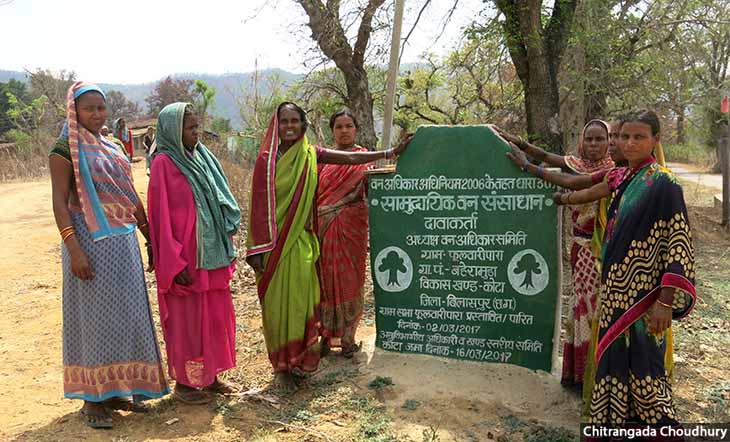
Baiga tribeswomen in Phulwaripara village in Chhattisgarh’s Bilaspur district protested against plantations in their village in October 2018. They spent 17 days in prison after the local forest department booked them, and are currently out on bail.
In mid-May, IndiaSpend met with Deepak Kumar Sinha, a senior environment ministry official and joint chief executive officer of the national CAF Authority to ask him about the upcoming implementation of the act, and the conflicts it could spark. Sinha pushed back on the view that the CAF Act violated tribal rights or facilitated land grab.
He said the rules issued last August “had taken on board all stakeholders.” He pointed to the fact that the rules now provide for forest departments to consult with gram sabhas while including CA projects in their annual working plans – an annual document devised during colonial times, by which forest departments plan their activities for the year.
But as the Parsa case shows, this provision fails to safeguards tribals’ rights–CA schemes get finalised as part of forest clearances without consultation with the affected villagers. “What is required in the CAF Act is a clear provision of going to the gram sabha for its deliberation and consent when a CA proposal is first floated, not after it has been finalised, for some supposed consultation,” Sarin said.
“Officials have been routinely seizing the land of Adivasis for mining and other projects in this region without their informed consent as required by FRA,” a land rights activist, working with Adivasi communities for the past two decades in north Odisha’s mineral-rich Keonjhar district told IndiaSpend, requesting not to be named. “It is a fool’s dream to imagine that the same officials will sit down with villagers in gram sabas, and democratically discuss plantation projects. The colonial attitude that forestlands are the property of the forest department and the sarkaar still thrives.”
However, Sinha argued, finding land for compensatory afforestation is a part of the clearance process, while the CAF Act is primarily a mechanism for what follows–afforestation. “The forest clearance proposal comes to us from the state… [the ministry] has to trust what state governments say when they identify a certain area as suitable for compensatory afforestation,” he told IndiaSpend. Sinha added, “At the end of the day, states have to decide how much land they want under forest cover. If they do not have the land for afforestation, then they should not propose forest clearance projects.”
Yet state government documents for specific CA schemes indicate that authorities often allocate land for plantations even when fully aware that local communities have historically used these lands for their survival.
“We are mountain people…”
Adivasi residents in Benedihi village of Keonjhar, Odisha have been in conflict with the forest department over plantations on their shifting cultivation lands. Odisha is set to receive the largest share of CAF money in the country.
One example of such an allocation is a compensatory afforestation proposal drafted by the Odisha forest department to offset the forest clearance given to the Odisha Mining Corporation’s Daitari Mine in Keonjhar. The proposal notes that the 1,700 acres of land earmarked for compensatory plantations is being used for podu (shifting) cultivation by local tribes, and for grazing livestock. It states that these lands, which it will take over for plantations, will be enclosed with “strong barbed-wire fencing to protect the area from grazing and other biotic interferences.”
The threat of forcible land-use change and disenfranchisement of tribals is particularly acute in Odisha, which is set to receive the largest chunk of compensatory afforestation funds–at more than Rs 6,000 crore ($862 million), it amounts to more than 10% of the national fund, and more than 10 times the forest department’s annual budget. This suggests the extent of the areas over which the government has permitted forests to be stripped.
The greatest number of clearances have been issued in Keonjhar district, a mountainous landscape of dense forests, vast iron-ore deposits, and more than 50 different indigenous communities who depend on local ecosystems for their survival, yet continue to lack formal titles to these ancestral lands.
For example, lands historically under shifting cultivation by Adivasi communities were declared en masse as government lands, a 2005 study by the development planner Madhu Sarin shows. “44% of Orissa’s supposed ‘forest land’ is actually shifting cultivation land used by tribal communities, whose ancestral rights have simply not been recognised,” Sarin’s report said.
Such lands are now being put into land banks, and allotted from there for compensatory afforestation.
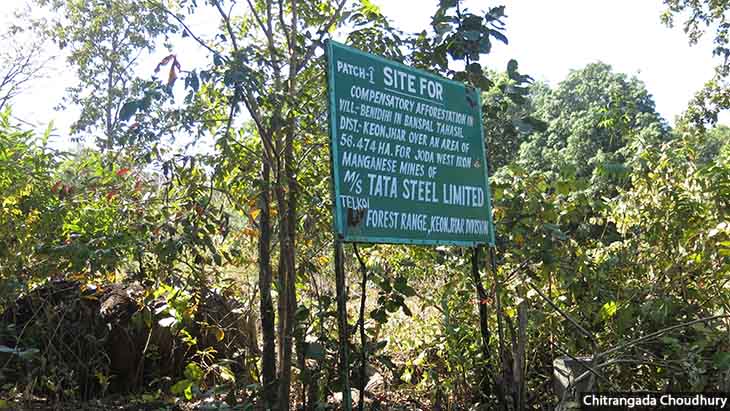
Benedihi, a village of the Bhuiyan tribespeople ensconced in the forested Eastern Ghats of Keonjhar, shows how locals are bearing the brunt of policies taking place in the name of compensatory afforestation.Over 330 acres in the village were included in the district land bank by the state government, and then earmarked in May 2016 to hand over to the forest department as part of a 1,700-acre compensatory afforestation scheme against forestland awarded to Tata Steel Ltd for an iron-ore mine.
A map drawn up by the government marks three plots in Benedihi where the plantations will take place. On the ground, these lands are part of a complex forest ecosystem, and the village is using these lands for a diverse food basket of millets, pulses, greens, tubers and roots through methods of shifting cultivation, and gathering of forest foods. The government has still not settled the CFR claims filed by the village in September 2015.
An undulating forested patch in Benedihi village has been marked out for compensatory afforestation by the forest department to offset forest clearance awarded to a Tata Steel Limited mine.
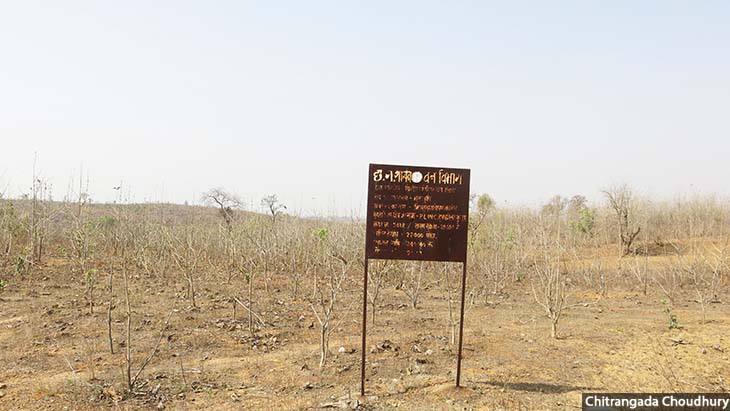
“Forest officials drive up in their jeeps, walk around with their compasses, put these boards in English, and drive away,” said Tulai Danaika, showing us a compensatory afforestation board erected in an undulating forested patch. “They never tell us anything, or ask us what we think. This has happened thrice now.”
The village practises shifting cultivation by communally drawing up the cyclical scheme by which certain lands would remain fallow, and others would be cultivated. “When the forest department comes and unilaterally fences off land in the village for plantations, our scheme gets disrupted,” Lakhman Pradhan, a former sarpanch said.
Villagers show some of the forest produce and the indigenous crops they harvest through shifting cultivation.
“We are mountain people. These are our desi crops grown through podu. These are our forests. These are the resources we live on. If they take it for plantations, we will face hunger,” Hali Dehury, a woman resident, said. Over a half-an-hour walk, a group of women from the village pointed out multiple medicinal plants on the land, and listed the range of crops the village grows through the year.
“Look at our rich forest floor,” said a loquacious Danaika. “Where the forest department makes plantations, you will not see this. Because they plant acacia and sagwan to harvest for its timber, which will go to the towns and cities. But such species are useless to us–they neither give any fruit, nor do birds live in them, nor do monkeys eat them. Our livestock cannot graze around it, even mushrooms do not grow under it!” Women residents of Benedihi narrate the damaging effects of plantations on their agriculture and forest food systems.
“The experience of Keonjhar and [the adjoining] Sundergarh districts is that vast areas of forest land, which have been used for shifting cultivation by marginal communities like the Juangs and the Bhuiyans since generations, and are their way of life, are getting fenced off by the forest department in the name of plantations,” the Keonjhar land rights activist said. Such land grabs are unfolding in multiple Adivasi districts of Odisha including Kandhamal, Rayagada and Kalahandi, with cases of villagers even moving the National Human Rights Commission, Odisha-based forest rights researcher Sanghamitra Dubey told IndiaSpend.
Dash pointed out that the CAF-FRA land conflicts unfolding in Korea, Keonjhar and countless other sites across India need urgent redressal. Earmarking land for compensatory afforestation was akin to forest diversion in that it pushed a change in land use, he argued. “The established legal principle in forest diversions is that it requires the informed consent of the gram sabha, and the prior settlement of all forest rights,” said Dash. “We argued that the CAF Act follow the same legal standards for plantations as forest diversions, but the government completely disregarded this.”
When IndiaSpend drew Sinha’s attention to such conflicts, he said the CAF Act was not cast in stone and could always be reviewed in light of the experience of implementation. He was echoing an assertion by the former minister Dave, who had said during the passage of the Act in 2016, “I assure the House that in case the rules are not found adequate in addressing the issues (of adversely impacting tribal communities), we will revisit them after a lapse of a year or so.”
Meanwhile, the CAF Act is set to get off the ground with thousands of crores of rupees flowing to state forest departments, and more and more lands earmarked for plantations, as the government pushes through a near-universal forest clearance rate.
“The demand for, and clashes over, land will only get more acute, to the detriment of tribals,” Dungdung forecasted.
Ramesh Sharma, national coordinator with the land rights group Ekta Parishad, seconded him. “The two laws are genetically different,” said Sharma. “The CAF [Act] is bureaucracy-centric and the Forest Rights Act is people-centric. It is a recipe for conflict.”
(Choudhury is an independent journalist and researcher, working on issues of indigenous and rural communities, forests and the environment. Email: suarukh@gmail.com)
This story was produced with support from the Pulitzer Centre and also appears here.
development and planning, two important pillars of India’s economic growth and development pathway, were given importance in the ‘New Urban Agenda’ adopted at the Habitat III conference in 2016 to help achieve Sustainable Development Goal (SDG) 11 – safe, inclusive, resilient, and sustainable cities. India’s urban development journey over the last two decades has coincided with increasing marginalisation, exclusion, conflict, and everyday violence in the cities. This violence has gone unnoticed and unanalysed in the urban planning and policy-making world.The economic reforms of 1991 increased urban inequalities, which have worsened through inequitable urban planning. As an instrument of planning, the Master Plan has also deemed many areas of the city to be illegal and, as a result, the Indian state has engineered the “elite capture” of urban spaces. It has also subverted pro-poor provisions of Master Plans.
The poor thus find spaces in the cities through “occupancy urbanism”, a gradual process of informal land occupation under political patronage, while living in fear of the constant threat of eviction. By being deemed “illegal”, the informal urban living spaces created by the poor themselves are denied the provision of basic services.
Governance is not just about what the state does in implementing plans, but also what the state does not do. A good example relates to the provision of basic services. The denial of essential urban services to the poor – because governments lack the political will, capability, or capacity to meet the needs of low-income communities – has also led to the emergence of non-state providers operating as mafias. These informal sector entrepreneurs and middlemen – often with links to government functionaries and the police – use the vulnerability and unmet needs of the poor to manipulate them.
The inability of the State to provide services, employment, and access to the corridors of power for the poor also leads to a failure to provide justice and protection. This failure introduces and sustains a system of violence, coercion, and extortion in urban areas. Such processes emanating from urban governance are not only forms of structural violence, but also cause non-state actors to threaten or use physical violence. The fact that the means of violence are no longer monopolised by the state and that non-state actors either collude or conflict with the state is interlinked to urban planning and governance processes as well.
Local design issues can also create opportunities for perpetrators of violence, conditions for tensions to escalate to violence, or an environment that invokes fear. Paved streets with streetlights and multiple activities throughout the day can create safe environments. In a culture such as India’s, where machismo is valued, everyday conflicts can escalate into violent confrontations. Geographic concentrations of low-income populations can create ghettos where criminals can find shelter.
Ahmedabad is the brand ambassador for the Gujarat Development Model of high growth accompanied by low human development, entrenched communalised polity, and social exclusion. In Ahmedabad, the focus areas and case-study locales were:
conflicts linked to land, housing, and basic services in urban informal peripheral localities, which are also religious (Muslim) ghettos (focusing on one such locality populated by more than 25,000 families)
conflicts linked to land, housing, and basic services in slum resettlement sites constructed using Jawaharlal Nehru National Urban Renewal Mission (JNNURM) funds (focusing on three slum resettlement sites on the urban periphery)
women’s safety in traversing public spaces and in accessing and using public transport (focusing on two low-income localities).
Land as a driver of structural violence
In Ahmedabad’s Bombay Hotel area, located in the informal urban periphery, a decade went by with the state being completely absent and residents having no political voice in the city due to the combined effects of living in an informal development and their identity as Muslims in a city and state dominated by a right-wing Hindu political party. Informal developments have grown up on agricultural land through informal land transactions and devious behaviour by land developers without development permissions.
Bombay Hotel’s development into a large and dense Muslim neighbourhood has a violent history. Muslims displaced due to state-engineered communal riots in 2002 (Concerned Citizens Tribunal – Gujarat 2002) either purchased a plot/house in the locality or were resettled there by charity organisations. The nuclearisation of Muslim families living in the old city areas also led to the search for affordable homes to purchase, which they found in Bombay Hotel as builders floated low-instalment-based housing schemes.
All the land transactions are on sale agreements made on stamp papers, which are quasi-legal documents that record the monetary exchange but not the transfer of ownership. The legal ownership of the lands thus remains with the original farmers.
In 2013, planning came to this locality through the Town Planning Scheme, which is a land pooling and readjustment mechanism. The mechanism mandates that up to 50 per cent of the original land be vested with the planning authority for uses categorised as ‘public purposes’ such as roads, water, and sanitation infrastructure; education and health facilities; and Socially and Economically Weaker Section (SEWS) (low-income) housing known in the global literature as social housing.
The implementation of two Town Planning Schemes as an urban planning tool would have demolished about 10 per cent (2,200) of the houses in the area. Since the residents do not hold legal land rights, they do not qualify for compensation. This led to tensions, followed by mobilisation and protests.
“This lane is supposed to be demolished under [the] TP [Town Planning] Scheme. We don’t know whether we will get a house or not. We have invested all our life savings in the house and have just completed paying our instalments and now this fear lingers above us.” (Resident of Bombay Hotel Area, Ahmedabad)
In recent years, slight shifts in politics in the city and the state saw Ahmedabad’s right-wing Hindu political party attempting to woo voters from among the Muslim community. Demolishing such a large Muslim neighbourhood would have attracted bad press and therefore the demolitions under the Town Planning Scheme were put on hold.
Further, the boundaries of electoral constituencies were changed during the 2010–2012 period, bringing a change in local elected representatives. Centrist party (Indian National Congress) candidates won the Ahmedabad Municipal Corporation and state assembly elections for this locality, leading to pressure from local leaders and residents on the elected representatives to halt demolitions and extend basic services to the locality. The residents were successful on both counts. Significantly, the conflict over eviction was mitigated when the elected representatives intervened, causing the local government to modify the implementation of its Town Planning Scheme to address people’s concerns.
However, the process is incomplete, and conflict over eviction could arise again as the Town Planning Scheme implementation progresses. In the meantime, municipal services, such as drainage and water supply, are being extended to the locality. This has the potential to alleviate some of the conflicts and violence emerging from the informal provision of services as well as structural violence resulting from deprivation. Housing as a driver of structural violence
The lack of an affordable housing policy and related schemes led to the development of informal housing. Low-income households prefer to live in locations where they can easily access a livelihood and do not have to incur commuting costs. If the formal housing is expensive in such locations, they tend to live in informal housing. In Ahmedabad, for example, informal housing emerged on lands in central areas of the city close to opportunities for work, such as on the banks of the Sabarmati River that divides Ahmedabad.
The riverfront development project displaced between 12,000 and 15,000 households of which approximately 11,000 were resettled at various JNNURM housing sites. Many were resettled at the Vatwa resettlement sites on the urban periphery, along with evictees from other infrastructure projects. The Vatwa sites comprise 9,200 dwelling units across seven sites that were selected due to their low land prices. We selected three of these sites, Sadbhavnanagar, Kusha Bhau Thakre (KBT) nagar,5 and Vasant Gajendra Gadkar (VGG) Nagar for our research.
Here, we found that urban planning has been used as a tool to displace low-income households from core areas of the city to the underdeveloped periphery, rather than bringing them into the urban mainstream and providing them with a wider set of opportunities. This is a typical case of reproducing and, in many cases, deepening inequalities through the urban planning process and further entrenching structural violence. The constrained mobility and stressed livelihoods faced as a result of relocation have deepened the structural violence in the lives of the majority of residents.
The resettled residents, uprooted from their former homes from which they could walk or cycle to work, are now forced to use motorised transport and pay for their travel to work. Specifically, women’s livelihoods were extremely constrained due to the fear of harassment and violence in commuting longer distances. Many dropped out of the labour market or began to work from their homes. At home, they produce goods on a piece-rate basis, resulting in a decline in their income.
All of these factors together have increased housing and transport costs for the residents and have pushed them below the poverty line. Residents reported spending between one-third and one-quarter of their income on commuting, while also indicating increased housing costs. This deepening of structural violence, through induced poverty, has led to thefts of private and common property.
Robberies and burglaries became widespread at the Vatwa resettlement sites. Petrol from bikes; the tyres of rickshaws, motorbikes, and even bicycles; lids of overhead water tanks; tubing covering electric wires; and water pipes have all been stolen.
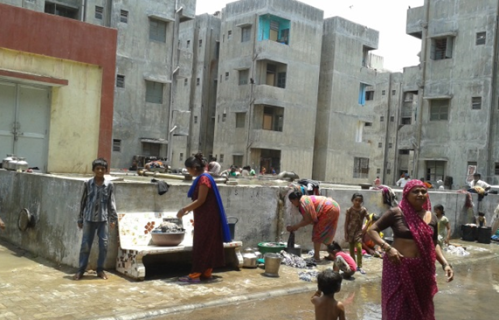
Many residents have been robbed, sometimes at knife-point, while moving in and around the sites. Residential burglaries have taken place where cash, jewellery, mobile phones, and other items have been stolen. Residents try not to leave their houses unoccupied for long. Residents described how they felt insecure; women, in particular, did not step out of their homes after dark, which was not the case where they used to live. Communities that used to be close knit have been dispersed across different sites and randomly situated within those sites due to the house allotment process.
A resettlement colony in Ahmedabad
This haphazard approach to resettlement has led to social disruption and resulted in the loss of moral authority that local leaders, elders, and residents in general were able to exercise previously. Overall, internal informal social control is now lacking at the resettlement sites, creating a “mahol” or environment in which crime is committed with impunity and youth, in particular, easily stray towards theft, gambling, and illicit activities such as selling/consuming drugs. This latter situation is exacerbated by the absence of feasible livelihood options.
“When there are no jobs, the youngsters get spoilt. They get into wrong activities [sic]. They do not have money for the transport fare … when a person goes hungry then he will steal; he will get into bad businesses.” (Female resident at the Vatwa resettlement site) “If [a child’s] mother is not at home the whole day and they are hungry then they might steal. If I leave my shop unattended just now and if a child who has not eaten since morning comes by, he might pick up something.… Today he might pick up something costing INR5; tomorrow he will steal something more.” (Female resident at the Vatwa resettlement site)
The built environment at the resettlement sites has also enhanced crime. Some stretches of the main road have few activities. The lack of ‘eyes on the street’ has created opportunities for robberies and the harassment of women. Within the sites, large sections do not have functioning streetlights and, where they are present, those who engage in crime break the lights whenever they are repaired. The common passageways in most buildings do not have functioning lights due to disputes about electricity bill payments.
Overall, the physical environment is intimidating, especially for women. Thus, we see structural violence leading to increased crime. Emanating from it is everyday fear of crime and violence among the residents. Lack of proper policing, due to the overall failure of local security governance at the site, has deepened these fears among residents, which have a strong gender dimension.
Water supply systems as a driver of structural violence
Conflicts related to water are primarily due to the lack of a formal water supply in informal settlements. This is an urban planning issue. However, conflicts have emerged: in Bombay Hotel, these are due to the supply by informal water providers; in the Vatwa resettlement sites, they are due to the local government’s approach to the design and governance of water infrastructure.
In Bombay Hotel, the absence of a municipal water supply has led to the emergence of many different kinds of informal water supply arrangements, such as builders or better-off residents providing water from private bore-wells and residents fetching water from surrounding factories. Some of these arrangements mitigate extreme deprivation and conflicts around water, but many lead to a variety of conflicts:
among residents of a neighbourhood
between residents of different neighbourhoods
between residents and water suppliers
between residents and the local government.
The conflicts often involve verbal and low-intensity physical fights on a daily basis. The informal water suppliers are motivated purely by profit; their approach to supplying water reflects this, with fixed territories of supply to protect profits and coercive practices. They collect monthly charges whether or not they are able to supply adequate water. Residents are unable to oppose this due to a lack of alternative sources and the high-handedness and threats from the suppliers.
In fact, residents cannot even complain about these operators without raising their ire. Multiple types of everyday conflicts emerge from the coercive management of water supply systems by these non-state actors. All conflicts have the potential to result in violence between residents and the water suppliers as well as among the residents themselves.
“In one of the societies [a community], a local leader complained to a politician about the poor quality of water being supplied by the bore-well operator. This angered the operator who then stopped supplying water to the residents which in turn led to an argument between the residents and [the] local leader as the former felt that the latter should not have complained to the politician as this had totally cut off their access to water.” (Resident of the Bombay Hotel area)
Municipal officials have been aware of unregulated groundwater extraction, its sale in the area, and the consumption of this contaminated water by residents. These facts point to the local government’s complicity in the situation. In recent years, the local government has started to send water tankers into the locality. However, this method of supply is wholly inadequate, leading to violence at the tankers, frequently among women who usually bear the family responsibility for water collection:
“Sometimes, these fights are bad. A few days ago, two women physically attacked each other and pulled each other’s hair. We had to call the police. One woman was sent to the hospital and the police arrested the other woman. Women fight with each other because only one tanker comes here for so many people and we cannot be certain that each of us will get water.” (Woman from Bombay Hotel)
In a couple of rare instances, residents have managed to collectively dig bore-wells to make arrangements for water, freeing them from the water suppliers and associated conflicts. This collective effort is an important bottom-up practice, but it still does not ensure good quality water and does not totally address the issue of deprivation and structural violence. At the Vatwa resettlement sites, water provision was arranged without sufficiently resolving outstanding governance questions. This led to a lack of potable water and inadequate running water due to leaking and blocked water pipes.
The structural violence created by resettlement on the urban periphery through socially disruptive processes has made the possibility of residents managing, maintaining, and sustaining the water supply extremely rare, thereby perpetuating structural violence. Municipal officials sometimes intervene, either out of benevolence or due to political pressure, but this generally results in uneven and inadequate interventions, furthering micro-local inequalities.
Some officials are also unsympathetic towards residents because they consider resettlement to be an act of charity. As a consequence of insulting them in this way, residents have retaliated by vandalising public property at the municipal office, exhibiting counter-violence against the state. Here, despite residents’ protests, the local government has remained unresponsive and has withdrawn the low level support that it was providing to keep the water supply system working.
Residents have almost completely stopped making demands on the government in the face of its increasingly uncompromising stance. But with access to water not resolved, the point of conflict has shifted to conflicts among the marginalised: among residents and between residents and water operators over maintenance and repairs. Furthermore, inequities are also reproduced as women and children regularly bear the brunt of gathering adequate amounts of water for the household.
Public transport as a driver of women’s insecurity
Ahmedabad has good public transport coverage through buses operated by Ahmedabad Municipal Transport Services (AMTS) and the Bus Rapid Transit System (BRTS). However, there are issues related to frequency, connectivity, and affordability of public transport in Bombay Hotel and the Vatwa resettlement sites. Women were forced to commute using para-transit vehicles such as ‘shuttles’ (three-wheeled auto-rickshaws that operate on a shared basis). Many women perceived the shuttles to be unsafe when sharing them with male passengers or when they had to take them alone because they feared the male driver.
“She used to go from here to the BRTS road in a shuttle and then from there to Dani Limda in another shuttle and then walk from there to school. The driver would keep a watch on her and would not take any other passenger when she was in his rickshaw; he would tease her and take her through different routes every day. Out of fear, she stopped going to school.” (Resident of Bombay Hotel regarding her niece’s experience)
In Bombay Hotel and Vatwa, walking to public transport stops was also challenging for women. They often face insecurity and harassment in public spaces. There are multiple drivers of this insecurity, many of which stem from the built environment: poor lighting; uneven roads and the absence of footpaths; and vacant spaces and structures along access roads that can be used by goons for illicit activities such as manufacturing, selling, and/or using alcohol and drugs or gambling.
Multiple causes, including a lack of good employment opportunities, draw many male youths into illicit activities, which then lead them to harass girls and young women. As such, women in Bombay Hotel and Vatwa will only undertake a trip if it is a necessity.
— *Visiting professor at the School of Arts and Sciences, Ahmedabad University, Ahmedabad; **independent scholar based in Ahmedabad, formerly senior research fellow at the Centre for Urban Equity, CEPT University
These are excerpts from the paper “Everyday violence in urban India Is planning the driver or mitigator?” published with the permission of Prof Darshini Mahadevia
On 10 April 2019, Prakash Lakda, a 50-year old Adivasi of Jurmu village of Gumla’s Dumri block, was lynched to death by a mob of men from the neighbouring Jairagi village. Three other victims from Jurmu – Peter Kerketta, Belarius Minj and Janerius Minj – sustained severe injuries due to the beating by the mob.
On 31 may 2019, Kendriya Jan Sangharsh Samiti organised a protest against the violence and administrative inaction. Despite this protest, the police has failed to take any action against the perpetrators of the Dumri lynching. The police has in fact charged the surviving victims of the lynching with cow slaughter. To once again protest against the continued injustice, Jan Sangharsh Samiti organized a protest today in front of the office of the Gumla Deputy Commissioner. The protest was attended by hundreds of people from not only Gumla, but also from the nearby districts of Ranchi and Latehar.
Today’s protest began with Albert Tigga from the Jan Sangharsh Samiti briefly recollecting the incident of lynching and the fact finding of the incidence and protests against the violence and administrative inaction. The fact finding team clearly established that the owner of the dead ox requested the victims and others of Jurmu village to carve the dead ox. While carving the dead ox, the villagers were attacked by a mob of 35-40 persons from Jairagi village and beaten for hours.
Ashutosh Rahul Tirkey shared that instead of taking action against the perpetrators of violence, the police filed a FIR against the Adivasi victims of the lynching. Further, the Gumla district court has rejected the anticipatory bail filed for these victims. The attached court order clarifies that the police did not include the testimonies of the residents of Jurmu in the case diary. Even the testimony of the dead ox owner has not been recorded properly by the police. The facts have been recorded in a distorted manner in favor of the perpetrators of lynching.
Villagers from Jurmu said that since the lynching, residents of Jurmu are being threatened by people from Jairagi. On the advice of the local administration, residents of Jurmu stopped supplying mud to a brick kiln being operated by a resident of Jairagi. In retaliation, the brick kiln owner threatened residents of Jurmu with the comment “khoon ki nadiyan baha denge” (will flow rivers of blood). Moreover, Adivasi children from Jurmu are denied water from a public hand pump at Jairagi chowk.
Social activist Ashok Verma said that on 17 June another person was lynched, this time a Muslim in Saraikela Kharsawan district of Jharkhand. Like in case of Dumri, this victim was also forced to say “jai shree ram” and “jai hanuman”. This is the eighteenth lynching death in Jharkhand in the past three years. These series of lynchings clearly indicate the immunity provided to the perpetrators of violence by the state government. Jan Sangharsh Samiti’s Saroj Hembram said that she protests against the bovine protection law that is used to kill people on the name of cow slaughter. Kendriya Jansangharsh Samiti strongly condemns these series of lynchings, the subsequent harassment of surviving victims and the administrative inaction against the perpetrators of violence. Towards the end of the protest meeting, a delegation of protestors submitted a memorandum to the Gumla Deputy Commissioner with the following demands:
Withdrawal of false cases of cow slaughter filed against the Adivasis of Jurmu
Arrest of all the perpetrators involved in the mob violence and file charges against them under The Scheduled Castes and Scheduled Tribes (Prevention of Atrocities) Act
Take action against the local police for its long delay in arranging medical treatment for the victims and filing of false case of cow slaughter
Provide interim compensation of Rs 15 lakh to the deceased’s family and Rs. 10 lakhs each to the injured victims
Compliance with the recent Supreme Court judgement on lynching
Action against the continued harassment of Adivasis of Jurmu
On June 18, the Adityanath-led Uttar Pradesh government approved the draft Uttar Pradesh Private Universities Ordinance, 2019. Among other things, the draft ordinance would make it mandatory for new and existing private universities to give an undertaking that they will ensure that no “anti-national” activities will take place in the campuses.
The approval comes right after the re-election of the Modi government at the centre, and is being seen by many as a repressive move. To understand the implications of the proposed law and what it specifically imeans for democratic rights, the Indian Cultural Forum spoke to some eminent academics and writers.
Nandini Sundar, Professor of Sociology at the Delhi School of Economics, said that such an ordinance would have a “chilling effect on all research, teaching and activity in the university. Even if “anti-national” activities are not defined, the target is quite clear – anything that is critical or questioning the current government will be considered as “anti-national”.” Sundar pointed out that the government prescribing such rules for universities is extremely dangerous, and added that “if people are engaged in anti-national activities there are other laws to deal with that.” Reacting to the draft ordinance, writer and scholar Ganesh Devy said, “Universities are meant for generating thought and meaningful social questions…This kind of “fatwa” is the end of the university system.”
The universities would be given a year to enforce the law. Many feel that this is a part of the larger attack on academic institutions since the current regime came to power in 2014. The Modi-led government, accused time and again of curbing debate and saffronising education, is opposed to the very idea of a university. The draft ordinance, they think, is another step in the same direction.
Ghanshyam Shah, sociologist and former Professor at Jawaharlal Nehru University, is of the opinion that the ordinance defeats the very purpose of a university. He says: “University is meant for free and open discussion. And nothing is sacrosanct as far as the discussion within the university campus is concerned. Now this “anti-national” – one wonders what is meant by that. Anything I might want can make an “anti-national”. I want development for dalits and I might be accused to be an “anti-national” because you are not talking about India’s upliftment, but dalit upliftment. So any opposition or any criticism of those in power would be then “anti-national”.”
Echoing a similar concern, Abha Dev Habib, Professor of Physics at Delhi University, points out: “Academic institutions may be funding or conducting various research projects – how will you scan whether what they are doing is ‘national’ or ‘anti-national’? By scanning every seminar? By scanning every research project? I don’t understand the need for such a bill.” She sees the move as contrary to the basic requirements of fruitful research and academics: “If you want to really do well in research or in knowledge production, then the universities – whether public or private – need to have the freedom to think in a new manner, and it may not be an easy task… We must understand that anything new in science came only through questioning what existed and challenging superstitions.”
According to her, there is also a direct connection between the unfolding projects of the Adityanath-led UP government and the agenda of establishing an academic stranglehold. She says, “If you look at what has happened over the last five years in Uttar Pradesh, and the kind of violence that has happened against dalits and women, and how the focus has been shifted to the cow…they want to have a greater control over these processes through control over universities – through a greater control over what is taught and how it is taught.”
Eminent historian Uma Chakravarty claims that the draft law is of a piece with some of the worst forms of authoritarianism historically. She says, “It is like from the McCarthy era in the US where they imagined “un-American” activities and hauled hordes of people from the universities and from the cultural world and slapped such accusations against them. They aunched a huge witch hunt against those whom they identified as “un-American” for their supposed communist sympathies. It didn’t matter whether they were or they weren’t communist. The process amounted to a farce. It wasn’t even any legal procedure — they called someone to testify, that person will then know other people, and they will be asked to come and testify, and then basically they lost their jobs, they moved away quite often from America to go and teach in other universities. They were terrible times. Even people like Charlie Chaplin went away from Hollywood. I am reminded, as a historian, of this kind of thing. It is a targeting of the universities where, according to the ruling regime, there should be no critical thinking, no independent thinking and you can create a bogey of nationalism and charge others with “anti-national” activities. You could be stuck in court and meanwhile your careers would be destroyed. I am reminded of the McCarthy era in America in the late 40s — their version of hysteria against the so-called communists. It is basically a witch hunt.”
While Uma Chakravarty invokes the migration of dissenting academics to other countries, Debaditya Bhattacharya, Assistant Professor at the Kazi Nazrul University, thinks that a different kind of journey may be playing out in India today. Locating the draft ordinance in the situation of public universities under the Modi regime, he says: “This is a clear move to bring the axe down on private universities because the public universities are already on their way to becoming privatised. Over the past five years, we have seen that public universities have been hollowed out of any kind of defence or even any potential for defence. Now that they have been neutralised and sanitised, the private universities have to be the next target.”
The move from public to private has been the result of a systematic persecution of voices in public universities. He says further: “Because of the larger policies that have been played out in terms of non-filling of vacancies, along with public university spaces becoming increasingly intolerant spaces, a lot of good people who were either working as contractual faculties within the public university, have either moved to private universities or have moved abroad.” He cites Jawaharlal Nehru University, Delhi University, Hyderabad Central University, Allahabad University and IIT Chennai as instances of this unfolding tragedy.
The “exodus”, as he terms it, naturally results in policies like the draft ordinance. He says, “People who have been students of public universities, people who have been trained to think about public initiatives, who have been taught to think about the order of the day, have all moved into private universities. Which is why there has to be a clamp down on private universities now.”
It seems, on the view of these academics and writers, that the draft ordinance brings together communalism with full-blown privatisation. While the full implications of the law will only be gauged in practice, the draft ordinance sounds an ominous note in the increasingly dismal situation of the right to democratic dissent in India. Response to it must also be, therefore, to the larger onslaught on democracy and dissent.