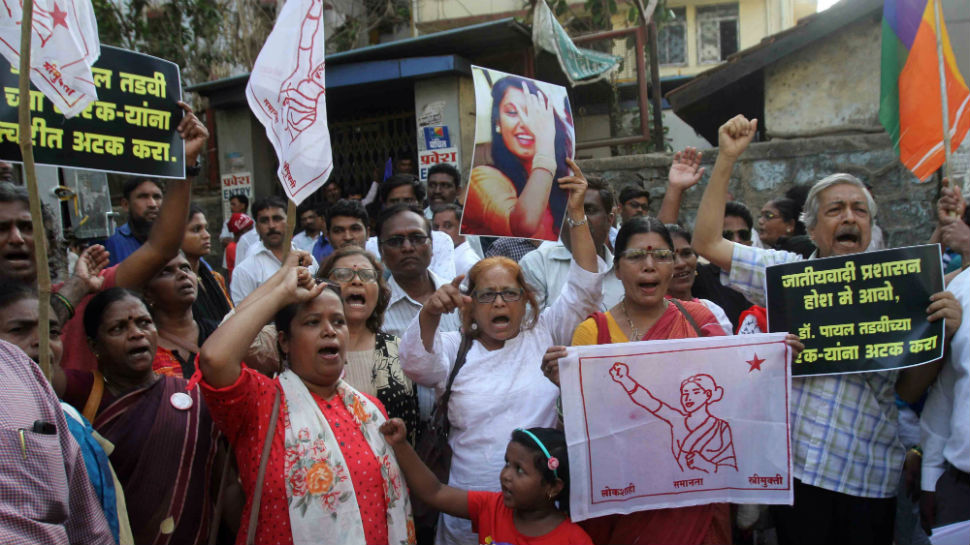
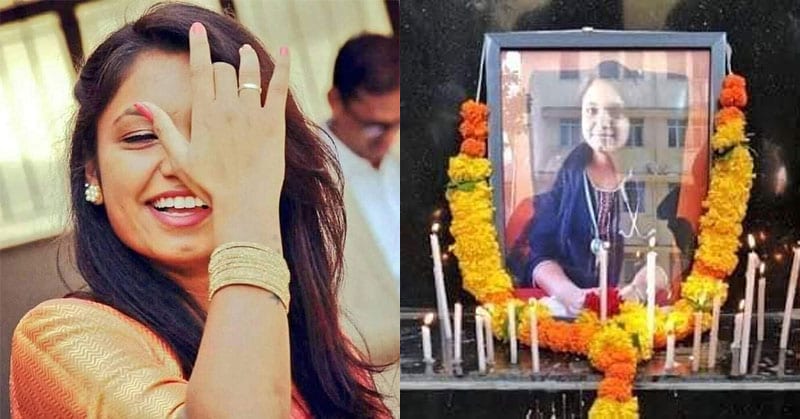
Hundreds of Mumbaikars gathered outside Nair Hospital on Tuesday expressing solidarity with and demanding justice for Dr Payal Tadvi, whose institutional murder has once again brought to light the indignities people hailing from oppressed castes and tribes are forced to suffer.
Image Courtesy: ANI
The demonstration was led by Dr Tadvi’s mother Abeda and husband Dr Salman. Demanding justice and raising graver questions about the institutional murder of his wife Dr Salman told India Today, “We want the government to intervene. The police are not taking any action. It is possible that Payal was murdered by the three women doctors.” The protest saw a huge participation from students, especially those who come from Dalit, Bahujan and Adivasi backgrounds. Several Adivasi rights organisations were also present at the protest.
Brief background of the case: On May 22, Dr Payal Tadvi, a 23 year old doctor hailing from a tribal community in Jalgaon allegedly committed suicide at her hostel in Mumbai’s prestigious Nair Hospital after being allegedly harassed by three seniors who would use casteist slurs against her. According to friends and colleagues, three senior doctors harassed Tadvi and used casteist slurs while addressing her and even mocked her on Whatsapp groups. They have been identified as Hema Ahuja, Bhakti Mehar and Ankita Khandelwal.
Even after repeated complaints, the hospital administration failed to take action against the perpetrators. This makes it a case of institutional murder, not unlike that of Hyderabad University student Rohith Vemula.
Action taken: An FIR has been registered against them under sections of the Prevention of Atrocities against SC/ST Act, IT Act, as well as section 306 of the IPC. The Maharashtra Association of Resident Doctors (MARD) has also suspended the trio’s registration. Gynaecology unit head Dr. Yi Chin Ling has also been suspended.
Even as the protests took place on Tuesday, the BMC followed in the MARD’s footsteps and suspended the licenses of the accused pending an inquiry. The Maharashtra State Commission for Women has also taken suo mostu cognizance of the case and written to the dean of the hospital demanding a report be submitted in eight days detailing anti-ragging measures and communication between the administration and students.
Meanwhile, a 21 member anti-ragging panel has taken statements of nearly 30 people in connection with the case. These include doctors, professors, nurses and other staff. The panel includes representatives from MARD, college administration and the police. Dr. Ramesh BHarmal, dean of the hospital told The Hindu, “Nearly 30 people, including the unit in charge, head of the department, nurses from the operation theatres, lab technician, and her roommates were questioned.”
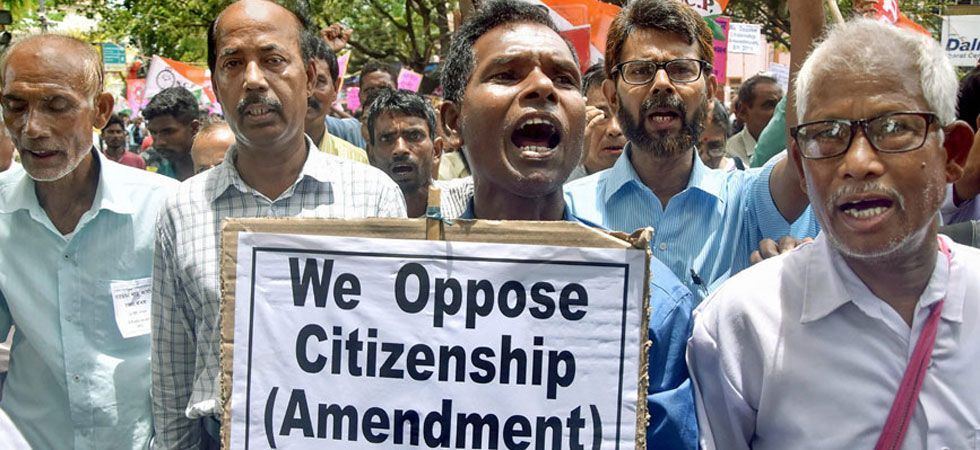
New Delhi: In what could be an interim but an indispensable relief for human rights activists and probable victims, the contentious Citizenship Amendment bill and the Triple Talaq bill have lapsed with the dissolution of the 16th Lok Sabha, as they were not passed by Rajya Sabha, the upper house.
According to the Indian Express, the two controversial bills couldn’t be passed by the Rajya Sabha in the Budget session, the last Parliament session of the outgoing government. The term of the present Lok Sabha was to end on June 3, but with the election process over, President Ram Nath Kovind dissolved the lower house on Saturday.
Both the bills were opposed by the non-BJP parties in the Rajya Sabha, where the then Narendra Modi-led BJP government lacked majority.
The Citizenship (Amendment) Bill, 2019 provided for according Indian citizenship to Hindus, Jains, Christians, Sikhs, Buddhists and Parsis from Bangladesh, Pakistan and Afghanistan, who came to India before December 31, 2014, after seven years of residence in India instead of 12 years, which is the current norm, even if they do not possess any document. The critics alleged that this bill was another tactic by the right-wing Hindutva party, BJP, to further other the Muslims and move towards its goal of a ‘Hindu rashtra’.
This bill was also strongly opposed by Assam and other northeastern states on the grounds that an easy entry of Hindus from the neighbouring nations would destroy their cultural hegemony. They even claimed that this bill was against the Assam Accord, 1985, as per which any foreigner (from Bangladesh or elsewhere) – Hindu or Muslim – who entered the state after March 24, 1971, would have to be detected and deported to their country of origin.
This controversial legislation was passed by the Lok Sabha during the Winter Session on January 8 but could not be cleared by the upper house.
Even the Muslim Women (Protection of Rights on Marriage) bill, which made the practice of instant triple talaq (talaq-e-bidat) a cognizable offence, attracting up to three years imprisonment with a fine, was challenged by the opposition parties on the grounds that criminalization of the act of divorce with a jail term for the husband could be legally untenable. Some critics and activists even raised apprehensions that if the husband is put behind the bars, the wife would be left helpless with no source of maintenance. Some other sections demanded the decriminalization of triple talaq by making it only a civil offence and in line with the way divorce is dealt with in general in India.
An ordinance for this was issued in September 2018 and later a bill was introduced which was cleared by the Lok Sabha in December but was pending in Rajya Sabha. Since the Bill could not get parliamentary approval, a fresh ordinance was issued in January, 2019.
With an unexpected landslide victory of the BJP government in the 2019 Lok Sabha elections, there is a high probability that these two bills will be taken up as soon as the first session of the 17th Lok Sabha commences. Until then, the lapse can be a much needed relief!
The first session of the 17th Lok Sabha is likely to commence from June 6.
All those who are insulting Dalits and Adivasis, humiliating them, compelling them to commit suicide, attacking them, their habitat and their land are criminals and should be dealt with under hate crime laws. The Savarna hate crime must be now on the top of the government agenda if it wants to win ‘sabka vishwas’, the trust of all.
In truly technical terms Dr. Payal Tadvi committed suicide on May 22, 2019, in her hostel room in Mumbai. But for all practical reasons, I would call it a murder, a crime which was not merely of racial hatred but also looked like Islamophobia as she belonged to a tribal community practising the Islamic faith. The 26 -year-old gynaecologist was pursuing her post-graduate course and would have become the first doctor from her community. It is so difficult for the Adivasis to come up when there is so much concealed hatred.
It is reported that Payal had complained to higher authorities about the continuous harassment by her Savarna colleagues and roommates namely Dr. Hema Ahuja, Dr. Bhakti Mehra and Dr. Anikta Khandelwal who were her seniors. They would not allow her to perform surgeries and were regularly harassing and humiliating her.
Payal had informed her mother Abeda Tadvi and father Salim who lived in Jalgaon and worked in the Zila Parishad office. She was a very hard-working girl, a brave one who graduated with an MBBS degree in Gynaecology from Miraj. A report in the Hindu, quoting her husband Dr. Salman Tadvi says, “When she came to Nair Hospital for her post-graduation, she was asked to temporarily share a room with Dr. Hema Ahuja and Dr. Bhakti Mehra. The two began harassing her soon after.” “The two doctors would go to the toilet and wipe their feet on her mattress and litter it. When she would be away, they would taunt her that she was spending time with her husband,” he said.
Her mother Abeda Tadvi is a cancer patient and has been listening to her daughter and standing by her side throughout. She said, “My daughter was extremely strong. But this constant abuse eventually broke her. The three accused should be punished so that it sets an example for others who traumatise and torture students like Payal.”
How do you define this treatment of Payal by her Savarna seniors? Is this pure hate crime?
All those who are insulting Dalits and Adivasis, humiliating them, compelling them to commit suicide, attacking them, their habitat and their land are criminals and should be dealt with under hate crime laws. The Savarna hate crime must be now on the top of the government agenda if it wants to win ‘sabka vishwas’, the trust of all.
The three Savarna doctors must be prosecuted with stringent laws so that this becomes an example but we know very well that the government and its officers have never been sincere in following the constitution and implementing the rule of law. Otherwise, Dr. Payal would not have died.
Where are the institutional mechanisms to protect SC/ST students? Her death is an institutional killing like that of Rohit Vemula and the BYL Nair Hospital, Mumbai cannot give up its accountability in this regard. Why are institutional mechanisms not strong to deal with the discrimination which is rampant in our educational institutions? Why was there no ‘committee’ which could have acted against these three girls? If there is a committee then what did it do? Who are the members of the committee? Are there SC/ST members in these committees? Can we trust those committees where no member belongs to these communities?
For clarification of many, unlike the scheduled castes, the tribes have got reservation irrespective of faiths. Payal belonged to the Bhil community which has about 2.7% of people practising Islam around Maharashtra. The total number of Bhils and Gonds in India is nearly 2.8 crore, which is 27% of the total Adivasi population in India. Among the Muslim Tribal communities, 1.32 lakhs live in Jammu and Kashmir and 1.12 lakh hail from Maharashtra where Bhils are the biggest tribal community, where Islam is one of the practising faiths.
Dr. Payal was killed by the three seniors who happened to be women. She became the victim of hate crime where her tribal identity practising Islamic faith might have further aggravated her troubles.
How can the racists hate-mongers allow a tribal Muslim doctor, full of confidence and equally meritorious, stand shoulder to shoulder with them? This is the crisis that the caste Hindus suffer.
First, they blame that the SC/ST don’t have merit and when people come and join them, they become so notorious that they create obstacles so that these students leave their courses mid-way and return home. Those who remain in the institutions are continuously harassed in the hope they will give up. Payal did not leave the hostel and decided to stay put. There is a limit to one’s patience. She was after all just 26-years-old with no one to help her or even console her. This is what girls from Dalit Adivasi communities face when they are in these Manuwadi institutions. The whole atmosphere in these so-called institutions of merit is so suffocating with Brahmanical arrogance that it kills the students from the Dalit Bahujan Communities.
With increasing Brahmanisation in these institutions, further obstacles are being created so that students don’t come up and leave. That is a strategy by the Savarna elite where the institutions and their caste owners are a party to hate crime. Will Maharashtra government act and get this case heard in a fast track court so that the hate criminals get the maximum punishment? Let the government develop a mechanism in all our colleges, universities, institutions as well as offices like women cell, develop special cell for SC/ST communities so that such murders are not repeated and India shows its commitment against caste and race-based prejudices which are the order of the day.
Our salute to Dr. Payal Tadvi. Her fighting spirit will remain alive and her death will always remind us of the grave nature of discrimination that exists in our minds and body against Dalits and Adivasis. We will remain the most barbaric, uncivilised and highly prejudiced society if India does not address this issue with honesty. With so many people being kept outside humanity’s reach and the denial of justice to them will never make us a great nation. Time to show real intent to fight against hate crimes against Dalits and Adivasis.
Shahjahanpur: In yet another unfortunate incident, a Muslim couple was denied an ambulance, to carry their ailing son, by a local hospital in Shahjahanpur, Uttar Pradesh, which led to his death. The incident took place on Monday night.
As reported by NDTV, the couple had taken their son, Afroz, to a local hospital after he was diagnosed with high fever. The doctors advised them to take Afroz to Lucknow for better treatment, after which they requested for an ambulance. However, they were reportedly not provided with an ambulance, neither did they have any money. Helpless, the couple began walking, carrying their child, and he allegedly passed away while they were on the way home.
“We took our child to the hospital in the morning. The doctors told us to take him elsewhere for treatment. We asked them for a vehicle but they refused. There were three ambulances parked in the premises. I do not know why we were denied one,” the father alleged.
Predictably, the doctors have rebuffed the allegations. The emergency medical officer, Anurag Parashar, said, “A child named Afroz came to the hospital at 8:10 pm. His condition was not well, so we directed the parents to take him to Lucknow for special treatment. They scoffed saying they will take him wherever they wish and left with the kid.”
While the allegations have not yet been proved, there is certainly an urgent need for a thorough investigation. It is also crucial to probe whether there is some communal angle associated with this untoward incident.
In the recent past, the Supreme Court has lent color of greater depth than perhaps ever before, to the jurisprudence surrounding the National Green Tribunal. It is a serious concern that across the spectrum of strict interpretation of environmental laws on the one hand and liberal on the other, the Supreme Court, in these judgments has decided against reposing faith in the NGT as an institution. The displeasure expressed by the Highest Court of this land should be taken as a warning on various levels.
First of all, as a warning that nothing but the stringent-most application of reasoning will suffice when it comes to deciding issues involving destruction of the planet. And secondly, as a warning that environmental law is no more to be treated as a juvenile field of law, and the words as well as principles of environmental law must not be treated casually under any circumstance.
On the stricter end of the interpretation spectrum is the judgment by a Supreme Court bench of Justices R.F Nariman and Naveen Sinha in the case of Tamil Nadu Pollution Control Board versus Sterlite Industries (I) Ltd. & Others dated the 18th of February, 2019. The subject matter of this batch of Appeals before the Court was the operation of a copper smelter plant at the State Industries Promotion Corporation of Tamil Nadu Ltd. (SIPCOT) Industrial Complex at Thoothukudi, Tamil Nadu, by Vedanta Limited. This is the same plant which was the subject matter of great social unrest and upsurge last year.
These appeals principally arose from two judgments passed by the NGT, in both of which it allowed Vedanta to operate its plant, deciding against the petitioners who raised serious concerns with respect to the seemingly perpetual pollution caused by the plant since it began operations in 1997. Of particular concern is the judgment of the NGT dated 15th of December, 2018, passed by the NGT in the case of Vedanta Limited versus State of Tamil Nadu & Others.
In this judgment, the NGT was hearing an appeal filed by Vedanta against a group of orders issued by the Government of Tamil Nadu directing closure of its Copper Plant. The NGT, in its wisdom, decided to refer the entire dispute to a Committee consisting of a retired Judge and two technical members for hearing and recommendations. On receiving the report of the committee which suggested, among various measures to mitigate the pollution caused by Vedanta, that the closure orders issued by the Government of Tamil Nadu were not valid, the NGT was swift to pass judgment, accepting almost all recommendations made by the committee. The result was the judgment dated 15th December, 2018, where the NGT allowed the operation of Vedanta’s Copper Plant at Thoothukudi.
Almost immediately thereafter, the Government of Tamil Nadu decided to go in Appeal against this judgment before the Supreme Court. The judgment, penned by Justice Nariman, is a fine example of plain or in other words, black & white interpretation of the law. The judgment did not go into the merits of whether the copper plant caused pollution to attract closure or not. However, the judgment shed considerable amount of light on the limitations of the NGT as a Tribunal exercising its appellate powers over decisions made by Government Authorities. The court repeatedly stressed on the fact that the NGT did not have jurisdiction to even hear the appeal because of the availability of another subordinate dispute resolution forum, the Appellate Authority of the Tamil Nadu Pollution Control Board. As per the law, it is this Appellate Authority which is to be approached before the NGT, when any decision of the Pollution Control Board is to be challenged. The orders to shut down operations which were issued by the Board must have been therefore challenged before this Authority. However, as the Court noted, the NGT passed judgment in the case before the Authority could even decide the issue. In doing so, according to the Supreme Court, the NGT overstepped its jurisdiction as laid out under the NGT Act of 2010.
The judgment clearly states that no jurisdiction could have been exercised by the NGT where none was provided for under the law of the land, irrespective of the failure of the Appellate Authority to decide the matter in a time bound manner. The Supreme Court therefore set aside the judgment of the NGT and gave all the parties before it the liberty to approach the Madras High Court to seek and obtain relief.
The signal sent by the Supreme Court in the Vedanta case is clear. The NGT may be an expert institution having a mandate to decide on questions of what is sustainable and what isn’t, but in the end, it is a statutory Tribunal which could not possibly have reviewed and set aside orders passed by the Government under in its capacity as an appellate tribunal. This was especially when the law never allowed the NGT to take up such a case in the first place.
As a side note, one would also wonder why the NGT, being an expert institution, felt the pressing need to refer the entire case brought before it to a committee having the same kind of constitution as the Appellate Authority of the Tamil Nadu Pollution Control Board. The level of concern compounds when one notes that this committee constituted by the NGT operated from the Southern Zonal Bench of the NGT at Chennai, which has been shut for more than a year, due to lack of appointment of Judicial and Technical members to the Southern Bench. Does the new NGT under Chaiperson Justice Adarsh Goel wish to replace its zonal benches with committees lacking the institutional independence of the NGT? How long can this top down approach sustain?
Moving on to the more liberal end of the interpretation spectrum is the judgment by a Supreme Court bench comprising of Justices Dr. D.Y Chandrachud and Hemant Gupta, in the case of Hanuman Laxman Aroskar versus Union of India & Ors. dated 29th of March, 2019.
As background, the case was initially filed by a batch of petitioners against an Environmental Clearance dated 28th of October, 2015, granted for the construction of an Airport at the village of Mopa located at Pernem Taluka in North Goa, bordering Maharashtra before the NGT.
The petitioners painstakingly argued that the said Airport was given Environmental Clearance from the Central Government despite serious illegalities in the decision making process leading up to the Clearance as well as large scale concealment of information relating to forests, biological diversity, ecological sensitivity and integrity of the Airport site and surrounding areas. In other words, the Central Government failed to take note of blatant lies spoken by the Government of Goa in its application for grant of Environmental Clearance and disregarded the red flags regarding the project raised by the public as well as by various experts in the field.
About three years of fighting before the NGT lead up to the judgment of 21st August, 2018, wherein the NGT refused to set aside the Environmental Clearance and instead stipulated certain additional conditions to be followed by the Government of Goa in the process of construction and operation of the Airport.
Aggrieved, the petitioners moved in appeal against this judgment before the Supreme Court. The Court, in its judgment dated 29th of March, 2019 effectively set aside the judgment of the NGT and suspended the Environmental Clearance and directed that the project be considered afresh by the expert panel of the Central Government taking into duly taking into consideration the environmental impact of the project.
It is important to note that the Supreme Court chose not to remand the case back to the NGT but instead itself went through the entire process leading up to an Environmental Clearance under the Environmental Impact Assessment Notification, 2006, with detailed commentary on why complete and honest disclosure of information pertaining to environmental impact of a project is necessary in order to achieve the laudable Sustainable Development Goals in addition to the need for highest scrutiny by the expert panel of the Central Government taking into consideration all views raised by public and information provided by the Government of Goa. The Supreme Court directed that after the project is considered afresh by the Central Government, the case is to be referred back to it for final consideration.
If one were to read the judgment of the Supreme Court, penned by Justice Dr. Chandrachud, it would naturally seem like the work that the NGT ought to have put in, in its own judgment dated 21st of August, 2018. The Court clearly stated that absence of any consideration by the NGT with respect to the various flaws in the process leading up to the Environmental Clearance only compounded the already existing problem of lack of consideration by the Central Government. What could be more clear than the Supreme Court of India telling the NGT that it should have been more thorough, citing two past judgments of the NGT itself. The ire of the Supreme Court is clear from the following extract of its judgment: ‘121. The failure to consider materials on a vital issue and indeed the non-consideration of vital issues raises a substantial question of law leading to the invoking of the jurisdiction of this Court under Section 22 of the NGT Act 2010. The failure of process in the present case has been compounded by the absence of a merits review by the NGT.’
The court clearly stated that the NGT was mandated to duly consider the case before it as per the three principles of Sustainable Development, Precautionary and Polluter Pays and in failing to do so, it has failed to exercise its jurisdiction under the NGT Act, 2010.
Therefore, in a way, the Court strictly interprets the provisions regarding Appeal under the NGT Act, 2010 while engaging in the liberal most interpretation of what the Tribunal ought to have done once such jurisdiction was supposed to be exercised by it.
There was a time when the Supreme Court was not taking the liberty of telling the NGT what to do and what not to. The reason was simple, the NGT, being an expert institution, was equipped to arrive at a rounded resolution of an environmental dispute from a legal as well as scientific paradigm and in fact, it was passing judgments of high quality and fearless in their nature. There have been cases before the NGT in the early part of the decade, where the NGT has asked billionaire industries and massive governmental projects to shut shop. The judgments of Jeet Singh Kanwar versus MoEF & Others dated 16th of April, 2013 and Prafulla Samantrey & Another versus Union of India & Others dated 30th of March, 2012 come to mind. In the former, the NGT quashed the Environmental Clearance granted by the Central Government to M/s Dheeru Powergen Private Limited for construction of a 700 MW Coal Fired Thermal Power Plant at Korba, Chhattisgarh for reasons including that of failure of the expert panel of the Central Government to properly consider the environmental impact of the project.
In the latter, the NGT effectively suspended the Environmental Clearance granted by the Central Government to M/s POSCO India and directed for fresh consideration of the project by the Central Government for reasons including failure to duly conduct Public Hearing and carrying out Appraisal of the project by the Government.
The NGT back in 2011-13 can very well be characterized as an institution which was fearless and uncompromising in meeting its mandate of providing expert environmental justice to common Indians. Those were the days when a bench of just two or three members of the NGT did not hesitate to show the door to massive scale projects for their failure to comply with environmental norms. Today’s NGT is far more reluctant in passing judgments, let alone considered judgments and instead seems keen on disposing off cases and forming committees to deal with environmental issues.
However, the NGT, with the recent warnings issued by the Highest Court of the land may be well advised to look back into its own past and begin continuing the trend of fearlessness established at a time when a lot of people of my generation were taking their Board Examinations.
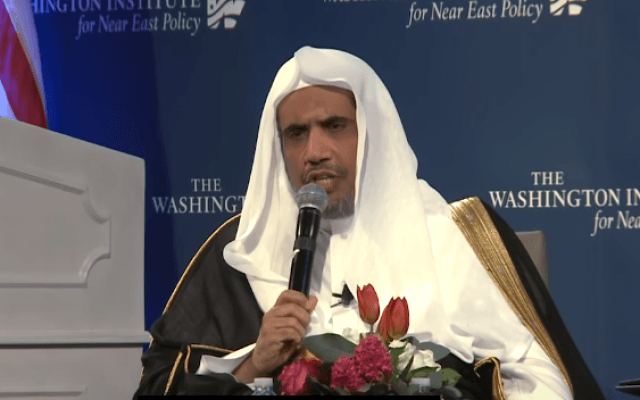
Meet Mohammed bin Abdul-Karim Al-Issa, the public face of Saudi crown prince Mohammed bin Salman’s version of moderate Islam.
A 54-year old former justice minister, Mr. Al-Issa, one of a younger generation of Islamic scholars willing to do Prince Mohammed’s bidding, has been doing the rounds internationally and making all the right moves to project the de facto Saudi leader as the spearhead of efforts to counter ultra-conservatism at home, fight political and militant Islam across the globe and promote the crown prince as a tolerant leader bent on fostering inter-faith dialogue.
Mr. Al-Issa’s moves also serve to strengthen ties with US President Donald J. Trump’s Evangelist voter base and shape an environment that legitimizes Saudi Arabia’s close cooperation with Israel.
In his latest move, Mr. Al-Issa is this week convening a four day international conference on moderate Islam as head of the Muslim World League, once a prime vehicle for the kingdom’s global promotion of anti-Shiite, anti-Iranian ultra-conservative strands of Islam, and a member of the Supreme Council of Ulema, Saudi Arabia’s highest religious authority.
Breaking with past Saudi religious and political tradition, Mr. Al-Issa has reached out to Jewish and Evangelist communities. He called during a speech in October at the Washington Institute for Near East Policy, widely viewed as pro-Israeli, for a Muslim-Christian-Jewish interfaith delegation to travel to Jerusalem to promote the cause of peace despite the fact that Israel and Saudi Arabia do not have formal diplomatic relations.
Mr. Al-Issa has defended Prince Mohammed’s reforms such as the curbing of the powers of the kingdom’s religious police, the lifting of the ban on women’s driving and the nurturing of modern-day entertainment such as cinemas and concerts.
No doubt, Mr. Al-Issa’s moves help reshape an environment in which religious intolerance and prejudice was the norm and still is widespread. Yet, critics charge that his efforts to project Prince Mohammed as a religious reformer do not go beyond speech and symbolism and constitute a public relations effort rather than true change.
It, moreover, remains unclear, how effective Mr. Al-Issa’s efforts are. They certainly help the Trump administration defend its unconditional support for Prince Mohammed, including its willingness to shield the kingdom from accountability for its conduct of the war in Yemen and the killing last October of journalist Jamal Khashoggi on the premises of the Saudi consulate in Istanbul. Saudi Arabia insists Mr. Khashoggi was murdered by rogue operatives.
Yet, some of Mr. Al-Issa’s well-connected interlocutors during his visit to Washington said they came away from discussions with him not sure what to think. Likewise, a Saudi intellectual rhetorically asked Saudi Arabia scholar Stephane Lacroix during an interview: “How can one take Mohammed al Issa’s statements seriously when religious bookstores in Riyadh are full of books advocating the exact opposite?”
Malaysia, one of the kingdom’s associates in countering extremism has taken a similarly critical view of the its efforts. Malaysian defense minister Mohamad Sabu last year closed the Saudi-backed King Salman Centre for International Peace (KSCIP) in Kuala Lumpur following criticism that the kingdom with its ultra-conservative interpretation of Islam may not be the right partner.
In a recent article discussing the limits of Prince Mohammed’s reforms, Mr. Lacroix, pointing to the arrests of Islamic thinkers critical of the kingdom’s ultra-conservative Wahhabi traditions and the suppression of all debate, concluded that “this makes MBS’s religious reforms look more like a public relations stunt than a genuine transformation.” Mr. Lacroix was referring to Prince Mohammed by his initials.
Mr. Lacroix’s conclusion is enhanced by the fact that there is little that would suggest fundamental reform of religion involving tolerance at a practical rather than a talking heads level beyond the countering of extremism at home and abroad, a key Saudi interest, and the social changes Prince Mohammed has so far introduced to polish the kingdom’s tarnished image and further his plan to diversify its oil-dependent economy and create badly needed jobs.
If anything, Prince Mohammed’s reforms appear to be designed to shave off Wahhabism’s rough edges, project a more moderate image, and promote at home and abroad in countries like Kazakhstan, Algeria and Libya an ultra-conservative interpretation of Islam that preaches absolute obedience to the ruler. Prince Mohammed’s crackdown on all forms of dissent enforces the principle.
By the same token, Prince Mohammed has done little to push reform since lifting the ban on women’s driving and enhancing their professional and sporting opportunities. The kingdom’s male guardianship of women has been softened at the edges but remains firmly in place.
Mr. Al-Issa’s Supreme Council of Ulema has no Shiite clerics among its members nor do Shiite judges sit on the benches of national courts or serve in the police force or as ambassadors.
The risk for Prince Mohammed is that religious moderation like economic reform that trickles down could become an issue on which his ability to deliver will be a litmus test of his reforms.
A recent poll of Arab, including Saudi youth, showed that two thirds of those surveyed felt that religion played too large a role while 79 percent argued that religious institutions needed to be reformed. Half said that religious values were holding the Arab world back. Said Mr. Lacroix: “If religious reform is only a push from above and not the result of genuine social debate, it is easily reversible.”
Dr. James M. Dorsey is a senior fellow at Nanyang Technological University’s S. Rajaratnam School of International Studies, an adjunct senior research fellow at the National University of Singapore’s Middle East Institute and co-director of the University of Wuerzburg’s Institute of Fan Culture.
Delhi: A beauty queen, an award-winning writer and four giant-killers; one who contested because she received a “signal from God” and another who once famously showed her middle finger to a hectoring news anchor, it is safe to say that the women contestants to the 2019 general elections reflect the diversity and vibrancy of India.
Of the 724 women who contested the 2019 general elections, 78 will be sworn in as members of parliament (MPs)–the largest-ever contingent of women in India’s parliamentary history. More than 60%, or 47 of these women, are first-time MPs, said Gilles Verniers, co-director of Trivedi Centre for Political Data (TCPD). Some, such as eight-time winner Maneka Gandhi, are veterans.
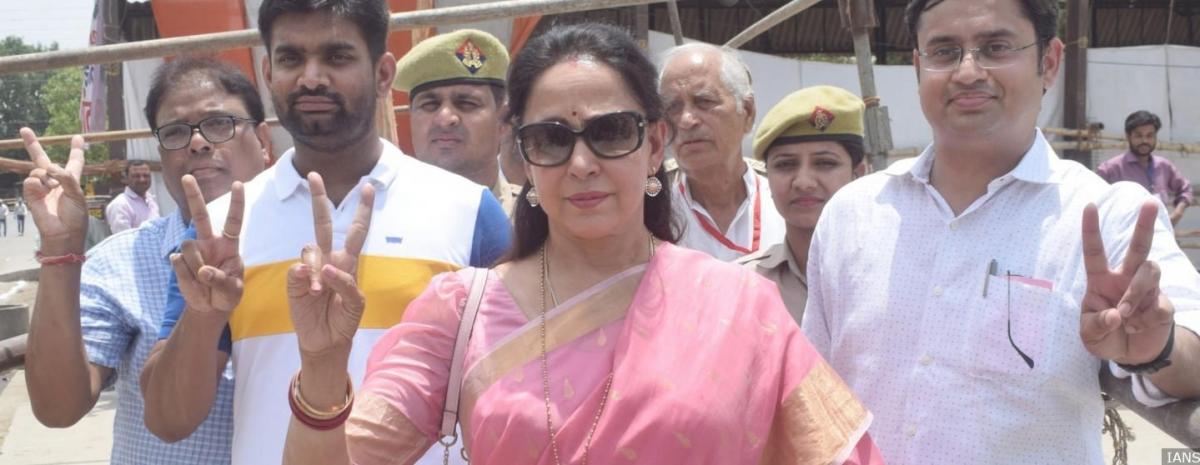
There are billionaires–the richest being Hema Malini of the Bharatiya Janata Party (BJP) with assets of Rs 250 crore, according to the Association of Democratic Reforms. And then there is Remya Haridas, the daughter of a daily-wager father and a tailor mother. With assets of Rs 22,816, the 32-year-old is Kerala’s second-ever Dalit woman MP and the only woman MP from the state this year.
Reportedly shortlisted in a talent hunt conducted by Congress president Rahul Gandhi back in 2011, the music graduate contested as a candidate for the Congress-led United Democratic Front, conducting a campaign that used music and singing to connect with her audience.
Haridas’s political rivals scoffed. But on counting day, she had defeated incumbent P.K. Biju of the Communist Party of India (Marxist), or the CPI(M), by securing 52.4% of the vote share.
One step forward…
In percentage terms, the gains made by women in the 2019 general elections are small: they form 14.6% of the house, up from the 12.1% (66 women MPs) of the outgoing 16th Lok Sabha.
“You cannot bring change immediately,” Chinta Anuradha, who describes herself as a “staunch supporter of the feminist cause” and won on a YSR Congress ticket from Amalapuram in Andhra Pradesh, told IndiaSpend. “But women are now getting into politics from different streams and are being taken seriously by political parties. That is a good start and we will very soon reach our rightful numbers in parliament.”
All four women candidates fielded by the YSR Congress in Andhra Pradesh have won–two of them, including Anuradha, for the first time.
In Odisha, the Biju Janata Dal (BJD)’s decision–unprecedented before this election for any party–to reserve 33% of its parliamentary seats for women candidates, has paid rich dividends with electoral victory for five of its seven women candidates. These include Chandrani Murmu, a BTech graduate who on counting day was, at 25 years, 8 months and 11 days, the youngest woman MP to be elected this year. Murmu won on a BJD ticket from Keonjhar, defeating her nearest rival, two-time MP Ananta Nayak of the BJP, by more than 66,000 votes.
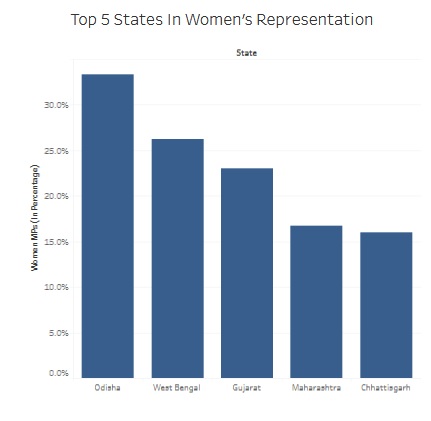
Along with two women MPs from the BJP, Aparajita Sarangi from Bhubaneshwar and Sangeeta Singh Deo from Bolangir, seven of Odisha’s 21 MPs are now women, representing a quantum leap for women’s representation from 9.5% in 2014 to 33.3% in 2019.
Source: Analysis by BehanBox, an upcoming digital platform for gender issues based on data from TCPD. Note: Does not include Tripura and Meghalaya, where one of two MPs each (50%) is a woman.
The reverse has happened in West Bengal, where despite All India Trinamool Congress (TMC) chief Mamata Banerjee allocating 41% of all seats (22 tickets) to women, the proportion of women MPs has shrunk from 28.6% in 2014 to 26.2% this election.
Despite this, West Bengal remains a significant state for women’s representation with 12 of its 42 MPs women–two from the BJP and 10 from the TMC, including Mahua Moitra, a former investment banker who returned from London in 2008 to join politics and once showed her middle finger to news anchor Arnab Goswami, then with Times Now.
Moitra has since involved herself in privacy issues, filing a public interest litigation against the Narendra Modi government’s proposal to monitor the social media.
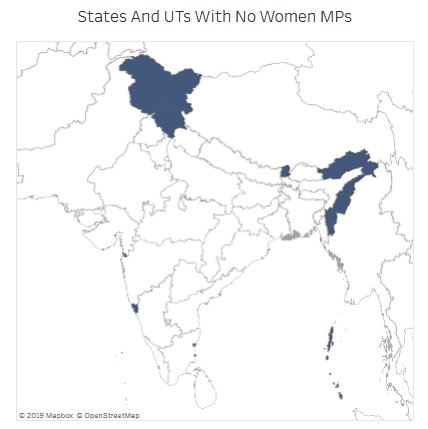
Despite the euphoria caused by the ‘highest number of women ever elected to the Lok Sabha’, 13 states and union territories have in 2019 failed to elect a single woman candidate.
These ‘zero women MP’ states include Himachal Pradesh, Jammu and Kashmir and Goa. In the union territories of Dadra and Nagar Haveli as well as Daman and Diu there was no woman candidate in the first place.
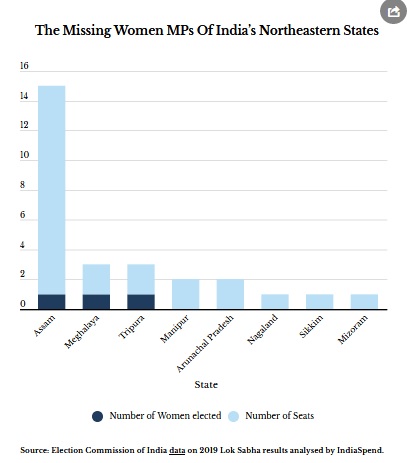
Source: Election Commission of India data on 2019 Lok Sabha results analysed by IndiaSpend.
In Mizoram, history was made when a woman contested parliamentary elections for the first time. Lalthlamuani said she had received a “signal from God” and contested as an independent candidate. The 63-year-old runs an NGO, Chhinlung Israel People Convention, which comprises of Mizo Jews who believe they are one of the 10 lost tribes of Israel. On counting day she had polled 1,975 or 0.4% of the votes.
Of the 14 MPs of Assam, one is a woman. But the Gauhati parliamentary seat saw a spirited contest with five women among its 17 candidates.
In the end, former Guwahati mayor Queen Oja, who contested on a BJP ticket, defeated her nearest rival, the Congress’s Bobbeeta Sharma, a well-known name in Assamese TV and films who, by virtue of once winning a beauty contest in Assam, invited some ‘Queen vs Beauty Queen’ headlines. Oja’s victory by a margin of more than 5.5 lakh votes makes her the first woman to represent her constituency since 1977.
“Nowadays women are aware about politics but not so active,” Oja said to IndiaSpend over the phone. “To come up, women need the support of their families and communities. But first they must get involved in society and community issues.”
A glass ceiling was also broken in Arunachal Pradesh, which saw a woman contest a parliamentary seat for the first time. Jarjum Ete contested from Arunachal West on a Janata Dal (Secular) ticket but was defeated by the sitting MP and BJP minister Kiren Rijiju who got 63.2% of the vote share compared to Ete’s 11.95%.
Of the two seats in Meghalaya, Tura has been won by Agatha Sangma, another dynast who is the 38-year-old daughter of the deceased P.A.Sangma, a former Lok Sabha speaker. This is her third electoral victory since she first won a by-election to the 14th Lok Sabha.
The north-east remained male dominated, with its 25 constituencies spread over eight states collectively electing three women–one more than in 2014.
Some northeastern states, Manipur for instance, had no woman candidate. Nagaland has never elected a woman to its state assembly (legislature). Its sole woman MP has been the late Reno Mese Shaize.
Losing big
Some notable losses for women candidates include Aam Aadmi Party’s Atishi, an educator and activist, who managed 17.44% of the vote share in her East Delhi constituency. In a three-way contest between the BJP, Congress and her own party, Atishi came in third after the BJP’s Gautam Gambhir (55.35%) and the Congress’s Arvinder Singh Lovely (24.24% vote share).
In Silchar, Assam, the Congress’s Sushmita Dev lost to the BJP’s Rajdeep Roy by 81,596 votes. Dev is a long-time advocate for 33% reservation for women in parliament and in state assemblies (legislatures).
The BJP’s Jaya Prada, a former actor who faced a sexist campaign by her nearest rival, Samajwadi Party’s Azam Khan, lost Rampur by more than one lakh votes. And the Congress’s Kumari Selja was defeated in Ambala, Haryana, by 3.42 lakh votes by the BJP’s Rattan Lal Kataria. Several women lost to stronger women candidates–Tamilisai Soundararajan of the BJP to DMK’s Kanimozhi Karunanidhi, and TMC’s Ratna De to the BJP’s Locket Chatterjee.
In at least 50 constituencies, women stood second, shows an analysis of the results of all candidates on the Election Commission of India website.
In three of these constituencies the margin of defeat was less than 10,000 votes. Mamtaz Sanghamita of TMC lost in Bardhaman-Durgapur, West Bengal, by 2,439 votes. In Koraput, Odisha, the margin of Kausalya Hikaka’s defeat was 3,613 votes. And in Maldaha Dakshin, also in West Bengal, BJP’s Sreerupa Mitra Chaudhury lost by 8,222 votes.
Dynasts
As usual, the new batch of women MPs includes dynasts. Overall, 30% of all new Lok Sabha MPs belong to political families but women candidates this election were more dynastic at 41%, said political analysts Gilles Verniers and Christophe Jaffrelot in The Indian Express on May 27, 2019. All the women candidates fielded by the Samajwadi Party, Telugu Desam Party, Dravida Munnetra Kazhagam and Telangana Rashtra Samithi are dynasts, they pointed out.
In two states, Punjab and Maharashtra, all the women MPs are dynasts.
Harsimrat Kaur Badal, the wife of former Punjab chief minister Sukhbir Singh Badal–who, after Hema Malini, is the richest woman MP with assets worth Rs 217 crore–has retained her Bathinda seat. The Congress’s Preneet Kaur, wife of current Chief Minister Amarinder Singh, has won back her Patiala seat, which she had lost in 2014, by winning 45.17% of the vote share.
All eight of the women who have won from Maharashtra claim political lineage. The daughter of NCP chief Sharad Pawar, Supriya Sule, for instance, will be making her third entry into parliament as the MP from Baramati, her father’s old constituency.
Two of the newly elected women dynast MPs from Maharashtra are related to each other. Poonam Mahajan is the daughter of slain BJP leader Pramod Mahajan. She defeated her nearest rival, Priya Dutt – incidentally, a fellow dynast and daughter of former Congress minister Sunil Dutt — in Mumbai North Central with a decisive 53.97% of the vote share. Poonam’s cousin, Pritam Munde, is the daughter of Gopinath Munde who was married to Pramod Mahajan’s sister. Pritam contested on a BJP ticket from Beed and, like her cousin, won with more than 50% of the vote share.
All dynasts did not win. Perhaps most notably, Samajwadi Party’s Dimple Yadav, the wife of former Uttar Pradesh chief minister Akhilesh Yadav, lost in Kannauj by a narrow margin of 12,353 votes to the BJP’s Subrat Pathak.
Breakthrough newbies
And then there are newbies who have worked their way up through grassroots leadership. Pramila Bishoyi, 69, studied only until class 2, speaks no Hindi or English, has never stepped outside Odisha and has two sons, one of whom runs a tea-stall.
Yet, it was for her success in launching a women’s self-help group in his constituency of Aska that Biju Janata Dal (BJD) head Naveen Patnaik asked her to contest from the constituency from where he had launched his own political career 20 years ago.
The story goes that soon after elections were announced, Bishoyi’s son got a call saying that the chief minister wanted to meet his mother, so could she please come to Bhubaneshwar, some 160 km away? There was no money for taxi fare, so he demurred. A few hours later, a car drove up to bring her to the state capital where she was given the ticket.
When the votes were counted, Bishoyi had won 54.52%, defeating her nearest rival, the BJP’s Anita Subhadarshini, by more than two lakh votes.
‘Giant killers’
While the term ‘giant-killer’ is being used to describe BJP’s Smriti Irani who defeated Congress President Rahul Gandhi in Amethi by 55,120 votes, there are at least three more among women MPs.
The most famous is terror accused Pragya Singh Thakur, who praised Mahatma Gandhi’s assassin Nathuram Godse as a “desh bhakt” (patriot). Her words caused a few blushes for the BJP’s leadership, and Prime Minister Narendra Modi said, “[I]n my heart, I cannot forgive her.” Yet, on counting day, she had wrested the Bhopal seat with a decisive 61.54% vote share from her nearest rival, Congress veteran Digvijay Singh, who managed 35.63%, losing by 3.64 lakh votes.
In Tamil Nadu, Jothimani Sennimalai, an award-winning writer and poet who contested on a Congress ticket, defeated M. Thambidurai of the All India Anna Dravida Munnetra Kazhagam (AIADMK) by more than 4.2 lakh votes to become the first woman MP from Karur.
In Karnataka’s Mandya, Sumalatha Ambareesh, the widow of former actor and Congress MP M.H. Ambareesh, was denied a Congress ticket, and so contested as an independent. She defeated her nearest rival, Nikhil Kumaraswamy of the Janata Dal (Secular), who is the son of former chief minister H.D. Kumaraswamy and grandson of former prime minister H.D. Deve Gowda, by more than 1.25 lakh votes.
(Bhandare is a Delhi-based journalist who writes frequently on gender issues confronting India.)
Punalekar was arrested along with his assistant, Vikram Bhave on May 25 in Mumbai
In an important development in the investigation of rationalist Dr Narendra Dabholkar’s murder case, Central Bureau of Investigation arrested Sanjeev Punalekar on Saturday in Mumbai. Punalekar is a lawyer for Sanatan Sanstha, an organisation which has been under the scanner for terror activities. Punalekar along with his assistant Vikram Bhave has been arrested and will be produced to Pune Court on Sunday. Dabholkar was murdered on August 20, 2013, during his morning walk in Pune. His was the first in a series of murders of rationalists that followed in Maharashtra and Karnataka, including Govind Pansare, MM Kalburgi and Gauri Lankesh.
Sanatan Sanstha is a right wing organisation spread across Maharashtra, Karnataka and Goa. Punalekar being their lawyer had defended all the accused in the case including Virendra Tawde, Sachin Andure, Sharad Kalaskar, Amol Kale and others. One of the accused in this case, Rakesh Pangera has got bail but is under custody of Karnataka ATS for the Gauri Lankesh case.
Punalekar has also defended the Sanatan Sanstha and its activities on almost all television news channels, debates, press conferences and elsewhere. He has also defended Sanatan Sanstha’s alleged activists Sarang Akolkar and others in Margao and Panaji bomb blast case, which had taken place in 2009. His arrest in the Dabholkar case is one of the most important development of recent times.
CBI’s Additional Superintendent of Police S R Singh has confirmed the arrest of both. He said that the both of them will be produced in Pune court on Sunday, where the CBI will seek their custody.
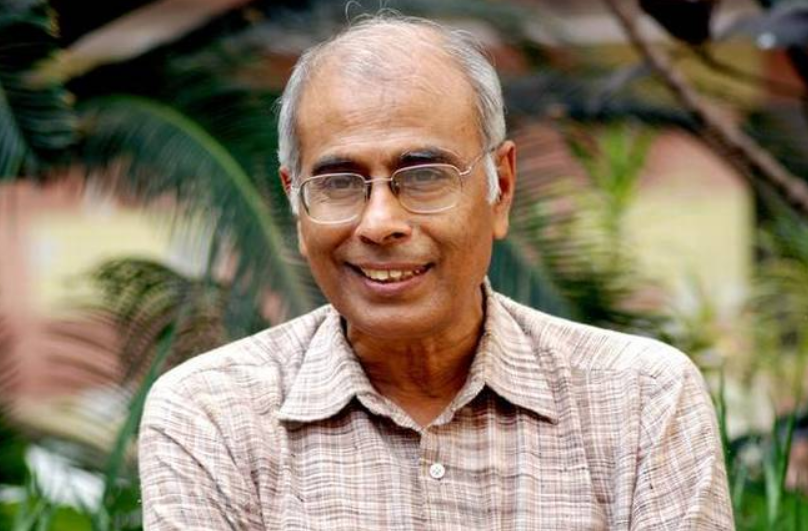
Dabholkar was known for his rationalism and activism against various superstitious beliefs. He had founded Maharashtra Andhshraddha Nirmulan Samiti, an organisation against superstitions, and was the torch bearer of progressive and secular values.