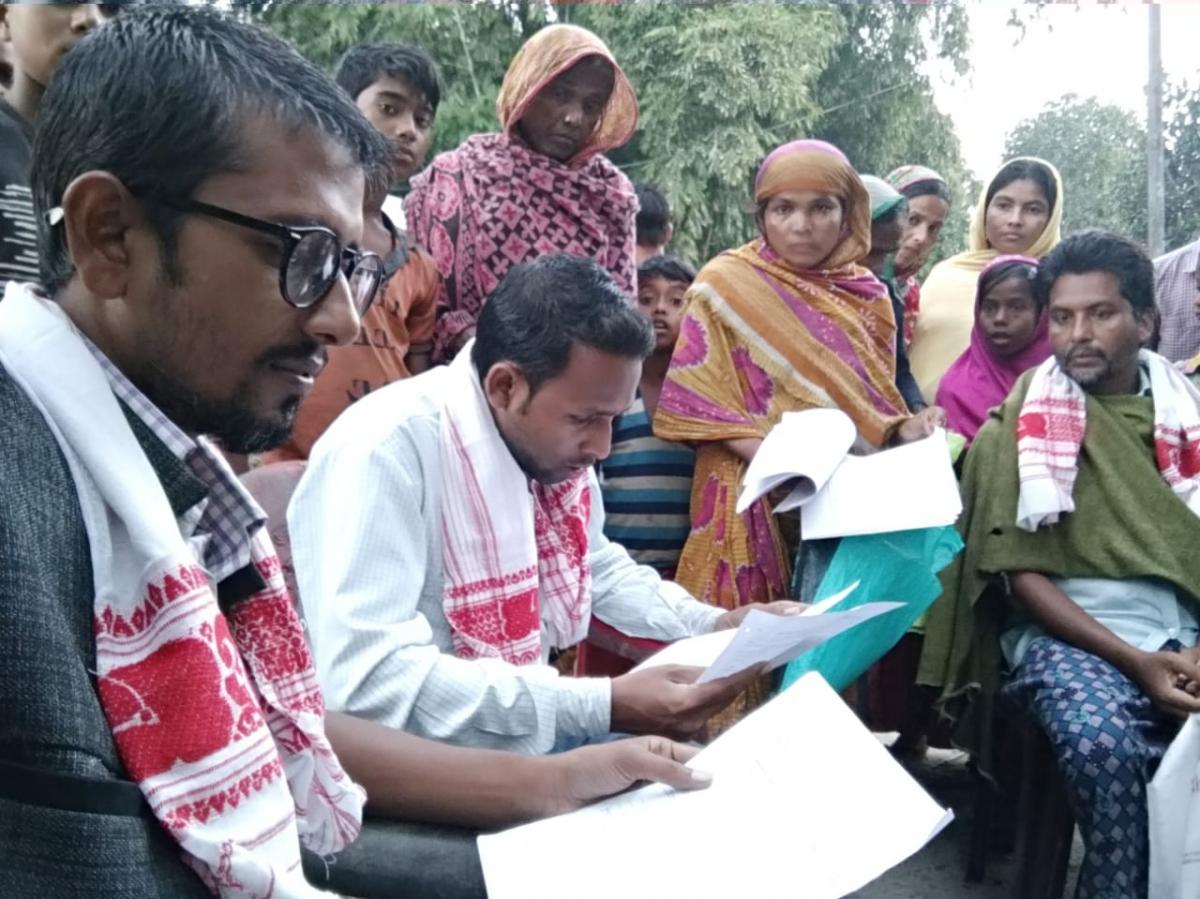
Ayodhya, Lucknow (Uttar Pradesh): Ram Tirath, 55, and his wife Mithilesh Kumari, 50, were squabbling over whom to vote for on May 6, 2019. The couple grow sugarcane and mustard on their 2.5-acre farm in the largely upper-caste village of Palia Pratap Shah in the central Uttar Pradesh (UP) district of Faizabad.

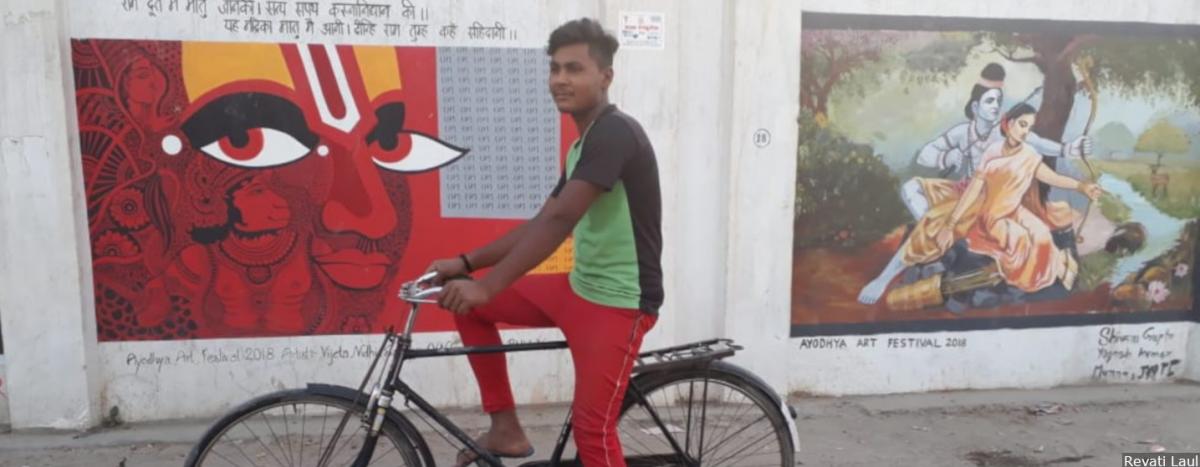
Paintings depicting events in the Ramayana line the streets of Ayodhya, the seat of the Bharatiya Janata Party’s temple politics that began in 1991. Nearly three decades later, in the place where it all started, rural distress and stray cattle are making farmers angry.
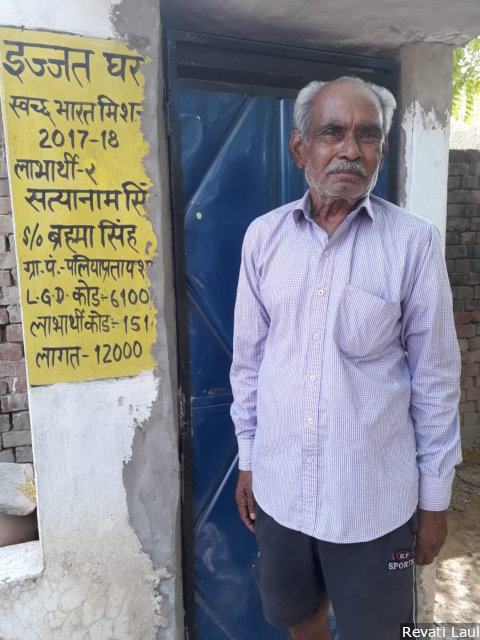
The husband said there was no question of voting for anyone besides the Bharatiya Janata Party (BJP) and Prime Minister Narendra Modi. “Modi gave us Rs 12,000 to build a toilet,” he said, pointing to the toilet labelled izzat ghar (place of pride) in keeping with Modi’s campaign.
It was unused, he admitted soon enough, because there is no water supply to the village. So, it does not make sense to carry buckets of water on one’s head a great distance to flush down a cement toilet far away, he said, when it’s much more sanitary to squat in a field and wash that off with much less water.
Ram Tirath, 55, stands next to the toilet he built with the assistance of the government’s Swachh Bharat scheme, at his home in Palia Pratap Shah in the western Uttar Pradesh district of Faizabad. There is no question of voting for anyone besides the Bharatiya Janata Party and Prime Minister Narendra Modi, he says.
He went on to list Modi’s insurance schemes and the money transfers to poor farmers–Rs 6,000 a year or Rs 500 a month. “At least he’s done that,” he said, before admitting that the main problem in the village were the stray cattle that had eaten up all his sugarcane and sarson (mustard), which he could have sold for about Rs 100,000.
How does the math add up then, to have received Rs 6,000 in cash and lost Rs 100,000, he was asked. Ram Tirath exclaimed that he saw no alternative to Modi. Caste and religion, he admitted later, were overriding factors.
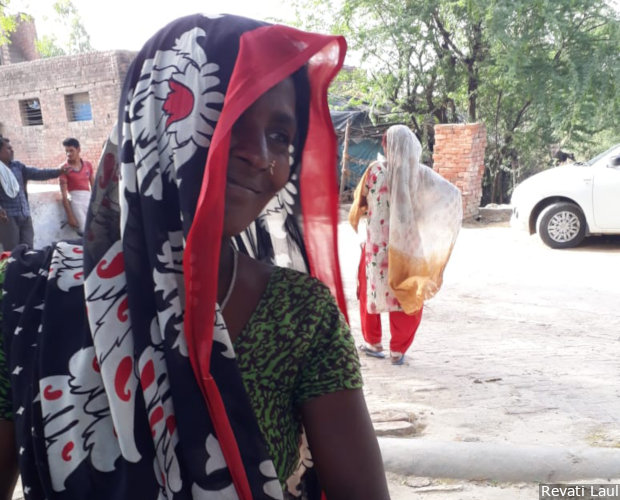
Kumari, the domineering wife, interrupted her husband’s hard-sell of the BJP with a one-liner that silenced him: “Hum nangey hain, aapke paas das kapde hain, hamarey paas ek nahi, be pardey khadey hain, ab aap hamarey upar pardah nahi daal saktey hum aapke peechey kyun marein? (If I am naked and you have 10 pieces of clothing and you can’t even give me one to cover my body with, then why should I run after you?)”
She continued. “Vote barabar dete hain, pichli baar diye they, teli ko. Kuch nahi kiya. (I voted for the man from the Teli caste the last time and he did nothing),” she said, referring pejoratively to Modi’s caste. By now, a few people had gathered to watch her take on her husband.
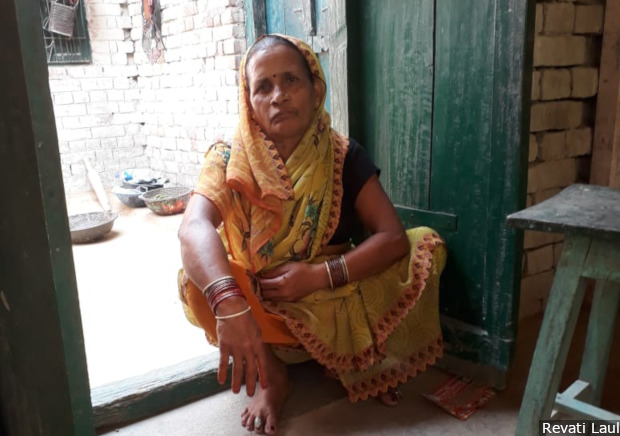
The question of whom to vote for in the election turned into a squabble between Mithilesh Kumari, 50, and her husband Ram Tirath. Kumari is disillusioned with the Narendra Modi government, she says, adding that she will not vote for anyone.
She ended with a critique of the BJP’s Ram mandir campaign. “Masjid toota woh sahi hua. Lekin mandir bana nahi na banega (It was right for the Babri masjid to have been brought down. But the Ram temple has still not been built in its place, nor will it be built),” she said, referring to the December 6, 1992, demolition of the Babri Masjid. “Modi ji bhi kehtey they ki baneyga, hoo haa hoo haa… uske baad khatam ho gaya. Ab phir Modi khadey hain toh ab kya karenge, kuch nahi. Dekhiye (Modiji had made a big hoo-haa about it the last election and nothing happened. And nothing will get done this time either, wait and watch),” she added.
She said she will not vote for anyone this time.
This is the fourth in a six-part series on the Hindu vote in Uttar Pradesh, India’s most hotly contested electoral battleground, which accounts for 80 of a total of 543 Lok Sabha seats (you can read the first part here, the second here and the third here). Awadh has 17 Lok Sabha constituencies, including Faizabad and Lucknow and the Congress party’s bastions of Amethi and Rae Bareli. About 32 million voters in the region will vote on May 6, 2019.
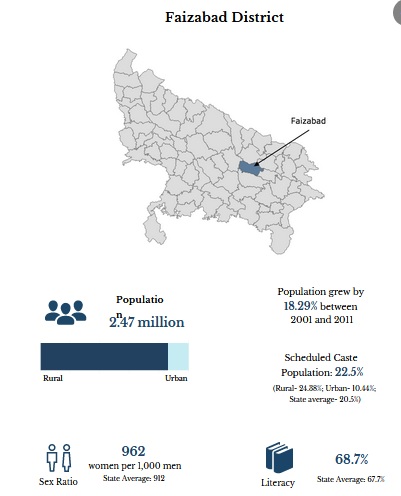
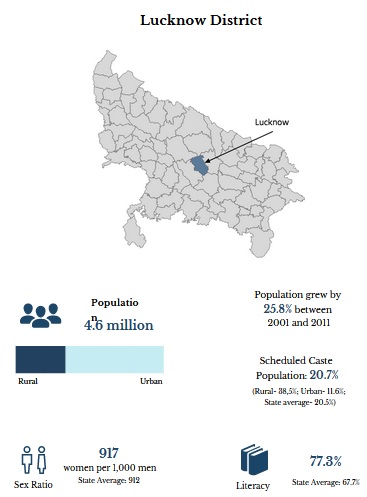
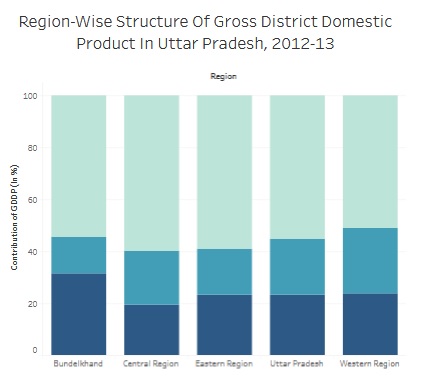
Source: District Census Handbook, 2011 census
Ayodhya, the seat of the BJP’s temple politics
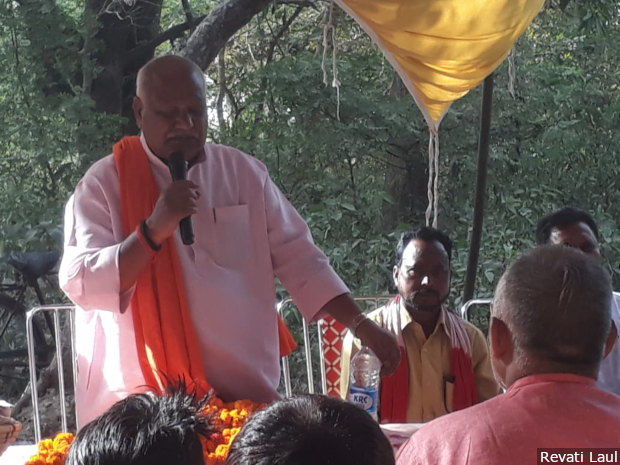
A little distance away in the same village, 64-year-old Lallu Singh, member of parliament (MP) from Faizabad constituency, and seeking re-election, had arrived. It was 45 degrees outside. Singh heaved himself out of his SUV. He needed help with getting out, and a party worker rushed to the rescue, bending over so Singh could place his leg on his back to climb out.
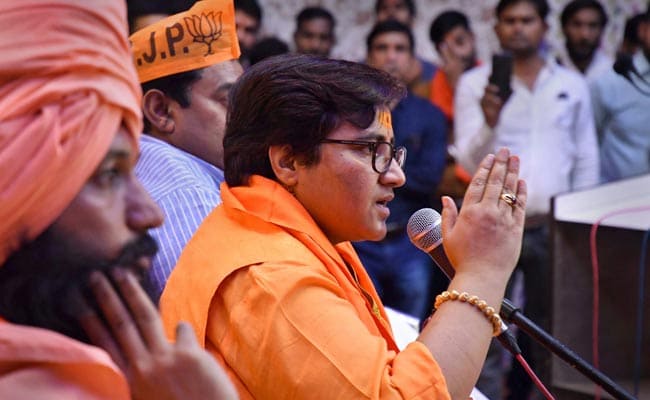
Singh spoke with his eyes shut, avoiding the heat and eye contact, feeding the crowd with a dose of the BJP’s main intoxicant–religion and the protection of Hindus.
Lallu Singh, 64, is seeking re-election to the Lok Sabha from Faizabad constituency. Speaking at a gathering in Palia Pratap Shah village, he feeds the crowd with a dose of the Bharatiya Janata Party’s main intoxicant–religion and the protection of Hindus.
He spoke of the campaign to turn Ayodhya into a world-class tourist spot and the BJP’s plans to turn the perimeter and the various temples and heritage sites–141 of them–into `Bada Ayodhya’ or the Greater Ayodhya circuit. More roads, more highways.
In the audience was a sadhu (priest) in saffron robes and shiny, gold reflector glasses. A man peering at him, who did not want to be identified, made a caustic remark: “This guy is the local mafia man here.”
| Faizabad’s Lok Sabha Members, 1991-2014 |
|---|
| Lok Sabha | Duration | Winning Candidate | Party |
| Tenth | 1991-96 | Vinay Katiyar | Bharatiya Janata Party |
| Eleventh | 1996-98 | Vinay Katiyar | Bharatiya Janata Party |
| Twelfth | 1998-99 | Mitrasen Yadav | Samajwadi Party |
| Thirteenth | 1999–2004 | Vinay Katiyar | Bharatiya Janata Party |
| Fourteenth | 2004-09 | Mitrasen Yadav | Bahujan Samaj Party |
| Fifteenth | 2009-14 | Dr. Nirmal Khatri | Indian National Congress |
| Sixteenth | 2014-Incumbent | Lallu Singh | Bharatiya Janata Party |
Faizabad, recently renamed Ayodhya, is the centre of the BJP’s temple politics that began in 1991, led by then prime ministerial candidate Atal Bihari Vajpayee and party president L K Advani. In the campaign, Advani embarked on a rath yatra in a Toyota bus made to look like a mythical chariot. With this God-like setting, Advani told crowds that a mosque called the Babri Masjid stood at Lord Ram’s birthplace. And that it needed to be replaced by a temple dedicated to Lord Ram.
A year later, on December 6, 1992, thousands of angry Hindu devotees swamped Ayodhya city and brought down the mosque. The site of the Masjid’s demolition is now a mound of mud on top of which sits an idol of Lord Ram, called the Ram Lalla. It is a site that thousands of devotees visit every day, snaking through a long, heavily-armed set of barricades flanked by the army and police in bunkers, armed with automatic rifles.
Devotees weave through five security checks to pray at the shrine, in the hope that the BJP’s promise–to build the Ram temple–will one day come true.
As they made their way to the shrine, a devotee remarked: “Here lies our beloved Lord Ram, in a hut, while we live in air-conditioned apartments. What kind of world is this?” His sentiment was echoed by many as they filed out, shaking their heads, believing that all other political parties save for the BJP were obstructing the construction of a temple–and only Modi (and the BJP) was their protector.
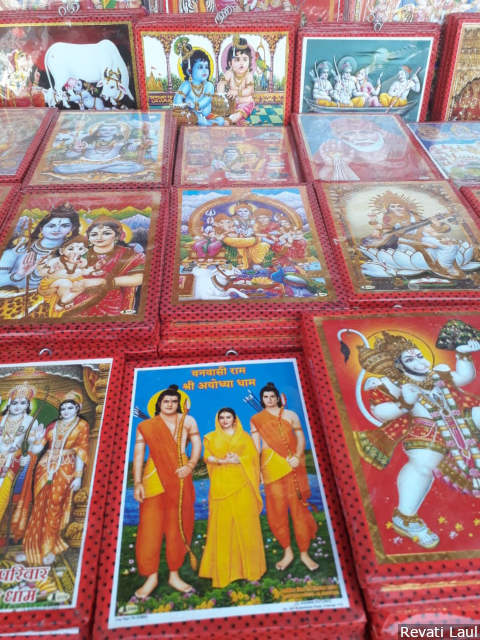
Outside the shrine, hundreds of shops sell articles of worship and pictures of Gods. The most frequent depictions are stills from the television series on the Ramayana, produced by Ramanand Sagar and aired in 1987-88 on state-run Doordarshan TV–the only television network that existed in the late 1980s.
Articles of worship and pictures of Gods–some of them depicting the stills from the television series on the Ramayana that aired in 1987-88 on state-run Doordarshan TV–on display in stores outside the shrine at Ayodhya.
Three years after this television series became a national sensation, Advani and Vajpayee used the iconography from the series in their Ram Janmabhoomi campaign. Now, posters from that serial, re-runs of which are still telecast, are sold as pictures depicting Lord Ram, Sita and Lakshman, in Ayodhya, pop-culture morphed into the politics that has dominated the Awadh region since.
Now, nearly three decades later, the site is the subject of a court dispute, but it continues to be the front and centre of the BJP’s campaign across 17 districts of central UP or the Awadh region–with Ayodhya its emotional register and Lucknow, at the other end of the region, its political centre.
Lucknow, where political aspirations find a home
Rakesh Pandey’s father had to sell a family plot on the highway to pay for his education. Conscious of his father’s sacrifice, Pandey spent his summer breaks finishing the math and science syllabus even before the semester began. His village did not have electricity, and this meant relocating at the age of five–moving 840 km from Kushinagar in the easternmost part of UP where he was from, to the westernmost district of Bulandshahr. This so he could live with his uncle, whose village had electricity.
When Pandey was midway through his engineering degree, his father lost his job at a sugar mill. Pandey had no money to pay his final semester fee and was being stopped from taking the exam. But Pandey’s resolve to study was so strong that he threatened the director of his college that he would jump off the building if he wasn’t allowed to take the exam. The director–out of fear, guilt and admiration–paid Pandey’s fee.
After turning himself into a teacher and an engineering coach, Pandey wanted more. The year was 2011. Pandey was teaching in the Noida region that abuts the national capital, when the city was overtaken by Anna Hazare and Arvind Kejriwal’s anti-corruption movement.
Pandey was swept by the tide, turning into a young man who wanted to change the world. He also took the civil services exam, but failed to clear it. “So I asked myself what else can I do, and the answer was politics,” he said.
But the party of aspiration and success Pandey found himself eventually gravitating towards was not the party Arvind Kejriwal created–not the Aam Aadmi Party. He saw, instead, in the BJP a much larger vehicle of aspiration and political success.
So, he returned to UP from Delhi and started frequenting the Lucknow office of the BJP until he made his way into the party’s IT cell. Within two years, by the start of 2019, he had impressed enough people in the state to be moved to the election management team.
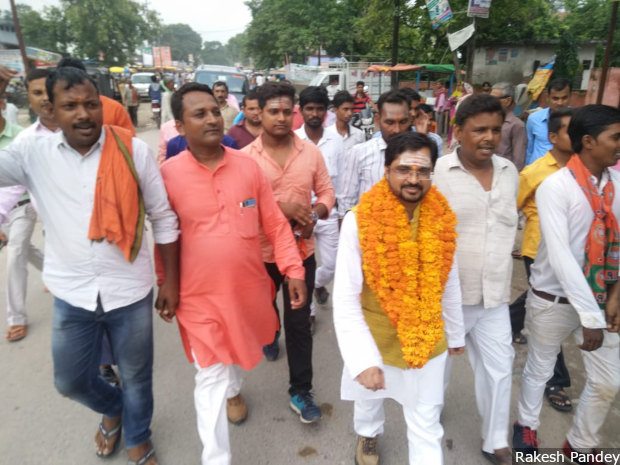
Rakesh Pandey (in white) participates in a rally in Uttar Pradesh’s Kushinagar taken out to mark his initiation into the Bharatiya Janata Party’s (BJP) IT cell. At age five, Pandey moved 840-km to his uncle’s home to be able to study under a lamp. Moved by Anna Hazare’s 2011 anti-corruption movement, he joined politics: He chose not the Aam Aadmi Party, but the BJP. (Photo courtesy: Rakesh Pandey)
Seated in a comfortable air-conditioned room in Lucknow’s prime real estate zone Hazratganj, Pandey squinted over his glasses as he threw a number up in the air like a challenge: That there are over 4 million volunteers and workers on the ground for the BJP this election in Uttar Pradesh alone.
No other party can possibly beat those numbers, the Modi fan suggested as he stirred his coffee. The 37-year-old leaned back in his chair in the sparsely done flat he was allotted by the party in an apartment complex meant for state assembly legislators. As part of the BJP’s UP election team, poring over numbers and working the phone lines to make sure each electoral booth has people on the ground, Pandey has earned the right to a comfortable home for the first time in his life.
Pandey broke down the BJP figure of 4 million: India’s most populous state, which accounts for a fifth of the country’s population sends about a sixth (80 of 543) of all MPs to the Lok Sabha. The state also has 163,000 election booths. The BJP has a team of 21 people per electoral booth, which adds up to 3.4 million people. In addition, there are farmers’ collectives, women’s collectives and a slew of allied groups that take the total to over 4 million.
Every bit of the party’s manifesto is in Pandey’s bloodstream–from the claim that the temple for Lord Ram must be built in Ayodhya, to the personification of the party in Prime Minister Modi.
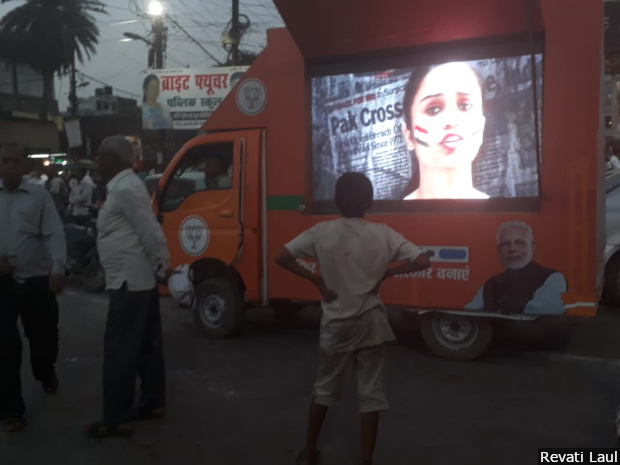
A screen mounted on a carrier plays campaign videos of the Bharatiya Janata Party in Lucknow. The constituency has unfailing voted for the Bharatiya Janata Party since 1991.
Looking at the election from his perspective and other urban aspirants in the city of Lucknow, it would appear that the story of BJP’s consolidation in the state is a foregone conclusion. Lucknow, the capital of UP, has voted for the BJP continuously and unfailingly since 1991.
| Lucknow’s Lok Sabha Members, 1991-2014 |
|---|
| Lok Sabha | Duration | Winning Candidate | Party |
| Tenth | 1991-96 | Atal Bihari Vajpayee | Bharatiya Janata Party |
| Eleventh | 1996-98 | Atal Bihari Vajpayee | Bharatiya Janata Party |
| Twelfth | 1998-99 | Atal Bihari Vajpayee | Bharatiya Janata Party |
| Thirteenth | 1999–2004 | Atal Bihari Vajpayee | Bharatiya Janata Party |
| Fourteenth | 2004-09 | Atal Bihari Vajpayee | Bharatiya Janata Party |
| Fifteenth | 2009-14 | Lalji Tandon | Bharatiya Janata Party |
| Sixteenth | 2014-Incumbent | Rajnath Singh | Bharatiya Janata Party |
But step outside the cities, and the Awadh region’s political picture is far more complex than a surface-level reading of Hindutva or Hindu proselytisation suggests.
The caste mathematics
The BJP candidate for Misrikh constituency, adjoining Lucknow, Ashok Rawat went from village to village. He was aware that with the opposition parties–the Bahujan Samaj Party (BSP) and the Samajwadi Party (SP)–having stitched together an alliance, a lot will depend this time on the caste calculus rather than a saffron one.
The 43-year-old’s politics are also centred on caste. He comes from a scheduled caste called the Pasis. He was with the BSP until the last elections and was invited into the BJP. The party was aware of the political heft of Rawat’s community.
The Pasis are the second-largest scheduled caste group in the region, following only the Jatavs–BSP leader Mayawati’s caste. As Rawat hopped from village to village listing the Modi government’s achievements, he also worked the caste math.
“There are 300,000 Jatavs (who will vote for the BSP), 100,000 Yadavs (who will vote for the SP) and 250,000 Muslims (who will also vote for the SP),” said Rawat. “That’s 650,000 votes in all, of a total voting population of 1.76 million voters.”
“Baaki votes hamarey (The rest will vote for us),” he said. “Or at least 60% of them, of which there are 250,000 Pasis, 250,000 Brahmins, 100,000 Thakurs and Kshatriyas, and 450,000 voters from other backward classes.”
These communities are seen as traditional catchment areas for the BJP. Since they view the BSP as pro-dalit and the SP as pro-Muslim, these groups by default stack up with the `Hindu-leaning’ party.
The British annexation of Awadh, and the modern political rhetoric
In an election season, Prime Minister Modi is re-packaging an old political idea from the region, borrowing as it were a leaf out of the British colonisers’ method of decimating the opposition. Lucknow, or the central region of UP, was once Awadh, or Oudh in British lexicon.
It gets its name from the region that was once a kingdom established in the 16th century by the Mughal emperor Akbar. When it was taken over by British colonisers in 1857, they made out a case of misrule by the previous dynast Wajid Ali Shah: Muslim misrule, the British alleged, as they annexed the kingdom and crushed the revolt. The British made sure they caricatured the king as a wastrel and a debauched ruler. Those paintings and their replicas are found all over cities across the region with Wajid Ali Shah’s bare breast hanging out of his coat.
Two-and-a-half centuries later, Prime Minister Modi and an army of many million are making out a case of misrule by all others. As Rawat entered the large maidan in the town of Hardoi, where Prime Minister Modi was campaigning for the region, the message was clear: It’s Modi versus misrule, Hindu dominance seeking to erase a syncretic medieval past, in a region with a history of people not doing their masters’ bidding.
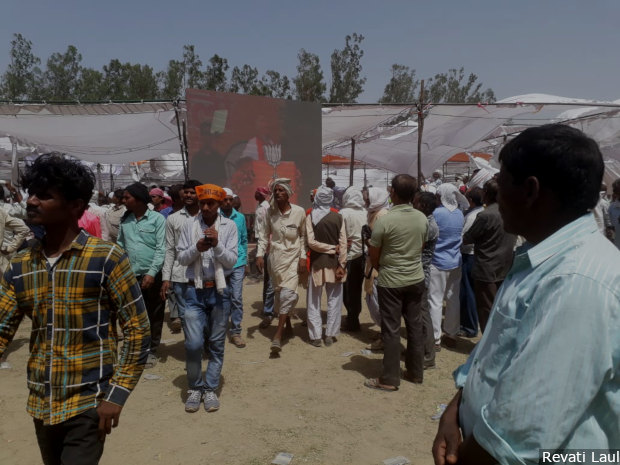
People watch Prime Minister Narendra Modi on a screen as he speaks at a gathering of more than 200,000 people in Uttar Pradesh’s Hardoi town. Two-and-a-half centuries after the British annexed Awadh citing Muslim misrule, Modi makes out a case of opposition misrule in the region.
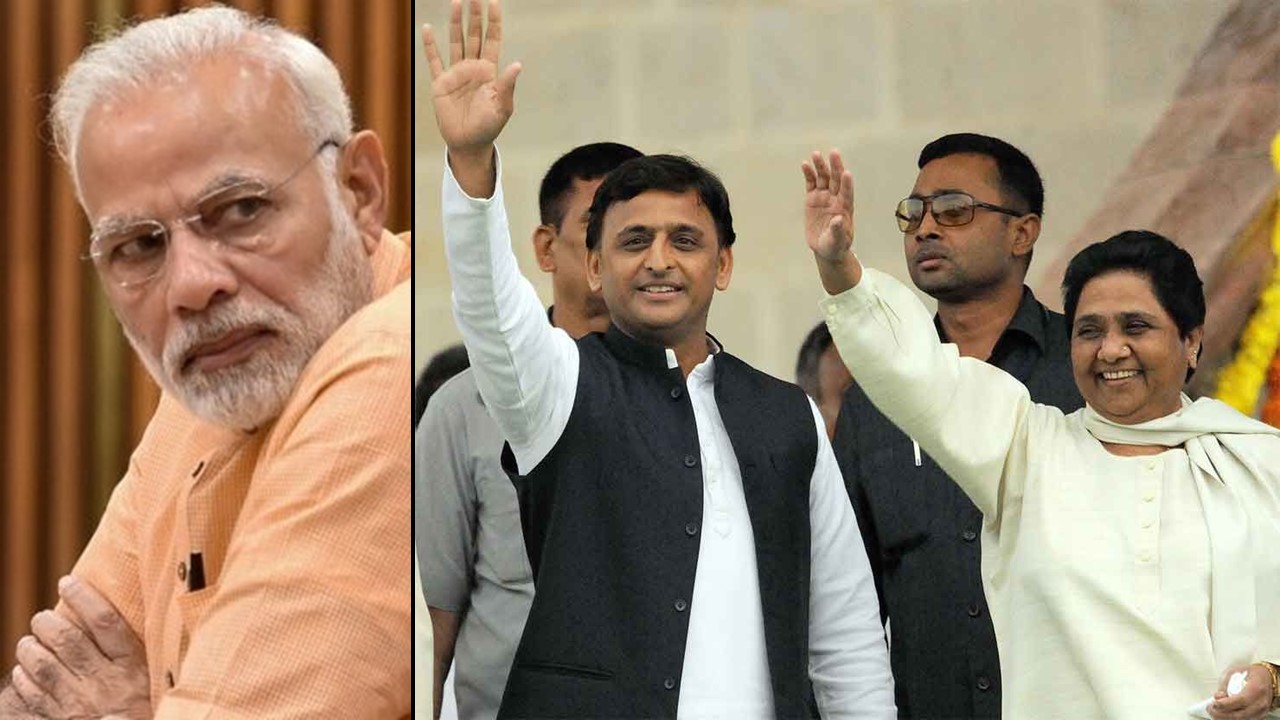
More than 200,000 gathered to listen to Modi in a large maidan in the town of Hardoi, as the campaign got raised to a fever pitch by party leader Naresh Aggarwal, who started by insulting the SP-BSP alliance. “Jab cycle pe haathi baith jayega toh cycle chaknachoor hoga. (When an elephant sits on a cycle, the cycle gets smashed),” said Aggarwal, referring to the electoral symbols of the BSP (elephant) and the SP (cycle).
Modi took the invective forward. “The same people who once called Ambedkarites ‘the mafia’…” Modi thundered, referring to the followers of BR Ambedkar, the leader of Dalits and lower castes who also wrote the Indian Constitution, “those same people are now talking about the politics of the lower castes”, the Prime Minister said, referring to the SP, once the political enemy of its current alliance partner, the BSP. “It is only the politics of convenience,” said Modi.
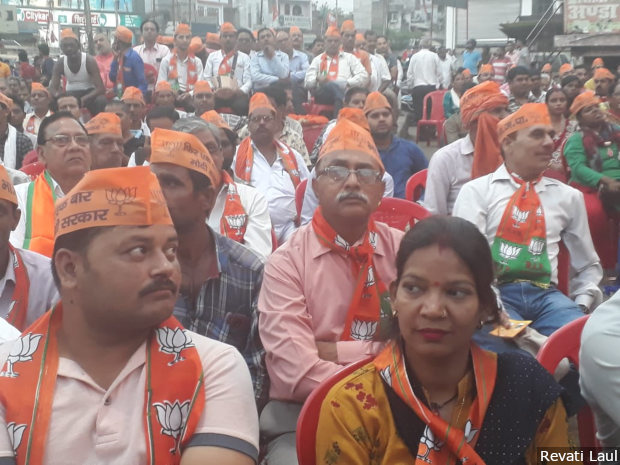
Supporters of the Bharatiya Janata Party sport the party’s campaign material at a rally in Hardoi town addressed by Prime Minister Narendra Modi and the party’s candidate for Misrikh constituency Ashok Rawat.
Cow politics worsens farm crisis
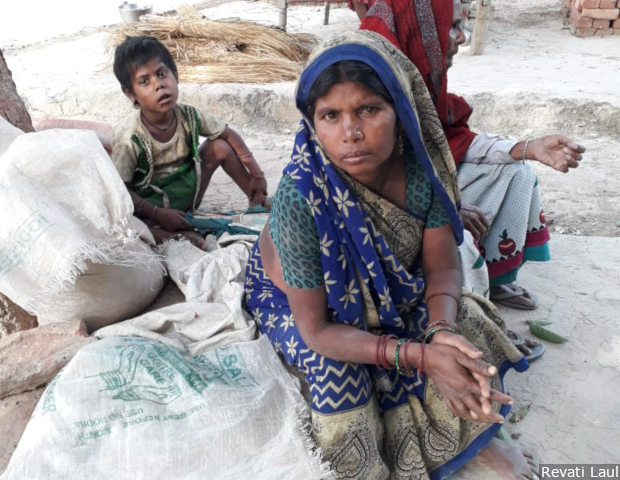
About 50 km away from where Modi and Rawat were campaigning, Raj Rani of the Parshuram caste (another word for the Pasis) twisted coir to make a rope. “Modi kuch nahi kiye hain (Modi has done nothing),” the 55-year-old said flatly, looking up from her rope-making, the sun setting behind her, in the village of Jaraha.
“Modi kuch nahi kiye hain (Modi has done nothing),” says 55-year-old Raj Rani.
Suneeta, aged about 50, also from the same caste, joined in: “There is a huge stray-cattle population in the village which has become a menace.”
“There is a huge stray-cattle population in the village which has become a menace,” says Suneeta in Uttar Pradesh’s Jaraha village. Farmer suffer losses as the stray cattle destroy farms in the region.
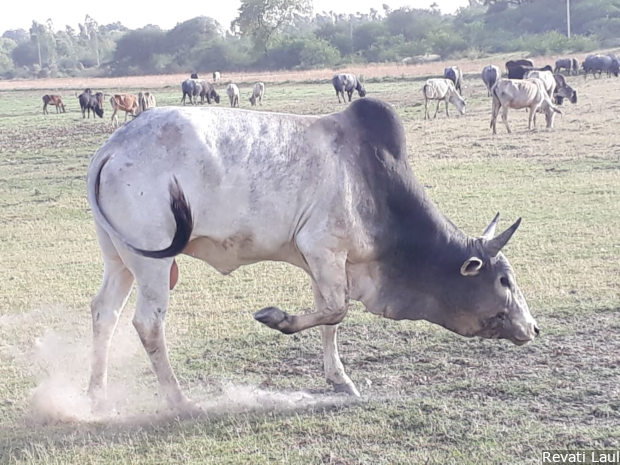
Others added in the missing pieces of the story. Ever since the BJP’s gau-raksha (cow protection) campaign began and vigilante groups started to take the law into their own hands, threatening and killing people for killing cows, the economy of villages like Jaraha have suffered.
Since 2014, 11 people have been lynched in cow-related hate crimes in UP, 73% of them Muslim, the highest number of such attacks in any Indian state, according to a database run by FactChecker.in.
Earlier, when cows were past the lactating age, farmers sold them. Jaraha had two cattle fairs in the year. Selling a male–the bull–or a non-lactating female cow was the farmers’ insurance against distress. This has become even more crucial in a state like UP where more than half the workforce or 55% is entirely dependent on agriculture, which contributes to less than a third of the state’s economic activity.
The picture sharpens when we look closer at how the state’s economy fares region-wise.
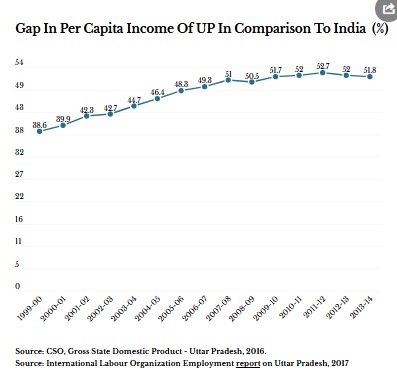
To start with, the gap in the average person’s income in UP (the per capita income–income divided by population of the region) has grown less than in the rest of the country (see below). This means economic distress. Farmers can ill afford to lose additional sources of income, such as, cattle.
In central UP, primarily the Awadh region, agriculture forms the smallest slice of the economy. Although it is what half the state leans on for its income, it yields less than 20% of the region’s income.
Source: International Labour Organization Employment report on Uttar Pradesh, 2017
Ram Kisan Maurya showed this reporter the common grazing area in the village now populated with stray cattle. He was also from a scheduled caste community and angry at the BJP government in the state and the Centre for his predicament.
“Pehle hazaaron me biktey they. Aamdani bhi hoti thi (Earlier, cattle sold in these parts in the thousands),” Maurya said, adding, ”Gai bech diye kuch paise bachey kapdey le liye. Bikega nahi toh palega kaun? (We spent the money we got from the sale on buying clothes and other basics. If we can’t sell them, how are we expected to keep them and keep feeding them?)”
Stray cattle graze in a field in Uttar Pradesh’s Jaraha village. Cow vigilante attacks worsen farmer distress, with stray cattle destroying crops in Awadh region.
While anger from within the BJP candidate’s own community may upset his caste calculation, it wasn’t quite clear if this anger would translate into votes of dissent. In a region already faced with rural distress and urban unemployment, some said it was best to vote for whoever the village headman advised them to.
In Jaraha village, the man in charge is upper caste: Amit Kumar Singh. It is actually his wife who is the village pradhan (head), but in a patriarchal set-up, the man controls the village in the name of his wife.
Singh is a local leader from the SP. However, he said, he liked Rawat, the BJP candidate from Misrikh, and has been loyal to him for over a decade. So, he was asking everyone to vote for the BJP, despite being from the opposition.
Singh went with Ashok Rawat to Hardoi, to the Modi rally. At a party office in the region, one of his supporters who did not want to be named bragged about adding essential fuel to the campaign to ensure large crowds for the rally: Whisky.
“Two bottles of Black Dog per house or 5,000 bottles,” the man claimed. Later, this reporter found a drunk man at the head of Jaraha village who claimed to be a beneficiary of this largesse.
If in Misrikh region, abutting Lucknow, a leader from the opposition party is canvassing for the BJP whilst in Ayodhya, the seat of the party’s temple politics, an upper caste woman speaks openly against the party, it is possible that the math on either side may not add up exactly the way the BJP has planned–even with a possible army of 4 million people at work.
This is the fourth in a six-part series on the Hindu vote in Uttar Pradesh. You can read the first part here, the second here and the third here.
(Revati Laul is an independent journalist and film-maker and the author of `The Anatomy of Hate,’ published by Westland/Context in December 2018. She tweets @revatilaul)
We welcome feedback. Please write to respond@indiaspend.org. We reserve the right to edit responses for language and grammar.
Courtesy: India spend