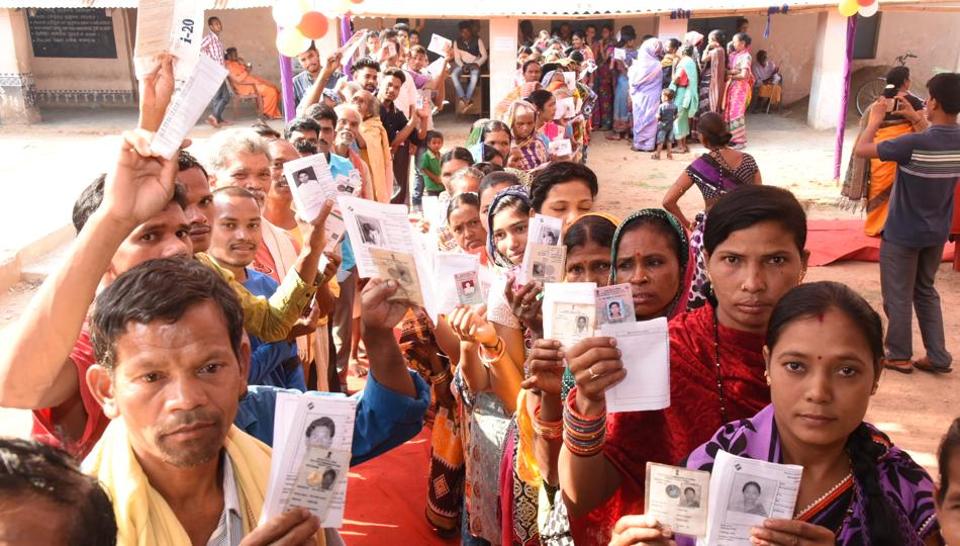
There were reports of altercations between supporters of TMC, BJP and CPI (M) from several polling booths in the constituency. BJP MP and Union minister Babul Supriyo’s car was vandalised during the clash.
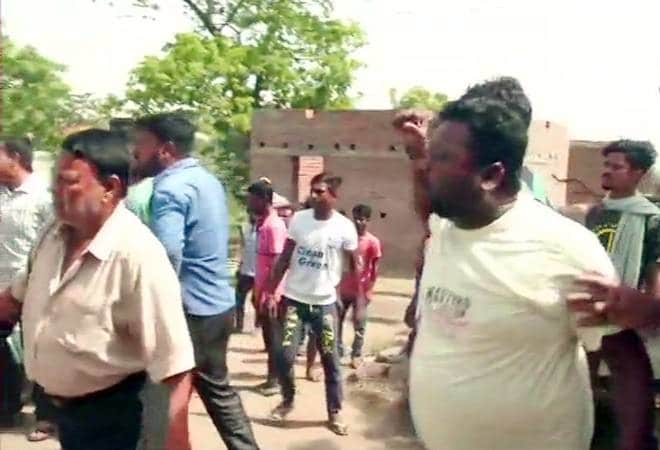
Kolkata: Security forces resorted to lathi-charge on Monday at a polling station in Asansol parliamentary constituency after clashes erupted between TMC and BJP supporters over allegations of electoral malpractices. There were reports of altercations between supporters of TMC, BJP and CPI (M) from several polling booths in the constituency.
Bharatiya Janata Party MP and Union minister Babul Supriyo’s car was vandalised during the clash.
The clash broke out after Trinamool Congress workers insisted that voting continue despite the absence of central forces at the polling booth. Workers of the Bharatiya Janata Party and the Communist Party of India (Marxist) opposed this, according to NDTV. Clashes were reported outside booth number 125-129 and 199 in Asansol, ANI reported.
Supriyo, the sitting MP and BJP’s candidate from Asansol, said people in West Bengal were aware that central forces were not stationed at the polling booth and that they wanted security personnel present there to cast their vote. “I will myself take the central forces to that polling station,” ANI quoted him as saying. “Mamata Banerjee is scared of democracy, that’s why this is happening,” he said, according to NDTV.
Supriyo is contesting against the CPI(M)’s Gouranga Chatterjee, Trinamool’s actor-turned-politician Moon Moon Sen and Congress’ Biswarup Mondal. Eight constituencies in West Bengal are voting on Monday.
Moon Moon Sen said was unaware of clashes in her Asansol constituency as she had “woken up late”. “They gave me my bed tea very late so I woke up very late. What can I say? I really don’t know,” she was quoted as saying by NDTV.
#WATCH Clash between TMC workers and QRF and security personnel outside polling booth number 125-129 in Asansol, after disagreement erupted between BJP & CPI(M) workers after TMC workers insisted on polling despite absence of central forces. #WestBengalpic.twitter.com/wmTE97gY4i
Villagers boycotted polls at polling booth numbers 222 and 226 in Jemua of Bardhaman constituency as central forces were not present, ANI reported. Voting was suspended at the polling station as voters reportedly staged a protest.
Clashes also took place between workers of the Trinamool Congress and Bharatiya Janata Party in Nanoor under Birbhum, reported India Today. The villagers had reportedly alleged that Trinamool Congress workers were threatening them.
A Trinamool Congress (TMC) delegation led by party MP Shukhendu Shekhar Roy on Monday sought time from Chief Election Commissioner (CEC) West Bengal regarding the violence caused during polling in Asansol Lok Sabha seat. EC’s response is awaited.
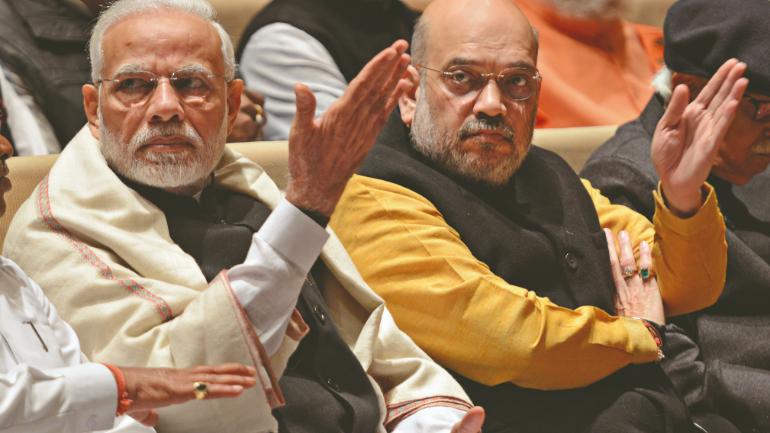
New Delhi: Supreme Court (SC) has agreed to grant an urgent hearing to a plea by Congress over the laidback response of the Election Commission (EC) against the gross model code of conduct (MCC) violations by Prime Minister Narendra Modi and BJP President Amit Shah.
Image Courtesy: Pankaj Nangia/Mail Today
Senior advocate and Congress leader Abhishek Manu Singhvi, who was appearing for Sushmita Dev, president of All India Mahila Congress, alleged that Modi and Shah have violated the MCC by indulging in hate speeches to polarise the voters and using the armed forces for ‘political propaganda’ since the day Lok Sabha elections were announced. It then accused the EC for a ‘less-than-a-lukewarm response’ to the numerous complaints.
The Congress has alleged that despite the EC clearly directing the political parties to not mention the defence forces in the election campaigns, as they are apolitical and neutral stakeholders in a modern democracy, the BJP, specifically Modi and Shah, have been using the Balakot air strike as their party’s courageous achievement.
On April 9, at a rally in Latur, Modi had urged the first time voters to dedicate their votes to the defence forces. Modi said, “I want to ask the first-time voter, can your vote be dedicated to those soldiers who conducted air strike on Balakot in Pakistan? Can your first vote be dedicated to those soldiers who were killed in Pulwama attack?” Adding further, he said, “We have ensured that terrorists are identified and killed, even if we have to enter other countries to do so.” Nine days after a Kolhapur-based individual, Mahendra Singh, complained to the EC, it said that it was still reviewing the speech. A controversy had broken out when the complaint went missing from the EC’s website which was later said to be a ‘technical glitch.’ The EC then sought an explanation along with the speech transcript from the Maharashtra Chief Electoral Officer.
At another rally in Surendranagar, Gujarat, on April 17, Modi again brought up the Balakot air strike and said “Earlier terrorists from Pakistan would carry out attacks in our country and go back unscathed, threatening to launch their nuclear bombs if we retaliate. But we have the nuclear bomb of nuclear bombs. I told them to do what they want (but we will retaliate).” Later, at a public meeting in Sitamarhi, Bihar, Amit Shah praised Modi for his valiant response to cross-border terrorism for national security and said, “India is only the third country after Israel and United States to have retaliated to terrorism in this brave manner.”
The petition even mentions the roadshow-type-event and Modi’s speech after he cast his vote in Ahmedabad on April 23 saying that it is a violation of the MCC. Congress had approached the EC; however, it hasn’t responded yet.
Earlier this month, Uttar Pradesh Chief Minister Yogi Adityanath also triggered a controversy by referring to the Indian Army as “Modiji ki sena (PM Modi’s army)” – an assertion that was condemned by opposition parties as well as Army veterans.
The EC had even earlier drawn ire from the SC for its lenient approach towards the ruling party members this election season. Even the senior Congress leader P. Chidambaram accused the EC of failing to perform its duty and having a biased approach by brazenly ignoring the violations by the BJP. “According to me, the Election Commission has largely failed the people of India. It has been a silent spectator to the excesses of the BJP, Mr Modi’s utterances and the enormous amount of money that has been spent by the BJP,” Chidambaram said.
The petition states, “The lack of decision despite cogent evidence, representations and exhortations to the Election Commission demonstrates abdication and indecision and a complete absence of justice, in ensuring a level playing field.” It further argues that the EC has been quick in acting against other candidates but has been “guarded and oblivious” to the complaints and evidence given by the Congress against Modi and Shah.
“The slow response of the ECI in this regard is also contended to be a tacit endorsement of Modi’s and Shah’s conduct, in effect giving them a clean chit despite MCC violations,” the petition said. It further noted that any action by the EC after the elections are over will be meaningless. Such “deliberate and wilful violations”, when unaddressed, “send a message of endorsement, not just to the offenders, but to all party functionaries down the line”, it said.
The petition has asked the court to direct the EC to expeditiously decide the complaints filed against Modi and Shah, “without any delay or demur, and in any case not later than 24 hours from the [court’s] order”.
The matter is scheduled to be heard on Tuesday by a SC bench headed by the Chief Justice of India (CJI), Ranjan Gogoi.
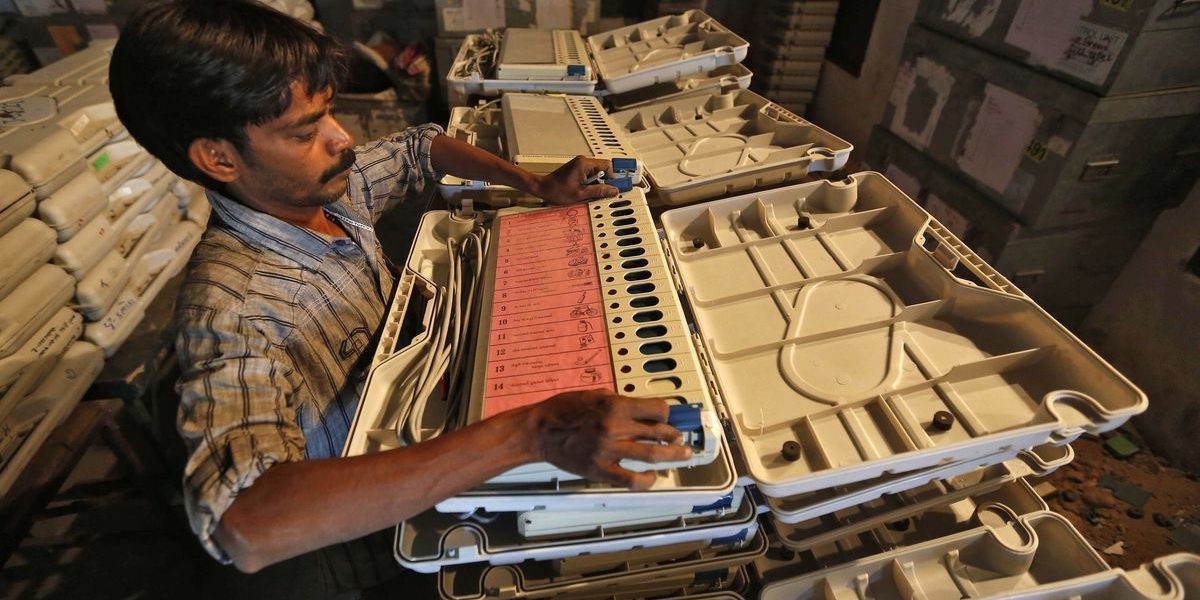
Following a series of complaints against the provision for punishing people with fines and imprisonment in case their complaint against a mismatch in their vote and VVPAT reading cannot be corroborated during verification before election officials, the Supreme Court, while hearing a PIL on the matter, has now issued notice to the EC.
CJP was the first complainant when we wrote to the Election Commission highlighting how provisions of Rule 49 MA of the Conduct of Elections (Amendment) Rules 2013 can be a deterrent to the democratic process by discouraging genuine complainants.
Under this provision, the complainant is required to give a written declaration that says, “I am aware of the penal provisions of section 177 of the IPC that I shall be liable to be punished with imprisonment for a term which may extend to six months, or with fine which may extend to one thousand rupees, or with both, if the declaration given by me in para 1 above to the Presiding Officer appointed under section 26 of the RP Act, 1951 is found to be incorrect.”
The rule not only puts the fear of punishment in the complainant, it also fails to take into account the possibility of mismatch due to malfunction or hacking.
Activist Philose Koshy had also raised the issue in his letter to the EC. Mumbai based lawyer Sunil Ahya then filed a PIL highlighting how placing the onus of proving the complaint would dissuade people from coming forward. Ahya’s petition also said, “This may also create an illusion of free and fair elections, whereas the fact would be that people have simply not come forward to lodge complaints.” The petition prays for a direction to the EC to set aside rule 49MA.
Earlier, BJP President Amit Shah had said that Mamata was protecting Bangladesh infiltrators. He also said that the WB chief minister was opposing NRC in Assam due to ‘vote-bank politics’.
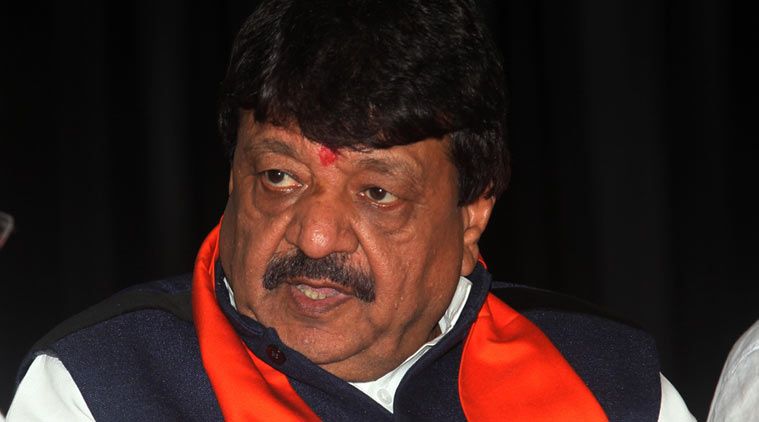
Kolkata: Senior BJP leader Kailash Vijayvargiya said on Sunday that if the Mamata Banerjee-led Trinamool Congress is not removed from power soon, West Bengal would “become like Jammu and Kashmir” in the face of threats from terrorist organisations like ISIS.
“If Mamata ji stays, Islamic State (ISIS) can enter West Bengal anytime. It will become like Jammu and Kashmir. It is because of her appeasement politics that people related to terror activities have made their base in the border-states and ISIS threat is a proof of that,” Vijayvargiya said while speaking to reporters. He was hinting at rising communal tensions under Mamata’s government.
Kailash Vijayvargiya, BJP: If Mamata ji stays, Islamic State (ISIS) can enter West Bengal anytime. It’ll become like J&K. It is because of her appeasement politics that people related to terror activities have made their base in the border-states & ISIS threat is a proof of that. pic.twitter.com/j2znRhYWyU
Soon after claiming responsibility for the deadly serial blasts on Easter Sunday in Sri Lanka killing more than 250 people, an ISIS telegram channel released a poster in Bengali last Thursday which says “Coming soon” hinting at possible attacks in Bangladesh or West Bengal. Intelligence agencies have been on high alert, anticipating a terror attack.
The BJP has been accusing Mamata Banerjee of being sympathetic to Muslims coming from across the border such as Bangladesh and Myanmar. Earlier, BJP President Amit Shah said that Mamata was protecting Bangladesh infiltrators. He also said that the WB chief minister was opposing NRC in Assam due to ‘vote-bank politics’.
Addressing a rally, Amit Shah said that Mamata Banerjee protested against Bangladeshi infiltrators in 2015, but she did that because they were Left’s vote bank. “Now these Bangladeshis are TMC’s vote bank and therefore she is against the NRC,” he added.
The BJP president asked that Mamata and Congress leaders should specify whether they wanted to protect the country or not. “I want to ask you (people), aren’t Bangladeshi infiltrators a threat to India? Shouldn’t we drag them out? We are members of the BJP. For us, the country comes first, and not vote bank politics,” he said.
Polling for the 42 seats of West Bengal has already begun. In the first three phases, 10 seats went for voting but it was largely marred by violence and EVMs glitches. In the fourth phase, 8 seats will go to polls. In 2014, the TMC had won 38 seats, while BJP got two seats.
With 80 seats in the Parliament Uttar Pradesh has the highest number of MPs. As the state enters the fourth phase of elections, several key constituencies go to polls. These include Unnao, Jhansi, Etawah, Kannauj and Kanpur.
Unnao: Unnao shot into the national spotlight after a BJP MLA was accused of kidnapping and raping a minor girl. As the constituency goes to polls today, the options before the electorate for an MP are as bleak with all major candidates having criminal charges against them. Unnao is India’s largest constituency with over 18, 97,474 voters.
If BJP’s Sakshi Maharaj, who is the incumbent, has over 30 cases including robbery and murder against him, Congress’s Annu Tandon has been accused of hiding black money worth over Rs 400 crores in Swiss bank accounts. Meanwhile, Samajwadi Party’s Arun Shankar Shukla is an accused in the infamous guest-house scandal that rocked the state in the mid-nineties. He has also been accused in a few cases of land grabbing.
Jhansi: The land of Queen Lakshmibai also goes to polls today. Though the current MP is veteran BJP heavyweight Uma Bharati, the party has fielded Anurag Sharma instead of her as Bharati was not inclined to contest. Sharma, son of Pt Vishwanath Mishr, heads the Bundelkhan Ekikaran Samiti that wants to carve out a separate state of Bundelkhand. The Congress candidate is Shiv Sharan Kushwaha and the Mahagathbandhan has fielded Sundar Singh Yadav of the SP. Caste plays an important role in this constituency that has sizable populations of Kushwahas, Ahirwars, Yadavs and Lodhs. There are also a large numbers of Brahmins and Jains. Jhansi is also home to over 1.5 lakh Muslim voters.
Key issues in this drought-prone region are water scarcity, unemployment and inadequate healthcare facilities.
Etawah: This is one of the most electorally unpredictable constituencies in UP. Etawah has elected MPs from the INC, BJP, SP and BSP in the past. The current MP is Ashok Kumar Doharey, who was previously with the BJP. But he jumped ship to the INC at the eleventh hour.
So, now the BJP has fielded Ram Shankar Katheria who was originally hoping to contest from Agra, but was denied a ticket from there and forced to contest from Etawah against Kamlesh Katheria of the SP-BSP alliance.
Kanpur: This is the constituency of one of BJP’s most formidable leaders, Murli Manohar Joshi. Joshi was part of the party’s original triumvirate along with Atal Bihari Vajpayee and Lal Krishna Advani. Now, Vajpayee is deceased, Advani has been unceremoniously dropped from his traditional Gandhinagar seat to make way for Amit Shah, and Joshi has also been denied a ticket this time. Instead the BJP has fielded Satyadev Pachauri. It will be interesting to see if the gamble pays off, given how there is growing dissent among ground level workers over the manner in which stalwarts were snubbed.
The Congress candidate is Sriprakash Jaiswal and the SP had fielded Ram Kumar.
Kannauj: A Samajwadi Party stronghold, this is the constituency of Dimple Yadav. But she has a formidable adversary in the BJP’s Subrat Pathak. Dimple had been elected unopposed in 2012 when her husband Akhilesh vacated the seat to become Chief Minister. She had also defeated Pathak by a wafer thin margin of 20,000 votes in 2014. Interestingly, Dimple’s father-in-law Mulayam Singh’s brother Shivpal Yadav’s Pragatisheel Samaj Party (PSP) withdrew its candidate Sunil Kumar Singh Rathore at the last minute. The fate of this constituency will be decided by the agrarian community that has been on the edge for the last few years. Potato farmers in particular are deeply upset with government policies. The caste quotient is also important given the large population of Yadavs, Lodhs and a few other OBCs. There is also a sizable Muslim population.
The civil rights organisation has demanded a free and fair inquiry on Mohd. Ramzan’s custodial death urgently. He was an inmate of Baran Jail who died due to custodial violence by the police guards of the Prison Ward of Kota Medical College Hospital on April 26.
Jaipur: Kavita Srivastava, the President of the People’s Union of Civil Liberties (PUCL) wrote a letter to the Chairperson of National Human Rights Commission (NHRC) New Delhi, demanding their immediate intervention in the matter of the custodial death of Mohd. Ramzan, an inmate of Baran Jail due to custodial violence by the police guards of the Prison Ward of Kota Medical College Hospital on April 26.
“Mohammaed Ramzan, son of Hafiz Alimuddin, resident of Mangrol, District Baran, Rajasthan was imprisoned in Baran Prison under the charges of Section 347 of the Indian Penal Code i.e. wrongful confinement to extort property, or constrain to an illegal act. He was awarded two-year imprisonment by the sessions court of Baran. He was out on bail when the High Court of Rajasthan rejected his appeal, he was arrested again in 2018 and put in Baran Jail. Subsequently, a Special Leave Petition was also filed in Supreme Court for bail, but the SLP was rejected,” she wrote.
Ramzan complained of liver and other gastro problems, so he was referred to the Kota Medical College for treatment. In the Jail ward of the Kota Medical College, there is a constant rotation of 4 guards sent by the police. A video which surfaced before the demise of Ramzan, shows him telling that three of these guards only had beaten him up very badly. He says the guards were inebriated on alcohol and would beat him up when he would cry up in pain. Upon talking to the Rizwan, son of Ramzan, he informs us that these guards would ask for Rs 500/- for each meeting of the family with the patient, so the family had complained about this demand to higher authorities, which has worsened the relationship between Ramzan and the guards, she wrote in the letter to NHRC.
Ramzan was then referred to SMS Hospital Jaipur, the family was informed that a leg of Ramzan had been fractured and needed to be operated upon urgently so they rushed to Jaipur. The family met Ramzan once, this is the day the video was recorded in which Ramzan has given a statement against the guards. They were then denied access to the patient and were later informed that the patient has been transferred back to Kota. The guards on their own volition moved Ramzan back to Kota, denying him proper medical treatment, which went against the advice of the doctors present and treating Ramzan. When the family of Ramzan was rushing to Kota, they were informed by the prison officials that Ramzan has expired in their custody of the police in the ward for prisoners of the Kota Medical College. The death was recorded at 10:30 pm on April 26, 2019, PUCL said in the letter.
“The family refused to take the custody of the dead body of Ramzan, until and unless an FIR was filed against the 4 police guards of the jail ward of Kota Medical College as well as those who took him away from the SMS Medical College, Jaipur. After 14-15 hours, SP Kota City assured the family that an enquiry will be done of the custodial death by a judicial magistrate under Section 176 of the Code of Criminal Procedure. He also informed the family that the four guards have been removed, the nature of removal is unclear, whether is a suspension or a change in duty. Post Mortem has been done by a Medical Board. Upon this reassurance, the family has now taken the custody of the body to go ahead with the burial of the departed man,” the letter stated.
PUCL’s demand:
Immediate lodging of the FIR against the police guards involved in the custodial violence leading up to the death of Ramzan, the police inquiry can run parallel to the judicial inquiry. The police authorities need to answer for the complete lack of due diligence in the above matter.
A detailed inquiry needs to be done by the Kota Medical College Hospital as to how could the prisoner’s ward allows such brazen violence against an ill man.
Compensation to the family of Ramzan.
Both the jails, Baran Jail and Kota Jail should submit a report each to NHRC, SHRC, home secretary and DG Prisons within 24 hours of the custodial death as required by the guidelines of the NHRC
The videography Post Mortem Report and the enquiry report by the Judicial Magistrate must be submitted to the NHRC at the earliest possible instance.
“We would be highly obliged if a free and fair inquiry can be done on Ramzan’s custodial death urgently. Communally targeted violence by the authorities raises a serious concern of human rights violations of minorities present inside the various correctional institutes across the nation. Ramzan’s family has suffered a great loss, and a speedy inquiry would give them some solace in these troubling times,” Srivastava wrote.
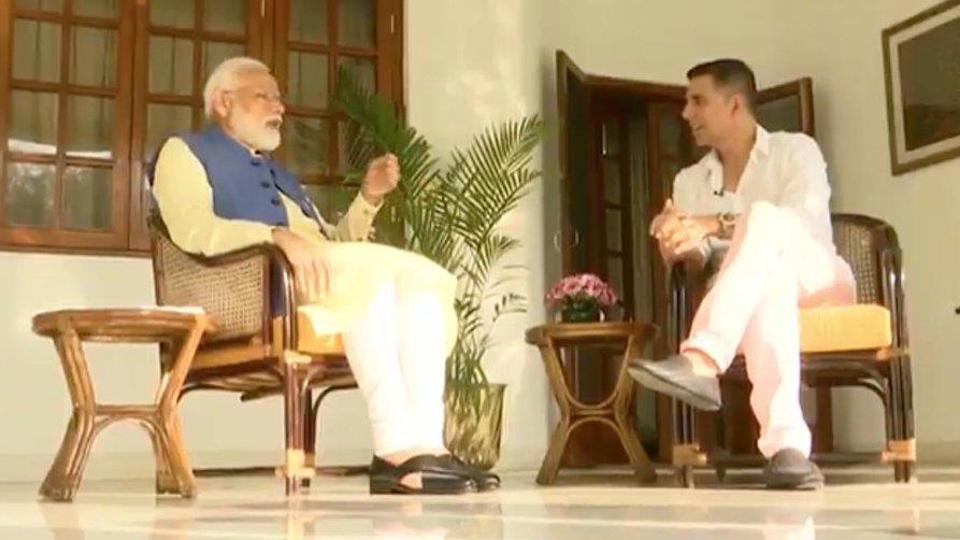
You started your interview by saying that you are going to have an apolitical interview. You have every right to do that. You can ask every stupid question under the sky – pattern of eating mangoes, bank balance, process of dealing with cold, wish from djinn of Aladdin’s lamp, sleep hours, desire for becoming PM, anger management, valuable things held by PM inside the house, pattern of styling, style of wearing watch and sleep hours.
But contrary to what you said, you are only playing politics. Through your interview you only wanted to convey the message to the people for them to turn away from the reality and see an apolitical Modi. You wanted to convey – Let things be what it is. Let things happen the way it happens. Let us not worry about issues – Jobs, Unemployment, Poverty, Demonetisation, GST, Rafael, Corruption, Women safety, Lynching’s, Communalisation, etc. Let us forget that there are elections and there are issues to think and bother about. Let us forget that the Prime Minister is to be questioned on these fronts. Let us just see the personal life of the Prime Minister, away from the Political life.
It is true that you are not one of those who has been affected by the policies of the Prime Minister. Whether it is Demonetisation, GST, Lynching’s, intolerance and growing communal environment. But if you are sensitive enough to your own industry, you would have realised that even the well-established popular and respected actors in your own industry are feeling at the environment that has grown in the last 5 years – whether it is Amir Khan, Shahrukh Khan or Nasiruddin Shah. If their situation is like that, imagine the situation of normal minorities. You could have at-least asked the Prime Minister about the growing sense of insecurity among the Minorities in the country taking a cue from your own industry.
You rather seemed to display the Bhakt in you and use your celebrity status to strengthen and continue the Bhakt narrative around the Prime Minister. You wanted to show the Prime Minister as a simple humble and saintly person – as a person from poor family who struggled even to buy mangoes, a simple person who wanted to become a saint or sainik, someone who sleeps less or works hard, someone who left family for doing something great for the nation. You also wanted to show how the Prime Minister controls his anger, is friendly towards opponents, and treats his subordinates. However, the things said by the Prime Minister goes against the points he made. His personal attacks against the political opponents, his encouragement of hatred against the political opponents through following trollers, encouragement of lynching’s through lack of action on offenders, encouragement of terrorism through providing electoral space to Pragya Sadvhvi, narcistic personality and concentration of powers display a completely different thing.
So contrary to what you said, you were only doing a political interview. You were playing a hide and seek game. You were hiding the burning issues bothering the citizens of the country – Jobs, Unemployment, Lynching’s, Demonetisation, Rafael. On the other hand you were seeking to explore aspects of Prime Ministers personal life which makes little sense to Public life. His style of eating mangoes, way of dealing with cold, sleeping lesser number of hours, style of wearing watch – means little for the people.
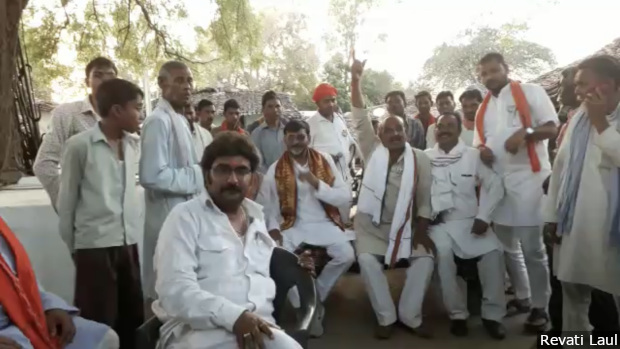
Jhansi and Banda districts, Uttar Pradesh: In a small clearing in the Banda-Purva village in one of Uttar Pradesh’s poorest districts, a Bharatiya Janata Party (BJP) supporter started a conversation on the party’s pet subject: Religion.
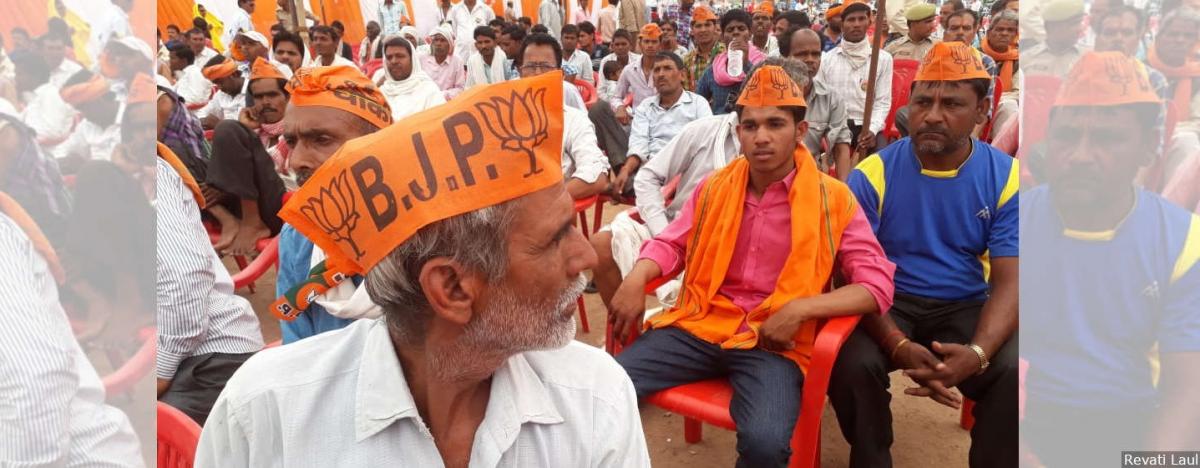
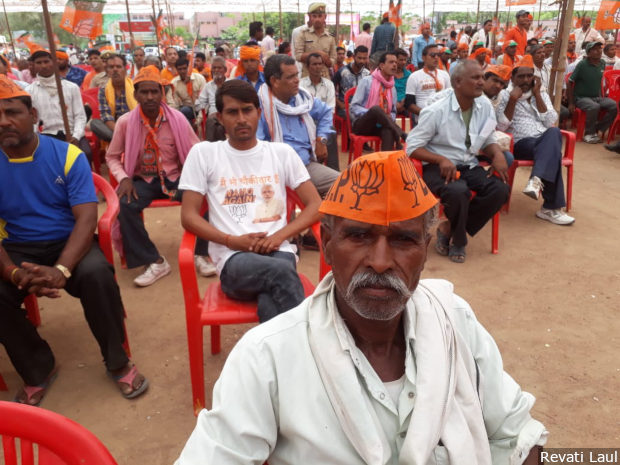
People don Bharatiya Janata Party caps, waiting for Uttar Pradesh Chief Minister Yogi Adityanath during a campaign rally in Jhansi. As the Bundelkhand region of the state is set to vote on April 29, we found religious fervour and cynicism among voters.
“We are with Lord Shri Ram. He is supreme. He has developed this world.”
When asked “What about Allah?”, he said, “Woh toh kisi ne dekha nahi (No one has seen him). But we’ve seen Ram.”
Shouldn’t Allah be recognised equally?
Another BJP supporter erupted: “Nahi. Allah nahi aatey usmey (No, Allah isn’t one of the Gods).”
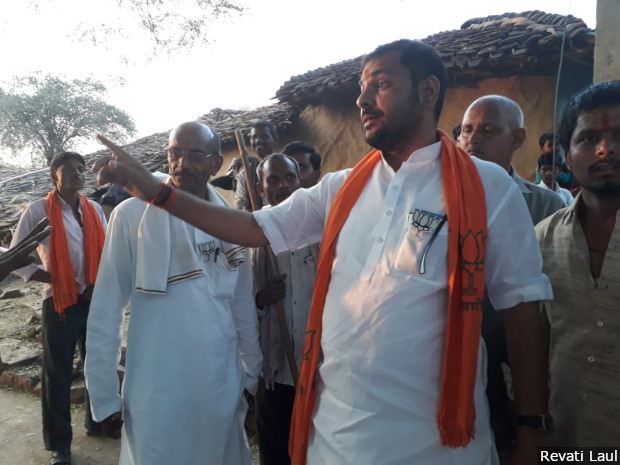
“We are with Lord Shri Ram. He is supreme. He has developed this world,” says Bharatiya Janata Party supporter (forward left). When asked “What about Allah?” he said, “Woh toh kisi ne dekha nahi (No one has seen him).”
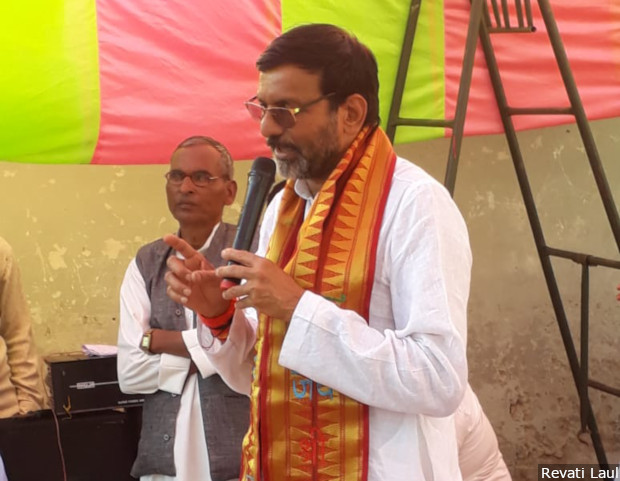
These views were not an aberration. This was election season and in meeting after meeting across Banda district, the BJP candidate R K Patel made that amply clear. He was campaigning with a local swami (monk), and a member of legislative assembly (MLA) Prakash Dwivedi. The opening lines of their campaign speeches: “This is a dharam yudh–a religious war–like the Mahabharata. A fight between good and evil.” The Narendra Modi sarkar (government) is good, the opposition collectively stands for evil. “Congress ki sarkar ne Muslim dushtikaran ke charam ko touch kiya,” said Dwivedi. “The Congress government crossed all limits of Muslim appeasement.”
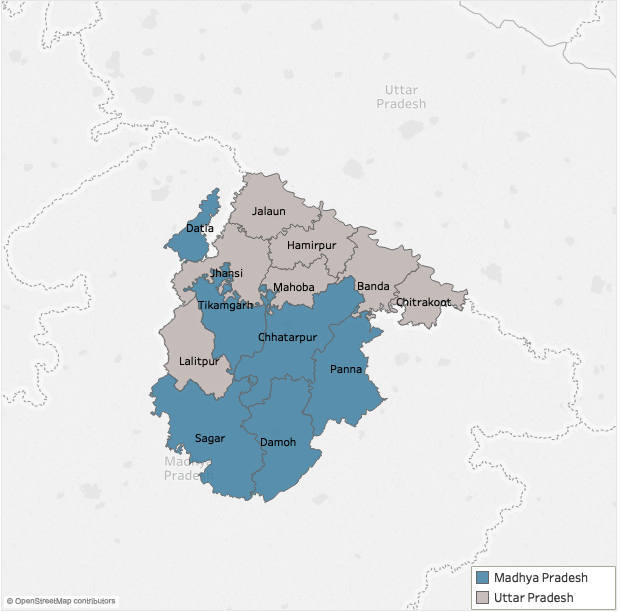
This is the Bundelkhand region–one of the most economically deprived parts of the country. This geographical zone, named after the Bundela rulers from the 14th century, is spread across two states in the present day–Uttar Pradesh (UP) and Madhya Pradesh (MP). It comprises seven districts of UP and another six in neighbouring MP.
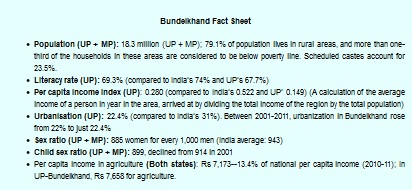
In the half of Bundelkhand that is in UP, the seven districts are amongst the most thinly populated in the state: UP has a population density of 829 persons per sq km, while the density in the districts of Bundelkhand is just 329. This means that the districts together account for only four parliamentary seats of the 80 (5%) that UP sends to the lower house. That is a tiny number of representatives or MPs for a geographical zone that is 28.7% of the total area of Uttar Pradesh but sparsely-populated zone. Local politicians said it gives the area lesser bargaining power with which to lobby for funds from the Centre–to build road and irrigation schemes.
This is the third in a six-part series on the Hindu vote in Uttar Pradesh, India’s most hotly contested electoral battleground, which accounts for 80 of a total of 543 Lok Sabha seats (you can read the first part here and the second here). Three of four constituencies in the region–Jhansi, Hamirpur and Jalaun–vote on April 29, while Banda votes a week later on May 6.
Three of the four constituencies were listed as drought-affected by the UP government in 2018.
So, the polarising nature of BJP candidate Patel’s campaign, said political observers, is not surprising. It may make a deeply cynical voter choose the Hindu right party over the other contenders, since convincing them of any development work is an almost impossible feat.
Source: Bundelkhand Human Development Report 2012, NITI Aayog Note: UP + MP refers to data for the combined Bundelkhand region, including districts from both Uttar Pradesh and Madhya Pradesh.
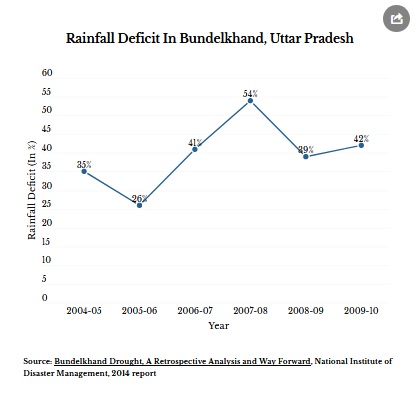
The history of under-development of the region has a lot to do with sparse rainfall and a shrinking water table. One of the markers for anyone travelling to the region are the hillsides of stark boulder and almost grey bramble and bush that pass for vegetation. The statistics tell the rest of this story. This is a drought-hit zone and, affected both by poor rainfall and, over time, a rapid depletion of groundwater. The rainfall deficit has been high, data from the National Institute of Disaster Management show.
People do not have water to drink or to water their fields. Whatever water does collect underground is getting contaminated. As much as 85% of rural India’s drinking water supply comes from groundwater, according to a 2016 study on the groundwater situation in India published in the journal Advances in Water Resources. Access to as much as 60% of that is restricted “by excess salinity or arsenic”.
Farmers, 71% of the workforce here, earn Rs 7,658 a year, on average, according to this 2016 report published by the United Nations Development Programme. That is Rs 638 a month or Rs 20 rupees a day. The farmers’ income, taken separately, is much lower than the overall income an average person in Bundelkhand earns, which according to an International Labour Organization report, is about Rs 26,805 a year–nearly four times the agrarian income.
There is virtually no sewage or garbage disposal, no jobs and the agricultural sector is suffering not just due to drought but also the apathy of successive governments, voters here said.
Lack of basic amenities triggers anger, discontent
As Patel listed schemes that the Narendra Modi government has rolled out, the anger and boredom of those gathered around was on full display. Patel described Modi as the big strong banyan tree under which they were all gathered. The next day, under the same banyan tree, in Tindwada village, in the district of Banda, villagers said they didn’t buy the speech.
“Yeh log kehtey hain dharam ki ladai hai. Koi dharam ki ladai nahi hai (These people say this is a religious war, it is no such thing),” said one farmer angrily. “Sab khokhey bata rahey hain (Those are all empty words).”
Sita Ram, a 70-year-old farmer has seen many elections come and go. “Nothing has changed here,” he said.
A third farmer was cynical enough to question what he had heard in speech after speech about Modi providing the support and strength for the Air Force to go in and strike Pakistan in retaliation for the 40 Central Reserve Police Force (CRPF) members killed in Kashmir.
“Jo, madam, Modi bol rahey hain 340 jawan marey gaye wahan Pakistani… kuch batao iske barey me, ka hua? (Madam, tell me, what do you make of what is being said that 340 Pakistani terrorists were killed?)” he asked.
When he was, in turn, asked what he believed, he said, “Kis pe vishwas karein… khud pe vishwaas nahi hota hai, toh batao (Whom to believe… at this point, I don’t even believe in myself).”
The most irate were women who had to walk several kilometres, carrying drums of water on their heads, since tubewells had not reached this village.
Gomti is one such angry woman who explained that at the very spot where Patel had listed how Bundelkhand’s water problems would soon be a thing of the past–with the Centre sanctioning a budget of Rs 9,000 crore–is the hand pump where women are forced to bathe in full public view.
There was Rekha, a young girl in her mid-twenties, bathing in a blue salwar kameez as people walked past. “This is what it’s like to be a young woman in Tindwada,” Gomti said, her voice full of anger. “To have no bathroom and no basic dignity.”
Voters–and leaders–shift loyalties across elections
Gomti’s cynicism is part of the matrix of the overall disconnect the voters in the region experience and the fact that the BJP contender from the area, Patel, has switched parties four times in the last decade only adds to this.
Patel started out as a student in 1980 by joining the Rashtriya Swayamsevak Sangh (RSS), the BJP’s ideological parent group. But he jumped into electoral politics a decade later with a party that defines itself as the BJP’s political opposite–the dalit bastion of the Bahujan Samaj Party (BSP). After losing one election, then winning the next on a BSP ticket, Patel switched to yet another party, the Samajwadi Party (SP), in 2007.
He lost one election on an SP ticket and then won the next. And when the last parliamentary election came around in 2014, when the SP didn’t give him a ticket, he switched back to the BSP and lost. Soon after, he joined the BJP and contested the 2017 state election on a BJP ticket. And won.
In defence of the political criss-crossing, Patel said: “Kanshi Ram ne jo vichar dhara shuru kiya, aaj Modi ji woh vichar dhara badha rahey hain (The ideas that [BSP founder] Kanshi Ram started with have been continued and taken forward by Modi ji).”
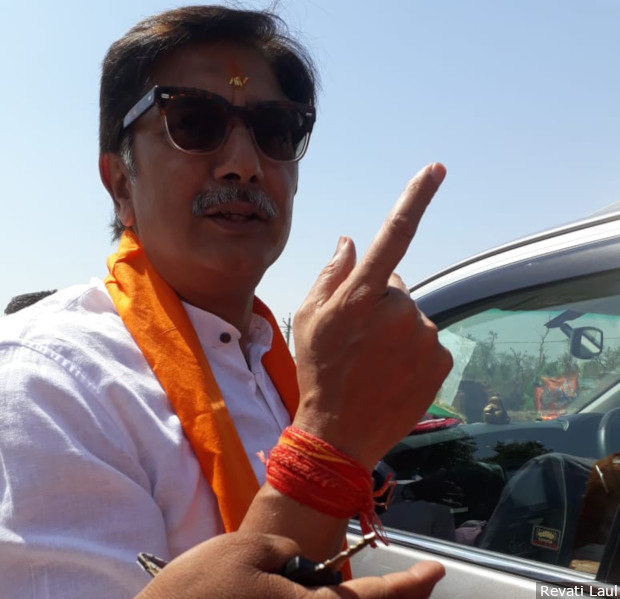
RK Patel, the Bharatiya Janata Party’s candidate from Banda, at a campaign event. Patel cut his political teeth with the Rashtriya Swayamsevak Sangh, before getting into electoral politics through the Bahujan Samaj Party and the Samajwadi Party.
His co-canvasser and the more colourful leader from the district of Banda, the MLA Dwivedi, said: “Agar vipakshi koi kalpit kalpana pe khwaab dekh rahey hon toh mai bata doon ki woh phadey kapda gyara bajey ke bhagenge. (If the opposition is even beginning to contemplate any sort of victory, let me tell you, come counting day, 11 am, they will tear their clothes and run).”
Prakash Dwivedi, the Bharatiya Janata Party legislator from Banda district, during a campaign for the party’s Lok Sabha candidate RK Patel.
But the politics of Bundelkhand in UP is anything but a straight line between voter fatigue and the BJP’s polarisation. Despite their apathy and deep frustration, voters across all four Lok Sabha seats voted for the BJP in the last general election and have been BJP voters intermittently in state elections.
While Ravi Sharma of the BJP had won the state assembly election from Jhansi both in 2012 and 2017, Banda voted for Vivek Kumar Singh of the Congress in 2012 before voting in Dwivedi in 2017.
Source: Trivedi Centre for Political Data, Ashoka University
This time, the people of Tindwada village in the Banda constituency were ambivalent. “Yeh toh abhi nahi bata saktey kisko vote denge (We can’t say yet who we will vote for)” was the standard answer.
When probed further, some said that while they were upset with the BJP, they didn’t have much faith in any of the political alternatives. So it might just come down to a choice between voting for religion or caste, some said. Hindus may vote for what many see as the `Hindu-leaning’ party–the BJP. Some castes and religions may vote for parties they see as the protectors of their communities–the SP or BSP.
But the picture gets more complex when the campaign in Banda district is squared with that of the more urban, slightly less economically deprived district of Jhansi.
The Jhansi formula: Jhansi = Valour = Modi
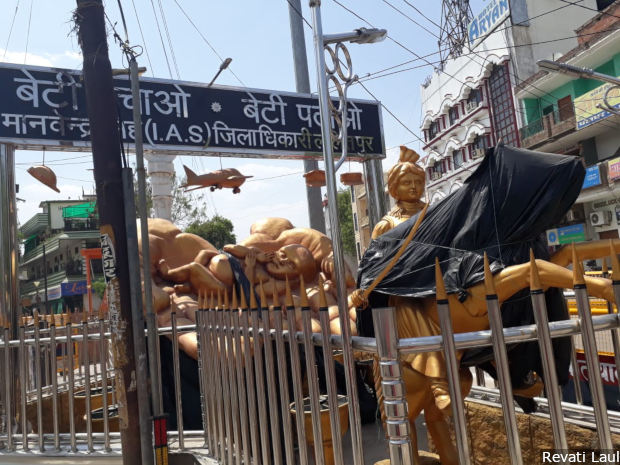
The BJP–and indeed most parties in Jhansi–lean on the valour and political history of Jhansi. The city is plastered with statues of its most famous leader of the revolt against the British in 1857, the Rani of Jhansi–used now in BJP campaigns to tell voters they have had a history of bravery, so they must vote in a government with a recent trajectory of bravery–in “giving it back to Pakistan at the border” when the country’s soldiers were attacked. In other words, Jhansi equals valour and valour equals Modi.
Uma Bharti, the BJP’s fire-brand leader who was a prominent face of the party’s Ayodhya campaign, won this seat for the party in 2014. Not only was there a Modi wave to ride on, the politics of building a temple for Lord Ram at Ayodhya, believed to be his birth-place, after the destruction of the mosque there in 1992 catapulted Bharti to the political centre-stage. This time, however, she isn’t contesting but is campaigning for the party candidate Anurag Sharma.
A town square in Jhansi district’s Lalitpur featuring statues of Rani of Jhansi, and a baby being cradled in its mother’s hands. The bill board above reads ‘Beti Bachao, Beti Padhao’, referring to the government’s flagship programme for the girl child. The BJP invokes the Rani to say the city has a history of bravery, so they must vote for a party with a record of bravery, In other words, Jhansi equals valour and valour equals Modi.
A first-time politician, Sharma is the chairman of the Baidyanath group of Ayurvedic medicines and a Harvard university graduate. His only campaign pitch is development, he said.
Stepping out of his large, green bungalow in Jhansi and into his luxury SUV, Sharma said he runs one of the largest charitable trusts in the Bundelkhand region, that is “entirely self-funded”. It made him travel to the remotest parts of the region, he said, and that is where he realised that no matter what he did–giving scholarships to 60,000 students, building borewells, sending tankers to areas that had no water–it was “just a drop in the ocean”. What was needed was “a change in the government’s policy towards Bundelkhand, someone to raise the right questions”. He further clarified that he has “never raised a religious slogan”.
Anurag Sharma, the Harvard-educated chairman of Baidyanath group of Ayurvedic medicines, is the Bharatiya Janata Party’s Lok Sabha candidate for Jhansi. Sharma says he has “never raised a religious slogan”.
As he got to his election rally in the municipal town of Lalitpur, he stuck to what he said. His speech was short and modest. “I am Anurag,” he said, “known by most of you here as bhaiya (brother).” He listed his charitable work and ended his speech.
What Sharma did not say and did not need to was that, despite his singular push for a progressive campaign, Jhansi had already seen two decades of polarisation.
The Hindu movement in Jhansi
At the RSS office in the city, two senior leaders who spoke on the condition of anonymity, explained what the Hindu right and its umbrella of institutions from the RSS to the BJP have done. In Jhansi, the process of Hindu proselytisation began shortly after emergency rule imposed by the Congress party’s Indira Gandhi in 1975. The next big spurt was the demolition of the Babri masjid or the Ayodhya campaign of 1991-92. There are now 700 shakhas or branches across the seven districts of Bundelkhand.
And it was in this second wave post 1991, the leaders explained, that the RSS made sure the institutions of the Hindu right move beyond their upper caste base to include Dalits or scheduled caste groups–since Bundelkhand has a high dalit population (23.5%, higher than the state average of 21.1%). “We added the celebration of Valmik Jayanti (traditionally a festival of the Valmiks amongst the scheduled castes) to the RSS celebration of Sharad Poornima,” they explained.
From the year 1996 on, they also worked with the Sahariya tribes that lived mostly in and around the regions of Lalitpur and Mauranipur that are part of Jhansi district.
“In communities where backward classes were not leaders, we made them leaders, like Uma Bharti,” they explained.
In these two decades, the community work they have done has extended from the very basic–like performing the last rites for the deceased–to cow protection and, most of all, building people’s identities. That crucial task is where all the proselytisation has worked to deliver successive victories to the Hindu right’s political arm–the BJP. It includes a re-branding of the word “secular” from its traditional meaning as many understand it to be in the Indian Constitution. “We have a different understanding of that word,” they said, going over the familiar tropes. India is a Hindu nation. “Musalmaan ki topi bharatiya kab se ho gayi? (Since when did the skull cap of the Muslim become part of Indian culture?)”
This wrestle between on-ground hard-to-do development work that the RSS calls seva or volunteer work and the cultural nationalism is borne out by the next generation of Hindu nationalists as well.
Over coffee and pakoras, Saurabh Mishra, a member of the BJP’s student wing, the Akhil Bharatiya Vidyarthi Parishad (ABVP), had an incredible story of his rite of passage into the world of politics. It came from a self-imposed hunger strike to force a moribund administration in his village to commit to providing drinking water.
The 25-year-old is currently studying law in Jhansi, but made his way here from an extremely backward part of Bundelkhand–a village called Icholi in the neighbouring district of Hamirpur. “There was no drinking water to speak of, what we had was such hard water that is wasn’t even fit for animals,” Mishra said.
So in 2016, he decided to go on a hunger strike with his friends. Initially, this was scoffed at by people in the village.
After four days of surviving on nimbu-pani (lemonade), the sub-divisional magistrate came to try and negotiate. By this time, the protest had become a popular uprising and on the strength of that, on day 8, the district administration gave them an assurance in writing that they would ask the state to sanction a Rs 7.5 crore fund to build pipes for drinking water.
Now, in 2019, a Rs 5-crore budget to build those pipes has finally been granted, said Mishra with a broad smile. Mishra emphasised that it was his training in the ABVP that made him persevere.
Muslims and Pakistan
At the other end of the spectrum of the Hindu right is Satyam Tiwari in the Badausa region of Banda. He is part of UP Chief Minister Yogi Adityanath’s state-grown cultural nationalist outfit, the Hindu Yuva Vahini.
Tiwari sat in his mud house, narrating stories of his vigilantism: Against “love jihad”, where he stopped Hindu girls from hooking up with Muslim boys to “save them from themselves”; and for cow protection–saving cows from being slaughtered by Muslims. Two years ago, he added another feat to this list of vigilantism: Entering a school run by Muslims and demanding that they put up posters of Mahatma Gandhi and the Prime Minister on their classroom walls.
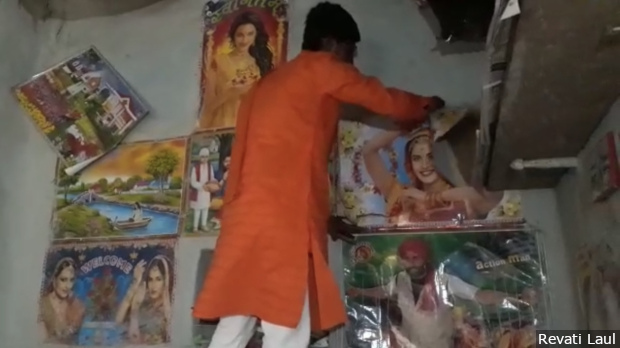
Tiwari was quick to demonstrate his Hindu-ness and accompanying aversion to everything that is Muslim. When it was pointed out that he was sitting in a room flanked by two posters of the actor Katrina Kaif who is part Muslim, he got up, took a blade to them and ripped them off the wall. “Aren’t Muslims also human beings?” this reporter asked him on camera. “Yes, they are, but they don’t have humanity,” he said.
Satyam Tiwari rips posters of Katrina Kaif off his wall after it was pointed out to him that the actor is part-Muslim. He says that sees that this kind of dramatic politics may get him the political attention he seeks.
Later, away from the camera’s eye, he said he has many Muslim friends and is also a fan of the Muslim actor Salman Khan. But, he said, he saw that this kind of dramatic politics may get him the political attention he wants.
Tiwari’s vigilantism seems like the hard end of the Hindu right’s political spectrum. But in a region of deep distress, the ‘Hindu’ factor underscores even the ideas of the BJP’s Jhansi candidate Anurag Sharma who believes that India is a “Hindu nation” and the BJP is the one party that stands for the “protection of Hinduism”.
At Sharma’s rally, there were at least 50,000 people. They weren’t there to hear what their candidate from Jhansi had to say about development. They were there because the CM Adityanath was leading the campaign.
While the crowd waited for Adityanath to arrive, a local leader tried to keep the crowd excited. He said, “Kamal par button nahi dabega toh Pakistan mazboot hoga (If you don’t press the button on the lotus [BJP’s electoral symbol], you will be strengthening Pakistan.”
Once the CM’s helicopter landed and everyone clapped, the heat took over. The crowd started to thin as Adityanath talked about how this election has been blessed by the prayers of Lord Hanuman, the strong, muscular God–Bajrang Bali–and likened it to the strong, muscular persona of the Prime Minister who led the armed forces to “attack Pakistani terrorists and finish them off”.
Farmer Hari Ram, 64, at a Bharatiya Janata Party rally in Jhansi. “No party has done anything,” he says, “But what to do? We have to vote for someone. It may as well be the present regime.”
A 64-four-year old farmer, Hari Ram from the Ghimar caste–a group classified by the government under “backward classes”–gazed into the distance. He had come to the rally riding on a tractor, from a village 25 km away. “What do I think?” he said, tuning in and out of the CM’s speech. “I have three kids, two are daily wage workers. One is handicapped. No party has done anything. But what to do? We have to vote for someone. It may as well be the present regime.”
This is the third in a six-part series on the Hindu vote in Uttar Pradesh. You can read the first part here and the second here.
(Revati Laul is an independent journalist and film-maker and the author of `The Anatomy of Hate,’ published by Westland/Context in December 2018.)