Home Blog Page 1458

Institute impartial inquiry into beating of Jaipur jail undertrials, take action against wrong doers

0

A three-member joint delegation of two civil rights organizations, Rihai Manch and Association for Welfare, Medical and Legal Assistance (AWMELA), went on a three day visit to Jaipur to look into reported facts of beatings of Jaipur blast undertrials and those arrested in the name of terrorism. The team met Jaipur based human rights/ social organizations, the jail superintendent, Central jail, Jaipur, and the victim undertrials.

jaipur

Comprising of Masihuddin Sanjari (coordinator, Rihai Manch, Azamgarh zone), Mohd Asim and Shadab Ahmad (AWMELA), the team has issued a report titled “Jaipur Central Jail: A tale of solitary confinement and brutal beating”. Text of the report:

Story of police: After the brutal beating on 30 March 2019 it was narrated to media by jail administration central jail Jaipur that the undertrials assaulted a jailor when he and his associates had gone to search high security ward No 10 with video camera. As a result he got fracture in one of his fingers. They resorted to light Lathi charge to overcome the undertrials. Meanwhile one of the undertrials wounded himself by hitting his head against the wall and the other ripped his hand with some pointed object to scare the jail administration. The administration has got a case registered against the undertrials for said offence, but the facts do not seem to verify the claims.

Series of incidents: Talks with undertrial victims, jail superintendent and members of human rights/social organizations and available documents reveal that the undertrials had gone on hunger strike against oppression in jail demanding installation of a complaint box and visit of a judge as incorporated in jail manual. Documents show that they had also written to special judge Jaipur blast cases about their demand. The facts that came to fore as a result of these talks as follows:-

After the killing of Pakistani convict Shukrullah on 20 February 2019 allegedly by don Raju Theth and his men the undertrial inmates of ward No 10 began to be kept completely locked in their cells in the unbearable heat of Rajasthan. The undertrials had objected to it, saying that they had nothing to do with that murder then why they were being tortured. The jail administration had taken action against Raju Theth and his men in the case of said murder.

The undertrials had gone on hunger strike against that kind of treatment in the last of this February but they rescinded the hunger strike on the assurance of the jail administration that the old situation would be restored. Before this, the undertrials were let out of their cells for six hours each in the morning and evening.

When after about 40 days no change was brought in their condition in restoring the previous condition, the undertrials went on hunger strike again demanding installation of complaint box and visit of a judge (so that they could easily complain of their grievances). As the hearing of Jaipur blast cases was going on daily basis, the undertrials Shahbaz Hussain, Mohd Saif, Mohd Sarvar, Mohd Salman and Saifurrehman gave an application regarding their demand to the special judge who was hearing the case.

When the said undertrials came back to jail after the hearing the Karyapal Kamlesh Sharma snatched the carbon copy of the complaint from their hands, abused them and told that it was their law that prevails in the jail. After that he went to high security ward No 10 and threatening to their life said if they dared complain against the jail authorities again they would not be able to go to court again. In the evening the night guard Ramesh Chandr Meena went to every single cell like his predecessor Kamlesh Sharma and threatening for life said to them if they kill two or three people they had to blacken only two or three papers.

On 30 March 2019 when the undertrials Shahbaz Hussain, Mohd Saif, Mohd Sarvar and Saifurrehman went for hearing in the court they gave a fresh application to learned judge apprising the him of the latest development and the judge, taking the cognizance, issued notice to the jail superintendent. Mohd. Salman had not gone to court that day because he had fallen sick.

At about 12:30 pm Karyapal Wilson Sharma, jailor Mahendra Pratap Vishnoi, Chief Karyapal Kailash Sharma, jailor Raj Mahendra Singh, Sunit Sharma, Awdhesh Sharma, Bhagwan, guard Ramesh Chandra Meena and inmate Gunna Sardar along with other jail personnel, home guards and few other inmates, about 50 in number, went to high security ward No 10 and dragged out the undertrials one by one from their cells and began to beat brutally with Lathis, iron rods and pipes.

As Salman was sick and he had not gone for hearing in the court that day but even he was not spared. When some convicts in the same ward overheard the cries of the victims they peeped out of their cells and asked the jail staff not to do that, they too, were misbehaved. Insult of religious books has also been reported during the beatings. Jailor Mahendra Pratap Vishnoi allegedly said that he was a man of mission and hurled communal abuses.

When Shahbaz, Mohd. Saif, Mohd. Sarvar and Saifurrehman returned from hearing, they also overheard cries coming from ward No 10. When they asked Karyapal Kamlesh Sharma about the same, he told them to go and see by themselves. As they moved swiftly forward they were attacked by the same people and wounded badly in the way to the high security ward No 10.

Human rights/social organizations’ jail visit: On 2 April 2019 a team of the members of human rights/social organizations of Jaipur i.e. PUCL, APCR, Samanvay Seva Sangh and eminent persons met director general jail Rajasthan NRK Reddy. He suggested the team to meet jail superintendent. Thereafter the team visited the jail and met the wounded undertrials in the presence of jail authorities.

A member of the delegation advocate Farooq Pekar told that the boys were badly wounded and blood was oozing from their wounds and there were two fractures in the hand of a boy from Seekar (Rajasthan). There was much possibility of two others having fracture in the hands and feet. The undertrials were so distressed that they had continued their hunger strike even in that condition. One of the members of the delegation Anil Goswami could not hold his tears when he saw their miserable condition.

Jail administration had first claimed of having video and CCTV footage of the incident in support of their claim but kept silent when the delegation repeatedly asked them to show footages. On the other hand, the account of the incident given by the violence victims corroborates the series of incidents that took place. The delegates persuaded them to rescind the hunger strike. Seeing the gravity of the matter advocate Farooq Pekar gave application in the court for a case to be registered from undertrials side and a medical checkup done. Only then the jail administration was compelled to get the medical checkup done.

Undeclared restriction on meetings: An undeclared restriction was imposed by jail authorities from meeting the guardians of the badly wounded undertrials. When Mohd Asim uncle of Mohd Sarvar went to Jaipur (about 850 kmts. from his native place), he was denied meeting. He had no idea of the happenings in the jail till then. He applied for the meeting and kept waiting for the whole day. At last the jail personnel at the gate asked him to go back as no meeting would take place. Later he came to know that guardians of the other undertrials had also to face similar response from the jail administration.

Meeting of the joint team with jail superintendent: The joint delegation (on visit to Jaipur) also met the jail superintendent with representatives of human rights/social organizations of Jaipur in his office. As we entered the jailor superintendent’s office we saw a board on the wall behind the jailor’s seat with “17.3.2019 ko Geeta Karyakram” (Geeta programme on 17.3.2019) written on it. He continued to assert that there were different kinds of people in jail administration. He did not have control over all of them. At times the arrogant behavior of inmates rouses instigation. It is the responsibility of the inmates to win their sentiments. He continuously skipped to talk on the demands of the undertrials and their brutal beating.

Questions arising on jail administration: Jail administration has got a case registered for assault on jailor against the violence affected undertrials wherein it is said that his finger was fractured. The jail administration has accepted of a mild Lathi charge to overcome the undertrials. It also said that one of the undertrials hit his head against the wall and another one ripped his hand with some pointed object.
But even then they did not get proper medical examination done. Place of incidents as told by violence affected are two and that told by jail administration is one. Among about 12 of the violence affected undertrials four had gone for hearing and the remaining were confined in their cells in high security zone. Allegation of assault (incitement) is over seven of them.

Then how did they attack the jailor together? Why did the jail administration not show any video or CCTV footages as they had claimed to have? Apparently, procedure of full-fledged treatment was not possible along with hunger strike. Why jail administration did not try to get the hunger strike rescinded or adopted the procedure of hospitalizing them. What was the motive of the jail administration in leaving them in that condition?
The hearing of the Jaipur blast case is in the final stages. Decision is expected soon. Only one witness remains. Elections are on and the witness happens to be a BJP’s leader. Perhaps, this is why he is not available for evidence.

Conclusion: The delegation concluded that the incident of beating in the jail was without any provocation, one-sided and pre-planned at the highest level. On the initiative of few officers the other jail personnel and inmates took active part in it. Gross negligence was done in the treatment of the wounded undertrials after the beating incident which could prove fatal. As written complaint has been filed from the side of undertrials, seeing the previous behavior of the jail administration, the chances of some happening unwanted incident are there in future.

Demand: The delegation demands the state government to make impartial inquiry into the incident and take action against the wrong doers as per law. The state govt. also needs to assure that incidents like this would not recur in the jail in future.

Courtesy: Counter View
Key hurdles in implementing Forest Rights Act in Gujarat: Experience from the ground

0

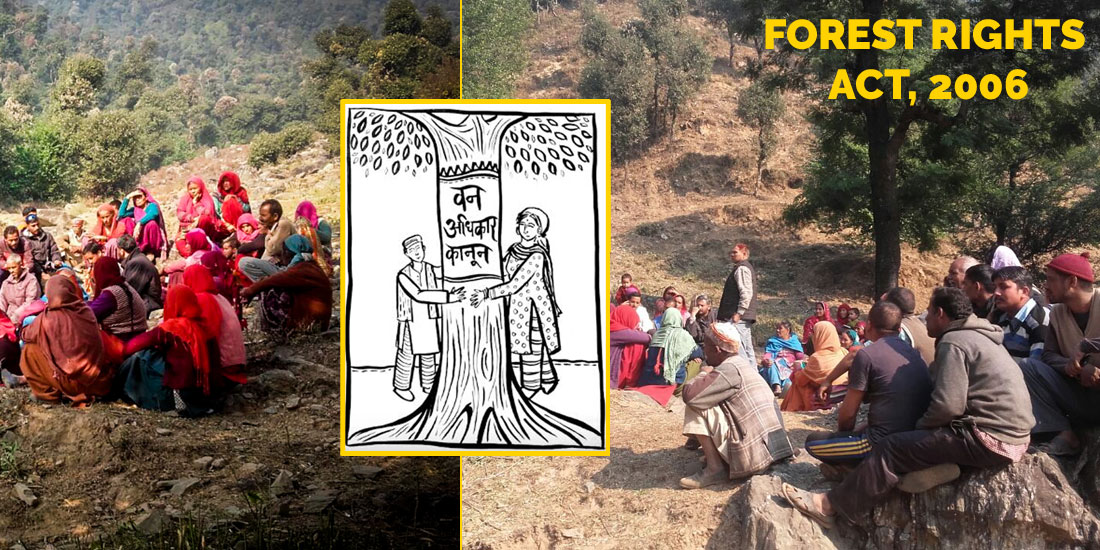
The report “Forest Rights, Legal Wrongs: Grassroots Realities and the Forest Rights Act (FRA), 2006 in Gujarat”, published by the IDEAL-Centre for Social Justice, Ahmedabad, outlines implementation of FRA across 10 villages in Meghraj and 15 villages in Dang over the past 2 years. Excerpts:

Since March 2008, the Government of Gujarat had begun issuing forms A and B under the Forest Rights Act (FRA) – forms required for filing claims of Individual Forest Rights (IFRs) and Community Rights (CRs, such as wells, temples, graveyards, etc.). Simultaneously, Sub-Divisional Committees (SDLCs), District Level Committees (DLCs), and village-level Forest Rights Committees (FRCs) were set up with such speed and intent that, by 2009, the FRCs were in advanced stages of verification of IFR claims.

But at this initial stage itself, the Government of Gujarat asserted that only about 10% of claims for recognition under the Act were valid.

Considering most claims at this point of time (in 2009-10) had not even moved beyond FRC verification, the assertion was dubious at best, and sinister at worst. Such statements did portend a difficult implementation process.

Up until 2013, several dilutions were made to the implementational framework of FRA that resulted in widespread disentitlement. The cut-off year – the year on which a prospective claimant must prove possession – was changed to 1980 from 2005, reflecting the extant position under a Government Resolution made in 1993 to regularise forest land holdings. Alongside this, a strict adherence to government-record-backed evidences for IFR claims meant that by April 2010, only 17,000 of a total 182,000 IFR claims were accepted.

Thereafter, increasing reliance began being placed on the use of satellite imagery as a means to establish possession/use of forest land. This process was itself fraught with hurdles. Satellite images were little to no help in identifying cultivated land in forests, and poor resolution mixed with hasty, careless assessment led to widespread rejections.

By June 2011, a further 19,000 claims were approved, while close to 113,000 claims were rejected. Such a haphazard and lackadaisical approach was bound to face challenge in the Courts. In 2013, the Gujarat High Court pronounced a momentous judgement, ordering the state to reexamine all rejected claims for IFRs and striking down the unfair reliance on satellite imagery as proof of possession.

Despite this scathing indictment of state apathy, the implementational machinery remained steeped in inertia. In fact, the implementational machinery moved beyond simple inertia and toward active violations of the law, accompanied by the curbing of any communitarian voice that attempts to demand accountability.

That is not to say that judicial pronouncements have had no impact – in the aftermath of the 2013 judgement, the government approved a further 84,540 claims of forest land as far as 2016 – but the spirit in which the judgement was delivered has not filtered into the implementation of FRA. Several thousand claims that were approved upon reexamination were granted rights over a tiny fraction of the land claimed (and indeed, over the land in possession). Several were also rejected once again, often on baseless and illegal grounds.

Key lapses in implementing FRA

Consistent community engagement revealed several key lapses in the implementation of FRA in Dang and Meghraj. What emerged were also deep-rooted institutional and policy concerns. Such concerns manifested themselves in specific issues in the passage of claims, such as the ones we highlight below. At the same time, emerging specific illegalities in the rejection of claims resulted in the recognition of further institutional/policy gaps and shortfalls that needed to be remedied.

Through extensive field visits, campaigns and legal camps, the Centre for Social Justice (CSJ) identified several specific illegalities in the process of filing of claims, their verification and their approval/rejection.

Rejection on account of being a government servant:

Across Meghraj, 128 claimants have had IFR claims rejected on account of being government servants. Crucially, this reason for rejection has also extended to those claimants whose parents or other family member is a government servant. This is in contravention of Section 3(1) of the FRA which confers a right to self-cultivation for bona fide, livelihood needs.

There is simply no credible basis to establish that a government servant’s family, or indeed herself, does not depend on agriculture as a vital means of livelihood security. Despite this, the Meghraj SDLC has rejected claims to IFRs – importantly, even after the High Court of Gujarat in its 2013 judgement ordered DLCs to re-examine all claims.

Rejection on account of submitting no evidence supporting the claim:

In Dang, several claimants have had their claims rejected at the SDLC on account of producing no evidence of occupation/cultivation supporting their claims. CSJ’s interactions with such claimants and examination of copies of claims they have submitted revealed that the required evidences as per the provisions of the FRA Rules, 2008 were indeed submitted with the claim.

The SDLC had summarily disregarded these evidences in arriving at its decision. Rule 13 of the FRA Rules makes it clear that any claimant must submit any two of a list of valid proofs of occupation/cultivation in support of their claim. The claimants CSJ engaged with had submitted – almost uniformly – significantly more than 2 documents as evidence. This particular issue is also closely linked with others, since the very meaning of appropriate evidence as defined by the SDLCs in practice (as opposed to the law in principle) has meant that even legally valid evidence of occupation/cultivation is in practice deemed invalid.

Rejection on account of not producing fine receipts:

In both Meghraj and Dang, CSJ engaged with claimants who had their claims rejected – including on appeal – on account of not possessing fine receipts issued by the Forest Department for encroachment on forest land. The receipts themselves are constitutive evidence of forest land possession/cultivation but are not the only – or the primary – evidence for the same. In several parts of Gujarat – including in Dang and Meghraj, forest department officials often do not issue receipts for fines levied, since that allows them to keep the quantum of money for themselves.

In Dang especially, several claimants did not possess fine receipts and that became the sole ground for rejection. In most cases – on account of the 2013 Gujarat High Court judgement – the lack of a fine receipt was not mentioned explicitly on the rejection letter, but instead was couched in other terms, such as there being no evidence produced to support the claim. The primacy given to fine receipts was only discovered through discussions with the DLC at the appeal stage.

Rejection on account of no recent evidence of cultivation:

The FRA was designed not as a land redistribution scheme (as it is often misrepresented), but as a legislation to recognise rights already held. There is thus a historicity intrinsic to the Act itself. As a result, the provisions establish that in order to be valid, any claimant must establish possession of forest land prior to the 13th of December, 2005. The law, thus, does not require claimants to establish cultivation at a more recent point in time.

It is merely to be established that the claimant was in possession of the claimed land in 2005, whether such land is cultivated thereafter is not of significance. Indeed, to establish a bonafide livelihood need evidence of cultivation/occupation of the land is necessary. But, in practice, the latter is rejected on account of not producing any recent evidence of cultivation; this despite providing evidence of possession of land in 2005, and of cultivation of land at that time (through photographs), along with a host of other forms of evidence.

In arguendo, even if evidence of recent cultivation is required/mandated, common sense dictates that such evidence must be gathered at a time when cultivation is underway. In CSJ’s experience in Dang, photographs of claimants’ land are taken during the summer months when land is left fallow. This is also evidenced from identifying nearby flora (such as particular kinds of trees) in such photographs. There is thus no visible cultivation on the land, and consequently, claims are rejected.

Rejection on account of purportedly not being in possession of land claimed:

Across Meghraj and Dang, scores of claims have been rejected because the claimant is purportedly not in possession of land claimed. The logic behind such rejections closely mirrors the logic underlying the issue of evidence of recent cultivation. The fact of possession (or dispossession) is determined merely by assessing whether the land claimed is cultivated.

Thus, satellite images (though these are of decreasing relevance after the Gujarat High Court’s judgement in 2013) and photographs of the land taken during periods of time when it is left fallow are constituted as indicating that the claimant is not in possession. This is a serious illegality since the procedure for taking photographs and assembling satellite maps is coordinated by the forest department and the DLC respectively. Both of these, especially the forest department, hold strong vested interests in whether claims get approved or not.

Inordinate delays and pendency in claims:

Even where “legitimate” claims have been filed and approved by Gram Sabhas, the process of vesting has not been smooth. Indeed, this is not limited to “legitimate” claims, since establishing legitimacy is itself the outcome of disposal by the DLC. Across the villages where CSJ’s work is situated a huge majority of claimants have heard nothing on the status of their claims. While a lack of access to information is a part of this, the real issue lies in the gross delays in disposal by the SDLCs and the DLCs.

Claimants are left in the dark because a decision on their claim simply hasn’t been taken. Concerns over pendency have been exacerbated by the 2013 judgement of the Gujarat High Court. The large majority of pending claims are awaiting disposal at the DLC level. Interestingly, in CSJ’s experience, such delays on part of district and block-level authorities are condoned while even marginal delays by claimants themselves result in disentitlement.

Extensive delays also result in the fact that notices – if and when they are issued – are sent by post to the claimant only a day prior to the expiry of the statutory appeals period. This in effect debars the claimant from her right to appeal, forcing her to file – alongside her appeal – an application for condonation of delay. These condonation applications are decided at the discretion of the DLC, meaning that the claimant’s right to appeal is reduced to a mere request.

Similarly, in Dang, CSJ identified that claimants would receive notices (of rejection) during periods of time when the local population would migrate to Maharashtra in search of labour. This once again disentitles the claimant, making her dependent on the “leniency” of the DLC to have her appeal heard. Such experiences do question the fundamental assumption behind delays and pendency, moving from a logic of administrative ineptitude to administrative strategy.

Occupation of claimed lands under the Compensatory Afforestation Fund Act, 2016:

Issues of pendency before the DLC could, in principle, be repudiated by pointing to the lack of human resource and infrastructural capacity to handle the large number of IFR claims. But, this line of argument ceases to carry any weight when we move beyond isolated principled positions. Across Dang, and in a few villages in Meghraj, the implementation of the FRA (itself prolonged inordinately) has come into conflict with the implementation of the Compensatory Afforestation Fund Act (CAFA), 2016.

Afforestation activities by the Forest Department have been initiated and carried forward at break-neck speed. This has naturally meant the disentitlement of forest-dependent communities. In Dang, scores of claimants have complained of the Forest Department encroaching their fields for afforestation activities. Forest guards have been responsible for the destruction of standing crop, fencing of agricultural lands and digging holes to plant saplings. All these activities are being carried out on land claimed under the FRA and is in clear violation of Section 4(5) of the FRA.

Two connected issues begin to develop here, the pendency of claims as a means to disentitlement, and the lack of a legislative-administrative structure that brings consonance between disparate legislations pertaining to the same geographic-political subjective landscape. We delve into these later.

Service of eviction notices from land on which claims were unduly rejected:

Several claimants who CSJ continues to support have received notices demanding they evict themselves from the land to which their claims under the FRA have been rejected. These notices – that are received by claimants within days of their claims being heard at the DLC – demand dispossession within 15 days. Failing to do so, would result in a forcible evacuation. The issue of such a notice is itself in violation of the law.
Section 4 (5) of the FRA makes it abundantly clear that, no claimant can be evicted/dispossessed of their lands, until the procedure for verification is complete. While ostensibly an order of the DLC rejecting a claim does indicate that the procedure of verification of claims is complete, the same does not hold true when we account for contextual factors that have a bearing on the verification process. In Dang, hearings at the DLC were – and are – conducted in a summary manner with no time given to claimants to state their case.

In such an instance, Section 7 of the FRA does provide a remedy to claimants and other aggrieved by appealing against such negligence of the law to the State-Level Monitoring Committee. Thus, the process of verification continues till the Monitoring Committee issues an order. In this light, the eviction notices issued by the DFO, Dang remain in violation of the law.

Non-recording of recognised rights into revenue records:

Where claims have been approved, there has been a glaring gap in actualising the rights vested. Orders of the DLC recognising rights are issued uniformly, but such rights over the land are – in most cases – not transmuted onto revenue records. In the small number of cases where revenue record reflects newly recognised rights, they do so incompletely.

That is, several hundred right-holders names are reflected as owners over the same compartment number. The delimitation of boundaries within each compartment number – and more fundamentally, the entry of rights vested into the revenue record – are of crucial importance because several state-run welfare schemes (especially those for agricultural entitlements) are designed and apportioned based on a criterion of one beneficiary for each survey number. Naturally, this results in widespread disentitlement and conflict.

Rejection of claims of single women and widows:

Among communities in Dang and Meghraj, filial bonds remain strong. This often results in daughters not receiving a share in the property of their maiden homes on account of the fact that they receive a share in their husband’s property upon marriage. The brother of a woman’s mother (called the Mama) plays a crucial role here. Being the man at her maiden home, and thus the de facto owner of family land, he is closely involved in the nexus that denies ownership to single women and/or widows.

Conventionally, the woman is given a series of gifts – each far lower in value than her right to a share in the land – that are understood to be in lieu of her share in family property. This in itself amounts to a gross disentitlement of women, however, in cases where such a husband dies, or where the woman remains unmarried, complications arise that result in further disempowerment.

Single women have – as CSJ identified – faced significant hurdles in ensuring their rights over forest land are recognised. This occurs in two ways. Firstly, widows cannot claim rights over the forest land that they possess (that was jointly held with their husbands) since rights over the same parcel of land are claimed by (and in many cases vested in) relatives of her deceased husband such as an uncle or a brother.

Similarly, single women are also thus disentitled owing to the fact that land under their possession is claimed by one of her male relatives, most often the Mama. This occurs because revenue records do not bifurcate ownership. Shares in property are not recognised within the revenue record and the names of all right-holders are written together. Thus, where the Mama files a claim to forest rights, the single woman/widow is precluded.

Additionally, where rights have been recognised, the records formulated do not bifurcate land holdings. That is, several rights-holders have their names registered on the same parcel of land. This is not to say that there exist competing claims, but that each right-holder enjoys rights over a part of the given parcel of land. This further disentitles single women/widows since land records where their names occur alongside the names of her relatives make it impossible for her to claim her rights independently.

Women are strongly discouraged to file claims and where they do file claims, conflicts arise as the two claims over the land compete for legitimacy. The statutory mandate to record the names of both spouses in the Record of Rights over forest land has largely been followed in practice, as CSJ’s own experiences show. But, this distinct facet of the disentitlement of women from land that they own and possess remains unaddressed.

Courtesy: Counter View

Army opens doors for women in military police

0

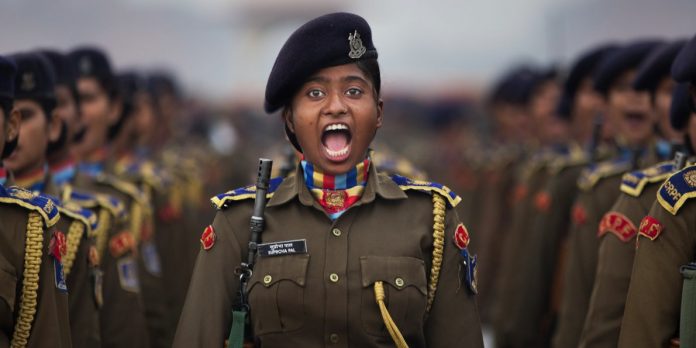
New Delhi, April 25 (IANS) In a historic development, the Indian Army on Thursday started the process of recruiting women, three months after the government announced its decision to open the entry of women as Personnel Below Officer Rank (PBOR).


Image courtesy: business insider

In advertisements in newspapers, the army has invited women to join the military police as general duty soldiers.

The military police staff, described PBOR, manage prisoner-of-war camps and have been part of UN mission contingents in Congo, Somalia, Rwanda and Sierra Leone, the army said.

The Indian Army website said the Corps of Military Police was responsible for preserving “good order and discipline and prevent breaches of the same by persons serving in or attached to the regular army”.

The responsibilities of those selected would include investigation of offences such as rape, molestation and theft; military operations where the army needs police assistance; assistance in evacuation of villages during cross-border hostilities; crowd control of refugees comprising women and children; frisking of women during cordon & search operations and ceremonial as well as policing duties.

The applications close on June 8, said the advertisement.

Courtesy: Two Circle

How the Constitution Was Built

0

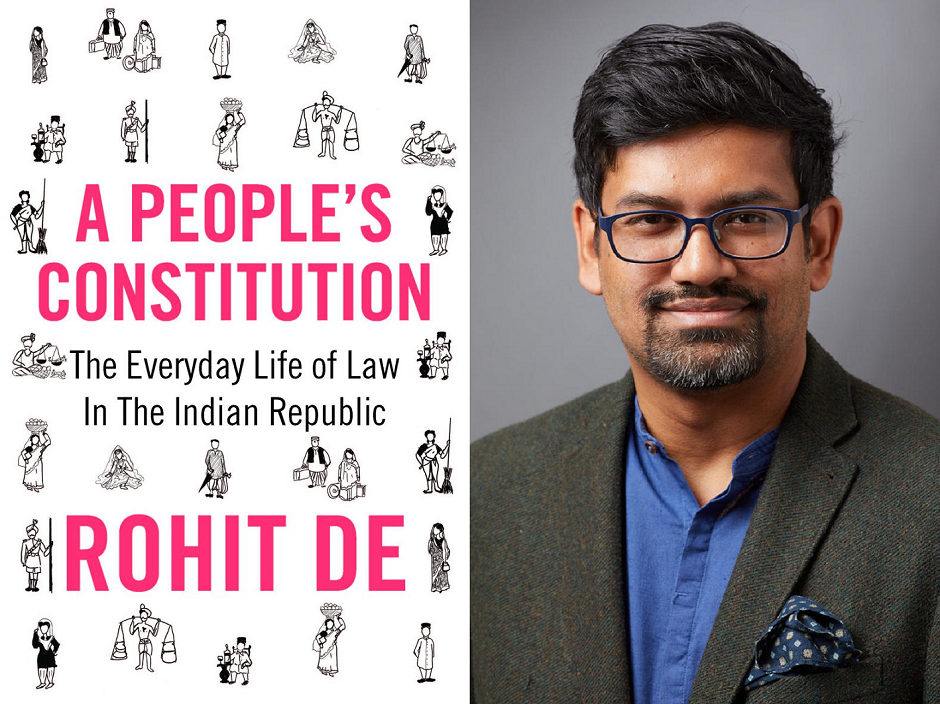
Rohit De’s recent book, A People’s Constitution, has received wide acclaim. The book tells the story of how India’s constitutional culture was built. As against conventional views of India’s constitutional history, De points out that it was the travails and struggles of ordinary citizens that shaped our understanding of rights and liberties. The Indian Cultural Forum speaks to Rohit De about his book and the current challenges of constitutional practice in India.  


ICF Team: As a book on the Indian constitution, A People’s Constitution has unlikely protagonists – from butchers to small traders to sex workers. Could you talk to us about the basic perspective animating your book?

Rohit De: The question I really began with was – “Does the Indian constitution matter?” Outside the self -invested legal academy, I saw deep skepticism about its impact. The first and most obvious reason was that the promise of “justice, economic, social and political” was far from being achieved and the small victories were driven by electoral mobilisation. Secondly, the constitution itself had strong structural continuities with the colonial Government of India Acts which expanded and centralised state power. Finally, there was a shared skepticism from both the right and the left that the constitution was not organic to India. As K. Hanumanthaiah had lamented in the constituent assembly, instead of the “music of the veena and the sitar.. what we got was the discordant notes of an English military band”. Or in Dr Ambedkar’s words, the constitution presented a democratic top dressing on a deeply undemocratic soil. Even those who found much to admire in the political vision of the constitution seemed to concede that it did little for the lives of ordinary people.

While agreeing with much of this criticism, I was struck by the fact that despite these constraints, ordinary Indians turned to the constitution from its earliest days to stake claims both in the courts and in the streets. This was a far cry from the popular belief that poor and marginal citizens repose little faith in the law. Indeed, after independence rates of civil litigation, i.e. Indians taking other Indians to court, actually declined. However, what steadily increased was litigation and claims against the state.

The book turns to the relatively understudied provisions of constitutional remedies to argue that the constitution came to matter in everyday life, and did so often because of repeated usage by some of the poorest and most marginal citizens. My argument does not rest on the claim that the constitution is emancipatory or repressive (both cases can be made), but that it has clearly been useful to large numbers of people. This is very much a work of history, focusing on a period where the rules were being worked out, and where the courtroom was often the space of the unexpected for both citizens and the state. My research began with looking at “constitutional resistance” to attempts by the postcolonial state to transform everyday life, through policies like prohibition, license-permit Raj, ban on beef, municipal licensing and regulation of sex work. This led to the emergence of a certain kind of citizen-litigant, who would use the “state’s language to resist the state”. Not all marginal groups were well represented in the period; peasants and landless labourers, for instance, enter the constitutional field quite late. But marginal figures on the edges of the urban economy, be it big cities or small Kasbah towns, faced the first push of regulations and found themselves turning to the constitution to make their claims.  

It is also becoming increasingly clear that despite being framed by political elites, large swathes of Indians were interested and engaged in the process of drafting the constitution, flooding the Constituent Assembly with letters and petitions and debating the constitution in a variety of forums.

ICF Team: Given the centrality of the constitution to Indian social and political life, what do you think explains the doctrinal focus of scholarship on the constitution till now?

RD: There are a number of reasons for this. The audience for constitutional law, until recently, was imagined to comprise largely of legal practitioners, be they lawyers, law students or judges. The emphasis, as a result, was on producing scholarship that was useful to practice and, therefore, centered on doctrine. The key questions were framed around the holding of a case, its value as a precedent, how it could be distinguished from other cases etc. There, of course, remained important exceptions to this – for instance, the work of Marc Galanter and Upendra Baxi or the early scholarship of Rajeev Dhawan, which attempted to understand the constitution and the court system structurally i.e. from the point of view of political economy or class composition. Apart from a few such exceptions, the favored form of writing about the constitution was that of a treatise, a how-to-book for practitioners.  

There was also work done by an older generation of political scientists – Susan Rudolph, Lloyd Rudolph, Francine Frankel and George Gadbois – which focused on courts and judges as a way of understanding the larger scale politics of the state. I would also include Granville Austin’s magisterial volume on the Supreme Court in this category. However, since this work was institution-centered, it focused on the “big narratives” and tended to treat doctrine as a variable. Feminist public law scholars like Lotika Sarkar, Brenda Crossman, Ratna Kapur, Kalpana Kannabiran and others were perhaps the most effective in bridging the gap between doctrinal study and lived experiences of individuals.

Historians were for a long time suspicious of both the constitution and the appellate courts. There had been an imperial tradition of “constitutional and administrative history” which was largely aimed at those preparing for civil service examinations. In this narrative, constitutional law was clearly about understanding a roadmap of power, and its actors were seen as elite figures. As historians grew more interested in looking at the lives of understudied ordinary people, they turned away to other forms of history.

What I attempt to do is to recognize that the constitution shaped the everyday lives and imaginations of Indians in significant ways. Perhaps a way to describe it would be a social history of doctrine. As I argue in the book, when we ask “what did the court do?” in a certain case, we fail to consider the real contestations among judges, litigants, lawyers, and other actors in the presentation of legal claims. To understand how constitutional law works in India, then, it is necessary to understand what people (whether legal officials or ordinary citizens) believe law is and what they do with this knowledge as they make decisions in their daily lives. We have to move beyond asking “who won?” or “what was the holding?” to trying to understand why people make repeated engagements with the law (or also why in some situations they do not).

I am glad to note that I am joined by several scholars in this endeavor. The work done by Nandini Sundar and Anand Vaidya on tribal engagements with the law is extremely exciting and based on rich enthnographies, as is the emerging scholarship on dalit constitutionalism.

ICF Team: There is a widely accepted narrative of ever-expanding writ jurisdiction in post-emergency India. Certain individual judges like PN Bhagwati and VR Krishna Iyer are often seen as heroes of this story. In what ways does your book complicate this picture?

RD: There has long been a conventional narrative about the Indian Supreme Court. That the court was conservative in its early years, and largely came into conflict with the government over the rights of the elite and the propertied. The court was also unable to stand up for civil liberties and the rule of law during the Emergencies. In order to rebuild the court’s legitimacy, in the 1980s the Supreme Court, led by Justices Bhagwati and Krishna Iyer, actively encouraged Public Interest Litigation and sought to reduce procedural hurdles to justice. In the words of Upendra Baxi, this marks a moment when the “Supreme Court of India became the Supreme Court for Indians”. This is a narrative that we are taught in law schools, and has been reiterated by the court itself on repeated occasions.

However, over the last decade scholars including Usha Ramanathan , Kaveri Gill, Gautam Bhan, Nivedita Menon and Aditya Nigam have been increasingly critical of this narrative, drawing attention to the fact that since the late 80’s, PIL’s have increasingly been an instrument used by judges to take control over questions of administration and governance, and define “public interest” to force an undemocratic, technocratic and neoliberal vision of governance, overriding efforts by the poor and marginal groups to mobilise politically. So the “right to a clean environment” was often mobilised to upset decades of negotiations worked out by the urban poor who were squatting in slums, or small traders who legitimised their workshops and factories.

While others have explained this shift through class interest, the rise of conservative judges and a dominant neo-liberal discourse, Anuj Bhuwania goes a step further arguing that the PIL was a continuation of the Emergency through the judiciary, instead of being an act of judicial redemption. The Emergency, at its core, allowed the abandonment of procedural safeguards in the name of “the people”. It is therefore unsurprising that judges like P.N Bhagwati, who ruled in favour of the executive during the Emergency, helmed the PIL revolution, and that stated goals like slum clearance, urban beautification and abolition of bonded labour echo the 20 point program of the Emergency

This body of work challenges the second part of the PIL narrative – the idea that the PIL was a moment of redemption and reorientation of the Supreme Court for the poor. My work challenges the first assumption, that prior to the Emergency the courts were largely conservative and a refuge of the elite. I show through archival evidence that certain marginal citizens were successful in using the constitution and the courts to mobilise and secure their aims. The courts, despite the overall commitment to conservative procedure, did make some space for questions of public interest, most notably in the case of prohibition.

More significantly, I argue that for some groups, the procedural gambit worked better than a substantive claim. If I may quote from the book: “ The four sets of litigants in this book represent groups that are marginal and have limited social capital amid a wider public… and had few allies outside their own groups. They stood outside the consensus of what a good Indian citizen should be. Therefore, an argument rooted in their rights as prostitutes, traders, or butchers would not find popular resonance outside their groups. However, by framing their problem as one of procedure, these litigants were able to deflect attention from themselves and generalize the problem to the broader public. This was an interesting contrast to colonial India, where emphasizing particular rights was more profitable, but all of them were rooted in custom and religion.”

Who does informality and reducing procedure benefit? Conventionally, the answer is that procedure is a form of systemic violence and greatly disadvantages the poor. This clearly comes through in Justice Krishna Iyer’s dismissal arguing that “procedure is but a handmaiden for justice”. However, the real story is a lot more complicated. Patricia Williams, in her Alchemy of Race and Rights, argues that informality works better in situations where all parties share some degree of trust, and advantages those who are better networked. I hope my book, along with the recent scholarship, will lead to a more sophisticated understanding of procedural reforms.

ICF Team: You make the point in your book that electoral minorities have been overrepresented in constitutional cases before the courts. What do you think explains this?

RD: This was in some ways a surprise. As I started researching on the book, I was interesting in looking at how ordinary citizens challenged new regulations after independence. While creating the first data set, I began to notice a certain similarity in the kinds of petitioners challenging particular kinds of legislation. It helped that in the early writs, petitioners also identified themselves by their community – “A Parsee resident of Colaba” etc. While more quantitative research needs to be done, within my data certain distinct communities seemed overrepresented.

Why was this the case? Something profoundly changed in both the character and rhetoric of the state with the coming into place of the constitution. Under colonial rule, Indians were subjects and were often administered through their community identities. Rights claimed were often framed on the basis of preserving “ancient customary liberties” or using Queen Victoria’s Proclamation of 1858 to assert a right to religious practice. Thus, Parsis in the 1930s challenged prohibition as a breach of both customary rights and ritual practice. Secondly, colonial representation was based not on universal franchise but the representation of interests; there were special seats in the legislature for “Indian Commerce”, “Women” etc. The constitution transformed this and created an equal relationship between the individual and state; it also subordinated the claim for particular rights to that of general interest (for example, the restrictions in Article 19). For Nehru’s government, the basis of governmental legitimacy lay in the fact that it had won a popular election.

However, what about interests that could not be represented through the institutions of electoral democracy? These included both religious and cultural minorities, but also groups that carried a pejorative public image. For them, the courts remained the only resort.

The idea of an electoral minority challenges conventional understandings of marginality, for instance social and economic deprivation. As Namita Wahi points out, at least two of the major groups, Parsis and Marwaris, occupy economic privilege, and the others – street vendors, prostitutes and butchers – have control over some capital. This is why turning to cultural sources from the 1950s was critical. I was able to show that these groups enjoyed little public legitimacy and support. The Marwari shopkeeper was a figure that was villainised in both government propaganda and popular culture, the prostitute seen as a figure of decadence and contagion, the Parsis portrayed as effete and anglicised, and the Muslim butcher demonised by an assertive Hindu public.

Group rights, particularly minority rights in India, have largely centered on questions of culture (language, religion, and status). This is despite Ambedkar’s memorandum on minority rights, which noted that the “connection between individual liberty and the shape and form of the economic structure of the society may not be apparent to everyone . . . nonetheless the connection is real”. It is also important to remember that community identity was not just a mark of culture, but was closely tied to the market. In a caste-based society, electoral minorities are not just members of a socioeconomic class or followers of a certain ideology but are inextricably linked to ascriptive identities.

ICF Team: In your book you describe the aura of secrecy that surrounds the Supreme Court Record Room, an archive you have drawn heavily from. Do you think there needs to be a concerted effort to make such legal archives more accessible?

RD: Most courts in India are designated courts of permanent record. This means that they have to maintain their records for all time. However, these records (with a few exceptions like the Calcutta High Court, or the papers relating to the Lahore Conspiracy Case) have remained on court premises, largely moldering away in basements. This is partly because legal imaginations do not see the court record as useful, except to the parties in the case. The published judgment is the final word on the case, framed by the judge’s authorial voice. Its chief value outside of the parties concerned is in its role as legal precedent. When I was trying to get access to the Supreme Court records, I did not meet with opposition but mostly bemusement and curiosity as to why these would be useful.

What these records are able to show are the contestations that go into a legal dispute, and often reveal the silences that remain in the judgment. For instance, one of my chapters is centered around the Mohd Hanif Qureshi case, often reproduced in reports and textbooks as Mohd Hanif Qureshi and Others. It was only on examining the case file that I discovered that “the others” included close to 3000 individually named petitioners from hundreds of villages across North India. This changed both the scale and nature of the intervention. Similarly, the judgment itself is framed as a question of religious freedom, and becomes a precedent for it. However, examining the petition one sees that this was almost an afterthought by the petitioners, who advanced very limited material to support it, and largely saw the cow slaughter ban as an economic impediment to their trade and profession. There has been exciting work coming out from High Court archives by scholars like Mitra Sharafi, Durba Ghosh, Julia Stephens, Kalyani Ramnath and others, that offer new ways of understanding both Indian history and the legal system[i]. Sharafi, for instance, works with the Parsi Matrimonial Court records and is able to show how Parsis, particularly Parsi women, were able to use and transform community norms through engaging with the colonial legal system. Kalyani Ramnath’s use of the Madras High Court records shows a world of legal transactions that tied Madras to Burma, Singapore and Malaya, and tracks what happened after independence when state borders came up.

There is also a pressing need for quantitative research on the courts using these records. Apart from Nicholas Robinson and Abhinav Chandrachud’s work on the Supreme Court and the Bombay High Court recently, the last major piece of research was by Rajeev Dhawan on the Allahabad High Court.

All of this is to say that there is much to be done in preserving these records and making them accessible. An easy way would be to move many of the older records to the state archives, as is the practice in the UK , Sri Lanka and Kenya. These are designed to preserve and make available records for academics. Currently, the records are largely stored in cloth bundles and dumped in basements. This makes retrieval almost impossible and puts the documents in danger of being damaged. There is a concerted effort to digitise these records, but the terms of the digitisation remain unclear. I have also heard the rather worrying rumor that the physical records are being destroyed after digitisation. While digitisation can be a good way of preserving and making records accessible, these need to be done with care and under supervision of trained archivists and historians, particularly when the digitisation is only partial.

The Supreme Court Museum is an under-utilised resource and could play a larger role in preservation. Other initiatives could include preserving the private papers and correspondence of key legal actors including lawyers, judges and non-governmental organisations. The PUDR papers in the Nehru Memorial Library, for instance, or the papers of Justices Gajendragadkar and Chagla, have been invaluable resources.

ICF Team: Do you think that despite the remarkable progress the Indian judicial system has registered in terms of constitutional practice, equitable access to the law remains a problem even today?

RD: Absolutely. How does one explain the persistence of Indian constitutionalism despite the malaise of the legal system? One of the arguments I make in the book is to separate constitutional litigation from the rest of the legal system. As a recent study shows, levels of civil litigiousness in India, i.e. the number of Indians who turn to the law to solve problems with their fellow citizens, has actually dropped sharply since independence. Most Indians, of all social classes and backgrounds, are reluctant to engage with courts in ordinary matters. In contrast, rates of litigation against the state have steadily increased after independence, both due to availability of constitutional remedies and the greater intervention of the postcolonial government in everyday life. This is also a product of judicial architecture; the High Courts and the Supreme Court are staffed by better judges and advocates, and face a greater degree of media scrutiny, than district courts. While delays are also endemic, they are less so than in the district courts.

In some ways, this mirrors the Indian state, which often invested in creating a few institutions of international repute and excellence rather than improving standards of ordinary institutions. This is perhaps clearest in the field of education when we compare ourselves to other postcolonial countries. For instance, the state subsided and promoted universities that produced world class scholarship and a technically trained manpower, but spent a marginal portion of the GDP on primary education. One could argue that this is a result of state capture by a certain group of elites, who transferred resources to build institutions that they could access without improving the access of the masses.

The trend changes over time, however, with greater democratisation of these spaces and increased access. It is worth asking in what ways access to justice can be made equitable. Why, for instance, are constitutional remedies only limited to the High Courts and the Supreme Court? Why cannot district courts exercise writ jurisdiction and hear certain kinds of administrative cases? If more was at stake in the lower judiciary, there would also be a greater urge to improve infrastructure and reform processes. Similarly, as Nicholas Robinson’s research shows, the Supreme Court disproportionately hears cases from Delhi and the surrounding regions[ii]. Would it make sense to create benches elsewhere in the country, have a travelling court, or create an intermediate court of appeals for different regions? Lastly, and most urgently, there is a need to rethink and reimagine legal aid and legal awareness. I am encouraged to see that some parties have made access to justice a political issue in their manifestos, and hope they will be seriously funded and implemented in the future.

Courtesy: Indian Cultural Forum