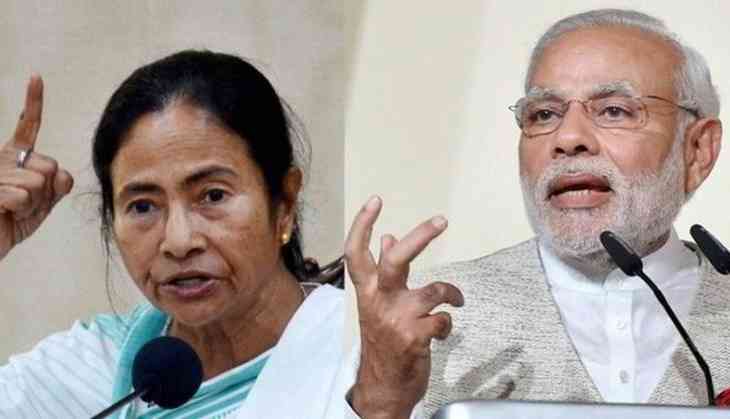
At the end of the third round of the on-going Lok Sabha elections, a much mellowed prime minister, Narendra Modi appears to be wooing “friends” in the Opposition, be it Trinamool Congress chief, Mamata Banerjee or senior Congressman, Gulam Nabi Azad.
In his much “hailed” interview to star power in the persona of Akshay Kumar Modi today said, in reply to a pointedly political question. “Do you have friends in the Opposition parties?” that he had “many friends.” Not to be bothered with what last week’s headlines had communicated when he had all but virtually cussed at the Bengal chief minister, he added today,“They are my very good friends. We even eat together once or twice in a year, though it’s formal.
Appearing to anticipate a new political reality, post May 23, here’s what Modi said, “ Although if I say so, I may even face losses in the election, but Mamata didi sends me Kurtas once every year, which she herself selects. (laughs heartily)”
Modi then speaks about chats with Gulam Nabi Azad and chats with the parliamentarian over the years. “We are joined together like a family. It can’t be understood from outside.”
This interview will no doubt fuel further speculation on whether Mamata will be willing –despite and inspite of all the obvious bluster—to offer support to a much-truncated BJP/NDA government at the Centre if the key numbers are needed to form a government.
Women March: Bombay, a group of women, gender non-conforming, and non-binary people who are campaigning for constitutional values, has released a resource detailing the failures of the current government, an important document as the 2019 Lok Sabha elections are underway. The resource argues that the long-awaited “achhe din” that Prime Minister Narendra Modi had promised never arrived; instead, the government “brought one policy after another that was great for ad campaigns but did nothing for generating employment; for any real development except constructing statues, flyovers, bullet trains.” Moreover, the government “spread terror and hate crimes,” and restricted “freedoms of the common person to wor, express, speak, eat, live while strengthening corporations, money launderers and loan defaulters.” The resource highlights key questions “that are crucial for a democracy to survive”.
The first is, “What is going on with our economy?” In response, the response details damning statistics, such as the fact that India is ranked 103rd of 119 countries on the Global Hunger Index, and says that the current unemployment rate 6.1%, the highest since 1972-73. Moreover, it notes that 11 million jobs were lost just in 2018, of which 8.8 million were women’s jobs. Also, the rural female workforce participation has declined from 93 million in 2011-12 to 64 million in 2017-18. The resource adds that demonetisation “has broken the back of farmers and small traders,” and that the GST that was implemented in July 2017 has “crippled small businesses.” Meanwhile, the wealth of Mukesh Ambani, India’s richest man, grew 67% in 2018.
The second question is, “What is going on with our society?” The answer notes that crimes against women and violence against Dalits have both increased. In 2014 to 2016, more than 1.39 lakh complaints were filed under The Scheduled Castes and Scheduled Tribes (Prevention of Atrocities) Act, 1989, “an 11.6-percent increase from the previous government,” the resource states. 90% of “religious hate crimes since 2009 have occurred after BJP took power at the Centre in 2014,” it says. Moreover, between 2014 and 2018, “the number of civilians killed in Jammu & Kashmir has risen by 35.71%”.
The resource analyses “the truth behind the shining flagship schemes of this government,” including the Swachh Bharat Abhiyan and the Beti Bachao, Beti Padhao scheme. It notes that Rs. 1.5 crore were spent every five days on advertising the former, even as one safai karmchari died every five days. For the latter, 56% of Rs. 648 crore were spent on publicity and advertising, and just 25% was distributed to states to implement the scheme. The resource notes that many schemes that were initiated by previous governments have simply been renamed by the current government. Meanwhile, it highlights that 22 of the 30 most polluted cities are in India, and that Mumbai’s BEST bus network is being privatised, even as Rs. 12,000 crore has been allocated for the city’s coastal road.
The resource also points out India’s low ranking on the World Press Freedom Index, noting that the Prime Minister has never addressed a press conference during his term. It outlines how democratic institutions are under threat, noting that the freedom of the judiciary is in question, education is being saffronised, and that the government has “scrapped release of all reports related to employment,” and that data from independent statistical agencies has been “delayed, discredited or manipulated for political purposes.”
Tulsi Gabbard – the first Samoan American and the first Hindu member of the United States’ Congress representing Hawaii – has been in a controversy ever since her election. She has been accused of using her political position to align with the right wing supremacist Hindutva party of India, the BJP.
Gabbard has openly shown her support for authoritarians abroad including the president of Egypt Abdel Fattah El-Sisi, Syria’s Bashar al-Assad and India’s PM Narendra Modi. Time and again, she has attended events of the RSS-BJP and have shown solidarity with the ‘threat to the Hindus’ due to the Islamist extremism. Due to her radical ideology, she has been labelled as a person who celebrates and embraces fascists who massacre Muslims, Christians and other minorities.
Hindu-Americans have supported Gabbard since the start of her political career, and that support has increased substantially since Modi’s election, much of it coming from Hindu nationalists. After Modi’s election in 2014, in a public gathering at a Hindu temple in Atlanta, organised by the Overseas Friends of the BJP, the American chapter of the BJP, the Modi supporters appealed to donate for Gabbard’s re-election campaign describing her as an “American Hindu” who “has fought against the anti-Modi resolution introduced recently by some members of Congress.” According to Gabbard’s financial disclosures from 2011 to October, 2018, majority of her donors have strong ties with the Sangh Parivar.
Since 2013, Gabbard has attended conferences across the US, organised by Sangh Parivar affiliates like the Vishva Hindu Parishad of America (VHPA) whose Indian counterpart has been recognized as a ‘militant religious organisation’ advocating violence against Muslims in India by the CIA World Factbook. Gabbard also has strong ties with the Hindu American Foundation, a not-for-profit advocacy organization of Hindu-Americans.
Gabbard’s ties to VHPA members have seeped over from professional to personal. VHPA member Rishi Bhutada and the National General Secretary of the BJP, Ram Madhav, were invited to her wedding at Hawaii. Madhav had reportedly given a gift to Gabbard on behalf of Modi.
Gabbard had openly criticized the US government’s decision to ban Modi’s visa owing to his alleged involvement in the 2002 Gujarat communal riots that killed more than 1000 people of which almost 800 were Muslims. Gabbard called the no-visa decision a “great blunder.” Further, in December 2013, she had voiced her opposition to the House Resolution 417 which criticized India for failing to protect the rights and freedoms of religious minorities referring to the mass violence against Muslim minorities that had taken place under Modi’s watch. She told the media, “there was a lot of misinformation that surrounded the event in 2002.”
The 2020 presidential candidate Gabbard has repeatedly expressed her sympathies for authoritarian world leaders. Her Hindu supremacist exclusionary ideology aligns with that of India’s BJP and its leader Modi with whom she shares a great rapport. After a meeting with Modi, she had said, “We had a wide-ranging discussion on several issues our countries have in common, including how America and India can work together to help combat the global threat posed by Islamic extremism.”
Predictably, Gabbard has denied connections with the Sangh Parivar and its affiliates. However, the Hawaiians have accused her of putting the interests of religious fanatics ahead of the interests of humanity calling her a ‘polarizing figure’. They have expressed their disapproval of Gabbard’s ignorance of the conditions of the people of Hawaii.
As right-wing nationalism rises across the globe, people like Gabbard are beginning to be recognized as an existential threat to a world order rooted in liberal democratic values.
There were twin grenade explosions triggered by suspected rebels near an Assam rifles transit camp in Imphal city on April 22 night.. A Physics teacher at Churachand Higher Scondary school, Konsam Santosh received splinter injuries on his arms and legs after the grenades went off in quick successions around 8 pm. He wasdriving past the spot of explosion. He is reportedly out of danger. Though police rushed to the spot and carried out a search operation, nothing was found.
A bomb was reportedly found planted along the NH-150 highway near Little Flower school in Imphal the same morning. Afterwards, he Imphal-Churachandpur section of the highway was blocked for several hours. The Highway was opened only after the bomb squad removed the grenade. The grenade was wrapped with black colour polythese bag and planted at the main entrance of the school. The roads were closed by the troops of J&K Rifles on ROP duty at around 6 am after they discovered the explosive.
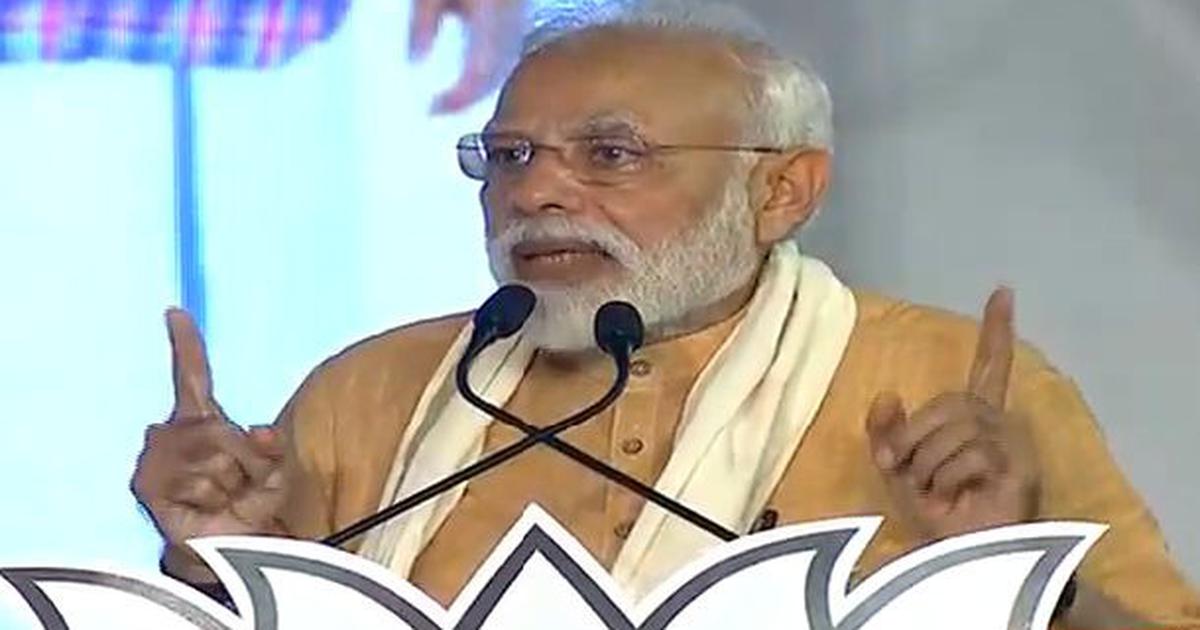
The Coalition for Nuclear Disarmament and Peace (CNDP) has released a statement expressing “shock and dismay” at Prime Minister Modi’s recent remark, in which he said, “India has stopped the policy of getting scared of Pakistan’s threats. Every other day they used to say “We’ve a nuclear button. What do we have then? Have we kept it for Diwali?” Modi made this remark while speaking at a rally in Barmer, Rajasthan. The CNDP has termed his comment “public nuclear sabre-rattling,” declaring, “To speak so casually about the possible use of nuclear weapons and that too for the purposes of winning votes through arousal of hatred and by promoting an ugly, masculinist militarism, is deeply disturbing.”
The CNDP argued that the “very least that is demanded from nuclear armed governments is that their leaders should display some sense of responsibility and sobriety in what they say and do,” adding that Modi “has disregarded all this only goes to reinforce the view that South Asia is potentially the most dangerous place in the world.” The organisation reasoned that those genuinely “concerned about ensuring the safety and security of Indians would not indulge in such reckless rhetoric,” and cited a study that, per the International Business Times, predicted that a nuclear war between India and Pakistan would prompt worldwide famine and kill two billion people. The 2013 study was conducted by the International Physicians for the Prevention of Nuclear War (IPPNW) and Physicians for Social Responsibility (PSR).
In fact, per Scroll, the Indian affiliate of the IPPNW, the Indian Doctors for Peace and Development (IPDP), also issued a statement criticising Modi. The group said its senior vice president, Dr. Arun Mitra, had filed a complaint with the Election Commission. The statement alleged, “The irresponsible, dangerous and provocative nuclear rhetoric that India does not have nuclear weapons for Diwali by the prime minister at Barmer, Rajasthan on April 21 amounts to threatening the neighbour,” adding, “It can push the whole region into nuclear catastrophe. He should be debarred from contesting elections and addressing any election rally and making such statements,” Scroll reported.
The complete CNDP statement may be read here:
It is with shock and dismay that the Coalition for Nuclear Disarmament and Peace (CNDP) takes note of the Indian Prime Minister’s public nuclear sabre-rattling on April 21, 2019 in Barmer in Rajasthan when he mindlessly and sarcastically declared that India’s nuclear weapons were not for celebrating ‘Diwali’ (the festival of lights and sound)! To speak so casually about the possible use of nuclear weapons and that too for the purposes of winning votes through arousal of hatred and by promoting an ugly, masculinist militarism, is deeply disturbing. The very least that is demanded from nuclear armed governments is that their leaders should display some sense of responsibility and sobriety in what they say and do. That Prime Minister Modi has disregarded all this only goes to reinforce the view that South Asia is potentially the most dangerous place in the world.
Those who are really concerned about ensuring the safety and security of Indians would not indulge in such reckless rhetoric. How will the promise of obliterating Pakistan through a “second strike” guarantee the security of those Indians who are likely to be wiped out in a Pakistani “first strike”? The issue is of taking all necessary steps to prevent a nuclear war; it is not about retaliatory strikes.
CNDP calls on the PM and all other politicians to immediately stop fuelling and inciting reactions in such a manner from those who gather in large numbers at such rallies. This is not just a further debasement of our public political discourse but such cavalier boasts and threats may provoke a war of words leading to an unwanted and unwarranted escalation of inter-country tensions which in turn can set off a very dangerous dynamic.
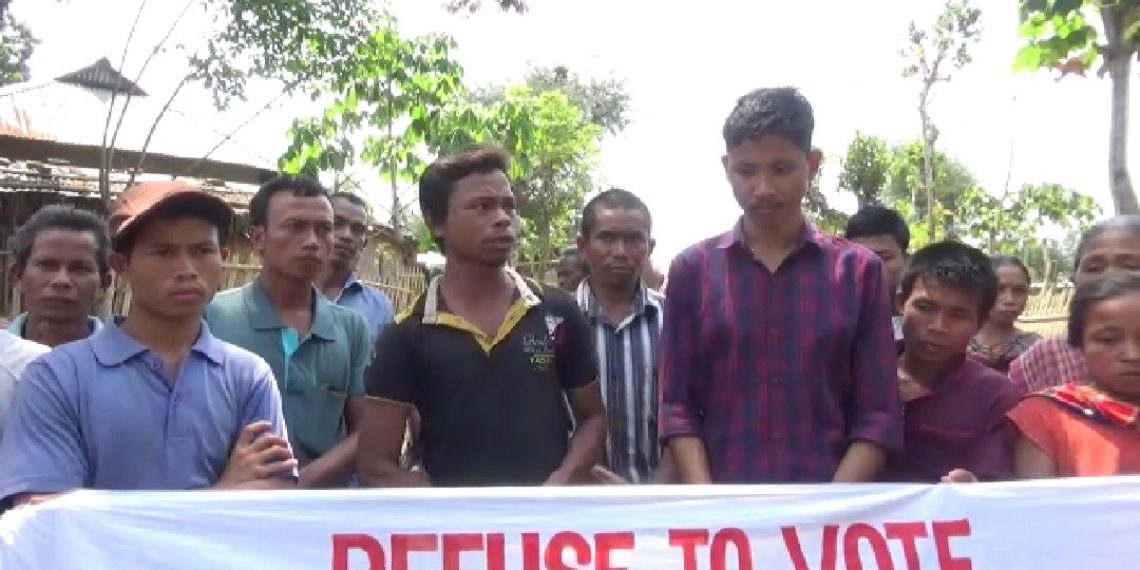
The protesting villagers had said they would not vote in the election unless Tripura Chief Minister Biplab Deb met with them and pledged to deliver on their demands, ANI said. On the morning of Tuesday, April 23, the day the Tripura East constituency went to the polls, local administration and police officials met with the villagers, “and convinced them to cast their vote after it was committed that all their promises will be fulfilled,” ANI said, adding that since that morning, voter turnout was zero at the Bhagirath Para polling centre. The BJP’s candidate for the constituency, Rebati Tripura, had accused supporters of the Opposition of threatening the villagers if they voted, ANI said.
The villagers had alleged that, in 2012, the previous government had taken Rs. 1,400 as an advance to supply electricity, but had not followed through. They also demanded water for pipelines that had been installed a long time ago, a higher number of teachers, and a hostel facility for students, ANI reported. The protesters, primarily youths, also demanded that a market shed, a panchayat office, and other essential facilities be established.
This was not the only boycott in Tripura. At around 10:30am on the day of the polls, The Hindu reported that 20 families in the state’s North Durgapur village in the Khowai sub-division were boycotting the polls after a local youth was allegedly assaulted by personnel from a paramilitary force. Separately, ANI reported that villagers in Gandacherra, also in the Dhalai district, were boycotting the Lok Sabha polls due to lack of adequate medical care. ANI said several villagers were suffering from fever, and spoke to one resident, who said that no doctor or officer was coming to the area, that medication was not available and that they had no money.
Misplaced votes and the farce of ‘Free and Fair’ elections as EC refuses to hard test machines and criminalises complainants
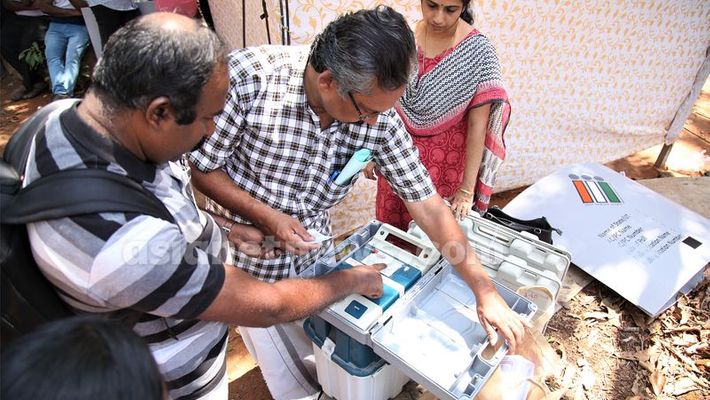
Even as phase three of Lok Sabha polls got over on April 23, 2019 things look far from ‘free and fair’. Several places reported ‘malfunctioning’ Electronic Voting Machines (EVMs). On a closer look at the mammoth number of complaints, these hardy fall into the category of ‘malfunction.’ This detailed report looks at the experiences of voters across various polling booths Election Commission’s approach to reports of complaints.
Convenient exchange of symbols? In Moradabad, people who voted at booth no. 86 alleged that when they pressed the “cycle button” (symbol for Samajwadi party), “lotus symbol came”. Lotus is the election sign for BJP. It was reported that when they tried to complain to the polling officer, they were told, “koi baat nahi” (no problem).
In the Jorhat constituency of Assam, the returning officer Vishal Vasant Solanki said that all EVMs in his custody are being put through a second level of test of test by engineers on reports of a ‘malfunction’ where all votes casted went to BJP.
Another voter in Kerala complained, “I have voted for Congress, but the picture [that] came on the (VVPAT) screen and the slip was lotus. I want to cast my vote again.”
Reports emerged of more than 20 EVMs ‘malfunction’ in Kasaragod, as five machines developed ‘technical glitches in Kayankulam. In Wayanad, the NDA candidate Thushar Vellappally demanded re-polling after an EVM malfunction.
Malayalam magazine Manorama reported that a faulty EVM in a booth at KizhakkeNalpathu near Cherthala had to be replaced after it was found that all votes were registered for BJP.
In Odisha, polling in two booths was adjourned due to incorrect pairing of EVM and VVPAT
Can EVMs be hacked “easily” Andhra Pradesh Chief Minister N Chandrababu Naidu on April 23 alleged that EVMs are vulnerable to “hacking and programming errors”, and urged the EC to check all polling machines after elections.
Naidu also alleged that EVMs can be hacked easily by using “many methods.”
In Uttar Pradesh, SP leader Azam Khan’s son said, “More than 300 EVMs aren’t working”, accusing the District Magistrate of doing this “on purpose.” In UP’s Rohilkhand region, more than 50 polling booths reported EVM ‘malfunction’ early morning.
Criminal negligence? SP leader Akhilesh Yadav called this as a case of “criminal negligence” as he reported that polling officials were “untrained” for a polling exercise that costs Rs. 50,000 crores.
In Goa, During a mandatory mock polling exercise, EVMs were adding votes to BJP. During the mock poll, in which 9 votes were cast for each candidate, the BJP candidate received 17 votes, Congress 9, AAP 8 and 1 independent.
Election of shame ? Mock poll with 9 votes for each of 6 candidates in booth no 31 in 34 AC in Goa. Total count BJP gets 17, Cong 9 , Aap 8. Ind 1 . Robbery. @SpokespersonECI , @CEO_Goa claims are hollow . @AamAadmiParty pl take up
The machines were replaced for AC34, PS no 31 as per report from DEO South Goa.
In Karnataka, where the voting took place for the remaining 14 seats, Minister Priyank Kharge wrote, “Way too many EVMs are malfunctioning in Chittapur. Over 20 reported so far. Hope the district administration has enough backups.”
A TDP delegate highlighted how EVMs are not displaying the printed slips for seven seconds as prescribed in the VVPAT manual, but only for three seconds.
Criminalisation of complainants In Assam, former Assam DGP Harekrishna Deka alleged that the VVPAT machine at a polling booth ‘malfunctioned’ as the machine displayed some other name and not the one he had voted for. He said that he was the first to go inside the polling booth at Lachit Nagar LP school. When he voted, “it didn’t show the name of the candidate” against whom he had pressed the button. When he reported that there was some anomaly, he was told that he can “challenge it”. Additionally he was also told that in case of a false complaint, he will be punished for six months. Case was filed against a voter in Thiruvananthapuram after complaints of faulty EVM
Tedious reporting of complaints The procedure to report a fault or error in the functioning of an EVM involves signing a declaration form by the complainant voter that they testify that the things reported in their complaint are true. This is an intimidating affair for a country whose population lives in poverty and a constant fear of harassment by public authorities. Ideally, such a declaration shouldn’t be required from the complainant and they should be allowed to report and complain about any errors they spot. Moreover, the complainant can be jailed for a ‘false’ complaint and can be fined upto Rs. 1000. It’s hard to fathom that in view of such stringent measures, why would an ordinary, working voter, who has taken a day out from their lives for voting, bother themselves with a complaint which may land them in trouble?
Not only that, even if the EVM is working fine, it has been reported that the VVPAT slips can be only seen for three seconds instead of the seven seconds as mentioned in the manual. Three seconds is too short a time for any voter to confidently flag an error even if they spot it.
The onus of proving the complaint is on the complainant. How is an ordinary voter who, far from being familiar with the technology and may even be using the technology for the first time, is supposed to prove their complaint?
Approach of Election Commission Questions on the accountability of EVM machines need to be addressed in a transparent way.
As reports of EVM ‘malfunction’ emerged from Andhra Pradesh, TDP delegate Hari Prasad raised fresh concerns over the functioning of the machines on the ground. On the reports that the VVPATs weren’t showing the slips for seven seconds, he noted that either there was a change in the code, or the EVMs are faulty. As rightly questioned in an article on Quint, this should have been investigated by the EC.
Instead it decided not to engage with the questions, and, moreover, raised questions on its impartiality and decisions. Even in the past, the EC filed a complaint of theft against Hari Prasad instead of acting on the issue.
Several questions arise here. How does the EC ensure the security of EVM especially when they have not checked or audited each EVM?
If there was a change in the code, was the change tested enough, or at all?
Has the code for the EVMs been centrally tested or it gets tested at the local level?
Where are the machines coming from and how is their security maintained?
Are there clear instructions to store the machines in a safe and secure manner? For example, the returning officer at Assam’s Jorhat constituency said, “These [faulty] EVMs were here for a long period. Usually EVMs are kept in the custody of the deputy commissioner and during elections they are taken to strong rooms.”
The Election Commission’s stance has been that EVM are tamper proof because they are not ‘networked’, and its code is signed to ensure no can change it. But what is the legitimacy of this claim?
In most countries such technological tools –open to mass use by the public — go through robust testing mechanisms. Entire teams of testers work together to break the code and find bugs. Only then can a robust code be developed.
But in case of India, the EC, though has adopted this technological tool, it’s shying away from robust testing and making this tool more transparent. Not only political parties, but the citizens of the country deserve a fair and transparent mechanism they can trust that their decision to vote for a safe future has been given the importance that it deserves.
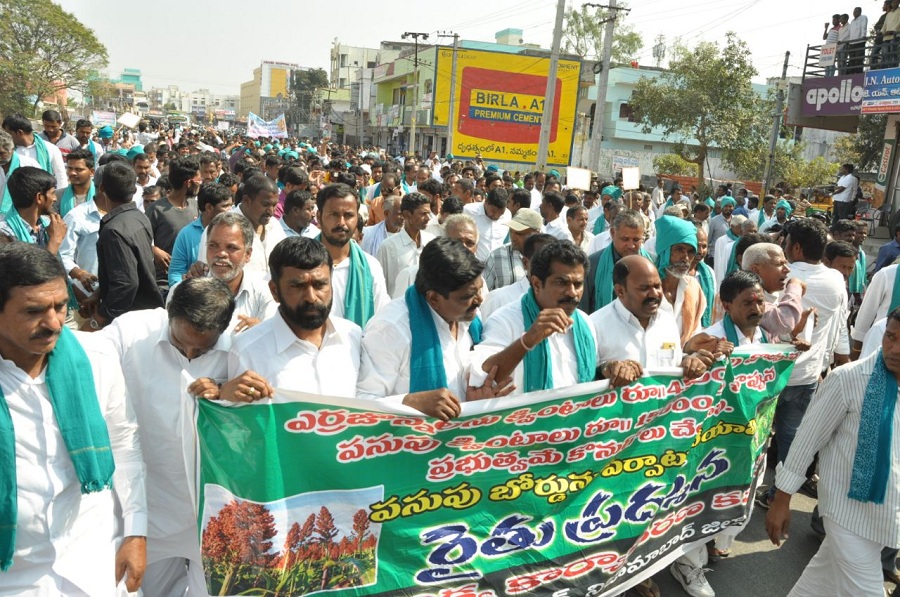
Fresh from the success of their efforts to draw attention to their plight by filing bulk nominations from Nizamabad during Telangana elections, Turmeric farmers now plan to use the same strategy in Varanasi.
File Photo
178 farmers had filed nominations from Nizamabad to demand a higher price for turmeric and red jowar crops. Now led by the All India Tureric Farmers Association, farmers including women and members of Scheduled castes from Amoor, Balkonda and Nizamabad areas will leave for Varanasi on April 25. They will also be joined by farmers from Erode in Tamil Nadu.
Varanasi is the constituency of PM Narendra Modi. The farmers are enlisting the support of local Varanasi farmers to contest elections as well as donors to pay for deposits.
Association’s president PK Deivasigamani told Hindustan Times, “The farmers will be filing the papers on April 29. We are mobilising the support of local farmers for the nominations. Each contestant requires the signatures of at least 10 locals.”
There are also reports of a possible similar campaign in Wayanad from where Rahul Gandhi is contesting his second seat.