After waiting for years on end, and at the same time working tirelessly for the Congress party, Advocate Shanimol Osman has got a ticket to contest for the Lok Sabha seat from her hometown Alappuzha. She is the lone Muslim woman candidate fielded by the Congress from Kerala and in fact the lone Muslim candidate from Congress after Advocate T Siddiq backed off for Rahul Gandhi to contest from Wayanad.
Shanimol Osman ( Picture from facebook)
Osman, the first woman secretary of the AICC from Kerala has worked for the party since joining the Kerala Students Union years back. Ever since, she has served the party in different positions such as President of the Kerala State Mahila Congress, Municipal Chairperson at Alappuzha, member of the Alappuzha District Panchayat, member of the District Planning Committee, and member of the committee for the National Youth Programme. She is presently a member of the AICC, the Political Affairs Committee in the Kerala PCC and the Pradesh Election Committee.
Osman had been in the news after the defeat of the Congress-led UDF in the last Assembly elections in the state in 2016. She alleged that she was defeated in the constituency of Ottappalam as the Congress had given its votes to the BJP candidate. She also said on Facebook that she was a victim of the caste-group politics inside the party, which kept her away from positions. She boycotted the KPCC meeting held after the elections, along with senior leader Bindu Krishna, demanding to discuss the reasons for the failure of the Congress.
Shanimol Osman speaking at an election convention ( Pic ffom face book)
She had also contested in the by-election to the Perumbavoor constituency in 2009 but lost to Saju Paul of the CPIM. She was offered a seat in the Kasargod Parliament constituency, an LDF stronghold, in 2014 but she refused.
Shanimol graduated in Zoology from SD College, Alappuzha, and is a postgraduate in Sociology from the Loyola College, Thiruvananthapuram. She then completed LLB from the Kerala Law Academy, Thiruvananthapuram. The 52-year old has a son and daughter – Alif Sathar Osman and Asya Thami Osman. A Mohammed Osman is her husband.
The LDF candidate AM Ariff, who is presently MLA from Aroor, is also a native of Alappuzha. He has been representing Aroor in the Assembly since 2006. The NDA has fielded Dr KS Radhakrishnan, former chairman of the Kerala Public Service Commission and former VC of the Sree Shankaracharya University for Sanskrit in Kalady, who recently joined the BJP.
The district of Alappuzha was the worst affected in the deadly floods which savaged Kerala last year. The Parliamentary constituency is made up of six assembly constituencies in the district and Karunagappalli in nearby Kollam district. While the UDF had a clear lead in all but one Assembly segment in the 2014 LS elections, it lost all but one in the 2016 Assembly elections. The UDF focuses on the national issues such as communalism and corruption targeted against the NDA, and attacks the CPIM for its violent politics. Osman had been highlighting on women’s issues too, such as the insecurity faced by girls and sexual abuses. The LDF is mainly focusing on the development works done by its candidate in his constituency.
The constituency was won by the Congress in the last two elections by its national secretary KC Venugopal, who refused to contest this time citing organizational responsibilities (AICC general secretary in charge of Karnataka). While the UDF is asking for votes to continue the development activities of the last ten years, the LDF is asking for a change.
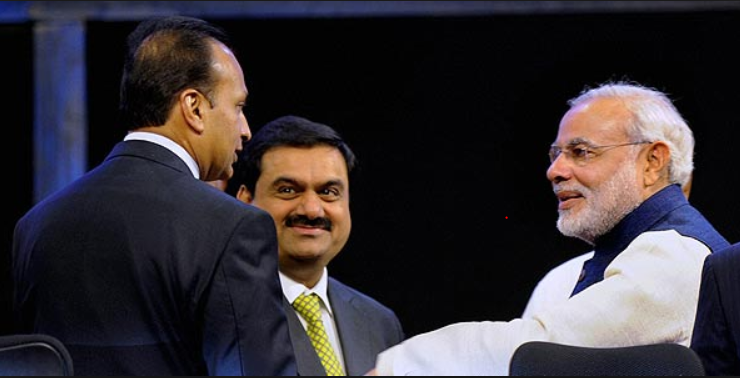
Companies headed by Gautam Adani and Anil Ambani signed no less than 18 deals when the two prominent businessmen accompanied Prime Minister Narendra Modi on his trips outside the country. Here is a compilation of these agreements based on publicly available information, including media reports.
Image for representational use only.Image Courtesy : Truth Of Gujarat
In the first four years of his term as Prime Minister of India, Narendra Modi travelled outside the country on 41 occasions to 52 different countries over a cumulative period of 165 days. In the process, he incurred total expenses amounting to ₹355 crore that was paid out of the national exchequer. These facts have been disclosed in replies to questions raised under the Right to Information Act with the Prime Minister’s Office. Among the businesspersons who accompanied him on many of these foreign trips were Gautam Adani and Anil Ambani. Companies controlled by these two individuals signed 18 agreements in 16 countries– thirteen of these deals involved corporate entities in the Adani group, while five of these deals were signed by companies in the Anil Dhirubhai Ambani Group (ADAG).
Here is a compilation of these agreements culled from various media reports. These have been categorised under three heads: defence, logistics and power.
Defence
Under India’s new defence partnership policy, a foreign aircraft maker can collaborate with an Indian firm to develop a world-class indigenous aeronautical manufacturing base that India has struggled to build for decades. The major companies that are going to make or service these aircraft include those owned or controlled by Adani and Anil Ambani. The former accompanied him on visits to Kenya and Uganda in 2008 when Modi was Chief Minister of Gujarat. The latter praised him as a “king among kings” and compared him to Mahatma Gandhi, Sardar Vallabhbhai Patel and the Hindu mythological character Arjuna during the Vibrant Gujarat summit in 2013.
France
Modi’s Visits: April 9-12, 2015, June 2-3, 2017 (Anil Ambani)
Date of Deal: March 28, 2015
The Indian Expressreported that Anil Ambani’s Reliance Defence was incorporated on March 28, 2015, just 12 days before Modi announced in France that India would buy 36 Rafale fighter planes in flyaway condition. According to the report, India would be paying ₹58,000 crore for 36 Rafale fighter jets – this works out to just over ₹1,600 crore per aircraft. It was claimed that the Indian Air Force needed the planes urgently and that these 36 planes would reach India within two years. Four years down the line, the aircraft are nowhere in sight. In fact, it was stated in Parliament that the first Rafale fighter aircraft would come only by September 2019, four-and-half years after the Prime Minister’s announcement.
Sweden
Date of Deal: March 22, 2015 (Ambani)
Swedish Prime Minister’s visit: February 13, 2016
Date of Deal: September 1, 2017 (Gautam Adani)
Modi’s Visit: April 16-18, 2018
In 2015, Anil Ambani’s Reliance Defence and Aerospace tied up with defence giant Saab AB of Sweden to bid for the ship-borne unmanned aerial vehicle (UAV) programme of the Indian Navy valued at ₹1,000 crore. Swedish Prime Minister Stefan Lofven arrived in India on February 13 on his maiden trip to the country as the head of government with a Swedish delegation to take part in the “Make in India” week in Mumbai in 2016 and in the following year, Saab announced that it was tying up with the Adani group to bid for manufacturing single engine fighter aircraft in India. The deal for 100 plus fighter aircraft was estimated to be worth over ₹60,000 crore.
Israel
Date of Deal: March 30, 2016 (Adani)
Date of Deal: March 29, 2016 (Ambani)
Modi’s Visit: July 4-6, 2017
As chief Minister of Gujarat, Modi expanded trade relations with Israel beyond the realm of defence and diamonds to include pharmaceuticals, water management and recycling plants, agro-research and technologies, and solar power. Modi also invited Israel to partner in the 2014 Gujarat Agro Tech Global Fair and a corpus fund for industrial development was proposed. Israel has strong business links in India, especially with corporate entities in Gujarat. In March 2016, the Adani group’s Aero Defence Systems & Technologies Ltd. signed a statement of intent with Elbit-ISTAR of Israel and the Indian company Alpha Design Technologies Private Limited to work together in manufacturing and developing unmanned aircraft systems (UAS). In the same month, Anil Ambani’s Reliance Defence announced a deal with Israel’s Rafael Advanced Defence Systems (not to be confused with the French Rafale aircraft) to develop air-to-air missiles for the IAF valued at about ₹65,000 crore. The joint venture has Reliance Defence holding 51% with 49% being held by Rafael Advanced Defence systems.
Russia
Modi’s Visits: July 8-10, 2015, December 22-23, 2015 (Ambani)
Announcement of Deal: December 24, 2015
Modi’s Visit: May 31-June 2, 2017
Vladimir Putin’s Visit: October 6, 2018
Date of Deal: October 6, 2018
In 2015, Reliance Defence signed a manufacturing and maintenance deal potentially worth $6 billion with Russia’s Almaz-Antey, the makers of air defence systems. The partnership was announced as Modi began a trip to Moscow aimed at strengthening defence ties between India and Russia. However, on Russian president Vladimir Putin’s arrival in India, the same deal was inked at a comparatively lower price of $5.4 billion (₹39,000 crore).
USA
Modi’s Visit: June 6-8, 2016 (Ambani)
Date of Deal: February 13, 2017
In 2017, Reliance Defence and Engineering signed an agreement with the US Navy for undertaking the service, maintenance and repair of the Seventh Fleet of American Navy at the Reliance group’s shipyard at Pipavav in Gujarat. According to a report in the Mint, the deal is expected to generate revenue worth ₹15,000 crore for Reliance Defence over next three to five years.
Logistics
Japan
Modi’s Visit: August 30- September 3, 2014, November 11-12, 2016 (Adani)
Date of Deal: July 16, 2018
Adani, Sunil Mittal and other industrialists were part of Modi’s delegation on his first major bilateral visit to Japan in 2014. The Hindu Business Line reported that Adani Logistics Limited subsequently signed an agreement with the Japanese firm NYK Auto Logistics to form a joint venture that would specialise in transportation of finished vehicles using automobile freight trains.
Australia
Modi’s Visit: November 14-18, 2014 (Adani)
Date of Deal: November 16, 2014
Adani was part of a delegation of businessmen accompanying Modi to the G20 Summit in Brisbane in 2014. The Adani group won a commitment from the Queensland government to take short-term, minority stakes in the railways and port infrastructure needed to unlock the massive coal reserves in the Galilee Basin. Adani and State Bank of India Chairperson Arundhati Bhattachary signed a memorandum of understanding (MoU) for a ₹6,200-crore loan for what was claimed to be the world’s “largest greenfield coal mining project” which is currently embroiled in several controversies.
Malaysia
Modi’s Visit: November 21-22, 2015 (Adani)
Date of Deal: April 3, 2017
In 2017, the governments of India and Malaysia signed business deals with the exchange of 31 memoranda of understanding, the largest number in the history of economic relations between the two countries. In the same year, the Adani group signed a MoU with Malaysia’s MMC Ports to conduct a feasibility study of the Carey Island Port Project which would be an extension of Port Klang, currently the 11th busiest container port in the world. The following year, the Malaysian media reported that economic ties between India and Malaysia had been elevated to a new, strategic level with the agreement for the development of an integrated maritime city on Carey Island in collaboration with MMC Ports Holdings, Sime Darby Property and Adani Ports, involving an expenditure of US $32 billion.
Iran
Modi’s Visit: May 22-23, 2016 (Adani)
Shortlisted for Tender: December 7, 2017
During Modi’s visit to Iran in 2016, a commercial contract relating to Chabahar port was signed between India Ports Global and Iran’s Aria Banader envisaging the development and operation of two terminals and five berths with multi-purpose cargo-handling capacities. The Indian government said it was committed on investing $500 million in the first phase of the project that would include a $150 million credit facility to Iran through the Export-Import Bank of India. After a tender was floated by India Ports Global, Adani Ports and Special Economic Zone Limited, the J M Baxi Group and JSW Infrastructure Limited (part of the Jindal Steel Works group) were short-listed. The Chabahar port was partly opened in late-2017.
Mozambique
Modi’s Visit: July 7, 2016 (Adani)
Agreement with India Pulses: October 19, 2015
During Modi’s visit to Mozambique, a long term agreement was signed under which India would buy pulses from this country to reduce its shortfall in demand and contain prices. Modi said the agreement would meet India’s requirements while helping raise the incomes of farmers in Mozambique. Interestingly, Adani Ports signed an agreement with the India Pulses and Grains Association (IPGA) for the import of pulses and storage in Indian ports.
Oman
Modi’s Visit: February 11-12, 2018 (Adani)
Date of Deal: September 30, 2016
Ahead of Modi’s visit to Oman in February 2018, the Oman Company for the Development of Special Economic Zone at Al-Duqm (Tatweer) had signed an MoU with Adani Ports and Special Economic Zone in September 2017. In February, Modi discussed measures to strengthen trade and investment in energy, defence and food security.
Power
Bangladesh
Modi’s Visit: June 6-7, 2015 (Ambani and Adani)
Date of Deal: June 6, 2015
Reliance Power and Adani Power signed separate MoUs with the government-run Bangladesh Power Development Board (BPDB) to set up several power plants in Bangladesh to produce up to 4,600 megawatts of electricity during Modi’s two-day visit to the neighbouring country in 2015. While Reliance Power signed an MoU to develop four power plants to produce 3,000 MW of electricity at the cost of $3 billion, Adani Power decided to set up two coal-fired plants with a total capacity of 1,600 MW costing more than $1.5 billion.
Pakistan
Modi’s Visit: December 25, 2015 (Adani)
No confirmed date of deal
The former Power Minister of Pakistan Khawaja Asif, a close aide of former Prime Minister Nawaz Sharif, told the country’s upper house of Parliament on October 13, 2015, that representatives of Adani Enterprises Limited had visited the country in April 2014 to “discuss matters relating to export of power” of up to 4,000 MW. However, the proposal got stalled because of tensions between the two countries.
Myanmar
Modi’s Visit: September 6-7, 2017
Proposal to supply power: September 3, 2017
During Modi’s first bilateral visit to Myanmar in 2017, India offered a $500-million credit line to Myanmar for the development of telecommunications, railways, roads and agricultural infrastructure. He had earlier visited the country in 2014 to attend the ASEAN-India Summit and East Asia Summit. It has been reported that nearly 70% of Myanmar’s population does not have regular access to electricity. The Adani group had proposed that it would supply power to Myanmar. In 2015, Reliance Industries (headed by Anil Ambani’s older brother Mukesh Ambani) also signed a production-sharing contract with Myanmar’s state-owned Myanmar Oil & Gas Enterprise for two offshore oil and gas blocks.
China
Modi’s Visit: May 14-16, 2015 (Adani)
Date of Deal: May 16, 2015
Twenty-six business pacts worth $22 billion were signed during Modi’s visit to Shanghai in 2015, including major ones involving the Adani group. The group signed an agreement to establish an integrated industrial park to manufacture photovoltaic equipment in the special economic zone in Mundra with China’s Golden Concord Holdings. Adani Power signed an agreement with China Development Bank on financing Adani Power’s plant in Mundra and the Guangzhou Port Authority initialled another agreement for establishing a “sister port” relationship.
Few had heard of Gautam Adani two decades ago. Today, he has become a household name in India. Adani topped the list of billionaires in terms of percentage gain in net worth in a year –from $4.63 billion in January 2017 to $10.4 billion in December that year, an increase of 124.6%. Though earlier Congress regimes had not been unkind to him, Adani’s spectacular rise as a businessperson has coincided with Modi’s ascension to power, first as Chief Minister of Gujarat from 2001 for 12 years and then as Prime Minister of India from May 2014 onwards.
Note: A shorter and different version of this article had been published by a website in October 2018 but was taken down within four hours due to the threat of a defamation suit from Anil Ambani’s group.
(The writer is an independent researcher and journalist.)
With less than a month time left for voting in Chatra Lok Sabha seat, BJP is yet to declare its candidates for Chatra, Koderma and as well as Ranchi seats. JVM chief Babulal Marandi maintains that out of fear of grand alliance BJP will contest elections with borrowed players
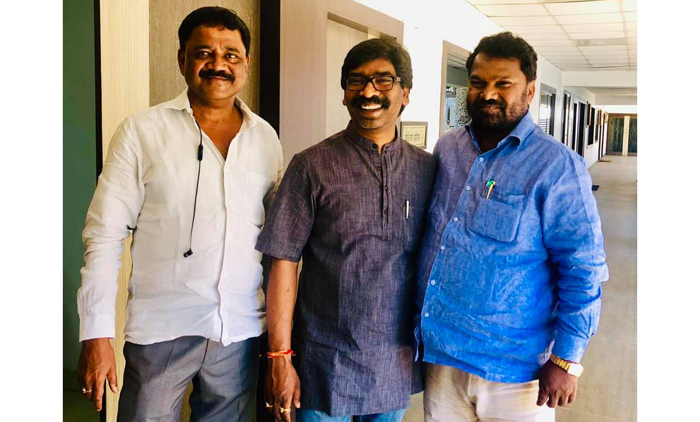
JMM working president Hemant Soren (center) with Jagarnath Mahto (right) and Sudivya Kumar on Saturday
Ranchi/Kolkata: It has been over a week, since Bharatiya Janata Party (BJP) declared the names of its Lok Sabha election candidates for ten seats in Jharkhand. However, the name of candidates for Koderma, Chatra and state capital Ranchi is yet to be announced. All these three seats were won by the party in 2014. Out of the 14 parliamentary constituencies, Giridih has been left for its alliance partner AJSU.
And in last seven days, a lot of action seems to be going on within BJP, which rules in the both center and Jharkhand state, barring the announcement the names of the three candidates.
BJP successfully broke away Annapurna Devi, former Rashtriya Janata Dal (RJD) state chief and took her into its fold. Party also managed to bring in Girinath Singh, another senior RJD leader.
Amid all, the supporters of Ram Tahal Choudhary, the outgoing Member of Parliament from Ranchi created ruckus at the party office in state capital.
But the ruling BJP, which claims that they are going to win more seats in the upcoming Lok Sabha election than it did in 2014, has not declared names of Koderma seat for which they have roped in Annapurna Devi, nor they have shown courage to name a candidate for Ranchi seat, where Choudhary’s supporters have warned of dire consequences, nor for Chatra seat.
Significantly, BJP’s state president Laxman Gilua, in a press conference on Friday stated that the performance of three MPs — Ravindra Rai (Koderma), Choudhary and Sunil Singh (Chatra) have been poor, so they might not get tickets.
On Saturday morning, some vernacular media reported that the outgoing MP from Koderma, Rai whose future seems uncertain with BJP, could join Jharkhand Vikash Morcha (JVM), which he had earlier joined for few years. According to the reports, Rai would be JVM’s candidate from Koderma instead of JVM chief Babulal Marandi.
However, when eNewsroom contacted Marandi, the former Chief Minister reacted by saying, “It is a planted news by BJP and its leaders, neither Rai is going to join JVM nor anybody else other than me will be contesting from Koderma seat.”
He then added, “Actually, BJP has been fearful since gathbandhan has formed. Its fear of losing is making it do such things. In fact today, my name has been declared for the Koderma seat,” he said.
The JVM chief added that BJP has no candidate to face gathbandhan, and it will fight with ‘borrowed’ players, “They (BJP) are delaying the names of these three seats, as they will fight with borrowed players.”
Meanwhile, the main opposition parties of Jharkhand, Congress, JMM, JVM and RJD is also to announce the names of their candidates in these three seats and other also. But on Saturday, JMM leader Sudivya Kumar Sonu shared a picture of party’s working president Hemant Soren, and Giridih’s probable candidate Jagarnath Mahto together in Ranchi, thereby ending all the speculations about JVM changing Mahto’s candidature for Giridih.
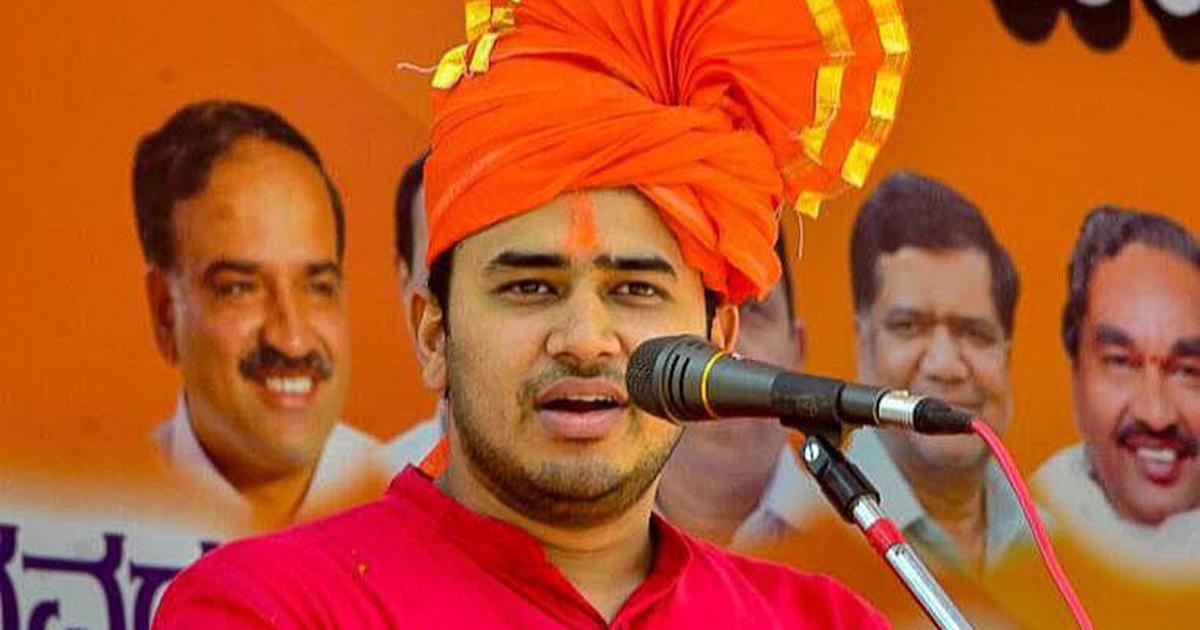
BJP’s rising sun in the south, its’ much touted ‘young face’, 28 year old Tejasvi Surya is fast proving to be a case of old wine in a new bottle, resorting to time tested BJP-RSS methods of arm twisting the media to hide uncomfortable truths. Faced with growing condemnation after media coverage of a #MeToo allegation on twitter against him went viral, Tejasvi Surya swiftly moved to get a gagging order against major media outlets including the Times Of India, The Hindu and Bangalore Mirror from a City Civil & Sessions court.
Image Courtesy: facebook
The court while passing a questionable interim injunction (valid till May 27) observed “… …How all of a sudden these allegations against the plaintiff emerged immediately after he filed nomination for the General Elections is a questionable question.” Questioning motives behind allegations of sexual abuse, harassment or violence with a ‘why now, why not earlier?’ is a sure fire patriarchal put down. That a court of law resorts to it in an ex parte judgement is surprising. In this context it must be noted that Tejasvi Surya himself, far from denying the allegations (right after the allegations surfaced) had made the following statement according to Deccan Herald ( https://www.deccanherald.com/state/accused-of-assault-surya-says-lets-stop-this-here-725594.html)
“[name] is a close friend of mine. She herself deleted the tweets that were against me. Further, she has also requested everybody not to continue this any further. As a gentleman, it is my utmost duty to respect her words and I will not continue this any further “
How gentlemanly it is to move court to gag media is perhaps a questionable question too.
Tejasvi Surya however is no stranger to controversy. Behind the suave veneer lies the well known grime of hateful Hindutva politics. His sanghi roots are often exposed in his misogynistic stances, hyper-nationalistic war mongering and aggressive anti-minority utterances.
On second thought, perhaps these are the very traits that have endeared him to the BJP central leadership and earned him his candidature. Albeit it is also possible that his over the top sycophancy has paid rich dividends. The current Prime Minister is known to enjoy and encourage bhakti.
So the question on everybody’s lips now is – will the media houses that have been named in the complaint take a stand by not only challenging the injunction in higher courts, but also calling out Mr. Surya’s cowardly bluff ? Because it is about time that someone did.
This book deals with most of the issues which took place with coming of Modi-BJP coming to power. It shows how the values of Indian Constitution and the Indian ethos are being undermined
by sectarian ideology espoused by Modi-BJP.
Ram Puniyani, former Professor IIT Mumbai, is a writer activist, working on the issues related to preservation of
democratic, plural values in the society. He has been focusing on the threats of sectarian politics in the name of religion
and the threat posed by the imperialist aggression for the lust of oil.
Ram Puniyani is recipient of Indira Gandhi National Integration Award (2006), National Communal Harmony Award (2007) and Mukundan C.
Article 35A surreptitiously inserted by Pt. Nehru’s govt. in the Constitution in 1954 vide Presidential order is responsible for discrimination by the J&K govt. between two categories of citizens on the basis of declaring some as permanent residents while leaving out the others.” Before I join the issue on legality or otherwse of Article 35A, let us try to read & analyze the motive behind Jaitley’s blog & tweet:
He has blamed Nehru Govt. for introduction of Article 35A in the Indian constitution .This is because of his electoral compulsion as BJP is desperately in need of votes in the ensuing elections and ridiculing Nehru fetches them votes.
Since the issue is likely to be heard anytime now by the supreme court, it is also aimed to influence the opinion of Hon’ble judges and to convey the court what the Govt. of the day expects from it.
Removal of article will throw the various privileges enjoyed by state subjects to challenge in Indian courts which may ultimately open a road for Indians to acquire land & other immovable properties in J&K, thus ultimatelychanging its demographic character.
At the outset it must be stated that Article 35A doesn’t grant or confer any new or fresh rights on the people of Kashmir .The article only restricts the Indian public to challenge their existing rights to immovable property & employment within the state etc. These rights were conferred on them in 1927 when Mahraja of Kashmir, in his wisdom, passed a law and granted his subjects i.e the people of Kashmir these rights. It needs to be appreciated that contemporary India was not even in existence then. Be that as it may, let us flag the issues raised by Mr. Jaitley:
That Article 35A was surreptitiously inserted in Constitution of India-By which he means that the said article was passed through a presidential order instead via the Procedure prescribed in article 368 to amend or alter constitution of India.In his opinion, the parliament didn’t have an opportunity to discuss the article in great detail and Nehru Govt.
That it is discriminatory
Let us take his allegations one by one. As far as his contention that it was surreptitiously inserted without discussing it in Indian Parliament is concerned, Nehru’s following statement to Lok Sabha in 1954, pursuant to an animated discussion on the issue, nails his lie;
“The question of citizenship arose obviously. Full citizenship applies there. But our friends from Kashmir were very apprehensive about one or two matters. For a long time past, in the Maharaja’s time, there had been laws there preventing any outsider, that is, any person from outside Kashmir, from acquiring or holding land in Kashmir. If I mention it, in the old days the Maharaja was very much afraid of a large number of Englishmen coming and settling down there, because the climate is delectable, and acquiring property. So although most of their rights were taken away from the Maharaja under the British rule, the Maharaja stuck to this that nobody from outside should acquire land there. And that continues. And in the state subjects notification by the Maharaja, they defined four grades of subjects, Class number one, Class two, Class three and Class four. And unless you come in one of these classes, you just cannot acquire land there, or any immovable property. So the present Government of Kashmir is very anxious to preserve that right because they are afraid, and I think rightly afraid, that Kashmir would be overrun by people whose sale qualification might be the possession of too much money and nothing else, who might buy up, and get the delectable places. Now they want to vary the old Maharaja’s laws to liberalise it, but nevertheless to have checks on the acquisition of lands by persons from outside. So far as we are concerned, I agree that under Article 19, clause (5), of our Constitution, we think it is clearly permissible both in regard to the existing law and any subsequent legislation”
Space doesn’t permit me to reproduce here three other statements/clarifications by Mr. Nehru to both houses of Parliament after sharp & probing questions were raised on the issue by both treasury & opposition benches. Mr. Jaitley will do well to dig into records of parliamentary proceedings to acquaint himself with the correct position. Suffice it to say here that this article was discussed threadbare in both houses of Paliament and there is no substance in his allegation that it was introduced surreptitiously.
A question arises here as to what prevented Nehru to insert the above article in constitution through the procedure prescribed under article 368 instead of a presidential order 1954, which has now became a bone of contention. The reply to this is provided in the then Attorney General M.C.Setalvad’s opinion, an eminent jurist, to whom the proposal was sent in the normal course for his comments . His robust opinion & sound advice was that since article 370 was already existing in the constitution, it was neither possible nor desirable to insert article 35A via the procedure prescribed under article 368 but only through a presidential order as prescribed under article 370. Unfortunately the important file containing this opinion is now reported missing from the safe vaults of Union home /LawMinistry- a phenomenon which occurs at regular intervals with this Govt.
Coming to the discrimination to women & non-state subjects issue raised by Mr. Jaitley, Let it be made clear that as far as women are concerned, Article 35A is gender neutral & it doesn’t discriminate between men & women. It has also been made clear that a married state subject women doesn’t loose her status & property rights upon marrying a non state subject by virtue of J&K High Court full bench decision in State of Jammu and Kashmir vs Dr Sushila Sawhney, which has attained a position of law in absence of any challenge.
As regards other sections of non state subjects like West Pakistani refugees, safai Karamcharis (Valmikis) desirous to obtain state subject status , it is sufficient to quote here the relevant portion of the judgment of Supreme court in Bachan Lal Kalgotra v. State of Jammu and Kashmir[ AIR 1987 SC 1169.]. The chief contention in the said case was that the refugees from West Pakistan who had migrated into the State of Jammu and Kashmir in 1947 are not permanent residents as defined in s.6 of the Jammu and Kashmir Constitution, with the result that they were disentitled to be included in the electoral rolls of the State Assembly or to be appointed to any service under the State Government by direct recruitment or to purchase land in the State etc. etc. The petitioner had sought the conferment of all such benefits under Article 35A read with section 6 of the Constitution of Jammu Kashmir thereof as are allowed to the permanent residents of the State . While dismissing the petition after dwelling at length on Article 35A , the Apex Court held that in view of the peculiar Constitutional position obtaining in the State of Jammu and Kashmir, we do not see what possible relief we can give to the petitioner. All that we can say is that it is up to the Legislature of the State of Jammu Kashmir to take action to amend various laws to accommodate the interests of West Pakistan refugees.
From the above it is clear that Mr. Jaitley’s grounds of attack on article 35A are fallacious and erroneous made only to mislead gullible Indian public with a twin purpose of reaping electoral dividends & furthering the Hindutva agenda on Kashmir.
The Internet Archive, nonprofit digital library based in San Francisco that specializes in offering broad public access to digitized and born-digital books, music, movies and web pages, has offered world’s largest collection of Tibetan Buddhist literature. Reproduced below is an Internet Archive blog by Alexis Rossi:
The exposition on the graduated path by Kadam Master Sharawa Yontan Drak (1070-1141)
The Buddhist Digital Resource Center (BDRC) and Internet Archive (IA) announced today that they are making a large corpus of Buddhist literature available via the Internet Archive. This collection represents the most complete record of the words of the Buddha available in any language, plus many millions of pages of related commentaries, teachings and works such as medicine, history, and philosophy.
BDRC’s founder, E. Gene Smith, spent decades collecting and preserving Tibetan texts in India before starting the organization in 1999. Since then, as a neutral organization they have been able to work on both sides of the Himalayas in search of rare texts.
Several months ago in a remote monastery in Northeast Tibet, a BDRC employee photographed an old work and sent it in to their library. It was a text that the tradition has always known about, but which was long considered to have been lost. Its very existence was unknown to anyone outside of the caretakers of the monastery that had safeguarded it for centuries.
The Kadampa school, active in the 11th and 12 centuries, was known to scholars – they knew who had started the tradition and where it fit in the history of Buddhism – but most of the writings from that period had not survived the centuries. And yet suddenly here was a lost classic of this tradition, the only surviving manuscript of the work: The exposition on the graduated path by Kadam Master Sharawa Yontan Drak (1070-1141). Dozens of pithy sayings are attributed to Sharawa in later works but this writing of his is never directly cited in the classics of the genre that date back to the fifteenth century and before.
Children studying Buddhist teachings
BDRC’s digitizers never know what they will find when they arrive at a new location, but their work has uncovered missing links, beautiful woodblock versions of known texts, writings of previously unknown authors, and texts by famous people that they thought had been lost to time. While the manuscript above is an amazing find, it is by no means the only one their work has unearthed.
This work highlights the importance of preserving cultures before they disappear or are too dispersed to gather together. In its efforts to make all of Buddhist literature available, BDRC is also digitizing fragile palm leaf manuscripts in Thailand, Sanskrit texts in Nepal, and the entire Tibetan collection of the National Library of Mongolia. Brewster Kahle, founder of Internet Archive, said, “In 2011 we announced that we had digitized every historic work in Balinese, and this year we are making Tibetan literature available. We hope that this is a trend that will see the literatures of many more cultures become openly available.”
This is not an academic pursuit. Many Tibetans have left their homeland, spreading to India and around the world. Younger generations who have been displaced and raised in other societies may not have the opportunity to grow up with these traditional teachings. The work of the BDRC is to make those teachings available to everyone.
Jeff Wallman, Executive Director Emeritus of BDRC and Jann Ronis, Executive Director of BDRC, addressed their reasons for making this information available on the Internet Archive: “The founding mission of BDRC is to make the treasures of Buddhist literature available to all on the Internet. We recognize that you cannot preserve culture; you can only create the right conditions for culture to preserve itself. We hope that by making these texts available via the Internet Archive, we can spur a new generation of usage. Openness ensures preservation.”
The BDRC’s extensive collection is used by laypeople and monks alike. Karmapa Ogyen Trinley Dorje is a frequent user of their collection. He and other traveling teachers call on the BDRC’s library for references and works when they are away from their libraries, or whenever they need a rare text that they could not otherwise access.
Chokyi Nyima Rinpoche, the Abbot of Ka-Nying Shedrub Ling Monastery in Nepal, and a well regarded teacher of Tibetan Buddhism around the world, is gratified that the teachings of Buddha have been made available. “We can share the entire body of literature with every Tibetan who can use it. These texts are sacred, and should be free.”
Children holding a manuscript in its box
BDRC’s home office is in Cambridge, Massachusetts, with additional offices and digitization centers in Hangzhou, China; Bangkok, Thailand; Kathmandu, Nepal; and at the National Library of Mongolia in Ulaanbaatar where it is establishing a project in collaboration with the Asian Classics Input Project (ACIP).
Internet Archive and BDRC are both delighted to join forces on sharing the Buddhist literary tradition for the benefit of humanity. About Buddhist Digital Resource Center:
BDRC is a 501(c)(3) nonprofit dedicated to seeking out, preserving, organizing, and disseminating Buddhist literature. Joining digital technology with scholarship, BDRC ensures that the treasures of the Buddhist literary tradition are not lost, but are made available for future generations. BDRC would like every monastery, every Buddhist master, every scholar, every translator, and every interested reader to have access to the complete range of Buddhist literature, regardless of social, political, or economic circumstances. BDRC is headquartered in Harvard Square in Cambridge, Massachusetts.
Gautam Buddh Nagar (Uttar Pradesh): Clouds of dust flew into people’s faces as the next white SUV full of Bharatiya Janata Party (BJP) karyakartas (workers) drove up to the maidan (ground) in Sutyana village, 56 km east of India’s capital.
Gautam Buddh Nagar is not as well known as its urban half, the Delhi suburb of Noida, a land of IT companies and glass-fronted buildings. Sutyana is at the other end of this parliamentary constituency, a space of shrunken farmlands and former farmers. Some were happy to sell their land, others protested when the government tried to acquire it in 2011 to build an expressway, and, more recently, in villages in and around Noida and Jewar town over various government projects including a new airport.
On a recent March day, protesters and party workers gathered for an election rally of union culture minister Mahesh Sharma, BJP member of parliament (MP) from the Gautam Buddha Nagar constituency. Sharma, 59, won 50% of the votes in 2014–a margin of 23.37% over his nearest rival from the Samajwadi Party. He hoped to re-create that result.
It was a BJP yuva morcha, or youth event, and they were getting louder. It was 12:20 pm, mantri-ji was expected any minute. But instead of the 2,500 people anticipated–for whom adequate chairs, microphones, megaphones and posters had been arranged–there were no more than 50.
The next SUV revved up and a leader from an adjoining village walked in, led by a thin drummer boy in a shiny outfit fraying at the edges. He drummed loudly and vigorously. ‘Modiji ki jai ho!’ they shouted, referring to their main vote catcher, Prime Minister Narendra Modi.
With a right-wing Hindu party in power appealing to the majority vote, this is the first of a six-part series that explores the Hindu vote from India’s most important battleground state: UP, home to 80 of 543 Lok Sabha constituencies or 14% of Parliament’s lower house. A state that is 79.7% Hindu and 19.2% Muslim, according to Census 2011, UP is where the Hindu right first gained ground with the demolition of the Babri Masjid in 1992, and the movement to construct a Ram temple in Ayodhya began.
How votes are garnered here in India’s second-poorest state by per capita income, how caste will compete with religion–or a combination of the two–will determine who gets India’s biggest bank of votes. Our journey through the heart of UP during the campaign of 2019 will bring you stories behind the electoral math, as we gauge how religious and caste issues are being presented and how voters anxious for jobs are reacting.
Gautam Buddh Nagar–84.6% Hindu–is crucial to the story of UP.
It is one of UP’s newest constituencies, carved in 1997 out of bits of Ghaziabad and Bulandshahr. It is an industrial hub, UP’s second-largest district economy (after Lucknow), and its urban face, Noida, was meant to provide opportunities for millions of the state’s job aspirants.
The state needs those opportunities realised because it has India’s largest working-age population among its 200 million people, as many as in Brazil, which is however 35 times larger than UP, but an economy half as large as Hong Kong’s, which is smaller in area than Gautam Buddh Nagar.
These opportunities are important because UP has India’s second-highest fertility rate, which means it will keep adding young people. That means its window to exploit its demographic dividend–the economic growth that accrues from a young population–is likely to be “fully open” till about 2050, according to a 2018 United Nations Population Fund (UNFPA) study.
“With its enormous potential, Uttar Pradesh will need to follow a growth path that results in remunerative jobs for its labour force, both within farm and non-farm sectors,” said a 2017 International Labour Organization study.
Between the last election and this, however, even BJP loyalists gathered in Sutyana village admitted, their sarkar has done precious little to alleviate rural distress. The real question was–whether or not this was going to make a difference to their voting.
‘We don’t have any other issue except Hindu versus Muslim’ UP has India’s largest youth (15-24) population, more than 40 million, which is almost double the state that is next, Maharashtra. Under-development, and a lack of employment have combined to create a political cauldron of caste politics over the last two decades. Religion is now stirred into this mix.
A year after minister Sharma won his 2014 election, this constituency also witnessed the first mob lynching since the Modi government was sworn in. Mohammad Akhlaq was killed on the September 28, 2015, in a village in the Dadri segment of Gautam Buddh Nagar because a mob believed he had killed and eaten a cow.
Since 2014, 11 people have been lynched in cow-related hate crimes in UP, 73% of them Muslim, the highest number of such attacks in any Indian state, according to a database run by FactChecker.in.
Now, in election season, in a tiny BJP office in another village in the same constituency, a party leader, speaking on condition of anonymity, commented on the BJP’s official campaign, sabka saath, sabka vikaas (with everyone, development for all).
“Hamarey paas iske sivaye aur koi mudda nahi–Hindu Muslim ke alaava, jeetney ka. We have no other issue except Hindu versus Muslim, to win this election,” he said.
The man saying this also belonged to the BJP’s parent body: the Rashtriya Swayamsevak Sangh (RSS). Once upon a time, his plain speaking had prevented him from getting a ticket to contest an election. Now, he sat in a tiny party office, in front of posters of the founders of the RSS–KB Hegdewar and his immediate successor, MS Golwalkar.
“From the bottom of my heart, I want there to be no Modi sarkar,” said the BJP leader. “I don’t want to be made to do things that weigh heavy on my conscience.”
But there was already a pile of things, that by his own admission, did weigh him down. That included the breaking of the Babri Masjid in Ayodhya in 1992 and the divisive religious politics his party had played in Gautam Buddha Nagar in the decades that followed.
Akhlaq and after In the last election, Mahesh Sharma defeated his rival from the Samajwadi Party by a margin of 23.37%. A year later, in Bisada village in Dadri, Mohammad Akhlaq was lynched. After Akhlaq’s lynching, Sharma had said: “It [the murder] took place as a reaction to that incident [cow slaughter].”
In the local Rajput settlement, there is a large electricity transformer at the head of the street. On the night of September 28, 2015, an announcement had been made from the village loudspeaker that the carcass of a dead calf had been found nearby. The transformer is not anywhere close to the Muslim neighbourhood where Akhlaq once lived, but in these parts, the save-the-cow campaign is strong emotional currency.
In the lane where Akhlaq was killed, Sanjay Rana sat in the outer courtyard of his house. His son, Vishal, was sent to prison for two years, one of the 17 young men accused of killing Akhlaq. “Woh ek swabhavik ghatna thi. Nahin honi chahiye thi, ho gayi [What happened was a natural outcome of the circumstances. It shouldn’t have happened, but it did],” Rana said.
His son is out on bail but has not been acquitted of the charges against him. Rana spoke of his despair as a father, and how it was not the BJP but the political opposition that turned Akhlaq’s killing into political capital.
“Jo gau maas paya gaya, usko bakre ka gosht keh kar ke ek tareeke se sarkaar ki chhavi kharaab karney ka kaam kiya. [Some politicians claimed it wasn’t beef but goat meat that was found in Akhlaq’s fridge, and they tried to spoil the government’s reputation],” said Rana.
Rahul Gandhi, Arvind Kejriwal, Asaduddin Owaisi, Brinda Karat. They were the real culprits in Rana’s eyes. It was the BJP’s elected representative, minister Sharma, who was trying to keep the peace.
Outside Rana’s house, there was no evidence of peace, only tension and anger.
Such was the atmosphere of Bisada village that as this reporter walked out of the narrow lane, past the murder site, the police were on a flag march. More than 80 of them patrolled the area because Holi was around the corner and, as one of Rana’s relatives explained, people in the area needed to get the message: do not stoke violence.
Elections or otherwise, Bisada, like vast swathes of Gautam Buddh Nagar, is now polarised.
‘A Hindu nation? How can it be any other way?’ In a clearing in Bisada, a cement mixer was in action. Construction of a boundary to a public ground was under way–a tiny, local undertaking that a cluster of men tried to project as “Modi sarkar’s development”.
When asked if they wanted India to be a Hindu nation, they circled this reporter and asked belligerently: “How can you even ask that question? What kind of negative question is that? Is there any possibility of things being any other way?”
It was clear that things were uncomfortable, so the reporter sped away in her cab to the other side of the village, to the settlement around the mosque, where about 30 Muslim families live. After the lynching, Akhlaq’s family had moved out. Of those that remained, a man in a skull cap, carrying logs of wood in a wheelbarrow, watched with discomfort as this reporter approached.
“We are all fine here, we have no problems, we are all very happy,” he said breathlessly before he was even asked.
Two years after Akhlaq’s killing, the polarisation yielded results for the BJP.
In the state elections of 2017, the MLAs contesting from the assembly segments of Noida and Dadri, which are part of this Lok Sabha seat, won by larger margins of 40.89% and 30.2%, respectively, a substantial bump up from the 23.37% lead Mahesh Sharma had in the Lok Sabha election in 2014, before the lynching. This is significant because of the way the caste math works in UP.
Although the government has not made caste census figures public, various reports quote National Sample Survey Office and panchayat data that show more than 40% of UP is made up of other backward classes (OBCs), which have traditionally voted for the Samajwadi Party, also known locally as the Yadav-Muslim party.
But the consolidation of the Hindu vote in many constituencies, such as Gautam Buddh Nagar, helped the BJP, previously known as the go-to place for upper-caste Hindus. Votes came in from other castes, including some from OBCs.
Polarisation, it would appear, helped the party trump UP’s traditional caste math. This time, despite the BJP’s renewed attempts to talk up Hindu issues and Modi, it may be more difficult.
‘Mahesh Sharma go back!’ One part of Gautam Buddh Nagar not convinced by the-Muslims-eat-beef kind of campaign message was Jewar, where a new airport is proposed on land that needs to be acquired from farmers.
The BJP won Jewar in the state election of 2017 by a much lower margin than Noida and Dadri–the lead was 10.49%. Since then, various parts of the constituency have been roiled by farmers’ protests.
In a village called Kachera, adopted by minister Sharma, farmers put up sign boards that said: “The BJP is strictly prohibited from coming to this village, adoptive village of Mahesh Sharma.”
They were upset that their standing crop was razed for the airport, and when they called their MP for help, none was forthcoming. The government said the farmers did not own the land, which had been acquired by a private company.
There was dissent and anger around Gautam Buddh Nagar and BJP watchers, including those who voted for Sharma the last time around, were wondering if he would get a ticket to contest. But the terrorist car bomb that killed more than 40 Central Reserve Police Force (CRPF) troopers in Pulwama, Jammu and Kashmir, on February 12, 2019, turned the tide, according to some party workers.
Sharma got the ticket. Where development failed, polarisation would work, was the calculation, said a party worker from Dadri, Radhacharan (he uses one name), who has been with the BJP and the RSS for over four decades.
“Pulwama ka kaafi asar hai. Pehle ki sthiti hum bahut kamzor mantey they, uske baad nahi. Pulwama has changed things quite a bit. We thought we were on a weak wicket before, not any longer,” said Radhacharan.
Radhacharan was once a communist. He spoke of the farmland takeover in Marxist terms: how a capitalist economy worked, how farmers were edged out.
Still, he fell out with his former colleagues, allied with former Prime Minister Charan Singh, in 1979 and crossed over to the BJP soon after. Radhacharan is a reflection of the complex matrix that the BJP and its extended arm of the Sangh Parivar–the family of Hindu nationalist organisations owing allegiance to the RSS–comprises. He was opposed to the destruction of the Babri Masjid in 1992, but also felt that he had chosen the winning side with all its inherent contradictions.
In many ways, politics in these parts is not always about a coherence of ideas or ideologies. It is, often, about picking the winning side.
The costs of doing business The polarisation over 27 years, from Babri to Dadri and now Pulwama, is taking root in different ways amongst the rank and file of Gautam Buddh Nagar, explained a BJP official on condition of anonymity.
On two separate occasions, this man said, he had filed police complaints against young men in Hindutva (Hindu nationalist) outfits loosely affiliated to his own party, when they had broken idols of Hindu gods at night in areas contiguous with Muslim residences–to pin the blame on Muslims.
Polarise and you are in business, is the message that some on the ground have picked up. These Sangh Parivar foot-soldiers were not expecting resistance from within their own party.
Back at Mahesh Sharma’s rally in Sutyana, it was 2 pm. Sharma had been expected to arrive at 12.20. The youth leaders had to prevent the few hundred who had been mobilised from leaving. One youth leader came up and made a rousing speech about the benefits of demonetisation, the voiding of 86% of India’s currency by Modi in November 2016.
Some in the audience tried to keep a straight face. Others laughed as hard as they could. “Demo ne toh mujhe berozgaar bana diya. [Demonetisation made me jobless],” said one young man. Two of the five companies he had worked for had shut down.
“But if I say anything, I will be kicked out and told to shut up,” he said. Realising he had spoken before party colleagues, he quickly added: “So many schemes announced by the Prime Minister are eaten up by middlemen.”
Despite the disappointment with his own sarkar over the downturn of the economy, this man came for Sharma’s rally. He sensed this was where he needed to be if he wanted to do business.
A BJP supporter summed it up: “This is election season, jod-tod toh hogi hi. [Some making and breaking of people, communities is bound to happen].”
It was a hot day, and a water dispenser was set up on a table at the back. By now, the area around it was a pile of strewn plastic glasses. On stage, the youth leaders spoke of the Prime Minister’s many campaigns, including Swachh Bharat Abhiyan, or the Clean India mission.
Cynics versus cynics “Caste will be a big factor in this seat,” said a tall, lanky man in glasses, a self-confessed BJP supporter at Sharma’s rally. He explained what he meant: “Mahesh bhai is an outsider to UP. He is from Rajasthan. And there is a huge outsider population [in Noida] that will vote for him and that will mitigate local caste factors.” By local caste factors he meant Gujjars, a pastoral community that are Hindus in UP, who observers said are likely to vote for the Gujjar candidate from the opposition party, the Bahujan Samaj Party (BSP).
“Yeh double MA hain. [He has a double MA degree],” one of the party workers said, introducing a BJP supporter, Dilip Kumar Swami, originally from Churu in Rajasthan, now settled in Noida. Swami beamed at the introduction and dissected the math, as the crowd around him grew. “3-33 ki ladai hai. [It’s a fight of three versus 33],” he said, referring to three communities in the opposition camp–the Jatavs (or Dalits as they are commonly known), Muslims and Gujjars–and 33 other castes supporting the BJP.
Despite this math and visible support for his party, Swami was cautious and expressed dissent against the party line. “There should be no mandir built,” said Swami. “And we need a strong opposition for a robust democracy, [but] here whatever Amit Shah says, goes.”
Swami then took some of the heat off the obvious criticism of his party with praise for the prime minister. He presented a proverb about the invincibility of the telis, Modi’s caste. “Baavan baniya, trepan teli. [If the trader’s brain size is 52, then the teli’s is 53]. When Modi dies, even his head will be preserved, even that will be valued,” said Swami.
Everyone was pleased. His audience clapped. It took away the monotony of waiting for their minister to show up. An enthusiastic supporter said Modi’s head would be preserved forever “just like Suraiya’s”. “Her voice was so sweet, they preserved her head to see what kind of vocal chords she had.” No one realised that perhaps the prime minister might not appreciate a comparison to a Muslim actor-singer from the 1960s.
Some dreams come true At a cafe in Noida, the urban part of Gautam Buddh Nagar, a BJP intern called Mayank Mishra looked very happy.
A year ago, he had been struggling to find the Rs 87,000 he needed for his dream: a bachelor’s degree in journalism. His father was unemployed, and his mother taught Hindi at a local school. Several banks turned him down or said he needed to submit a salary slip proving his parents earned at least Rs 25,000 a month.
A member of the RSS, Mishra realised in April 2018 that the BJP youth wing or Yuva Morcha had a national internship programme. He was one of 150 to be chosen. After being humiliated because of his background and lack of money, he was finally being recognised. One day, he would rise, like minister Sharma, who started out as a doctor with a small clinic in Noida and now owned a fleet of hospitals and was a member of India’s cabinet.
“Main apne aap ko mazboot karna chahta tha, itna mazboot karna chahta tha ki koi mujhe daba na paye. [I wanted to make myself so strong that no one can trample over my ego ever again],” he said, his eyes shining.
The task handed to him in his internship was a test of this resolve. He was asked to design a Swachh Bharat campaign. “I was feeling a bit awkward about this, that I had to do jhaadu [sweep] on the streets,” he said, peering into his coffee.
Mishra and his family are migrants from Jharkhand, a state poorer than UP, but belong to an “upper” caste. To do the job of “lower” castes was difficult. “So, I thought I would pick an area far away from where I live and set out at 4:30 am, when nobody was watching,” he said.
Eventually, he went along with his fellow interns to a public park. It was a “big success”, he said. Mayank measured success by the fact that as soon as they had cleaned the park, taken before-and-after videos and pictures and tweeted and re-tweeted them, 1,700 people had followed suit on Twitter.
Soon after, his photo and profile were on the Internet. On Google search, his name appeared right at the top of the search for “BJP Noida”, above that of the MLA or the state legislator from the area, Pankaj Singh, who is the son of India’s home minister, Rajnath Singh.
Without saffron, dissent rises Meanwhile, in Jewar, at the other end of Gautam Buddh Nagar, where minister Sharma in November 2018 got official sanction to build an airport for the district, he has realised that turning a rural area into urban is complicated.
One person’s dream is another’s nightmare when land is acquired, as it was in Jewar with farmers. Under the Land Acquisition Act of 2013, the formula for compensating farmers for taking their land was applied. In a rural zone, farmers are entitled to a compensation of four times the “circle rate” of the land (the minimum price at which land can be sold, set by the state government’s revenue department). In an urban area, farmers get only two times the circle rate as compensation.
In the beginning, it was not the BJP but their opponents, the Samajwadi Party, which ran the government when acquisition started, that antagonised the farmers. The then government declared the entire constituency to be urban in 2013, so farmers could only get two times the circle rate as compensation and not four.
But when the BJP government, “the party with a difference”, replaced the Samajwadi Party in 2017, nothing changed. Farmers whose land was visibly rural were paid the reduced urban compensation. When many of these angry farmers launched protest after protest, the BJP MLA from the area took the farmers to meet chief minister Yogi Adityanath, who changed the compensation from two times to two-and-a half-times the circle rate.
The farmers have “nothing to complain about”, said MLA Dhirendra Singh. The airport will mean progress, development, hospitals, consumers.
Over time and so many elections, voters and contestants have developed a cynicism. So, those who turned up for Sharma’s rally appeared to be hedging their bets, trying to be seen with the winning side. But first they had to assess if he might win.
By 3.20 pm news filtered in that Sharma was not going to show up at the rally, after all. Party managers quickly found another leader to garland and declared the rally a success. The drummer left. The maidan was full of empty plastic glasses, as the last SUV sped away.
(Laul is an independent journalist and film-maker and the author of The Anatomy of Hate, published by Westland/Context in December 2018.)
This is first of six stories exploring the Hindu vote in Uttar Pradesh.