Various studies done within Indian prisons have concluded that a majority of prisoners are Adivasis, Dalits or from other marginalised communities that are being criminalised. Their social and economic situation makes them vulnerable, being unable to defend themselves legally and financially. This compilation aims to highlight the general issues related to Women Prisoners, the Structural Exclusions within the Prison, Analysing the Monitoring Process, Legal Aid, and Accountability of Jail Staff to procedures laid down in Jail manuals.

In the year 2016, over three lakh women were arrested for crimes under the Indian Penal Code (IPC) and Special and Local Laws (SLL). A large number of these women were reportedly arrested for crimes under the Prohibition Act, for cruelty by relatives of husband and rioting etc. The overall number of crimes by women has been relatively consistent over the past decade or so.[1] In Maharashtra, 1336 women occupied prisons in 2015[2].
As per the most recent data available from the report Women in Prisons published by the Ministry of Women and Child Development, Government of India, there are 4,19,623 persons in jails in India. Women constitute 4.3% of this figure, numbering a total of 17,834 women. These are the official figures. Of these, 66.8% (11,916) are under-trial prisoners.
In India, an analysis of prison statistics at five-year intervals reveals an increasing trend in the number of women prisoners – 3.3% of all prisoners in 2000, 3.9% in 2005, 4.1% in 2010 and 4.3% of prisoners in 2015 were women.
A majority of female inmates are in the age group of 30-50 years (50.5%), followed by 18-30 years (31.3%).Of the total 1,401 prisons in India, only 18 are exclusively for women, housing 2,985 female prisoners. Thus, a majority of women inmates are housed in women’s enclosures of general prisons.
Maharashtra
According to latest report from the National Crime Records Bureau (NCRB), Maharashtra has a total 9 central jails with an authorised capacity of 452 women prisoners. However, they accommodate 722 prisoners. There are also 28 District jails with a capacity of 334 prisoners, but that actually accommodate 356 prisoners. The 100 sub-jails have an authorized capacity of 568 prisoners and house 8 prisoners, while one Special jail with an authorized capacity of 3 prisoners actually accommodates 6 prisoners.
There is one women’s jail with an authorized capacity of 262 prisoners, but houses 200 prisoners. There are also 13 open jails with an authorized capacity of 100 prisoners but house 44 prisoners. In all, Maharashtra has 154 jails with an authorized capacity of 1,719 women prisoners, but the actual number of inmates is 1,336.
| Type of Jails | No | Total Capacity | Occupied |
| Central Jails | 9 | 452 | 722 |
| District Jails | 28 | 334 | 356 |
| Sub Jails | 100 | 568 | 8 |
| Special Jail | 1 | 3 | 6 |
| Women Jail | 1 | 262 | 200 |
| Open Jails | 13 | 100 | 44 |
There are various International Rules and Standards governing the Rights of Prisoners. Following are the International Treaties, Rules and Standards directing the model prison conditions.
The rules of incarceration in India are determined by following laws:
Earlier, because of the plethora of laws in the country, there was no uniformity in laws, or standards relating to prisons. Hence, the Ministry of Home Affairs brought in the Model Prison Manual aimed at ensuring some uniformity in laws relating to prisons. The Union Ministry of Home Affairs advised the State Governments/UT Administrations that in order to ensure basic uniformity in prison rules and regulations, all States and UTs should revise their existing Prison Manuals by adopting the provisions of the National Model Prison Manual, 2016.
Some of the important guidelines mentioned in Model Prison Manual 2016 published by Ministry of Home Affairs, Government of India are:
As discussed above, there are numerous clearly defined Rights of Prisoners. However, the implementation of most of the conditions is found missing in prisons today. The following are the major problems faced by women in prisons in the country, with special focus on Maharashtra.
Prison Staff
Sanitation and Hygiene
Accommodation
Health
Legal Aid
Violence
Children
[1]Women in Prisons Report published by Ministry of Women and Child Development, India in June 2018.
[2]NCRB’s Crime in India Statistics, 2015
First published on cjp.org.in

Image Courtesy: NDTV
New Delhi: Bhim Army Chief Chandrashekhar Azad said he will fight the upcoming Lok Sabha elections from whichever seat Prime Minister Narendra Modi contests from in Uttar Pradesh. Even if it is from the Varanasi Lok Sabha seat, he said he doesn’t want Modi to win the election by fighting against weak candidates.
“I am afraid that a weaker candidate should not contest against Prime Minister Narendra Modi, by defeating whom he easily walks into the Lok Sabha. I will not let the murderer of my Muslim, Dalit and OBC brothers go to the Lok Sabha from Uttar Pradesh,” said Azad.
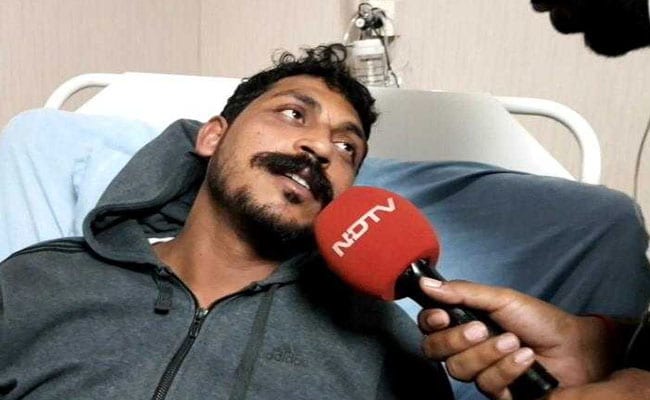
He said that Congress leader Priyanka Gandhi visited and enquired about his health.
“She asked about my health and well being. She came on her own and I did not invite her, I will not invite others also,” he said.
Congress General Secretary for UP (East) Priyanka Gandhi Vadra who met Bhim Army chief Chandrashekhar undergoing treatment at a hospital said that the meeting has no political implications but is rather her support to the voice of a youth fighting against the central government.
“It is to be seen from the perspective that he is a youth and is struggling. He is raising his voice and saying to society to hear his pain. But this government is so arrogant that it wants to suppress the youth. The government doesn’t want to hear the voice of youth,” said Priyanka Gandhi.
Chandrashekhar Azad and his supporters were taken in custody on Tuesday for allegedly violating the model code of conduct by using more than the stipulated number of motorcycles in a political rally.
Chandrashekhar was taken ill soon after being detained, following which he was admitted to Anand Hospital in Meerut.
They were taken into custody when they were planning to take out a procession to Muzaffarnagar on motorcycles and other vehicles, in violation of the model code of conduct, set in since announcement of poll schedule by the Election Commission of India.
Senior Superintendent of Police Dinesh Kumar said: “Azad organised a rally and violated the Model Code of Conduct on Monday. The local officials tried to stop them, but he continued with his rally. He was held for four hours in a private school.”
Police said the rally had been organised without required permission at Kasimpura village by Azad. When the police tried to stop the rally, they resisted and later blocked Muzaffarnagar-Saharanpur highway.
On Tuesday, Azad started a ‘Padayatra’ from Saharanpur to Delhi and announced to address a rally in New Delhi on March 15.

Image Courtesy: Livemint
New Delhi: The Labour Bureau’s survey on the number of jobs created under the Micro Units Development & Refinance Agency (Mudra) scheme will not be made public for another two months making this the third report on employment to be kept under wraps before the elections, Indian Express reported on Thursday.
“The number of jobs created under the Mudra scheme will be released after the polls as the Expert Committee found anomalies in the methodology used by the Bureau in arriving at the findings,” sources said.
The multi-phase elections will start on April 11, with the counting of votes scheduled for May 23.
The Prime Minister Mudra Loan Yojana, the government’s flagship job creation programme, helps small businesses get a credit of Rs 50,000 to Rs 10 lakh from private and public sector banks, micro-finance institutions and other lending institutions.
Besides this survey, the government has not made public, the National Sample Survey Office’s periodic Labour Force Survey Report for 2017-’18, which found the unemployment rate in India at a 45-year high of 6.1% in 2017-’18. The government also reportedly failed to release the Labour Bureau’s sixth annual employment-unemployment survey, which showed that unemployment touched a four-year high of 3.9% in 2016-’17.
The Labour Bureau’s Mudra survey has hit a roadblock. According to the Indian Express, the expert’s committee asked the bureau to “reconcile some errors” at a meeting on Friday. The Labour Bureau asked for two months to do that – which means the results will not be public before the upcoming elections.
In February, the NITI Aayog had reportedly asked the labour minister to process the Mudra survey and present its findings on February 27. The survey looks at one lakh Mudra scheme beneficiaries between April 2015 and January 31, 2019.
In May last year, The Wire had reported on how the Mudra scheme may not be the large-scale job creator it was being floated as. The number of larger-sized loans – of more than Rs 5 lakh – that can create real jobs were just a tiny percentage, or 1.3%, of total loans disbursed under the scheme, an RTI query had revealed.
The code of conduct came into effect on March 10 after the Election Commission announced the poll schedule.

Bhaben Das family


Rahul Gandhi has declared that his party would reserve 33% seats for women in Parliament and State assemblies as their representation is very low. He went a step forward and suggested that they would also ensure that 33% women are taken into Union government’s various services. These announcement are great for many but they also sound an alarm bell. Congress has already said that if voted to power, it will pass the Women’s Reservation Bill. Now Rahul Gandhi is also promising that his focus would be to strengthen the government spending on Education upto 6% of the GDP which is definitely a welcome step. He has also talked about the Minimum Income scheme for all. The congress party consider these announcement as vote catchers like MNREGA.
Rahul Gandhi has spoken to strengthen Forest Rights Act as well as he also wrote against the current roaster policy which was welcomed by many. Though it is a welcome step that Rahul Gandhi is speaking on various issues leaving monotonous Rafale and chowkidaar chor hair, which may not impress everyone everywhere, yet we need Congress Party to respond to the issues emerging out of these announcement. I can say that Rahul Gandhi’s interaction with various youngsters, students are quite inspiring and interesting yet he need to go beyond that as most of the narratives are build around upper caste upper class urban rich youth as if there is no other India. Rahul’s outreach should be in the rural India and is he ready to take hard questions from the Adivasis, Dalits, Muslims, OBCs youths related to caste discrimination and his party’s track record on the issue ? Can he promise things would be different this time if his party come to power at the Centre. Will he promise that he would not focus on building Ram Mandir or Gaushalas but strengthen our institutions and make them more diverse and inclusive.
Rahul Gandhi is very forthcoming in various issues which is a welcome step but he and his party are playing with various other issues which they think are ‘complex’. The Women’s Reservation Bill is as such complex issue. While I do agree that even the social justice parties have not really been pro women in this regards, Congress record on this is dismal to say the least. It is because, Congress Party like many others, never really acknowledge that women’s are as diverse, heterogeneous and different like their men counterparts. Woman or man is not the primary identity of a person as some people might make us believe. The primary identity of an individual in our part of the world is caste, followed by religion and region. Woman come after these three identities. A woman face discrimination not being just woman but because she happen to be an Adivasi woman, a Dalit woman or a woman from a different region. In Today’s India, Muslim women face much bigger threat preserving her identity with her head high. So, when Rahul Gandhi suggest passing the Women’s reservation bill, does he accept that we should ensure a proportional representation of women in Parliament as well as in the government jobs. When I say proportional, it means clear that women’s heterogeneity based on caste, religion and gender must be respected otherwise the Women’s identity project in India would pave the way for a backdoor entry of the Savarna elite or strengthening the status quo in favor of the brahmanical hegemony in our system.
I also think, how is Congress party going to reserve 33% for women. It means it will be a proportional ‘adjustment’ from all the reservation. I would like Rahul Gandhi to also commit for 52% OBC reservation and constitution of an All India Judicial Services with quota on similar lines as UPSC services provide to all. Equally important is the Congress Position on 10% quota for ‘poor Savarnas’ of Rs ten lakh annual Income variety. Will Congress do away with this variety and if it is really interested in helping the poor savarnas, then constitution a commission like Mandal commission to find out which communities are under represented among Savarnas in the government services and which are over. Let there be a state wise survey and decide on the basis of that. It will ultimately, an issue of representation and not an economic welfare programme.
I do not say it without any historical context and have seen it at different places. It is visible in seminars, in conferences and in political parties when women and feminism becomes elite savarna women’s club without any respect for diversity in terms of class, caste, region and religious identities. Attempt are made to tell us that women of the world are same without any other barriers ignoring the fact that the violence on women in Mujaffarnagar happened because of their being Muslim and that India’s ‘collective conscience’ is still not woken up to provide them any hope of justice. State has failed, political parties have failed and except a few among the human rights defenders, majority dont even want to remember.
After the ‘Nirbhaya’, we have not seen any outrage like that in India as if things have improved now and issues sorted out.
I do feel that women’s across the spectrum have been denied justice but it is also a factor that they have also ‘wisely’, not challenged their own caste and class privileges. Frankly speaking women should have been reading Dr Ambedkar, Jyoti Ba Phule, Savitri Bai Phule and EVR Periyar and would have become a factor in demolishing the caste system. Unfortunately, not many of them would quote or understand it as caste gives you lots of privileges and therefore allow women to become its ‘torch bearers’ unknowingly or knowingly.
I would also like to request other parties particularly Samajwadi Party and BSP to clarify their positions on this issue and not confine merely just opposing it. Please develop a vision document based on the thoughts of Phule, Dr Ambedkar and Periyar and engage with thought leaders, Ambedkarites, social activists and not party propagandists. Unless Bahujan movement and parties adhering to social justice come out with their vision document on the issue of representation of India’s Bahujan communities at all sectors including our Parliament, judiciary and elsewhere, we will not reach anywhere and Women’s reservation will only be a clear ploy to keep the vacant seat fixed for the Biwi, Bahu, Beti brigade.
Congress is doing what is important for it and good that it is reaching its wider audience though ‘Januedharis’ in the party is still powerful and have capacity to thwart any good attempt but for us it is essential that BSP and SP should come out with their vision document of India which can be used in annihilation of caste and provide space and justice to Bahujan women which include Dalit, pasmanda, most backward communities and Adivasi women. If they fail to do it, they can not blame Congress for protecting brahmanism alone, they will have to share the blame.
Courtesy: Counter Current

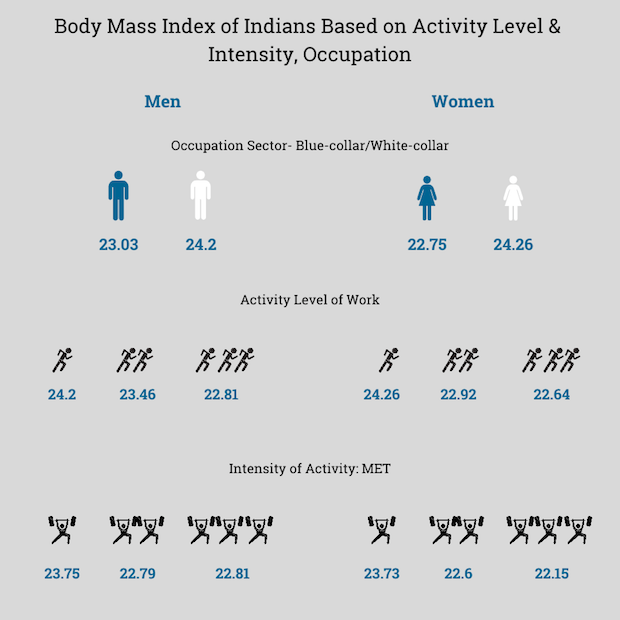
BMI is derived by dividing an individual’s body mass by the square of the body height and is expressed in units of kg/m2. The average BMI of men in white-collar jobs was 1.17 kg/m2 higher than those in blue-collar occupations; among women, the difference was 1.51kg/m2, the study showed. A lower BMI is better than higher.
Individuals are categorised as underweight if their BMI is under 18.5 kg/m2, normal if it is in the range of 18.5 to 25 kg/m2, overweight if it is somewhere between 25 and 30 kg/m2 and obese if the index surpasses 30 kg/m2, according to the standards prescribed by the World Health Organization (WHO).
India has experienced high rates of economic growth in the last two decades, and the resultant increase in income is related to a rise in the proportion of those who are obese, according to this study.
India currently has the third highest number of overweight or obese individuals among all countries–20% of its adults and 11% of adolescents can be categorised as obese, according to this September 2014 paper, that has been cited in this study.
Higher levels of BMI have been associated with higher levels of energy intake and lower levels of energy expenditure. But there has been a long-term, persistent decline in the average energy intake in India, studies have shown. Given this, the rise in BMI can be traced to the rise in sedentary occupations–a natural consequence of economic development.
“Lower physical activity level at work is possibly one of the factors of rising BMI, given the backdrop that, on an average India has witnessed a decline in energy intake as shown by studies such as Deaton and Drèze, 2009 and Ramachandran, 2014,” Archana Dang, co-author to the study, told IndiaSpend.
Unhealthy levels of BMI are directly related to chronic health risks such as hypertension and diabetes, diseases that can have substantial impacts on household budgets, according to the study.
Given “a reduction in the proportion of workers engaged in heavy work and an increase in the number of workers in moderate and sedentary occupations”, a committee set up to determine how the national minimum wage should be calculated recommended reducing the per head (adult) minimum calorie requirement to 2,400 calories, IndiaSpend reported on March 5, 2019.
However, the committee emphasised that the monetary value for food consumption used in the formula must account for including 50 gm of protein and 30 gm of fat in an adult diet.
Average BMI among women in desk jobs ‘way above Asian standard, alarming’
The study analysed the BMI of men and women, based on the sector of their occupations, the level of activity at work and their intensity. It focused on adults between 18 and 60 years of age who worked for at least 180 days in the preceding year.
Women and men in low-activity jobs recorded an average BMI of 24.26 kg/m2 and 24.20 kg/m2 respectively. This average was lower by 1.62 kg/m2 for women in jobs that involved high levels of activity. For men, it was lower by 1.39 kg/m2.

Source: Labor market engagement and the body mass index of working adults: Evidence from India
Note: Figures are in kg/m2
“The WHO cut-off defines individuals as overweight or obese if BMI is greater than or equal to 25, which is the standard benchmark,” said Dang. “But WHO re-defined cut-offs for Asians at 23 because they appear to be at risk for non-communicable diseases at lower levels of BMI than other populations as they have a higher percentage of body fat than, for example, European populations of the same age, sex, and BMI.”
The average BMI of 24.26 kg/m2 in women holding white-collar jobs is “way above the Asian cut-off, which is alarming”, Dang said.
For data analysis, the study assigned each occupation with a metabolic equivalent (MET) value, based on this May 2011 study. The MET of an activity is the ratio of the rate of energy spent during the activity to the rate of energy spent at rest. One MET is the energy it takes to sit passively or be at rest.
For example, an individual engaged in an activity with a MET value of 4 spends four times the energy used by a body at rest. Occupations were classified on the basis of their MET values: light (MET < 3.00), moderate (MET>3.00 and MET<6.00), and vigorous (MET > 6.00).
Engineers, technicians, mathematicians, scientists and teachers were assigned a value of MET lower than 1.80. Housekeepers, fisherpeople, miners and farm workers were assigned METs in the moderate range. Agricultural and plantation labourers were associated with METs higher than 6.0.
The average BMI of women and men with light-MET jobs was 1.58 kg/m2 and 0.94 kg/m2 more, respectively, than those employed in jobs with vigorous METs. The average MET for white-collar jobs is 1.87 whereas it is 3.23 for blue-collar jobs.
Similarly, on the basis of the level of activity involved, low-level activities have an average MET of 1.87, whereas medium-level and high-level activities have MET of 2.78 and 3.42, respectively.
The association between low-activity jobs and high BMI remained significant even after demographic characteristics, education, socio-economic status and various other household characteristics were controlled, the study found.
Threat to health from rise in BMI rises progressively
“In developed countries like America, maximum obesity is seen rising in low-income groups, not in upper classes, because fast-food joints serve really cheap food there,” said Pune-based endocrinologist Uday Phadke. “However, it is different in developing countries such as India where eating at fast-food joints is a matter of [higher] social status.”
Asians are prone to pre-existing conditions of central obesity, or the excess accumulation of fat in the abdominal area, and adiposity (excessive obesity) resulting from unhealthy lifestyles, according to Phadke.
“The thin-fat phenotype which occurs when fat is added to a thin frame is also evident among Indians,” he said. “Hence a slight increase in the BMI levels can be a threat. Also, the threat caused by rising BMI rises progressively–a rise from 30 to 31 is more dangerous than a rise from 20 to 21.”
Local govt can ensure environment that promotes physical activities
The results presented in this paper suggest that the increase in BMI observed in India is possibly driven by a ‘structural transformation’ that has led to the decline in employment in the blue-collar sector.
The study prescribes procedures to tackle behavioural risk factors linked with high BMI levels such as increased physical activity and a better diet. It has recommended campaigns to increase awareness about the benefits of an active daily routine, such as a short walk, in one’s commute.
Local governments can be key players in creating an environment which is more conducive to physical activities through their land-use policies, the study suggested. For example, builders can be mandated to provide parks and recreational facilities in new developments.
(Raibagi, a data analyst and a graduate of computational and data journalism at Cardiff University, is an intern with IndiaSpend.)
We welcome feedback. Please write to respond@indiaspend.org. We reserve the right to edit responses for language and grammar.
Courtesy: India Spend

As of March 11, unemployment stood at 6.9 per cent, according to Centre for Monitoring Indian Economy (CMIE). It has been in this range continuously since the end of monsoon, reaching a high of 8.6 per cent in the week ending on February 10. Rabi harvest has brought it down slightly but sustained unemployment at this scale and sweep is reminiscent of economic distress in the early 1970s.
Although, Modi and his associates have been repeating the discredited numbers of Employees’ Provident Fund Organisation (EPFO) enrolment or how many vehicles were sold or hotels started, CMIE data on labour participation rate (the share of working age population that is employed) shows virtually no increase in the past two years. In fact, it has dipped slightly to 42.7 per cent in February 2019, compared to 45.3 per cent in January 2017. Since the working age population is constantly growing, this means that the absolute number of persons working is declining – a bizarre condition for a country supposed to be the fastest growing major economy in the whole world!
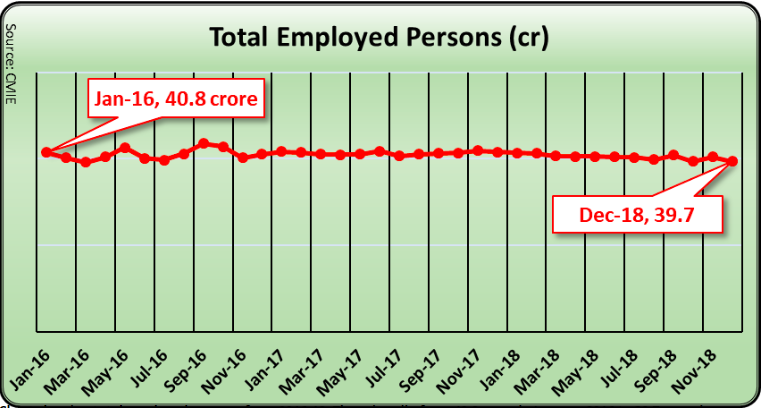
The chart below shows the stagnation in number of employed persons in the country and the dip in December 2018. This is from CMIE data which is based on a household survey, and thus covers all manner of employment, including informal or gig economy jobs.

Chart showing total employed persons from 2016-18. There is a dip from 40.8 crore in January 2016 to 39.7 crore in December 2018.
So: employment is not increasing, as this chart depicts. That leaves people with two options, either stop looking for work altogether and drop out of the workforce, or continue to seek work actively. This latter category is what is known as ‘unemployed’. Surveys will find out this number, often not estimating those who have become frustrated or discouraged and dropped out.
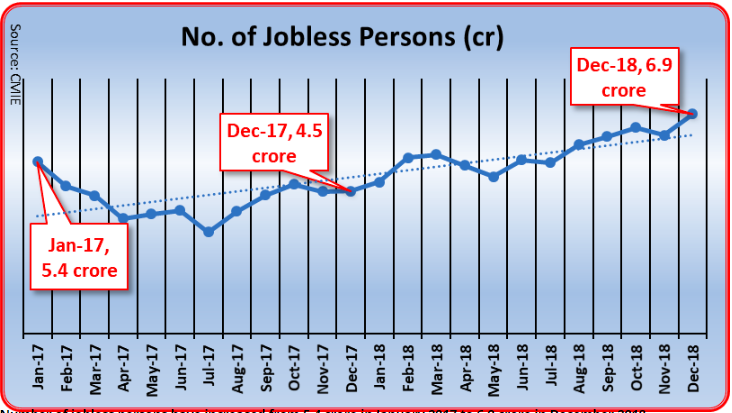
Now, here is a look at the jobless numbers. Again, converting the CMIE data to numbers, we see a dramatic increase in the number of unemployed people in just the past one year. Latest estimates for December 2018, put the figure at nearly 7 crore persons, as shown in the chart below.

Number of jobless persons have increased from 5.4 crore in January 2017 to 6.9 crore in December 2018.[/caption]
The rising trend, and the staggeringly high numbers are evident. This is too big a crisis to be washed away with some data juggling or dodgy arithmetic.
There is another aspect of the jobs crisis that neither analysts nor Modi and his advisors are thinking about. That is: the wage crisis which is directly linked to the lack of jobs.
Poor people only temporarily drop out of the employment market, say for a couple of months during a lean season. Only the middle class can afford to start attending some course or training while they look for jobs, thus not getting counted as jobless.
For the vast majority of our country folk, no work is not an option. They take up some work or other even part time, seasonal, irregular or very low paying, just to survive. So, there is a metastasis of low paid, back breaking work. This can be agricultural work, or construction or domestic work or simply pulling rickshaws to earn a few rupees. This is nothing but disguised unemployment because people are forced into subsistence work in the absence of decent jobs. There are no recent estimates for the extent of such work but a National Sample Survey Organisation report in 2011-12 had indicated that as much as 35 per cent of the workforce is under-employed in this manner.
Since Modi and his electoral machinery is blissfully unaware and silent about this catastrophe that is happening every day, and since the media too is blithely pretending that there is no problem as long as we are doing well in ease of doing business rankings, it is safe to say that Modi and the BJP are headed for a surprise of their lives when votes are counted on May 23 this year.
Courtesy: Indian Cultural Forum
Join our mailing list to get the latest human rights news that matters, straight to your mailbox.
© Sabrang | All Rights Reserved