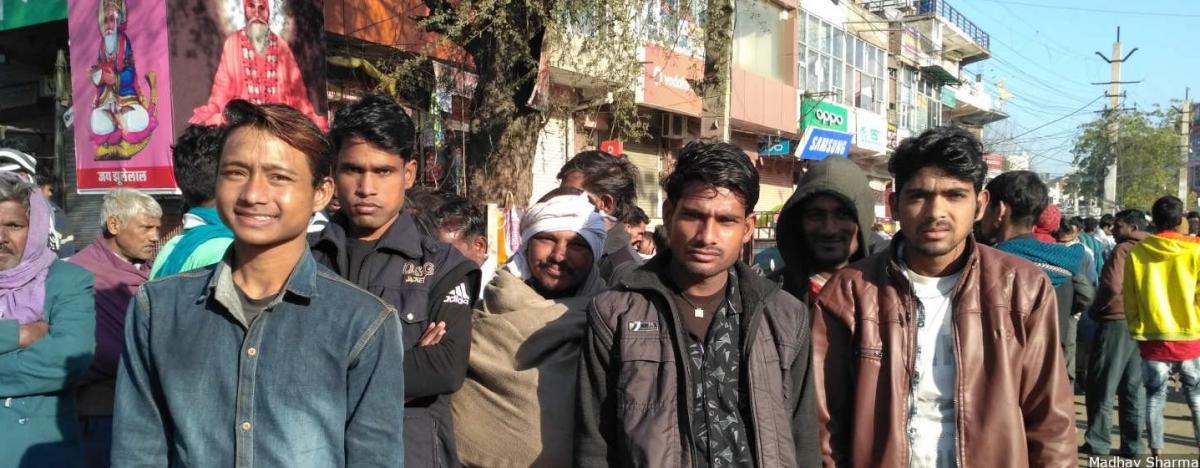
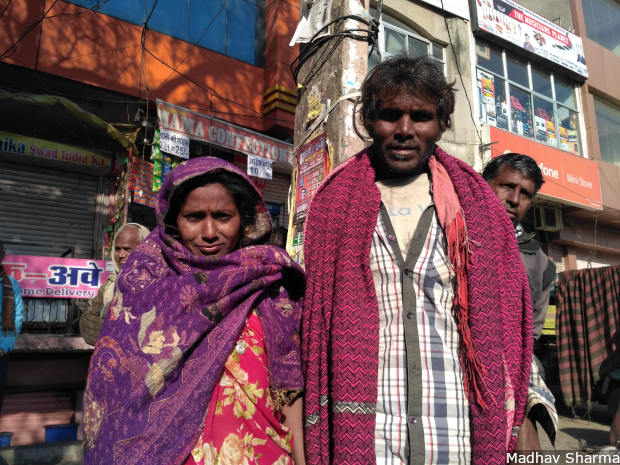
It had been eight days since Shanti Devi, 30, and her husband Babulal Saini, 33, had found work. Draped in a bright, red saree, Devi sat on the pavement. Nearby, Saini, dressed in a checked shirt and gray pants stained with paint, was in animated discussion with some of the 300 gathered labourers.
Here at the Thadi market choukdi or square–one of 35 where workers in search of daily jobs gather in Rajasthan’s capital–everyone was distressed about the lack of employment.
Devi and her husband have worked at construction sites for daily wages since they moved to Rajasthan’s capital eight years ago from their village of Rajor in Karauli district, 150 km east, where they had a “small farm”, which they sold because they could not pay back a loan of Rs 5 lakh.

Shanti Devi and her husband Babulal Saini–who sold their farm to pay a debt–now earn Rs 8,000 together, down from Rs 18,000 in 2017. “Two years ago, we would get work for 25 days a month, but now we get only eight to 10 days of work a month,” said Devi.
They said they had never before experienced such a lack of jobs.
“Two years ago, we would get work for 25 days a month, but now we get only eight to 10 days of work a month,” said Devi. Their earnings in this period dropped about 55%: Today, the couple together earn up to Rs 8,000 per month; in 2017 it used to be Rs 9,000 each.
All the people in this story earn enough to be above Rajasthan’s official urban poverty line, Rs 1,002 per person per month, which means they are likely not eligible for government subsidies and social-security programmes.
The drop in wages and opportunities, experts said, were precipitated by Prime Minister Narendra Modi’s demonetisation programme–which invalidated 86% of India’s currency overnight–in November 2016 and the implementation in June 2017 of the Goods and Services Tax (GST), widely criticised for its hasty, often chaotic implementation.
Over the year to February 2019, the number of employed Indians fell by 6 million to 400 million, according to the Centre for Monitoring Indian Economy (CMIE), a consultancy. The unemployment situation mirrored the year following demonetisation but now indicates a “deeper and more sustained problem”, Mahesh Vyas, CMIE managing director and CEO, wrote on March 5, 2019.
“The low job opportunities compared to the size of the working age population have reduced wages in the private and unorganised sectors to a point, where, only the desperate are willing to take up such jobs,” wrote Vyas.
Competition from Chinese-driven automation and goods has further crippled economies nationwide, our reporting has found. A compounding factor in Rajasthan is a 2017 Supreme Court ban on environmentally damaging gravel- and river-sand mining, which threw thousands out of work, sent rural workers to cities and increased the pressure on jobs in India’s eleventh-poorest state by per capita income.
This is the second of an 11-part series (you can read the first part here), reported from nationwide labour hubs–places where unskilled and semi-skilled workers gather to seek contract jobs–to track employment in India’s informal sector. This sector, which absorbs the country’s mass of illiterate, semi-educated and qualified-but-jobless people, employs 92% of India’s workforce, according to a 2016 International Labour Organization study that used government data.
By delving into the lives and hopes of informal workers, this series provides a reported perspective to ongoing national controversies over job losses after demonetisation and GST. The number of jobs declined by a third over four years to 2018, according to a survey by the All India Manufacturers’ Organisation, which polled 34,700 of its 300,000 member-units. In 2018 alone, 11 million jobs were lost, mostly in the unorganised rural sector, according to data from the Centre for Monitoring Indian Economy (CMIE), a consultancy.
Devi and Saini represent India’s informal sector, which employs, as we said, 92% of India’s 527 million workforce and absorbs those who have failed in other professions and those who are not qualified for anything but manual labour.
Like millions of informal workers nationwide, their already precarious economic situation has deteriorated over the last two years. Half their Rs 8,000 monthly wages are spent as rent on a one-room house with kitchen and toilet, and Rs 2,000 on the education of their two sons, aged five and seven. Devi studied till grade VIII, her husband is illiterate. They have a daughter, who was married at 13.
Their home is 4 km from the choukdi, and they pay Rs 10 per person per trip to commute to and fro in an electric rickshaw. The Thadi market choukdi is frequented by skilled, semi-skilled and unskilled labour. Skilled workers, considered the cream of the labour class, earn around Rs 500 per day; unskilled about half that.
But their stories are the same.
“Everyday, we wait for work from 8 am to 12 pm,” said Saini, clearly distraught. “When we do not get work, we return home. After this our whole day is lost because we have no work.”
A growing unemployment problem
Demonetisation and the GST “severely affected” Rajasthan’s small-scale construction, mining, gems and jewellery industries, made worse by a tide of Chinese imports and equipment that replaces jobs and a mining ban, experts and daily wage workers told us.
“Due to the cash crisis, the purchasing power of people decreased, and the market fell into recession,” said Nesar Ahmed, an economic analyst at the Budget Analysis Rajasthan Centre, a think-tank. “Since November 2017, jobs have reduced continuously (sic). The impact of the government’s decisions started showing after one year.”
Rajasthan’s unemployment rate more than doubled over two years, from 6.6% in 2016 to 14.9% in December 2018, according to CMIE data.
The jobs crisis has pulled into its fold even the educated.
Ganesh Mertha’s story reveals the magnitude of the crisis. At the Gurjar ki Thadi labour hub in Jaipur, Mertha, 22, an arts graduate of the Shaheed Captain Ripudaman Singh Government College in Sawai Madhopur in eastern Rajasthan, waited on a cool February morning to be picked up by a labour contractor. It had been a year since he moved to Jaipur in search of a job. On the day we spoke to him, he hoped to find work as a labourer for Rs 300 a day.
“I came to Jaipur thinking there would be a job for me, and I would like a good life in the city,” said Mertha, dressed in khaki pants and a worn, black tee shirt. In January 2019, he worked for only 12 days, earning Rs 4,800, of which Rs 3,500 was spent on rent for his single room near the choukdi.
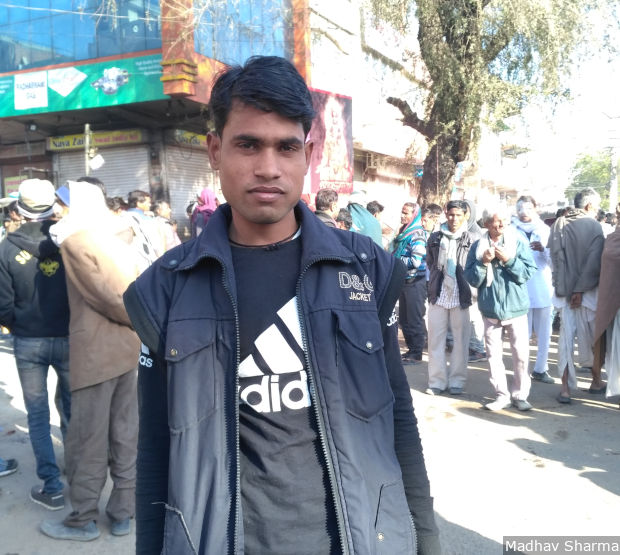
Ganesh Mertha, an arts graduate, moved to Jaipur a year ago in search of a job. On the day we spoke to him, he hoped to find work as a labourer for Rs 300 a day.
In 2016, 200 of 300 people at a choukdi would find work, estimated Harikesh Bugalia, secretary of Nirman Mazdoor Union, a union of informal workers; today only 50-80 people do, and contractors exploit their desperation. “Labourers are going back to their villages,” said Bugalia. As their desperation grows, contractors offer lower wages, he said. “They are on the verge of hunger.”
Mertha knows that hunger.
“Many days I ate plain rice because I had no money,” he said, almost in tears. In February, he had found work on three of 28 days. “I am a graduate, and I am doing mazdoori (hard labour).”
Mertha’s life is harder because he must compete with scores of rural workers streaming into towns and cities after the mining ban, competing for fewer jobs than before. Mining continues illegally, but the ban has also slowed construction, which needs the sand, further squeezing jobs.
As sand-mining closes, more workers at labour hubs
Saurati Devi (45) and husband Rameshwar (49)–he uses one name–explained how they left Tonk city for Jaipur, 100 km to the north, after they lost their jobs to the sand-mining ban.
Her face lined and hands calloused, the effects of a lifetime of hard labour, Devi said she and Rameshwar, both illiterate, found work for no more than eight days a month, down from about 20 in Tonk.
“I have sent my son (who now studies in a college) back to Tonk,” said Devi, “Because it was difficult to afford the expense of having him here.”
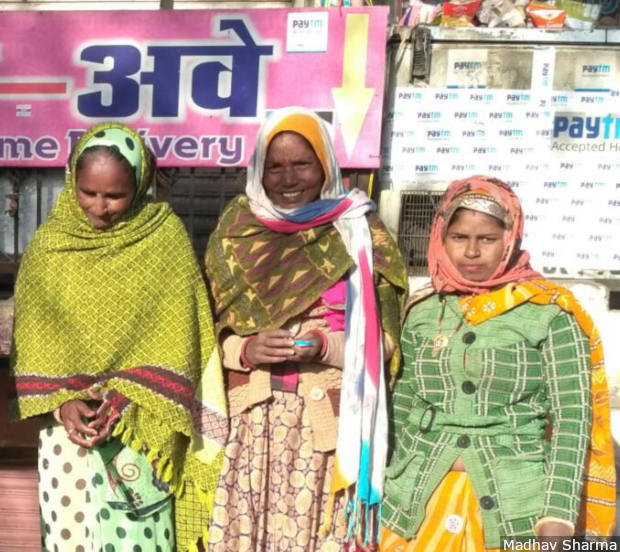
Saurati Devi (centre) and her husband left Tonk city for Jaipur after they lost their jobs to the sand-mining ban. In the capital, the couple found work for no more than eight days, down from about 20 back in Tonk.
Their income is down by half to Rs 8,000 per month since 2017.
“People are forced to work on low wages because there isn’t work,” said Tarachand Verma, a lawyer at the Rajasthan High Court and an associate at the Human Rights Law Network, an advocacy. Even when there was more work, the options for daily wage workers were limited.
There are no official data, but about half the state’s 69 million people are workers–30 million on daily wage labour–according to estimates from the Nirman Mazdoor Union.
More than 3.5 million are construction workers, 2 million work in mining, 1 million in brick kilns, 500,000 in dyeing and printing, 200,000 in the gems and jewellery industry and 3 million on farms, the group estimates.
It was in gems and jewellery sector that we found the greatest anger at demonetisation and GST.
‘From a contractor I became a labourer, thanks to BJP’
Lalaram Chowdhury, 40, seethed with anger at the mention of demonetisation and the GST.
Once the owner of a gemstone-cutting and polishing factory, which he started in 2008, earning up to Rs 40,000 a month after expenses and employing 25 workers, we found Chowdhury at the Sitapur choukdi–looking for a job. He now travels 14 km to and fro by bus to Sitapur, earning up to Rs 10,000 and finds work for 14 days every month.
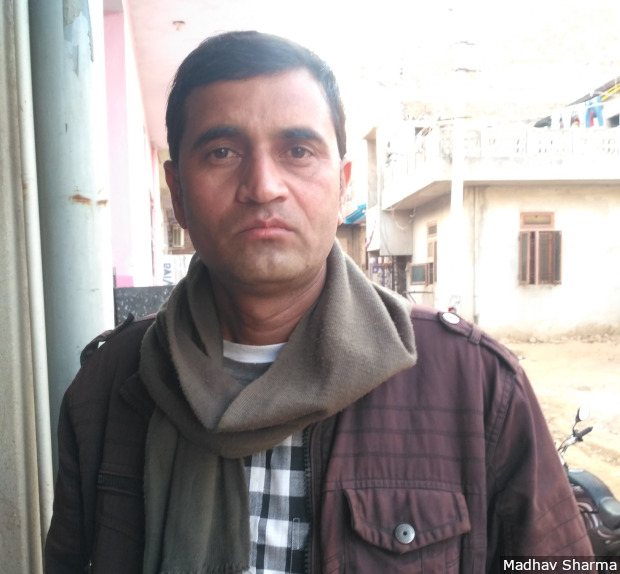
At first glance, Chowdhury looked out of place, dressed as he was smartly, in a black-and-white checked shirt, jacket and a grey muffler. A closer look revealed his jacket had faded. He has bought no clothes for two years, he said, and his family–parents, wife and two children, all of whom he supports–grow vegetables at home to save money.
Lalaram Chowdhury, once the owner of a gemstone-cutting and polishing factory, sold the factory’s machines, paid his 25 workers and gave up his dream. Today, he survives on manual labour, earning up to Rs 10,000, and finds work for 14 days every month.
“I lost Rs 200,000 in a year after demonetisation, and then GST came, so I had to close down the factory in December 2017,” Chowdhury said. He sold the factory’s machines, paid his workers and gave up his dream, although he continues to live in the three-bedroom house he built in 2013.
“I will not vote for BJP in the [2019] Lok Sabha elections,” said Chowdhury. “Because of their policies, I became a labourer from a contractor.”
It did not help that demonetisation and GST arrived at a time when Chinese machines were reducing manual labour in the gems and jewellery industry.
Dressed in jeans and a blue, checked shirt, Ramphool Haritwal, 36, the owner of a gem-cutting factory in the Jaipur neighbourhood of Sanganer and a 10-year veteran of the industry, explained how Chinese machine tools had reduced manual work by 60%.
Over a year, Haritwal has cut his workforce from seven to three. Previously, raw gemstones needed to be cut, shaped and polished before being sold to jewellers. “Now, with the arrival of Chinese machines, all this work is done in one place,” said Haritwal.
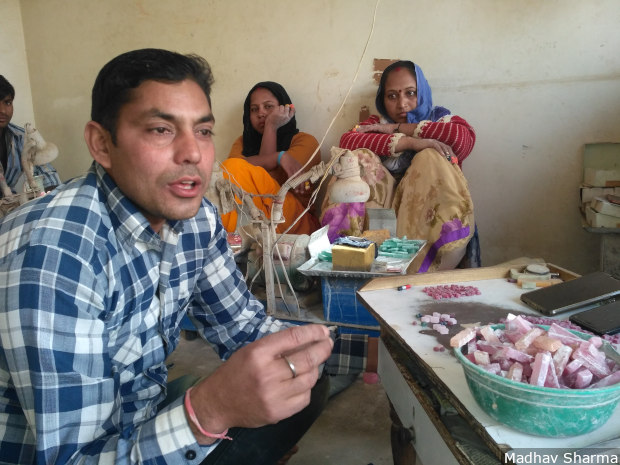
Ramphool Haritwal, 36, the owner of a gem-cutting factory in the Jaipur neighbourhood of Sanganer and a 10-year veteran of the industry, explained how Chinese machine tools had reduced manual work by 60%. Over a year, Haritwal has cut his workforce from seven to three.
Demonetisation and GST, he said, broke their economic chain. A 0.25% GST rate on cut and polished diamonds and precious stones ended the businesses of small units that survived for decades on marginal incomes. The son of farmers, whose parents now live with him, Haritwal’s earnings decreased from Rs 25,000-Rs 30,000 every month to between Rs 10,000-Rs 15,000 at present.
The jewellery industry ran on cash, and with demonetisation and a government decision to limit cash purchases of jewellery to Rs 200,000–with the worthy aim of curbing unaccounted cash transactions and widening the tax net–the industry has been unable to cope, said Amit Basole, an economics professor at Bengaluru’s Azim Premji University.
“Due to lack of demand for gems and jewellery, we had to remove workers,” said Kailash Mittal, 53, president of the Jaipur Sarafa (jewellery) Traders’ Committee. Mittal owns a jewellery shop, where he has cut his workforce from 10 to six. By his estimation, the majority of those who drive electric rickshaws in Jaipur were once jewellery designers and gems cutters.
As Jaipur’s economy was wrecked, the government has always been many steps behind in addressing the resulting employment problem.
Social security programmes late, inadequate
In 1996, the Building and Other Construction Workers (BOCW) Act was passed, intending to register all unorganised sector workers so they could benefit from government welfare and social-security programmes. Rajasthan implemented the law 13 years after it was passed and created a labour welfare board.
In theory, this should have led to substantial benefits for the state’s masses of informal workers: education and skill development; life insurance; compensation for accidental death or injury; maternity benefits; bicycles and more.
So far, 2.3 million labourers have been registered in the state, according to CBS Rathore, additional commissioner of Rajasthan’s labour department, and Rs 2,200 crore collected as labour cess.
But no more than 73%, or Rs 1,600 crore, has been spent, and no more than 23.9%, or 550,000 workers, have benefitted, Rathore said.
Government tardiness was revealed during a 2018 social audit ordered by the Supreme Court in Salumbar block of Udaipur district. The report revealed that 22% of informal workers received benefits more than four to six months after submitting applications, 6.43% after seven to nine months and 4.56% after almost a year. The report also revealed that 39% of the 1,400 workers surveyed were not labourers, calling into question the government’s database.
Rathore acknowledged that the last two to three years had affected workers. “But the responsibility of getting them work is the industrial department’s, not ours,” he said, adding that his department only implements welfare schemes.
Santosh Poonia, programme manager at Aajeevika Bureau, an organisation that helps labourers secure livelihood, blamed the labour department for “negligence and oversight” in registering those who were not labourers under the BOCW law. Many were so registered, alleged Poonia, by bribing registering officers.
Rathore, the labour department additional commissioner, denied allegations of negligence and corruption, saying benefits of all schemes had been given to registered labourers on time.
The Centre and state have presented no long-term solutions to rural unemployment. The new Congress government, which took office in December 2018, started the Kaam Mango Abhiyan, or Ask-for-Work campaign, under the Mahatma Gandhi National Rural Employment Guarantee Scheme (MGNREGS), a rural jobs programme, demand for which increased when the campaign ran–initially, from January 5 to January 20, 2019, with a further extension to February 28.
More than 2.5 million have thus sought work, according to the government.
To address the issue of informal employment, the Congress had promised labour welfare boards in its manifesto before assembly elections in December 2018, but there has been no further word.
“The newly-formed Rajasthan government has not put forward any plans for employment of educated youth, although their unemployment allowance has increased from Rs 3,000 to Rs 3,500 per month,” said Poonia.
Back at Gurjar ki Thadi, Mertha, the unemployed arts graduate, echoed the sentiments of other daily-wage labourers. “The government is not able to provide even small jobs,” he said. “Elections are held every time, promises are made to change everything, but nothing changes. In 2014, Narendra Modi had said that he would give 2 crore (20 million) jobs every year, but I read in the newspaper a few days ago that highest unemployment in 45 years has been recorded in his rule.”
At Thadi market choukdi, former farmers Saini and Devi term the 2019 general elections of little relevance. “My understanding of politics is very poor,” said Devi. “[All I know is] it is very difficult for workers to arrange for morning and evening meals. The government does not make any difference to any of us.”
Around her, most workers nodded in silent agreement.
This is the second of 11 reports. Here is the previous story from Indore.
(Sharma is a Jaipur-based freelance writer and a member of 101Reporters.com, a pan-India network of grassroots reporters.)
We welcome feedback. Please write to respond@indiaspend.org. We reserve the right to edit responses for language and grammar.
Courtesy: India Spend