First Published on: August 4, 2017
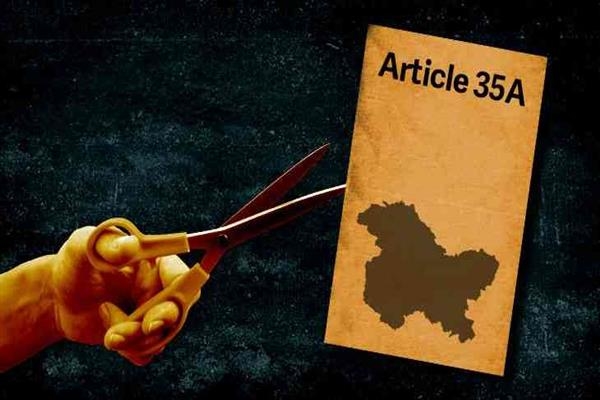
Once again, none less than RSS senior leader Indresh Kumar raised the bogey of Article 370 and Kashmir. As representative of the ideological backbone of the party that rules Delhi with a brute majority since May 2014, and is an alliance partner in the state of Jammu and Kashmir, the far Hindutva right has consistently raised this bogey and connected it, without fact or historical basis with Kashmir and Kashmiri ‘loyalty’ to the Indian nation. Demanding that Article 370 should be repealed temporarily in Jammu and Kashmir on an “experimental basis”, and he would reach out to senior leaders of all parties in the strife-torn state for taking the step. “This will help us see whether the people of Kashmir unfurl the flag or set it on fire,” he said. He was at Panjab University to felicitate Mohammad Faiz Khan for ‘Gau Seva Sadhbhavna Padyatra’. Predictably, the chief minister of the state reacted with her views on the subject. If the special constitutional status of Jammu and Kashmir is tampered with, or the Permanent Resident Act (35A) — a provision that empowers the state’s permanent residents — removed, there will be “no one to shoulder the Indian flag in the Valley,” Mehbooba Mufti said. Without seeking to explain the reasons behind the special status and its intent, once again the entire issue of Article 370 and the J & K state again, is likely to deteriorate into a war of words, without historical substance.

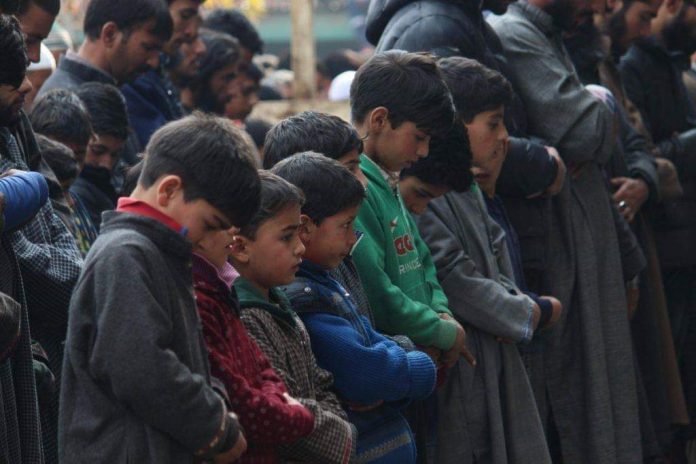
Image Courtesy: Kashmir Reader
In this compilation, the author seeks to unravel, for the reader the Historical Background of Article 370 and the Hindu Right
Article 370 & the Hindutva Right
Article 370 was brought into the Constitution after the events of 1947, when a more popular section of the Kashmiri leadership, led by Sheikh Mohammad Abdullah, negotiated Kashmir’s unique relationship with the Indian Union. The “special status” granted to the state through Article 370 allows the state to have its own Constitution – that is why elections to its legislative assembly are held once in six years, unlike other states where they are held once in five years.
Wall, Bride or Tunnel?
Article 370 debated in Parliament as early as 1963. In the process of convincing the parliament about the technical difficulties involved in abrogating the Article, Nehru set out to dispel the still-prevailing notion that it prevented people from outside the state from buying land in Kashmir. “That is an old rule coming on, not a new thing, and I think that it is a very good rule which should continue, because Kashmir is such a delectable place that moneyed people will buy up all the land there to the misfortune of the people who live there; that is the real reason and that reason has applied ever since British times and for one hundred years or more,” Nehru said in the Lok Sabha.
On August 15, 1947, when India became independent, J&K was not a part of its territory. It was only by the Instrument of Accession, dated October 27, 1947, signed by the Maharaja of J&K that the state acceded to the Dominion of India. By clause 3 the Maharaja accepted that the matters specified in the schedule are the matters with respect to which the dominion legislature may make laws for the state of J & K. The instrument further provided that the terms of instrument shall not be varied by an amendment to the Act or the Indian Independence Act, unless such amendment was accepted by the Maharaja. The instrument also clearly laid down that nothing in the instrument shall be deemed to commit the state in any way to the acceptance of any future Constitution of India. The instrument of accession may be read here.
This instrument accepted only a limited number of matters — Defence, External Affairs, Communications — with respect to which the Indian legislature could make laws for J&K. This special relationship of J&K found its reflection in Article 370 of the Indian Constitution which laid down that notwithstanding anything in the Constitution, the powers of Parliament to make laws for the state shall be limited to those matters in the Union List and the Concurrent List, which, in consultation with the government of the state, are declared by the President to correspond to matters specified in the Instrument of Accession, and such other matters in the said lists with the concurrence of the state the President may by order specify.
Thus by virtue of Article 370 Parliament can legislate for J&K on matters other than those mentioned in the instrument but only after obtaining the concurrence of the state of J&K (emphasis supplied). Thus J&K has special status, unlike the other states in India where Parliament can legislate on its own on subjects mentioned in the Union and concurrent lists. Whatever is critical to note it that today almost all subjects in the Union and Concurrent lists have been extended to J & K completely eroding the substance of the Article.
Legal luminary AG Noorani in his book Article 370: A Constitutional History of Jammu and Kashmir documents how the Article was tampered to the extent that only husk has been left. Noorani’s book mentions the first “unfortunate breach” by N Gopalaswamy Ayyangar on October 16, 1949, in unilaterally altering the draft agreed to with Sheikh Abdullah and Mirza Afzal Beg. If the original agreed-upon draft had been approved, the ouster of Sheikh Abdullah later in 1953 would have been impossible.
Myth
It was only at its genesis that Article 370 gave the Union government jurisdiction only over three subjects—defence, foreign policy and communications. Over the decades, this has changed: 94 of the 97 entries in the Union list and 26 of the 47 entries in the concurrent list were extended to J&K. So were 260 of the 395 Articles of the Indian Constitution. Subsequent presidential orders further ‘eroded’ the original substance of the Article. Today, it is a mere husk of the original seed.
It is no doubt true that Article 370(3) provides that the President may by notification declare that this article shall cease to be operative, but the proviso clearly lays down a limitation that the recommendation of the Constituent Assembly of the state shall be necessary before the President issues such a notification. It is not disputed that the Constituent Assembly of J&K has never given any such recommendation. In that view Article 370 cannot be withdrawn by Parliament purporting to exercise the power of amendment given by Article 368. That the power to amend the Constitution is not totally unfettered admits of no disputes vide the famous case of Keshvanand Bharthi, (1973) in which the Supreme Court held that a “Constitution like ours contains certain features which are so essential that they cannot be changed or destroyed”.
There is also nothing very special in laying this limitation in Article 370. Even Article 368 limits the power of Parliament to make any amendment to the Constitution which would result in a change in any of the lists in the Seventh Schedule; such amendment shall also require to be ratified by the legislatures of not less than half of the states.
Myth 2: J & K is the Only State with Special Status
Under our Constitution the Governors are only formal heads of state and have no powers at all in the administration of the state which is vested in the Cabinet. But yet by the Constitution Amendment Act 1956, Article 371 provides for a special responsibility of the Governor for the establishment of separate development boards for Saurashtra and Kutch (in Gujarat) and Vidharba in Maharashtra for an equitable allocation of funds for the development of the area. No objection by the BJP has been raised which curtails the power of Gujarat Chief Minister Modi, while there is not such limitation on the chief ministers in other states!
Land Ownership Restricted and Protected in Mizoram
Article 371-G, introduced by the 55th Constitution Amendment Act 1986, provides that no Act of Parliament in respect of the ownership and transfer of land shall apply to the state of Mizoram unless the legislative assembly of Mizoram by a resolution so decides. This provision is identical to Article 370 of the Constitution regarding J & K. The BJP was a party to the above amendment.
Why then do the RSS and why does the BJP apply double standards between the cases of Mizoram and in the case of the Muslim majority state of J & K? Is it because J & K is the only state that has a Muslim majority?
Myth No 3 about Article 370: It prevents Indians from buying land in Kashmir
That prohibition is a holdover from Dogra times. Besides, other states have similar restrictions.
Among the foremost grievances against Article 370 of the Indian Constitution, which grants special autonomous status to Jammu and Kashmir, is the impression that it prevents Indians from buying land in the state. That is not true. While the Article does give the state a “special status”, it says nothing about land. As it turns out, the prohibition against outsiders buying land in Kashmir was introduced by the Dogras who bought the territory from the British in 1846 under the Treaty of Amritsar.
Article 370 Status Reduced in the Case of J & K Over Time
Article 370 eroded over time, has, in fact reduced the Status of J & K as compared to Other States. Jammu and Kashmir has been relegated to a status inferior even to other states.
Examples:
· Parliament had to amend the Constitution four times to extend the President’s Rule imposed in Punjab. In the case of Jammu and Kashmir, the same was accomplished, from 1990 to 1996, by mere executive orders under Article 370. The Article was also freely used not only to amend the Constitution of India but also of the state. On July 23, 1975, an order was made debarring the state legislature from amending the state Constitution on matters in respect of the governor, the election commission and even “the composition” of the Upper House, the Legislative Council.
· On July 30, 1986, the President made an order under Article 370, extending to Kashmir Article 249 of the Constitution in order to empower Parliament to legislate even on a matter in the state list on the strength of a Rajya Sabha resolution. Ironically, concurrence to this was given by the Centre’s own appointee, governor Jagmohan. Former law secretary of J&K, GA Lone described how the “manipulation” was done “in a single day” against his advice and “in the absence of a Council of Ministers”.
· When May 1996 Parliamentary elections in the state — the first since 1989 — were marred by the boycott call by separatists and coercive voting, the central government offered a bait to the lone mainstream party — the National Conference — to participate in the assembly polls. The NC leader Dr Farooq Abdullah, cooling his heels in London, was adamant in seeking Constitutional changes before committing to take the plunge into the electoral process. His hesitation stemmed from the famous “sky is the limit” observation of Prime Minister PV Narasimha Rao from Burkina Faso to underline that any kind of future arrangement for Kashmir could be discussed. What changed?
A year earlier in 1994, Dr Abdullah was part of a delegation to Geneva to persuade Iran to drop the Organisation of Islamic Countries (OIC) resolution at the UN Commission on Human Rights (UNCHR), later rechristened as Human Rights Council, condemning India for human rights violations in Kashmir. The resolution, with UNCHR approval, was to be referred to the UN Security Council for initiating economic sanctions and other punitive measures against India. (Privately, Dr Abdullah says, he had been offered restoration of Constitutional arrangement that existed prior to 1953. A euphemism for greater autonomy in lieu of saving India from possible disgrace at a time when the country had mortgaged its gold reserves. Dr Abdullah was however, persuaded by Rao’s successor Deve Gowda to participate in the October 1996 assembly elections on the assurance that he was free to pursue legislative process to seek changes in the Constitutional relationship between Srinagar and New Delhi. )
State Autonomy and Federalism
Even in the USA such is the width of state autonomy that an advocate getting his law degree from Washington University cannot as a matter of right practice in the state of New York. No one has suggested that this is endangering the unity of the USA.
Recently in the election fever even the Congress seems to have got entrapped when it gave an election promise to separate Ladakh from the territory of J&K and even give it a separate legislative assembly. This is a provocative suggestion, which can only inflame the sentiments of people of J&K against India, apart from the fact that it is not legally possible because the J&K legislature will never give its consent, as provided by Article 370.
It needs to be appreciated that the retention of Article 370 is a matter of self-respect and honour and an assertion of their distinct identity for the people of J&K. Can’t the BJP leaders, even when most of the parties in J&K are desirous of finding a lasting solution, be statesmen enough to give up their opposition to Article 370, which no Kashmiri can possibly agree to abrogate because it is a matter of preserving his special identity?
Faced with this reality, politicians must realise that all talk of abrogation of Article 370 is moonshine and a non-issue. It is also a very sensitive matter touching the credibility of our secular professions and the justifiable fears of the minorities. With all this, when it is also patent that the abrogation of Article 370 is not legally and constitutionally possible, is there any moral, political or logical justification to keep up this empty noise?
In other words, if Article 370 is abrogated, then it will have to be replaced by a similar article. Otherwise, abrogation would require renegotiating the terms of accession, which may open up the issue of accession itself, and would certainly permit the introduction of new terms. Are the people of the state and India willing to reopen the accession issue and terms? Have their representatives considered what could be put in place instead, not to mention, ever discussed it?
Much water has flowed since then. The argument that Article 370 constitutes a psychological barrier between the governing elite in Delhi and the Kashmiri youths is a false one. The real problem lies in Kashmir’s history of rigged elections and foisting unpopular Chief Ministers on the people. Delhi needs to address are these two areas of anxiety and suspicion — and not Article 370.
Most importantly, India, especially New Delhi needs to reach out to the youth of J&K, to persuade them that Article 370 is a ‘psychological barrier’ that must be dismantled to meet their aspirations. That persuasion must be directed to where it matters most: in the Valley. The sentiment there is that the country’s only Muslim-majority state must preserve what remains of its distinctive political and cultural identity and its territorial unity.
There are constitutional hurdles that the new government will also have to cross should it move to abrogate Article 370. A new constituent assembly will have to be formed to recommend the abrogation. (Given the majority of disaffected Kashmiri Muslims such an assembly will have, no such recommendation will be forthcoming.) Only then can the President of India issue a public notification to this effect. Parliament is well within its rights to amend this provision. But what if the Supreme Court rules that the special status accorded to J&K is a basic feature of the Constitution?
Article 370 cannot be abrogated or amended by taking recourse to the amending provisions of the Constitution. For, in relation to Kashmir, Article 368 has a proviso which says that no constitutional amendment “shall have effect in relation to the state of Jammu and Kashmir” unless applied by Order of the President, that requires the concurrence of the state government and ratification by its Constituent Assembly. With the Assembly’s dispersal on November 17, 1956, after adopting the Constitution of Jammu and Kashmir, there is no authority left to recommend its abrogation.
Jitender Singh’s initiative will open a Pandora’s box. It will give a fillip to secessionist forces in the Valley, increase Pakistan-supported terrorist activities and, no less serious, internationalise the Kashmir issue. And this at a time when Pakistan has begun to send signals that it is prepared to move away from its entrenched stand on this intractable problem.
370 Then and Now
- In its pristine form, Article 370 of the Indian Constitution had given J&K the constitutional right to have its own separate Constitution, its own prime minister, its own president and its own national flag. The residuary powers were vested with the state assembly and not the Parliament of India.
- The residents or state subjects of J&K were not citizens of India and the entry of Indian nationals into J&K was restricted. The goods from India had to pass through a customs barrier by paying import duties. The people of J&K were not obliged to uphold the integrity and sovereignty of India.
- The Supreme Court’s jurisdiction was restricted only to Article 131 dealing with disputes between the Union and the states. In all other matters, the apex court was given only appellate jurisdiction.
- The J&K government had complete, exclusive control over all the taxes. The I-T department of J&K was free from all central controls. There was no ‘financial integration’ between J&K and India.
- To put it simply, J&K was a sovereign within India having an agreement on three matters—defence, foreign affairs and communication—with the government of India.
- None of this holds true now. Over the years, the privileges have been overridden by various constitutional orders issued by the president of India.
- Article 370 is now just a husk; the seed has been long taken out. Out of the total number of 395 articles of the Indian Constitution, 260 have been applied to the J&K Constitution. The remaining 135 are identical to the Indian Constitution. So there are no real privileges or protections. In other words, Article 370, even though it is there, has been made irrelevant. Yet, it is important! Why?
- The answer to this comes from the most unlikely of people, Mr Narendra Modi! As the chief minister of Gujarat, Modi in his Republic day message, wrote, “A country such as ours cannot survive without a vibrant and functional federal structure. Sitting in New Delhi, the Centre may not always be able to do justice to the potential and needs of various states.” Article 370 is exactly about tilting the existing power balance in favour of J&K, which is a state within the Union.
- In an obvious reference to the appointment of the governor and the Lokpal, Modi wrote, “Chief ministers are not consulted on crucial appointments. Rather, appointments are being thrust down, violating the spirit of the laws of the land.” Article 370 prevents exactly this from happening in the case of J&K.
- Further, Modi has been lamenting the fact that the “Sarkaria Commission, which called for consultation between the states and the Centre on the concurrent list, hasn’t seen the light of day”. Again, Article 370 makes it obligatory on the Centre to seek concurrence of the state on matters of the concurrent list.
- Modi was also in the forefront in criticising the Centre for not discussing the Communal Violence Bill or the NCTC with the states. The benefit of Article 370 in the case of J&K is that even if the Centre passes these laws, they will require the concurrence of the state legislative assembly to be applicable. So the last word rests with the J&K state!
- For its detractors, Article 370 is a hindrance to beneficial legislations like the Right to Education, which are not automatically applicable to J&K. This is a fallacious argument; all these can be easily extended as other laws have been over time.
- Unlike Article 371, sub-clause (a to g), which gives North-eastern states constitutional protection on the ownership of land, Article 370 doesn’t do that for J&K. The restriction on ‘outsiders’ buying and selling land in J&K is because of a state law promulgated in 1929 by the Dogra maharaja of the state.
- To put it on its head, the emaciated Article 370 may well provide PM Modi with the framework for a new federal structure that he had been advocating as Gujarat CM.
- For what was a “sovereign within a nation” has been over the years, wittingly or unwittingly, converted into a model for a country aspiring to have genuine cooperative federalism. As such, far from abrogation, it may serve as the basis of a model for other states.
- The benefit of Article 370 has been to make J&K a politically empowered state, an inclusive economy, an identity- conscious society. The single biggest benefit of Article 370 to the people of J&K is the radical restructuring of agrarian relations. It is not well recognised that the land reforms carried out in J&K have been possible only because of Article 370.
As such, the current controversy on Article 370 is completely mindless; it’s only giving a lifeline to the otherwise thoroughly corrupt and compromised political forces. There is no need to abrogate as there is nothing left to abrogate!
- To borrow a medical analogy, Article 370 is to India what the appendix is to the human body. As long as it’s left alone, one can live with it forever. The moment it gets inflated or infected, it needs surgical attention! Or it will burst, endanger life. Better to leave it alone, especially as it isn’t infected.
Footnote:
The acrimonious relations between Srinagar and New Delhi — going beyond this controversial Article — are historically beset with broken promises and lack of trust, which often manifest in violent outbursts.
The Article 370 was negotiated as a temporary provision because until the 1960s, the Government of India’s stated policy was to conduct a plebiscite to determine the future of Jammu and Kashmir. Accordingly, a Government of India sponsored White Paper on Jammu and Kashmir in 1948, authored by Sardar Vallabhbhai Patel, recorded: “In accepting the accession, the Government of India made it clear that they would regard it as purely provisional until such time as the will of the people of the State could be ascertained.” The Constituent Assembly debates show both Patel and Syama Prasad Mookerjee had fully approved Article 370, which accords special status to Jammu and Kashmir.
Jammu and Kashmir is the only state in the Union of India, which negotiated the terms of its membership with the Union. The ruler of Jammu and Kashmir had acceded to India by an Instrument of Accession on October 26, 1947, in respect of only three subjects — defence, foreign affairs and communications. A schedule listed precisely 16 topics under these heads plus four others (elections to Union legislature and the like). Clause 5 said that the Instrument could not be altered without the state’s consent.
Therefore, Article 370 was a solemn compact — with neither side mandated to amend or abrogate it unilaterally — except in accordance with the terms of that provision. While all the provisions of Indian Constitution were debated in the Constituent Assembly after deliberations in its Drafting Committee, Article 370 was discussed for five months by Nehru and his colleagues including Sheikh Abdullah, then Prime Minister of J&K.
References:
1. (By Justice Rajindar Sachar, 20 May, 2014, http://www.countercurrents.org/sachar200514.htm)Justice Rajindar Sachar is a former Chief Justice of the Delhi High Court. He was a member of United Nations Sub-Commission on the Promotion and Protection of Human Rights. He chaired the Sachar Committee, constituted by the Government of India, which submitted a much debated report on the social, economic and educational status of Muslims in India
2. http://scroll.in/article/665862, Parvaiz Bukhari ,Myth No 1 about Article 370: It prevents Indians from buying land in Kashmir
3. http://epaper.dnaindia.com/story.aspx?id=65225&boxid=19585&ed_date=2014-06-02&ed_code=820009&ed_page=8, 02JUN2014, Iftikhar Gilani ,History of broken promises
4. http://www.outlookindia.com/article/Open-The-Pandoras-Box-At-Your-Own-Peril/290898
Dileep Padgaonkar, Open The Pandora’s Box At Your Own Peril, OUTLOOK
5. http://www.outlookindia.com/article/The-Appendix-370/290902, Haseeb A. Drabu, Article 370 is just an emaciated husk now, best left well alone, Drabu an economist and ex-chairman, J&K Bank
Read More here