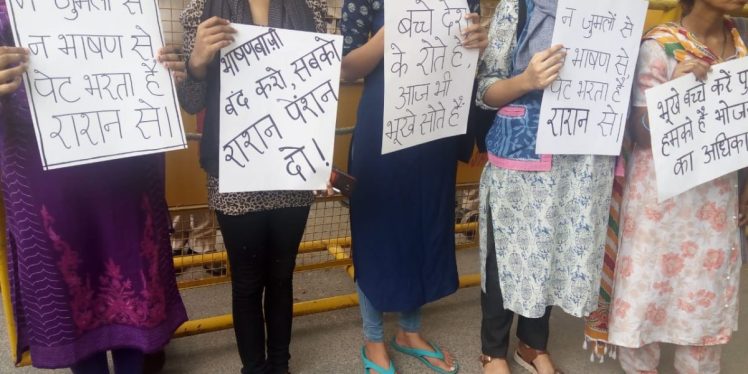
Kavita Srivastava and Dipa Sinha, conveners, Right to Food Campaign (RFT), on behalf of the Steering Committee of the RFT, have released a list of demands which political parties must address in their election manifestos:

The Right to Food Campaign requests all political parties to consider the following suggestions towards ensuring right to food for all while working on their manifestos for the General Elections 2019. We need to remember that these elections are coming at the backdrop of regular reports of starvation deaths from different parts of the country on the one hand and rural distress and farmers’ protests on the other.
While the country now has a National Food Security Act (NFSA), the recent spate of deaths shows that the Act is limited in its vision and implementation. It is currently not even able to ensure the minimum; which is that a person does not go hungry due to lack of food. The Act needs to be amended to expand its scope and also ensure that it prevents hunger (by including a section on starvation protocol) and also contributes to better nutrition status of the people (by including pulses, oil in PDS, eggs in schools and anganwadis etc.).
Along with the NFSA, it needs to be recognised the current situation of hunger is a reflection of rural distress arising out of the agrarian crisis, poor employment and livelihood opportunities, failure of various social security mechanisms and the overall macroeconomic situation. In this regard, we also make some recommendations for the manifesto beyond the changes required in the NFSA framework.
Public Distribution System
Universalisation: Currently, the NFSA is supposed to provide 67% of the population in the country with subsidised foodgrains (cereals). However, it is seen that a number of deserving households (or some members of household) are excluded in many states due to identification issues as well as the caps placed on the number of ration cards (based on 2011 Census data). In order to avoid these exclusion errors, the PDS benefits must be made universal for all residents.
Increase Foodgrains: Increase the foodgrains provided, especially millets, in the NFSA, from 5 kgs at the current prices under the Act.
Double the Antyodaya Coverage: Double the coverage of the Antyodaya Anna Yojana, with priority to vulnerable groups such as Particularly Vulnerable Tribal Groups (PVTGs) and single women, as per Supreme Court orders.
Pulses and Oil: Include dal (pulses), edible cooking oil and other nutritious foods at subsidised rates in the PDS.
Local Procurement: Procurement must be done in an increasingly local manner, promoting local varieties.
Children’s Right to Quality Nutrition
Eggs: Provide eggs 6 days a week in all schools and anganwadis and ensure midday meals are also served during school vacations.
Child Development Centres: To treat severely malnourished children, substantially increase the quantum of and support for community-based village child development centres (VDCs).
Crèches: To reduce the care work burden on women as well as to provide better nutrition, all children under six years of age must have access to a crèche/day care centre which provides trained adult supervision, child development activities, adequate nutrition and link to health services. The crèche access will need to be provided through multiple models including workplace crèches, anganwadi-cum-crèches and so on. Twenty-five percent of anganwadi centres should be converted to anganwadi-cum-crèches and should be operational for 8 hours.
ICDS and Mid-day Meals: The diet under the Integrated Child Development Services (ICDS) and mid-day meals should be enhanced through the use of millets, animal products like eggs, milk, yogurt, and meat (for those who eat it), and other locally available foods. Menus must be decided primarily in consultation with the community.
Universalisation with quality and equity of ICDS is required to protect the rights of all young children, pregnant and lactating women and adolescent girls. All children in India must have access to the full range of anganwadi services. In addition to improving coverage, several steps should be taken to improve ICDS quality and infrastructure.
Coverage of ICDS: Along with dalits, tribals, minorities, disabled children; special efforts must be made to also cover children of PVTGs and migrants through different models. There must be greater decentralisation and flexibility in ICDS with local consultation to decide timings of Anganwadi Centres, menus etc.
Care Work as Decent Work: All workers providing care work, such as Anganwadi Workers and Helpers, ASHAs, should be provided with at least the minimum wage and a decent working conditions.
Mid-Day Meal should be extended to all children up to class XII. Local farmers and self-help groups should be given an opportunity to sell food items directly to schools for Mid-Day Meals where possible, as a means to stimulate the local economy.
Stop the systematic budget cuts and privatisation of services food and nutrition programmes of the government like ICDS, Mid-Day Meal etc.
Ban private contractors in all public feeding/food distribution programmes such as the ICDS, Mid-Day Meals and PDS.
Kitchen Gardens: Organic kitchen gardens must be promoted in schools and anganwadis to improve the nutrient content of the meals served in these institutions.
For Pregnant and Lactating Women
Community Meals: Provide free, hot and cooked nutritious midday meals for pregnant women, lactating mothers, homeless persons and the elderly in anganwadi centres (similar to programs introduced in Karnataka, Andhra Pradesh and Telangana).
Maternity Entitlements under NFSA: The NFSA provides an entitlement of at least ₹6,000 for all pregnant and lactating mothers. The scheme to implement this currently is applicable only to the first birth, and entitles only ₹5,000. The scheme must be amended to ensure that there are no such conditionalities and all women are included. The amount of benefit must be increased (for example, it is ₹16,000 in Madhya Pradesh and ₹18,000 in Tamil Nadu). It must also be ensured that the instalments are paid without any delays.
Universal Maternity Entitlements: The Maternity Benefit Act currently covers only women in the organised sector. Women do paid and unpaid work at multiple sites simultaneously such as farms, forests, worksites, factories, markets, and home. Legal, programmatic and institutional provisions must be made to ensure maternity entitlements that is equivalent to at least minimum wages at prevalent rates for nine months for all women.
Special Packages
Community Kitchens in urban areas: Start subsidized community kitchens in all cities, towns and block headquarters (like Tamil Nadu’s Amma Canteens) and also in hamlets with high tribal populations.
Particularly Vulnerable Tribal Groups: Acknowledging the crisis of hunger and malnutrition amongst PVTGs, provide all the 75 identified PVTGs nationwide with doorstep delivery of a special free nutritional package (similar to the one provided to Rajasthan’s Sahariyas of 35 kg foodgrain, 2 kg of dal, 2 kg cooking oil and 1 kg of ghee every month along with monthly social pensions as introduced in Jharkhand).
Social Security Pensions
Universal Pensions: Provide unconditional universal social security pensions to all elderly above 60 years, differently-abled persons, single women and other vulnerable communities such as transgender persons (as initiated in Tamil Nadu) and PVTGs (as initiated in Jharkhand).
Increase Pensions: Increase the amount for social security pensions from monthly ₹200 to at least ₹3,000 or half the minimum wages (whichever is higher) and ensure that they are inflation-indexed.
National Rural Employment Guarantee Act
Double NREGA: Double the annual guarantee from 100 to 200 workdays per household.
Living wages: Index NREGA wage rates to Consumer Price Index Rural Labourers and ensure that they are not less than the minimum agricultural wage rates in all states.
Timely Payment: Ensure strict timely payment of wages within a fortnight, unemployment allowance to those who are not allotted work and compensation for delayed payment in accordance with the Act.
Urban Employment Guarantee Act: Enshrine and implement a National Urban Employment Guarantee Act (as implemented as a programme in Tripura) with a guarantee of at least 100 days per household for both unskilled and skilled jobs, suitable for urban contexts.
Right to Food Choice
Beef Ban: Remove bans on slaughter of cows on religious and other grounds.
Social Accountability
Grievance Redressal: Appoint State Food Commissions, District Grievance Redressal Officers and Vigilance Committees in all states, districts, blocks and fair-price shops and also ensure a mechanism so that social audits are regularly conducted for all food schemes.
Right to Information: Do not amend the Right to Information Act, but instead strength the state information commissions, appoint Information Commissioners, Lokpals and Lokayuktas and implement the penalty provisions of these laws.
Whistleblower protection law: Implement whistleblowers protection Act and create a conductive environment wherein people have easy access to information.
Agriculture
Minimum Support Price: Enact the Bill for Farmers’ Right to Guaranteed Remunerative Minimum Support Price pending in both houses of Parliament.
Land Reforms: Implement redistributive land reforms and stop forcible land acquisition.
Minimum Wages: Secure minimum wage of not less than Rs 18000 per month for all workers.
Encourage food production: Encourage food production through sustainable and equitable means, and ensure adequate food availability in all locations at all time.
World Trade Organization: Make sure that India does not agree to any restrictions imposed by the World Trade Organization on public stockholdings and press for re-negotiating the agreements in relation to agricultural subsidies in favour of developing countries.
Sustainable Farming: India should discontinue pesticides banned by other countries and over the next five years should completely phase out all synthetic pesticides. Fertilizer subsidies should be reduced and investment should instead be made in organic agriculture. There should be a total ban on genetically modified crops and other foods.
Right to livelihoods resources of the marginalised people
Safeguard land rights of adivasis by strong implementation the Forest Rights Act (FRA) 2006; appoint people’s representative at the district and block level with immediate effect.
Protect dalits from forceful evictions, allocate specially reserved land to the landless dalits, and create fast track courts for speedy resolution of land disputes.
Implement with letter and spirit The Right to Fair Compensation and Transparency in Land Acquisition, Rehabilitation and Resettlement Act, 2013.
Technology and Welfare
Prevent Aadhaar Exclusions: Ensure that no one is excluded because of Aadhaar to avail of their social security entitlements especially rations, pensions and NREGA – delink Aadhaar from all social welfare schemes.
Aadhaar: Delink Aadhaar from and amend Section 7 of the Act to ensure that Aadhaar is not made mandatory to avail of any social security entitlements including rations, pensions, schools and others
Technology should ensure welfares of people and not exclusion, marginalisation and pain.
Management Information System data should be accessible to people and should be in public domain.
Courtesy: Counterview.org