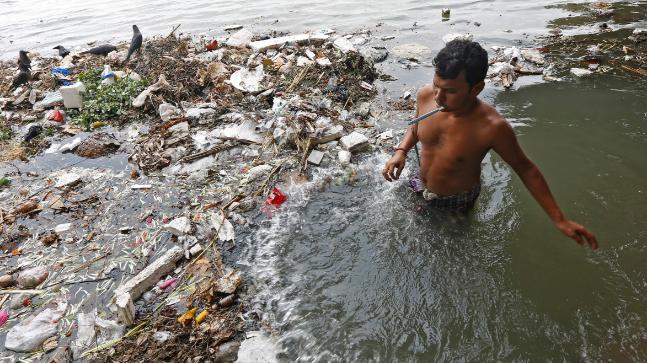
The spiritually charged waters of Ganga are in danger claim citizen activists and The National Alliance of People’s Movement (NAPM) and added that the spiritual charges from the Holy Shrines of Badrinath, Kedarnath and Gangotri are being destroyed by the turbines of the existing hydropower projects at Vishnu Prayag, Srinagar, Maneri, Tehri and Koteshwar.
Image Courtesy: Reuters
The spiritually charged waters of Ganga are in danger claim citizen activists and The National Alliance of People’s Movement (NAPM). In a letter addressed to PM Narendra Modi, Nitin Gadkari, Minister, Water Resources and Ganga Rejuvenation Ministry, Government of India and Trivendra Rawat, Chief Minister, Uttarakhand, they asked how many more sons of Ganga will have to lose their lives in a bid to save the holy river.
“To save the holy Ganga, her sons have risen and stood up for her. Swami Saanand fasted for 111 days to draw the attention of the powers to be to its cries for survival before he succumbed unheeded. Carrying on the baton, Sant Gopaldas fasted for 146 days when he disappeared under suspicious circumstances unheard and unheeded. Presently the 26-year-old young Brahmachari Aatmabodhanand from Matri Sadan, Haridwar, has been on a fast since October 24, 2018, determined to carry on the baton for Ganga for a positive response,” they said.
They want the government to immediately stop work on three dams. “Presently, three under-construction dams namely Tapovan-Vishnugad, Vishnugad-Pipalkoti and Singoli-Bhatwari are further threatening the survival of this holy river adding to the damage already done by a number of existing dams. These are no less than ticking time bombs,” they wrote.
They added that they want the implementation of the ‘CPCB order dated December 06, 2016 issued vide letter no. PCI-SSI/direction-DM/SSP, Haridwar/2016 prohibiting mining and stone crushers within 5 km from either side of Ganga up to Raiwala 2, Bhogpur, Haridwar, up to Raighati and issue directions to halt.’
They also said that the spiritual charges from the Holy Shrines of Badrinath, Kedarnath and Gangotri are being destroyed by the turbines of the existing hydropower projects at Vishnu Prayag, Srinagar, Maneri, Tehri and Koteshwar.
“Research by Japanese scientist Masaru Emoto has shown that water crystals of spiritually charged and free-flowing waters are of beautiful forms while those of negative thoughts and stagnant waters are of ugly forms. Research by Swiss organization Aqua Viva has shown that water upstream Tehri is spiritually charged and has a halo while downstream is without the halo,” they wrote.
Full text of the letter:
Subject: River Ganga is being put to rest- how many more sons of Ganga will have to pay with their lives to save Maa Ganga? – Depends on you.
Dear Sirs,
We congratulate the Hon’ble Prime Minister and yourself for taking a policy decision not to make new dams on the Ganga.
There is no debating that Ganga must flow free or will perish with all attendant ill consequences. This is vindicated by Ravi Chopra Committee in its report to the Supreme Court submitting that there has been an increase in disasters in Uttarakhand ever since the tragedy in 2013, due to the presence of big dams. Acknowledging this reality, the Union of India under your leadership pledged to rejuvenate the Ganga and its three tributaries namely Alaknanda, Mandakini and Bhagirathi.
Presently, three under-construction dams namely Tapovan-Vishnugad, Vishnugad-Pipalkoti and Singoli-Bhatwari are further threatening the survival of this holy river adding to the damage already done by a number of existing dams. These are no less than ticking time bombs.
To save the holy Ganga, her sons have risen and stood up for her. Swami Saanand fasted for 111 days to draw the attention of the powers to be to its cries for survival before he succumbed unheeded. Carrying on the baton, Sant Gopaldas fasted for 146 days when he disappeared under suspicious circumstances unheard and unheeded. Presently the 26-year-old young Brahmachari Aatmabodhanand from Matri Sadan, Haridwar, has been on a fast since October 24, 2018, determined to carry on the baton for Ganga for a positive response.
The powers that be must immediately engage with them ensuring that every step necessary to sustain the river is taken proactively without any further loss of life of the sons of Ganga on chain Amaran Anshan for her.
The Himalayas are rugged mountains. The tunnels being built for dams have been weakening the Himalaya Mountain. Landslides are on the rise. The spiritual charges from the Holy Shrines of Badrinath, Kedarnath and Gangotri are being destroyed by the turbines of the existing hydropower projects at Vishnu Prayag, Srinagar, Maneri, Tehri and Koteshwar. Further, the water of the Holy River stagnates in the Tehri Reservoir and becomes dead without oxygen as established by the methane emissions recorded by the National Environment Engineering Research Institute.
Research by Japanese scientist Masaru Emoto has shown that water crystals of spiritually charged and free-flowing waters are of beautiful forms while those of negative thoughts and stagnant waters are of ugly forms. Research by Swiss organization Aqua Viva has shown that water upstream Tehri is spiritually charged and has a halo while downstream is without the halo.
The Government has notified that minimum 36 cumecs water will be released from Haridwar and 24 cumecs will be released from Narora. These e-flows are only 6 per cent of the flow at Haridwar and 3 per cent at Narora. This is inadequate considering that IIT Consortium has recommended about 50 per cent e-flows from hydropower projects.
To save our holy river let’s begin with:
1. Stopping the following dams under construction on Ganga at Tapovan-Vishnugad on Dhauli Ganga, Vishnugad-Pipalkoti on Alaknanda and Singoli-Bhatwari on Mandakini. 2. Forthwith Implementing CPCB order dated December 06, 2016 issued vide letter no. PCI-SSI/direction-DM/SSP, Haridwar/2016 prohibiting mining and stone crushers within 5 km from either side of Ganga up to Raiwala 2, Bhogpur, Haridwar, up to Raighati and issue directions to halt. 3. Saints have and are sacrificing their lives in an unbroken chain of amaran anshan at Matri Sadan. The concerned authorities must immediately engage with them to resolve the demands.
The time to act is now for tomorrow will be too late.
We are the children of Maa Ganga sending you SOS for her:
Medha Patkar, Narmada Bachao Andolan (NBA) and National Alliance of People’s Movements (NAPM) Prafulla Samantara, Lok Shakti Abhiyan; Lingraj Azad, Samajwadi Jan Parishad & Niyamgiri Suraksha Samiti, NAPM Odisha Dr.Sunilam, Adv. Aradhna Bhargava, KisanSangharshSamiti, Rajkumar Sinha, Bargi Baandh Visthapit evam Prabhavit Sangh, NAPM, Madhya Pradesh P. Chennaiah, Andhra Pradesh Vyavasaya Vruthidarula Union-APVVU, Ramakrishnam Raju, United Forum for RTI and NAPM, Meera Sanghamitra, Rajesh Serupally, NAPM Telangana – Andhra Pradesh GautamBandopadhyay, Nadi Ghati Morcha;KaladasDahariya, RELAA, NAPM Chhattisgarh Swami Agnivesh, Bandhua Mukti Morcha Kavita Srivastava, People’s Union for Civil Liberties (PUCL); Kailash Meena, NAPM Rajasthan Sandeep Pandey, Socialist Party;Richa Singh, Sangatin; ArundhatiDhuru, Manesh Gupta, NAPM, Uttar Pradesh Gabriele Dietrich, Penn Urimay Iyakkam, Madurai; Geetha Ramakrishnan, Unorganised Sector Workers Federation; Arul Doss, NAPM Tamilnadu Sister Celia, Domestic Workers Union; Maj Gen (Retd) S.G.Vombatkere, NAPM, Karnataka Vilayodi Venugopal, Prof. Kusumam Joseph, NAPM, Kerala AnandMazgaonkar, Swati Desai, Krishnakant, ParyavaranSurakshaSamiti, NAPM Gujarat VimalBhai, Matu Jan sangathan; Jabar Singh, NAPM, Uttarakhand Dayamani Barla, Aadivasi-MoolnivasiAstivtva Raksha Samiti; Basant Kumar Hetamsaria and Ashok Verma, NAPM Jharkhand Samar Bagchi, AmitavaMitra, NAPM West Bengal Suniti SR, SuhasKolhekar, Prasad Bagwe, & Bilal Khan, GharBachaoGharBanaoAndolan, Mumbai NAPM Maharashtra Faisal Khan, KhudaiKhidmatgar; J S Walia, NAPM Haryana Guruwant Singh, NAPM Punjab Kamayani Swami, AshishRanjan, Tanmay, Jan Jagran Shakti Sangathan; MahendraYadav, KosiNavnirmanManch; Sister Dorothy, Ujjawal Chaubey, NAPM Bihar Bhupender Singh Rawat, Jan SangharshVahini; Sunita Rani, Domestic Workers Union; Rajendra Ravi, Nanhu Prasad, Madhuresh Kumar, Amit Kumar, Himshi Singh, Uma, NAPM, Delhi
Previously unknown recording reveals extraordinary ‘black ops’ on three continents – exploiting weaknesses in democracies left wide open by governments and Silicon Valley.
Alexander Nix, weeks before Channel 4 News screened its fatal investigation. Image: Christian Charisius/DPA.
“I worked at Cambridge Analytica while they had Facebook datasets. I went to Russia one time while I worked for Cambridge. I visited Julian Assange while I worked for Cambridge. I once donated to WikiLeaks. I pitched the Trump campaign and wrote the first contract. All of these things make it look like I am at the centre of some big, crazy thing. I see that, and I can’t argue with that. The only thing that I’ve got going for me is that I didn’t do anything wrong. So they can search everything that they want!”
It was May 2018. Brittany Kaiser, the second Cambridge Analytica whistleblower to go public, had just heard she was being subpoenaed by the Mueller investigation, in a moment captured in ‘The Great Hack’ (a documentary which premiered at the Sundance film festival this week). The media were reporting her February 2017 visit to Assange, another piece of circumstantial evidence supposedly connecting her to the controversies around the successes of Donald Trump and Brexit. Kaiser continued to protest her innocence, and to cooperate fully with investigations. And today we can reveal more about what she knew.
In explosive recordings that Kaiser made in the summer of 2016, excerpts from which are published exclusively by openDemocracy today, her former boss, Alexander Nix, makes a series of extraordinary claims. The onetime Cambridge Analytica CEO talks of bribing opposition leaders, facilitating election-stealing and suppressing voter turnout.
When we asked Nix to comment on this new material, he told us that many of our claims had been proven to be false, and others were completely speculative and not grounded in reality. But what we are publishing for the first time are his own words.
Nix boasts of orchestrating election black ops around the world. He reveals how in Trinidad and Tobago, Strategic Communications Laboratories (the British company behind Cambridge Analytica) engineered a highly successful grassroots campaign to “increase apathy” so that young Afro-Caribbeans would not vote. In Nigeria, evidence was found that SCL used rallies by religious leaders to discourage voting in key districts. Nix also makes a knowing reference to Brexit, although Cambridge Analytica has repeatedly denied involvement in that campaign.
In the recordings, Nix describes one of his major clients, Republican presidential candidate Ted Cruz, as a “fascist”. And he sheds more light on the nexus of data, money and power that Cambridge Analytica deployed as it backed Donald Trump’s bid for the presidency.
A number of these shocking allegations are also revealed in ‘The Great Hack’. Yet this is far more than a story of one rogue company, now brought low after its name became a byword for electoral controversy. It exposes the back doors through which democracies across the world have been left vulnerable to manipulation. And it is the tip of the iceberg.
What the whistleblower told Parliament
It was almost six years ago, in a London sushi bar, that Cambridge Analytica’s chief executive Alexander Nix first sought to enlist Brittany Kaiser, saying: “Let me get you drunk and steal your secrets.” Back when she was an idealistic nineteen-year-old Democrat from Chicago, she had dropped everything to work on Barack Obama’s first presidential campaign. Later, after studying human rights and international law, she had moved into the unruly world of trade deals with states like Libya and Iran.
Kaiser resisted Nix at first, volunteering for the Ready for Hillary campaign instead. But her experience of the Clinton machine left her disillusioned and frustrated. What’s more, her parents were caught on a financial razor’s edge; she needed to pay the bills. In 2014, she finally struck her perilous bargain with Nix. He became her mentor, she his apprentice.
Brittany Kaiser in front of Parliament’s fake news inquiry, April 2018 Image: PA Images
Nix had teamed up in 2013 with the alt-right entrepreneur Steve Bannon and the family of hedge-fund billionaire Robert Mercer to launch Cambridge Analytica. Their mission was to arm a rising populist right to defeat the big data machine built by Obama.
Kaiser’s decision to work for Nix and Bannon was hard for her former Obama colleagues to understand. Looking back, she told me with a measure of irony that she had been guided by the first African-American president’s creed: “It is important to sit down with rogue actors, without preconditions.” Like others of her millennial generation, she also felt dispossessed, impatient with the status quo and hungry for adventure.
I first met Brittany Kaiser in February 2017. She was shockingly frank about her company’s role in the right-wing political revolutions of 2016, but it was clear that she knew even more.
We spoke on several occasions over more than a year, before I suggested that she blow the whistle publicly to myself and Paul Lewis of The Guardian. She readily agreed.
She testified against her former colleagues, providing arresting new evidence about their unpaid data work on Brexit for the controversial businessman Arron Banks (now under investigation by the National Crime Agency) and his Leave.EU campaign, as well as possible abuses of Facebook and insurance data. She provided the first real proof of Steve Bannon’s role in setting up these deals for Nix, and of Cambridge Analytica’s exclusive data relationship with Bannon’s alt-right propaganda platform, Breitbart News.
In April 2018 Kaiser testified before the British parliament’s ‘fake news’ inquiry. She covered a dizzying array of topics alongside Cambridge Analytica, including her friends’ cryptocurrency-powered telecommunications schemes in Mexico, and her time working with WikiLeaks’ British lawyers at Doughty Street Chambers on “prisoner of conscience” cases.
According to whistleblower Chris Wylie, Cambridge Analytica/SCL used the campaign video in this report from The Guardian to influence the Nigerian presidential election of 2015.
Immediately after running the controversial Nigeria campaign for Nix, Patten went into business with the Russian operative Konstanin Kilimnik. His new partner was not only the right hand of indicted Trump campaign chairman Paul Manafort in Ukraine, but also a suspected Russian military intelligence asset. Patten has recently pleaded guilty to channelling donations from a Ukranian oligarch into Donald Trump’s inauguration fund. Kilimnick himself is wanted for questioning by special counsel Robert Mueller, and has recently fled to Moscow . One of the British parliamentarians asked Kaiser the obvious question: “Have you ever worked for, paid or unpaid, or provided information to, any country’s intelligence agency, their representatives or associated organisations?” Her answer was “No;” but pressed, she acknowledged having been “approached” in the past, before her time at Cambridge
Analytica, “although they wouldn’t properly identify themselves… I’ve been taught what to look out for: my grandfather was a military intelligence officer for 27 years, and knew when I was young that would be a possibility, and told me what to look out for… and to say no.”
Damian Collins MP, the chair of the fake news inquiry, had one final question for Brittany Kaiser. “If Alexander Nix wanted to reach out to Julian Assange, couldn’t he do it through you?” Without losing her self-possession, she laughed for a split second and responded: “That’s what I was wondering…”
Collins then announced that Nix was pulling out of his own scheduled interrogation the following day. Within weeks, Cambridge Analytica and Nix’s wider network of data, political and security consulting operations had filed for bankruptcy. It took another month before the silver-tongued, polo-playing Etonian consultant accepted his third summons from Parliament. Wriggling under the spotlight, he claimed to be the real victim of the Cambridge Analytica scandal. According to his telling, a liberal media witch-hunt had found him guilty of the victories of Trump (who Nix had proudly helped to elect) and Brexit – which he still claimed to have had nothing to do with.
Nix threw particular doubt on the credibility of Chris Wylie, the pink-haired Canadian whistleblower who first set off the firestorm by revealing to Carole Cadwalladr in The Observer his own role in procuring and weaponising the hijacked data of tens of millions of Facebook users for Cambridge Analytica. Nix claimed that Wylie had left in 2014 to set up his own competing firm, which then itself pitched work for both Trump and Brexit. According to Nix’s telling, Wylie had even spoken of being excited to engage with “crazy evil Russians”.
I was part of the small audience for Nix’s parliamentary grilling. Next to me sat David Carroll, the principled campaigner for data rights who sued Cambridge Analytica to expose the thousands of pieces of political, consumer and psychographic information they held on him and 240 million other Americans. (Carroll’s dogged campaign recently secured the first guilty plea from Nix’s UK firm.) Suddenly I received a flurry of urgent messages from Kaiser, then in the US.
The Guardian had just broken the story of her meeting with Julian Assange in February 2017. Based on private material submitted to Parliament, the article suggested that not only had she discussed the US elections with the WikiLeaks founder, she had even funnelled cryptocurrency payments to the organisation. On the same day, Kaiser contradicted the allegations in an interview with the Financial Times. “I didn’t conspire to leak Hillary’s emails and I have nothing to do with Russia,” she told me despairingly.
I wondered: could this young woman really be the elusive link connecting the Trump campaign to Assange and ‘Guccifer’, the hacker subsequently unmasked as Russian military intelligence? Or was someone framing her to throw us all off the scent?
Brittany Kaiser had already allowed me to review emails and documents in the course of my reporting, and to help analyse her materials for testimony and publication by Parliament. Now she allowed me to privately review a further motherlode of files so I could find out the truth for myself; she also agreed to be followed by ‘The Great Hack’ filmmakers. I understand that Mueller’s team issued a subpoena but it was never served on her, and that she has cooperated very closely with official investigations in the US. I found no indication whatsoever that she might have been involved in the Democratic National Committee hack.
Kaiser had originally acknowledged in Parliament that she introduced Nix to her friends in Julian Assange’s London legal team in 2015, but said she knew nothing of her boss’s own contacts with him. Her cryptocurrency donation to WikiLeaks (made with gifted Bitcoin she had no other use for) had taken place several years earlier, while she was working on human rights issues in countries like Iraq.
If we blame a young woman like Brittany Kaiser for all the failings of Western democracy, or harp endlessly on the significant roles played by Julian Assange or Russia, we risk obscuring where the greatest responsibility lies. As we unearthed more pieces of the puzzle, learning ever more about the back doors through which our democracies have been hacked, I realised the real scandal was closer to home.
Anyone seeking a single master key to the conspiracy of 2016 risks missing the forest for the trees. As Assange himself wrote in 2006, “Not every conspirator trusts or knows every other conspirator, even though they are all connected… When we look at an authoritarian conspiracy as a whole, we see a system of interacting organs, a beast with arteries and veins whose blood may be thickened and slowed until it falls, stupefied; unable to sufficiently command and control the forces in its environment.”
Investigations into Trump and Brexit are spotlighting a whole system of conspiracies against democracy, which together do more than any individual plotter to undermine the public good. Leading Western oligarchs, from the Mercers and Steve Bannon to Mark Zuckerberg, did far more than the Russians to elect Donald Trump. The full story has yet to be told. Justice demands that we ask the bigger questions.
Black ops, lies and leaks
Throughout 2016, as a practitioner of politics and technology, I tracked the movements that carried Brexit and Trump to victory. They broke the mould of establishment right-wing campaigns, challenging the broken status quo and tapping bottom-up energies like never before.
But they were also full of black operations, lies, hacks and leaks, with playbooks eerily reminiscent of the Russian political technologists sometimes nicknamed “The Wizards of Oz”. Most strangely, this strange company called Cambridge Analytica, with access to masses of illicit Facebook data and a track record in psychological warfare, seemed to have played a significant part on both sides of the Atlantic.
I personally campaigned against Brexit, I followed the Bernie Sanders campaign on the ground in 2016, and my friends and I lost those fights. We watched the technologies we had been trying to harness for democratic ends being turned against us; we saw hard-right populists hijack our banner of change.
I felt a crack in history opening up during 2016. I was spending most of my time starting up Crowdpac (our political crowdfunding and democratic big-data platform) in Europe. We never sold data, but almost a million people used our questionnaires to inform their Brexit vote; so I understood what Cambridge Analytica was doing from the other end of the telescope. After Trump’s election, I started trying to find out what had really gone wrong and how we could fix it.
Private conversations with contacts on the other side, notably Brittany Kaiser, gave me a glimpse of their murky network of international connections. My wife is a creative and product visionary who had worked at Deepmind, the leading British artificial intelligence company taken over by Google. I told her what I was discovering, and she agreed I needed to pursue it. Over the following two years, this journey took me to dark places I would never otherwise have entered. At times I feared for my own life, or for others’.
In a former life, Kaiser had participated in some of the progressive movements and platforms I had helped to build. Now we shared support for Sanders, experience in private diplomacy and a conviction that data could be used for good. Yet she told indiscreet stories of her own proximity to leading right-wing players, and the moral conflict between some of her work and her underlying values seemed intense.
I decided to find out if Kaiser’s company had truly hacked our elections, whether they had covert links to Russia, and how culpable Silicon Valley and the West’s own oligarchs were behind the scenes. It was not easy.
One former employee of Cambridge Analytica compared others’ reticence to “the omertà of the Mafia”, not least because people were afraid of the company’s powerful principals. The family of Robert Mercer, not only a billionaire but also a data scientist accused of white supremacist views, were its controlling investors. The Mercers’ consigliere Steve Bannon sat on Nix’s board with Robert Mercer’s daughter Rebekah, who Nix sometimes referred to as his “work wife”.
Steve Bannon in his White House days, 2017. Image: Douliery Olivier/ABACA/ABACA/PA Images
Materials revealed to me and testimony provided by Brittany Kaiser and other sources, some of which have subsequently been published, confirm that Bannon was actively involved in brokering Cambridge Analytica’s relationships with Trump, Brexit campaigners and a flotilla of Mercer-linked organisations. (Whistleblowers have also provided extensive evidence to openDemocracy of the relationships between the Brexit campaign, Cambridge Analytica and Steve Bannon). Bannon admitted last spring that he “put the company together”, but continues to claim he knew nothing of Cambridge Analytica’s misdeeds during his time on its board. Earlier this month he launched The Movement, his latest attempt to lay waste to the politics of the European Union and empower the populist far right with data and strategic advice.
Brittany Kaiser and Chris Wylie remain almost unique among former Cambridge Analytica staffers in their willingness to talk publicly. This is particularly striking given that Alexander Nix reportedly failed to pay most of his employees severance they were owed, but himself walked away with a payoff of at least $8.7 million. Nix has denied these allegations, although they were confirmed by multiple sources.
In the course of my investigation, I nonetheless managed to speak with almost a dozen sources with close knowledge of the company’s operations, and gathered previously unpublished materials and insights from a number of them. One senior source who originally wanted to save the company swiftly realised that they had to “kill the dragon”.
Why? For most of its employees, Cambridge Analytica was just another startup, battling for clients in the Wild West world of personal data and advertising technology (“ad-tech”). It overhyped its value proposition, its data architecture and processes were chaotic, not all projects went well; but many felt proud of their work. They compartmentalised the most controversial contracts, blamed Nix and his lieutenants for any sketchiness, and believed that Cambridge Analytica had become a scapegoat for the systemic abuses of the data brokerage industry. “Everyone is doing it,” I heard again and again.
The smoking gun
Brittany Kaiser spoke often about “the crazy things Alexander would say”. But it was hard to find the smoking gun. Then Kaiser and I found an old recording buried deep in her laptop files. It was Alexander Nix’s extraordinary pitch, recorded on her iPhone in the heat of that fateful summer of 2016.
Last March The Guardian, The New York Times and Britain’s Channel 4 News broke the story of Chris Wylie’s whistleblowing for the first time. Seventy-two hours later, Channel 4 News released undercover recordings of Nix and his fellow executives. They talked about ‘honey traps’ that used Ukrainian prostitutes and boasted of secret teams who “ghosted in, did the work, ghosted out” of countries, and “put information into the bloodstream of the internet… with no branding, so it’s unattributable, untrackable”. But even in the Channel 4 sting, Nix was careful to caveat his most inflammatory claims. Not so in Kaiser’s iPhone recording: the mask is truly off.
“What we sought to do here is… to build a workable model of persuasion that could be rolled out across the United States initially. To help us to target people at an individual level in a way that would increase compliance through communications.
“Our inventory has questions like, are you frequently lonely, do you enjoy taking part in new initiatives? It’s not an opinion survey. Because we’re not interested in what you think about the president. We’re interested in you, and trying to work out…” Nix searches for the right phrase: “what are your buttons?
“A few years later we were in Nigeria again, and this was a campaign for [presidential candidate Umaru] Yar’Adua, who was the puppet for [incumbent president Olusegun] Obasanjo,” Nix continues. He appears to be talking about the 2007 elections, not the 2015 race in which Brittany Kaiser and Sam Patten were involved. “So we persuaded our client to do something quite unusual. We persuaded him to allow us to tell everyone in Nigeria that they were planning on stealing the election.
“And the reason we did this was to inoculate them. We ran this campaign for about 12 months saying, oh, the government’s going to steal the election. And then, when the Jimmy Carter Center – who was monitoring the election – announced that the election was not ‘free and fair’, everyone was like… ‘Yeah, we know that.’ As opposed to going ‘WHAT?!!’ and getting really angry!” Yar’Adua won the election by a landslide, but the outcome was controversial and widely thought to have been rigged.
Nix’s UK company Strategic Communications Laboratories and its US wing Cambridge Analytica were usually careful to mask their most controversial activities in case studies. But I found one brochure in which further telling details of this Nigeria campaign slipped through: “SCL advised that rather than focusing on swing voters, the party should instead aim to dissuade opposition supporters from voting – an action that could be easily monitored. This was achieved by organising anti-election rallies on the day of polling in opposition strongholds, many conducted by local religious figures to maximise their appeal to rural communities.”
Kaiser heard Alexander Nix give this pitch many times. This previously unknown recording provides irrefutable evidence of him boasting to prospective clients about his experience in voter suppression, his comfort with sowing apathy and fatalism about corruption, and his readiness to facilitate election-stealing. Asked for comment about his own statements, Nix today denied that SCL had worked in Nigeria in 2007.
Crucially, this recording sets in context the claim by a senior Trump campaign source that “we have three major voter suppression operations under way”, made to Bloomberg in October 2016. By then Cambridge Analytica was working simultaneously with the Trump campaign; the Defeat Crooked Hillary Super PAC, overseen personally by Rebekah Mercer; an underground platform doing psychographic microtargeting of congregations and religious communities; the far-right Media Research Center; the National Rifle Association; and a massive, secretively funded campaign by the National Sports Shooting Federation of gun companies.
How to make black youth not vote
Nix moved on to pitch his next case study – a youth mobilisation campaign. Again, all is not as it seems. “Trinidad is a very interesting case history of how we look at problems,” Nix said. “Trinidad’s tiny – it’s 1.3 million people – but almost exactly half the country are Indian and half the country are Black, Afro-Caribbean. And there are two main political parties, one for the Blacks and one for the Indians… when the Indians are in power the Blacks don’t get anything, and vice-versa, you know – they screw each other. So we were working, I think for the third time in Trinidad, and we were working for the Indians, and we did a huge amount for research, and two really important things came out.
“One was that all the youth, Indian and Afro-Caribbean, felt disenfranchised … And secondly, amongst the Indians the familial hierarchies were really strong. There was huge respect for their elders and their parents and their families, but not so for the Afro-Caribbeans. And that was enough information to inform the entire campaign.
“We went to the client and said, we only want to do one thing, we want to run a campaign where we target the youth – all youth, all the Blacks and all the Indians – and we try and increase apathy. And they didn’t really understand why… but they allowed us to do this campaign, and the campaign had to be non-political, because no one, the kids don’t care about politics. It had to be reactive, because they’re lazy; inclusive of all ethnicities; bottom-up. It had to be exciting, because kids want to do something fun.
“We came up with this campaign which was all about ‘Be part of the gang, do something cool, be part of a movement.’ And it was called the ‘Do So’ campaign… A3 posters. And graffiti, yellow paint, you know, we cut stencils with the jigsaw… And we’d give these to kids, and they’d get in their cars at night, you know, just make a drawing, get in the car, and race around the country putting up these posters and getting chased by the police and all their friends were doing it, and it was fucking brilliant fun…
A poster from the ‘Do So’ campaign. Image: courtesy of Kierron Yip Ngow/Facebook.
“Do So. Don’t vote. Don’t be involved in politics. It’s like a sign of resistance against – not government, against politics. And voting. And very soon they’re making their own YouTube videos. This is the prime minister’s house that’s being graffitied! … It was carnage.
“And the reason why this was such a good strategy is because we knew, and we really really knew, that when it came to voting, all the Afro-Caribbean kids wouldn’t vote, because they ‘Do So’. But all the Indian kids would do what their parents told them to do, which is go out and vote. And so all the Indians went out and voted, and the difference on the 18-35-year-old turnout is like 40%, and that swung the election by about 6% – which is all we needed!”
Again, Nix was selling his company’s expertise in promoting cynicism and apathy to suppress turnout among the opposition. But this campaign was even more manipulative: enlisting young Afro-Caribbeans in what pretended to be an authentic youth movement, secretly designed to manipulate them into surrendering their votes. This is what ‘compliance’ means in psychological warfare: achieving the desired behavioural effect from a ‘hostile audience’.
Asked for comment on the Do-So campaign, Nix responded in an email earlier today, writing, “The objective of this campaign was to highlight and protest against political corruption. There is nothing unlawful or illegal about assisting with this activity. SCL / CA has never undertaken voter suppression and there is no evidence to the contrary.”
Nix’s closing comments in his summer 2016 pitch were tantalising: “We’ve got an in-house intelligence team, so we can do full intelligence protection… Opposition don’t hack your emails and everything else. And we’re pretty good at getting intelligence too… You know what? We do a lot of counter operations. You can spend $10 million on an election. Or we can send one of our guys in to go offer the leader of the opposition a bribe, you know, three weeks before polling. It’s a very good way to win an election.”
Beneath the veneer, this seems to have been some of the work Alexander Nix was most proud of. This is how he pitched his company around the world, just as he was finally starting to work for Trump. This is the man who the Mercers and Steve Bannon enlisted to help them reshape the American political mind.
On the US stage
In Kaiser’s recording Nix talks cynically about his work in the Republican primaries: with Ted Cruz, with Ben Carson, and then with the presumptive nominee, Donald Trump. He claims to have turned Cruz from “the most hated man in US politics” into the front runner before Trump’s wildcard surge. It was not out of love: “We hated this guy. He’s far right wing, he’s like, you know, fascist,” Nix says of his own candidate. The success factor was big data, which “allows you to literally go in and target every single individual”. What about Brexit? “We don’t talk about that,” he says knowingly, after including it in a list of campaigns they were involved in. Kaiser adds ironically, “Oops – we won!”
Nix compares his strategies to a marketing campaign selling Coca-Cola in a movie theatre. Instead of working on branding and adverts, turn up the temperature. Get the viewers hot and bothered: they’ll buy more Coke for sure. This cynical perspective can be traced back to the founder of the modern public relations industry, Freud’s nephew Edward Bernays, who wrote: “In almost every act of our daily lives, whether in the sphere of politics or business, in our social conduct or our ethical thinking, we are dominated by the relatively small number of persons… who understand the mental processes and social patterns of the masses. It is they who pull the wires which control the public mind.”
In the early days of the Cold War, Bernays worked to topple the government of Guatemala through a domestic and foreign propaganda campaign on behalf of the United Fruit Company, the forerunner of Chiquita. Decades later, Nix claimed to be at the forefront of an evolution from “Mad Men” to “Math Men”, replacing the lightbulb moments of unreliable Don Draper creatives on Madison Avenue with mass data and predictive microtargeting. He wanted to precisely hit the Pavlovian reflexes of you, me, everyone. Through this lens, voters become rats in the oligarchs’ maze.
As Nix gleefully claims of another campaign in which the son of a billionaire African liberation leader covertly funded the youth movement which then drafted him as their candidate for president, “We created everything. We created a need that didn’t exist.”
Exit Nix
A year after this recording, Nix was negotiating an abortive acquisition deal with Martin Sorrell’s world-leading WPP conglomerate of advertising and marketing firms. In January 2018, he finally raised almost $20m for a new company called Emerdata.
Papers obtained by my investigation indicate the Mercers were joined by Chinese and Gulf investors in this effort, although the ultimate sources of their funds remain unclear. Johnson Ko, the Chinese state-linked business partner of American mercenary Erik Prince, briefly joined Emerdata’s board alongside one of his associates. (Cambridge Analytica China was also incubated at Ko’s firm Reorient Capital during 2017.)
The majority of the new funds injected into Emerdata seem to have been extracted personally by Nix through various different pretexts, according to conversations I had with well-placed sources and review of bankruptcy documents. The biggest withdrawal of $8.7 million took place after Kaiser’s whistleblowing, and before Cambridge Analytica and SCL Elections went into administration. Many employees were never paid their outstanding salaries and severance: the general sacrificed his footsoldiers, most of whom just wanted to get out and move on. I first discovered Brittany Kaiser’s support for Bernie Sanders via a YouTube video of a company party at the dog races, arrestingly subtitled “We ‘Rigg’ Elections”. It shows a comedy routine performed by one of Cambridge Analytica’s data scientists, who notes Kaiser’s past involvement with the Obama campaign, suggests she may still be working for the Democrats, and includes this memorable line about Alexander Nix: “He could sell an anchor to a drowning man.”
Listening again to the pitch recording, I felt that Nix, who continues to protest his innocence and attempt to reboot his career, is now the one sinking under the weight of accumulating evidence. What about those who enabled him?
Beyond Facebookistan, New Deal 2.0?
There is no question that Cambridge Analytica’s tactics were somewhat effective in pulling “the wires which control the public mind”, although I have found little evidence that their much-vaunted psychographics actually worked. What seems to have had the most impact was the dubious data hoard they assembled to target dark ads on Facebook, combined with the brutal efficacy of their messages and tactics.
Yet this was just one of the tangled web of conspiracies now being exposed. It is increasingly clear that a global underworld of manipulators and power brokers treated 2016 as a playground of opportunities. The democracies of the US and the UK were left wide open; we turned out to be almost defenceless against their designs. Central players in the subversion of our open societies regularly attend conferences of the global elite, such as last week’s World Economic Forum in Davos, Switzerland. Most still seem to operate with impunity.
During our debrief in Thailand, Kaiser soon started connecting the dots between her fury at the powerful men who had been pulling her strings, her conviction that the greatest abuses of power were taking place in Silicon Valley, and the way her own company had been used to “manipulate millions of voters across America”. Her curiosity started to sharpen: how had she and countless others been so misled?
“Brittany spent a long time in the underworld,” I say toward the end of ‘The Great Hack’. Karim Amer, the film’s co-director, asked me whether I was ever concerned she would let me down. It took me a while to answer. I believed that she had made mistakes, that sometimes things break and cannot be put back together, and that ultimately only she was responsible for her own actions. But more importantly, I believe in the possibility of redemption: both for individuals, and for us collectively as a society. Those who have not gone beyond the pale can always learn and grow. Few of us have made no mistakes.
Nix memorably describes in his pitch how much more effective it is to protect a private beach from trespassers by putting up a sign that says “Sharks! Keep Out”. The brutal reality is that we live in a world that is under constant siege by sharks of many different kinds, from the financial markets to Silicon Valley and the White House. The ultimate goal of Russian interference and billionaire voter suppression campaigns alike is to get us to ‘Keep Out’ of politics: to accept the dominance of transnational oligarchs, and to lose hope that things can change.
This is reason enough to reject apathy and disengagement. The outrageous scale of the challenge calls us to embrace our democratic role as citizens, to join our forces and fight for real change. For all their ruthless cynicism and common methods, the pseudo-movements manufactured by Cambridge Analytica, Steve Bannon, the Russians and the architects of Brexit can only thrive in a vacuum. They dissolve when confronted with genuine people power.
Bannon, Nix, the Mercers and Facebook will soon have many more questions to answer. Yet Cambridge Analytica cannot be allowed to be the scapegoat for our broken system. Its successes came from its extraordinary access to data, money and power; but it was simply exploiting the back doors in our democracies which irresponsible elites and Silicon Valley had left wide open.
In an early 2016 email thread, Cambridge Analytica scientists talk matter-of-factly about using illicit Facebook likes to build ‘lookalike’ models, months after they were supposed to have deleted all their Facebook data; but one writes that their approach “is not competitive with relatively simple processes that Google and Facebook provide using the wealth of their data”.
Nix modelled his data barony deliberately on the worst excesses of Silicon Valley, while exploiting the loopholes in their platforms to the full. It is long past time for us to learn the larger lesson. The internet giants must do all they can to fix their failings and better serve their users; but they cannot really flourish until their inevitable excesses are reined in by democracy. Kaiser has given detailed testimony to Parliament about Cambridge Analytica’s retention of tainted Facebook data. We have no visibility into what she told US authorities. The Federal Trade Commission is reported to be considering imposing an “unprecedented” fine on Mark Zuckerberg’s empire, which has also been indicted by Washington DC’s attorney general for facilitating the breach of users’ data without our consent.
Every expert I know believes that the Cambridge Analytica breach was just the tip of the iceberg: my investigation found evidence that other huge ‘friend databases’ were similarly extracted from Facebook and weaponised for political use. Last year I co-founded the Freedom From Facebook campaign calling for Zuckerberg’s near-monopoly control of social messaging data to be broken up; we were immediately targeted with disinformation by Facebook’s own negative PR firm, Definers Public Affairs. Definers is run by notorious Republican ‘opposition researchers’ from the political action committee America Rising, which even hosted a joint Christmas party with Cambridge Analytica in 2015.
Brittany Kaiser initially hoped Zuckerberg and Sheryl Sandberg would turn out to be benevolent oligarchs. Last year she launched a petition calling for them to allow Facebook’s users to own their own data, asking them to learn and change. They have shown no signs of doing either. As a result, ‘Facebookistan’ now has its own leakers and whistleblowers. In recent months, new revelations have shone savage new light on Facebook’s bartering and exposure of user data.
I spoke on the phone with Kaiser shortly before Christmas. “I was being too nice,” she said. “It gets worse every day. You can’t fix it now, it’s not fixable, not in its current form. Break it up with anti-trust laws. Pull away WhatsApp and Instagram… reorganise their business model. It’s completely out of control, and they never thought anything would happen. They’re not really keeping any of it secret; it’s all in the open, but they thought nobody would notice or care.”
Instead of the scapegoat, Cambridge Analytica should be the canary in the coalmine. The urgency is clear: we must secure and renew our democracies. That means closing every loophole that enables the laundering of money and data; encouraging mass participation; and establishing strict safeguards against political meddling by billionaires and underworld operatives (both foreign and domestic). We also have to start building a social contract around data that properly respects the digital human rights of citizens, giving us ownership individually and collectively.
If data is the new oil – a social resource of extraordinary value and danger – then we ought to put it in the hands of the many, not the few, with appropriate safeguards against abuse. If we can build a new wave of technologies that are more deserving of the public’s trust, we will be laying the foundations of a 21st-century commonwealth: a future in which this cornucopia of technology can finally start to be harnessed for the good of all. We need a New Deal for the internet age.
Update, 29 January 2019: This article has been amended to reflect the fact Channel 4 News also broke the story about Christopher Wylie’s whistleblowing.
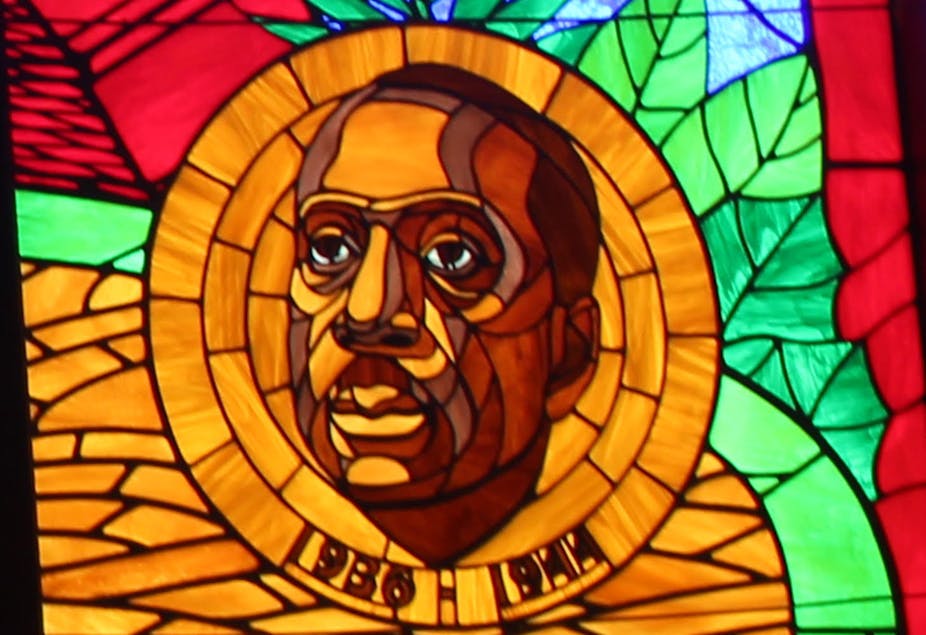
I have been a scholar of Howard Thurman and Martin Luther King Jr. for over 30 years and I serve as the editor of Thurman’s papers. Thurman’s influence on King Jr. was critical in shaping the civil rights struggle as a nonviolent movement. Thurman was deeply influenced by how Gandhi used nonviolence in India’s struggle for independence from British rule.
Visit to India
Born in 1899, Howard Washington Thurman was raised by his formerly enslaved grandmother. He grew up to be an ordained Baptist minister and a leading religious figure of 20th-century America.
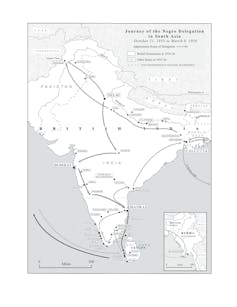
Journey of the delegation in South Asia. Marc Korpus, CC BY
In 1936 Thurman led a four-member delegation to India, Burma (Myanmar), and Ceylon (Sri Lanka), known as the “pilgrimage of friendship.” It was during this visit that he would meet Mahatma Gandhi, who at the time was leading a nonviolent struggle of independence from British rule.
The delegation had been sponsored by the Student Christian Movement in India who wanted to explore the political connections between the oppression of blacks in the United States and the freedom struggles of the people of India.
The general secretary of the Indian Student Christian Movement, A. Ralla Ram, had argued for inviting a “Negro” delegation. He said that “since Christianity in India is the ‘oppressor’s’ religion, there would be a unique value in having representatives of another oppressed group speak on the validity and contribution of Christianity.”
Between October 1935 to April 1936, Thurman gave at least 135 lectures in over 50 cities, to a variety of audiences and important Indian leaders, including the Bengali poet and Nobel laureate, Rabindranath Tagore, who also played a key role in India’s independence movement.
Throughout the journey, the issue of segregation within the Christian church and its inability to address color consciousness, a social and political system based upon discrimination against blacks and other nonwhite people, was raised by many of the people he met.
“Let not the 12 million Negroes be ashamed of the fact that they are the grandchildren of slaves. There is no dishonour in being slaves. There is dishonour in being slave-owners. But let us not think of honour or dishonour in connection with the past. Let us realise that the future is with those who would be truthful, pure and loving.”
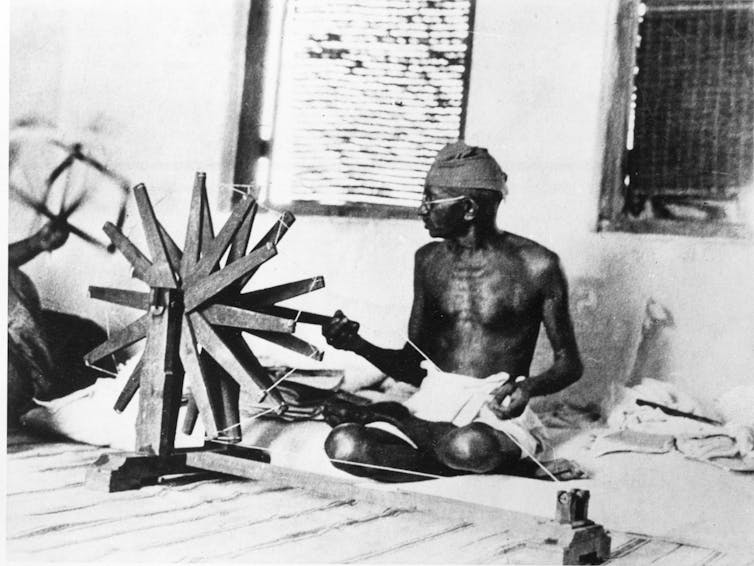
Gandhi, spinning cotton, in a photo from 1931. AP Photo
He reasoned that at least in religions like Islam, all were considered equal. Gandhi declared, “For the moment a slave accepts Islam he obtains equality with his master, and there are several instances of this in history.” But he did not think that was true for Christianity. Thurman asked what was the greatest obstacle to Christianity in India. Gandhi replied that Christianity as practiced and identified with Western culture and colonialism was the greatest enemy to Jesus Christ in India.
The delegation used the limited time that was left to interrogate Gandhi on matters of “ahimsa,” or nonviolence, and his perspective on the struggle of African-Americans in the United States.
According to Mahadev Desai, Gandhi’s personal secretary, Thurman was fascinated with the discussion on the redemptive power of ahimsa in a life committed to the practice of nonviolent resistance.
Gandhi explained that though ahimsa is technically defined as “non-injury” or “nonviolence,” it is not a negative force, rather it is a force “more positive than electricity and more powerful than even ether.”
In its most practical terms, it is love that is “self-acting,” but even more – and when embodied by a single individual, it bears a force more powerful than hate and violence and can transform the world.
Towards the end of the meeting, Gandhi proclaimed, “It may be through the Negroes that the unadulterated message of nonviolence will be delivered to the world.”
Search for an American Gandhi
Indeed, Gandhi’s views would leave a deep impression on Thurman’s own interpretation of nonviolence. They would later be influential in developing Martin Luther King Jr.’s philosophy of nonviolent resistance. It would go on to shape the thinking of a generation of civil rights activists.
In his book, “Jesus and the Disinherited,” Thurman addresses the negative forces of fear, deception and hatred as forms of violence that ensnare and entrap the oppressed. But he also counsels that through love and the willingness to nonviolently engage the adversary, the committed individual creates the possibility of community.
As he explains, the act of love as redemptive suffering is not contingent on the other’s response. Love, rather, is unsolicited and self-giving. It transcends merit and demerit. It simply loves.
A growing number of African-American leaders closely followed Gandhi’s campaigns of “satyagraha,” or what he termed as nonresistance to evil against British colonialism. Black newspapers and magazines announced the need for an “American Gandhi.”
Upon his return, some African-American leaders thought that Howard Thurman would fulfill that role. In 1942, for example, Peter Dana of the Pittsburgh Courier, wrote that Thurman “was one of the few black men in the country around whom a great, conscious movement of Negroes could be built, not unlike the great Indian independence movement.”
King, love and nonviolence
Thurman, however, chose a less direct path as an interpreter of nonviolence and a resource for activists who were on the front lines of the struggle. As he wrote,
“It was my conviction and determination that the church would be a resource for activists – a mission fundamentally perceived. To me it was important that the individual who was in the thick of the struggle for social change would be able to find renewal and fresh courage in the spiritual resources of the church. There must be provided a place, a moment, when a person could declare, I choose.”
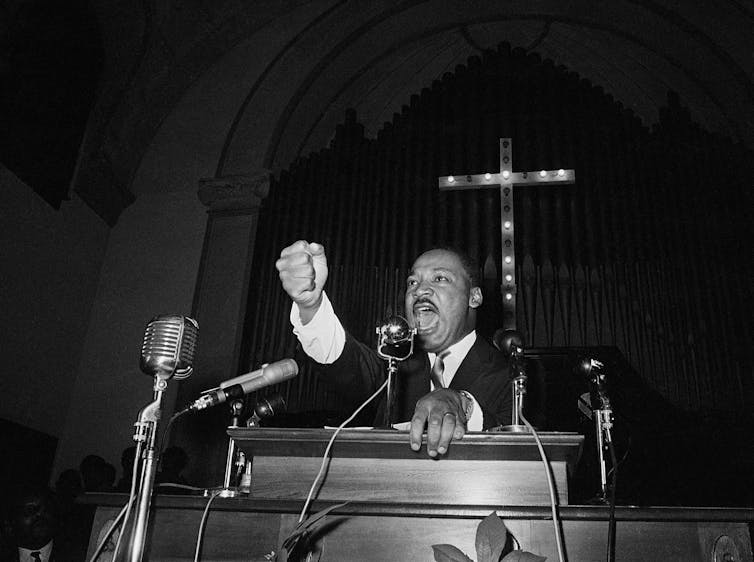
Dr. Martin Luther King Jr., speaking at the Southern Christian Leadership Conference in Atlanta. AP Photo
Indeed, leaders like Martin Luther King did choose to live out the gospel of peace, justice and love that Thurman so eloquently proclaimed in writing and the spoken word, even though it came with an exacting price.
In his last letter to Martin Luther King, dated May 13, 1966, Thurman expressed his regret for the time that had elapsed since he and King last spoke. He ended the short note with a rather foreboding quote from the American naturalist and essayist Loren Eiseley,
“Those as hunts treasure must go alone, at night, and when they find it they have to leave a little of their blood behind them.”
King, like Gandhi 70 years ago, fell to an assassin’s bullet on April 4, 1968.
While the Indian establishment is too concerned about the “anti-national” elements abroad and their attempts to insult national symbols, there is complete silence over repeated attempts to demonize Gandhi, who is widely known as the father of the Indian nation.
In January, when India marked its 70th Republic Day, some Sikh and Kashmiri separatists burnt Indian flags in UK and US to protest the mistreatment of minorities in the world’s so-called largest democracy.
Unable to tolerate this, the Indian government objected to it and raised the issue with foreign governments.
While the Sikh separatists have been campaigning for a separate Sikh homeland of Khalistan- an imaginary nation to be carved out of Punjab, Kashmiri separatists too have been fighting for independence.
Not only was there a knee jerk reaction of the Indian establishment to this flag arson, but several Kashmiri journalists were also barred from attending the Republic Day parade in Srinagar.
Some time ago, the Indian government blacklisted revolutionary leftist activists who had protested outside the Indian consulate in Vancouver on Independence Day. They were merely protesting against the growing repression of minorities and marginalised people in India. And for exercising their freedom of expression, were denied visas to travel back home.
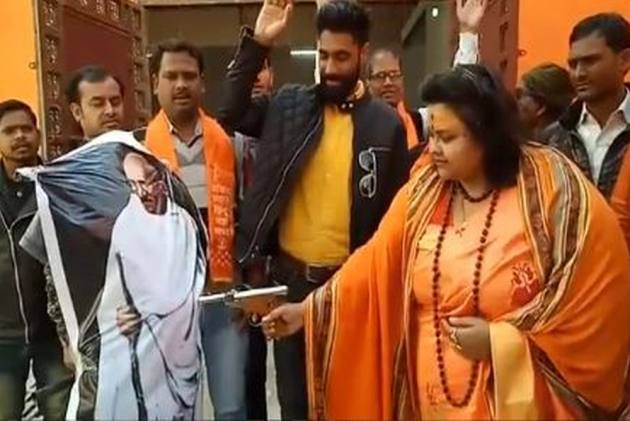
Barely four days after the Republic Day drama ended, Hindu fanatics in India belonging to the Hindu Mahasabha publicly shot at an effigy of Mahatma Gandhi and garlanded the statue of his assassin Nathuram Godse.
Gandhi, who was the leader of the passive resistance movement against the British occupation of India and a strong advocate of Hindu-Muslim unity, was assassinated by Hindu Mahasabha activist Nathuram Godse on January 30, 1948.
Godse is frequently glorified by the Hindu Right and ever since the current Hindu nationalist Bharatiya Janata Party (BJP) government came to power, those who consider Godse as a hero have become emboldened. After all, the Hindu Mahasabha founder Vinayak Damodar Savarkar, who wanted to establish a Hindu nation is revered by the Prime Minister Narendra Modi and his party colleagues. Savarkar was also arrested in the Gandhi murder case but was acquitted due to lack of evidence.
Not only Gandhi’s brand of Hinduism was more liberal, but his philosophy of a secular India was also in complete contradiction of an exclusionist Hindu state that the BJP wants to create.
The latest incident happened in Uttar Pradesh where BJP is in power.
While the Indian establishment is too concerned about the “anti-national” elements abroad and their attempts to insult national symbols, there is complete silence over repeated attempts to demonize Gandhi, who is widely known as the father of the Indian nation.
It is pertinent to mention that BJP supporters had used the Indian flag in the past, during their controversial demonstrations in support of Hindu extremists involved in heinous crimes such as sexual violence and murders in the name of cow protection.
Taking all these episodes into account, will it be too much to ask the Indian government led by Modi to hold the hyper-nationalism of extremists from the majority community accountable?
Rather than making a big fuss about flag burnings all the time, why not first teach your own supporters to respect Gandhi and the national flag and not let patriotism be used as a refuge by those involved in hate crimes.
It is this selectivity and appropriation of nationalism and the process of othering the minorities, with grouses against the Indian establishment, which provokes people to burn the flags. It shouldn’t be a big deal compared to the mass murders of Sikhs and Muslims in Kashmir and elsewhere by the supporters of Hindu nationalism.
Instead of forcing patriotism on minorities, the Indian state needs to embrace it with honesty.
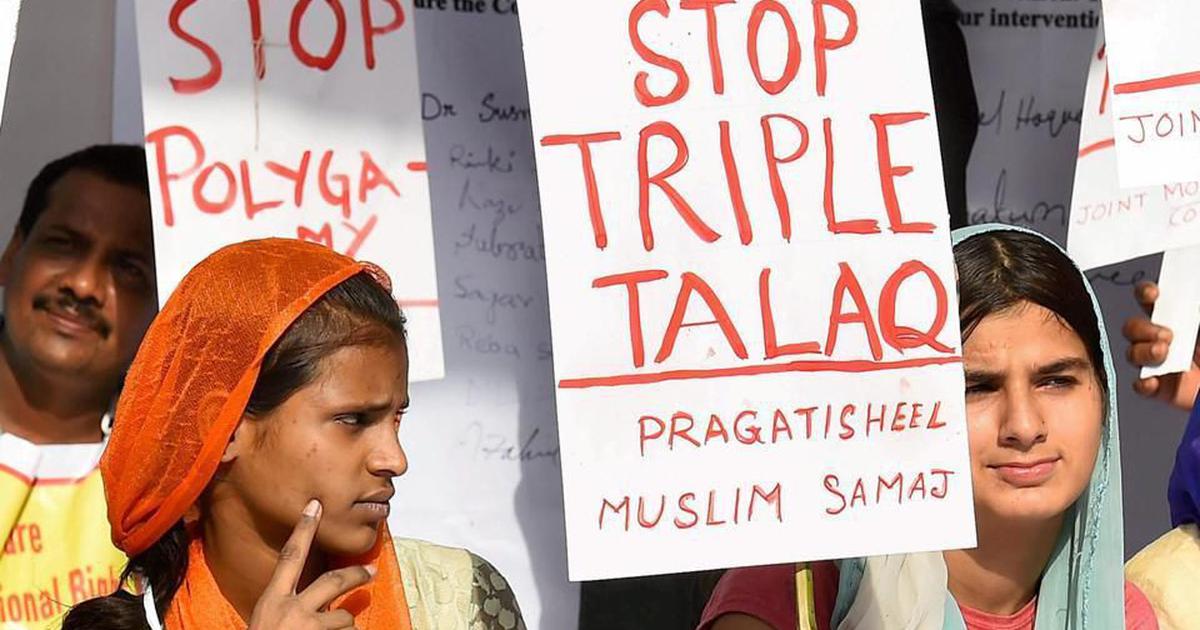
The followers of the Quran and Hadith known as Salafi and Ahl-e-Hadith in the entire world have welcomed the bill against the Triple Talaq in one sitting presented in the Parliament by the government on 27th December 2018 because it has been proved by the arguments in the Quran and Hadith that triple Talaq proclaimed in one sitting is a sin and an innovation in the religion and the holy Prophet pbuh has expressed his unhappiness over it.
Image courtesy: PTI
The holy prophet has declared three Talaqs in one sitting a mockery of the Quran. Seeing the Prophet’s anger over three Talaq one Sahabi(companion of the holy prophet pbuh) even sought the permission of the prophet pbuh to slay such a person.
Such a Talaq is a violation of Quranic verses and also a violation of Sahih Hadiths. Caliph Hadhrat Umar would punish people proclaiming triple Talaq in one sitting with lashes and then would conduct Tafreeq. If a person proclaims triple Talaq, it would be considered one Talaq and not three according to the Quran and Hadith and the husband will have the right to take back his wife before the completion of Iddat and if they want to unite again, they can unite with a new declaration of Meher, permission of the Wali and new marriage contract. That’s why many Muslim countries have declared triple Talaq in one sitting null and void and have banned it through legislation.
Therefore, this dilemma has been put to end in those countries years back. People like Badruddin Ajmal are opposing the bill against triple Talaq because they are giving importance to the ulema and scholars of their own group vis a vis the clear injunctions of the Quran and Hadiths. These people cannot see the light of the Quran and Hadiths because the stance of their particular imam goes against the injunctions. They become the enemies of those who follow and believe the injunctions of the Quran and Hadith. People of these category only are very fond of this kind of triple Talaq and want this obscurantist and oppressive practice to continue though their sacred and reliable book Hadayath also calls triple Talaq a Biddat(innovation) (See Al Hadayah, Kitab al Talaq by Shaikh Ali Bin Abi Bakr al Marghabani: 593 Hijra Vol 1 p 247 publisher Darul Kutbul Ilmiyyah, Beirut, Lebanon). These biased scholars also approve of illicit sexual relationship for a night or two in the name of Halala; rather they consider it a virtuous act. Their purpose is merely to protect their own sect or Maslak though the fact is that the holy prophet pbuh has cursed both parties involved in Halala. He pbuh has called the person performing Halala a borrowed bull and a condemned person.
Hadhrat Umar also threatened the person performing Halala and the woman taking part in the Halala to be stoned to death. Hadhrat Umar considered Halala un-Islamic and Zina. Therefore, in the views of all the Sahaba and after them a majority of Islamic scholars have declared such a marriage of Halala immoral and void and so after Halala the woman will not be Halalfor her former husband. These biased followers of their sect support the triple Talaq and oppose the bill against triple Talaq because in the event of the practice of triple Talaq and Halala continuing, people will consult them for seeking fatwa for Halala. Similarly, the triple Talaq bill has become a cause for concern for those also who would get a golden opportunity to rape hapless poor divorced women in the name of making them Halal for their former husbands and sometimes the practice is lucrative too. This bill has also become a cause for worry for those who would engage in this dirty practice considering it an act of Sawab and also encourage others to promote it.
Therefore, the continuance of the practice of triple Talaq in one sitting was serving the interests of many unscrupulous elements. That’s why their opposition to the bill is not a matter of surprise.
Perhaps the readers will ask whether anybody may consider an act of shame and indignity like Halala an act of virtue and Sawab, my answer would be: yes, there are Muslims who consider this act a virtuous act. To believe me, you should see Fatawa Darul Uloom Deoband Volume 7 page No.492 in which the compiler Sheikh Zafir quotes the statement from Fatawa Durr-e-Mukhtar:
“Marrying a divorced woman to another man with the condition of making her Halal for her husband is Makruh Tahrimi (Haram), though the woman will become Halal for her husband through this Halala marriage in vogue and the state of being Mamruh-e-Tahrimi of this is proved by this Hadith of holy Prophet pbuh in which he condemns and curses both the parties involved in Halala. But if the person marrying the woman to perform Halala does not mention the condition for Halala, instead he has the intention to make the woman eligible for her husband, the Halala marriage will not be Makruh-E-Tahrimi but permissible. Moreover, if the intention of the man is reformation that is helping the former husband and reinstating his home, then marrying her for one or two night will instead be a virtuous act for the man and he will be rewarded for it.”
Did you see how our muftis declared an act of sin a virtuous act despite the intention behind it being clear? The holy prophet pbuh has said, “Indeed, all the acts depend on the intention of the doer. The doer will get rewarded according to his intentions.”(Bukhari, Kitab badul wahi Hadith No. 1) In fact, it is they who want this satanic practice to continue in the name of reforming husband and wife and with the intention of getting rewards. But our demand is that this practice of triple Talaq is un-Islamic, Haram and an innovation and that’s why it should be abolished as it has been in many other countries because this shameful practice (Halala) is a result of the practice of triple talaq being in continuance. If Muslims want to save the dignity and modesty of their women, they should support the bill brought by the government and thank the government for this favour because it is supported by the Quran and Hadith. And every truth has the right that it should be supported irrespective of who is imposing it or writing about it or telling it.
As for Maulana Ajmal’s statement accusing Salafi or Ahl-e-Hadith sect of promoting terrorism, the Mohtamim of Jamia Salfia Varanasi, Sheikh Adullah Saood has rightly, sufficiently and timely rebuked him in his letter 28. 12.2018. The editor of the Urdu daily Inquilab has given him and his extremist tribe a wise, affectionate and realistic advice that Muslims should not make such allegations against each other which might cause problems for them. They should read his message and read between the lines. (Editorial in Inquilab page No. 8 dated 31. 12. 2018) the editorial has message not only for Maulana Ajmal and his ilk but for all Muslims.
We should stress on the fact that Maulana Badruddin Ajmal has made a serious allegation from a position of responsibility and this has hurt the sentiments of the followers of the Quran and Hadith who are called Salafi and Ahl-e-Hadith and so he should apologize for his irresponsible statement from the same position of responsibility, that is, Parliament of India and repudiate his statement in the Parliament.
There is no doubt that triple Talaq and Halala in vogue is a condemned act and Haram in the eyes of the Quran and Hadith and grave injustice to women. This practice should be abolished as soon as possible. To prove this practice wrong and un-Islamic, I have written a 1000 page book with arguments from the Quran and Hadith and have also mentioned the incident of the divorce of Rakana bin Abd-e-Yazid who had proclaimed triple Talaq and was later repentant. The holy prophet pubh had declared the triple talaq one Talaq and instructed him to revoke his Talaq. And following this Hadith, more than one hundred and 70 Fatwas of muftis are present and some of the muftis belong to Maulana Badruddin Ajmal’s sect. Some of them are Maulana Mufti Ateequr Rahman, Maulana Mohammad Sayeed Ahmad Akbarabadi, Maulana Mahfoozur Rahman Bastawi, Maulana Abdul Halim Qasmi, Maulana Murtaza Hasan Qasmi and Maulana Suheb Qasmi whose campaign against triple Talaq and nikah-e-Halala has borne fruit with the grace of God.
It should also be noted that the issue of triple Talaq and the evil practice of Halala has been solved in more than twenty Muslim countries. God has already rid the women of these countries of this evil because abolition of triple Talaq and Halala has been declared invalid through legislation and the entire community has accepted the legislation. In our country too, thanks to the initiative of the central government, particularly the initiative of our Prime Minister honourable Bhai Narendra Modi this act has been passed on behalf of the honourable Supreme Court. Now, if someone opposes this act, he should be punished for this as Hadhrat Umar would punish those proclaiming triple talaq in one sitting with lashes. The mode of punishment may change with the change of time. Therefore, the punishment should be imprisonment or fine.
In the end I very humbly request my Muslim brethren to follow the Quran and Hadith in every sphere and affair of their life as the holy prophet pbuh had addressed on the occasion of the last Hajj:
“O Muslims! I am leaving for you two things. If you follow these two things sturdily you will never go astray. The first is the Holy Quran and the second is my Hadiths or my life and practices.”
Another Hadith of the holy prophet pbhh says thus:
“O Muslims! Note it that whoever will oppose my instructions and advices will incur the wrath of God and will be humiliated by God. “May God save us from indignity and humiliation. Amen
By souring relations with India, Pakistan turned its back on Indian Muslims
A region divided / BIGSTOCK
There is no doubt that the infamous two-nation theory of the pre-partition Muslim League and post-partition Pakistani state has been a flawed one. The independence of a part of Pakistan as a Bengali nation-state in 1971 vindicates it best alongside many other kinds of examples.
Although, it seems that the sub-continent was divided based on this two-nation theory of Mr Jinnah, in reality, it wasn’t so entirely. The then Indian National Congress, which adopted a secular all-inclusive Indian nationalism, in their view, accepted partition as a contingency measure to save the sub-continent from potential governance paralysis had it remained one under Muslim League’s terms.
Jinnah and Muslim League considered Congress an essentially Hindu political party, and feared that in a united India, Muslims, who are minority in overall count, would be under perpetual domination of the Hindu majority. Hence, the idea of Pakistan evolved around Muslim majority northwest of the sub-continent and the eastern part of Bengal.
The Muslim League, the Muslim socio-political elites, and the emerging middle class of Pakistan at those times obviously considered carving out a Pakistan as a validation and accomplishment of the two-nation theory. The independence of Bangladesh and other later political developments in the remaining part of Pakistan in the west, could not eradicate this core ideal of Pakistani state; although incremental Islamization has given it a theocratic mix — certainly for worse.
In some sense, Jinnah’s two-nation theory was close to a secular one. Jinnah theorized the Muslim nationhood in the sub-continent in terms of social and cultural values and lifestyle, and collective Muslim view of the sub-continental history and the solidarity emanating thereof. He hardly put emphasis on the theocratic aspect of a Muslim society. The theory postulates that Muslims of the sub-continent are one nation and that doesn’t change even after the partition.
But the weirdest functional aspect of the Pakistani national ideal — the sub-continental Muslim nation ideal — is the lack of responsibilities of a sub-continental Muslim nation state like Pakistan towards the Muslim minorities in India and non-Muslim minorities of Pakistan.
Ironically, the partition, expounded as the ultimate political achievement for the sub-continental Muslims, effectively cut the so-called Muslim nation into three equal yet substantial parts — one in the west wing of Pakistan, one in the east, and the other in India.
For India, it had to leave a way smaller percentage of Hindu population in Pakistan. In the West, the partition time migration, although very painful, almost solved the Hindu and Sikh minority issue for India.
In the East, a big part of the Hindu population of East Pakistan gradually moved to India phase by phase in the 50s, 60s, and early 70s because of both push and pull factors.
It was considered by many politicians of both the camps in 1947 that the Hindu and Sikh minorities in Pakistan would work as safeguards for Muslim minorities in India and vice versa. But with hardly any Hindu or Sikh left in West Pakistan, and violent independence of Bangladesh from Pakistan as a secular state, this equation changed significantly.
However, theoretically the responsibility of the Pakistanis towards the well-being of Indian Muslims remains, especially in light of their much touted concept of sub-continental Muslim nationhood. In reality, did the Pakistanis behave responsibly when it came to helping the well-being of the sizeable Indian Muslim population, now at 180 million, the second-largest national Muslim community in the world?
The best course for Pakistan to ensure well-being of Indian Muslims would have been a real good relation with India, including extensive connectivity and free movements and good treatment of minorities in Pakistan itself. But Pakistan went the opposite way.
Illegitimate usurpers of power in the Pakistani state made anti-India propaganda an almost constant agenda. Fabrication, exaggeration, and deliberate spread of minority-related bad news from India became commonplace. It resulted in worse mistreatment and persecution of Hindu minority in Pakistan. Waging the 1965 war against India by Pakistan brought the relationship to a massive low at that time.
In India, although Muslims weren’t persecuted the way minorities were in Pakistan, the socio-economic condition of the Muslims weren’t good either. A few factors coalesced in keeping the Indian Muslims conservative and backward.
The prime of which were and, still are, the absence of affirmative actions towards them by the Indian state, unlike other backward groups ie scheduled castes (SC) and scheduled tribes (ST), and their self-imposed confinement in religio-cultural orthodoxy.
Indian Muslims have gradually broken away, over the past several decades, from the hangover of Pakistan movement of the 1940s after India’s independence and with the multifarious social and political developments in India and rest of South Asia.
They are now increasingly aspiring to get into India’s mainstream like the SC and ST. It’s about time for India to undertake a nation rebuilding scheme.
Many progressive Indians argue that India can protect its minority and ensure equality for them with the strength of its own liberal constitutional values and democratic, rather than majoritarian, political culture. The claim is true — but only to a certain extent.
It’s also important to underscore the irresponsibility and hypocrisy of the Pakistanis towards Indian Muslims from the stand point of their sub-continental Muslim nation ideal. Perhaps many Pakistanis have also started realizing in their minds the falsehood of the idea of sub-continental Muslim nationalism or even the Ummah as the primary source of bonding.
The coming together of Muslims in 1940s in one platform was more for socio-economic ambitions through political means rather than Muslim nationalism.
Many Pakistanis may not admit it openly, but they also came to comprehend it in their hearts. It’s true that partially overlapping, with citizenship bonding, trans- national or regional community solidarity also exist ie global catholic community, global Muslims, global Hindus, South Asian Muslims, Southeast Asian Buddhists etc.
But that ideally comes second or in later order to citizenship solidarity within a liberal progressive state. Even from this angle, Pakistani behaviour towards India, and in turn, responsibilities towards Indian Muslims were way below a moral standard. In this sense, Bangladesh also has responsibilities towards Indian Muslims in terms of how it treats its own minorities, and how liberal and progressive the nature of Bangladeshi state and society are.
Sarwar Jahan Chowdhury is an opinion contributor to Dhaka Tribune.
Mumbai: By 2050, India will record the world’s highest urbanisation rate–497 million more residents, or 60% of the country’s population, will move into its cities, according to the United Nations’ 2011 Revision of the World Urbanisation Prospectsreport. Over the same period, China will see 341 million people shifting into cities, Nigeria 200 million, the United States 103 million, and Indonesia 92 million.
With the 2019-20 budget set to be released in an election year, urban India can expect a bigger slice of the pie, experts estimate. But with the government lagging behind its targets, development in the sector remains dismal, showed an IndiaSpend analysis of available government data. Here are our main findings:
While the union budget expenditure on urban development in 2018-19 was the highest ever, as a share of the grand total this had actually declined by 0.2 percentage points to 1.7% of the budget.
Barely 7-20% of the central assistance earmarked for the three flagship schemes have been used since their launch, indicating that states remain chronically underfunded.
In the three schemes, work has been sanctioned for not more than a third of the set targets which will meet their deadlines in 2019-20 and 2021-22. The number of works actually completed is even lower.
On January 28, 2019, IndiaSpend contacted the ministry of housing and urban affairs for comments. We will update the story if and when they respond.
Why we need to pay attention to urban development Over a century to 2001, the population residing in India’s urban areas grew by 17.1 percentage points to 28.5%. By 2011, this grew to 30% with 377 million Indians now residing in urban areas. In 20 years to 2031, the population is expected to double to over 600 million or 41% of the country.
The Indian economy is expected to grow alongside the urban population expansion as cities and towns offer several entrepreneurship and employment opportunities. More than 60% of the country’s gross domestic product (GDP) is generated in urban areas, the government said in this 2014-15 standing committee report. The country’s 100 largest cities, which hold 16% of the population and occupy 0.24% of its land area, produce 43% of its GDP.
Rural-urban linkages need to be strengthened for “comprehensive and inclusive development”, the government said. The transition to a quasi-urban society has to be accompanied by a commensurate increase in the supply of housing and basic urban services such as water supply, sewerage and drainage network, garbage disposal facilities, and planned urban mobility, it added.
Despite the government’s recognition of the fact that unbridled urbanisation can lead to a rise in slums, worsening environmental conditions, and a decline in standard of living, the problem is set to snowball with not only continued rural distress and migration, but also the expansion of villages into small towns.
About 190 million Indians–equivalent to the combined population of Bangladesh and Sri Lanka–live in overgrown ‘villages’, according to a new study, IndiaSpendreported on January 23, 2019. Classified as ‘large’ and ‘very large’ villages–less than 25% of their population is engaged in non-agricultural work–these areas continue to miss out on urban infrastructure, housing and basic services necessary for sustainable living in densely populated regions.
How is government spending on urban development? As we mentioned earlier, current spending on urban development constitutes 1.7% of the total budget, a 0.2-percentage-point decline since 2017-18 when it was 1.9%–the highest in a decade, showed an IndiaSpend analysis of budget data over 10 years since 2009.
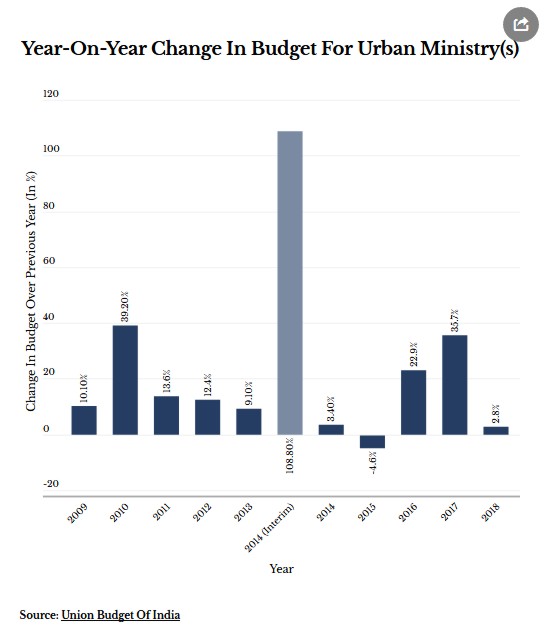
In 2018, finance minister Arun Jaitley allocated Rs 41,765.13 crore for urban development–a 64% increase from 2014 when the NDA took charge of the government from the Congress-led United Progressive Alliance (UPA) government. This is actually a 2.8% increase over the previous year 2017-18, when the NDA merged the ministry of housing and poverty alleviation and the ministry of urban development. In 2017, the allocation had grown a significant 35.7% from 2016-17.
Still, the highest rate of increase in expenditure allocation for the two urban ministries was recorded in 2014, when the UPA released its interim budget before the general elections of May 2014–the urban budget then rose 108.8% from Rs 11,831 crore to Rs 24,702 crore, and its share of the grand total rose from 0.7% to 1.4%. When the NDA came to power a few months later, they increased the allocation by 3% to Rs 25,548 crore.
How NDA’s flagship schemes are faring Smart Cities Mission: For the mission, the government has so far allotted Rs 16,604 crore, roughly a third of the promised outlay of Rs 48,000. Of this, Rs 3,560 crore has so far been utilised, 7% of the programme’s outlay, according to this Lok Sabha response by the ministry on January 1, 2019. The mission is supposed to transform 100 cities into “smart cities” by 2022, through the application of information and communications technology to manage basic services such as water supply, sanitation, housing, waste management and mobility.
With a budget of Rs 48,000 crore, the Centre was to invest Rs 500 crore per city. The state governments had to put in a matching contribution through private investments in projects. The mission could be implemented either as a “pan-city” programme that incorporates information technology (IT) with the use of public infrastructure across the city, or as an “area-based development” which introduces IT infrastructure in a smaller portion of the city.
In terms of physical progress, the ministry has approved 5,151 projects worth Rs. 2.05 lakh crore for the selected 100 cities, according to this Lok Sabha response by the ministry on December 11, 2018. As of November 30, 2018, work on less than a third of these–or 1,675 projects–worth Rs. 51,866 crore (25% of the approved cost) is being done, the response further said. It is unclear how many of those projects have so far been completed.
The mission also came for criticism from the latest standing committee meeting on urban development held in July 2018. While the budget allocation over the last three years for the scheme has been over Rs 15,000 crore, “the revised expenditure is much lower at around Rs 10,094 crore with an even lower actual expenditure”, the committee observed in its report, adding it was “perplexed” about this.
“The committee observe numerous instances of one agency undoing the work of another agency and strongly feel that lack of coordination between implementing agencies is a major reason why the intended benefits are still not visible to public,” the committee said, adding that it had reservations about the mission causing “uneven development” in the areas surrounding smaller towns.
Of projects worth Rs 2.03 lakh crore, 21%–worth Rs 43,088 crore–are being carried out in convergence with other schemes, the ministry told the standing committee in its response.
Fund Utilisation Under Smart Cities Mission
Fund Allocation (2015-19)
Rs 16,604.2 crore
Fund Utilisation (2015-19)
Rs 3,560.22 crore
Percentage Utilisation (2015-2019)
21.40%
Program Outlay: Central Assistance
Rs 48,000 crore
Percentage Utilisation of Central Assistance Outlay
AMRUT: AMRUT, like its predecessor, the Jawaharlal Nehru National Urban Renewal Mission (JNNURM), aims to develop basic urban infrastructure. For five years upto 2019-20, and with a focus on water supply, sewerage, septage management and stormwater drains, the government has so far allotted 27% or Rs 13,447 crore of the Rs 50,000 crore central assistance promised to states. Of this, Rs 9,877 crore (19.88%) has so far been utilised, according to this Lok Sabha response by the ministry on January 1, 2019.
Upto July 2018, the ministry had approved State Annual Action Plans–proposed by states as plans for each year–under the programme to the size of Rs 77,640 crore for various infrastructure projects, it informed the standing committee. Of this, 50% of project funds have been allotted to water supply works, 42% to sewerage and septage management and the rest to other components included in the AMRUT scheme. As many of these works are capital-intensive long-term projects, they are expected to be completed in three years, the government said.
While real-time information on actual implementation of the scheme at the ground-level across India remains unavailable, here are some achievements made under the programme:
In the water supply sector, contracts for 600 projects worth Rs 21,762 crore had been awarded as of July 2018, according to data presented by the ministry in its reply to the standing committee in July 2018, the latest and only data available in public. Of these, 42 projects, or 7%, worth Rs 112 crore (0.5% of awarded contracts’ worth) had been completed.
In the sewerage and septage management sector, contracts for 318 projects worth Rs 15,058 crore had been awarded, and four projects (1.3%) worth Rs 12 crore (0.07% of approved spending) had been completed as of July 2018.
In the storm water drainage sector, contracts for 71 projects worth Rs 1,139 crore had been awarded and 11 projects (15%) worth Rs 4 crore (0.3%) have been completed, the ministry said.
Fund Utilisation Under AMRUT
Fund Allocation (2015-19)
Rs 13,447.19 crore
Fund Utilisation (2015-19)
Rs 9,876.71 crore
Percentage Utilisation (2015-2019)
73.40%
Program Outlay: Central Assistance
Rs 50,000 crore
Percentage Utilisation of Central Assistance Outlay
PMAY (U): Of the Rs 1 lakh crore worth of central assistance sanctioned so far for constructing homes under the PMAY scheme, which is an amalgamation of previous housing schemes, about a third of funds, or Rs 33,652 crore, have been allocated and 20% or Rs 20,892 crore actually utilised, according to the Lok Sabha response from January 1, 2019.
Of a targeted 12 million houses to be constructed under the PMAY urban scheme, as of December 10, 2018, 6.8 million or 56% had been sanctioned for construction, according to this press release. Of these, 3.5 million or 29% of the target had been grounded for construction and 1.2 million houses (10%) had been completed, the ministry said. In the next three financial years, to meet its target of 12 million houses by 2022, the government will have to finish construction on roughly 9,813 houses across India every day.
Fund Utilisation Under PMAY Urban
Fund Allocation (2015-19)
Rs 33,652.34 crore
Fund Utilisation (2015-19)
Rs 20,892.01 crore
Percentage Utilisation (2015-2019)
62.10%
Program Outlay: Central Assistance
Rs 1,00,275 crore
Percentage Utilisation of Central Assistance Outlay
Data on the government’s actual progress of its urban schemes remain inconsistent, making it difficult to assess their progress, experts who we spoke to pointed out. This is especially so for centrally-sponsored schemes such as Smart Cities, and AMRUT, where states are expected to meet some part of the cost and maintain records of implementation. “It is difficult to gauge what exactly is happening at the implementation-level of the programmes. We can’t rely on any of the figures,” Nilanchala Acharya, research coordinator at the Centre for Budget and Governance Accountability (CBGA), a Delhi-based think-tank, told IndiaSpend.
Experts also complained about the lack of clarity and accountability. “There is absolutely no transparency in the way these schemes are functioning. It is obvious there are overlaps and no clear accountability for various works under different schemes,” T R Raghunandan, advisor to Accountability Initiative of the Centre for Policy Research, a Delhi-based think-tank, told IndiaSpend.
What the urban sector needs right now The upcoming budget is likely to increase its spending on urban India, experts said, but will probably focus more on highly publicised projects that mainly serve the middle and upper classes. “It is likely that the government will allot over Rs 51,000 crore for the urban sector–in absolute figures, this is high but when you adjust it for inflation, it is not that much of an increase,” Acharya said. He added there is likely to be more funding for water supply projects, and the Smart Cities Mission this election year as it has quicker, tangible output compared to other schemes. But the budget for urbanisation needs to focus more spending on the social sector. “Current schemes are directed towards serving 20-30% of the urban population who comprise the city’s elite–we need to focus on urban healthcare, livelihoods, affordable public transport, public housing, community centres and parks to improve the all-round quality of life,” Acharya said.
Experts also welcome more investment in the rural sector as it may help stall the burgeoning pressure on cities. “People come to cities in search of jobs, it is necessary to try and ease the distress migration by focusing on these rural linkages,” Acharya said. Raghunandan believes that while the government needs to focus more on urban development, it has to do this by empowering local urban governments. “Obviously a lot more money needs to be pumped into the urban sector but we need decentralisation of power for the money to be actually used,” he said.
While the UPA’s JNNURM programme intended (but eventually failed) to offer states monetary incentives to bring in reforms aimed at strengthening participatory governance, the new flagship schemes, run by special purpose vehicles (SPVs), discourage the decentralisation of power to urban local bodies and citizens altogether, Raghunandan said.
“Citizens have no say in how they want their city to develop,” he said. “We can’t have smart cities without streamlining processes and fixing accountability.”
(Saldanha is an assistant editor with IndiaSpend.)
The aim of Gau Raksha is to instil fear among the Dalits, adivasis and Muslims, to economically disempower rural working people, and to further consolidate the political dominance of the BJP.
India’s livestock economy is among the biggest in the world. A ban on cow slaughter would either result in more and more unproductive animals being killed in most unscientific and cruel ways or would entail such a high cost for maintaining unproductive animals that cattle rearing would cease to be a profitable enterprise for farm households. Restrictions being imposed on cow slaughter and the actions of the cow vigilantes would deal a serious blow to the agrarian economy and in particular to the livelihoods of the poor and middle peasants in rural India.
Trends in population of livestock As of the last livestock census, conducted in 2012, there were about 21.6 crore milch cattle and 8.4 crore male cattle. I am using the term cattle to include both cows and buffaloes.
Over the last two decades, between 1992 and 2012, number of male cattle heads declined by 3.5 crores while number of milch cattle increased by about 4.6 crores. The increase in number of milch animals was solely on account of increase of 2.6 crores in the population of buffaloes and increase of 2.3 crores in the population of crossbred cows. Number of cows of indigenous breeds declined by 32 lakhs over these two decades. In case of bullocks, the decline has been primarily in the number of bullocks of indigenous breeds (3.4 crores). It is noteworthy that the indigenous (cow) bullocks are the animals mainly used in farming. Buffalo bullocks and bullocks of cross-bred cows cannot provide the level of draught power that is needed for farm work, and are only used, if at all, for light transportation.
With the rising population of buffaloes and crossbred cows, India has seen a very substantial growth in milk production. With 15.5 crore tonnes of milk production, India is today the largest producer of milk in the world. Milk is a very important source of protein in Indian diets and thus crucial for nutrition.
While there has been a marginal overall increase in the number of cattle, it has not kept pace with the growth of rural population. On balance, the size of cattle holdings of rural households has been falling for last several decades. NSS data show that the bullock holding fell from 90 animals per 100 rural households in 1992 to only 45 animals per 100 rural households in 2012. The size of milch cattle holding has also declined from 107 per 100 households 2012 to 93 per 100 households in 2012.
Ownership of cattle is strongly related to the ownership of land. With a decline in access to areas for pasturing, only those rural households that have land can have cattle. Landless households that do not have land – either owned or leased – do not keep cattle. Table 1 based on the 70th round of the NSS Land and Livestock Holdings Survey clearly shows that the average size of livestock holdings increases as one goes from the smallest cultivators to households with large landholdings.
Where have all the bullocks gone? In 2012, in comparison with about 21 crore milch cattle heads in India, there were only about 8.4 crore male cattle heads. That is, male cattle heads were only about 39 per cent of female cattle heads. Why and how is it that the total population of bullocks is much less than the population of milch animals? After all, cows and buffaloes produce male and female calves with equal probability.
The answer to this question is rather straight forward. Use of bullocks in farming has fallen drastically with increasing deployment of machines. This has happened across all classes of cultivators. Rental markets in agricultural machinery have become widespread almost everywhere in the country, and even the households that do not own tractors and other machinery, can obtain them on rent.
There are many reasons why machines are preferred by farmers over bullocks. First, access to fodder is limited and the cost of feeding animals is high. Secondly, machines perform a given task much faster than the bullocks. Getting agricultural tasks completed quickly is often crucial because of weather and, on irrigated lands, also because of multiple cropping. Thirdly, working with bullocks requires deploying greater amount of labour than working with machines. In many areas, the cost of hiring workers to work with bullocks far outweighs the cost of hiring a tractor. Finally, among poor peasants who migrate to cities in search of wage employment for part of the year, it is much easier to hire tractors for ploughing than maintain bullocks. With increasing rural-urban migration among the poor peasants, this has become an important consideration.
Since bullocks have become unwanted, when a male calf is born, it is sold for slaughtering in abattoirs, abandoned in urban settlements, or even more commonly, simply made to die. In our surveys in North Indian villages, we have found that the male calves often had mysterious deaths. Given the stigma around the sale of cows and bullocks to a butcher, many farm households find it easier to put the animal to sleep, or worse still, to starve a young calf or expose it to biting cold on a winter night so it just dies.
Milch animals Let us now look at the milch animals that are reared for dairying. Most common indigenous breeds of cows have very low milk yields; peak daily milk yield of an indigenous cow is at best about 4-6 litres per day. Peak yield of a buffalo or a cross-bred cow could be easily three times or even more than that. This is the primary reason why the share of cows of indigenous breeds in total population of milch animals has steadily fallen: from 54 per cent in 1992 to 41 per cent in 2012.
But economics of cattle rearing is not just about milk. Animals are not like other assets. They are a means of production but they also reproduce, they grow and they age. These biological processes have an important bearing on the economics of cattle rearing. As milch animals produce calves, these have to be fed. Since any farm household has a limited supply of hay and a limited capacity to maintain animals, the progeny of the milch animals has to be periodically disposed of. Selling these calves is also an important source of income. And when milch animals age, they have to be replaced.
The cattle and the calves also provide some insurance against economic shocks as farm households can sell them when there is a drought. Cattle population shrinks during such years as the supply of hay declines and the prices rise sharply. Excess cattle are sold to traders for slaughter or for selling further to farm households in other areas that may not have been hit by the drought. Such distress sale of cattle is crucial for farm households to deal with income shortfall in years of crisis. Rural farm households have to dispose of unwanted and aged animals. While abandoned animals are a common sight in towns and cities, in rural areas, abandoned animals can cause havoc to standing crops. Because of this, farm households cannot just abandon an animal. They sell their aged milch animals to traders, who sell them to abattoirs.
Implications of a Ban on Cattle Slaughter Modern abattoirs are essential for the bovine economy. Given the present population of milch cows in India, it can be estimated that about 3.4 crore male cow calves are born every year in India. Assuming that India has to maintain the level of milk production, and by implication, the current size of milch animal stock of India, we have to deal with birth of 3.4 crore male cow calves every year.
If no male cow calves are allowed to be slaughtered, with an average age of even 10 years, one is talking of having a population as large as 34 crore male bullocks, five times the current living population of male bullocks. This is a conservative estimate as a cow or a bullock, if properly fed and taken care of, can easily live up to 15-20 years.
In addition, no cow slaughter would mean that there would be about 6 crore unproductive old female cows to maintain. Even if we net out the current stock of cow bullocks and male calves (6.7 crores) to deal with the existing demand for bullocks for farm work and the current stock of female calves and old cows (5.5 crores) to account for the existing capacity of maintaining unproductive animals, we are still talking of maintaining an additional stock of about 27 crore unproductive cows and bullocks.
Where would we keep them and what would we feed them? What would be the cost of maintaining these bullocks?
Building cattle shelters for 27 crore unproductive cows and bullocks would require 5 lakh acres of land and a capital expenditure of about Rs. 10,00,000 crores towards construction of cattle shelters. The annual cost of fodder and veterinary care for these additional cattle would be about Rs. 5,40,000 crores. This is about 1.5 times India’s total defence budget and about 35 times what centre and all State governments together spend on animal husbandry and dairy at present.
Maintaining these animals would require about 70 thousand crore tonnes of fodder. Where will we get so much fodder? India simply does not have enough land to produce so much additional fodder. Even if each animal drinks one bucket of water a day, you would need more water for drinking by these animals than all the water humans drink.
It is clear that anyone talking of building gau-shalas and cow-reserves does not have any sense of scale.
What would happen if cow slaughter is banned? Let me put it simply: if a farm household that has a cow has to feed it, and all its male calves, till they all die a natural death, no farm household would dream of acquiring a cow. Restrictions on cow slaughter, legally or because of fear of cow vigilantes, would make cattle rearing uneconomical.
In all likelihood, restrictions on cattle trade and cattle slaughter would result in unproductive animals being simply killed in the cattle sheds. Abandoned cattle in rural areas can become a huge menace to crops. So, cattle would have to be killed. It is not difficult to imagine what would happen if slaughter of cows in abattoirs was not allowed: unproductive cattle would be poisoned, starved or left to die in cold. This would be the perverse outcome of restrictions on cattle trade and operation of proper abattoirs. Is that what the gau-rakshaks want? There is no doubt that the least painful death of an unwanted cattle takes place in a modern abattoir.
Restrictions on cow slaughter would hit incomes of farm households, in particular, of the rural poor. Cost of rearing an animal is higher for landless and poor peasant households than for large landowning households. Households that do not own land maintain cattle by leasing in land, and using hay produced on leased-in land to rear cows. In coastal Andhra Pradesh, dalit households often take land on lease on highly unremunerative contracts, with rents as high as 75 per cent of the grain production, only with the hope that the hay produced on the land would allow them to rear cattle. Rearing cattle is a major source of employment for rural women everywhere in India. With increasing inequality in land and declining availability of fodder, women are finding it increasingly hard to gainfully engage even in cattle rearing. In Haryana, poor dalit women take female calves on lease, harvest sugarcane and wheat to get hay to feed these calves, so that they would get some income when these calves grow up and are sold.
Restrictions on cow slaughter would simply mean that cattle rearing would cease to be a source of livelihood for rural poor households and in particular for rural women. It would further marginalise the rural poor and force them further towards destitution. Restrictions on cow slaughter would result in a decline in the stock of milch animals and thus in milk production.
India currently has milk availability of 337 grams per capita per day. Milk is a crucial source of protein in Indian diets. Protein undernourishment are the more important reasons for high prevalence of stunting in India. India has 62 million stunted children, one third of stunted children in the world. These children need to be eating more of animal products: milk, eggs and meat. Any decline in availability of milk would have disastrous consequences for levels of nutrition.
Gau raksha is a political project of the hindutva brand. It is a project to mobilise upper caste hindus on religious lines against dalits and Muslims. Its aim is to instil fear among the Dalits, adivasis and Muslims, to economically disempower rural working people, and to further consolidate the political dominance of the BJP.