Don’t judge a book by its cover- A recent incident of violence in Savitribai Phule Pune University (SPPU) gave literal meaning to this idiom.
A book titled “JNU Diaries” written by Mithilesh Priyadarshi and translated by Amarnath Chandaliya in Marathi created a furore on the SPPU campus on Constitution day, November 26. The book, which has been published by Hariti Publication, became the centre of controversy when ABVP termed its content ‘anti-national’ merely because of the mention of “JNU” in its title.
As per members of Hariti Publication, on November 26, they had organised a book stall in which books with democratic, secular and progressive values were displayed for sale. One of the books was “JNU diaries.”
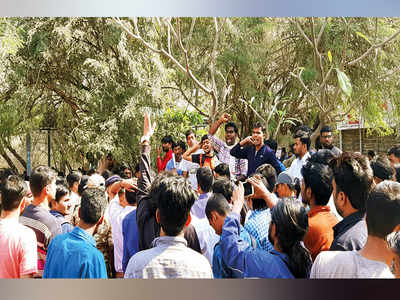
Reportedly, ABVP members came to the stall and started creating ruckus. Their contention was that JNU Diary propagates anti-national sentiments and promotes “Naxalite ideology”.
Hariti Publication’s representative, Shyam Ghuge, who was present there, tried to calm them down and tried telling them that all of Hariti’s publications had an ISBN number. The said book in question had been published two years back in Marathi and that it wasn’t illegal. He further added that Hariti follows the ideals of Phule, Shahu, Ambedkar, Marx and others. Ghuge also told them that Hariti’s books evoke the thirst for knowledge in the society and take the tradition of different ideologies forward. However, all their pleadings fell on deaf ears and ABVP members continued arguing, after which they resorted to assaulting those who were present there. Allegedly, Shyam Ghuge’s shirt got torn in all of this. Meanwhile, units of other students groups, SFI and NSUI reached there and tried to bring the situation under control and tried to hush away those who were indulging in vandalism.
NSUI member and a student of English Department, Satish Gore said, “While the ABVP students tried to create problems at the stall on Saturday, we feel they are no one to object. The books that were being sold were based on various thinkers. The JNU one, too was informative and had its own thought process. And, as soon as ABVP created a ruckus, the book was immediately bought by many students and was read with interest.”
“ABVP saw only the cover of the book and objected to it. They could have at least read it and then decided to hinder its sale. We have demanded that SPPU should have such bookstalls on campus more frequently that gives readers variety,” he added.
Shyam Ghuge responded by saying, “Hariti Publications believes in disseminating knowledge. We respect the constitution and law. Our books evoke the hunger for democratic values and consciousness and knowledge. Hariti is working towards promoting free, creative thinking in Marathi language and is working to promote social consciousness. We want to build a culture of knowledge and thoughts”
Shyam Ghuge has said that the book stall had been set up as a refresher course was in progress. He added that the book stall will be there on campus till the course goes on. They also said that they had oral permission from the Registrar Prafulla Pawar.
The Registrar commented, “While the decision to set up the book stall would have been taken at the department level, there is no harm in selling a book if it is officially published.”
Ajay Choudhary, a student of the Hindi Department and president of ABVP’s SPPU unit, however, maintains that they “went to check if the publication house had permission to sell books. The book related to JNU has an anti-national reference and should not be sold on campus as it could have a negative impact on students.”
Hariti Publication was started in 2013 with the aim of spreading, what they call “reading cultures.” With the intention of looking at ‘reading as a movement’ they engaged in activities and evolved their slogan, “Intervention, Dialogues and Change.”
They carry their own political affiliations with larger anti-caste, anti-class and feminist movement in India and are trying to produce and circulate progressive material of various scholars and academicians. Texts that they have published till now, include Gopal Guru, Late Com. Rajiv Kalelkar, Vilas Sonawne, Keshav Waghmare, P. Sainath, Prakash Shirsat, com. Datta Desai, Charu Gupta, Mithilesh Priyadarshi. Some more books of few renowned activists and academicians in various movements are in progress, these include Vidyut Bhagwat, Dilip Chavhan, Suhas Palshikar, Pratima Pardeshi, Sanjiv Chandorkar, Bharat Patankar, Rajkumar Ghogare. Producing and circulating such progressive material in the form of ‘book stall’ is one of the important initiatives taken up by Hariti Publication.
With the aim of making good reading material available as well as developing culture of reading, discussion on the university campus, books published by Hariti are often made available and are circulated on Savitribai Phule Pune University Campus in various programmes. Students on the campus also support this activity.
Hariti Publication members note in a mail communication, “ABVP, a right wing militant organization violently opposing this activity of circulation of progressive reading material is not at all surprising! Violent attack on Hariti book stall and incident of beating Hariti book distributor Shyam Ghuge on November 26 on Savitribai Phule University campus thus can be seen as a part of the series of violent attacks on progressive thinkers, academicians and educational institutions such as JNU, that are taking place especially since BJP government has come into power. There has been constant attempt by right wing forces to curb the voice of equality and democracy in the form of violent attacks on speeches as well as writings of progressive thinkers, academicians such as Kancha Ilaiah, Gauri Lankesh, Romila Thapar, Kalburgi, Com. Govind Pansare, Rana Ayyub, Dr. Dabholkar, Ravish Kumar, and S. M. Mushrif est.
Hariti Publication has planned to hold a meeting on December 2, 12 pm at SM Joshi Socialist Foundation (parking), Pune and have requested participation from various organisations and individuals.
The recent incident indicates ABVP’s haste and the threat they feel from progressive thinkers and books. Looking at the recent movements for students struggles, JNU’s example, if at all, is a good example of successful students struggles. It appears that this bothers ABVP cadres to an extent that they didn’t think it was necessary to go through the content of the book before launching their “assault.”
More than one-fifth of the world’s cows are in India, the number growing more rapidly than for the rest of the world because of the slaughter ban. Cows contribute more to global warming than the entire transport industry, releasing a massive amount of methane into the atmosphere, and a freely roaming stray cow pollutes the environment many times more than a cow kept in a farm.
A huge number of abandoned cows in India is thus an alarming problem.
Methane is 86 times worse for global warming than carbon dioxide and excessive emission of methane is extremely toxic to global environment and human health. Livestock is responsible for 18% of the emissions of greenhouse gases according to a report by the UN Food and Agricultural Organization.
European scientists are increasingly asking for the reduction of cattle livestock. They are proposing artificial milk and meat to reduce the burden on the environment. This plan could perhaps be possible for Western countries. But in India, since India has banned cow slaughtering in certain big states, the problem seems to only be getting worse.
According to the US Department of Agriculture, the cattle population of India is a staggering 305 million, easily the largest in the world in 2018. It is estimated that the cattle population increased by 23 million from last year.
According to World Animal Protection, there are approximately 1.5 billion cows releasing 150 billion gallons of methane and dropping 23.7 billion methane-rich cowpats weighing approximately 43.4 million tons every day. It should be noted here that cows are “ruminant” animals that burp every 90 seconds to digest their food.
According to India’s Ministry of Environment and Forests, about one-eighth of greenhouse emission of India was caused by cattle population in 2007, and scientists have recently revealed that the actual figure is 38% higher than previously thought.
Globally, the number of cows is not increasing. In the US, 39 million cows are slaughtered each year. The cow population in the US has slightly dropped, but this is definitely not the case in India. If the number of cows keeps on rising, the environmental ramifications will be catastrophic — and the environmental issue is not a national but a global problem.
Millions of cows have been abandoned by dairy farmers in recent years. At least 5.2 million stray cows are roaming, causing chaos, and these cows grazing on carbon-rich soil causes the emission of CO2 from the ground.
Free roaming cows exhaust four and a half times more greenhouse gases than cows in farms, according to research of Arhus University. These cows don’t get a proper diet that cows in captivity get — they roam for food and eat much more than cows in farms.
In farms, cows get enzymes that facilitate the digesting process. A longer digestive process makes free cows excrete more, and therefore produce more methane.
Scientists underestimated how much cow excretions contribute to global warming. Methane is a principal component of excretions, and it is noteworthy that methane blocks heat escaping the Earth’s atmosphere.
Europe and the US are working on a plan to reduce their cattle inventory. But it is not possible to reduce the number of cows under the existing legislation. Sterilization of cows could be an option. Chemical sterilization is possible as an alternative to surgical castration.
American scientists say that India can reduce cow emissions by feeding seaweed as a dietary supplement.
Researchers at the University of California experimented with the ocean algae which they added to cow food.
The result showed a 30% reduction of methane emissions released by cows.
However, this diet cannot be provided to millions of stray cows. It is essential for the Indian government to bring stray cows in shelters and offer them a proper diet. The Indian government must be called upon to act immediately to save the environment.
Obaidul Karim Khan is a Business Consultant and Researcher in Denmark. He can be reached at karimkhan@live.dk.
Amid the barrage of racist, anti-immigrant, and other attacks launched by President Trump and his administration in recent months, a series of little noted steps have threatened Native American land rights and sovereignty. Such attacks have focused on tribal sovereignty, the Indian Child Welfare Act (ICWA), and the voting rights of Native Americans, and they have come from Washington, the courts, and a state legislature. What they share is a single conceptual framework: the idea that the long history that has shaped U.S.-Native American relations has no relevance to today’s realities.
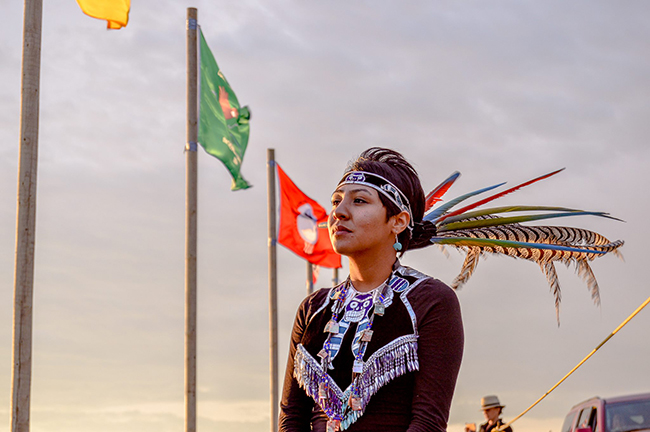
Photo by Rob Wilson Photography.
Meanwhile, in an apparently unrelated event, Senator Elizabeth Warren, egged on by Donald Trump’s “Pocahontas” taunts and his mocking of her claims to native ancestry, triumphantly touted her DNA results to “prove” her Native American heritage. In turning to the burgeoning, for-profit DNA industry, however, she implicitly lent her progressive weight to claims about race and identity that go hand in hand with moves to undermine Native sovereignty.
The DNA industry has, in fact, found a way to profit from reviving and modernizing antiquated ideas about the biological origins of race and repackaging them in a cheerful, Disneyfied wrapping. While it’s true that the it’s-a-small-world-after-all multiculturalism of the new racial science rejects nineteenth-century scientific racism and Social Darwinism, it is offering a twenty-first-century version of pseudoscience that once again reduces race to a matter of genetics and origins. In the process, the corporate-promoted ancestry fad conveniently manages to erase the histories of conquest, colonization, and exploitation that created not just racial inequality but race itself as a crucial category in the modern world.
Today’s policy attacks on Native rights reproduce the same misunderstandings of race that the DNA industry is now so assiduously promoting. If Native Americans are reduced to little more than another genetic variation, there is no need for laws that acknowledge their land rights, treaty rights, and sovereignty. Nor must any thought be given to how to compensate for past harms, not to speak of the present ones that still structure their realities. A genetic understanding of race distorts such policies into unfair “privileges” offered to a racially defined group and so “discrimination” against non-Natives. This is precisely the logic behind recent rulings that have denied Mashpee tribal land rights in Massachusetts, dismantled the Indian Child Welfare Act (a law aimed at preventing the removal of Native American children from their families or communities), and attempted to suppress Native voting rights in North Dakota.
Profiting by Recreating Race Let’s start by looking at how the ancestry industry contributes to, and profits from, a twenty-first-century reformulation of race. Companies like Ancestry.com and 23andMe lure customers into donating their DNA and a hefty sum of money in exchange for detailed reports claiming to reveal the exact geographical origins of their ancestors going back multiple generations. “Who do you think you are?” asks Ancestry.com, typically enough. The answer, the company promises, lies in your genes.
Such businesses eschew the actual term “race” in their literature. They claiminstead that DNA reveals “ancestry composition” and “ethnicity.” In the process, however, they turn ethnicity, a term once explicitly meant to describe culture and identity, into something that can be measured in the genes. They conflate ethnicity with geography, and geography with genetic markers. Perhaps you won’t be surprised to learn that the “ethnicities” they identify bear an eerie resemblance to the “races” identified by European scientific racist thinking a century ago. They then produce scientific-looking “reports” that contain purportedly exact percentages linking consumers to places as specific as “Sardinia” or as broad as “East Asia.”
At their most benign, these reports have become the equivalent of a contemporary parlor game, especially for white Americans who make up the vast majority of the participants. But there is a sinister undertone to it all, reviving as it does a long-discredited pseudoscientific basis for racism: the notion that race, ethnicity, and ancestry are revealed in the genes and the blood, and passed down inexorably, even if invisibly, from generation to generation. Behind this lies the assumption that those genes (or variations) originate within clearly defined national or geographic borders and that they reveal something meaningful about who we are — something otherwise invisible. In this way, race and ethnicity are separated from and elevated above experience, culture, and history.
Is There Any Science Behind It? Although all humans share 99.9% of our DNA, there are some markers that exhibit variations. It’s these markers that the testers study, relying on the fact that certain variations are more (or less) common in different geographical areas. As law and sociology professor Dorothy Roberts puts it, “No sooner had the Human Genome Project determined that human beings are 99.9% alike than many scientists shifted their focus from human genetic commonality to the 0.1% of human genetic difference. This difference is increasingly seen as encompassing race.”
Ancestry tests rely on a fundamental — and racialized — misunderstanding of how ancestry works. The popular assumption is that each of us contains discrete and measurable percentages of the “blood” and DNA of our two biological parents, four grandparents, eight great-grandparents, sixteen great-great-grandparents, and so on, and that this ancestral line can be traced back hundreds of years in a meaningful way. It can’t. As science journalist Carl Zimmer explains, “DNA is not a liquid that can be broken down into microscopic drops… We inherit about a quarter of our DNA from each grandparent — but only on average… If you pick one of your ancestors from 10 generations back, the odds are around 50% that you carry any DNA from him or her. The odds get even worse beyond that.”
In reality, such testing does not tell us much about our ancestors. That’s partly because of the way DNA is passed down through the generations and partly because there exists no database of ancestral DNA. Instead, the companies compare your DNA to that of other contemporary humans who have paid them to take the test. Then they compare your particular variations to patterns of geographical and ethnic distribution of such variations in today’s world — and use secret algorithms to assign purportedly precise ancestral percentages to them.
So is there really a Sardinian or East Asian gene or genetic variation? Of course not. If there is one fact that we know about human history, it’s that ours is a history of migrations. We all originated in East Africa and populated the planet through ongoing migrations and interactions. None of this has ended (and, in fact, thanks to climate change, it will only increase). Cultures, ethnicities, and settlements can’t be frozen in time. The only thing that is constant is change. The peoples who reside in today’s Sardinia or East Asia are a snapshot that captures only a moment in a history of motion. The DNA industry’s claims about ancestry award that moment a false sense of permanence.
While whites of European ancestry seem enthralled with the implications of this new racial science, few Native Americans have chosen to donate to such databases. Centuries of abuse at the hands of colonial researchers who made their careers on Native ancestral remains, cultural artifacts, and languages have generated a widespread skepticism toward the notion of offering genetic material for the good of “science.” In fact, when it comes to one DNA testing outfit, 23andMe, all of the countries included in its lists of the geographical origins of those who have contributed to its “Native American” database are in Latin America and the Caribbean. “In North America,” the company blandly explains, “Native American ancestry tends to be five or more generations back, so that little DNA evidence of this heritage remains.” In other words, 23andMe claims DNA as conclusive proof of Native American identity, then uses it to write Native North Americans off the map altogether.
The Ancestry Industry and the Disappearing Indian The ancestry industry, even while celebrating diverse origins and multiculturalism, has revived long-held ideas about purity and authenticity. For much of U.S. history, white colonizers argued that Native Americans would “vanish,” at least in part through biological dilution. New England’s native peoples were, for instance, systematically denied land rights and tribal status in the nineteenth century on the grounds that they were too racially mixed to be “authentic” Indians.
As historian Jean O’Brien has explained, “Insistence on ‘blood purity’ as a central criterion of ‘authentic’ Indianness reflected the scientific racism that prevailed in the nineteenth century. New England Indians had intermarried, including with African Americans, for many decades, and their failure to comply with non-Indian ideas about Indian phenotype strained the credence for their Indianness in New England minds.” The supposed “disappearance” of such Indians then justified the elimination of any rights that they might have had to land or sovereignty, the elimination of which, in a form of circular reasoning, only confirmed their nonexistence as a people.
However, it was never phenotype or distant ancestry but, as O’Brien points out, “complex regional kinship networks that remained at the core of Indian identity in New England, despite the nearly complete Indian dispossession that English colonists accomplished… Even as Indians continued to reckon membership in their communities through the time-honored system of kinship, New Englanders invoked the myth of blood purity as identity in denying Indian persistence.”
Such antiquated understandings of race as a biological or scientific category allowed whites to deny Indian existence — and now allow them to make biological claims about “Indian” identity. Until recently, such claims, as in Senator Warren’s case, rested on the murkiness of family tales. Today, the supposed ability of DNA companies to find genetic “proof” of such a background reinforces the idea that Indian identity is something measurable in the blood and sidesteps the historical basis for the legal recognition or protection of Indian rights.
The ancestry industry assumes that there is something meaningful about the supposed racial identity of one of hundreds or even thousands of an individual’s ancestors. It’s an idea that plays directly into the hands of right-wingers who are intent on attacking what they call “identity politics” — and the notion that “minorities” are becoming unduly privileged.
Indeed, white resentment flared at the suggestion that Senator Warren might have received some professional benefit from her claim to Native status. Despite an exhaustive investigation by the Boston Globe showing conclusively that she did not, the myth persistsand has become an implicit part of Donald Trump’s mockery of her. In fact, any quick scan of statistics will confirm the ludicrousness of such a position. It should be obvious that being Native American (or Black, or Latino) in the United States confers far more risks than benefits. Native Americans suffer from higher rates of poverty, unemployment, infant mortality, and low birth weight, as well as lower educational levels and shorter life spans than do whites. These statistics are the result of hundreds of years of genocide, exclusion, and discrimination — not the presence or absence of specific genetic variations.
Reviving Race to Undermine Native Rights Native rights, from sovereignty to acknowledgment of the conditions created by 500 years of colonial misrule, rest on an acceptance that race and identity are, in fact, the products of history. “Native Americans” came into being not through genes but through the historical processes of conquest and colonial rule, along with grudging and fragile acknowledgement of Native sovereignty. Native American nations are political and cultural entities, the products of history, not genes, and white people’s assertions about Native American ancestry and the DNA industry’s claim to be able to reveal such ancestry tend to run roughshod over this history.
Let’s look at three developments that have, over the past year, undermined the rights of Native Americans: the reversal of reservation status for Mashpee tribal lands in Massachusetts, the striking down of the Indian Child Welfare Act, and Republican attempts to suppress Native American votes in North Dakota. Each of these acts came from a different part of the government: the Bureau of Indian Affairs in the Department of the Interior, the courts, and North Dakota’s Republican-dominated state legislature. But all three rely on notions of identity that place race firmly in our genes rather than in our history. In the process, they deny the histories that turned the sovereign and autonomous peoples of North America before European colonists arrived in “the New World” into “Native Americans,” and imply that Native American historical rights are meaningless.
The Mashpee of Massachusetts finally achieved federal recognition and a grant of reservation land only in 2007, based on the fact that they “had existed as a distinct community since the 1620s.” In other words, federal recognition was based on a historical, not a racialized, understanding of ethnicity and identity. However, the tribe’s drive to build a casino on its newly acquired reservation in Taunton, Massachusetts, would promptly be challenged by local property-owners. Their lawsuit relied on a technicality: that, as they argued in court, reservation land could only be granted to tribes that had been federally recognized as of 1934. In fact, the Mashpee struggle for recognition had been repeatedly stymied by long-held notions that the Indians of Massachusetts were not “real” or “authentic” because of centuries of racial mixing. There was nothing new in this. The state’s nineteenth-century legislature prefigured just such a twenty-first-century backlash against recognition when it boasted that real Indians no longer existed in Massachusetts and that the state was poised to wipe out all such “distinctions of race and caste.”
In September 2018, the Department of the Interior (to which the court assigned the ultimate decision) ruled against the Mashpees. Recently appointed Assistant Director of Indian Affairs Tara Sweeney, the first Native American to hold that position, “paved the way for a reservation to be taken out of trust for the first time since the termination era,” a 20-year period from the 1940s to the 1960s when the federal government attempted to “terminate” Native sovereignty entirely by dismantling reservations and removing Indians to urban areas to “assimilate” them. The new ruling could affect far more than the Mashpees. Some fear that, in the Trump years, the decision portends “a new termination era,” or even a possible “extermination era,” for the country’s Native Americans. Meanwhile, on October 4th, a U.S. District Court struck down the Indian Child Welfare Act, or ICWA. This is a potentially devastating development as Congress passed that Act in 1978 to end the then-still-common practice of breaking up Native families by removing Indian children for adoption into white families. Such acts of removal date back to the earliest days of white settlement and over the centuries included various kinds of servitude and the founding of residential boarding schools for Indian children that were aimed at eliminating Native languages, cultures, and identities, while promoting “assimilation.” Indian child removal continued into the late twentieth century through a federally sponsored “Indian Adoption Project,” as well as the sending of a remarkable number of such children into the foster care system.
According to the ICWA, “An alarmingly high percentage of Indian families are broken up by the removal, often unwarranted, of their children from them by nontribal public and private agencies and that an alarmingly high percentage of such children are placed in non-Indian foster and adoptive homes and institutions.” States, it added, “have often failed to recognize the essential tribal relations of Indian people and the cultural and social standards prevailing in Indian communities and families.” The Act gave tribes primary jurisdiction over all child custody issues including foster placements and the termination of parental rights, requiring for the first time that priority be placed on keeping Native children with their parents, kin, or at least within the tribe.
The ICWA said nothing about race or ancestry. Instead, it recognized “Indian” as a political status, while acknowledging semi-sovereign collective rights. It was based on the Constitution’s implicit acknowledgement of Indian sovereignty and land rights and the assignment to the Federal government of relations with Indian tribes. The District Court’s ICWA decision trampled on the collective political rights of Indian tribes by maintaining that the act discriminated against non-Native families in limiting their right to foster or adopt Native children. That rationale, like the rationale behind the Mashpee decision, directly attacks the cultural and historical acknowledgement of Native sovereignty.
Superficially, the assault on Native voting rights may appear conceptually unrelated to the Mashpee and ICWA decisions. North Dakota is one of many primarily Republican-controlled states to take advantage of a 2013 Supreme Court ruling eliminating key protections of the Voting Rights Act to make registration and voting more difficult, especially for likely Democratic voters including the poor and people of color. After numerous challenges, a North Dakota law requiring prospective voters to provide a street address was finally upheld by a Supreme Court ruling in October 2018. The problem is this: thousands of rural Native Americans, on or off that state’s reservations, lack street addresses because their streets have no names, their homes no numbers. Native Americans are also disproportionately homeless.
In the North Dakota case, Native Americans are fighting for a right of American citizens — the right to vote — whereas the Mashpee and ICWA cases involve fights to defend Native sovereignty. The new voting law invoked equality and individual rights, even as it actually focused on restricting the rights of Native Americans. Underpinning such restrictions was a convenient denial by those Republicans that the country’s history had, in fact, created conditions that were decidedly unequal. (Thanks to a massive and expensive local effort to defend their right to vote, however, North Dakota’s Native Americans showed up in record numbers in the 2018 midterm election.)
These three political developments downplay Native American identity, sovereignty, and rights, while denying, implicitly or explicitly, that history created today’s realities of racial inequality. The use of DNA tests to claim “Native American” genes or blood trivializes this same history.
The recognition of tribal sovereignty at least acknowledges that the existence of the United States is predicated on its imposition of an unwanted, foreign political entity on Native lands. The concept of tribal sovereignty has given Native Americans a legal and collective basis for fighting for a different way of thinking about history, rights, and nationhood. Attempts to reduce Native American identity to a race that can be identified by a gene (or a genetic variation) do violence to our history and justify ongoing violations of Native rights.
Senator Elizabeth Warren had every right to set the record straight regarding false accusations about her employment history. She should, however, rethink the implications of letting either Donald Trump or the ancestry industry define what it means to be Native American.
Godda, Jharkhand: Soon after police personnel drove up in a convoy of vehicles that Friday, August 31, 2018, “Adani ke log (Adani’s people)” arrived with earthmoving equipment, recounted Adivasi (tribal) and Dalit villagers in Mali, in this lush eastern corner of Jharkhand.
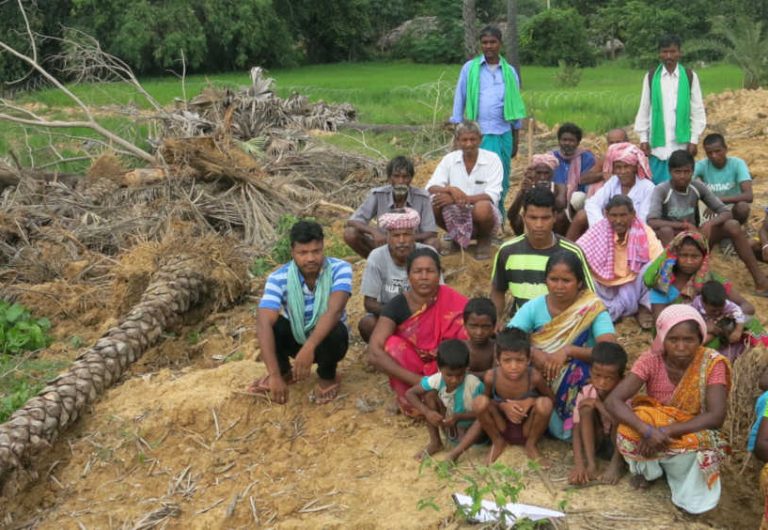
On August 31, 2018, Adani Group officials, backed by the Jharkhand police, destroyed the standing paddy crop and uprooted the trees of these Santal Adivasi farmers, in a bid to take their lands for a power plant that will supply electricity to Bangladesh.
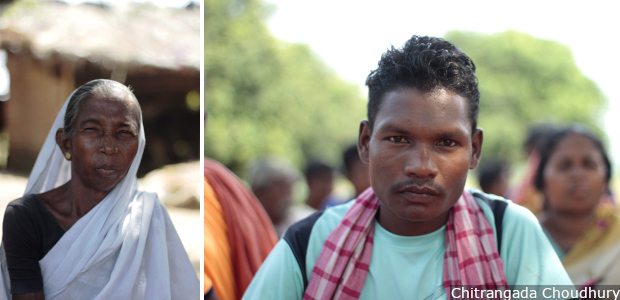
“There were eight to 10 police for each of us villagers,” said Sita Murmu, a wiry farmer in her 40s from the Santal community, one of India’s largest indigenous tribes, describing the attempt that followed to take over the villagers’ farmlands, abutting a clutch of mud and brick homes.
Santal Adivasi farmers fall at the feet on Adani personnel on August 31, 2018, begging the company to not take their land. Credit: Abhijeet Tanmay/Kashish News
These fertile, multi-crop lands are their only source of livelihood, and the villagers were shocked when the earthmovers began uprooting valuable palm trees and bulldozing the young paddy stalks, laboriously sown weeks ago.
“We begged Adani’s people to stop,” said Santali farmer Anil Hembrom. “But they said our land was theirs now, that the government had given it to them.”
Villagers said they made urgent phone calls for help to Godda’s deputy commissioner (DC) and the superintendent of police (SP). “The SP told us, ‘Go to the local thaana (police station) and lodge a complaint,’” they recalled. “We told him, ‘how can we lodge a complaint at the thaana, when the police from there are here with Adani.’” The DC too ignored their pleas, villagers said, recalling, “She said, ‘Your money (compensation for the land) is lying in the government office. Go, take it.’”
Meanwhile, Adani personnel were casting concertina wire to fence off the land, and a farm pond. Santalis bury their dead on their land, and the earthmovers dug up this clan’s burial site too, the farmers recalled.
Witnessing the destruction, women farmers fell at the feet of Adani’s personnel, pleading with them to spare their land. They wept as they said they could not survive without it.
Onlookers filmed these scenes on their cellphones, and the story was picked up by a Godda-based Hindi news outlet but found no mention in India’s legacy media. Alarmed by the women’s protests, the Adani team and the police eventually aborted the land acquisition attempt that day.
IndiaSpend sent questionnaires to the Adani Group and Godda DC Kiran Pasi on the morning of November 20, 2018, about the incident in Mali and the broader land- acquisition project. Neither replied. If they do, we will update this story with their responses.
The villagers’ battle against the Adani Group began in 2016, when Mali, 380 km east of state capital Ranchi, and nine other villages around it became contested territory. That was when Adani Power (Jharkhand) Limited, a subsidiary of the Adani Group, told Jharkhand’s BJP-ruled government that it wanted to build a coal-fired plant on over 2,000 acres of land—private farms and commons—in these villages, according to official documents reviewed by IndiaSpend.
The Adani Group is led by Gautam Adani, one of India’s richest and most powerful tycoons. Its proposed 1,600 megawatt (MW) plant in Godda is to be fuelled with Australian and Indonesian coal imports. When complete—the commissioning year is 2022—it will sell all the electricity via high-tension lines to Bangladesh. The proposal for the plant came in August 2015, following a visit by Prime Minister Narendra Modi to Bangladesh. Adani was among the industrialists accompanying Modi, and the agenda featured power transmission.
Forcible state takeover of land and private property for infrastructure and development is a legacy of British India, legitimised by the 1894 law. In post-independent India, this colonial-era law was particularly criticised for being abused by governments to take over private rural land for industry, sparking numerous bloody battles over land, from Kalinganagar to Nandigram. The brunt of this eminent domain—the power of the state to take over private property, citing public purpose—was disproportionately borne by Adivasis. Among India’s most disadvantaged communities, they make up 8% of India’s population, but an estimated 40% of those dispossessed for dams, mines and industrial projects.
The LARR Act provides “additional safeguards for them, such as informed consent to acquisition of their land,” said Muhammad Khan, a lawyer, and Congress party spokesperson who had helped draft the act, and also co-authored ‘Legislating for Justice’, a book on the issue. “The Act also provides for additional compensatory measures of land-for-land for Scheduled Castes (Dalits) and Scheduled Tribes (Adivasis),” he said. “This was an important safeguard, a recognition that the identities and livelihoods of such communities are strongly grounded in land.”
But the Jharkhand government’s use of the LARR Act, we found, demonstrates how a relatively progressive law can end up replicating the colonial predecessor it was meant to negate. This case holds important lessons for Jharkhand, and the rest of India, because it marks the first time the state government has evoked the LARR law for private industry.
In Mali and surrounding villages, IndiaSpend found that the LARR Act’s aim of making land acquisition a “humane, transparent, participative and informed” process has been compromised. For government institutions, long accustomed to deploying eminent domain powers with little public accountability, key safeguards introduced by the LARR Act—related to social impact assessment, “public purpose” justification, free prior, informed consent of affected families, land-for-land compensation for Adivasis and Dalits, and transparency and participation in decision-making, have been either undermined, or bypassed.
In a brief conversation with us on 19 November, 2018, Godda DC Pasi defended the acquisition.
“Farmers want the plant on their land,” she said, referring to the government’s acquisition of nearly 500 acres of land in four villages over this year. Asked about protests, in particular by Adivasi and Dalit farmers, she asked us to send her a questionnaire. IndiaSpend did so on 20 November, 2018, but Pasi did not respond, despite two reminders over two days.
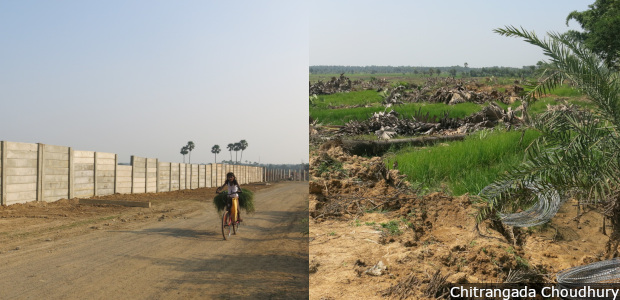
How a ‘humane, transparent, participative’ law is flouted Backed by the government, Adani personnel are taking over and fencing off private land and village commons. They are destroying multi-crop farm land, which provides year-round work and livelihood to its owners, sharecroppers and farm labour (right).
On August 31, 2018, Mali’s Santali farmers, such as Talamai Murmu, fell at the feet of Adani personnel, begging them to not acquire their land. “They just took it over like dacoits,” said Gangta villager Ramesh Besra (right), whose land is now in the company’s possession.
When IndiaSpend first visited Mali’s farmers weeks after the violent acquisition attempt of August 31, 2018, their lands had still not been taken over. But villagers were tense about the possible return of Adani personnel and police. Manager Hembrom, one of the landowners, said if that happened, they would “vehemently protest.”
“Land is everything for us,” Hembrom said of the fertile farms, where villagers grow rice, wheat, maize, pulses and vegetables around the year. “Our livelihood, our life, the basis of our identification for every benefit from the state.” Sita Murmu and other women farmers agreed: “We labour on our own land, and sustain ourselves. There is no way we will give it up.”
The villagers were looking at serious economic losses and food insecurity, given Adani personnel had destroyed their standing rice crop, and there would be no paddy to harvest in coming weeks.
“With our crop destroyed, we will also struggle through this coming year to get enough (fodder) to feed our livestock,” said Hembrom. Murmu has filed a case in the district court under the Prevention of Atrocities Act against the Adani personnel who destroyed her crop on August 31, 2018. They would have to wait until November to sow the next crop of wheat, said the villagers. On 23 November 2018, farmers told us this crop too was in question: eight days earlier, Adani personnel sent a complaint to the Godda police asking them to stop Hembrom and others from growing a new crop on their land. The company said the government had acquired this land for them.
As the villagers were speaking to IndiaSpend, Bimal Yadav, an aged sharecropper among them, started to weep. “Adani babu, please leave our land,” he pleaded. “We might get by on the money you are giving us for it, but what will our future generations live on? We beg you, please do not take our land.”
The following day, walking through the uprooted trees and damaged crop on her land, Lakhimai Murmu, one of the villagers also broke down. “When we have not agreed to give our land, how can they forcibly take it?” she said. “Why don’t they just kill us first?” She surveyed the field, pointing to small surviving paddy patches here and there, and told her family, “Maybe we can retrieve a little bit of dhaan (rice).”
Villagers in this section of Mali still hold out hope that the government might heed their protests. But Adivasi farmers in the neighbouring villages of Gangta and Nayabad like Suryanarayan Hembrom and Ramesh Besra, have seen their ancestral lands seized in recent months for the plant. “They just took it over like dacoits,” said Ramesh Besra of his farmland in Nayabad. “We could not do anything.”
Hembrom said that in the second week of July, 2018, a day after he had sown his fields, Adani personnel arrived in Gangta with police and began cordoning off land and moving in earthmovers. Hembrom’s farm was among those destroyed. When he tried to protest on his land the following day, joined by other villagers, Adani personnel and officials arrived and tried to evict them, he said.
“‘On which authority’s orders have you come here,’ they asked me,” Hembrom recalled. “We told them, ‘This is our ancestral land. We survive on farming. Should we ask the government for permission to come on our own land?’”
Marynisha Hansdak, a Godda-based Santali reporter, who was with the farmers that day, had been reporting Hembrom’s story. Adani officials who arrived on the scene threatened her to delete her footage, including visuals of them on the contested land, she said.
“I told them I was doing my job of reporting the story and would not delete my footage,” Hansdak said. Adani personnel, she said, responded by summoning the police. Hansdak left with the villagers from the area and took refuge in one of the villages for the night.
Within days, a court notice landed at Hembrom’s house, informing him that the police had admitted an FIR by Adani staff, who charged five Adivasi villagers including him with rioting, criminal trespassing, and breaking public peace. Hembrom is currently out on bail. An Adani spokesperson did not respond to questions by IndiaSpend on the cases filed by the company against the farmers.
Godda MLA Pradeep Yadav, who has raised questions since 2016 about the project, spent five months over 2017 in prison on similar charges and is currently on bail. “I was questioning the government’s and Adani’s outrageous mili-bhagat (connivance) to profit the company,” Yadav alleged. “So, the police slapped numerous cases on me. Sending their elected representative to prison was a clear message to the villagers to live in fear.”
Suryanarayan Hembrom and other farmers are facing criminal cases for resisting the acquisition of their land.
On a recent morning, a large group of villagers gathered in Mali-Gangta, to speak about the terror they felt. “We have no peace since the company has come,” said a Santali farmer Mohan Murmu. “They have taken away the grazing lands of our livestock too.” Those who spoke up in solidarity were not spared either, others in the group said. Adani group personnel threatened them, they said, telling them to not join protests, else their land would be taken too.
Both Besra and Hembrom have refused to accept monetary compensation, on the ground that they never agreed to give their land to the Adani Group. The same is true for farmers Balesh Kumar Pandit, Chintamani Shah, Ramjeevan Paswan, and Jayanarayan Shah from nearby villages. A retired schoolteacher, Chintamani Shah has filed numerous complaints since December 2016, listing violations in the land acquisition process.
“When I have been opposing losing my land to Adani since Day 1, and I continue to do so, on what moral grounds can I take that money?” Chintamani Shah asked, referring to the 42 lakh rupees compensation, which he has refused to take, after the government acquired his land in May.
Several villagers brought out letters, appeals and gram sabha (village assembly) resolutions made between 2016 and 2018 stating their opposition to the land acquisition. These were addressed to a number of authorities—from officials in the district to those in the state capital of Ranchi, to the Jharkhand governor Draupadi Murmu.
The governor has a special role under the Constitution, with regard to scheduled tribes, in particular, in preventing the alienation of land. Governor Murmu’s office did not respond to an IndiaSpend questionnaire about action taken by her office on these complaints.
“Kisise koi sunwaai nahi hai (there is no hearing for us from any quarter),” was a refrain we heard over and over again in the 4 villages witnessing acquisition.
Public Purpose: Farmland for Adani, electricity for Bangladesh When the LARR Act came to be, India’s minister for rural development, Jairam Ramesh, had argued that the state should rarely invoke the power of eminent domain granted by the law, and instead, opt for the market mechanism. This principle especially applied to land acquisition for private corporations, he argued.
“You want land? Go buy the land,” Ramesh had said, addressing industry at that time.
For its proposed power plant in Godda, however, as per documents reviewed by IndiaSpend, the Adani Group wrote to the Jharkhand state government on May 6, 2016 and August 2, 2016, asking it to acquire over 2,000 acres of land in ten villages of the district. In March 2017, the government said it would acquire 917 acres in six villages: Motia, Gangta, Patwa, Mali, Sondiha and Gaighat. The administration has so far acquired 519 acres of private land in the first four villages. Acquisition notices in the remaining two villages lapsed in August 2018, with the plant’s land requirements changing.
The company secured environmental clearance for the plant in August 2017, citing Godda’s Chir river as the water source. It now says it intends to draw water from the Ganga in adjoining Sahibganj district, and wants sub-surface rights over 460 acres for a 92-km pipeline to transport water. It also wants 75 acres for a railway line to transport coal.
Had the government turned down the Adani Group’s request, the company would have had to approach farmers to purchase their land, and villagers like Murmu, Hembrom and others would have had a say. On March 24 2017, in a 11-page note, which the Jharkhand government has not made public, the Godda DC declared the proposed power plant to be “for public purpose”, which meant it would acquire from farmers the land the Adani Group sought.
The LARR Act defines “public purpose” as covering several infrastructure activities, including power generation and transmission. But villagers point out that the Adani Group will sell all the power generated at the plant to Bangladesh.
“Adani benefits. Bangladesh benefits. How do we benefit?” asked an agitated Chintamani Shah, echoing the views of several farmers IndiaSpend spoke to.
The state has the first right of refusal for 25% of the power generated by thermal power plants built in the state, which means plants are legally obligated to sell 25% of the power to the state, at rates determined by government policy, according to the Jharkhand government’s 2012 Energy Policy. However, since the Adani Group wants to sell all the power generated at the Godda plant to Bangladesh, a February 2016 MoU between the state government and the Adani Group states that the government has agreed to the company’s request to sell power equivalent to 25% “from alternative sources”.
The government has not made its MoUs with the Adani Group public; the February 2016 document accessed by IndiaSpend is silent on the details of this “alternatively sourced” power. “The MoU is between the company and the state government, I cannot comment on that,” said Pasi when asked for specifics. Officials speaking to IndiaSpend, requesting anonymity, said the company has not provided “clear answers” about where this power will be sourced from and when will it be sold to the state. An Adani spokesperson did not respond to IndiaSpend’s questions on this issue.
The “alternative source” reasoning riles Babulal Marandi, an Adivasi leader and former chief minister of Jharkhand. “How can the state government justify grabbing land from farmers, and giving it to Adani on the grounds that Adani will sell us 25% power from other sources?” asked Marandi. “We can buy power ourselves. The state is already doing it. Why do we need Adani for it?”
An investigation by Aruna Chandrasekhar for Scroll.in in June 2018 revealed how the state government tweaked its energy policy in October 2016, months after signing the MoU, to buy costlier power from Adani. This “preferential treatment”, words used by the government’s own auditors, will result in a Rs 7,410-crore ($1.05 billion) benefit to the Adani Group, Scroll.in reported.
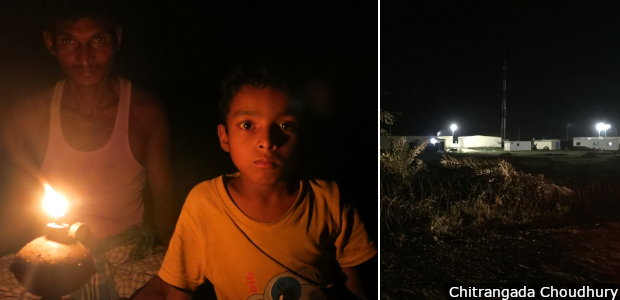
While acquisition of fertile agricultural land to generate electricity for Bangladesh is being called “public purpose”, villagers losing their land for the plant have little or no power. After sundown, electricity lights up Adani’s plant construction site, while the villages around it are swathed in darkness. In Mali and Gangta, on a recent night, people got by with the light of little lamps burning on kerosene, “bought at Rs 50 per litre”, as one villager said.
The 1600 megawatts of electricity generated from the Adani power plant will be sold to Bangladesh. Villages losing their farms and commons to the plant get by on kerosene lamps. The only electricity in the area was at the plant site (right).
“Earlier we used to get power for one or two hours. But since four months, after this company began building its plant here, we have not been getting any electricity,” said a schoolteacher in one of the villages, fanning himself with a textbook as he watched over his wards. “The government is issuing circulars for smart classrooms, and asking us to teach using projectors. And here, children haven’t seen electricity since four months,” said the teacher, requesting anonymity.
A 2016 government report lists even Godda’s district headquarter town as undergoing 18-20 hour daily power cuts.
Social impact assessment silent on impacts The LARR Act requires the government to conduct a social impact assessment (SIA) to weigh an acquisition’s socio-economic costs and impacts against potential benefits.
Under the law, the SIA study is required to be a publicly available document, circulated and disclosed widely, from gram sabhas in the relevant villages, to government offices and relevant websites. It must detail the extent of private, common and government land to be affected by the proposed acquisition as well as the number of affected families, including the number of displaced. It must assess whether land acquisition at an alternate place was considered and found unfeasible. The assessment also requires that the government hold public hearings to incorporate views of the impacted families.
The SIA report in this case contravened several requirements, we found. It is not publicly available, nor is it placed on any relevant government websites, such as the Godda district website, or the Jharkhand Land Department website. Few villagers like Shah have a copy obtained from “sources”.
Although the SIA states that 5,339 villagers were “project-affected”, it documents the views of only three villagers in the Motia hearing and 13 in Baxara. All the views favour the project and mirror each other. The SIA’s account of the hearings do not record the views of any Adivasi or Dalit residents.
Several locals in the four villages where the government was acquiring land for the Adani Group said that on December 6, 2016, the day of the SIA public hearings, they were barred from attending the proceedings. “There was large police deployment around the hearing site,” said Devendra Paswan, a Dalit farmer .
Only those who had a yellow card or a green card issued by company agents–dalaals as the villagers called them–were allowed in by the police, numerous villagers in Mali, Motia, Patwa and Gangta said. Villagers alleged that the police prevented them from entering even though they were carrying voter IDs and Aadhar cards.
When villagers protested, the police baton-charged and teargassed them, they alleged. Mali resident Rakesh Hembrom said they had no option but to gather outside and protest. “The next day the local paper carried a photo of us with our hands raised in protest, but saying the villagers are in support of the project,” recalled Hembrom.
Residents say they were kept out of the SIA public hearings In December 2016, several villagers, including women, told a Newslaundry reporter, Amit Bhardwaj, how they were beaten and barred from the SIA hearing site. A local journalist who captured footage of the police violence against villagers in Motia told Bhardwaj the police forced him to delete it.
While the Jharkhand government has empanelled several Jharkhand-based institutions, and public universities, including the area’s Sido Kanhu Murmu University, to conduct SIAs, the SIA for the Adani plant was awarded to a Mumbai-based consultancy firm called AFC India Limited. In the SIA, neither does AFC list the socio-economic costs of the project nor its impact on locals, as it is supposed to.
For example, the SIA omits rudimentary information, such as farming incomes in the area, landholding patterns, the extent of irrigated and multi-crop land, the economic losses for land losers, the impact on women and children, sharecroppers and farm labourers, the extent of common property resources such as grazing grounds and water bodies and the impacts of their loss. The SIA mentions that 97% of the residents are dependent on agriculture, but it does not say how they will get by after losing their land to the plant.
The SIA lists the number of “affected families” in nine villages at 841. But that only includes landholders. Moreover, in the four villages witnessing land acquisition so far, government data has listed 1,328 landholders.
The SIA also claims that the power plant will cause “zero displacement” and that habitations are “very far” from the site of land acquisition. It provides no evidence to support this statement, repeating claims made by the Adani Group in filings to the government, as well as claims by district officials that land acquisition for the project will not displace anyone. The Godda DC’s March 2017 note lists “zero displacement” as one of the grounds for Adani’s plant being a “public purpose” project.
The realities contradict this assertion. For example, the Santali families of Mali, who protested the acquisition bid of August 31, 2018, stand to lose their entire farmland. Their homes abut these farms.
“They may not touch our homes today,” pointed out Sita Murmu, “But without any land, what will we do here and how long can we survive here? We will eventually be forced out.”
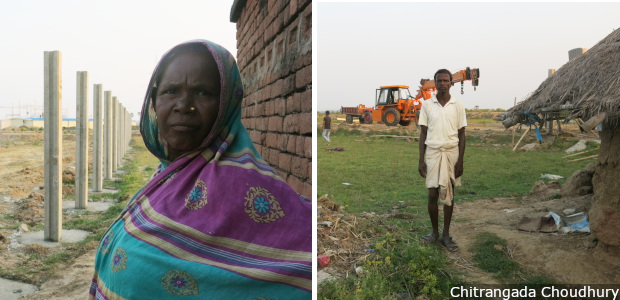
In the adjoining village of Motia, at the site of the power plant, the land was being levelled and construction had begun. Construction workers were marking boundary pillars just shy of the walls of the homes of Dalit and Adivasi villagers, such Punam Sugo Devi and Karu Laiyya.
“The company has hemmed us in on all sides,” said Devi. “Where are the poor supposed to go?”
Officials and Adani personnel claim land acquired for a power plant will not displace anyone. But the plant site is enveloping homes of Dalit and Adivasi villagers, such as Punam Sugo Devi and Karu Laiyya (right). “Where are the poor supposed to go?” Devi asks.
“Adani’s people keep telling us every day that we will be evicted from here, this is now sarkar ka zameen (the government’s land),” said Devi’s neighbour Deepak Kumar Yadav. “There is no knowing where they will throw us.” Construction personnel at the site confirmed that they were not taking this area “now”, but, as one said, “it will happen soon.”
Yadav, a landless sharecropper said they were financially hit by the land acquisition, which had subsumed the farms they used to work on – impacts the SIA report was meant to document, but ignored.
“Usually at this time, we would be busy in the fields. But we are without work since the past three months,” said Yadav, adding that they could not even get loans. “Earlier, the moneylender would lend to us against the crop that we would harvest as a sharecropper. Now nobody does so, since they know the land we worked on is gone.”
Sharecroppers and landless labourers say they have lost work and incomes, post-land acquisition
Asked for details of the social impact management and rehabilitation plans—the LARR Act requires these to be in the public domain—Godda’s DC Pasi refused. “That is confidential,” she said. “It contains third party information.”
Land rights expert Usha Ramanathan was a member of the High-Level Committee (2013-14), set up by then Prime Minister Manmohan Singh to report on the socio-economic, health and educational status of India’s Scheduled Tribes. The manner in which the Jharkhand government was taking land and livelihood from farmers demonstrated how “the idea of who, or what, is the public in ‘public purpose’ has got distorted beyond recognition,” she said.
Questions of consent Under the LARR Act, even if the government declares a private project as “public purpose”, it has to secure the “informed consent” of at least 80% of the landholders.
On March 7 and 8, 2017, district officials scheduled nine back-to-back ‘consent’ meetings in the nine villages where 1200 acres of land was to be acquired. The notification did not frame the meetings as a space for villagers to evaluate the acquisition proposal, and award or deny their consent. Instead, the government urged them to consent to the acquisition. According to the administration, in these meetings, and during the 15-day “grace period” following it, 84% of landowners agreed to give their land to the government. The consent process was finished within a fortnight.
The next day, on 23 March, 2017, the Godda government pleader provided a legal opinion to the district administration: since over 80% of the landowners had given consent, the Santal Parganas Tenancy Act–a law that protects Adivasis–“has lost force”, and “land can be acquired even if the area is falling under the SPT Act”. On 24 March, 2017, the Godda administration issued the 11-page note recommending that the government acquire 917 acres of land for the Adani Group. On March 24 and 25, 2017, it issued LARR notifications for the acquisition.
The 1949 Santal Parganas Tenancy (SPT) Act was intended to prevent Adivasi dispossession by placing several restrictions on the transfer of land from farmers in the erstwhile Santal Parganas district, now divided into six districts, including Godda. “There is no provision in the SPT Act for the government to transfer land to a company,” said Rashmi Katyayan, a Ranchi-based lawyer, specialising in land matters. To say that the Act had lost force, Katyayan argued, “was akin to legal fiction that benefits Adani.”
The SPT Act gives powers over the village’s common property (gair mazruwa) lands, such as grazing grounds to village heads, not the government, said Katyayan. But such common lands too have been acquired by the administration and are being given to the Adani group on 30-year leases, while titles of farmers’ land are being transferred to the company.
As with the MoU, the SIA report and the “public purpose” reasoning, the government has not made public the recordings and minutes of the consent meeting proceedings or official documents related to consent. It is hard to verify the government’s claim of consent from 84% of locals independently, since it has not implemented a key requirement of the consent process.
According to rules for the LARR Act, reiterated in the Jharkhand government’s own LARR rules issued in 2015, the landowner’s declaration giving or denying consent must be counter-signed by a district official. The rules state that a copy of this declaration, with the attached terms and conditions, must be handed to the affected landowner. None of the farmers IndiaSpend interviewed possessed these declarations.
Instead, several landholders, especially Adivasis and Dalits, said they had repeatedly refused consent for their land being taken. In Gangta, residents displayed copies of a gram sabha (village assembly) resolution sent to the district administration, the state’s energy department and the governor’s office.
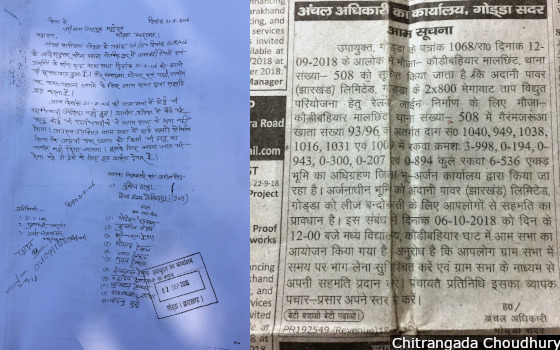
“The gram sabha has collectively decided that it will not give any private or common property land of the village to Adani Power Plant…” said the resolution passed at the meeting held on August 31, 2016. “If we need to give up our lives in the process, we are ready for it.” The resolution is stamped as received by the district administration on September 2, 2016.
An August 2016 gram sabha resolution in Gangta opposed giving land to the Adani Group for the power plant. A September 2018 notice (right) by the Godda administration directed villagers to give consent for handing over gair mazruwa (common property) lands to the Adani Group.
Several villagers alleged that the consent meetings called by the government were flawed and manipulated. “We boycotted them in protest, and have never given our consent,” said Chintamani Shah, adding that he filed right-to-information requests for the consent proceedings and was told that all records have been put on the website. “There was nothing there,” said Shah. IndiaSpend confirmed that was indeed the case.
The official opacity surrounding the project violates several LARR provisions, as well as Jharkhand’s 2015 LARR rules. These rules state: “As early as possible, the government will create a dedicated, user-friendly website that will be a public platform where the entire workflow of each acquisition case will be hosted, tracking each step of decision-making, implementation and audit.” This has not happened.
Officials said that most of the landowners have taken the compensation, which demonstrates consent. Several villagers offered a different perspective. A Dalit landholder in Motia, requesting anonymity for fear of retribution, said that all through, the government presented land acquisition for the Adani plant as a fait accompli, rather than a scenario of free and informed consent.
“My land is surrounded on four sides by that of upper castes,” he said. “Adani’s people told me that I should give the land, else I will be stranded and not get anything. I gave my land and took the compensation of 13 lakh rupees in a state of helplessness.”
Sikander Shah who lost his farm earlier this year, and has taken compensation of around 35 lakh rupees, had a similar account: “Adani’s people told me that if I don’t give consent, I will lose my land, and not get any money. I held out until the very end and finally had to relent.” Shah said that company personnel took him to their office, where he signed some documents. “Laachaar hokay karna pada (I had no choice but to do it),” he said.
Another Dalit famer in Motia, Ramjeevan Paswan, alleged that Adani personnel forcibly acquired his land in February, 2018. “Adani’s officials pushed me, uttering a casteist slur,” he said. “They said if you don’t give your land, we will bury you alive in it.” He filed a case under the The Scheduled Castes And The Scheduled Tribes (Prevention of Atrocities) Act against Adani personnel Dinesh Mishra, Abhimanyu Singh and Satyanarayan Routray. Nine months on, Paswan said, the police are still recording his statement.
Compensating land for land Perhaps the most serious impact of the Jharkhand government’s use of the LARR Act to acquire land for the Adani Group, results from its interpretation of the land-for-land compensation principle, laid down in the act for Adivasi and Dalit landowners.
Clause Two in the Act’s Second Schedule states: “..in every project (emphasis added), those persons losing land and belonging to the Scheduled Castes or Scheduled Tribes will be provided land equivalent to land acquired, or 2.5 acres, whichever is lower.” This compensation, the schedule says, is in addition to money.
On June 14, 2017, the Godda district administration wrote to the state government for guidance on implementing multiple compensation and rehabilitation provisions of the act, specifically mentioning the Second Schedule, as well as the Act’s Section 41, which deals with safeguards for Scheduled Castes and Scheduled Tribes.
Officials were thus deliberating important aspects of compensation three months after they had called meetings in the villages on March 7 and 8, 2017, and claimed to have secured “informed consent” from over 80% of the villagers.
On September 1, 2017, K Sriniwas, the state government’s director (land reforms), told Godda’s officials that the land-for-land compensation clause for Scheduled Tribes and Scheduled Castes “only applied to irrigation projects.” For this, Sriniwas drew on the preceding part of the land-for-land section, which mentions that land-for-land compensation would be provided in all irrigation projects as far as possible.
Sriniwas is no longer the land reforms director. His successor, A Muthu Kumar told IndiaSpend: “I cannot comment on this. It is a policy decision of the government.”
The land-for-land compensation principle is a critical one, especially for Scheduled Tribes. “Adivasis are intertwined with land, forests and nature,” National Commission for Scheduled Tribes Chairperson Nandkumar Sai told IndiaSpend during a land rights seminar in September 2018. “Land is the very basis of their life, their culture and their identity,” Sai said, echoing the views of the Santalis in Godda’s villages.
In a 29 October 2018 note, following a meeting Sai held with officials of the central ministries of land resources, tribal affairs, and environment and forests, the NCST has drawn on the LARR Act’s land-for-land compensation principle to ask the government to award Adivasis, whom it relocates from tiger reserves, a minimum of 2.5 acres of land as compensation.
The Jharkhand government’s decision to deny land-for-land compensation to Scheduled Castes and Scheduled Tribes “violates Article 14 of the Constitution, i.e. the principle of equality before law,” Ramanathan said. “Whether it is an irrigation project or a power plant, the fact of dispossession is the same across projects. Then how can you compensate with land in one case, but not in another?”
Jharkhand was formed as a separate state in 2000 due to decades of collective struggles for tribal self-determination, and that its government should dispossess tribal farmers thus is “particularly ironic,” Ramanathan said. IndiaSpend asked Kumar, the land reforms director, if it was the Jharkhand government’s stand to deny land-for-land compensation in all LARR projects, barring irrigation projects. “This is the government circular as of now,” said Kumar. “I cannot comment on any future circulars.”
Back in Godda, asked for information on how many Dalit and Adivasi families are losing their land to the Adani group, officials say they have not done “a caste-wise analysis” of those being dispossessed.
The land records in Jharkhand have not been updated since 1932. Documents around the project, including the SIA report, seem to be an unreliable guide. According to the SIA, of the acquisition’s “841 impacted families” (it is counting only land losers), Dalit and Adivasi families number 130, or around 15%. But a basic ground check raises questions about this data.
For example, the SIA lists the number of impacted Adivasi families in Mali village as one. But just one patch of land, which was the target of the controversial acquisition of 31 August 2018, includes 6 families as landowners. Nearly 40 people, across three generations, are dependent on this land. But the SIA states that this land title is reported to be “issue-less”, which means it has no claimants. Titleholders of this section of land include farmers like Anil Hembrom. Farmers said they would not be able to use the compensation money to buy alternative land, given the SPT Act, which places several restrictions on transfer of farmland in the region. “If the government takes our land from us, we, and our future generations will be condemned to landlessness forever,” said Hembrom. “Our Adivasi existence will be wiped out.”
Adivasi farmers explain why the acquisition will render them landless for good “Numerous studies, including our report, have shown that communities whose lives are entwined with their habitat, especially Adivasis, have subsistence capability precisely because they have access to natural resources,” said Ramanathan. “If you fence these off from them, you render them immensely vulnerable.”
In Godda, this vulnerability has become a reality for many.
“We cannot even go into what was ours. The company has built a fence all around it,” said Sumitra Devi, a Dalit farmer in her 50s in Motia. Adani personnel threatened and intimidated her family into giving up their land, before eventually forcibly acquiring it this February, she alleged. Devi said her family has not taken the compensation on the grounds that they did not consent to giving their land. “Humein paise ka moh nahi hai, humein zameen ka moh hai (We have no attachment to money, we are attached to land),” Devi sobbed.“Please find a way for us to get our land back.”
With the land gone, she said, they were struggling to make ends meet, and take care of their 10 cows and calves. She suffered from gastric ailments and diabetes, and did not have enough money for her medical tests and medicines, she said.
On October 8, 2018, shortly after giving this interview, Devi died.
Days after being interviewed about how her land was forcibly acquired, Dalit farmer Sumitra Devi passed away.
(Chitrangada Choudhury is an independent journalist and researcher, working on issues of indigenous and rural communities, land and forest rights, and resource justice. Follow her on Twitter @ChitrangadaC)
A World Federation A “With law shall our land be built up, but with lawlessness laid waste” Njal’s Saga, Iceland, c 1270 AD
Image Courtesy: Maxim Shemetov/Reuters
The present United Nations Charter After the unspeakable horrors of World War II, delegates from 50 Allied nations met in San Francisco California. The purpose of the conference, which took place between 25 April and 26 June, 1945, was to set up an international organization that would be able to abolish the institution of war. However, the Charter which the delegates produced was too weak to achieve this goal.
In many respects the United Nations has been highly successful. During the 73 years that have passed since its establishment, a world war has been avoided. The agencies of the United Nations, such as the World Health Organization, the Food and Agricultural Organization, UNESCO and the IPCC, have provided urgently-needed services to the international community. The Universal Declaration of Human Rights and the Millennium Development Goals have set up norms towards which we can and should aim. Further-more, the UN has provided a place where representatives from many nations can meet for informal diplomacy, through which many dangerous conflicts have been avoided.
Nevertheless, the United Nations, with its present Charter, has proved to be too weak to achieve the purpose for which it was established – the complete abolition of the institution of war. If civil wars are included, there are, on any given day, averages of 12 wars somewhere in the world. The task of abolishing war has become extremely urgent since the advent of thermonuclear weapons. The danger that these weapons will be used, through accident, technical or human error, or through uncontrollable escalation of a war with conventional weapons, poses an existential threat to human civilization and the biosphere.
The Russell-Einstein Manifesto of 1955 described our present situation in the following words: “Here then is the problem that we present to you, stark and dreadful and inescapable: Shall we put an end to the human race, or shall mankind renounce war? There lies before us, if we choose continual progress in happiness, knowledge and wisdom. Shall we, instead, choose death because we cannot forget our quarrels? We appeal as human beings to human beings: Remember your humanity, and forget the rest. If you can do so, the way lies open to a new Paradise; if you cannot, there lies before you the risk of universal death.”
Why Call War An “Institution”? Because the world spends almost two thousand billion dollars each year on armaments, it follows that very many people make their living from war. This is the reason why it is correct to speak of war as a social institution, and also the reason why war persists, although everyone realizes that it is the cause of much of the suffering that inflicts humanity. We know that war is madness, but it persists. We know that it threatens the future survival of our species, but it persists, entrenched in the attitudes of historians, newspaper editors and television producers, entrenched in the methods by which politicians finance their campaigns, and entrenched in the financial power of arms manufacturers, entrenched also in the ponderous and costly hardware of war, the fleets of warships, bombers, tanks, nuclear missiles and so on.
Military-industrial complexes, throughout the world, drive and perpetuate the institution of war. Each military-industrial complex involves a circular flow of money. The money flows like the electrical current in a dynamo, driving a diabolical machine. Money from immensely rich corporate oligarchs buys the votes of politicians and the propaganda of the mainstream media. Numbed by the propaganda, citizens allow the politicians to vote for obscenely bloated military budgets, which further enrich the corporate oligarchs, and the circular flow continues.
A World Federation In order to save the world from destruction in a thermonuclear World War III, the United Nations Charter must be reformed and strengthened. At present, the UN is a confederation of absolutely sovereign nation-states. But in a world of all-destroying modern weapons, instantaneous global communication, and economic interdependence, the absolutely sovereign nation-state has become a dangerous anachronism.
Furthermore, history has shown confederations to be fatally weak. For example, the original United States Constitution was a confederation; but it soon became apparent that this form of governance was too weak. Instead, a federation was needed. In his Federalist Papers, Alexander Hamilton wrote: “To coerce the states is one of the maddest projects that was ever devised… Can any reasonable man be well disposed towards a government which makes war and carnage the only means of supporting itself, a government that can exist only by the sword? Every such war must involve the innocent with the guilty. The single consideration should be enough to dispose every peaceable citizen against such government… What is the cure for this great evil? Nothing, but to enable the… laws to operate on individuals, in the same manner as those of states do.”
George Mason, one of the drafters of the Federal Constitution, believed that “such a government was necessary as could directly operate on individuals, and would punish those only whose guilt required it”, while another drafter, James Madison, wrote that the more he reflected on the use of force, the more he doubted “the practicality, the justice and the efficacy of it when applied to people collectively, and not individually.”
At present, the United Nations attempts to coerce states through sanctions; but sanctions are a form of collective punishment, and collective punishment is expressly forbidden by the Geneva Conventions. The worst effects of sanctions are usually felt by the weakest and least guilty of the citizens, while the guilty leaders are usually unaffected. Besides being a violation of the Geneva Conventions, sanctions are ineffective, their only effect being to unite the people of a country behind its guilty leaders.
The Success of Federations A federation is a union of organizations to which specific powers are granted, all other powers being retained by the subunits. Historically, federations have proved to be highly successful and durable.
Besides political federations, many other kinds exist, examples being Universal Postal Union, established by the Treaty of Bern in 1874, and the International Tennis Federation (ITF), founded in 1913.
Examples of political federations include the European Union, the Federal Republic of Germany, the Swiss Federation, the Russian Federation, the Federal Government of the United States, and the governments of Australia and Brazil.
Laws Binding On Individuals In general, political federations have the power to make laws which are binding on individuals, thus avoiding the need to coerce their member states. An effective World Federation would need to have the power to make laws that act on individuals. The International Criminal Court is an important step towards the establishment of a system of international law that acts on individuals rather than on states, and the ICC deserves our wholehearted support.
Greatly Increased Financial Support for the UN A very important step towards strengthening the United Nations would be to give it at least 50 times the financial support that it has today. At present the entire yearly budget of the UN is only 2.7 billion US dollars, a ridiculously low figure, considering the organization’s duty to ensure peace, law, human rights, social justice, respect for the environment, human health, and a safe food supply for the entire world. If the financial support of the United Nations could be greatly increased, its agencies could perform their vitally important duties much more effectively. This would give the UN increased prestige and authority, and the UN would thus be better able to resolve political disputes.
Various methods for increasing the money available to the UN have been proposed. For example, James Tobin, who was Sterling Professor of Economics at Yale University, and Nobel Laureate in Economics, proposed that international currency transactions be taxed at a small fraction of a percent. He believed that even this extremely small tax would make exchange rates much more stable. When asked what should be done with the proceeds of the tax, Tobin added, almost as an afterthought, “Give it to the United Nations”. In fact, the volume of international currency transactions is so enormous that even the tiny tax proposed by Tobin would be sufficient to solve all the UN’s financial problems.
A Standing UN Emergency Force The United Nations is often called on to act quickly in emergency situations, an example being the call for the UN to stop the Rwandan genocide. It would be helpful if the UN had a standing armed force which could act quickly in such emergency situations. The force could consist of volunteers from around the world, pledged to loyalty to humanity as a whole, rather than loyalty to any nation.
A Reformed Voting System In the present UN General Assembly, each nation is given one vote regardless of size. This means that Monaco, Liechtenstein, Malta and Andorra have as much voting power as China, India, the United States and Russia combined. For this reason, UN resolutions are often ignored.
The voting system of the General Assembly should be reformed. One possible plan would be for final votes to be cast by regional blocks, each block having one vote. The blocks might be. 1) Latin America 2) Africa 3) Europe 4) North America 5) Russia and Central Asia 6) China 7) India and Southeast Asia 8) The Middle East and 9) Japan, Korea and Oceania.
In a reformed, democratized and possibly renamed Security Council, the veto power would be absent, and final votes would be taken between regions of roughly equal populations.
Hope for the Future Can we abolish the institution of war? Can we hope and work for a time when the terrible suffering inflicted by wars will exist only as a dark memory fading into the past? I believe that this is really possible. The problem of achieving internal peace over a large geographical area is not insoluble. It has already been solved. There exist today many nations or regions within each of which there is internal peace and some of these are so large that they are almost worlds in themselves. One thinks of China, India, Brazil, the Russian Federation, the United States, and the European Union. Many of these enormous societies contain a variety of ethnic groups, a variety of religions and a variety of languages, as well as striking contrasts between wealth and poverty. If these great land areas have been forged into peaceful and cooperative societies, cannot the same methods of government be applied globally?
Today, there is a pressing need to enlarge the size of the political unit from the nation-state to the entire world. The need to do so results from the terrible dangers of modern weapons and from global economic interdependence. The progress of science has created this need, but science has also given us the means to enlarge the political unit: Our almost miraculous modern communications media, if properly used, have the power to weld all of humankind into a single supportive and cooperative society.
We live at a critical time for human civilization, a time of crisis. Each of us must accept his or her individual responsibility for solving the problems that are facing the world today. We cannot leave this to the politicians. That is what we have been doing until now, and the results have been disastrous. Nor can we trust the mass media to give us adequate public discussion of the challenges that we are facing. We have a responsibility towards future generations to take matters into our own hands, to join hands and make our own alternative media, to work actively and fearlessly for better government and for a better society.
We, the people of the world, not only have the facts on our side; we also have numbers on our side. The vast majority of the worlds peoples long for peace. The vast majority longs for abolition of nuclear weapons, and for a world of kindness and cooperation, a world of respect for the environment.
No one can make these changes alone, but together we can do it. Together, we have the power to choose a future where international anarchy, chronic war and institutionalized injustice will be replaced by democratic and humane global governance, a future where the madness and immorality of war will be replaced by the rule of law.
We need a sense of the unity of all mankind to save the future, a new global ethic for a united world. We need politeness and kindness to save the future, politeness and kindness not only within nations but also between nations.
To save the future, we need a just and democratic system of international law; for with law shall our land be built up, but with lawlessness laid waste.
A freely downloadable book A new 418-page book entitled “A World Federation” may be downloaded and circulated gratis from the following link: http://eacpe.org/app/wp-content/uploads/2018/11/A-World-Federation-by-John-Scales-Avery.pdf
Dr Mubeena Ramzan of Kashmir created history earlier this month when she became the first Kashmiri woman to be enlisted among the 500 most influential personalities in the Muslim world. The list was released by The Royal Islamic Strategic Studies Centre, an independent research entity affiliated with the Royal Aal al-Bayt Institute for Islamic Thought.
Dr Mubeena Ramza, head of Ansar-un-nissa’ a soio religious organisation (Photo: Auqib Javeed/ TwoCircles.net)
The list named Dr. Mubeena from North Kashmir’s Sopore as one among the world’s most influential persons. Dr Mubeena heads the women-only socio-religious organization ‘Ansar-un-Nissa’ and is the Rector of ‘Jamia Islamia Mahdul Muslimat’, which has its branches in Sopore (Baramulla), Baghat (Srinagar) and Sumbal (Bandipora) under the aegis of a registered public trust namely ‘Mahdul Muslimat Educational Trust’ in Kashmir. Dr Mubeena travels extensively across the valley for women’s rights and ensure that women suffering from domestic violence are provided “a vent”. In an exclusive interview with TwoCircles.net, Dr Mubeena talks about her activism, journey and her views regarding role of women in conflict-torn state.
Here are the experts
Could you please tell us a little about yourself? I was born in Sopore of District Baramulla and had my initial schooling from Islamia High School, Sopore where we were taught Islamiyat, Arabic and Hindi, which broadened our thought process.
Students of the madarsa run by Dr. Mubeena (Photo: Auqib Javeed/ TwoCircles.net)
After pursuing Bachelor’s degree in Islamic Studies, Education, Political Science and Philosophy from Islamia College, Sopore. After that, I completed my B.Ed, Masters degree and Research from University of Kashmir (KU). During my Research in Kashmir University, I had specialised in Islamic Law, Jurisprudence (Fiqh) and Orientalism.
Besides all this, I had learned Islamic Sciences from Hazrat Mufti Muzaffar Hussain Qasimi Sahab, Head Mufti, Darul-ul-Uloom Sopore.
When did the idea of setting up your own institute for women come to your mind and why? As a scholar, my research on Kashmiri Society and its social evils had made me realise that I must play an active part in mitigating the crisis. The very idea motivated me to quit lectureship in a B.Ed college in Kupwara and started Jamia Islamia Mahdul Muslimat under the aegis of Mahdul Muslimat Educational Trust in 2002, from a rented building in Sopore and took us eight years to purchase a land and built a proper girls-only seminary-cum-skill school there.
The objective was to inculcate education with Islamic integration and impart skills among women. We started another branch in Baghat area of Srinagar city and recently, opened another campus at Sumbal-Hajin area of Bandipora district.
What do you teach to your students? Jamia Islamia Mahdul Muslimat is a seminary-style girls only institute where besides teaching of religious text we impart worldly education also. But main thrust is on religious scriptures like Quranic exegesis, science of Hadith, Jurisprudence and History.
We also teach languages viz, Arabic, English, Urdu and train them in the field of Computers, Cutting & Designing skills to help them become competent and self-reliant.
Tell us about this institute and your journey with it? We empower our students through education and skills, which boosts their confidence to face different realities of life. I believe that training a girl on these parameters was not possible by mere religious sermons, debates, seminars, etc.
We had to upgrade our religious syllabus on modern lines to make our girl students relevant to the contemporary society. We believe in natural upbringing of students, especially girl. We understand it well that apart from education and shelter, orphans also need motherly love and care. While we try to provide that, we also counsel and guide them regarding their future. This is what our Institute Jamia Islamia Mahdul Muslimat provides.
Dr. Mubeena with some of the women ( Photo: Auqib Javeed/ TwoCircle.net)
In 2013, we called a meet of women from different walks of the life-around 100 of them-in Sopore where we decided to have some welfare initiatives among women. And as a result, in March 2014, we floated “Ansar-un-Nissa”, a women welfare body which provides a helping hand to the needy, would-be brides, widows, orphans, and also establishes vocational training centres.
What challenges do you face during your activism in a society that can be patriarchal? When it comes to a woman who observes Hijab, challenges are tremendous. Women now-a-days is sandwiched between two extremes – Religious and Western. A man is called qawwam in Quran, which means head / protector / sustainers of the family but this status has been misused by some by enslaving women.
I was opposed by so-called Moulvis for starting girls only seminary style institute (Madrassa) as it was in their mind how come a female run a Madrassa. But Alhamdulillah, now their perception has changed as we are successfully running three branches now.
The need of the hour is to have a very balanced approach where woman and man both would take care of their roles and responsibilities. Men and Women are equal, but not similar.
Reportedly, you were associated with Dukhtaran-e-Millat (DeM) of Aasiya Andrabi and later on due to some differences you left from the organisation. What were the differences?
Yes, I was associated with the organisation till 2004. Later on the differences grew with the organization for it being more into political spectrum. I left the organization as I wanted to do activism on academic parameters and started academic activism among women folk.
Do you think there are need for more Muslim women scholars in Kashmir? Obviously, yes. In the rest of the Muslim world, we have good number of women Islamic Scholars but in Kashmir we are lacking them. We need more and more women scholars in Kashmir in order to educate common women-folk.
You must be knowing that in Ottomans Empire, 40% of contribution to Bait-al-Mal (House of money) was by the women and the oldest degree-granting university in the world i.e., Al-Qarawiyyin University was founded by Fatima al-Fihri, a women.
Women have been the pioneers of the education from the beginning of the Muslim society which is evident from the fact that a great major of Ahadiths (sayings of the Prophet, saws) are quoted by none other than his wife, Hazart Ayesha Siddiqa (r.a).
You have conducted various religious gatherings in different parts of the valley.
What draws you to that endeavour? There are many issues related to women where she needs to be educated in right perspective. People often gossip about four wives, but no one thinks about having four daughters. Even a mother’s face turn pale now-a-days on the birth of a girl child.
The experiences which I gained after travelling throughout the Valley and beyond it for conduct of various religious gatherings are quite astonishing and still prevalent in this century. Most of the daughters and sisters are being debarred from the property / inheritance while Islam and Islamic law have given them a Right to Inheritance. Remarriage, Widow Marriage is still considered something evil in this Kashmir.
Daughters, Sisters, Wives are being forced to work outside for earnings and height of the things are that now-a-days it is difficult for an unemployed girl to get a suitable match as most mothers prefer to have employed daughter-in-law.
The hadiths of the Prophet (peace and blessing be upon him) about raising girls are beautiful and amazing. Girl children come with great rewards and blessings. If you offer care, love, support and education to your girl child, Paradise awaits you.
A gathering of women to listen to Dr. Mubeena (Photo: Auqib Javeed/ TwoCircles.net)
At a time when baby girls were deemed a source of shame, even buried alive, the Prophet (peace and blessing be upon him) came to rectify this grave wrong. The Prophet (peace and blessing be upon him) said: If anyone has a female child, and does not bury her alive, or slight her, or prefer his male children to her, Allah will bring him into Paradise. (Ahmad). On one other occasion, The Prophet (peace and blessing be upon him) said, “Whoever supports two girls till they attain maturity, he and I will come on the Day of Resurrection (close to each other) like this –The Messenger of Allah (peace and blessing be upon him) joined his fingers to illustrate closeness.” (Muslim)
These are just examples of how Islam cared for the girl children. The care mentioned in these hadiths and others is comprehensive. It covers the girls’ physical, emotional and mental needs. Such is the care and affection that our daughters deserve. The Prophet (peace and blessings be upon him) commands us to be loving, patient and supportive parents.
You were recently listed as one among the most influential 500 personalities in the Muslim world. Do you have any comments on your selection? I came to know through my husband about it and I believe that real action and delight comes from helping your people grow. But yes, if your welfare activism is being recognised in any way, it does boost you.
Do you have any personal Muslim women heroes you would like to mention? Not Hero, but inspiration. Maryam Jameela is one in this regard. She was brought up in a modern society but did not get getting influenced by it. On the contrary, she was able to influence and inspire people with her thought. Yvonne Ridley is other one.
Do you have any messages for young Kashmiri Women? As Muslims, they should believe that their rights, duties and status are justified. They don’t need any westerner or any ragtag activist to tell them their rights as a woman. Those who are rallying behind it are knowingly and unknowingly attempting to overlook the dignified status and rights given to women by their religion.
Islam invites you to a mission based on obedience to Allah and Islam addresses person’s spirit, emotions, belief, etc. West is dragging women from homes, only to fulfil economic and materialistic objectives. It’s intended to commercialize things but Islam gives dignity and status while addressing the soul.
There are some jobs in the field of Education and Health and other suitable fields, where women have a primary role. However, in choosing any job, your home should be your preference. Your family should not suffer at the cost of earning. People in Kashmir nowadays prefer earnings over other things which need to be discouraged.
Almighty Allah says in the Qur’an …..“For Muslim men and women, for believing men and women, for devout men and women, for true men and women, for men and women who are patient and constant, for men and women who humble themselves, for men and women who give in charity, for men and women who fast, for men and women who guard their chastity, and for men and women who engage much in Allah’s praise, for them has Allah prepared forgiveness and great reward” (Al-Ahzab 33:35)
Dr. Mubeena Ramza with her students at the convocation in Srinnagar (Photo: Auqib Javeed/ TwoCircles.net)
Men have had every advantage of us in telling their own story. Education has been theirs in so much higher a degree; the pen has been in their hands. I will not allow books to prove anything.” ― Jane Austen, Persuasion
Austen’s words, a searing commentary on how patriarchy controls the narrative, remains relevant today despite tenacious efforts by women to wrest authorial control from men and narrate our own stories. Even as the struggle to find one’s voice and to be heard continues, we might also ask ourselves what we will be left with after we have successfully challenged male authority and supremacy in our stories, the idea of heroes and villains, of chaste wives and women of disreputable characters. In the moment of triumph, is there also a need of introspection? The MeToo movement, in India and elsewhere, opens our world(s) up to these and many other questions that do not have easy or ready answers. A standard reply, reproduced in several platforms when questions like ‘why now’ or ‘what next’ are raised is illuminating of the problem societies face when women tell stories: “For now, we should just listen to the women who want to speak up.” It not only represents the struggle to tell our stories on our own terms but also tell them without a fixed agenda or plan.
The current moment in Hindi cinema has been complementing these societal struggles, perhaps even foreshadowing the MeToo challenges to patriarchy by both wresting authorial power to tell stories of relatable people, especially of women, but also displacing plot devices and narrative arcs familiar to stories that end up reaffirming patriarchal authority. Perhaps, one of the biggest challenge to patriarchy is to just tell stories of women who do not want to be like men but such trends have also provoked a backlash. This article seeks to unravel some of these tangled webs of struggles witnessed in our popular, mainstream story-telling medium.
Subverting the Narrative Veere di Wedding was promoted as the revolutionary film with four women play its leads but it rather represented a normalisation of a marginal trend in Hindi cinema, which has now become commercially viable. I cannot comment on Veere for I have not watched the film but I want to reflect on what it meant to have four-five women as leads in two other films, Lipstick Under my Burkha and Angry Indian Goddesses.
Angry Indian Goddesses started the trend with an account of privileged women, whose privilege is accentuated by the inclusion of a domestic maid in their sisterhood. It is sisterhood with an asterisk. In this film, men are included primarily as sexual predators and the only solution against them is presented as the ‘final solution’. One that many vigilante films have adopted before and after its release but there is one crucial difference – in Angry Indian Goddesses, the murders are not planned in cold-blood. It’s a reaction that comes from several women who are successful or accomplished at what they do but are frustrated with the world they live in. They realise that despite their merit they are never seen as more than sexual objects and, in fact, resented for the success that is never seen as rightfully theirs. They are angry not only because they have had enough, they also know that end to this struggle is not in sight. The film closes on a meta note with one of the characters espousing the hope that one day we will be able to tell our own stories.
Lipstick Under my Burkha is also a tale of frustrated aspirations. But unlike Angry Indian Goddesses, these women do not have the privilege or the platform to nurture their talents. The younger women know what they are capable of and aspire to a life different than the one they see around them. Those who hold them back are not unknown sexual predators, as in Angry Indian Goddesses, but people close to them (who also indulge in sexual abuse). Both films are about women struggling to make a different life for themselves and realising that the pushback from patriarchy can be swift and brutal.
MeToo reflects this very frustration, in India and elsewhere, that while women’s lives have phenomenally transformed through the opportunities now available to them, men have been slower to adapt. By this I am not just referring to sexual predators and sexist family men – in the struggle against the patriarchy, an attack on individual patriarchs is much easier for men, who believe in equality, to support. When it comes to addressing patriarchy, the pushback appears inevitably. When I read reputed film critic, Baradwaj Rangan, on Lipstick Under my Burkha, I could see this disjuncture clearly: “It’s not that these men don’t exist. It’s that we’ve seen them far too often in far lesser films, and it looks like a cop-out when a brave new film of today opts for the same black-and-white imagery.” Rangan’s specific complaint against Lipstick was that all the men in it were ‘cads’. As opposed to Arth or Parched, he continues, there are no sympathetic men in Lipstick Under my Burkha. This complaint did not find its way into the review he wrote for Angry Indian Goddesses, which had almost no redeeming men in the story. The review for Veere gets extra points from him for finding a guy as well as a (heterosexual) couple to root for. The larger question is, do films on women owe men a sympathetic male character to identify with? A hero, even if in a minor role?
it is true that Lipstick is perhaps a tad indifferent to its men (except for the photographer Arshad’s character). The men are peripheral to the women’s story and their struggles and in this aspect, it is a mirror image of Dil Chahta Hai or Zindagi Na Milegi Dobara, made by the Akhtar siblings. In those films, it is the women’s roles that are superficial, some bordering on the offensive, and they have been criticized for this. But when your sample size of multi-starrer films with women in leads is a total of three movies, complaining about how under-written male parts are seems a bit unfair.
The stories were about showcasing women’s aspirations, sexual and otherwise, and the factors that hold them back. Men and women around the women are patriarchal agents if not patriarchs themselves; they can be fleshed-out characters but their purpose here is to highlight the way patriarchy functions. Their roles are driving the plot symbolically rather than via embodiment. Buaji’s (the character played by Ratna Patak) swimming coach, for example, is a respectful and even sympathetic character who refuses to see a middle-aged woman as just another ‘aunty’, demands to know her name and adds a respectful ji to it. He encourages her to learn swimming, coming across as a warm, caring young man, ironically from ‘brute Haryana’. He is not perfect but considerate. That he wanted a mate of his own age and felt betrayed by Buaji’s actions does not make him a ‘cad’ but his character was not given enough time to dwell on this complexity. The movie was about these four women and taking attention away from them would be akin to weakening the subversive element. It might be interesting to know more about the coach but it is not owed.
The success of Lipstick Under my Burkha and Veere, along with many smaller movies without proverbial heroes, filmed in non-metro settings (Bobby Jasoos, A Death in the Gunj, Masaan, Bareilly ki Barfi, Shubh Mangal Savdhan, in fact the whole sub-genre of Ayushmann Khurrana films), hints at a larger trend in our consumption patterns – perhaps, we no longer need masculine heroes to drive plots in good, successful cinema. Khurrana appears to have realised this as he has been stating in interviews given ahead of Badhai Ho’s release that movies where he was cast as a larger-than-life protagonist have not worked and he has now decided to pick projects where his roles are defined in relation to other characters in the story.
Khurrana is not a card-holding revolutionary but his successful challenge to patriarchy lies in the refusal to accept emasculation in situations that may underline a crisis in masculinity (Shubh Mangal Saavdhan, Badhai Ho). Re-interpreting both femininity and masculinity is a thread that connects these divergent attempts at subverting cinema but a patriarchal backlash has also emerged somewhere between the hits and misses.
The Patriarchal Backlash, Violence and the Hero Image Pink is a particularly well-crafted film in the context of subversive cinema. The story of three young women out of their depth as they fight against powerful sexual predators could have easily turned into an anthem for the male saviour complex. With a simple plot-tweaking, the filmmakers gave us an aging lawyer with manic depression who agrees to provide legal aid. The depression had no particular role to play in the film other than take the edge of hypermasculinity off. Consequently, unlike Damini, survivors of sexual assault in Pink no longer needed muscular heroes who will fight in the mean streets and scream in the courtrooms to protect and defend their honour. Amitabh Bachchan clearly did not understand this narrative subversion as he tweeted a picture in celebration of this unusual film, excluding the gutsy women from the frame. He assumed that he (and the filmmakers) were heroes although the film itself did not provide us with any.
We live in an age of cynicism where heroes in many of our stories have been replaced by real-world, complex and often flawed people. This can be frightening for some and I am not referring to the oppressed and the vulnerable who need hope – I am referring to those who watch Bollywood films to elevate themselves from their own insignificance. If male authors have used every advantage to write stories that cast men as heroes, there are other men who have sought solace in these plots, those who project themselves in the role of a hero.
Violence is integral to the image of a hero but can violence, once subverted through the lens of gender, caste or class, be reclaimed in service of a testosterone-fuelled hero? It has been reported that in Dilwale Dulhaniya Le Jayenge, Aditya Chopra had not planned an action sequence as its climax but Shah Rukh Khan had insisted on one because the role had otherwise appeared to him ‘too girlish’. Twenty years later, when shooting for Chennai Express, Shah Rukh again sought to include a final action sequence although, in this film, he was supposed to be a timid guy (who called himself ‘a common man’ while shaking with fear in the face of burly thugs), slightly vulgar and bigoted towards South Indians. He was far from perfect but had some endearing qualities that made a much younger woman fall for him. The plot twist that turned this common man to a violent rampage against his rival represented an inability to accept the resonance the larger film plot of a timid man, alternatively insensitive and caring, held in the context of current Bollywood films. It was a bone thrown to aspirational and insecure men – and perhaps, the star himself – who could not accept a story where the hero cannot reclaim violence from the thugs. After the extended brawl, he also proceeded to lecture the thugs on women’s autonomy and choice, a move that would likely make the Angry Indian Goddesses angrier. Ironically, Shah Rukh had insisted that Deepika Padukone’s name to appear ahead of his own in the opening titles of the film – he just did not want her to speak for herself. Over a period of time, there is one star who has harvested this masculine insecurity with more convincing stories than Chennai Express, appropriating tropes from subversive cinema more seamlessly in service of a larger-than-life protagonist. The erstwhile hypermasculine Khiladi, Akshay Kumar, has found a winning formula to reinvent the regular guy into a hero in the old-fashioned sense of the term. Featuring in a series of films where his masculinity is threatened, he often emerges as the ‘mansplainer’ par excellence who lectures women (and men) endlessly on how to save themselves – from themselves. With Padman, this agenda is no longer a secret. He wants to be a superman without using violence or intimidation and his method is simple and effective – he just tells women repeatedly that they are wrong. No wonder the insecure men with fewer role models flock to his films. (As they do with Salman Khan, who is at heart an anarchist.) Kumar’s films cleverly obscure their goals for domination, especially of domination over women.
Kumar is, in one sense, the quintessential neo-hero of the Modi era. In one of his recent films, titled Gabbar is Back, he brutally murders ordinary people who happen to be in positions where they could corrupt the system. A more nakedly fascist plot can only be seen in the Shankar’s Tamil films (South Indian action film plots, incidentally, work very well for our ‘Hindu stars’, Kumar and Ajay Devgn). According to Gabbar is Back, fear is an instrument to keep the society in check. The iconic villain of all times, the outlaw Gabbar Singh, is recast as a hero who can clean up the system by rejecting the rule of law.
The resonance of such a plot in post-2014 India is fairly apparent as lynch mobs, Hindutva terrorists and rapists are garlanded, celebrated or defended, respectively. Gabbar is Back is to India’s lynch mobs what Toilet-Padman is to Swachh Bharat Abhiyan – they are two halves of the same whole. Attractive slogans for ‘a clean-up’, created for the middle class to rally behind a pretend reformer, who challenges hierarchies and uses shame as an effective tactic. He encourages self-loathing as the means to demoralise and destroy you till you submit to his rule. This is a hero who emerged from the ashes of subversive cinema that had once successfully challenged dominant narratives. The neo-hero is vying for a renewed life among stories like Toilet and Padman, set again in small town India, with multiple, competing voices, seeking to push the simple narrative of a superman who is here to rescue us from ourselves but also to deny us control over our own stories and struggles. The challenge to hierarchies that the right-wing ostensibly poses is also designed to displace the more liberal aspects of the mainstream society where women’s stories are shared and heard, replacing them with the patriarchal authority of a man who takes care of women’s needs because they are apparently incapable of doing so. Dismissing MeToo stories as liberal and elitist even as the right wing celebrates violence perpetrated by ‘son of the soil’ underdog men elsewhere highlights how central maintaining patriarchal authority is to our homegrown fascism.
Kumar, in short, is making fascist films by both appropriating from and indirectly delegitimising the subversive cinema at the same time. More disturbingly, he – and the anarchist Salman Khan – have been more successful in reclaiming violence than Shah Rukh has. Kumar’s films are a product of a crisis of masculinity created by a world where authorship of tales has finally been wrested from the monopoly of men. This has led to the popularisation of dictatorial men who privilege male supremacy over the rule of law. We are, consequently, caught between the utopic potential of subversive tales and cathartic MeToo narratives, on the one hand, and the dystopic popularity of fascist heroes, on the other. Modis of the real world or Gabbars in the reel world will keep returning as long as insecure men need heroes, even if they are fascist heroes. The struggle to control the narrative continues.
Rama Srinivasan is an anthropologist based in Germany.
Setting the tone for the movement ahead, a draft with farmer’s demands has been issued in public interest to mobilise people against the anti-farmer NDA regime.
Congregating in Delhi, thousands of farmers and tribals from 26 states of India, marched from Ramlila Maidan to Parliament Street to make their voices heard at the gates of India’s Parliament. Holding red, yellow and green flags, singing songs and shouting slogans, the historic farmers’ march pledged to intensify their struggle against the ‘kisan virodhi’ policies of the Narendra Modi government that had added to their distress, and oust it in the next general elections.
The farmers, united under the umbrella of the All Indian Kisan Coordination Committee, are demanding that Parliament must convene a 21-day special session to discuss the ongoing agrarian crisis. If the Modi government can conduct a midnight session in the House to pass the GST (good and services tax) Bill then why are the farmer’s issues not on its agenda? the farmers asked. They are also demanding Parliament must pass the two Bills prepared by a Kisan Parliament last year to ensure liberation from debt and assured remunerative prices. Two Bills have been introduced as private member bills in Parliament by K.K. Raghesh, a CPI(M) MP and Joint Secretary of AIKS in Rajya Sabha, and by Raju Shetti, MP from Maharashtra in the Lok Sabha and leader of the Swabhiman Shetkari Sangathana.
Addressing the farmers, Raju Shetti said, “Aaj Kisaan yahan pe nange aaye hai, aur asliyat ye hai ki kisaanon ne iss sarkaar ko nanga kardiya hai. Ye hakikat leke hum yahan aaye hai, Narendra Modi ko chetawani dene.” He added, “Desh ki azaadi ke baad pehli baar kisan iss tarah ek manch pe aaye hai. Agle saal lal quile se bhashan kaun dega ye ab kisan tai karenge.” (The farmers of the nation walked naked today, but the truth is that the farmers have exposed the Narendra Modi government, we are here to warn him and his regime., This is the first time in independent India’s history that farmers have come together like this, it is up to them to decide who will give the speech next year from the Red Fort.
Riding on the wave of farmer angst against the Modi government, Congress President Rahul Gandhi, Delhi Chief Minister Arvind Kejriwal and National Conference leader Farooq Abdullah took on Modi for his ‘dictatorial tactics’, assuring them that their parties would make the farmers’ agenda an electoral during the Lok Sabha poll next year.
Speaking with Newsclick, Hannan Mollah, General Secretary of the All India Kisan Sabha (AIKS), said, “Kisan akela nahi, aaj hum sab kisan ke saath khade hai, yahi humein 2019 ke chunaav main BJP ko dikhana hai, unke jhoothe vaadon ka natija unke saamne lana hai.” (The farmers of this nation are not alone, the entire nation is standing by them today, the same approach needs to be translated in the 2019 elections to show BJP the consequences of their false promises.”
While seeking votes, the BJP government had promised the farmers complete loan waiver, 1.5 times cost over the cost of production of the farm produce, fair price of commodities and doubling for farmer incomes.
Highlighting the inadequacy and false promises made by the BJP government, Sitaram Yechury, General Secretary of the CPI (M), said “Agricultural growth was already slow in other governments. However, in the last five years, agricultural growth has seen a decline like no other. It has come down from 5.2 % to 2.5%. Not just this, the BJP government instead functioned to protect the interests of big corporates by doling them benefits, big chunks of land in the name of industrial growth and development projects.”
Shedding light on the plight of the displaced, Pratibha Shinde of the Lok Sangharsh Morcha said, “They (the BJP) have ensured that the land of the farmers and the tribals gets taken over by big corporates, the slogan of this government has been, Kisaan ko vayda, companies ko fayda ( make promises to the farmers, benefit the corporates.”
Ahead of the 2019 polls, while the BJP and RSS are convening Dharma Sabhas and polarising voters in Kashi and Ayodhya, farmers and the common people of the country are convening their own Parliament to set the agenda for the future.
The march in Delhi today was modelled on the lines of the Kisan Long March in Nashik earlier this year, With the upcoming worker’s strike on the January 8-9 and the demand draft of the farmer’s movement, the fight of the common people of the country against Modi’s government is only set to intensify.