Email: sabrangind@gmail.com
Why Can’t Sabarimala Take A Cue From Haji Ali Dargah?
Sabarimala and the Brahminisation of an Adivasi deity: Caravan
On 28 September, a five-judge bench of the Supreme Court lifted the ban on women’s entry into the Sabarimala temple situated on a hilltop in Kerala’s Pathanamthitta district. The temple, managed by the socio-religious trust Travancore Devaswom Board, is a shrine to Ayyappan, a deity regarded as a Naishtika Brahmachari—eternally celibate—in Hindu mythology. Around 1955, the TDB prohibited the entry of women in the age group of 10–50 years to “protect Ayyappan’s vow of celibacy.” After the judgment, thousands descended on the streets of Kerala proclaiming that the verdict was an attack on their faith regarding Ayyappan. On 17 October, the temple opened its gates for six days for its monthly puja. Women who attempted the pilgrimage to the shrine were hounded by mobs, which created a situation that threatened to escalate into riots. No woman was able to enter the temple.
In its judgment, the SC declared that prohibiting women’s entry was a form of untouchability. Appointing priests from non-Brahmin communities is also a disputed issue in Sabarimala. The verdict states, “A claim for the exclusion of women from religious worship, even if it be founded in religious text, is subordinate to the constitutional values of liberty, dignity and equality. Exclusionary practices are contrary to constitutional morality.” In the wake of the verdict, the Mala Araya, an Adivasi community listed as a Scheduled Tribe by the central government, is staking its claim to practise religious rituals at the temple. Mala Araya, from the word “Malai Arayan” which means “Monarch of the Hills,” is one of the largest tribal communities in areas of Kottayam, Idukki and Pattanamtitta districts of Kerala.
They claim that they practised religious duties in the temple until they were forced to stop after the Thazhamon Madom, a Brahmin family, took over the priestly responsibilities of the temple in 1902. Since then, the post of the “thantri,” or the head priest of the temple, has been passed on hereditarily within the Brahmin family. According to the Mala Araya, the subsequent Brahminisation of the temple—and its rituals and history—effectively ousted the Adivasi community from the temple.
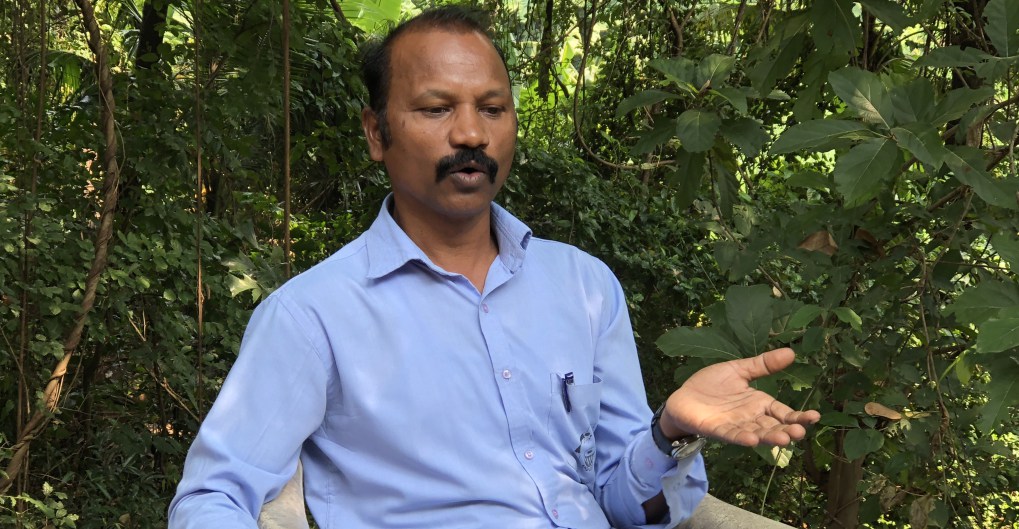
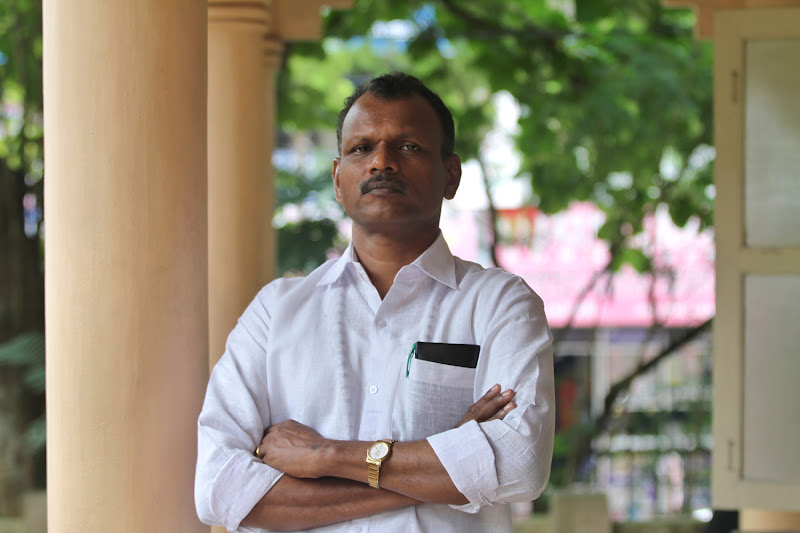
Aikya Mala Araya Maha Sabha is a developmental organization working towards the welfare of the Mala Araya people in Kerala. In an interview with Aathira Konikkara, a reporting fellow at The Caravan, the founder and general secretary of AMAMS, PK Sajeev, discusses the Mala Araya’s beliefs about Ayyappan, the disputed belief regarding women entering the temple and the Brahminisation of rituals in the temple. “That is my biggest point of protest,” Sajeev said, referring to the Mala Arayas’ role in Sabarimala. “History is being deliberately neglected.”
First Published on https://caravanmagazine.in/
Aathira Konikkara: Which rituals and customs did the Mala Araya’s practise before the Thazhamon Madom took over?
PK Sajeev: Sree Ayyappan was born in this [Mala Araya] community to Kandan and Karuthamma, in a cave in Ponnambalamedu [a district in Kerala near the Sabarimala temple]. During this period of history, the Cholas had been on the offensive against Kerala for over 100 years. Kandan and Karuthamma had approached a priest known as Korman, praying for a solution to defeat the Cholas. It is said that they were told to fast for 41 days so that they would have a son who could defeat the Cholas. So the 41-day fast emerges from Sree Ayyappan’s birth. Sree Ayyappan, as the commander, mobilised the people against the Chola dynasty. He united all the people who were trained in martial arts and became a force of strength. That is how they faced the Cholas.
The Mala Arayas looked after the temple till the 1800s. The rituals came into being after Ayyappan attained samadhi. The ritual of the 41-day fast is what makes Sabarimala distinct from other temples.
As far as I have read, the numbers 18 [in reference to 18 steps leading to the temple’s sanctum sanctorum that is considered sacred] and 41 [in reference to the 41-day fast that has to be kept before the Sabarimala pilgrimage] do not hold any importance in Hindu mythology. The 18 steps are symbolic of 18 hills [that surround Sabarimala] in the Mala Arayas’ belief. One must visit Ayyappan only after saluting the 18 hills.
The customs of the Mala Araya community entered Sabarimala. Later, it was Brahminised. The 18 steps were later given other terminologies such as Sama, Dhana, Bheda or something along those lines. Neyyabhishekam [the offering of ghee to the deity, which is the first ritual that pilgrims perform upon reaching the temple] is not ancient. Before that, the Mala Arayas performed thenabhishekam after the 41-day fast—they collected honey and bathed the idol of Ayyappan with it. This was the most important ritual.
AK: When and how were the Mala Arayas ousted from Sabarimala?
PKS: This was around the 1800s. It had only been a short while since the king of Pandalam started ruling there. Kerala had laws such as head tax and breast tax. [Till the mid-nineteenth century, Kerala imposed taxes on all members of lower-caste communities to cover their head and on women from these communities to cover their breasts.] Abuses and atrocities were rampant. From what I hear, everyone was threatened and driven away from the hills. They had to flee their homes—our ancestors in Karimala had to go as far as Thodupuzha.
These were innocent people with no one to protect them. Today, we have a constitution to protect us. But back then, the powerful attacked the innocent.
AK: How did the Thazhamon Madom family take charge of the temple? After they took over, were there any changes in the temple and its customs?
PKS: The responsibility was entrusted to them by the kingdom of Travancore. Around 1942, when the kings visited the temple for puja, they brought their own thantris [the Thazhamon Madom family] for the purpose. The Padi Pooja [worship of the 18 steps] did not exist before. All the customs practised there today were introduced by them.
Ayyappan is Ayyan + Appan. Appan [father] is someone we respect. Ayyan was a name commonly used among people of ancient times. In our community, a majority of us had grandfathers named Ayyappan. But we don’t see anyone named Ayyappan Namboothiri. Even after earning an income from Sabarimala for centuries, why has nobody in that family been named after Ayyappan?
AK: What changed after the TDB was established in 1950?
PKS: Majority of temples in Kerala, which belonged to Parayars, Pulayars, Sambavars or Adivasis were Brahminised and adopted other customs—including temples managed by my own community such as the Karimala and Nilakal Mahadeva temple. These are now administered by the Devaswom board. The Valliyankavu Devi temple, which receives devotees in large numbers, is also now run by the Devaswom board.
AK: How did Makara Jyothi originate in the Mala Araya faith?
PKS: When Sree Ayyappan attained samadhi, his parents in Ponnambalamedu were inconsolable on receiving the news. Sree Ayyappan appeared before them and said that he would appear every year as jyothi [flickering light]. [The] ritual is performed to receive the jyothi [in the Ponnambalamedu district]. Earlier thellipadi [fire-inducing material] was used. But now, camphor is used instead.
The forest officials harassed the [Mala Arayas] living in the forests in various ways. They used to go back to practise the ritual even after that. But when threats and harassment increased, it became impossible. Aruvikkal Appooppan was a priest and an oracle in Karimala. He had to move to Kalaketty village due to the threats. He still walked all the way back to light the lamp and had to trek several hills to make it. Forest officials and people from the Devaswom board threatened him and drove him away.
AK: What is the existing archaeological evidence of the Mala Arayas’ life in Sabarimala?
PKS: The temples were built from ancient rocks, nearly 10,000 years ago. Intricate sculptures were carved on to the pillars of the temple. They were found in Karimala, Ponnambalamedu, Kothakuthithara, Nilakkal, Thalaparamala and so on. They are in ruins now. They were abandoned in forests—these were deliberately neglected as a part of the plan to introduce new customs and traditions. Today, you won’t see those kind of idols. Old idols were disposed and replaced with new ones which were projected as idols.
A civilisation and a culture was lost. That is my biggest point of protest—that history is being deliberately neglected.
AK: Are there members of the Mala Araya community still living in Sabarimala or the surrounding regions?
PKS: Yes. They live in four hills—Udumbaramala, Koparamala, Nilakkal and Karimala. They constructed new temples for worship because they cannot return to the places under the control of Devaswom board—they cannot be challenged.
AK: Have you considered resorting to legal remedies?
PKS: Yes, we are planning to move the Supreme Court. Many have asked me why this issue was not raised earlier. The British ruled India for 200 years—our predecessors could have asked for their rights 10 years later or even 100 years later. But they were unable to question it in the face of threats. [We] were evicted from Ponnambalamedu the way Red Indians were evicted from America. After the kingdom’s rule, it was the reign of forest officials in these regions.
The SC verdict was historic and instrumental in giving us an opportunity to speak up. It created a huge opportunity for us to reveal a historic truth. We want all the rights restored.
The ownership over the temple was with a member of our community. We want the right to perform the thenabhishekam, which was practised on the 1st of every month, as per the Malayalam calendar. We also want the right to practise the ritual of Makara Jyothi in Ponnambalamedu. We are not asking for anything new—these were experiences of our forefathers.
In a democratic country, those who are in power should restore the rights to those who lost them. The Mala Araya cannot be compared to other communities because traditions are to us what water is to fish, what air is to humans. Even when a tree grows up, it cannot stay on earth without its roots.
AK: Do you agree with the Supreme Court verdict on women’s entry into Sabarimala?
PKS: They can go if they are going out of faith. To tell you impartially about what I have seen in my community, women did not go to temples during the seven days of periods. I have never heard of any instance of young women from the Mala Araya community going to Sabarimala [while menstruating]. [But even] back then, after a delivery, women resumed their periods only after some [one or] two years. They could follow the 41-day continuous fast completely—one or two have gone in those situations.
We as a community stay rooted in our beliefs. But as a part of democracy, we greatly depend on the constitution, the judiciary, the government and we are very much aware that such systems are what sustain the nation at all times. It is a change towards a mature society.
We perceive this as Sree Sabareesan, Ayyappan’s, own people. So if women of that age group go there, our faithful evaluation is that they are going there because they wish to see Ayyappan, because Ayyappan has invited them there. Not activists, those who go there out of devotion. Why will we stop those who go to see Swami, to see Ayyappan? Obstructing them is equal to obstructing Ayyappan.
AK: I had read another article where you stated that the Mala Araya don’t see a distinction between men and women …
PKS: No, we don’t see a distinction. The Neeli Mala hill is named after Neeli, a woman. In Ramayana, there is a portion known as Shabari Ashrama Pravesham. That hill is known in the name of Shabari [a woman]. Remember that Sree Ayyappan chose Sabarimala for his penance after praying to the ascetic, Shabari. Karimala was ruled by a woman from the community named Chakki—the region had several human settlements. So a woman from the community could become the ruler. Similarly, a woman who is an ascetic can also rise up. None of that is forbidden in terms of faith.
Courtesy: https://caravanmagazine.in/
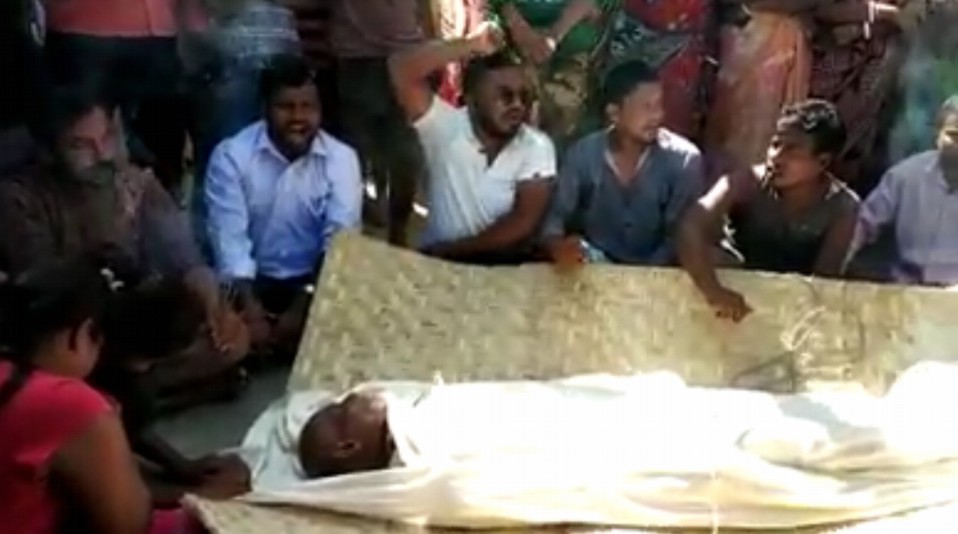
EXCLUSIVE: Despairing of Justice, the 30th Citizen commits Suicide in Assam: NRC
After being falsely accused of being a ‘foreigner’, Deepak Debnath of Udalgiri district, Assam committed suicide by hanging himself in a grove near his house. This is the thirtieth such incident in the span of four years since the process of updating NRC.
This was a tragedy foretold. In the run up to the publication of the final draft of the NRC, a number of last minute decisions taken by the NRC state coordinator and a sudden rise in the number of cases of ‘D-voter’ being referred to foreigners tribunals by the border police in Assam, has ensured that a number of genuine Indian citizens were left out of the register.
The many potent ramifications of such a move was not lost on the men and women who found themselves excluded. That some of them would be pushed to take an extreme step was certainly possible. An alert, compassionate state government might have taken steps to alleviate fears and ensure that the the natural principal of ‘innocent until proven guilty’ was clearly communicated. And since no such move is forthcoming from the ‘leaders’ in Assam, many more of such tragedies seem to be now a certainty. Sabrangindia has painstakingly collated this list of suicides that we will be releasing shortly.

Mr Debnath’s name had appeared in the first draft of the NRC, published on December,31, 2017 but had been struck off the NRC final draft released on 30th July this year. The reason listed for rejection was a ‘Pending case in Foreigners Tribunal’ case that the Border Police has mysteriously foisted in him in the intervening months. In a cruel twist of fate, his ‘legacy’ data, that establishes him as a bonafide Indian citizen as his name in the 1971 voter list.
The humiliation of being labelled a ‘foreigner’ in his own land, fearful of what the future holds for him and his family, especially in the light of rampant fearmongering by right-Wing politicians and regional supremacist groups, Deepak Debnath chose to kill himself today morning. Watch Sabrangindia’s exclusive reportage here.
In our efforts to bring national focus to the tragedies unfolding in Assam, Sabrangindia has been reporting on the entire process. The
ramifications of this curiously exclusionary process are far-reaching especially for persons who hail from marginalised communities and have little access to the laborious criminal justice system. The combination of a callous bureaucracy and a politically motivated process, skewed by the current RSS-BJP ruled dispensation has converted, the entire process of the compilation of the National Register of Citizens (NRC) into a maccabre tragedy.
This is even as the Supreme Court monitors the process and the ‘mainstream media’ selectively reports on this hug process underway in Assam.
Assam: Deepak Debnath’s ‘legacy’ data was his name in the 1971 voter list. It establishes him as a bonafide Indian citizen
Related Articles
EXCLUSIVE: Suicides in Assam Continue, after NRC dubs retired School Teacher, ‘Foreigner’
Labelled as a foreigner, Assamese man dies in detention camp
Another Suicide in Assam due to the ‘Foreigner’ Issue
Meet this Lover of the Aarey Forest, Prakash Bhoir
Reclaiming Forest Land, One Tree at a Time

Prakash Bhoir is a fiery Adivasi activist from Aarey, whose consistent initiatives have helped shed light on the condition of Adivasis in this forest. The Aarey forest, located in the Northern suburbs of Mumbai, is the only green cover in the area, and is known for its lush greenery, with tall trees, grasslands and rocky hills. The Aarey land has consistently faced onslaughts from many development projects, and is home to Warli Adivasis who are on the brink of getting displaced from their land, and losing their livelihood.
“Sometimes the trees come in my dreams. They say, you gave us life, but will you be able to keep us alive? Will I be cursed if these trees die?”- Prakash Bhoir
The walk to Bhoir’s house in Unit 18 in Kelti Pada (an Adivasi settlement) has abundant sunshine, and is dotted with exquisite flora and little streams of water flowing from the nearby dairy farm. The streams have been intelligently used to water the plants and trees in the area. His house is built of mud, amid massive trees, and blends with the natural exterior. Several Warli paintings adorn the mud walls. Bhoir also makes arrangements for environmentalists, researchers, and students, so that they can come and stay in the forest and communicate the importance of saving these forests to the world outside.

CJP team with Prakash Bhoir and Amrita from Save Aarey campaign
“Earlier this was a dense forest. We extract honey from the trees and there are multiple varieties of fruit bearing trees. Drumsticks grow very well in the area. These are very nutritious too. But the forest is disappearing fast,” says Bhoir, talking about the current condition of the Aarey forest land.
Recalling various government projects here, he says, “First came a veterinary. Then the SRPF which acquired 200 acres of land. Force 1 too is now situated here. And now the Metro line construction has started. I wonder what will happen to the forest.” A natural fallout of the development projects is that the Adivasis lose their land every time there is a new project. Many of them are now being pushed into Slum Rehabilitation Authority (SRA) buildings, in precarious conditions. This also disconnects them from the forests, the main source of their livelihood and survival.
The Aarey dairy farm is located inside the forest. Bhoir is of the opinion that when the dairy business went into loss, the land that had been acquired from the Adivasis should have been returned to them. However, this land started getting distributed for various other purposes.
‘Vikas nahi, Vinash’
Highlighting the precarious situation in which Adivasis are staying, Bhoir asks, “What does development mean? People should have electricity and water, right? But when Adivasis try to get the NOC (No Objection Certificate) for any kind of water supply, they don’t get it. He adds that research by a group of TISS students revealed that the water available in the forest is polluted, and is unfit for even animals to consume.

Water storage in Adivasi household
“This is destruction in the name of development,” he says.
Per Bhoir, the multiple development projects in the area have impacted Adivasis’ farming, their cattle, as well as the wildlife. “We are the people responsible for the green cover of Mumbai. With our expertise we help nourish the trees, which in turn give oxygen to the environment. Can you say that our existence is futile? We are giving the city its oxygen,” he says.
Bhoir remarks that any time one talks about the supposed development projects, it is the Adivasis who are sacrificed at the altar of this development. Essentially, he says that the existing notions of development have actually been very violent to Adivasis. He adds, “They [the authorities] say that we will shift you to SRA buildings. Sometimes in the name of zoo construction, today in the name of Metro. This has been going on for past 8-9 years.” Instead, there is a need to radically reverse this notion of development.
“Development should be seen the other way round. Instead of constructing more buildings, why don’t we grow forests in the concrete jungles?” asks Bhoir.
Uncovering the farce of afforestation projects, Bhoir says, “The way most of these afforestation drives work is illogical and unscientific. How can you plant twenty-five trees at mere spacing of a foot or less. What happens to the trees when they grow up? This proves that the approach is incorrect. Most of the saplings planted during afforestation projects die in this manner.”
Talking about the unscientific way of transferring trees from one place to another for ‘city beautification’ purposes, he says, “They dig out trees from one place and plant them to another. So many trees have died like this.”
Lover of the Forest
“We were the kings of the forests. When SRPF came inside the forests in 1975, they snatched away our water reserves. Today, we have to take permission to drink water,” says Bhoir, who is committed to protecting the interests of Adivasis who are not willing to leave their ancestral lands.
Bhoir is now on a mission to safeguard trees. He has built a small nursery around his house. He plants and nurtures good quality saplings and seeds, so that these become healthier trees later. He hasn’t yet started selling these, but may have to sell them in the future.

Prakash Bhoir’s nursery
He is keen that people should visit the forests and see how the Adivasis are living and how their lifestyles have changed.
“We live in great fear. This has an impact on our culture too. We don’t feel like dancing and singing since we live in fear and our minds aren’t free,” says Bhoir about the Warli culture.
Bhoir’s house is adorned with a host of Warli paintings, on different surfaces, done by different members of his family. Some paintings were done on old mushrooms. The colonisation of the forest is reflected in the art as well. The paintings that used to depict the Adivasis’ daily lives, forest animals as deities, weddings etc. are now dotted with helicopters, bridges, and roads. Bhoir believes that this is the subconscious effect of the various security training camps that have been built on the forest land.

Warli paintings on Wild Mushrooms
Bhoir, who juggles his job in the BMC’s water department and his role as Deputy Chief of Shramjeevi Sangathana, Mumbai, which is working to save the Aarey land, says, “My children say that no matter the nature of assaults, we will preserve our land. We are not going anywhere!”
Courtesy: https://cjp.org.in
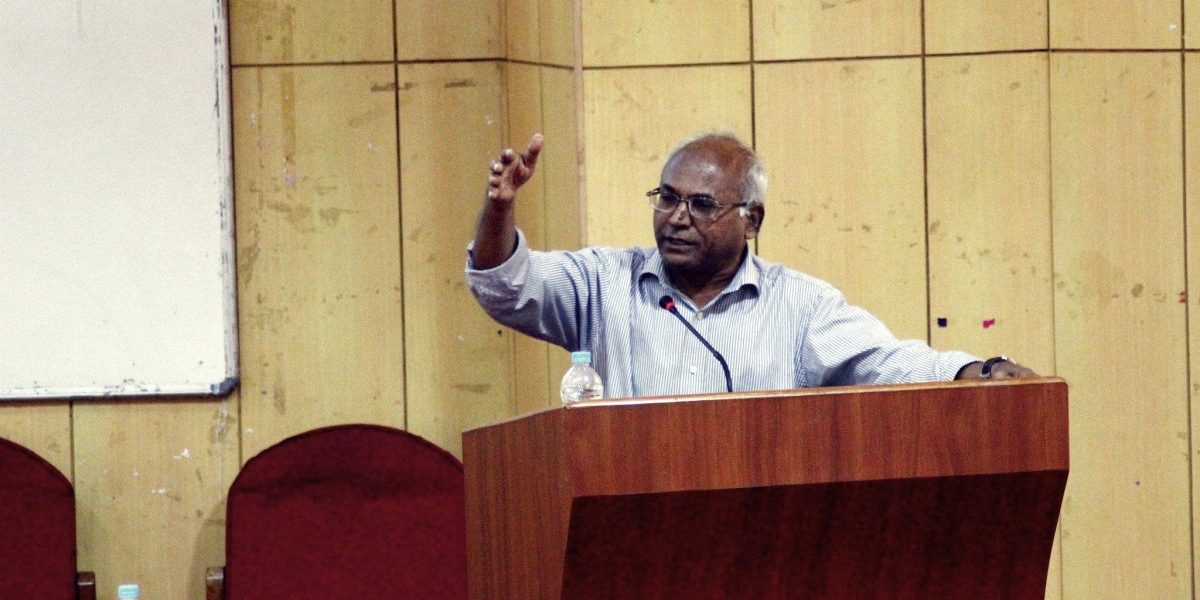
Members of DU’s Academic Council Protest Removal of Kancha Illaiah Shepherd’s Books
Prominent members of DU’s Academic Council have strongly protested the university’s decision to remove Kancha Illaiah Shepherd’s books from the curricullum, In a letter written to Vice Chancellor Yogesh Tyagi, Indira Chandrashekhar, Deo Kumar, Jyoti Sabharwal, Mohd. Riyazuddin Khan, Sachin N., Saikat Ghosh, Shashi Shekhar Prasad Singh and V. S. Dixit have said that “The Standing Committee on Academic Affairs carries no brief on the privilege of determining the academic value of his works. By branding him ‘anti-Hindu’, it conflates the philosophical critique of Brahminical Hinduism with the abuse of faith.

The entire text of the letter may be read here
Prof. Yogesh K. Tyagi
Vice-Chancellor
University of Delhi
Delhi – 110007
October 26, 2018
Sub: Reg. the Standing Committee on Academic Affairs’ decision to recommend removal of Sh. Kancha Ilaiah Shepherd’s works from the Political Science M.A. Syllabus and the decision to disallow use of the term ‘dalit’ in academic discussions, teaching and learning
Dear Prof. Tyagi,
We express our dismay and disappointment at the manner in which certain members of the Standing Committee on Academic Affairs have held academic exercises to ransom. On the basis of their ideological predilections, they have repeatedly resorted to censoring curricular content in the Humanities and Social Sciences. We have communicated our concerns to you on this matter previously, in relation to the Standing Committee’s arbitrary decision to recommend removal of Prof. Archana Prasad’s and Prof. Nandini Sundar’s work from the M.A. History syllabus. We are yet to receive any response from your office. We are compelled to write to you again, alerting you to the unnecessary and completely avoidable controversy that the Standing Committee has created around the use of the term ‘dalit’ and the works of the renowned Dalit thinker and political philosopher Kancha Ilaiah Shepherd that were included in the Draft M.A. syllabus of the Political Science Department.
Based on widely reported details in the media and public statements made by certain members of the Standing Committee, we have learned that Sh. Kancha Ilaiah Shepherd has been branded “anti-Hindu” and that the Standing Committee has decided to recommend removal of his works Why I am Not a Hindu (1996), Buffalo Nationalism (2004) andPost-Hindu India (2009) from the M.A. Political Science syllabus. We are also alarmed to learn that the Standing Committee has decided to replace the term ‘dalit’ with ‘bahujan’ in every possible academic reference within the context of teaching-learning in University of Delhi.
If the above-mentioned details are true, we wish to place on record to the following points of contention:
1. The term ‘dalit’ is widely used in academic discourse. It is an acceptable coinage, as can be evidenced from the widespread use of categories like ‘Dalit Movements’, ‘Dalit assertion’, ‘Dalit Political Philosophy’, ‘Dalit Literature’, ‘Dalit Poetics’ etc. The Standing Committee has been wilfully misled into believing that the Supreme Court has proscribed the use of the term. In fact, the Supreme Court has directed public institutions to use the terms ‘Scheduled Castes’ and ‘Scheduled Tribes’ instead of the terms ‘Dalit’ and ‘Adivasi’ in official correspondence pertaining to Government Policy as the former terms are strictly juridico-legal in nature whereas the latter terms are political and cultural. To conflate juridico-legal contexts with academic discourse shows a terrifying lack of sensitivity on the part of a Standing Committee that assumes the right to advise faculties and departments on the finer points of curricula and syllabi.
2. Sh. Kancha Ilaiah Shepherd’s intellectual accomplishments need no certificate of merit from the University of Delhi. He is an internationally renowned political philosopher and his works are studied as part of course-readings and syllabi in the best universities across the world. The Standing Committee on Academic Affairs carries no brief on the privilege of determining the academic value of his works. By branding him “anti-Hindu”, it conflates the philosophical critique of Brahminical Hinduism with the abuse of faith. Abuse of faith is a recognisable offence in law and punishable under appropriate provisions of the Penal Code. To our knowledge, no criminal charge of abuse has ever been brought against his writings; nor have any of his books or articles been proscribed by law. Hence, the Standing Committee has clearly overreached itself. Additionally, in publicly representing the Standing Committee’s position against Sh. Kancha Ilaiah Shepherd’s writings as “anti-Hindu” the named members are guilty of defaming him and making libellous remarks to demean his stature. If the University of Delhi endorses the Standing Committee’s hasty decision and the justification provided by the members to the Press, it becomes complicit in defamation and invites legal action against itself.
3. The Standing Committee neither possesses the required domain-expertise nor the statutory prerogative to excise readings from a Draft Syllabus prepared by an authorised Committee of Courses comprising of subject experts. It can advise or seek clarification from the concerned department (in this case, the Political Science department) but it cannot override the academic decisions of the department and faculty. If the Standing Committee is allowed to ignore the appropriate locus of academic decisions, it becomes an instrument of tyranny.
4. The Standing Committee cannot be used as an ideological platform to police or limit the spectrum of opinion that learners are entitled to. It is unfortunate that in recent times, the Standing Committee has been repeatedly used to purge all divergent ideas and formulations that are found to be critical of the dominant ideology that the ruling dispensation subscribes to.
We yet again urge you to intervene and ensure that fairness and objectivity is restored in the functioning of the Standing Committee and the decisions of the Academic Council. For a start, your office is urged to immediately reverse the exclusion of elected AC members of a different ideological persuasions from the Standing Committee on Academic Affairs. The recent decisions of the Standing Committee have drawn public criticism from many quarters of civil society and the international academic community. If this destructive trend remains unchecked, it will tarnish the reputation of our University as a liberal and democratic institutional space for free intellectual enquiry and exchange of ideas.
We hope that your office will consider this matter as urgent and issue appropriate caution to the Standing Committee so that the academic prerogatives of the Committees of Courses in the departments of Political Science and History are safeguarded and the erroneous decisions of the Standing Committee are set aside. We also hope that the University of Delhi will issue an official apology to Sh. Kancha Ilaiah Shepherd while immediately withdrawing the slander (attributed to the Standing Committee constituted by the University of Delhi) against him that has unfortunately been put on record in the public domain.
Regards,
Indira Chandrasekhar (Member, Executive Council and University Court)
Deo Kumar (Member, Academic Council)
Jyoti Sabharwal (Member, Academic Council)
Mohd. Riyazuddin Khan (Member, Academic Council)
Sachin N. (Member, Academic Council)
Saikat Ghosh (Member, Academic Council)
Shashi Shekhar Prasad Singh (Member, Academic Council)
V. S. Dixit (Member, Academic Council)
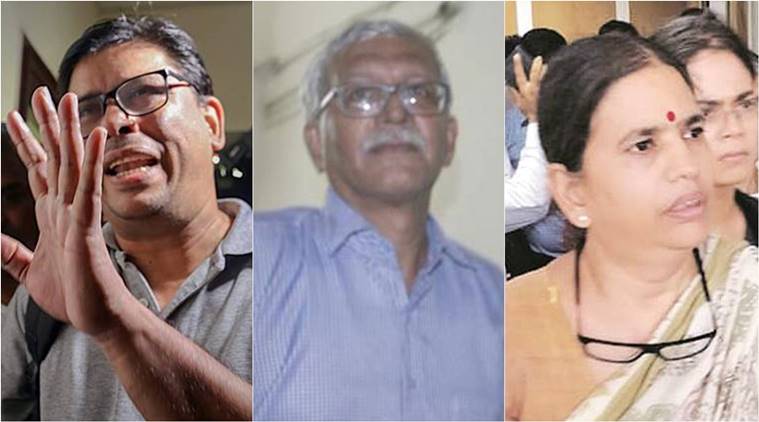
Three Lawyer-Activists Arrested as Pune Court rejects Bail Pleas
Rejection of bail pleas by Pune court on the last day of house arrest paves way for custody. The SC also rejected the review petition seeking extension of time for house arrests

While Vernon Gonsalves and Arun Fereira were feretted away by the Pune police in Mumbai within minutes of the Pune court rejecting their pleas for bail, the police waited outside Sudha Bharadwaj’s home from the midnight of October 26-27
Drama over the arrests of renowned human rights activists and lawyers continued into the midnight of Friday, October 26 as the Pune Sessions Court, in a much awaited order, dismissed the bail pleas of Arun Fereira, Vernon Gonsalves and Sudha Bharadwaj. Gautam Navlakha has been protected from arrest until November 1 and a Hyderabad Court has extended the house arrest of Varavara Rao for three weeks.
The review petition filed by Romila Thapar and others in the Supreme Court of India was dismissed in chambers on October 26 itself though news of the same only reached the public around noon on Saturday, October 27 when it was uploaded on the website. While the Pune police had reached the homes of Fereira and Gonsalves by four p.m. on October 26, while they had also arrrived at Sudha Bharadwaj’s home outside Delhi at midnight, until 1 p.m. they had not taken her into custody. All five activists-lawyers were under house arrest for a time period until October 26, a time period extended by the Supreme Court allowing them time to seek bail or other remedies in appropriate courts.
The Bail Order of the Pune Court dismissing the bail applications may be read here.
The SC order dismissing the Review Petition may be read here.
Activists and human rights organisations, of which Citizens for Justice and Peace (CJP) is a part will be addressing a press conference on Saturday, October 27 at 3 p.m. to protest the high handedness of the Pune police.
On Friday, arguments continued in the Bombay High Court for over four hours on matters related to these hasty arrests. Like Anand Teltumbnde, an academic and professional, who ahd been raided on August 28 (though not arrested), Fr Stan Swamy has also moved the Bombay High Court to quash the investigations naming him as involved in crimes. He has been protected from arrest, as has Anand Teltumbde until October 31. Eighty-one year old Stan Swamy, a Jesuit priest from Ranchi and an active part of all human rights movements moved his petition on October 24.
The petition filed by Fr Stan Swamy may be read here.
The FIR in the case, lodged by Pune resident Tushar Damgude on January 8 (Cr 4/2018), initially named Harshali Potdar, Sudhir Dhawale of Republican Panthers, Sagar Gorkhe, and Ramesh Gaichor, Jyoti Jagtap, Deepak Dhengle of the Pune-based Kabir Kala Manch. It claimed that the accused, as per the strategy of the CPI- Maoist, “mislead the Dalits and spread thoughts of violence” in their minds.
In an earlier bout of arrests, on June 6, the Pune police had arrested activist Rona Wilson, Nagpur-based lawyer Surendra Gadling, Nagpur University professor Shoma Sen, former Prime Minister Rural Development fellow Mahesh Raut and Sudhir Dhawale in connection with the case.
In an investigation that has, been in turn called roving and predatory, the Pune police have alleged that the suspects played a role providing funds of banned CPI-Maoists to Elgaar Parishad. All those arrested/placed under house arrest, were charged under the Unlawful Activities (Prevention) Act (UAPA). On August 28, cops arrested Bharadwaj, Varavara Rao, Gonsalves, Ferreira and Gautam Navlakha, alleging them to be part of larger plan of banned CPI-Maoist to form a front called “Anti Fascist Front” to overthrow the democratic government. However, the Supreme Court, in response to a review petition placed them under house arrest, a proviso that was extended to today, October 26.
Later on September 28, SC dismissed a petition for a SIT probe in the case filed by Romila Thapar and others and said the five activists would remain under house arrest for four weeks. But the court had also said the accused could seek legal recourse at the appropriate court.
Yesterday, October 25, Thursday, a high court in Hyderabad extended Vara Vara Rao’s house arrest by three weeks. Earlier, the Delhi High Court had, on October 1, ended Navlakha’s house arrest. The Maharashtra government has moved the Supreme Court against the Delhi High Court order.
Accused persons Shoma Sen, Surendra Gadling, Ferreira, Gonsalves, and Bharadwaj had moved their bail applications before special judge K D Vadane in Pune. Opposing the bail applications, district government pleader Ujjwala Pawar had argued that investigation is at a crucial stage. Pawar produced letters recovered from the digital material seized from some of the accused persons claiming that these alleged Maoist communications show and there is a prima facie evidence to show that accused persons are active members of banned CPI-Maoist.
Defence lawyers Dhairyasheel Patil, Rahul Deshmukh, Yug Choudhary, Ragini Ahuja argued that letters being produced by police as evidence are unverified and make no sense. So Pawar produced two email communications allegedly between P Vara Vara Rao and Ganapathy,the secretary of banned CPI-Maoist.
In these emails exchanged in July this year, Pawar said that the alleged Maoist leader expressed concern about seizure of confidential letters by police and need to find out by whose negligence the letters were leaked, what method or technology was used by intelligence agencies for getting access to these letters and understand full scale of the breach.
Meanwhile, on Wednesday, a Bombay high court set aside an order of Pune court granting 90 days extension to the police to file a charge sheet against five persons arrested in June in the case. Justice Mridula Bhatkar ruled that the Pune court order giving the extension and thus subsequently extending the custody was ‘illegal’.
Though the order would have facilitated a default bail for the five accused as per the provisions of the law, Justice Bhatkar put a stay on her own ruling from becoming operational till November 1, after state government’s plea for the same for moving the Supreme Court against the same order.
State government then filed a special leave petition in this regard before the SC and hearing on it is expected on Monday. Meanwhile, in the view of high court order, special court in Pune decided to hear the bail applications of Gadling and Sen after November 1. And today the special court rejected bail applications of remaining three accused persons.
Related:
State Crushing Dissent Again!
Raiding the Resilient
The Truth about the Elgaar Parishad
SC directs arrested Human Rights Activists be placed under House Arrest
SC disposes off Petition against Arrest of Activists
Freedom in Sight for Surendra Gadling!
Bhima Koregaon Case: Maharashtra Gov’t moves SC against Bombay HC order
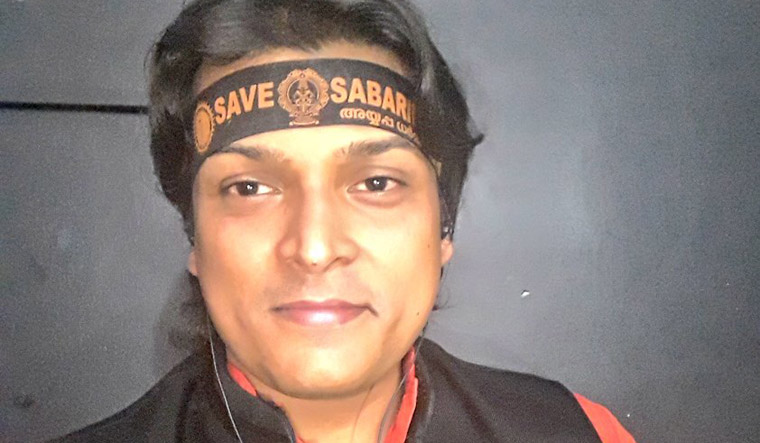
Meet Rahul Easwar, Brahmin activist fighting to ‘protect’ Sabarimala from Women
For the Brahmins who hold the priesthood in most temples and the Nairs who hold the administrative works in the temples, women’s entry in Sabarimala is a major blow to their authority over the temples. They feel the threat from the Constitution which ensures equality. … The recent emancipatory Supreme Court verdict opens up the possibility of the court also seeking to allow lower caste priests into Sabarimala

Two months after the devastating flood, Kerala has been in the limelight again – this time for one of the most regressive reasons. This is tragic, especially for a state, which is otherwise hailed for its progressive ideas. The landmark verdict of the Supreme Court allowing women’s entry to Sabarimala and the state government’s welcoming stand on the verdict infuriated the conservative sections of the state – across gender and religion. Both the BJP and the Congress took it as an opportunity to slam the state government for allegedly endangering Hindu customs and rituals. The five days during which the temple opened for monthly rituals witnessed widespread attack across the state against women, journalists and even the police.
There has been much debate around the globe around the idea of whether democracy and Islam can function together. However, few discussions on the contradiction of Brahmanism and democracy are audible (or visible) beyond narrow academic discourse.
Only Dr. Ambedkar understood the possible oxymoronic existence between the two; and that is why, possibly, where the Constitution of India acquires its uniqueness from. Ideologically, the Constitution stands in sharp contradiction to the fundamentals of Brahmanism.
The Constitution stands for equality as opposed to Brahmanism which is founded on ascribed inequality. The Indian state, post Independence, did not work towards downsizing Brahmanism or Brahmanical hegemony; on the contrary, it allowed the existence of institutionalised power centers of the Brahmanisms like the Sankaracharya Mats with their numerous rituals. Within the Kerala version of such Brahminic institutions, it is the Thazhamon and Tharananellur families who have continued their domination on the social system and the Hindu shrines in the state.
Interestingly, both the BJP and the Congress were not at the forefront against the Supreme Court’s Sabarimala verdict in the first few days; especially with both the centralised leadership of both parties welcoming the verdict. But then, it was one man – Rahul Easwar, who made the first call to mobilise devotees to ‘fight’ against the verdict. Easwar, who claims to belong to the Thazhamon family becomes relevant in Kerala not because of his activism but because of the social system which rebuilds and glorifies upper caste patriarchal society. Hence to talk about Rahul Easwar is to talk about the Brahminical system in Kerala. The question is not what he is but how he came to be what he is.
Rahul Easwar’s website and his Wikipedia page say he is an activist and the qualification mentioned is the he has been an invitee in numerous channel discussions, including national channels. Why is he an invitee on these channels? This self proclaimed activist belongs to the most prominent (and powerful, monetarily, socially and politically) Brahmin family which controls the Sabarimala temple. So let’s understand this – Eswar’s fundamental significance is that he belongs to the Thazhamon family. Or to put in a different way – what makes Rahul important is the social capital of being a Brahmin.
The one who speaks with the utmost clarity about Easwar’s politics is himself. “I am not a liberal, I am an advocate of Brahmin-Savarna politics”, said Easwar during a channel discussion. Given the public space of Kerala, it is not possible to envisage what a person from a ‘lower’ caste, possibly with a dark complexion would say at the same time, in the same situation, even if he belongs to the RSS cadre which profess the same ideological position as Easwar.
It would not be wrong to say that Rahul Easwar is even more credible than the RSS in Kerala. He is able to make himself acceptable within the liberal space of Kerala and beyond. Even those who stand against the BJP in Kerala might not necessarily see a problem with him. And that is because, the majority still thinks that Brahminism is serene and respectful, an idea which grows naturally in the given social context of Kerala and beyond.
Although not a BJP or RSS member, the politics of Rahul Easwar is undoubtedly most beneficial to the BJP in Kerala. Easwar was the first one to openly come out against the Supreme court verdict and created a riot like situation among believers. In the following days, it was natural that the BJP would alone reap the benefits of Eswar’s acts.
The re-assignation on the impurity of menstrual blood in the name of Lord Ayyappa is nothing but the reproduction of the savarna patriarchal ideas which people like Easwar represent. Prima facie, he says the rituals and beliefs of Hinduism must be followed. That the Brahmins themselves have gone through several reformations within, by going against what were called as beliefs, just years or decades before, is conveniently side-stepped, if not completely ignored.
For instance, now, only the first son of a Brahmin family in Kerala is expected to marry a Brahmin woman as per the traditional Brahmin family. The other males of the family are supposed to have relations with Nair women which is not a marriage. The relationship between a Brahmin male and a Nair woman is called ‘Sambandam’, which was practiced until a few decades before. Easwar himself married a Nair woman and did not keep a ‘Sambandam’. For Waswar, such an internal reformation within the Brahminical system is acceptable but women entering Sabarimala goes against beliefs.
This selective double standard on what can be reformed and what not, stems from the socio-economic interests of the Upper castes. For the Brahmins who hold the priesthood in most temples and the Nairs who hold the administrative works in the temples, women’s entry in Sabarimala is a major blow to their authority over the temples. They feel the threat from the Constitution which ensures equality.
Recently, a document emerged on social media and was shared widely. It was a document that revealed how a priest from a ‘lower caste’ was rejected after applying for a post at Sabarimala. The recent emancipator Supreme Court verdict opens up the possibility of the court also seeking to allow lower caste priests into Sabarimala, if approached. This is the threat that the current Brahmin-Nair nexys foresees as an outcome of the recent Supreme Court verdict.
In conclusion: the Sabarimala Supreme Court verdict is a landmark milestone which shakes the foundation of Brahmin-Savarna patriarchal monopoly over Hindu temples and their wealth. As long as hundreds of other castes and cultures also consider themselves ‘Hindu’ — and are called Hindus by the law and by savarnas — only such democratising measures promoting ideas of equality can serve justice to every section within the ‘Hindu’ fold including its women.
Related Articles:
1.Supporting entry of women at Sabarimala, Former Guj DGP writes to Kerala CM
2. Chaos in Kerala as Sabarimala Temple opens its Doors to Women of all Ages
3. Unholy and Unconstitutional: the ban of women from Sabarimala
Barbarism normalised: The Killing of Young Azeem
Is this because of the excessive consumption of violence dished out on TV or the killing and hate being celebrated on whatsapp? I am afraid this could be a possibility. Let this celebration of violence and killing be stopped as it will destroy us all, completely. Nothing will be left if we don’t ponder over this. Now. The dangers of children being used as a tool for spreading political propaganda, hatred and poison in the name of caste and religion.

The incidents of lynching, killing and abusing the ‘enemy’, particularly Muslims, in India, have become a norm. The vast majority in the country appear to be either satisfied with justifying such acts or calling them ‘aberrations’. Every time such incidents happen, some of us shed tears, visit the families. Some of us conduct fact findings, other go and share their agony. But things remain unchanged. The thugs responsible for this hate-mongering in politics justified as ‘anger’ are actually gloating. They feel, such killings suit their political interest.
You make a million effort to ensure that the people, and the polity debate the issue of the ongoing economic crisis that we are facing, but end of the day, they bring Hindus, Muslims, Pakistan, Gaay, Ganga, Ram Mandir, anti Hindu and so on to the forefront. This agenda is being set from Nagpur and the agent-provocateurs are visible playing their ‘victim card’ notion in television studios.
India is fast plunging into the dark ages where violence and hatred become a norm. Right now, it does not affect all others, but I can bet that it will haunt those who have initiated the process, soon, too. There are various reasons behind these things including the economic one which places the most vulnerable communities at war with each other, make them enjoy being hateful to each other, while those who are the real perpetrators ‘enjoy’ the fallout.
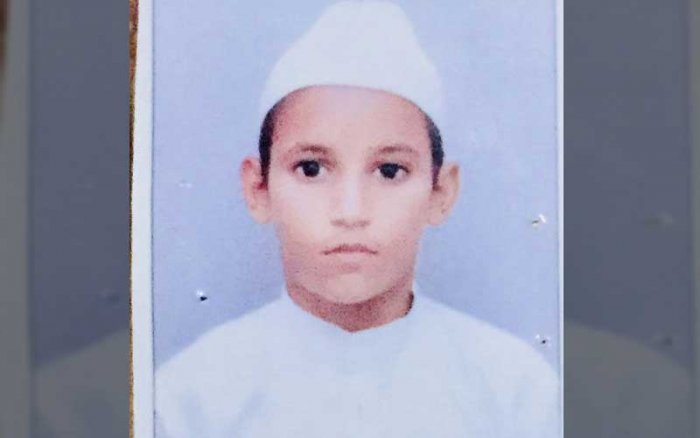
The killing of an eight year old boy, Mohammad Azeem, who was a Madarasa student in Malviya Nagar in South Delhi is today at the centre of discussions. Some claim it was lynching while others say it was a ‘fight among children’. Young boys beat Azeem to death. Whatever be the case, it is a killing. Is it a hate crime or not? This is the question that needs to be fore grounded.
The Madarasa is located near the Valmiki camp. There have been complaints by the Maulvi that anti social elements create problems, forcibly enter into the campus, drink alcohol and pass slanderous remarks. It is not that Mohammad Azeem was suddenly killed. We feel these are pre-determined, created conditions, there is a build-up, and certainly there are forces that instigate people into such targeted violence. Clearly, the Valmikis here have become a tool to the poison being spread against Muslims.
Today India’s diversity is not a matter of celebration but a matter of concern. This is the ideology of the Sangh. We are told that all the problems that India faces is because of the Muslims and Christian who live here. This is the ‘mainstreamed’, Sangh public discourse. The internal Brahmanical (rigid and authoritarian) discourse of the Sangh parivar is more about the assertive Ambedkarites who are building up parallel narratives and questioning this Brahmanical hegemony which the religious minorities could not do as their own leadership has had biases towards the marginalised. The issue is not about the Valmikis who have suddenly turn anti Muslims, the problem is, to avoid any discussion, agitation or resolution of the discrimination Valmikis face, these hate-mongers have actually diverted their angst — through various stories and narratives –into resertment and venom against Muslims.
This will continue. Muslims are easy targets as they provide the perfect opportunity to the Sangh parivar to unleash its Manuwadi agenda. By targeting Muslims, the Hindutva propagandists actually create a new breed of followers who have been denied justice and dignity in the Brahmanical system; they are made to convert their cry for justice (against caste indignities and injustice) into a war against Muslims. That the Valmiki Basti and the Muslim Madarasa is at loggerheads for such a long period and that we, as a society, as activists, failed to intervene to resolve it, reflects, also, the growing nature of alienation of the communities and the big trust deficit among them. This has happened in the past too. It is our failure as a society to bring people together and build up counter narratives of joint struggles. The enemies of humanity are building up propaganda through their whatsapp universities and we are still busy debating whether Azeem’s death should be called a lynching or a murder or a killing due to rivalries.
The issue is not simple, it is much larger. Will we allow such incidents to just happen ? The time has now come for us to be proactive, bring communities together, work on their inclusion and fight the politics of hatred through our common cultural heritage. These matters are political but ‘secular’ politics has failed.
The RSS has successfully ‘brahmanised’ the Indian polity so ‘brahmanical narratives’ have become part of the propaganda tool of political parties. For many, such brute killings are not major issues or concerns because of their ‘electoral worry’ of a loss of the Hindus or savarnas support. They maintain a silence in the face of such brute cruelty in the interest of their political survival. Parties like the Congress have no different set of narratives for mobilisation, they continue to flirt with soft Hindutva. Rather than a secular heritage, we are now being sandwiched between the liberal versus traditional Brahmins. The time has come to venture out of such dangerous narratives and build up a truly secular inclusive narrative.
I have always mentioned that all this is happening because the Sangh Parivar and Hindutva forces are finding it deeply difficult to maintain control over the levers of power. With the growing assertion of the Bahujan Samaj, it is now difficult for them to keep their hegemony intact and hence they are weaving new theories every day. They have are hundreds of paid theoreticians who are working overtime to find ways and means to keep their hegemony intact.
The Brahmanical system that divides people on the basis of their birth has not worked towards the radicalisation and democratisation of our society. Rather, it has tamely defended and hailed a culture which has not treated human being equal.
With the legacy of the body of work of Dr Baba Saheb Ambedkar, Jyotiba Phule, Periyar and others, India’s Bahujan masses have become politically powerful even when they do not have powerful political parties but we all know the fact that these Bahujan masses will dictate politics more powerfully over the coming days. The more Bahujan assertion questions and creates problems for Brahmanical hegemony, the more the instances of violence and attacks on minorities.
We must all be worried about these trends, however. Why are these forces of hatred still succeeding ? Because somewhere we have failed in our proactive approach ?
Our ideologies and writings are dictated by the political masters who have surrendered to caste hegemonists. Where are the vulnerable in this discourse? Why are we not working and speaking against all forms of repression and violence? Why do we speak according to expediency and convenience? While politics is important, in India it we have reached a dangerous point because today’s polity is depoliticising people. Don’t raise the issue. Don’t take it to its logical conclusion. Don’t bring forward an alternative.
We have seen cases of mob lynching and violence of Dalits. These are hate crimes. There is a need to build a campaign against hatred and look into the politics of social exclusion and its conversion into the hate crime. We must be worried about how our children are being used for political propaganda. The children who should be enjoying their childhood, which includes the occasional brawl, are becoming so violent that they don’t feel hurt even in the act of killing.
Is this because of the excessive consumption of violence dished out on TV or the killing and hate being celebrated on whatsapp? I am afraid this could be a possibility. Let this celebration of violence and killing be stopped as it will destroy us all, completely. Nothing will be left if we don’t ponder over this. Now. The dangers of children being used as a tool for spreading political propaganda, hatred and poison in the name of caste and religion.
India needs a people’s movement against hatred. Do not expect too much from your political masters as they won’t do anything. It is time for a massive movement of social inclusion and celebration of diversity. Let our children and their parents know that normalisation of hate and violence will ultimately kill them too. Hate is not constructive. It is destructive and will only bring disaster for all and not to a particular community.
Let us stand up against hatred and reclaim India as per the dreams of our constitutional forefathers. Defeat the hate-mongers by creating better versions of inclusion and social cohesion. Celebrate Diversity.
Also Read
Eight-Year-Old Madrasa Student Lynched to Death: Delhi