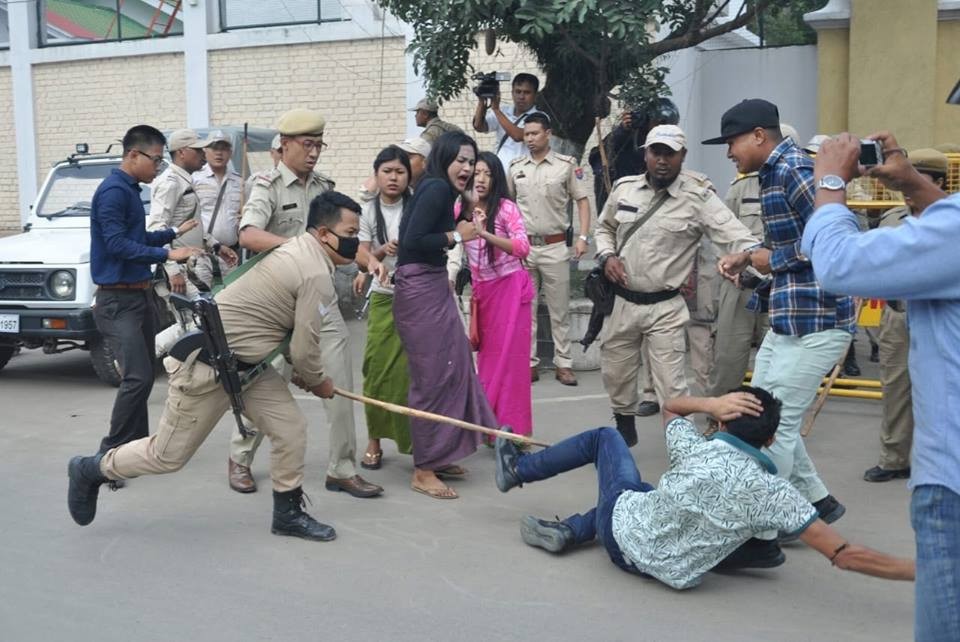
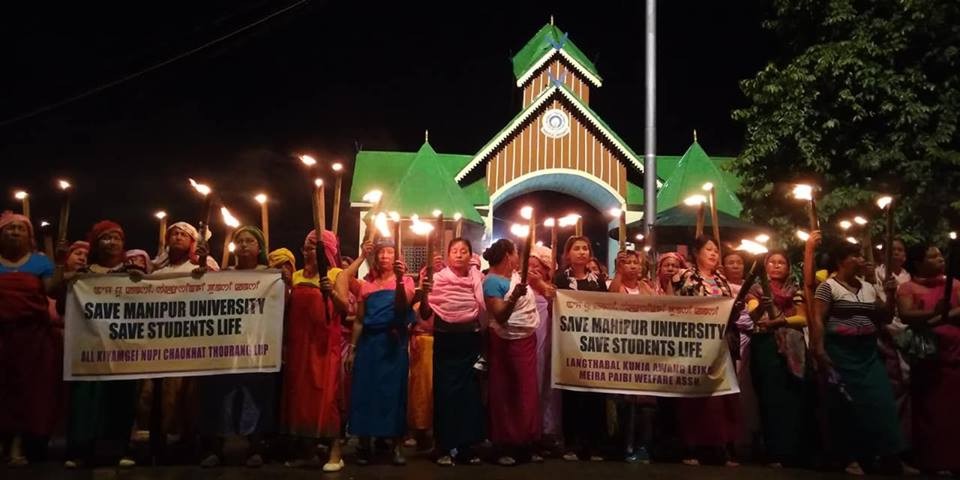
A shocking video of police brutality on Manipur University students has emerged on July 18. Manipur Police can be seen mercilessly beating up students. In the process, one student falls in front of a running vehicle and gets critically injured. The police not only witness this, they keep on beating the students. The students frantically stop another vehicle passing by and load the injured student on it.
Video (Sent on Whatsapp)
This is not a random video. The video is testimony to more than 50 days old protests and discontent building up in Manipur University.
A pamphlet issued by Manipur Students’ Association Delhi (MSAD) informed that a military battalion was stationed inside the campus which the students claim is “one of its kind in the whole world.” The reaction from the Centre has been to call in more armed forces within the campus. This is reminiscent of Sardar Patel’s statement made in 1949 in which he asked, “Isn’t there a brigadier in Shillong?”
The Manipur University Students’ Union (MUSU) gave a call for a general strike on July 17 and on the first day of the strike, ‘normal life’ seemed to have been “paralysed”

At the heart of the strike and protests is the demand for the removal of Manipur University’s Vice Chancellor, Adya Prasad Pandey from his current position. Students launched the protests to oust the VC from May 30, alleging “administrative failure” as the main reason for such a demand.
Students allege that the VC has not stepped inside the University campus since the time protests started. Instead, it appears he is busy hobnobbing with the Centre and made a trip to Delhi even amid an atmosphere of huge crisis. Simultaneously, in a booklet released by the MUSU, it has been alleged that the VC has a “bizarre habit of remaining away from the campus for very long periods” and most of these tours are “unofficial.” He has also been accused of violating the Manipur University (MU) Act, 2005 and failed to adhere to procedures related to financial assessments and planning. No convocation was held in the university since April 2014. Another serious issue flagged in the booklet is that a “large amount of unaccounted money is being donated to several politically motivated organisation with the ulterior motive” leading to “misuse.” The booklet also sheds light on the “notorious manner” in which the money from the university is being transferred to one Lucknow based firm. The VC has also been accused of failure to start much awaited courses such as LLM, MA fine Arts, M.Ed. Apart from that, there has been an apparent delay and disruption of academic calendar. And students also allege “psychological” harassment in the name of frequent frisking by guards.

Responding to the call for strike, all government and private institutions remained shut and all forms of transportation stayed off the road except for some private vehicles seen plying on the roads.
The MSAD also gave a call for protest in New Delhi, with key demands such as:
1) The ruining of Manipur University affecting the entire student community by the presence of VC, A.P Pandey.
2) Arbitrary eviction by the BJP government.
3) The border conflict between Manipur and Myanmar.
It is noteworthy that as many as 60-70 Undergraduate colleges fall in the ambit of the Manipur University. Students allege that the current crisis has impacted all of their functioning. Students also seem to believe that this is a systematic disruption of the University space in Manipur.
A joint statement released by the community of protesters said a joint meeting of the executive members of Manipur Teachers’ Association (MUTA), Manipur University Students’ Union and Manipur University Staffs’ Association was held on July 18 at MUTA office. And the bodies there resolved to reiterate that the removal of VC Pandey was non-negotiable before one could proceed towards any intervention to resolve the present crisis in the varsity.
The meeting also took serious note of the brutal force used against the students who were “democratically agitating” and strongly condemned the actions of the state police stating the “manner will even put the animal kingdom to shame.”
Also, another important and controversial issue is that of the “arbitrary eviction” at Khetri Bengoon, Imphal East, which, as per the MSAD statement, poses an existential threat to “the territoriality of Manipur” and “it seems that the policy is an appeasement foxship from the part of Delhi to Myanmar, considering the China factor” The alleged eviction drive wiped out an entire village without any rehabilitation plan, violating an MoU signed between CSOs and government.
There is a strong sentiment that interests and sentiments of Manipuri people are not reflected in the decisions that are being made at the Centre.
People across the United States and around the world have been rightly outraged by U.S. federal agencies’ detention of migrants and separation of their families at the U.S.-Mexico border. Shortly after, the Supreme Court’s ruled to uphold the Trump administration’s racist travel ban on several Muslim-majority countries, reviving another fierce reaction to the administration’s policy toward immigrants, travelers and asylum seekers.

In middle school, children in the United States learn that the three branches of the federal government are arranged with a system of “checks and balances,” so that no one branch oversteps its power and violates the rights of individuals. But now, the whole world can see that the only thing “checked” by the White House and the Supreme Court is the human right to freedom of movement.
The cases are united by more than one administration’s xenophobia. Much of Latin America and the Muslim world share a legacy of U.S. interventions driving the very migration now being cruelly restricted.
Latinx migrants at the southern border have been in the national spotlight. But too rarely has the question been asked: What situation would compel so many people to leave their homes and take the perilous journey north in the first place?
An honest answer requires an examination of U.S. policy in Latin America, particularly Central America.
While the Trump administration talks incessantly about its favorite villain, the gang MS-13, it says nothing about the origins of the gang. MS-13 was actually incubated on the streets and in the prisons of Southern California, where so many Salvadoran migrants were incarcerated in the 1990s. Washington’s deportation of former prisoners — among other Salvadorans — back to El Salvador was the context for the development of the MS-13.
The Salvadoran community that developed in the United States in the 1980s and 1990s itself emerged as Salvadorans fled a nightmarish civil war. The United States was deeply involved in that conflict, arming and supporting the Salvadoran government and right-wing paramilitary forces throughout Central America.
These death squads committed acts of unspeakable violence that still reverberate throughout the region today. Similar patterns have played out in Guatemala and Honduras, which are also countries of origin for refugees where the United States has a legacy of backing right-wing leaders past and present.
On the other side of the world is Yemen, one of the seven countries whose people are targeted by the travel ban — and the site of a catastrophic U.S.-backed war. We may not hear the cries of Yemeni children the way we heard those of children detained at the border. But many of them are also separated from their families here in the United States because of the travel ban.
As with Central America, the United States is committing crimes in Yemen that force millions into desperate circumstances.
According to the United Nations, the worst humanitarian crisis in the world todayexists in Yemen — a striking distinction, given that there’s no shortage of other disasters around the globe. There is a civil war in Yemen, in which combatants on both sides have taken actions that have had severe consequences for civilians. But the overwhelming responsibility for the destruction lies with a coalition led by Saudi Arabia and the United Arab Emirates, which has bombed Yemen mercilessly in support of the Saudi-friendly Abdrabbuh Mansour Hadi, whom the Gulf States seek to install as the president.
Their campaign has targeted civilian infrastructure, weddings, funerals and even medical facilities. As a result, tens of thousands have been killed and millions have been displaced. Millions face starvation as well as sickness and death from entirely preventable diseases like cholera. According to UNICEF, 11 million children, or “nearly every child in Yemen,” is in need of humanitarian assistance.
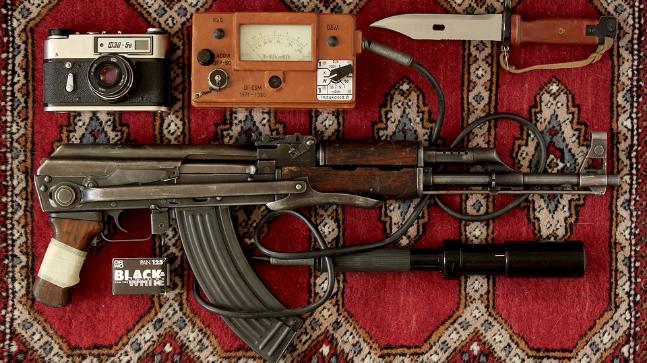
A dropped bomb or exploded missile leaves so much in its wake. But there is a particular and peculiar remnant of the blasts that have wounded Yemen. Yemenis find, again and again, labels on bomb fragments that indicate they are made and sold by the United States.
Indeed, last summer, Trump negotiated with Saudi Arabia to sell the kingdom $110 billion in weapons. The United States also approved $2 billion in arms sales to the U.A.E. last year. The United States is also supplying intelligence to the Saudi/Emirati coalition, as well as mid-air refueling for coalition aircraft.
The United States, therefore, is doing everything but dropping the bombs itself. But even that distinction dissolves when one remembers that the United States did bomb Yemen repeatedly using drone strikes and cruise missile attacks throughout the Obama administration.
The United States has bombed Yemenis. It is supplying the weapons for other countries to bomb Yemenis now. And, as it’s doing toward Central Americans in the most callous way, it is denying Yemenis the right to enter the United States.
The beginning of accountability for those actions is letting these — and all — refugees in. But that cannot be the end. Let this time of anguish and outrage be one of a deep reckoning — with what the United States does at its borders, within them, and beyond them.
This article was produced in collaboration with In These Times.
Khury Peterson-Smith is the Michael Ratner Middle East Fellow at the Institute for Policy Studies.
Courtesy: https://fpif.org/

Lord Curzon / BBC Hulton Picture Library
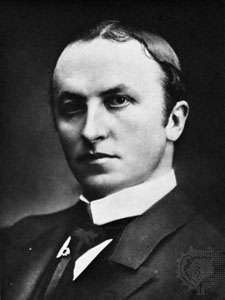
It was on July 19, 1905, that, the British governor-general Curzon, in a cynical and divisive move, announced the partition of Bengal into two provinces-Eastern Bengal and Assam, and the rest of Bengal which included Bihar and parts of Orissa. Motive? To divide the Bengal population and to weaken the nationalist movement, of which Bengal was the most important entre. Also, the British move was also to disrupt Hindu-Muslim unity by convincing upper class Muslims that the newly created province with its Muslim majority was in their interest.
How the move failed. Seeing through this design of the colonial masters, all sections of the people in Bengali people came together in an unprecedented fashion, in a mass movement to oppose this move. Anger spread to many other parts of the country. The anti-partition agitation assumed a militant from on August 7, 1905 when thousands of people at a meeting in Calcutta resolved to boycott British goods until the partition proposal was withdrawn.
When the partition came into force on 16 October 1905 which day was observed as a day of national mourning throughout Bengal. It was during this movement that Swadeshi or use of Indian goods and boycott of British Goods became an integral part of the freedom struggle. At thousands of meeting people took the pledge of Swadeshi and boycott. Resolutions supporting Swadeshi and boycott were also passed at the Benares session of the Congress under the president ship of Gokhle in December 1905, although the Moderates then and later tried to restrict their scope.
The message of Swadeshi spread to the entire country and helped in promoting Indian Industries. A large number of educational institutions were also opened by nationalists and a National Council of Education was set up. The movement which had begun in Bengal over the question of partition was transformed into a wider movement for freedom of the country. The British rulers, in order to crush the rising tied of nationalism, unleashed naked repression.
Calcutta in Morning
The first part of a news item, which appeared in the Amrita Bazaar Patrika of October 17, 1905 entitled “Calcutta in Morning-A Unique Sight”, describing the situation in Calcutta on 16 October 1905, the day Bengal was partitioned, is given below.
YESTERDAY WAS one of the most memorable days in the history of the British administration of India. It being the day on whish the Bengal partition scheme took effect, the day on which our unsympathetic government forced a measure by a proclamation in the official gazette against the wishes of the whole population, the day on which our rules tried to separate the Bengali speaking people of the East Bengal from those of the West Bengal, the people of Calcutta, irrespective of nationality, social position, creed and sex, observed it as a day of mourning. The leaders of the Bengali community-Hindus and Mahomedans-did not however silently mourn and weep. They did something more. They as a legacy to posterity and as a landmark to British administration laid the foundation of the Federation Hall. They also took a practical step towards the furtherance of the Swadeshi movement by opening the National Fund.
The Scene on the Bank of the Hooghly
From the small hours in the morning till noon, the bank of the Ganges from Bag bazaar to Howrah presented a unique spectacle. It looked, as if it were, a surging sea of human faces. From all streets, lanes and bye-lanes, leading to the bank a quick succession of streams of people all bare-footed-found their way to the bank to have a plunge in the sacred river.
As the day advanced, the gathering thickened more and more and by 10, about a lakh of the male population of the metropolis-all in mourning-thronged the bank and the Ghats of tender sex. They cry of “Bande Mataram” now and then, broke the silence of the still air and reverberated through it imparting a chastening influence on the minds of those who gathered together there…innumerable processions consisting of scores and hundreds of men, after arriving at the bank of the sacred river and wearing Rakhi (yellow thread) proceeded in procession singing ‘Bande Matram’ all the way. Several thousands of such processions passed all over the city especially the northern quarter of it from 8 am. To 2 pm. They accosted on the way everyone they met with “Bande Mataram” in embracing each other and putting on “Rakhi”. It was a sight for the gods to see….
Roads and Streets
The scene in the roads and streets of whole Calcutta was quite novel and was perhaps never before witnessed in any Indian city….No purchasers were there and thus no sellers had to exhibit their articles…All the mills were closed and the mill hands paraded the city in procession…The only cry that was heard was of “Bande Mataram” . Bands of Mahomedans and Marwari’s joined the percussionists and greatly enhanced the enthusiasm.
Rakhee Sangeet
During the swadeshi and anti-partition agitation people in both the Benglas took out processions in the streets of towns and villages and sang swadeshi and patriotic songs. An English version of one such song, originally composed in Bengali by Rabindranath Tagore, is reproduced below.
Let the earth and water of Bengal,
Let the air and fruits of Bengal, be sacred, be sacred, be sacred, my god.
Let the homes and marts of Bengal,
Let the forests and fields of Bengal, be full, be full, be full, my god.
Let the promises and hopes of Bengalis,
Let the deeds and language of Bengalis, be true, be true, be true, my god.
Let the lives and hearts of Bengalis,
Let all the brothers and sisters in Bengali homes, be united, be united, be united, my god.
Excerpts from Gokhale’s Presidential Address
The following lines are taken from Gopal Krishna Gokhale’s Presidential Address at the Banares Congress (1905), where the made a detailed analysis of the question of the partition of Bengal and the swadeshi movement.
GENTLEMEN, THE question that is uppermost in the minds of all at this moment is the partition of Bengal. A cruel wrong has been inflicted on our Bengalee brethren, and the whole country has been stirred to its deepest depths in sorrow and resentment, as had never been the case before. The scheme of Partition concocted in the dark and carried out in the face of the fiercest opposition that any Government measure has encountered during the last half-a-century, will always stand as a complete illustration the worst features of the present system of bureaucratic rule-its utter contempt for public opinion, its arrogant pretensions to superior wisdom… Lord Curzon and his advisers… could never allege that they had no means of judging of the depth of public feeling in the matter. All that could possibly have been done by way of a respectful representation of the views of the people had been done. As soon as it was known that a partition of some sort was contemplated, meeting after meeting of protest was held…. The Secretary of State for India was implored to withhold his sanction to the proposed measure. The intervention of the British House of Commons was sought, first by a monster petition, signed by sixty thousand people, and later by means, of a debate on the subject raised in the House by our over-watchful mend, Mr. Herbert Roberts. All proved unavailing…. To add insult to injury, Lord Curzon described the opposition to his measures as “manufactured”-an opposition in which all classes of Indians, high and low, uneducated and educated, Hindus and Mahomedans had joined, an opposition than which nothing more intense, nothing more wide-spread, nothing more spontaneous had been seen in this country in the whole course of our political agitation.. . .
The tremendous upheaval of popular feeling, which has taken place in Bengal in consequence of the partition, will constitute a landmark in the history of our national progress. For the first time since British rule began, all sections of the Indian community, without distinction of caste or creed, have been moved by a common impulse and without the stimulus of extend pressure to act together in offering resistance to a common wrong. A wave of true national consciousness has swept over the province…. Bengal’s heroic stand against the oppression of a harsh and uncontrolled bureaucracy has astonished and gratified all India, and her sufferings have not been endured in vain, when they have helped to draw closer all pasts of the country in sympathy and in aspiration….
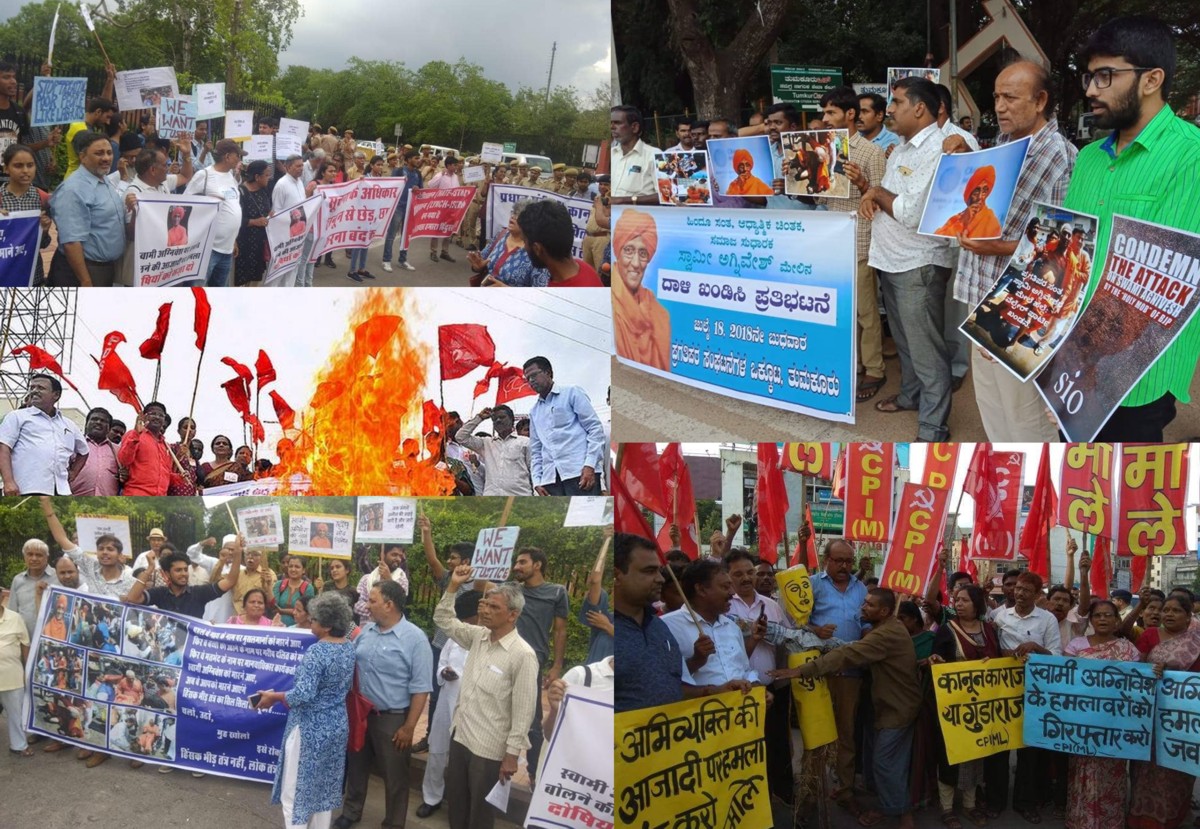
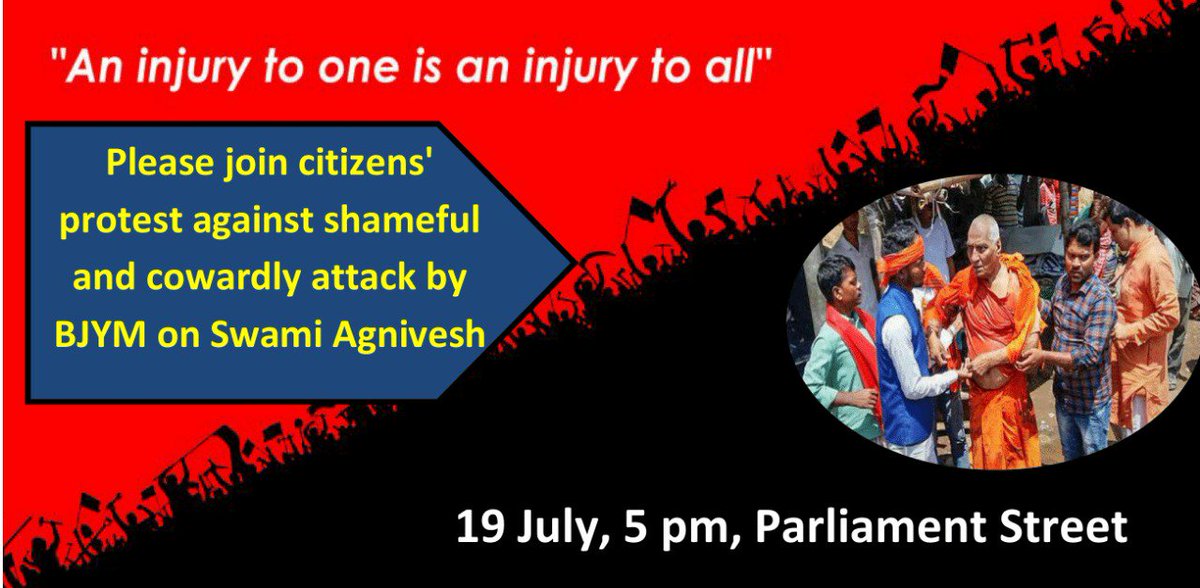
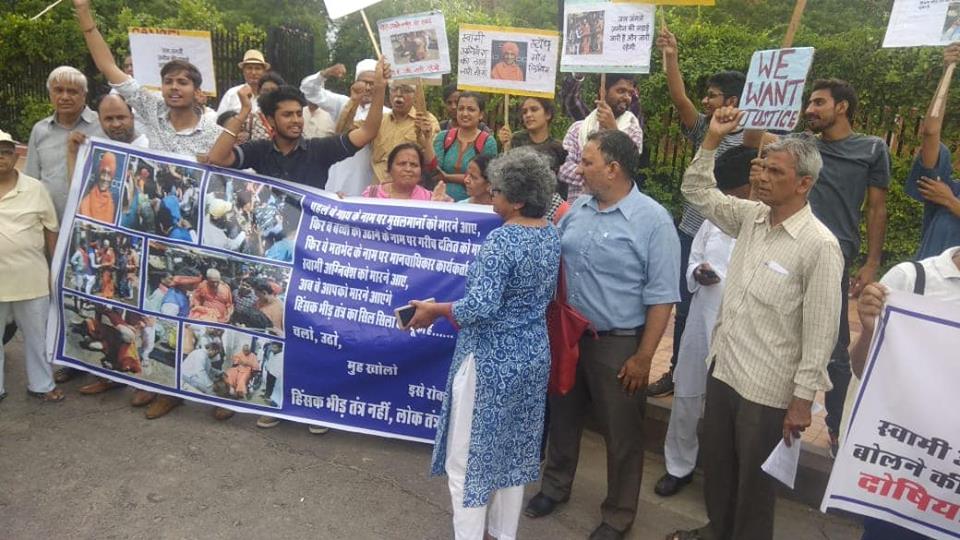
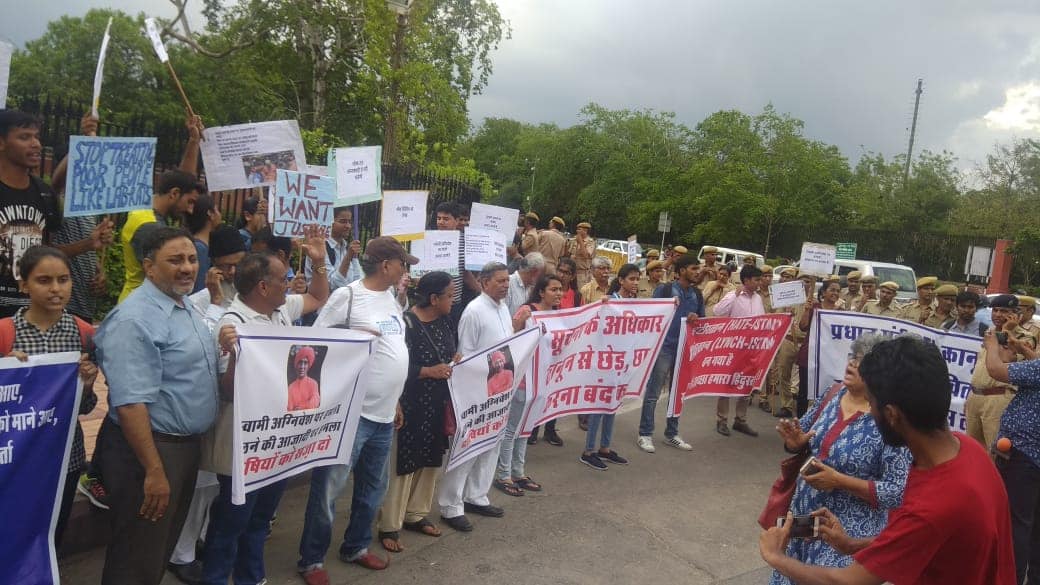
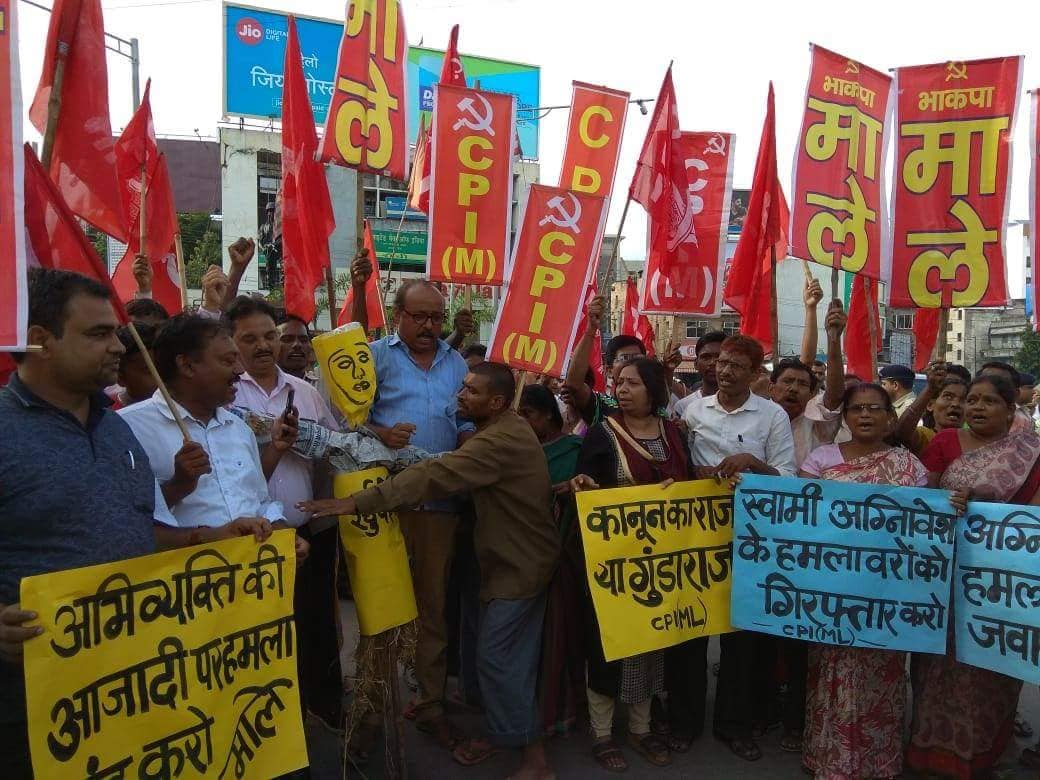
Many corners of the country are erupting with protests against the brazen attack on Swami Agnivesh. On July 19, Bengaluru, Mumbai, New Delhi and more cities have organised a protest.
A citizen’s protest against the mob attack has been called at 5 pm at Parliament Street in New Delhi. It is being hosted by known social rights activist Kavitha Krishnan and Sucheta De from AISA .

A joint protest has been called in Bhubaneshwar, Odisha on July 19 at 5 pm at Master Canteen Square by Narendra Mohanty, State Convener of INSAF & Campaign Against Fabricated Odisha. The protest is a united effort by the left, democratic and human rights organisations.
Another protest has been organised for July 19 in Mumbai as well. “Various secular democratic organisations and parties have decided to organise a peaceful protest to condemn the fascist mob attack on Swami Agnivesh, a respected national leader, former parliamentarian and an internationally renowned social reformer,” read a forwarded message. The protest will be held near Capitol Cinema, CSMT at 4.30 pm.
“Many leading citizens of our city will be attending the protest to take on the rising tide of communal fascism and intolerance that threatens to engulf our nation. We appeal to all constitutional, democratic and secular forces to resist the tide of the fascist onslaught.”
Eminent people like Anand Patwardhan, Com. Rege, Com. Prakash Reddy, Com. Anil Tyagi, Varsha Vidya Vilas, Jatin Desai, Feroze Mithiborwala, Irfan Engineer, Ravi Bhilane, MA Khalid, Amol Madame, Ajmal Khan, Salim Alware, Nuruddin Naik, Jyoti Badekar, Smita Salunke will also be present.

Civil society groups and individuals are hosting a protest rally in Town Hall, Bengaluru on Thursday at 4 pm. “We all believe in the secular and democratic ethos of the country. We are against divisive and hate politics propagated by communal forces in the country. We are hosting the protest to raise our voice against the barbaric attack on Swami Agnivesh,” said a Bengaluru-based activist.”
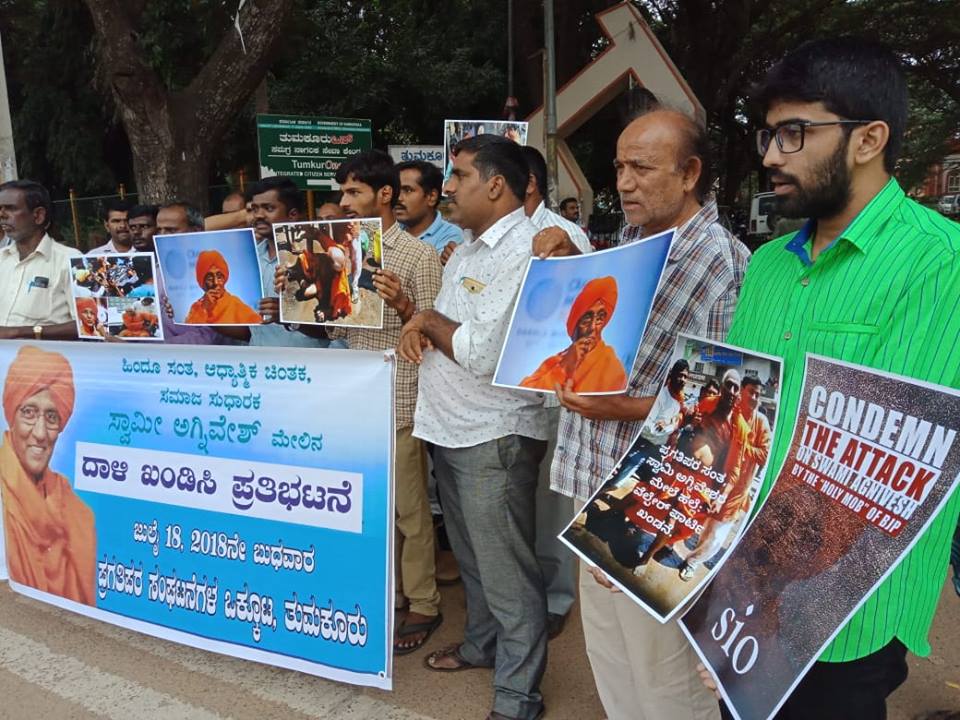
The Students Islamic Organisation of India held protests at many of their centres across India. One was organised on July 18 at the Town Hall in Tumkur, Karnataka. Their page also said that the accused people from BJYM also held a protest in Jharkhand against the attack.

A protest was also held in Jaipur at Ambedkar circle on Wednesday.
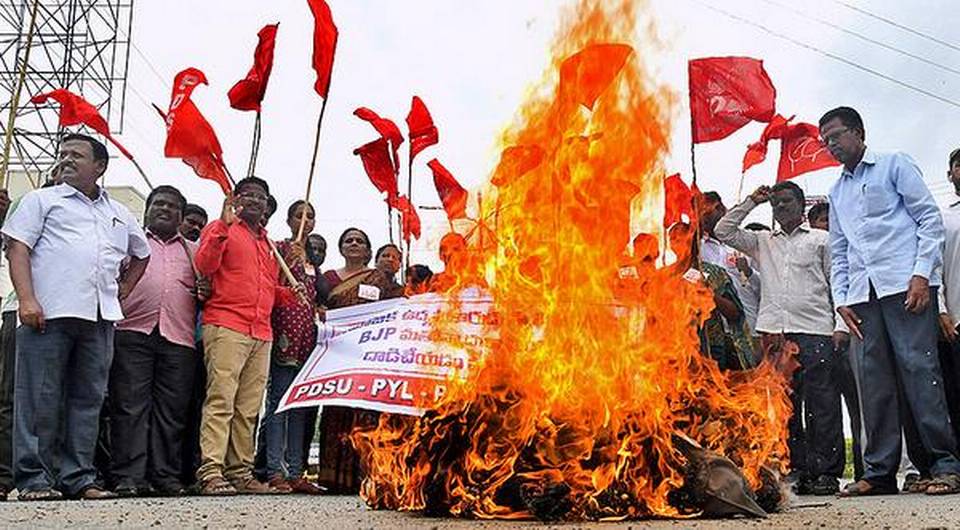
Effigy of ‘fascist forces’ was burned in Khammam, Telangana on Wednesday. “Activists of various organisations representing students, youth, women, farmers and labourers took to the streets here on Wednesday to protest against the attack on noted social activist Swami Agnivesh allegedly by members of the BJP’s youth wing in Jharkhand on Tuesday. Members owing allegiance to the Progressive Democratic Students Union (PDSU), the Progressive Youth League (PYL), the Progressive Organisation of Women (POW), the Indian Federation of Trade Unions (IFTU) and the all India Kisan Mazdoor Sabha (AIKMS) staged a demonstration near the RTA office on the bypass road here vehemently condemning the incident,” reported The Hindu.

“The demonstrators set ablaze the effigy of ‘fascist forces’ in a symbolic protest against the alleged unabated attacks on writers, social activists, and other intellectuals by fascist elements across the country,” the report added.
The opposition also organised a noisy protest in the Jharkhand assembly. “Opposition parties today staged noisy protest over assault on social activist Swami Agnivesh in Pakur, forcing adjournment of the House. This happened despite Parliamentary Affairs Minister Nilkanth Singh Munda saying that Chief Minister Raghubar Das had set up a probe committee immediately after receiving the information,” reported NDTV.
“The Left and democratic forces organised protest demonstrations and burnt effigies of RSS at Ranchi, Jamshedpur & Koderma following the attack on Swami Agnivesh yesterday at Pakur by the sangh parivar hooligans. Comrade Brinda Karat along with Comrades GK Bakshi, Md Iqbal and Prakash Viplavi met SP in Pakur and condemned attack on Swami Agnivesh. They also demanded that all the accused who have been released on bail within a day of arrest should be taken back into custody and strict actions must be taken,” a facebook post shared by Rampari, a social activist and member of CPI stated.

Canadian organisation Indians Abroad for Pluralist India strongly condemned the recent attack on Swami Agnivesh by the supporters of Hindu nationalist Bhartiya Janata Party (BJP). “Agnivesh is a vocal critic of superstition and religious fundamentalism. He has been speaking out against growing intolerance and attacks on minorities under the BJP government in India. He was viciously beaten during his visit to Jharkhand by those affiliated with the BJP. The attack was aimed at intimidating Agnivesh and muzzling a voice of reason. This follows series of murders of rationalist scholars and activists by those who are seeking to turn India into Hindu theocracy. The incident that left Agnivesh badly injured, must be taken seriously in the light of the killings of Narendra Dahbolkar, Govind Pansare, MM Kalburgi and Gauri Lankesh by the Hindu extremists. We also deplore the recent attack on the office of senior Congress Party leader Shashi Tharoor who came under sharp criticism from the supporters of BJP for denouncing attempts to turn India into an exclusionist Hindu state. Though we don’t agree with the policies of the Congress party and will continue to question its secular credentials for its involvement in sectarian politics for opportunistic reasons, we believe that Tharoor should not be targeted for saying the right thing. Any act of violence to suppress the voice of those who believe in a diverse and pluralistic society must be condemned by everyone,” they said.

Sometimes back, there was a proposal in JNU to teach a course on Islamic terrorism. There was severe criticism from different sections of society as to why such a course was proposed in the first place. The academic world argued that the course should be more inclusive and therefore should teach about uses of terror in various religions not just Islam. Now there cannot be any argument with the historical fact that various religions have used terror in one way or the other. To single out Islam, as the course did, lent credence to the perception that the course was ideologically prejudiced.

On the other hand, when so much of contemporary terrorism seems to be happening in the name of Islam, then it makes sense to engage specifically with this phenomenon. And what better way to do it but within the academia. It also must be kept in mind that clubbing all religions together will de-focus the entire program. If what one is interested in is the linkage between Islam and terror, then the entire focus should be on that particular linkage itself.
Moreover, in this particular instance, the sound liberal position to take would be to leave such academic matters in the hands of the university or the teachers concerned. The problem is that liberals in India have come to believe that while freedom and autonomy of teachers and educational institutions should be paramount when they are in power, others should be denied such freedoms.
Another level of problem was with the very word Islamic itself. Critics were quick to point out that no religion sanctions violence and therefore using the word ‘Islamic’ for a course on terrorism was going too far. After all, the argument continued, we don’t use Christian terrorism or Hindu terrorism so why should we use the term Islamic terrorism.
This narrative is historically uninformed. Christians, Muslims and Hindus, acting out their belief system have all used violence at some point of time in their histories. If not then how do we understand the crusades, the burning at the stakes and the persecution of Buddhists? The problem is not so much that religions have used terror; rather the bigger problem is that there is no consensus on how to define terror.
For example, the history of independence of third world countries is replete with example where our prominent freedom fighters have used terror and violence as a viable and respectable means to achieve their ends. But then we do not have a problem with this kind of terror. Terror has also been used by various states in the developing and developed worlds on their own population but then since the state has a monopoly of violence, we do not understand this as terror. So it is the word terror which is very difficult to map and define because one’s terrorist might well be the other’s martyr.
However, this should not deviate us from the more fundamental question of religious terrorism. If acts of terror are carried out in which religious motivation is the prime motivating factor, then why should we shy away from calling the name of religion associated with the terrorists. And more importantly, if those who are carrying out such attacks in the name of Islam, then who are we to say that they are no truly Muslims?
Disparate Muslim groups opposed the proposed course simply because it would bring a bad name to Islam. They were quick to point out that Islam means peace and that there is no place for violence in this religion. Nothing can be further from truth.
Firstly, it has become fashionable these days to start with the faulty premise that Islam is a religion of peace. No religion is completely about peace or violence. With Islam in particular, the history of the religion is filled with violence right since its inception. What is worse, Muslims started fighting each other over political power soon after the death of its prophet. It is not that Muslims are unaware of their own history. Rather the problem is just the opposite: they are too aware of their violent historical past. And that’s the reason why they now want to proclaim it as a religion of peace.
Properly speaking, Islam should mean submission more than anything else and the Muslim in one who submits. There is no need for Muslims to deny their past: all religions have been violent at some point in their history. The point is to accept the problematic history and see to it that it is not repeated. Merely saying that Islam is a religion of peace will not make Islam into one; Muslims have to actively construct an alternative hermeneutic tradition if they want to proclaim Islam as a peaceful religion.
Against this backdrop, it was rather rich of AMU students Union and the Delhi Minority Commission chairman to write to JNU to change that particular course. The AMU needs to answer some tough questions in this regard. Why is it that it is taking interest in the affairs of another university? Shouldn’t the job of AMU students union be to take care of the needs and interests of student community in their own university? Granted that they have a right to political critique, but then when will they start critiquing the situation in their own campus? If they demand from JNU that it respects ‘their’ sentiments, isn’t it about time that AMU shows the same sensitivity towards its own diverse student population.
How about starting a course on Hinduism in AMU? Similarly, it shouldn’t be the business of a minority commission to seek clarification from a university over the contents of an academic course. Muslims are facing far serious problems in this country and it will be better if the commission actually focuses on the daily humiliations which Muslims are facing today. It is better to leave academic matters to the concerned university.
After a huge uproar, JNU decided to drop the course and even denied that they were planning to introduce any such course at all. However, it is now learnt that they are planning to introduce it as a research theme by altering the title from ‘Islamic’ terrorism to ‘Islamist’ terrorism. But even the research theme has run into trouble. Muslim critics have been quick to point out the ‘nefarious’ designs of the university behind introducing the research theme. Even if we grant that given the political discourse in the country, the usage ‘Islamic’ terrorism might have disturbed Muslims, one doesn’t understand why ‘Islamist’ terrorism should have the same effect.
We need to differentiate between Islamic and Islamist: the latter only attests the political use of Islam to capture state power where violence is indeed one of the many options. Isn’t this the ultimate aim of Islamists the world over and isn’t it that they have used terror as a method to achieve that end? How do we understand the Taliban and more recently the ISIS except through the lens of Islamist terror? Worldwide, even amongst Muslim scholars, there is now a consensus that it is the ideology of Islamism which needs to be resisted.
So what’s the problem in a course or a research theme which is intends to teach and research different aspects of this phenomenon and why should Indian Muslims resist it? The only reason seems to be lack of clarity to differentiate between Islam and Islamism. Additionally, Indian Muslims seems to have a problem with any usage or reference of Islam made by others which is non-flattering.
This is a huge problem and the sooner Muslims address it, the better it will be for them. They should have the willingness to openly debate any existing criticism of Islam. Without this self-introspection, it is difficult to see how we as Indian Muslims, can come to terms with the world around us. Not accepting that Islam, like any other religion, can lend itself to terrorism will only push us towards a dystopic worldview where Muslims become the perpetual victim and terrorist incidents like 9/11 appear to be the handiwork of the Zionists.
Arshad Alam is a NewAgeIslam.com columnist
Courtesy: New Age Islam
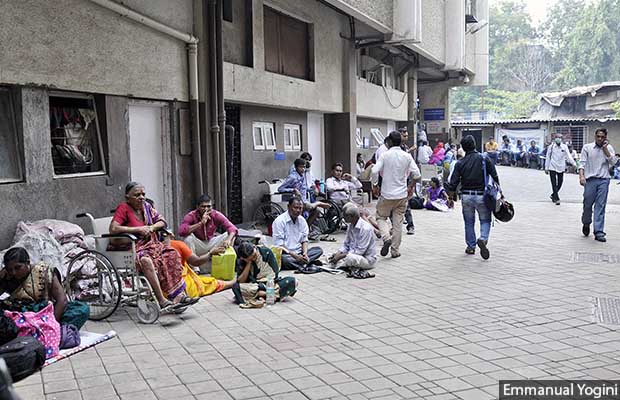
Mumbai: Out-of-pocket (OOP) health expenses drove 55 million Indians–more than the population of South Korea, Spain or Kenya–into poverty in 2017, and of these, 38 million (69%) were impoverished by expenditure on medicines alone, according to a new study.

These calculations by the Public Health Foundation of India (PHFI), an advocacy, were released on June 6, 2018, and based on the official Indian standard for poverty line–a monthly expenditure of Rs 816 in rural areas and Rs 1,000 in urban areas–as per a 2013 report of the erstwhile Planning Commission. The PHFI study used secondary data from National Sample Survey reports and other sources for these estimates.
Over 80% of Indians incur OOP–direct payments individuals make to healthcare providers–on healthcare, as per 2011-12 figures cited in the study. It was 60% in 1993-1994. Medicines contributed to more than 67% of OOP healthcare expenditure in 2011-12.
In real terms, monthly OOP payments increased by more than 100%–from Rs 26 in 1993-1994 to Rs 54 in 2011-2012.
India spends the least on public health among BRICS nations, IndiaSpend reported on May 18, 2017. It ranked 147 among 184 countries, a notch below Pakistan, in this regard. Insurance-based government initiatives have been largely unsuccessful in easing the burden on citizens, the report added.
The heavy load of spending on medicines can be explained by a study carried out in Chhattisgarh reported by IndiaSpend on June 13, 2018. An analysis of 1,290 prescriptions from 100 public health facilities across 15 districts showed that only 58% prescribed medicines were available at government pharmacies. This left patients with no option but to buy at higher rates from private pharmacies.
The consequence of the inadequate public health system is that India has become the sixth biggest private spender on health among low-middle income nations.
About 68% of the Indian population has limited or no access to essential medicines, according to a World Health Organization report. In addition, over the last two decades, the availability of free medicines in public health facilities declined from 31.2% to 8.9% for inpatient care and from 17.8% to 5.9% for outpatient care, according to a 2011 PHFI study.
| Components Of Out-of-Pocket Expenditure, 1993-2012 | |||
|---|---|---|---|
| Financial Burden Indicators | 1993–1994 | 2004-2005 | 2011-2012 |
| Percentage households reporting OOP payments | |||
| Any OOP payments (%) | 59.2 | 64.4 | 80.5 |
| Medicines OOP payments (%) | 57.5 | 63.6 | 79 |
| Monthly per capita expenditure (INR at constant 1999–2000 prices*) | |||
| Household consumption expenditure | 517 | 619 | 794 |
| OOP expenditure on health | 25.59 | 36.3 | 54.3 |
| Medicine OOP expenditure | 20.86 | 26 | 36.1 |
| Share of health to total household expenditure (%) | |||
| Share of total OOP expenditure to total household expenditure (%) | 4.84 | 5.78 | 6.77 |
| Share of medicine OOP expenditure to total household expenditure (%) | 3.93 | 4.1 | 4.49 |
| Share of health to non-food household expenditure (%) | |||
| Share of total OOP payments to non-food expenditure (%) | 12.37 | 10.82 | 11.46 |
| Share of medicines OOP payments to non-food expenditure (%) | 10 | 7.68 | 7.6 |
Source: Public Health Foundation of India Study 2018
Cancer treatment cost highest
The PHFI study also looked at the disease conditions which contributed the most to the financial burden on households.
It found that the treatment of cancers, cardiovascular diseases and injuries–in terms of both outpatient and inpatient care–dominated health expenditures in India. The share of non-communicable diseases–such as cardiovascular problems, diabetes, cancer, mental illness and injuries–in OOP health expenses increased from 31.6% in 1995-1996 to 47.3% in 2004.
The survey results suggested that the most common health condition for seeking outpatient care was fever (22.7%) and for inpatient care was childbirth (27.3%).
In addition, the study estimated that households incurred the highest monthly OOP spending on cancer (Rs 5,121), in the case of both outpatient and in-patient care. This is followed by injuries in outpatient care (Rs 3,045) and cardiovascular events in inpatient care (Rs 2,808).
Two earlier studies–the PLOS study of 2013, and the World Bank study of 2014–too had reported that households incurred significant OOP payment burden in the case of cardiovascular diseases and cancers.
Rise in poverty caused by health expenses in 2011-12
The study calculated the implications of OOP and the part of it spent on medicines for poverty estimates by using three steps:
As per these calculations, monthly OOP payments and expenditure on medicines deepened poverty among the poor by Rs 29 and Rs 23, respectively, in 2011-2012. And the percentage of households below the poverty line increased from 4.19% in 1993-1994 to 4.48% in 2011-2012.
This rise in poverty was sharper in 2012 than in 2004-2005 and 1993-1994. The headcount ratio of those impoverished due to OOP payments was 3.97% during 1993–1994; this inched up to 4.30% in 2004-2005 and then went up in 2011-2012 to 4.04%, as per the global measure for poverty line ($1 per day).
There was an increase of more than 50% in every household’s consumption expenditure in real terms over this period–from Rs 517 to Rs 794.
(Salve is an analyst with IndiaSpend.)
Courtesy: India Spend
Nearly a year ago, the draft of a proposed law MASUKA-Manav Suraksha Kanoon-came into light when several lawyers, civil rights activists, and politicians came together to demand a unified and a separate law which could bring justice to the lynching victims and also could help in preventing such crimes in future.
A peculiar feature of MASUKA was that it was supposed to be a specialized law—like POSCO and SC/ ST Act—the draft of which was made public on July 7 last year. Opinions and change suggestions were asked from the common public in order to make the law more inclusive.
But even after a year since MASUKA came into existence, the draft is still struggling through its way to becoming a law, and worse, no one is now talking or campaigning about it anymore. In fact, just today, a writ petition filed by the same parties who were campaigning for MASUKA was heard in the Supreme Court, where a bench comprising of Chief Justice of India Dipak Misra, Justice A.M. Khanwilkar and Justice D.Y. Chandrachud asserted that it is the State’s duty to ensure efficient functioning of the law and order situation. However, even the name MASUKA was missing in the entire judgement.
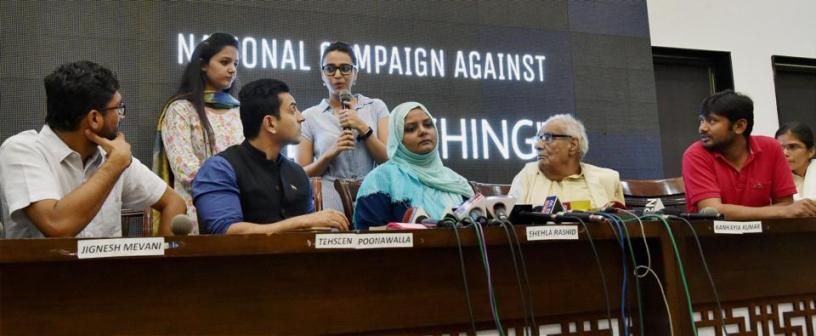
There are many reasons why MASUKA slipped into oblivion. Many of the campaigners have either moved away from the cause completely or have started refraining from commenting on the issue completely. The Facebook page National Campaign Against Mob Lynching, which was created to gather public support to stop mob lynching and to amplify the campaign for MASUKA did not become popular with only 14,500 likes. Also, the page has not been updated after November 22, 2017.
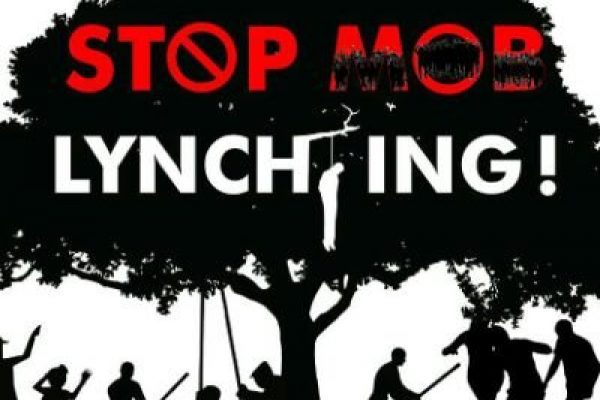
The digital campaign to stop mob lynching incidents and to bring MASUKA as a concrete law also failed miserably. The website established for the same “stopmoblynching.com” is now closed, and the domain’s registration lapsed on June 10, 2018. At the time of writing this story, the web address denoted “It’s your lucky day! This domain is available now”, and anyone could buy the domain in just Rs 753.42, intending towards the seriousness of the intention of the campaign.

screenshot of the website for MASUKA and stop mob lynching campaign
Civil rights activist and once a Congress leader Shehzad Poonawalla has been a leading figure in the MASUKA campaign. The idle Facebook page to stop mob lynching has featured several videos of Poonawalla, who is a prime figure on the evening news channel debates. However, Poonawalla changed his tone in December 2017, coming hard on the “dynasty politics” being exercised by the Indian National Congress. Poonawalla’s stand on the family politics of the Congress—which came at the time when Rahul Gandhi took over as the National President of Congress party—coincided with him moving away from the MASUKA campaign. As Poonawalla came hard on Congress politics, his elder brother Tehseen Poonawalla, who has also been actively involved in MASUKA campaign, broke all relations with him. And for Shehzad Poonawalla, this “souring of relationships between the brothers” has led him to pull out from MASUKA campaign.
When asked about the roadblock in the MASUKA movement, Shehzad Poonawalla told TwoCircles.net, “The movement was Tehseen’s brainchild and since the souring of our relations, he has not involved me. So I am unable to give you any further information in this regard specifically.”
What Shehzad Poonawalla further told us gives the idea that personal, as well as political reasons, are behind a law draft which could prevent lynching in the country. “I am no longer part of the movement as Tehseen was behind it and he broke off all relations and may not want me involved as he has made it clear,” he further said. He also lashed out at the Congress party allegedly blacking him out from appearing on various news channels, thereby denying him a chance to talk more about the project. He said, “If Congress doesn’t get me boycotted by blackmailing some channels where such topics are discussed, I will be happy to go and explain the need for such a law or for appropriate changes in current laws.”
However, Tehseen Poonawalla, a political activist, is still associated with the MASUKA and accepts that there have been several roadblocks which have come in the way. Tehseen told TwoCircles.net, “There are indeed several personal as well as political reasons due to which the movement suffered a major setback. Sometimes people leave behind a campaign when they see it not giving out the desired result. But I think this is the time when we can stand again for the desired campaign.”
“We gave a copy of the law draft to Ravishankar Prasad, the law minister, a few months back and he forwarded it the home minister Rajnath Singh. But I don’t think the current central government is ready to come up with the MASUKA as a law,” Tehseen Poonawalla further said.

File image from the campaign launch for MASUKA and against mob lynching.
According to Tehseen, the government is mulling to introduce MASUKA as Private Member Bill in the parliament, but there are very fewer hopes that a Private Member Bill could turn into a law.
On July 19 last year, an all-party meet was organised keeping MASUKA on the table in which Shashi Tharoor (INC), Prakash Ambedkar (Bharatiya Republican Party), Pawan Verma (JD (U)), Manoj Jha (RJD), Digvijay Singh (INC), Salman Khurshid (INC), MB Rajesh (CPI-M), Sanjay Singh (AAP), TKS Elangovan (DMK), Devashish Jarariya (BSP) and Pankhuri Pathak (SP) took part. However, none of the aforesaid politicians is talking about it anymore.
When the campaign to enact MASUKA started, several activists and scholars came in who actually came together during ‘Not In My Name’ protests which were held countrywide where people, mostly Hindus, asserted that the lynchings could not be linked to their religious and social identities. Shehla Rashid, the former vice-president in students union of Jawaharlal Nehru University, was one of them. When we tried to reach her for the story several times, she did not comply to the request.
Another chapter in the MASUKA campaign was an online petition at change.org which was addressed to Narendra Modi to enact MASUKA. Started by Bollywood actress Swara Bhaskar, the petition was signed by several Bollywood celebrities, however, it failed to reach its target 50 thousand signatures. We contacted Swara Bhaskar several times over this story. She did not reply. However, we have sent her questions about the petition and MASUKA in general to her WhatsApp, and the story will be updated if we receive her response on this.
The lawyers who drafted the MASUKA have also seemed to be moved away from it, but the reason is different. Sanjay Hegde, the Senior lawyer at Supreme Court, assisted by Advocate Anas Tanwir submitted few guidelines for recommendations through a writ petition in Supreme Court containing preventive, remedial and punitive guidelines in a case pertaining to lynching by cow vigilantes. When contacted for comment, Anas Tanwir said that he could not comment on MASUKA as they have already submitted guidelines in the Supreme Court. The guidelines submitted before the Supreme Court are intended to potentially address the issues discussed under MASUKA.
Reserving its decision on the aforesaid petition on July 3 this year, Chief Justice of India Dipak Misra said, “The concept of vigilantism is not about any particular incident or motive. It is about mob violence. Members of any concerned group cannot take the law into their hands. Even if there is no law, they are nobody.”
He further said, “We intend to pass the judgment on the petitions, keeping the contempt alive. These kinds of instances cannot occur. It is the obligation of the states to prevent the same, hence, an elaborate judgment is needed.”
On Tuesday, the Supreme Court in its response to the writ petition directed registration of FIR under Section 153A of the IPC (promoting enmity between different groups on grounds of religion, race, place of birth, residence, language, etc.) and other relevant provisions of law against people “who disseminate irresponsible and explosive messages and videos having content which is likely to incite mob violence and lynching of any kind.” While the SC has issued a series of directives on the issue, it is important to note that these are not binding either on the Central government or the state governments.
But in the entire debate, the absence of MASUKA points out how the attempt to introduce a law fell flat on its face because the people who were promoting it fell into political arguments with each other. It also shows how celebrity activists latch on to every burning issue until their own goals are met and then discard those very issues once the ‘debate’ around it subsides.
Courtesy: Two Circles

Join our mailing list to get the latest human rights news that matters, straight to your mailbox.
© Sabrang | All Rights Reserved