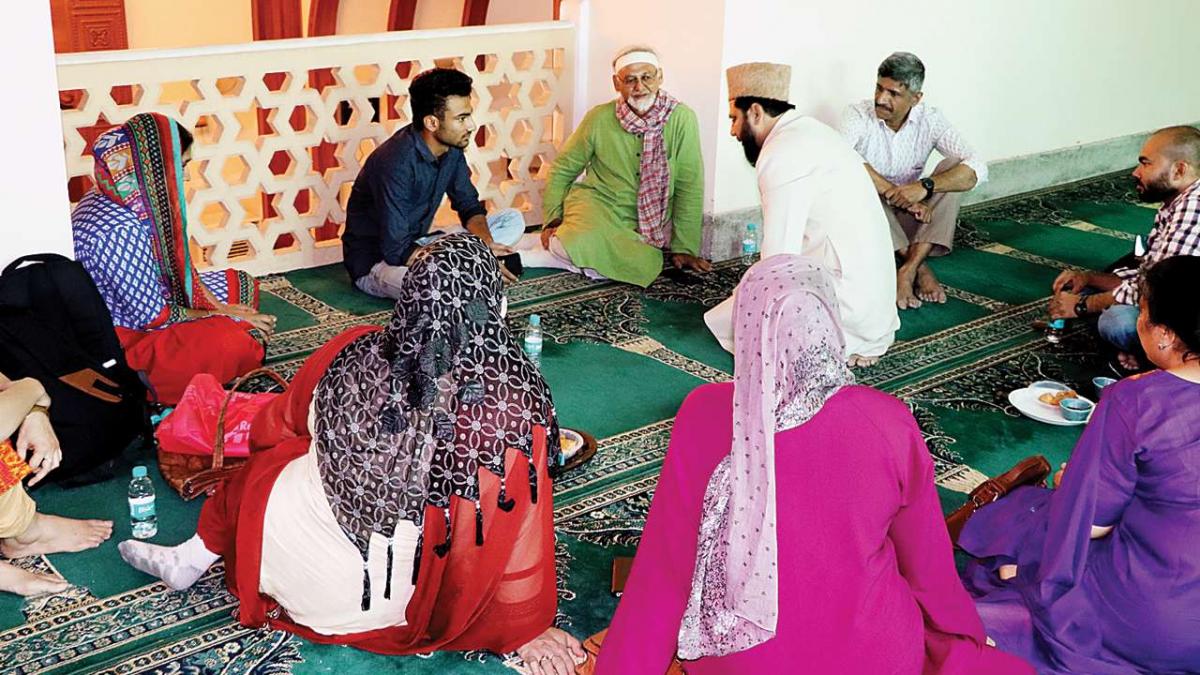
With an objective of celebrating communal harmony and heralding in peace and love, an event was organised by Red Cross Road Jama Masjid on Parliament Street on July 22 and 23.
Image Courtesy: DNA
Non-Muslims were invited by their Muslim friends to grace the occasion, organised as part of Eid-E-Milan. “The event has helped spread warmth and affection among the communities. Such functions help people get to know each other, said Mohibbullah Nadvi, the Imam of the Masjid.
According to him, the event is an annual feature, but it is for the first time that they have put up invitation banners in order to bring in maximum people at the event.
A murderous mob killed one and critically injured another over the rumour of cow slaughter on June 18.
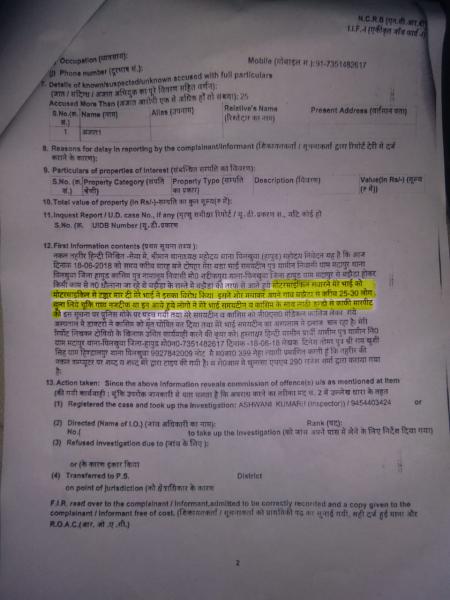
On the afternoon of June 18, a new video surfaced purportedly showing 67-year-old Samiuddin, a resident of Madhapur Mustafabad in Hapur district of Uttar Pradesh, being brutally assaulted by a murderous mob on the rumour of cow slaughter. Now it is being alleged that the state police is trying to cover up the incident of mob lynching as a case of road rage. Two men were brutally assaulted by a lynch mob at the district’s Bajhera Khurd village following a rumour that they were chasing a cow and its calf to catch them for slaughter. Md Qasim – a 45-year-old resident of Saddiqpur in the district – died in the attack, while Samiuddin suffered critical injuries and is undergoing treatment at a private hospital.
The police claim that the two people were assaulted after a scuffle with some bike-borne men from Bajhera Khurd village. They have registered a murder case and arrested two people. “We are probing the angle of cow slaughter as well because there are rumours in this regard. We have charged the accused under appropriate sections (302 – murder and 307 attempt to murder) of the IPC (Indian Penal Code) and the culprits will be brought to book,” said Hapur Superintendent of Police Sankalp Sharma.
But the family members of both victims are saying that the attack was a clear case of hate crime and not “road rage” as the cops are suggesting. “When I reached the hospital, I spotted an ink mark on my brother’s left thumb. When I inquired about that, he told me he has no memory. The police wrote something and asked us to sign. We were reluctant and that’s when they would have taken my brother’s thumb impression,” alleged Mehruddin, the elder brother of the man fighting for his life in hospital.
But the allegation has outrightly been denied by the UP police.
“The brother of Qasim, the man killed, gave a written complaint wherein he had said that his brother was killed in a brawl after few bike-borne men hit him. The investigation is still on. If either family files another complaint, we will include it in the FIR,” said a senior police officer, without wishing to be named.
Qasim’s family said the police version is nothing but a concocted story, which is not even near to the truth. “My brother left home at around 11 am when he got a call from someone in Bajhera who asked him to come over there for buying few animals and he never returned. We got a call from the police at around 2 pm who informed us that he is no more. The police called us and asked us to sign few papers which we did. We don’t know what was written on them. We have not filed any written complaint so far,” deceased Qasim’s younger brother Salim told NewsClick.
Asked about the “road rage” incident, he said his brother did not know how to drive. “He never drove any vehicle; he did not know how to drive. He always used public transport,” added Salim.
The second video of the incident – which surfaced yesterday and has gone viral on Internet – points to the fact that the two Muslim men were assaulted on the allegation of cow slaughter. In the one-minute video, whose authenticity cannot independently be confirmed by NewsClick, a mob of young men can be seen abusing and hitting Samiuddin and at times pulling his beard. He is purportedly been forced to say he was slaughtering a cow in their field. But the elderly man can be seen repeatedly denying the allegations. The attackers also asked him about the people accompanying him.
Blood spots can be seen on the clothes of the victim, who survived the assault.
Another video that had emerged first on the same day the incident took place showed Qasim lying on the ground with his clothes torn off. In the one-minute video – filed almost at the same time, he can be heard writhing in pain and begging for water, which the mob refuses.
A voice off camera asks the attackers, who are also off-camera, to give some water to him and back off. “You have hit him, assaulted him, enough is enough. Please understand. There are consequences,” says the voice.
However, another voice cuts him off, saying, “If we had not reached within two minutes, then the cow would have been slaughtered.”
Another voice in the video can be heard, saying, “He is a butcher, someone ask him why he was trying to slaughter a calf.”
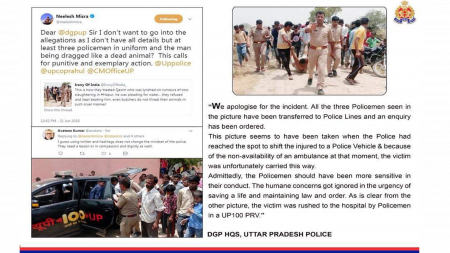
Qasim later died in hospital. A photo of him being dragged in the presence of policemen has forced the police chief of the state to offer an apology. The Director-General of the UP police admitted on Twitter that the conduct of the men in uniform was “insensitive”. He said their personnel were acting in the heat of the moment trying to get the dying man to the hospital.
“We apologise for the incident. All the three policemen seen in the picture have been transferred and an enquiry has been ordered. The picture seems to have been taken when the police had reached the spot to shift the injured to a police vehicle & because of the non-availability of an ambulance at that moment, the victim was unfortunately carried this way,” said the DGP Headquarters in a statement adding that “admittedly, the policemen should have been more sensitive in their conduct”.
Speaking to Sabrangindia after the abrupt decision of the BJP to pull out of the ruling coalition in the state and get Governor’s Rule declared (June 20,2018), four times elected MLA from the CPI-M, Yusuf Tarigami expressed worry and concern at the situation in the valley and appealed to all Indians to extend understanding and love to the plight of Kashmiris
Excerpts:
With the Amarath Yatra set to begin on June 28, we had expected (wrongly) that the BJP would wait at least two three months before taking this step, in the larger interests of the people of the state, the yatris. We expected this out of respect for the Yatris. But they are concerned only about narrow political consdirations
It is the tradition of the Kashmiris to lend a hand and support to the Yatris and we are sure this will continue but the overall atmosphere of tension and fear cannot help
The decision to end the alliance is meant to help their campaign for the 2019 elections since the state government has no favourable record to show
Jammu and Kashmir is headed for troubled times. This government, with separate agendas of the two alliance partners before the elections came together in such an opportunistic way after the election results and has a poor performance.
Kashmir is bleeding, on fire, needs now more than ever the understanding, love and affection of the people of India
The Amarnath Yatra begins every year in the month of Shravan (July-August) and this year it is scheduled from June 28 to August 26. This year, with Governor’s Rule suddenly declared after the BJP pulled out its support from the alliance government in the state, there is an anxiety around this annual event. This anxiety appears justified given what CJP’s Hate Watch has found.
Hate Watch identified this particular brand of hate speech as a part of a systemic campaign in which one BJP youth page spreads false news of Omar Abdulla threatening he’ll end Amarnath Yatra and then the other page responds with hate-speech on a Facebook Live broadcast. All happens right after the PDP-BJP alliance fails and when the Amarnath Yatra is starting.
Shameless display of Unbridled Hate
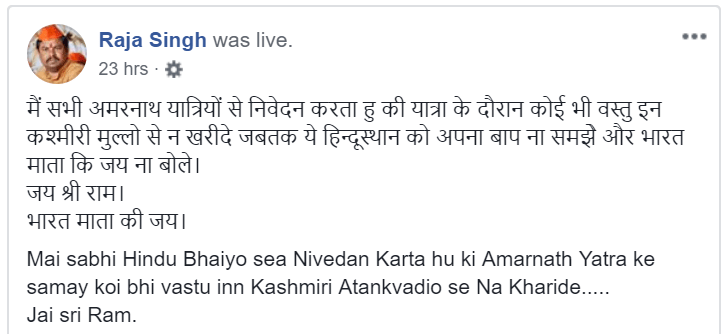
The video may be viewed here. We must warn you that the language in this video is deeply offensive and unsuitable for minors. The description to the video says:
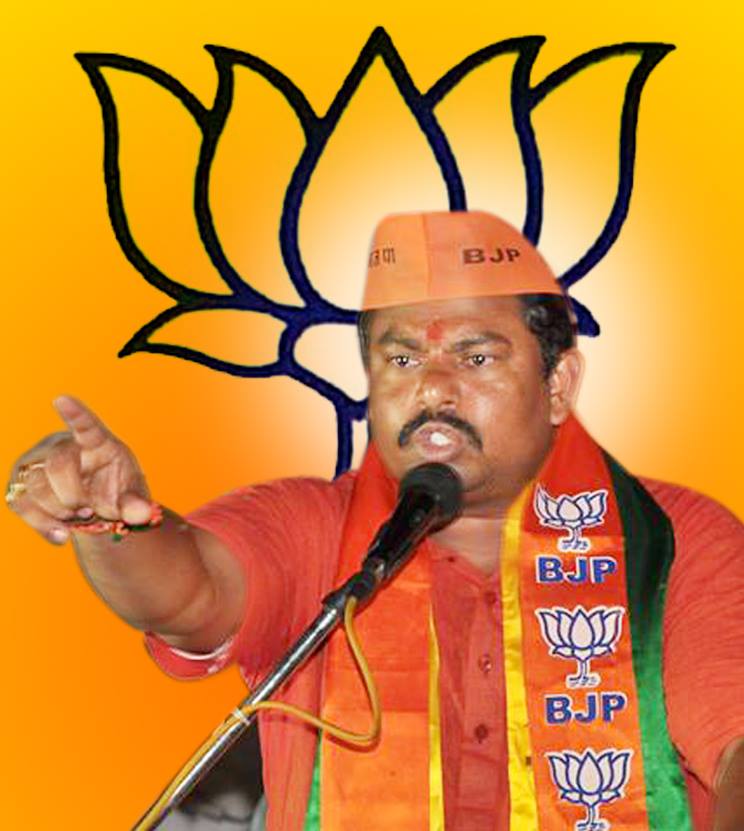
This Facebook live video of Raja Singh has already been shared 6600 times, and viewed 1,72,000 times!
Here’s some Background: Kashmiriyat and pluralism Kashmir has a very unique syncretic culture where the Muslims and Hindus both revere common saints. Nuruddin Nurani is Nund Rishi and a Shaivite female mystic, Maa Lalleshwari, is fondly remembered by the Muslims as Lalla Mauj (‘Mother Lalla’) or Lalla ‘Arifa (‘Lalla, the Realised One’). Though Amarnath cave is reported to be about 5,000 years old many people don’t even know that the Amarnath cave was discovered by a Muslim shepherd named Buta Malik (from the Bakrawal Tribe), in 1850!
Last year, 2017, the bus driver Sheikh Salim Gafur who saved 52 Amarnath pilgrims got second highest gallantry award ‘Uttam Jeevan Raksha Padak’. The Mamalaka temple which is a stopover for pilgrims going to the Amarnath cave shrine is maintained by Mohammad Abdullah and Ghulam Hassan, who are fulfilling the promise given to the Pandit of Mamalaka temple by his friend Abdul Bhat in 2004. In Mohammad Abdullah and Ghulam Hassan’s words “We have faith in Lord Shiva. We not only maintained the temple, undertook repairs but also ensured that the temple remains fully functional despite threats from the militants”.
Amarnath Yatra is a great occasion that bridges the communal gap and a living example of Kashmiriyat, the ethno-national and social consciousness and cultural values of the Kashmiri people. Therefore, it has become the target of all hatemongers who want to destroy the secular identity of India disrupt peace to polarize masses.
Triggering hostility
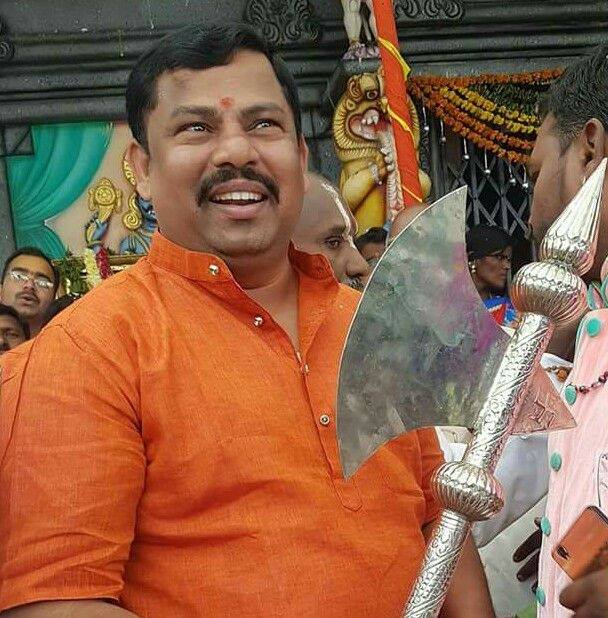
However, the June 22, 2018 Facebook live video by Raja Singh is blatant example of inciteful expression or hate speech intended, in CJP’s view, to create hostilities between communities that may well lead to violence. It is pertinent to note that T. Raja Singh is not just another extreme right-wing social media troll posting hate speeches. He is a member of the Telangana Legislative Assembly representing the Goshamahal assembly constituency in Hyderabad. He is a member of the Bharatiya Janta Party, and also occupies the position of party whip for Telangana. He has half a million followers just on Facebook and therefore, BJP cannot isolate itself from this hate speech. This appears to be a deliberate attempt to divert the attention from four years of failure of governance and chaos in J&K by the an alliance government (BJP and PDP) of which the party was a part. In the live video one can see Raja Singh reading out the scripted hate message by looking at the bottom of the frame instead of the camera.
The premise of this hate speech is based on a Fake propaganda by the social media page of BJP youth wing
“Youth India” page (which has about 2.5 lakh followers) in their propaganda have cooked up a fake news saying “Omar Abdullah has threatened to end the Amarnath Yatra.” This bit of fake propaganda has been exposed in this link.
The pattern is clear, even sinister. One BJP-associated page spreads fake news on social media then the other makes hate speech based on that piece of fake news. This is a well coordinated and collaborative strategy to create communal division (even hatred) around the time of Amarnath Yatra.
Venom in the Video
The video starts with a warning to “mere dushmano (my enemies)”. He says, “The time of war has arrived and we have to see who is standing with the nation and who is not.”Which war is he talking about? “Ek Kashmiri k#*%a bhaunka, Omar Abdullah” (A Kashmiri dog barked, Omar Abdullah) and goes on to say that he (Abdullah) will end the Amarnath Yatra. Then Raja Singh reminds of Bala Saheb Thackeray’s hate speech where the late Shiv Sena where he had said, “If Amarnath Yatra stops then no flight for Hajj will take off from Mumbai.” He also says that PM Modi should have broken the alliance much before now. Then he also contradicts himself by saying that the day Hindus stop going for the Amarnath Yatra the Muslims of Kashmir will die of starvation because that is the only source of earning for Kashmiris. He says, “Every year I request my Hindu brothers and sisters to boycott Kashmiri Muslims when they go for Amarnath Yatra and they should only buy products and take services of Hindus”. In the video, Singh also warns all the Muslims of India saying, “Till now there was the government of impotent people, now under Modiji’s government you can survive (only) by keeping quiet and obeying us. Otherwise, we’ll pull the carpet below your feet and you won’t even know.” Of late the earlier spontaneous Amarnath Yatra has also gotten increasingly militarized.
A staggering Rs 3,118 crores mysteriously found their way to these banks according to a document released in a press conference today
An RTI reply had last week sensationally revealed that a cooperative bank in Gujarat with BJP President Amit Shah as a director, had collected the highest volume of old Rs 500 and Rs 1,000 notes that were abruptly demonetised on 8 November, 2016 by Prime Minister Narendra Modi.
Even today, according to the website of the Ahmedabad District Cooperative Bank (ADCB), Shah continues to remain its director raising serious conflict of interest given his proximity to the finance ministry as the president of the ruling party. Shah is still being described one of the directors of the cooperative bank. (see below). He was also the bank’s chairman in 2000. ADCB’s total deposits on March 31, 2017, were Rs 5,050 crore and its net profit for 2016-17 was Rs 14.31 crore. Congress President Rahul Gandhi too tweeted using a catchy hashtag #ShahZyadaKhaGaya (Amit Shah has eaten too much), “Congratulations Amit Shah ji , Director, Ahmedabad Dist. Cooperative Bank, on your bank winning 1st prize in the conversion of old notes to new race. 750 Cr in 5 days! Millions of Indians whose lives were destroyed by Demonetisation, salute your achievement.”
Soon #ShahZyadaKhaGaya became a top national trend on Twitter yesterday.
Another branch with a BJP minister as its chairman received the deposit of Rs 693.19 crore in the same period. The Rajkot District Cooperative Bank has Jayeshbhai Vitthalbhai Radadiya, a cabinet minister in Gujarat Chief Minister Vijay Rupani’s government, has its chairman.
According to the AICC press release that may be read here, these are the links: 1. Surat District Co-operative Bank Ltd. which received ₹369.85 Cr Director- Shri Prabhubhai Nagarbhai Vasava, BJP MP (Lok Sabha) from Bardoli Chairman is Shri Nareshbhai Patel, a prominent BJP leader. 2. Sabarkantha District Central Cooperative Bank Ltd. – which received ₹328.50 Cr Directors- Shri Rajendrasinh Ranjitsinh Chavada, BJP MLA from Himatnagar and Shri Praful Khoda Patel, Former MoS Home in the BJP Govt of Gujarat and is now appointed by Modi ji as Administrator of Daman & Diu and Dadra & Nagar Haveli. Chairman is Shri Maheshbhai Amichandbhai Patel is a BJP leader. 3. Banaskantha District Central Co-operative Bank Ltd- which received ₹295.30 Cr Director- Shri Shankar Chaudhary, Former Minister of State for Urban Housing, Health, Family Welfare and Transport in the earlier BJP Government of Gujarat and General Secretary of the Gujarat BJP. Chairman is Shri M L Chaudhary, a BJP leader. 4. Mehsana District Central Co-operative Bank Ltd received ₹215.44 Cr This bank is controlled by Deputy CM, Shri Nitin Patel through registrar. Elections due. 5. Amreli Jilla Madyastha Sahkari Bank Ltd. which received ₹205.31 Cr Chairman- Shri Dileepbhai Sanghani, Former BJP MP & Former Cabinet Minister in the BJP Gujarat Govt and is presently appointed by Modi ji as Vice Chairman, NAFED 6. The Bharuch District Central Co-operative Bank Ltd received ₹98.86 Cr Chairman is Shri Arunsinh Rana, BJP MLA 7. Baroda Central Co-operative Bank Ltd received ₹76.38Cr Director, who controls the Bank, is Shri Satishbhai Patel, BJP MLA and Chairman is Shri Atulbhai Patel, BJP leader 8. Junagarh Jill Sahakari Bank Ltd received ₹59.98 Cr Chairman is Shri Jashabhai Barad, Ex Cabinet Minister in BJP Govt & a prominent BJP leader 9. Panchmahals District Co-operative Bank Ltd. received ₹ 30.12 Cr This bank is controlled by Former BJP MP, Shri Gopalsinh Solanki through registrar.Elections due.
Rajkot is also believed to be a hub of Gujarat BJP politics as PM Modi was first elected from there as a legislator in 2001. “The amount of deposits made in the State Cooperative Banks (SCBs) and District Central Cooperative Banks (DCCBs) — revealed under RTI for first time since demonetisation — are astounding,” Manoranjan S. Roy, the RTI activist who made the effort to get the information was quoted by IANS.
Yesterday, just before the Congress held its press conference, National Bank for Agricultural and Rural Development, also known as NABARD, issued a statement, saying that the average deposit amount in the Ahmedabad DCCB was Rs 46,795 per account holder, which it said was lower than the average per depositor in 18 DCCBs of Gujarat, reported PTI. NABARD is the country’s apex financing agency for institutions that promote rural development.
Using the the NABARD statement, the BJP clarified that the Ahmedabad DCCB was one of the biggest in the country and that it was not out of the ordinary for it to collect such an amount, added PTI report. However the fact that the BJP is feeling compelled to respond to allegations speaks of how the political discourse is turning.
Demonetisation: A Modi-Made Disaster (AICC Press Note)
On November 8th, 86% of India’s currency was nullified in an effort to clean out “black money” and “counterfeit notes”; this effort resulted in a massive disruption to the existing social, political and economic functions of the world’s second largest emerging market. All 500 and 1,000 rupee notes were instantaneously voided, and a 50-day period ensued where the population could (ideally) redeem their cancelled cash for freshly issued 2,000 and later 500 rupee notes or deposit them into their respective bank accounts.
In the ensuing days after Demonetization, the public in general was hit quite bad, but it was the poor who took the largest share of pain. The poor and the lower middle-classes that constitute the vast majority of the population, simply did not have the access to structural and cultural resources needed to adapt to such shock economics. Even the banks, debuted to do all the heavy lifting on the ground, weren’t kept in the loop; ill-equipped for the crisis and unable to make sense of an outlandish government order, they still managed to do a remarkable job despite not even having an adequate supply of new notes to balance out the nullified currency. With 86% of existing cash that was in circulation having been demonetized, the Indian Economy came to a sudden, screeching halt.
Trade across all facets of the economy was disrupted, and cash-centric sectors like agriculture, fishing, and the voluminous informal market, were virtually shut-down. Many businesses and livelihoods went under completely, not to mention the economic impact to the country when you have millions of productive people just standing in line for hours and hours, just to exchange or deposit cancelled banknotes, rather than working or running their businesses.
Even the undeclared emergency in the newsrooms failed to contain the news spreading like wildfire throughout India: Demonetisation was a colossal and completely avoidable failure and the largest government-abetted money laundering scheme in history.
Demonetisation failed to curb black money as 99% of the withdrawn 500 and 1000 rupee notes were returned, according to the RBI. This was expected as black money isn’t usually stored in currency, but property, bullion and more easily convertible currency like dollars. Thus, the dichotomy between ‘Black Money’ and ‘Black Wealth’: one is a flow variable and one is stock variable. And no amount of demonetization can bring about any change in stock variables. The claims of unearthing large amounts of black money are unfounded and based on a naïve and uninformed view of what actually constitutes black money.
Furthermore, the announcement failed to stem any sort of terror attacks and insurgency as there were 23 more attacks in Kashmir alone after the announcement. There were numerous reports of insurgents caught with large hordes of new currency on the Indian border.
The extent of circulation of counterfeit notes in the Indian economy is exaggerated. A special report carried out by the Indian Statistical Institute (ISI), Kolkata, found out that the circulation of counterfeit currency was about Rs. 400 crore i.e. a mere 0.022%, of the total notes in circulation; simply not worth the 2% damage to India’s GDP growth.
It failed to produce a cashless economy as whatever rise in e-commerce sales took place during that period, returned to the same growth trend-line as before in a matter of few months, when cash supply was finally normalised. Considering the extent of the Indian unorganized sectors, it was simply illogical to even attempt digitalisation before creating an alternate payment infrastructure. As a result of this catastrophic move, 3 lakh crore rupees in national income was lost; a conservative estimate given the informal cash-based economy accounts for nearly 50% of GDP or 65.25 lakh crore rupees. Some bank managers grew rich from the haircuts they took on people’s hard-earned money, quickly forming a sophisticated and organised money laundering racket. Meanwhile, a 115 people died as a direct result of the ‘note-bandi’—almost all were poor. Even after the supportive mainstream media declared demonetisation a failure, PM Modi has still not been able to bring himself to condole with their bereaved families or pay them any compensation for the loss of in many cases, their primary breadwinners.
The demonetisation move represents not just a faulty economic policy but also holds high potential for indiscriminate state surveillance, violation of privacy and abuse of civil liberties, with the replacement of cash payments with digital payment systems. With big data analytics growing bigger day by day, personal data of private citizens have turned into commodities on the grey markets, that may result in a breakdown of basic social-contracts and trust between the state and its citizens.
The end truth is, the Prime Minister expected to make a tidy profit of 4 lakh crores from dispossessing those who weren’t able to exchange their notes. Instead, 21,000 crore rupees of our tax money was squandered on printing notes, while only 16,000 crores were left unclaimed.
The entire text of the AICC Document may be read here.
Ethnic cleansing begins with seeing a group as less than human
The most friendless people in the world REUTERS
At the start of this year the Myanmar military confessed that several of its soldiers killed 10 unarmed Rohingya at the coastal village of Inn Din in Rakhine state.
Apparently, these men — suspected as terrorists — were captured by villagers. Yet instead of taking them to the nearest police station, which is protocol, the villagers along with security forces not only executed the men — but buried them in a mass grave.
I imagine that scene at the start of Quentin Tarantino’s Inglourious Basterds. The one where Aldo Raine (played by Brad Pitt) and his team execute a group of Nazis — brutally and one by one.
Of course in this case, the victims were not fictional Nazis but innocent Rohingya men. In real life, the villagers hacked two of the captives with swords; the rest were shot dead by security forces.
This all happened on the morning of September 02, 2017 (I hope you don’t remember what you were doing then).
While the Myanmar military announced action will be taken against those involved, such “breach of protocol” raises serious questions about the current repatriation pact between Myanmar and the UN (there was already a prior agreement between Myanmar and Bangladesh).
Now, I was going to make a sardonic joke about if there are a few bad apples in the army, how do we know the whole batch isn’t bad? And pretend — like the Myanmar military — this was the only incidence of violence in the last year.
But even as I wrote it, the words felt too hollow, too empty. Because we all know it’s not just a few bad apples: Because across the Naf river, less than a couple hour’s flight from Dhaka, a genocide occurred. That eight-lettered word coined in 1944, demarcating the eradication of a people group based on race, religion, or ethnicity.
And it terrifies me to no end that the current plan is to send them back, as if the problem was one of logistics and not of ethnic cleansing (although, even as I write this, it is unclear how willing Myanmar actually is in bringing back its second-class citizens).
The current plan — framed in the language of bureaucratic development — focuses on “voluntary, safe, dignified, and sustainable” return. Yet there is no guarantee of protection, nor an explicit pathway for citizenship.
Voluntary or not, if the Rohingya return, they will be returning to a living nightmare, a land of their own ghosts.
Back into the heart of darkness The right of return is not just about safe passage; it’s about how the Rohingya people are imagined by the state of Myanmar. As long as the Rohingya are seen as outsiders, as not belonging, they are in danger.
Like many others have written, for the Rohingya to return — they have to belong in the most fundamental sense; and I couldn’t agree more.
As contemporary French philosopher, Étienne Balibar, argues — and I realize I am doing that thing where you take an incredibly complex thinker and try to summarize their thoughts in barely a few words, but still — ethnic cleansing is the extreme logical conclusion of societal racism.
Of course, this isn’t to say that all instances of societal racism will inevitably lead to ethnic cleansing; but such racism is a necessary precondition for genocide to occur. Before you can “eradicate” a people group, you have to first learn to see them as less than human. Such was the case for the Jews in Germany, the Hutu and the Tutsi respectively in Burundi and Rwanda, the Bosniaks in Srebrenica, and so on and so forth. It was even the case for Bengalis during the time of East and West Pakistan.
Undoubtedly, every society has their pretend monster, the marginalized group that does not belong. The “other” that becomes the cause of all societies woes, a constant and perpetual scapegoat.
For the US at present, it is mostly likely the figure of the Mexican immigrant that represents this “outsider.” For France, it is most prominently the North African, and for North Africa it is the sub-Saharan African.
Such a “figure” allows unjust elements of society to continue, because it allows for a scapegoat. Instead of blaming the rich and powerful, we are taught to blame the weak, those we learn to see as vile.
If the Rohingya return as is, it will be back into the heart of darkness. The “most friendless people in the world” will once again find themselves in an abyss from which there is no escape.
Among the 10 slaughtered on Spetember 2, 2017: Five were fisherfolk, the two wealthiest shopkeepers, one was an Islamic teacher, and the last two were high school boys.
They were held in a school overnight, and on early September morning brought to a hill to be killed.
You can see them all in the photo. It’s devastating to look at, and I’m not sure what good saying their names does, but you can find them online if you wanted.
It’s almost cliche at this stage to reflect upon Bangladesh’s own birth by fire, a country that too emerged from unspeakable acts of violence.
And let’s not forget, in the eyes of the Myanmar soldiers, those killed at Inn Din weren’t Rohingya at all — they were Bengali.
The mob waylaid the couple in their 20s and assaulted them at Pukhurpur village in Rongjuli area on June 19. The brother of the man who was attacked has claimed that villagers later held a meeting and forced the two to get married.
Assam Director General of Police Kuladhar Saikia said that as no case was filed, the police registered a case and investigations were on. While one person was arrested on Thursday, another person was picked up Friday morning, police said.
They were booked under various IPC sections including 342 (wrongful confinement), 325 (voluntarily causing grievous hurt) and 354b (assault or use of criminal force to woman with intent to disrobe).
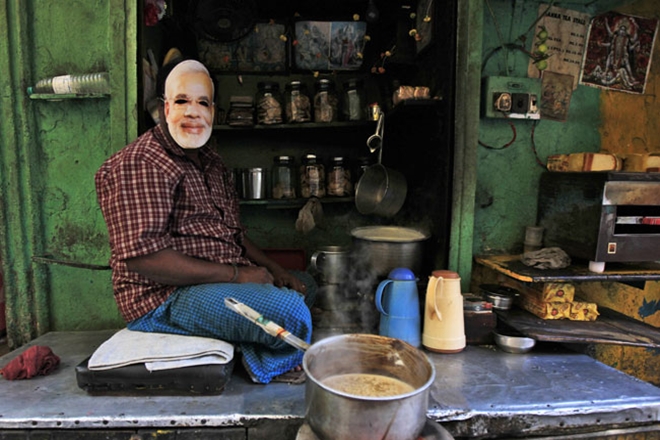
This is not the story of a man who once sold tea and later ‘sold’ dreams to a people and managed to reach top echelons of power in the biggest democracy in the world.
This is also not a recap of the role played by an international PR agency which was appointed by him á decade back to “seek professional and rare expertise” in reaching out to broadest mass of people with a fresh message.
This is also not to revisit this man’s thoughts which find mention in his book which compare the work of cleaning an “experience in spirituality.” (https://www.countercurrents.org/gatade010313.htm).
This is also not the story of the man who abandoned his legally married wife merely few months after their union and this is no exercise in telling you that he never went back to enquire about her, nor took the initiative to formalise the separation.
May be he suffered from selective amnesia for a long duration in his life or was supposedly so engrossed in the work that he considered working for the ‘nation’ that he even forgot to mention it to others. May be the organisation with which he worked frowned upon any such union and he desisted from sharing the news.
This is also not to share with you that when the need arose and he was expected to put the matters straight he supposedly faced Hamlet’s paradox about his being married or not married and preferred to remain ambiguous. This is no comment on those people who could question this ambiguity, who were in seats of power and preferred to look the other way or maintained silence.
This is also not to tell you that when he toured the country mobilising people to march on the citadels of power – to break the monopoly of the dynasts – he had no qualms in maintaining an ambiguity about his own life. And this style still continues. In fact, once he even told the people that “he is basically a ‘faqir’, a man of god, with no worldly attachment or possession and that it would not take him a moment to leave his office and go away.” (https://www.nationalheraldindia.com/opinion/narendra-modi-his-speeches-and-politics-the-art-of-public-speaking). This is no attempt to tell you that few years back his selective amnesia or his ambiguity vis-a-vis his marital status was finally over and he formally acknowledged that he was married.
This is also not to tell you that for all those people who looked at him as a ‘messiah’ – who adored him – who voted for him in overwhelming numbers, who supported him; did not complain at all even when they came to know that he had been very selective with his words while describing his marital status.
This is also not a comment on the immense tolerance level of the people, that they preferred to nod their head even when one of his deputy frankly admitted that one of his key promises to win over people was merely a ‘jumla’.
This little note has nothing to add to all these things and many more which are available in the public domain.
Maybe later day historians would be able to throw light on them better or sit in judgement. Maybe they would be able to say whether he was really the ‘visionary statesman’ India had awaited or was a modern day reincarnation of a medieval king who had decreed to shift India’s capital without larger consultation.
This is just to tell you that the woman he abandoned