UPDATE On Tuesday, April 17, Chhattisgarh Chief Minister Raman Singh said that the police’s formal order currently stands cancelled, and that the state government would appeal the Supreme Court’s decision. “We have always been sensitive towards SCs & STs. The state government, just like Centre, will appeal against the decision of Supreme Court. Till then the order (to strictly implement the Supreme Court order) by Police headquarters stands cancelled,” Singh said.
Even as the central government is reportedly mulling passing an ordinance “to restore the original provisions” of the Scheduled Castes and Scheduled Tribes (Prevention of Atrocities) Act 1989, at least three BJP-ruled states have begun enforcing the new law as per the recent Supreme Court order. On March 20, the SC ruled that, arrests cannot be made under the law without obtaining prior permission, along with a host of other stipulations.
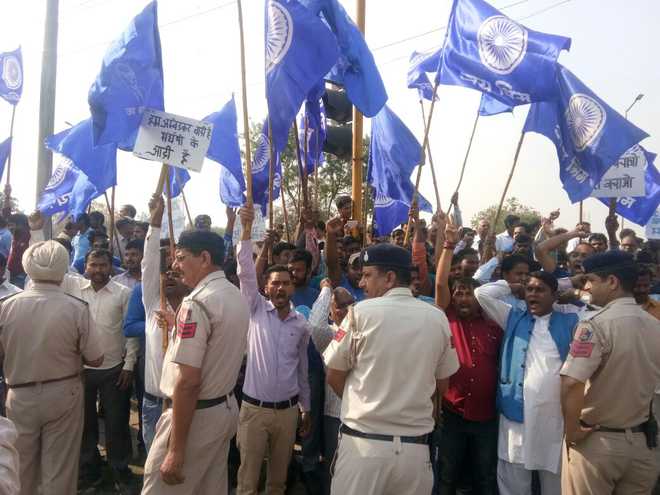
Image: The Tribune
Dalits and civil rights activists fear that the Supreme Court’s ruling weakens the law. Another potential option for the central government is reportedly a bill that may come up in the Parliament’s monsoon session to amend the SC/ST Act. The Centre, which has filed a review petition over the court’s order, has reportedly said that state governments “should not do anything by which the SC/ST Act is weakened or whittled down“.
Rajasthan, Madhya Pradesh, and Chhattisgarh have handed out formal orders, directing police chiefs to act upon the Supreme Court’s order. Himachal Pradesh has informally disseminated the order to police officers, with DGP S. R. Mardi curiously saying he has only “circulated” the order on WhatsApp to senior police officers, but “no formal instructions have been issued.” Haryana is seeking legal advice.
Rajasthan’s ADGP (Civil Rights), M. L. Lather, said that his office sent out a circular to all district police and commissionerates to implement the new guidelines in relevant cases a few days after the Supreme Court’s order.
In Madhya Pradesh, ADGP (Scheduled Castes) Pragya Richa Shrivastava notified officials in charge of SC/ST police stations, districts, ranges, as well as government railway police regarding the Supreme Court order and directed them to comply with the guidelines. According to a senior officer, the guidelines did not require a notification as once the order was passed, it became law. The police headquarters was compelled to send out a circular as a case was reported in the state’s Damoh district following the Supreme Court order. Local police were not aware of the new order, and so adhered to the prevailing guidelines; however, the accused pointed to the new guidelines.
In Chhattisgarh, Additional Director General of Police R. K. Vij, who sent out a circular to all SPs, refused to comment on Monday, April 16. However, a senior police officer said, “Once the Supreme Court issues directives, it is routine practice for the administration to issue orders to the lower rank and file to apprise them of what the Supreme Court has said. This has happened in changes of law of juvenile justice, rape and so on. The police are duty-bound to follow Supreme Court directives. If the Supreme Court were to review the changes, then of course the police would do so too.” Chhattisgarh police issued a circular on April 6.
Haryana’s DGP B. S. Sandhu said, “Although there is a Supreme Court verdict on the case, the Centre has also filed a review petition. Thus, I have forwarded the issue to ACS (Home), requesting him to seek legal opinion on the matter and advise us accordingly. So far, we have not implemented any change. As per standard practice, we do conduct a thorough probe in all such cases before arresting any accused.”
In Punjab, ruled by the Congress, the state welfare department has reportedly advanced the order’s file to Chief Minister Amarinder Singh, who hadn’t responded. On April 1, the Chief Minister’s office said in a statement that the government was “committed to the welfare of Scheduled Castes and Scheduled Tribes” and that Punjab’s Assembly “had sought the Centre’s intervention to legally pursue the case.” In Congress-ruled Karnataka, where elections will be held next month, the order has been informally disseminated. Kerala, ruled by the CPI(M), has filed a separate review petition over the Supreme Court order, making it the only state to thus far challenge it. There, the police chief has just forwarded the order.
Insidious attempts to demonise the minority community using incendiary posts and inflammatory tweets
‘Whataboutery’ and ‘fake news’ have become such a staple of our times that every time a news story involving the minority community is reported, it is accompanied by ‘conspiracy theories’ and attempts to draw ‘false equivalence’. The Kathua rape and murder case was no different. What was disturbing though was how the willful campaign of spreading misinformation and fomenting hate also managed to somehow blame Rohingya refugees for the crime.
Ever since the body of a little girl was discovered in the forest on the outskirts of Kathua, and the complicity of influential and powerful right wing functionaries and local cops came to light, several websites and social media accounts of known right wing sympathisers went into an overdrive to spin a parallel narrative.
CJP believes that Fake News is a dangerous weapon against democracy and peace. To learn more about how to spot and stop fake news and hate speech, join CJP. Become a Member.For example this tweet by Madhu Kishwar blames Rohingyas for raping the little girl in Kathua:
This new narrative not only attempts to absolve the accused of their crimes, but also blames it on Muslims, especially members of the Rohingya community who had been recently resettled in the region. This was evident at the rally held in favour of the accused where supporters of the alleged rapists were seen carrying the national flag and claiming that the accused were actually innocent and had been framed.
Rally by Hindu Ekta Manch in support of key accused Deepak Khajuria
There were also several attempts to draw false equivalence between the Kathua rape and murder and other cases where victims were non-Muslim. Many also accused ‘liberals’ of selective outrage:
However, what they failed to take into account was that it was in the Kathua case that there were demonstrations and rallies held in support of the accused. In fact, members of the ruling party, Industries and Commerce Minister Chander Prakash Ganga and Forest Minister Lal Singh, were present at this rally. They subsequently resigned following national outrage and due to mounting pressure.
Shankhnaad, a website (that is no longer accessible) popular among right wing supporters published the following conspiracy theory that quickly went viral on social media:
The claims were promptly fact checked and shot down by The Quint, which in turn elicited this response from Shankhnaad. But the manner in which the Rohingya thread was woven into the narrative was particularly interesting given how it was subsequently also played up at multiple protests in Jammu.
“The Rohingya are living in Jammu illegally and want to criminalize our society,” said Paviter Singh, a leader of Jammu Province People’s Forum that supported the shutdown protests. “We will keep protesting” until the government deport Rohingya from the state, he told UCA News.
Why are Rohingyas being targeted
Nearly 10,000 Rohingya refugees have been settled in Jammu. These families have been targeted by local politicians such as those from the Jammu and Kashmir National Panthers Party using posters and banners as well as during the recent ‘bandh call’ in the state, allegedly for the purpose of striking fear in their hearts. Infact, the campaign to evict Rohingyas began in 2017 with right wing groups demanding their ouster.
Ever since the Rohingya exodus first began, refugees started arriving in Cox Bazaar and other refugee camps in Bangladesh. Many of them gradually started migrating to India by allegedly crossing the Bangladesh border along Poschim Bongo or Assam after paying huge sums of money to human traffickers. As it is these regions have seen an influx of (mostly Hindu) Bangladeshi migrants post the Bangladesh war in 1971.
But when Muslim migrants started entering the country Saffron groups raised concerns about the Islamisation of Bengal. These fears were fanned further when fake news stories of Muslims targeting Hindus spread during the recent communal clashes in Malda and Bashirhat. Similarly viral and often fake news stories of brutal rapes of local women and girls by perpetrators with clearly Muslim names also help foment hate. As it is difficult to tell if the alleged perpetrator is Indian, Bangladeshi or Rohingya, right wing sympathisers, websites and trolls have a field day playing the blame game.
For instance take a look at this tweet by Shankhnaad on April 12, where they spin a narrative around ‘Rape Jihad’:
This once again draws attention to the religion of the alleged rapists and also makes a case against Rohingyas. Other widely shared social media posts about minors murdered in Assam and Bihar were debunked by Boom Live as either outright wrong information, fake stories or for using images not connected with the crimes.
Despicable Lows
Even as the conspiracy theories and fake news reports kept appearing on social media in the Kathua case, most people had the decency to not speak ill of the dead child. However, one Kochi man, sank to a new low when he posted on social media allegedly saying,
good that she was killed at this age itself. Else, she would have grown up and returned throwing bombs in India”
He was promptly fired from his job after enraged twitter users demanded his ouster.
Meanwhile, senior advocate Prashant Bhushan has filed a criminal complaint against Madhu Kishwar under sections 153A, 295A and 505 of the IPC for inciting hate and violence with her tweets.
The Wider Demonisation of Muslims on Social Media
There are several other instances of demonisation of Muslims on social media. The community is routinely shown as a threat to cows, women and Hinduism, which is why there has been an increase in cases of Gautankwad or cow vigilantism and Anti-Romeo squads unleashing terror on unsuspecting youngsters.
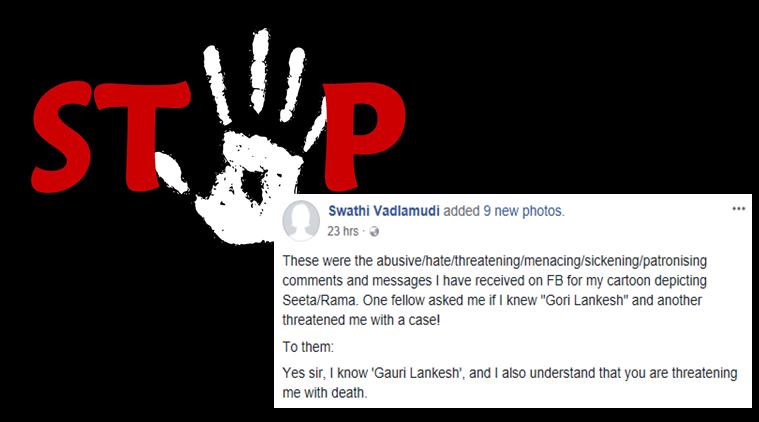
The Network of Women in the Media (NWMI), a forum for women media professionals in the country, has issued a statement condemning the filing of an FIR against journalist and cartoonist Swathi Vadlamudi. According to the statement, the FIR was filed at Hyderabad’s Saidabad police station under Section 295A of the Indian Penal Code (“deliberate and malicious acts, intended to outrage religious feelings of any class by insulting its religion or religious beliefs”). The statement says the FIR was filed by Hindu Sanghatan, an off-shoot of the right-wing Vishwa Hindu Parishad (VHP).
Vadlamudi’s cartoon, which was published on her Facebook and Twitter pages on April 10 and 11, shows the Hindu gods Ram and Sita discussing “the issue of abduction and violence against women in India. The message in the cartoon does not in any way insult Sita or Ram; instead it poses a question to the public,” the statement says.
The NWMI has noted that since April 10, Vadlamudi has been targeted with “online abuse by Hindutva groups, where some users have threatened that she will meet the same fate as Gauri Lankesh and the murdered cartoonists of the Charlie Hebdo magazine in France,” adding that the Hindu Sanghatan has also filed charges against Times NOW Chennai Deputy Editor Shabbir Ahmed, who shared Vadlamudi’s cartoon on Twitter. According to the NWMI, another cartoonist, Satish Acharya, has also received abuse and death threats.
The statement has highlighted that Vadlamudi’s cartoon has been shared at least 8,000 times on Facebook, and received several thousand ‘likes’, a clearly indication that it “touched a chord among the Indian public which in the recent past has seen abductions, brutal gang-rapes and murders of women and children in different parts of the country, from Kathua in Jammu and Kashmir to Unnao in Uttar Pradesh, Surat in Gujarat and elsewhere.” NWMI has stressed the significance of cartoons in the news media, saying they “hold a mirror to the current world in a particularly effective manner that goes beyond what is captured by words (spoken or written), photographs or videos. In a vibrant democracy such an art and the artists who create it should be encouraged to thrive instead of being stifled by hate groups.”
The NWMI has demanded that the Hyderabad Police should immediately drop all charges against Vadlamudi, Ahmed, and any other individuals against whom cases have been filed in this context. Moreover, it has called on the police to take “prompt action” against anyone abusing Vadlamudi, Ahmed, Acharya, and others. The organisation has also urged the Editors’ Guild of India and the Press Council of India to take suo moto cognisance of such attacks on media professionals, particularly women, and called on them to “come out strongly” to support and defend anyone being attacked.
Whether or not diversity is a good thing is still a topic of much debate. Though many businesses tout the benefits of diversity, American political scientist Robert Putnam holds that diversity causes people to hunker down, creating mistrust in communities.
Shutterstock.
Empirical investigations into how diversity affects communities are too few and far between to provide any definitive answer to the question. So, together with colleagues in Singapore and the US, we set out to examine this very question in a series of studies – the results of which were recently published in the Journal of Personality and Social Psychology.
There is indeed evidence that diversity creates mistrust in communities. But diverse communities also provide an opportunity for people from different racial and ethnic backgrounds to come into contact with each other, and we thought that these experiences would create a positive effect on people’s identities: specifically, the extent to which they identify with humanity, as a whole.
A human connection
This is one of the biggest and broadest forms of identity, which a human being can comprehend. A number of spiritual and philosophical traditions have upheld that believing you share a fundamental connection with other human beings – regardless of race, religion, sexuality or gender – is the sign of a mature mind.
My colleagues and I thought that living in diverse neighbourhoods might create opportunities to come into contact with different people again and again, thereby expanding a person’s sense of identity. As a result, people living in diverse neighbourhoods should be more helpful towards others. We examined this possibility in five empirical studies.
In the first study, we took to Twitter to analyse the sentiments of tweets across the 200 largest metropolitan areas in the US. This was a somewhat basic, exploratory test of our hypothesis, using a large sample of data. In this study, we found that the likelihood that a tweet mentions words which suggest positivity, friendliness, helpfulness, or social acceptance was higher in a more diverse city.
Opening up
Encouraged by our findings, we then sought to examine how diversity of a zip code where people lived might affect people’s likelihood to offer help in the aftermath of a disaster, such as a terrorist attack. We used data from a website that the Boston Globe set up, where people could offer help to those stranded after the 2013 Boston Marathon bombings.
After accounting for factors such as distance from the bombings, political diversity, religious diversity and the mean household income of these zip codes, we found that people who lived in more racially diverse zip codes were more likely to offer help to those in need after the bombings.
To take our investigation even further, we examined whether people living in more diverse countries would report that they had helped someone in the recent past. We used data from the Gallup World Poll in 2012, which asked more than 155,000 individuals in 146 countries to report whether they had helped a stranger in the recent past. Again, we found that people in more diverse countries were more likely to report that they had helped a stranger in the past month.
Expanding identities
These three studies seemed to provide converging evidence for our ideas, but we needed to understand whether this was because diversity expands people’s identities. From a scientific standpoint, this presented a big challenge. It would almost be impossible to conduct a real experiment where we allocate people to live in different neighbourhoods and then check whether this had an effect on their level of helpfulness.
So instead we borrowed a technique routinely used by social psychologist, called priming. Priming is a psychological method, used to activate a state of mind for people in an experiment. We primed people to think about neighbourhoods that were either diverse, or not. We made this allocation randomly, then examined how this affected their willingness to help.
We also measured whether this simple procedure of priming also altered their identities. We used a survey measure developed by other psychologists, which measures how much someone identifies with all of humanity. In two studies, we found that imagining living in a diverse neighbourhood expanded people’s identities, which in turn made them more willing to help a stranger.
These results don’t prove definitively that diversity is always a good thing. But they do offer an encouraging view of some of the benefits which diversity might bring to communities, given the way that people’s identities shift when they often encounter those who are different to them.
Some governments are already putting policies in place to make the most of these potential benefits. For example, in Singapore, each public housing apartment block maintains the same ratio of Chinese, Malay and Indian residents as exists in the wider population. This has prevented segregation and created diversity in neighbourhoods, which has led to a better society for everyone.
In ancient Indian texts, sages exhort people to view the whole world as one family. Our studies show that this isn’t a pipe dream – it’s a real possibility.
Sangh Parivar’s silent support to accused in Kathua case derives from their icon Savarkar’s exhortation.
The barbarism of the eight Kathua accused who conspired to abduct, rape and murder an eight year old girl, hiding her in a temple for three days, has shocked India. There have been widespread protests across the country and outraged calls for speedy justice. One fact that seems to be getting slowly air-brushed out of the picture is this: the conspiracy to abduct the Bakerwal (a Muslim nomadic tribe) girl was planned and executed by these men with the express purpose of getting rid of the Bakerwals from that neighbourhood. However you slice and dice it, the fact remains that it was a Hindu fanatic conspiracy against a Muslim community. It was the ultimate expression of the poisonous hatred sown and fostered by the Sangh parivar in the minds of the Hindu community in the Jammu region over the years.
It was because of this connection that RSS/BJP supporters, in the garb of the Hindu Sena, held protests when the accused were arrested, that lawyers prevented chargesheet being filed in the Sessions Court in Kathua, that a Jammu bandh call was given (though it flopped), and that two BJP ministers attended a rally in support of the accused.
There is a similarity between Kathua to the other case in Unnao, where the victim was not a Muslim but the accused is an elected MLA of the BJP. The similarity lies in this immediate rallying of support to rapists and murderers, attempts to disrupt the due course of law, diversionary tactics and use of political power to shield the guilty.
But it would be doing injustice to Kathua minor girl – and the rape victim in Unnao – if this is merely seen as some perverted, power-crazy men acting with impunity, some kind of lunatic fringe gone wild. The ideology of rape as a tool of exercising power over political or other opponents, or as a weapon to advance one’s ideology through force has been imbued in the Sangh Parivar by none other than their adulated icon ‘Veer’ Savarkar. He is referred to every so often by RSS and PM Modi himself went to lay flowers at his portrait that now adorns the Central Hall of Parliament thanks to Atal Bihari Vajpayee who got it installed back in 2003 when he was the prime minister.
Vinayak Damodar Savarkar, in one of his books Six Glorious Epochs of Indian History clearly explains why raping of Muslim women is justifiable and not to do so when the occasion permits is not virtuous or chivalrous but cowardly. (See Chapter VIII of the online edition made available by Mumbai-based Swatantryaveer Savarkar Rashtriya Smarak)
Savarkar explains at length that Hindus in the past had suffered from a ‘suicidal’ (para 452) sense of virtuousness and chivalry in showing mercy towards Muslim women by letting them off easily. He gives examples (para 450) of such famous figures as Chhatrapati Shivaji who reportedly let off the daughter in law of Muslim governor of Kalyan, and Peshwa Chimaji Apte who similarly allowed the wife of Portuguese governor of Bassein to leave unscathed.
In passionate tones Savarkar argues that since Muslim oppressors had been punishing Hindu women, the same treatment should be meted out to vanquished Muslim women by Hindu victors.
“Once they are haunted with this dreadful apprehension that the Muslim women too, stand in the same predicament in case the Hindus win, the future Muslim conquerors will never dare to think of such molestation of Hindu women,” he writes (para 451).
He argues that had Hindus adopted this policy of ravishing Muslim women from earlier times, their condition would have been far better than today:
“Suppose if from the earliest Muslim invasions of India, the Hindus also, whenever they were victors on the battlefields, had decided to pay the Muslim fair sex in the same coin or punished them in some other ways, i.e., by conversion even with force, and then absorbed them in their fold, then? Then with this horrible apprehension at their heart they would have desisted from their evil designs against any Hindu lady.” (para 455)
Apart from the erroneous notion which “every Hindu seems to have been made to suck, along with his mother’s milk” (para 429-430) that religious tolerance is a virtue, Savarkar also identifies the “foolish notion” among Hindus that to have “any sort of relations with a Muslim woman meant their own conversion to Islam” (para 453) as the reason for avoiding raping them. He writes that this notion restrained Hindu men from punishing “Muslim feminine class” (para 454).
In case somebody starts feeling sympathetic towards Muslim women, Savarkar takes us on an unsubstantiated ride through all the wrongs that Muslim women have committed which include enticing Hindu girls and sending them to “Muslim centers in masjids and mosques” and generally supporting Muslim men in their violence against Hindus.
This is the kind of stuff RSS and its fronts have been propagating over the years and Veer Savarkar remains a much admired hero among Sangh parivar followers. It has inspired Hindu rioters to commit horrendous atrocities on Muslim women in Gujarat (2002) and Muzaffarnagar (2013), and many others.
So, for the rapists and murderers of Kathua or Unnao, whatever be their psychological compulsions, the ethical and ideological sustenance is drawn from none other than Veer Savarkar. Small wonder that it becomes so difficult for the Sangh Parivar to condemn them or take action. Small wonder that the list of BJP/Sangh members committing crimes against women goes on extending.
Russia has made clear that any future attack will have major consequences, and also has promised to arm the Syrian forces with more advanced S-300 and S-400 anti-missile batteries to stop any such strikes.
With the Syrian missile attacks being declared as a one-of-action by the US, the immediate threat of further escalation has receded. The catch is in the premise of the strike: it was a punitive action by France, UK and the US – FUKUS – in response to Assad government’s alleged chemical attack on Ghouta. This means that if the strike was indeed engineered by Jaish al Islam, or al Qaeda lite—as has been claimed by the Syrian and Russian governments—the promise of such a response from the US/NATO will act as an incentive for rebels to stage similar chemical attacks. A collision course between the Russian-China-Iranian and NATO has now been set, with the control of the future in the hands of the ISIS, al Qaeda and similar forces.
Russia has made clear that any future attack will have major consequences, and also has promised to arm the Syrian forces with more advanced S-300 and S-400 anti-missile batteries to stop any such strikes.
There are three questions that need to be addressed. One is whether the Russians were informed of the impending strikes and targets. Second is the number of sites targeted by the US. The third is, how many missiles were interdicted by the Syrian anti-missile batteries, and if indeed 60 per cent of missiles were shot down, how could Syrian air defence, which is of Soviet vintage, i.e. pre 1990’s, be so effective?
We will deal with the allegations of Syria’s chemical weapons use separately. For all, who follow what is happening in Syria, it is beyond belief that the Assad government, which is clearly winning the war against the US and its “rebels”, should use chemical weapons at this juncture. This is even less believable, when we see that the Ghouta rebels were on the verge of surrendering their arms in lieu of a safe passage. Why would Syrian government forces take such a step, which would not only have international repercussions, but also invite the US to intervene? That too, specifically after Trump’s statement that he wanted to withdraw all US troops from Syria .
If we go by who has benefitted from the crime of the use of chemical weapons, it is certainly the rebels; or the proxy warriors for the US and its allies. If indeed chemical weapons were really used, and the Ghouta incident is just not a video production by the White Helmets, the group funded and trained by British intelligence .
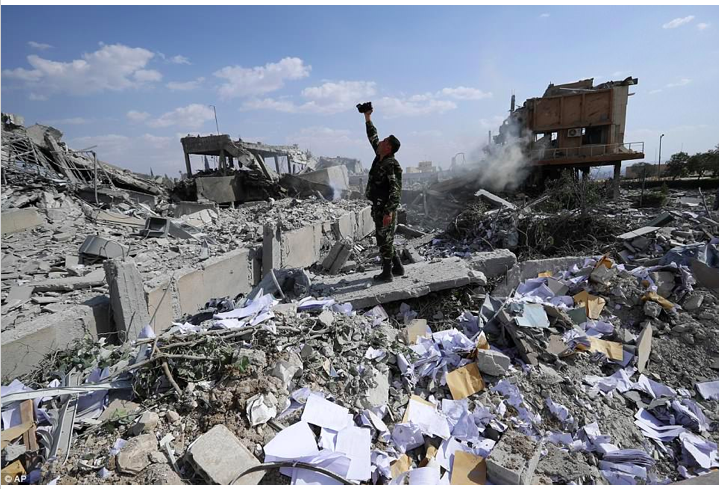
The US and its allies launched – according to the briefing given by General Kenneth McKenzie, the Director of the Joint Staff – 105 missiles. All the missiles performed as planned, and hit three targets, one in Damascus and two in Homs. All the three are supposed to be chemical weapon development or storage sites.
The Russians and Syrians have contested the claims that only three sites were attacked, and said that a number of other targets such as Damascus airport, and critical installations were also attacked, but these missiles were brought down by the Syrian air defence.
The cruise missiles were launched by three US ships, one US submarine, and aircrafts. The aircrafts used were US B-1B strategic bombers, French Rafaeles and British Tornadoes. From the routes of the missiles, and the airports from which the aircrafts took off, it is clear that Turkey, Qatar, Gulf Emirates and Jordan have cooperated with the US and its allies. Turkey, used to a number of flip flops on Syria, again executed another flop ; they announced that their cooperation with the US forces in carrying out strikes was due to Syria’s use of chemical weapons. The Joint Chief of Staff of US Armed Forces General Dunford, in his press conference with General Mathis, the US Secretary of Defence, held that the US did not “ … do any coordination with Russia on these strikes, and neither did we pre-notify them”. Answering a specific question, General Dunford said that only “the normal deconfliction of the airspace” information was shared with the Russians.
Is this simply Orwellian doublespeak, meaning that the only difference between “deconfiction information” and “sharing information regarding strikes” is the information on specific targets? The rest is the same, meaning the Russians would have known well in advance when the strikes would take place, from where they would originate and the air path that would be followed. From this, the targets – or at least the broad areas being targeted would be easy to deduce.
There is evidence that the Russians did inform the Syrians of the impending strikes five hours before they took place. The Russians and the Syrians pulled out men and materials from possible strike sites. That would explain why the only casualties in this high visibility exercise are three Syrians being wounded, and three buildings and two bunkers being demolished.
The site Sic Semper Tyrannis say s: Russia was told where we were going to strike. Russia in turn warned the Syrians. Both the Syrians and the Russians evacuated key personnel and equipment from the target sites. Any claim by the United States that we caused devastating damage or destroyed essential capabilities is total fantasy.
The Dunford and Mathis briefing also talked about how every missile hit its target. The above article continues on how many of the 105 missiles hit their targets:
The second issue concerns the imagined success of the U.S. TLAM strike. Before General Mattis (retired) approached the podium Friday night, he knew full well that a significant number of the inbound missiles had been shot down inside Syria…The Russians and Syrians were not lying when they claimed to have downed more than 70 of the U.S., UK and French missiles.
The Russians and the Syrians have said that the bulk of the missiles – more than 70 – were shot down by the anti-missiles defences of the Syrian forces. Most were shot down by missiles using 1970’s Soviet technology. For those who believe in the technical superiority of the west, which includes Indian defence “experts”, this must be an unwelcome shock.
The US has also released pictures of the strikes. Such pictures are available from satellite imagery as well. Again, defence experts seem to concur that the amount of damage – three buildings and two bunkers – do not amount to more than a 100 missiles hitting such targets.
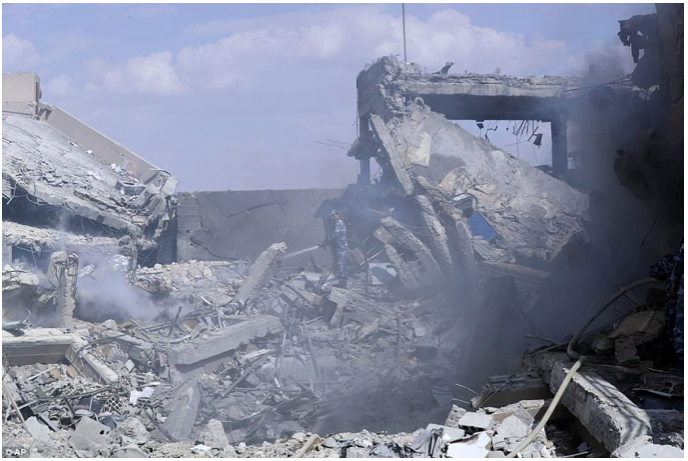
The US has also claimed that this time, they were targetting chemical weapon production and storage sites, not the delivery systems. There are pictures of people without any protective clothing and masks looking at or wandering around such bombed “chemical weapon” sites. We give below pictures, carried by UK’s Daily Mail, of the Barzah Research Centre in Damascus, struck by missiles on Saturday morning, and photographed a few hours later.
If indeed this was a chemical weapons site, such pictures, with people going about without any protection, is unbelievable. Similar pictures are also available for the other two sites near Homs that were hit. All these indicate that Syrians are right when they say these are not functioning chemical weapons sites.
The Syrians have said that these sites were dismantled as chemical weapon manufacture or storage sites in 2013. OPCW has verified periodically that these facilities are no longer in operation. Therefore, the story that the US and its allies are presenting to the world of the Assad government still continuing its chemical weapons program has no basis. At least on the basis of any evidence that the US and its allies have been able to produce.
It is impossible to not hear the term ‘Bangladeshi’ when you are in Assam. It is a term that divides Assam;a region where human migration precedes national boundaries by centuries. No one ever says that there are no Bangladeshis in Assam; the questions seem far more focused on “what to do with them”. It is also pretty clear that no one exactly knows who a “Bangladeshi” is: Assamese Muslims, Bengali Muslims, Bengali Hindus and sometimes even Assamese Hindus, along with even Nepalis and Bodos, have all been signalled out as Bangladeshis. When human lives are reduced to statistics and government policies put one religion against the other, it is the marginalised who suffer the most.
Sajahan Ali talking to TwoCircles.net about his detention.
The Idea Of a ‘Foreigner’ : The Assam Accord, signed in 1985, has played an extremely important role in this regard. The issue of ‘foreigner’ was central to this Accord. Contested migrations after two partitions (1947 and 1971) along with a subsequent surge in Assamese nationalism resulted in a policing of “foreigners”. As a result, the Assam accord enlisted a series of measures to be taken as part of a Memorandum of Understanding between the then Prime Minister Rajiv Gandhi and the All Assam Students Union along with Assam Gana Sangram Parishad. One of the most important points of the Accord was that all ‘foreigners’ who had arrived after March 1971 be expelled from the state.
The Creation of a D voter : Following the Accord, it was in July 1997 that the Election Commission of India (ECI) asked the state government to segregate its citizens and non-citizens. Following this, the ECI prepared a list of voters in the state and mark ‘D’ (doubtful) next to the names of people who were suspected to be non-citizens. In 1997, this list included 3.5 lakh names. As of February 2017 according to Assam Parliamentary Affairs minister Chandra Mohan Patowary, the Assam Border Police were conducting investigations into 6,21,688 cases related to foreigners till October 2016. Of these, 4,44,189 were referred to the 100 Tribunals established in the state, where about 2,01,928 cases are still pending.
Detentions : Among the cases that have been ‘resolved’ however, are the stories of about 1,800 persons who have been detained across Assam on charges of being a Bangladeshi. Even the most cursory conversations with the families of the detained people show that almost all the detainees belong to poor families who could barely afford any lawyers or appeal against the judgement issued by the Foreigners’ Tribunal. Since this issue comes under the Foreigners Act, 1946 and Foreigners (Tribunal) Order, 1964, a lot of times the lawyers are unaware of how to approach the case but nevertheless take it for easy money.
In this three-part series, TwoCircles.net looks at how detention camps are wreaking havoc with the lives of people, especially Muslims, across the state.
In the first of the three-part series, we tell the story of Sajahan Ali, an Assamese-speaking Muslim who was in jail (detention) for 11 months on charges of being an illegal Bangladeshis. While he may be out now, the case has broken his family, left him with no savings, a sizeable burden to pay off and a mortgaged house.
A week before Ramadan was about to begin, Sajahan Ali, a resident of Buzurg Manikpur village in Barpeta District, had gone over to his mother’s house for the night. Dining at a stone’s throw away from his own house, Sajahan decided to call it a night in his mother’s house while his wife and two children remained home. At that time, Sajahan Ali did not realise that this was the last night his family was together. Around midnight, the police knocked on the door. Ali, confused and scared, thought that they had come to arrest him for a small-time feud which took place a few months ago. “I remember that night well…when the police came, I thought it was because I was involved in a local feud and a fellow resident of this village had filed a complaint. But I did not understand why they needed to arrest me in the middle of the night,” Ali says in a conversation with TwoCircles.net.
TwoCircles.net met Ali in a village called Kukiripada, located about 30 km from his village, where he was working with other men erecting electric poles as part of the Deen Dayal Upadhyay Gram Jyoti Yojana. It has only been three days since he came out of the jail but Ali has little time to take rest or reflect on what happened over the past 11 months. Having erected the last pole for the day, Ali and other men sit down to discuss the trauma that Ali has undergone in the past year. “It was only when I was produced before the Foreigners’ Tribunal that I realised that I had been arrested on charges of being an illegal Bangladeshi in Assam,” he says. “I was shocked…all my life, I had been living here without any such issue. I voted in 2016 state elections and all elections before that. How did I become a Bangladeshi all of a sudden?”
Within a few days, Ali, who is in his early 40s, went from being a poor resident of an Assamese village to a poor ‘illegal Bangladeshi’ in Assam. He was now one of the about 1,800 people who had been put in one of the six ‘detention camps’ in Assam. Talking about his case, Ali explains, “When my case was brought to the Foreigners’ Tribunal, I found that I had been a D-voter (doubtful voter) since 2005 and that I was being arrested because I had failed to reply/honour any of the court summonses that had been sent to me.”
But like most of the cases of D-voters, Ali’s case was much more than what met the eye. Turns out, Ali says, he had been declared a doubtful voter in the same district (Goalpara), but in a different Tehsil (Dudhnoi) in 2005. Over the next 12 years, as the court paper shows, he had been sent a summons seven times by the Foreigners’ Tribunal but he never showed up so finally, he had been tracked down and arrested. “My voting is in Buzurg Manikpur, which falls under Goalpara East. I was declared a doubtful voter in a Tehsil and village that I had never resided in. How was I to know what happened?” Regarding the summons, he says, “I was supposedly sent a summons but at an address where I have never lived. Then how am I supposed to respond? If you live in one village and a letter comes for you in another village, how are you at fault?” he asks.
Ali’s claim might be valid, but this did not matter much when it came to the legal implications. As the summons went unanswered, his case was declared ‘hanging’ and the Assam Border Police, which is the main security force which looks after this issue, pushed for an ex-parte decree in this case. An ‘Ex parte decree’ is a decree passed against a defendant in absentia. On the date of hearing, if only the plaintiff appears and a defendant does not appear, the Court may hear the suit ex parte and pass a decree against the defendant. So, while Ali had been working as a labour in Assam and then in Meghalaya, the Police were on a ‘lookout’ for him.
All of this meant that after he was arrested in July, he was sent to the Barpeta detention camps, located about 100 km from his residence. Inside, he realised that being an illegal Bangladeshi was even worse than being a criminal. “We were kept separately from the convicts and treated much worse too. The food was horrible, the hygiene was non-existent and we had no money. We could not even work in the jail.”
Nurul Islam, a lawyer based out of Goalpara who handled Ali’s case, explained how the case unfolded “After Sajahan Ali was arrested, we approached the Gauhati High Court for a stay order since the FT had passed an ex-parte order. It took us nearly four months, but we finally got the stay. Then, the case was contested in Foreigners’ Tribunal and I presented all the required proof of residence on behalf of Ali. Earlier this month, Ali finally won the case in the FT and he was free after nearly eleven months in jail.”
Given that most people sent to detention camps either spend years inside or are still inside, one might even say that Ali was lucky: he, after all, came out within 10 months. But of course, the arrest has taken a massive toll on his life. “In the days following my arrest, my wife left with my son and went to her parents’ place. I am not sure why she did so…maybe she thought I would never come back. I haven’t even seen my son in almost a year…my daughter, who had got recently married, was sent back by her in-laws after they came to know that I had been arrested as an illegal Bangladeshi. Thankfully, my brother and his wife along with our extended family took care of her. My brother is also a worker. When I was in jail and we had an appeal in the High Court, he had to mortgage his brother’s house to raise the much-needed money. Now, Ali is scared thinking if/when he will lose the house. “I don’t know how I will save my house…and even if I save my house, my family is broken…who will live there?” he asks.
In such cases, the need for legal aid becomes paramount but given the complexities of the issue, there are no such facilities available for the detainees. “In any other case in Indian courts, if the accused cannot afford a lawyer, he/she is provided one by the government. But not in these cases…similarly, once sent to detention, there is no bail, no parole not even to appear in your own case even when you appeal the verdict in the High Court,” says Islam.
As we end our conversation, Ali can barely hold his tears. He says, “I am a poor person but I had a family. I lost a year’s worth of income, I have almost lost my house and my wife and son left me…for what? How can I be a Bangladeshi when I have lived here all my life, like the rest of my family?” He shrugs off any idea that he should file for compensation. “I do not have the time, money or the courage to approach the courts again…when you see the condition in which human beings are made to live in these detention camps, you thank Allah for bringing you out of it. I hope others also come out…it is hell inside. No human being, Indian or Bangladeshi, should ever be made to live like that,” he says.
Senior lawyer and activist Prashant Bhushan has filed a criminal complaint against Madhu Kishwar and called her “fake news purveyor & communal hate & violence inciting tweets of Madhu Kishwar”He has filed the complaint “for serious offences u/s 153A, 295A & 505 of the IPC against serial fake news purveyor & communal hate & violence inciting tweets of Madhu Kishwar who thinks she can get away without accountability.” He said it was time to call her bluff.
The complaint has been filed with SHO, Tilak Marg Police Station in Delhi and accuses Kishwar of publishing “misleading and false information”through her twitter handle. It also says that she has been doing this for “last several months.
Apart from recent tweet, the complaint also cites Kishwar’s tweet dated April 14, 2018 in which she alleged that in the Kathua incident of rape and murder, it was,”very likely that family accused of rape have been scapegoated.”She further claimed that the “ Murder of Kathua Minor Girl suspected to be handiwork of jehadi #Rohingyas settled by PDP in Jammu region. Since Jammu people angry at settling criminal Rohingya in Hindu areas, Mehbooba used this murder as counterblast strategy”.
Prashant Bhushan also alleged that her tweets are meant to incite communal hatred and create a disturbance to public peace and tranquility. He said that she has a following of more than two million and her tweets have a far reaching impact.