Maai,

Maai,
Why is the colour blue associated with Dalit movements?
Recently, a statue of Dr. B. R. Ambedkar, jurist, social activist, and Dalit icon, was vandalised in the Badaun district of Uttar Pradesh, sparking widespread controversy. Although it was promptly replaced, the new statue depicted Dr. Ambedkar clad in a saffron sherwani. This new statue was eventually painted blue, reportedly by Himendra Gautam of the Bahujan Samaj Party (BSP). “They painted Ambedkar’s statue Saffron to own him and showcase him as per their own ideology,” says author and Dalit rights activist Kancha Ilaiah, adding, “This is also why they are highlighting ‘Ramji’ in his name. Today people from different backgrounds are busy claiming Ambedkar, because he has shaken them! The OBCs are also claiming Ambedkar as their own as he was the man who gave us our constitution and laid the foundation for our democracy. Neither the BJP nor any Hindutva group can survive without the support of OBCs. So they are busy carrying his pictures and showing how much they respect Ambedkar.”
According to Bharat Singh Jatav, District President of the Aarakshan Bachao Sangharsh Samiti, “There is anger among the community members due to the colour of the coat. Saffron is unusual as we have always seen his pictures and statues in dark coloured western outfits, blazer and trousers. It must be repainted,” he had added. Sinod Shakya, a former BSP MLA, said, “After painting many buildings saffron across the state, the BJP government now wants to saffronise Ambedkar statues, which is unacceptable.” The vandalism of the Ambedkar statue was not an isolated incident; there have been reports of Ambedkar statues being damaged in several other districts in Uttar Pradesh.
Why so blue?
Several Dalit protests in the recent past have involved carrying blue flags. But why is the colour blue so significant for Dalits? According to Raosaheb Kasbe, formerly a political science professor at the Savitribai Phule Pune University, “The idea behind it was that blue is the colour of sky—a representation of non-discrimination, that under the sky everyone is believed to be equal. There are many theories around this, but there is no settled history on why blue became the colour of Dalit resistance”. Ilaiah says, “I read somewhere, I don’t remember where exactly, but I read that Ambedkar had said that the blue sky is all over us. Just like how Dalits, Shudras and tribals are all over the country. We should therefore claim this universal colour as our own. We are all equal under the blue sky.”
Many Indian towns have statues of Ambedkar clad in a three-piece blue suit and carrying India’s constitution; Beena Pallical of the National Campaign on Dalit Human Rights has opined that Ambedkar’s blue suit was one of the primary inspirations for the blue flag of Dalit movements.
Ambedkar’s suit itself was reportedly a symbol of “political resistance,” flouting the rules regarding what Dalits were permitted to wear. According to Dalit writer and entrepreneur Chandra Bhan Prasad, “Manudharma, or the laws of Manu, codify the rights and duties of various social groups prearranged into castes. According to that, we are told we can only wear the apparel of corpses, or ragged, old, dirty clothes. We are not supposed to be nicely dressed or even be clean”. In 2002, Ramachandra Guha wrote of Ambedkar, “By the canons of tradition and history, this man was not supposed to wear a suit, blue or otherwise. That he did was a consequence of his extraordinary personal achievements: a law degree…a Ph.D. from America and another one from England, the drafting of the Constitution. By memorialising him in a suit, the Dalits were celebrating his successful storming of an upper caste citadel.” In Ilaiah’s opinion, Ambedkar “favoured the colour blue for his suit as it represented the blue sky under which everyone is equal. Also, he was educated in Amercia where all Presidents wore blue suits on important occasions. Perhaps, this might have influenced him. Blue in America represents democracy, republicanism and equality, all ideas that meant a lot to Ambedkar.”
According to the 2017 paper Fabric-Rendered Identity: A Study of Dalit Representation in Pa. Ranjith’s Attakathi, Madras and Kabali, “Blue as a colour is often used by Dalit communities especially in protests and rallies as a mark of empowerment.” The paper notes that the colour blue “emerged as a self-identifying sign for Mahar Dalits in Maharashtra.” Mahars comprise the largest group of Dalits in the state. The paper, while citing the book Dr. Ambedkar and Untouchability: Analysing and Fighting by Christophe Jaffrelot, explains, “Ambedkar is known to have introduced the blue Mahar’s Flag as his party flag for the Independent Labour Party. It is representative of identifying with Dalit consciousness that is non-discriminatory. It also appeals to the masses as in the ‘blue collar workers’.” However, the colour blue has also been employed to single out the Dalit community; the paper recalls a 1995 instance when the Bharatiya Janata Party (BJP) and Shiv Sena in Maharashtra implemented a policy requiring Dalit children to wear blue uniforms.
The UNHCRand the Bangladesh government have finalised a Memorandum of Understanding (MoU) on the voluntary return of Rohingya refugees once conditions in Myanmar are conducive.
The MoU, signed by the UN High Commissioner for Refugees, Filippo Grandi, and Bangladesh Foreign Secretary, Md Shahidul Haque, in Geneva on Friday morning. It establishes a framework of cooperation between the UNHCR and Bangladesh on the safe, voluntary, and dignified return of refugees in line with international standards, said a UNHCR statement.
More than 670,000 Rohingya have fled violence in Myanmar to Bangladesh since last August, joining an estimated 200,000 Rohingya who have already sought shelter in the country over past decades.
For the hospitality, protection, and assistance provided to those refugees, UNHCR would like to extend its sincere thanks to the Government and people of Bangladesh, read the statement.
In the absence of a tripartite agreement between UNHCR, Myanmar, and Bangladesh, the UNHCR has continued to engage with both governments in negotiations on two separate MoUs, meant to ensure that any future returns are conducted in line with international standards of voluntariness, safety, and dignity, it added.
UNHCR considers that conditions in Myanmar are not yet conducive for returns to be safe, dignified, and sustainable. The responsibility for creating such conditions remains with the Myanmar authorities, and these must go beyond the preparation of physical infrastructure to facilitate logistical arrangements, according to the statement.
Refugees in Bangladesh have said that before considering a return to Myanmar, they would need to see concrete progress in relation to their legal status, citizenship, security, and their ability to enjoy basic rights at home in Rakhine State. UNHCR has continued to call on the Government of Myanmar to take concrete measures to address the root causes of displacement, in line with the recommendations of the Kofi Annan-led Advisory Commission on Rakhine State.
One step the Government of Myanmar could immediately take is to provide UNHCR and other relevant actors with full and unhindered access to refugees’ places of origin in Rakhine State, the statement said.
Another practical measure would be to ease restrictions on movement for internally displaced persons encamped in the central townships of Rakhine State.This would also help to build confidence among refugees in Bangladesh, it added, saying that such concrete measures would help demonstrate to Rohingya refugees that the Myanmar government is committed to a sustainable solution.
In Myanmar, together with the UN Development Program (UNDP), UNHCR is in ongoing discussions with the Myanmar government, on a tripartite agreement to outline the scope of cooperation between these agencies and the Myanmar Government in Rakhine State. The agreement would aim to set forth a framework for refugees’ voluntary repatriation in line with international standards, aim to create conditions that are conducive to eventual voluntary repatriation, and provide humanitarian and development assistance for all people of Rakhine State.
Courtesy: Dhaka Tribune

Image: Kobani during bombing by US-led coalition in 2014. PA Images/Depo photos/ABACA, all rights reserved.
Despite all the moral hand-wringing, international law forbids nations from attacking each other, outside of Security Council approval or in self-defence, and alleged use of chemical weapons is no exception. Western media and politicians are once again calling for our governments to commit what Nuremberg Judges labelled the “supreme international crime”. They risk further escalating the conflict despite a lack of independent verification as to what actually happened in Douma, eastern Ghouta.
Something must be done
We once again find ourselves surrounded by a hypocritical, self-righteous and war-mongering echo chamber. Liberals and Conservatives, with few exceptions, all appear to agree the question is not whether the UK and US shall be launching military strikes against Syria, but rather when, and with what level of payload.
The scene is all too familiar. Unverified (though certainly possible) use of chemical weapons. Crying children. Pictures and videos of people being hosed off in medical facilities. How can anyone not be moved to “do something” rather than “stand by and do nothing”?
Unfortunately, the only “something” being offered to the British, American and French public is the launching of a military assault (of an unspecified nature) inside Syria – a sovereign state – which has attacked neither Britain, America or France. Humanitarian options like taking in refugees beyond the measly 11,000 or so that Britain has grudgingly accepted thus far, are not on the table. The only response by an apparent use of violence by the Syrian government is even more violence by the self-proclaimed leaders of the “free world”.
The situation has reached boiling point with Russia officially stating that they will “[shoot] down” US missiles and “even the sources from which the missiles were fired”. The state of Israel has already launched strikes within Syria, also without any legal justification whatsoever, apparently killing 14 Iranians. Iran has vowed to retaliate against the attack. Now it appears May won’t even seek permission from parliament before she drags the country further into the war in Syria, having been pushed relentlessly by the British press and political class to “act” now.
This already multi-layered conflict risks snowballing even further, without any concrete evidence as to what exactly happened, as former Marine Corps intelligence officer and weapons inspector, Scott Ritter outlines in his important piece for the American Conservative.
The supreme international crime
For the avoidance of any doubt or confusion, attacking a foreign country without legal basis under international law represents the “supreme international crime”. The launching of an “aggressive war” is the “supreme crime” because it is the overarching offense which contains within itself “the accumulated evil of the whole” (e.g. rape, torture, murder, mass murder, ethnic cleansing, etc).
People were tried, convicted and hung at Nuremberg for the crime of waging wars of aggression (as well as crimes against humanity).
Regardless of how unpalatable we may find it, even the verified use of chemical weapons -be they by state or non-state actors – is not a legal basis to attack a country, any country.
As Phyllis Bennis, Fellow and Director of the New Internationalism Project at the Institute for Policy Studies in Washington, D.C., clearly explained (following the last alleged use of chemical weapons by the Syrian government, and subsequent military strike on the Syrian air base ordered by President Trump):
“The UN Charter is very vague about a lot of things, but it’s very clear about one thing, and that is, when is it legal to go to war? When is it legal to use a military strike? There’s only two occasions according to the UN Charter…The UN Charter says, “A country can use military force under two circumstances: Number one, if the Security Council authorizes it.”…Number two, Article 51 of the UN Charter, which is about self-defence. But it’s a very narrowly constrained version of self-defence… It says very explicitly, “If a country has been attacked.”…”until the Security Council can meet, immediate self-defence is allowed.” Neither of those two categories applied here. So, it was clearly an illegal act.”
We find ourselves once again in the exact same situation.
We have been here before
In July 2017 award winning investigative journalist Seymour Hersh discussed with The Real News Network his article published by the German Die Welt, describing the claims that Trump ignored warnings by US intelligence that there was “no evidence that” Assad used chemical weapons in Kan Sheikhoun on 04 April 2017.
A subsequent UN report concluded (well after the strikes were conducted) in September 2017 that there “reasonable grounds to believe” that the Syrian government was responsible for a chemical attack on Kan Sheykhoun on 04 April 2017 along with two chlorine attacks on 25 and 30 March in Al-Latamneh this was well after the strikes.
US Secretary of Defense James Mattis would then, five months later, go on to tell reporters that the US still “had no evidence” that the Syrian government used Sarin gas.
Irrespective of the UN findings, or Mattis’ subsequent bombshell, as Phyllis Bennis pointed out, the strike was illegal.
Yet, despite the illegality of the 2017 US strikes, despite the death toll that followed (nine Syrian soldiers and nine civilians including four children according to Syrian state television), and despite the lack of conclusive proof at the time that there even was a chemical attack, let alone verification as to what party or parties were responsible, Donald Trump received strong bi-partisan support for the strikes. The “liberal” press, including outlets such as MSNBC and CNN, along with the Democratic Party establishment supported the attack.
“I am tempted to quote [singer and songwriter] Leonard Cohen” said MSNBC News Anchor, who proceeded to then quote Leonard Cohen: “I am guided by the beauty of our weapons”.
Influential commentator (and protégé of the late Samuel Huntington) Fareed Zakaria told CNN, “I think Donald Trump became president of the United States last night. I think this was actually a big moment.” Apparently the killing of twenty five men, women and children in Yemen by US special forces four months earlier wasn’t enough to establish Trump’s “presidential” bona fides.
This one minute video by CNBC of a list of “experts” on their view of the value of the Syria strikes is also well worth watching, if only to belabour the unanimity of the views on this missile strike.
The constant blasting of Trump as being a “Putin puppet” puts immense pressure on the US President to prove otherwise. Launching military strikes against the Russian backed Syrian government delivers Trump bi-partisan establishment praise. It appears to be a lesson he has learned well.
Media manipulation
All of this seems to be of little concern to the British establishment and their compliant press. The former British Prime Minister Tony Blair told Sky News that the UK will have to intervene in Syria or give “cart blanche” for the further use of chemical weapons.
Conveniently left out by Sky News is that Blair himself is guilty of deceiving parliament and the international community about “weapons of mass destruction” possessed by Iraq, and pushed an illegal invasion of the country that has killed hundreds of thousands, led to mass ethnic cleansing, the rise of Al Qaeda in Iraq (AQI) and ISIS, along with other sectarian death squads.
All water under the bridge apparently.
Another example of the press cultivating a climate conducive to a British attack on Syria is ITV’s Good Morning Breakfast show asking its followers on Twitter:
“After horrendous chemical attack in Syria, should British forces hit back?”
As the conservative commentator Peter Hitchens once noted, opinion polls are more often about manufacturing opinion than they are about gauging it.
Attempting to bring attention to the manipulative nature of the “poll” I replied:
“No such poll for “striking back” against Turkey’s illegal invasion of Northern Syria, or Israel’s massacre of unarmed Palestinian protesters in Gaza, or the use of White Phosphorus (a chemical weapon) by the US in Raqqa or allied forces in Mosul or Saudi’s carpet bombing of Yemen.”
Neutral bystanders?
Also conveniently left out of mainstream media discussion over “what to do about Syria” is that the United Kingdom, France, Turkey, the US, Saudi Arabia, Qatar and the UAE have all been inflaming the civil war, and keeping it going since it broke out in 2011. These governments are not now, nor have they ever been, neutral or innocent bystanders.
On the contrary, they have been funnelling billions of dollars’ worth of conventional weapons, rocket launchers, assault rifles, anti-tank missiles and the like. Britain is already neck deep in this conflict, as are its “allies”, a point that award winning investigative journalist Gareth Porter illustrates in frightening detail in his article “How America armed terrorists in Syria”. Porter describes a declassified US Defense Intelligence Agency report that revealed:
“that the [Saudi funded and CIA facilitated] shipment [into Syria] in late August 2012 had included 500 sniper rifles, 100 RPG (rocket propelled grenade launchers) along with 300 RPG rounds and 400 howitzers. Each arms shipment encompassed as many as ten shipping containers, it reported, each of which held about 48,000 pounds of cargo. That suggests a total payload of up to 250 tons of weapons per shipment. Even if the CIA had organized only one shipment per month, the arms shipments would have totalled 2,750 tons of arms bound ultimately for Syria from October 2011 through August 2012. More likely it was a multiple of that figure”
The same declassified report described the main armed opposition backed by “the west” to be highly sectarian in nature and seeking to create a “Salafist Principality” or “state”.
The criminality of these actions and their destructive effect on the people of Syria is difficult to overstate.
Relearning the lessons of the past
It seems every generation must be perpetually (re)educated as to the extent to which truths, half-truths and outright lies are repeated daily by their politicians, governments and media, particularly in matters of war and peace.
Perhaps chemical weapons were used in eastern Ghouta and perhaps not. Hersch and others have suggested that there is some evidence of discussions about “false flag” operations to justify incursions into Syria in the past. The timing now is noteworthy – President Trump has publicly stated that he wants to bring US troops “back home” from Syria, and eastern Ghouta is falling into government control, according to Reuters reports.
Or perhaps the Syrian government did use chemical weapons simply to crush any last hope among the rebels.
Unfortunately the proposed military strikes will have nothing to do with exposing the truth or holding anyone accountable. They will be purely for show, by self-interested parties that are themselves deeply implicated in crimes against humanity and war crimes being committed in Syria. And as was outlined at the beginning of this article, military strikes by Britain, France or the US into Syria would not only continue to destabilise the country and risk direct confrontation with Russia they would also be wholly illegal.
We cannot hold people to account for committing alleged war crimes by committing further actual war crimes.
Unlike citizens in many other parts of the world, those of us in self-proclaimed liberal democracies have the ability – however limited – to assert pressure to curtail our governments’ use of violence. I would go further and say we have the obligation to do so.
We may not be able to stop all the horrors going on in Syria but we can certainly reduce them by calling out and pressuring our governments to cease and desist in their complicity in crimes against humanity and war crimes, including the arming (directly or indirectly) of Salafi-jihadist groups, their support for the unlawful Turkish invasion of Northern Syria, as well as opposing any military strikes against the country.
Write to your local paper, contact your political representatives, and tell them you oppose any further involvement in Syria, other than providing humanitarian aid and support to civilian victims of the war in a manner that is transparent and verifiable.
Mohamed Elmaazi obtained an LLB from SOAS and Masters in International and Comparative law from AUC. He volunteers with the Campaign Against Criminalising Communities and researches for The Real News Network. He tweets at @MElmaazi.
Courtesy: https://www.opendemocracy.net/
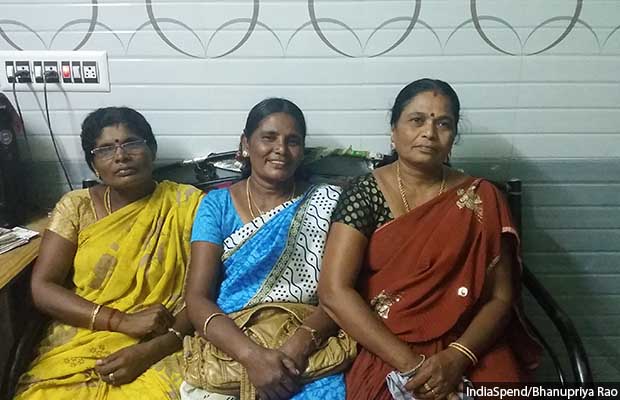
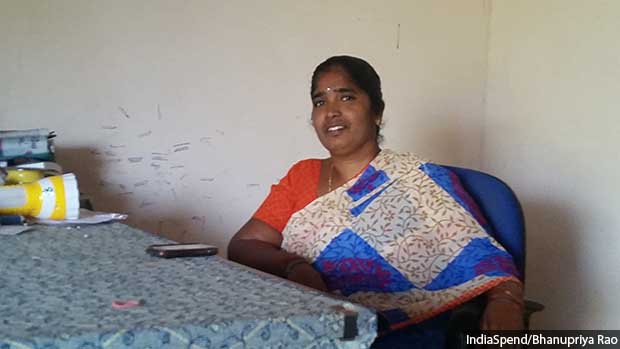
Madhavakurichi Panchayat, Tirunelveli district, Tamil Nadu: It wasn’t personal ambition that drove K Muthukanni to stand for election as panchayat president from Madhavakurichi in Mannur block of southern Tamil Nadu’s Tirunelveli district. It was indignation at the humiliation heaped on the incumbent dalit panchayat president by the dominant Maravar caste.

K Muthukanni (center), the president of Madhavakurichi panchayat in southern Tamil Nadu’s Tirunelveli district, was voted to power by six of the seven hamlets. But this was the beginning of her troubles, a story all dalit presidents narrate–of not being allowed inside the panchayat office, of being prevented from hoisting the national flag or carrying out her duties.
“They just would not allow him to work,” she said, her voice ringing with rage. “He was not allowed inside the panchayat office. One time he went in, he was locked in by those monsters. The poor man had to sign cheques while standing on the road. I wanted to end this indignity.”
An active member of Pudhu Vaazhuvu, a state government microfinance programme, for the last 17 years, Muthukanni contested in 2011 from a seat reserved for scheduled caste candidates. As is the general practice in most parts of India, such seats are almost always contested by men.
Muthukanni, hugely popular among the women of the panchayat, was voted to power by six of the seven hamlets. But this was the beginning of her troubles, a story all dalit presidents narrate–of not being allowed inside the panchayat office, of being prevented from hoisting the national flag or carrying out her duties.
On her first day at work, she was verbally abused by Maravar men. But Muthukanni fought back. She shifted her panchayat meetings to a community library in the neighbouring hamlet of Venkalapoddal. It was attended in huge numbers by women but boycotted by Maravar men.
Assured of the people’s support, she lobbied with India Cements, whose flagship plant is at neighbouring Shankarnagar, for corporate social responsibility (CSR) funds to set up a new panchayat office building. With a Rs 50-lakh grant, she set up a swanky, air-conditioned panchayat office in Madhavakurichi.
That building is a testament not only to Muthukanni’s efforts to reclaim her community’s dignity but also to her commitment to the idea of social justice. “This office is open to all. Anyone can come and meet me and talk to me,” she said.
The last two stories in the IndiaSpend series on Tamil Nadu’s women panchayat leaders focussed on how they battled gender prejudices and sparse resources to bring a better quality of life to their villages. In this story, it becomes clear that even though the 73rd Amendment of the Constitution created institutional spaces for women from the marginalised groups like dalits and adivasis, they still have to deal with entrenched caste beliefs, discrimination and harassment.
Dominant castes control the election process
Dalit and adivasi women in panchayat politics have to negotiate three kinds of oppression–rigid caste structures within the village, patriarchy within and outside their families and feudalism, where they are in a dependent economic relationship with the dominant caste in the village.
Among these women too, those who rank higher in the caste hierarchy have the advantage of economic and social mobility brought by political organisation. Women of the Pallar sub caste, dominant in southern Tamil Nadu, and Parayar sub caste, dominant in the north, have the backing of Pudhiya Tamizhagam and Viduthalai Chiruthaigal Katchi (VCK). They have the powers to resist land-owning castes such as the Mukkalathors (collective name for three dominant castes Thevars, Maravars and Kallars), Gounders, Vanniyars and so on.
Arunthatiyars (also called Chakkiliyar/Sakkiliyar) are lower in the caste hierarchy and suffer at the hands of the powerful castes in whose farms they work. They are also discriminated against by the Pallars and Parayars.
Of the 76 sub castes among the state’s scheduled castes, it is primarily the Pallars, Parayars and Arunthatiyars who contest elections.
Caste oppression begins with the election process where the dominant castes directly sponsor candidates for seats reserved for scheduled caste women. A katta panchayat, one comprising men from landed communities, picks a woman candidate, usually a daily wager Arunthatiyar who works on the farm of one of these landlords. These women are expected to be pliable, and once elected, take the back seat while their sponsors take charge.
George Dimitrov, a lecturer at Gandhigram Rural University near Dindigul in central Tamil Nadu, who has documented dalit women presidents in the district for his PhD thesis, found that nine of its 25 dalit women presidents had been sponsored by katta panchayats. Of these, seven are from the Arunthatiyar community and the other two from communities even lower in the caste order.
Once the katta panchayat decides, the women have no choice but to contest. They often have to borrow money from the local money lenders on interest for contesting elections, pushing them into further debt and feudal dependence.
Angammal (37), a daily wage labour from the Arunthatiyar community, was forced to contest by the Gounders of the Appipalayam panchayat in Dindigul. Her predecessor, Selvi, had been chosen in this manner but she had begun to resist the dominance of the Gounders once she took office so the panchayat stopped backing her. They banked on Angammal being more pliant.
“Arunthatiyar women borrow anywhere between Rs 30,000 and Rs 3 lakh from the local money lenders to contest elections, an amount they neither have nor afford to pay back,” said Dimitrov.
In areas where Pallars or Parayars contest elections, dominant castes often sponsor an Arunthatiyar woman to create a further divide within the dalit block. Podhum Ponnu, the president of R Vellodu panchayat in Dindigul, is still angry with the Arunthatiyar woman who contested against her in the 2011 elections.
“I have good relations with everybody in the village except the Arunthatiyars,” she said. “What is the need for her to take the support of upper caste people? They do this to divide us,” she said.

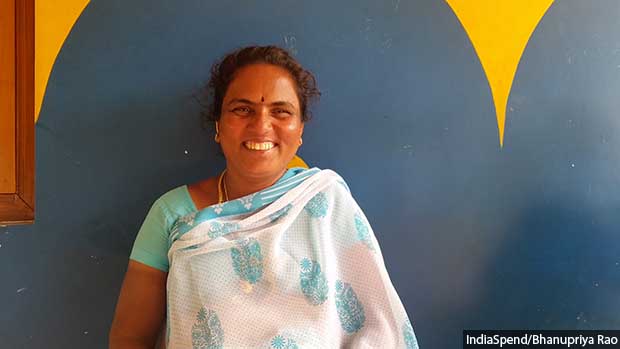
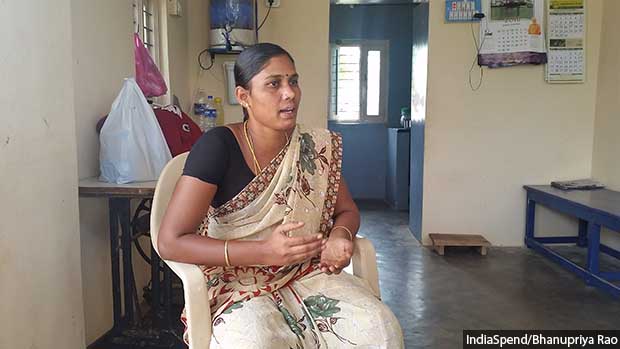
Podhum Ponnu, the Parayar dalit president of R. Vellodu panchayat in Dindigul district, is angry with the Arunthatiyar woman who contested against her. In areas where Parayars/Pallars contest elections, dominant castes field Arunthatiyar women to create divide and resentment within the dalit block.
The dominant castes retain the job of the vice president for themselves, it has been observed. As joint signatories of panchayat cheques, they are in a position to create roadblocks when dalit and adivasi women leaders assert themselves. They also ensure that a bulk of state funds are diverted to areas they are invested in.
When powerful village lobbies ‘auction’ panchayat leadership
Seats are also illegally ‘auctioned’ by katta panchayats to retain control of village politics, it is reported.
“Katta panchayats usually meet in the middle of the night in the village temple to decide on the next president,” said Dimitrov, who has witnessed such bidding in Dindigul and Madurai during his research. “If more than one candidate decides to stand for the election, an auction is called and bids go upto Rs 5 lakh.”
In the case of seats reserved for scheduled caste, especially women, this ‘auction’ takes another form: The katta panchayat sponsors a pliable candidate and asks for bids to decide who gets to control her actions once elected.
Balamani Veeman of Kudikulam panchayat in Madurai district was auctioned off, despite her protests, to the local Thevar landlord Karuppasamy, the Indian Express reported in November 2006. Balamani would then have to sign contracts for works in the panchayat and hand over all the “earnings” (a euphemism for bribes) from panchayat works to Karuppasamy.
When brought to their notice, district authorities nullify such ‘auctions’ but rarely punish those responsible.
The practice came to light in 2001, according to this October 2001 report in Frontline, and it continues to-date. The most recent case was reported from three villages in Paramattivelur taluka in Namakkal district, for the 2016 panchayat elections, which have since been postponed.
There are historical cases of Pappapattti, Keeripatti and Nattermangalam villages in Madurai district and Kottakachiyenthal in Virudhunagar district, where the local dominant castes blocked dalits from assuming power for ten years between 1996 and 2006. They ran a parallel system that flouted every principle of democracy without being held accountable.
When the marginalised castes resist, the dominant castes use a very high handed structural tool–Article 205 of the Tamil Nadu Panchayats Act–to discredit them and have them dismissed.
The tyranny of Article 205
Muthammal (68), the president of Veerappanaikampatti panchayat in Harur block of Dharmapuri district, is still traumatised by the sustained harassment at the hands of three local Vellalar men during her tenure between 2011 and 2016. These men were the vice president, the panchayat secretary and the chairman of the district panchayat (the highest tier of rural local governance).
Muthammal, a Parayar, owns 15 acres of land and her family members hold good positions in civil service, police and judiciary. In spite of this, she faced the axe of Article 205, which gives the district collector power to dismiss the panchayat president.
Muthammal recalled that she refused the demand of vice president Murugan for a share of his “commission”, an aphorism for graft, from panchayat funds. The secretary, a government functionary whose job is to keep records and accounts, then fudged accounts over a long period, Muthammal alleged.

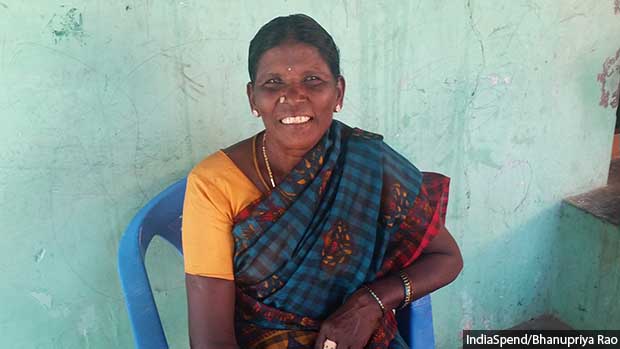
Muthammal, the dalit president of Veerappanaikampatti panchayat in Dharmapuri district, had her financial powers suspended under Article 205 of Tamil Nadu Panchayat Act, for standing up to the dominant caste panchayat functionaries.
Dalit women presidents are disproportionately affected by the use of Article 205, which gives the district collector the power to remove/suspend elected panchayat presidents.
“One time, I had signed a cheque for Rs 14,000 which he changed to Rs 22,000. The bank manager detected it and alerted us,” she said.
Accused of corruption during the annual audit, Muthammal’s powers of signing the cheques were suspended by the district collector under Article 205.
“Not just me, five other scheduled caste presidents from Harur block–two of them women–had been charged under Article 205 and their powers suspended,” she said, hinting at casteist collusion.
Women, as we reported in our 2017 series on Tamil Nadu’s women leaders, appear to be disproportionately affected by the use of Article 205. In the five years between 2011 and 2016, 42.5% of panchayat presidents dismissed were women, according to data we obtained from the Directorate of Panchayat and Rural Development; 30% of these were dalits.
Activists have been demanding that the posts of vice president be reserved for scheduled castes and women in panchayats where the president’s post is already reserved for these groups to avoid such conflicts. The Tamil Nadu Women Panchayat President’s Federation has been demanding the repeal of Article 205 for several years.
The state is yet to act on these demands.
Muthammal’s powers were restored only after she pleaded her case with the commissioner of the Directorate of Panchayat and Rural Development at Chennai. Other presidents had to go to the court to get their powers restored.
The double whammy of caste and patriarchy
Reservations for dalit women are often seen as opportunities for male relatives to realise their own political aspirations. This is especially true of those with several years of political activism with the Dravidian parties–the All India Anna Dravida Munnetra Kazhagam and the Dravida Munnetra Kazhagam. Panchayat politics, for these men, is a good opportunity to access power in party organisations that are highly competitive and dominated by upper castes.
Women are persuaded to contest, despite little interest, by male members of the family. And if the women start showing real interest in their work, they are threatened and abused.
Muthumariammal (32) of T Puthupatti panchayat in Dindigul was persuaded to contest in 2011 by her husband Perumal, a daily wage worker. Though she was politically aware, she was expected to hand over all control to her husband.
When she started showing signs of resistance, Perumal became oppressive and even confiscated her mobile phone. After three years, Muthumariammal filed for divorce and took back control of her chair.
But unlike her, most women have no choice but to navigate between their roles as wives, homemakers and leaders.
Dominant caste women who become panchayat leaders struggle with patriarchy too. But then they are spared the kind of oppression dalit women are subjected to.
‘We want the dignity of the office but live in fear’
The two-decade old chronicle of dalit and adivasi women panchayat leaders in Tamil Nadu is at once a story of oppression and resistance.
Kalpana Ravindran (42), the president of the Vadakapatti panchayat in Harur block, is a Parayar who was harassed by the Vellalar secretary.
First, he asked her to stay out of panchayat affairs. When she resisted and sought the block development officer’s (BDO) intervention, he began fudging accounts to discredit her, she alleged. When the misappropriation of funds came to light, block and district officials accused her of incompetence and corruption.
“Maintaining the accounts is the secretary’s job, so why was I blamed?” she said in a voice filled with despair.

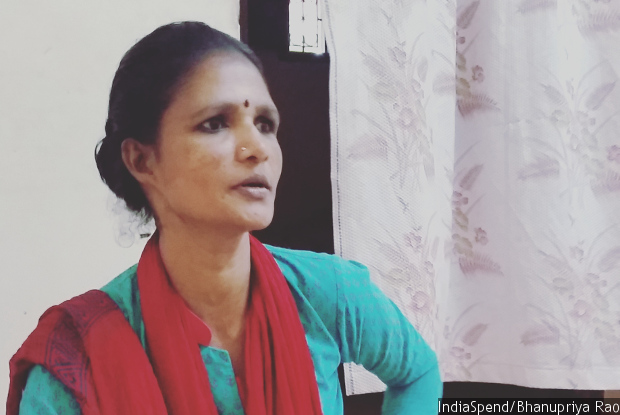
Kalpana Ravindran still struggles with the mental agony of the discrimination and harassment she faced at the hands of her dominant caste panchayat secretary after she refused to hand over the entire functioning of the panchayat. Dalit women presidents, when they resist the dominant caste clout over the panchayat, are often implicated in cases of corruption and misappropriation of funds, to discredit them.
Her five-year term between 2011 and 2016 has left her scarred. “All I wanted to do was learn when I got the chance. But these people made sure that I lost face in my own village. For many days after that, I did not step out of my home. I would sit and cry for hours after my husband left for office,” she said, adding that she still finds it hard to socialise in her village.
A dalit or adivasi woman leader ought to be addressed as thailaivi (leader) in Tamil, just as a male leader is called thalaiva. But quite often she is addressed with casteist slurs such as “Ei Sakkilichi” (You, Sakkiliar woman).
When Thulasimani of Koombur panchayat in Dindigul insisted on sitting on the president’s chair, the entire village would sneer at her for her “arrogance”, she recalled. “Thulasimani is thimiru pidichava (a woman with a swollen head). How dare she sit in front of the Gounder men?” was a common refrain.
The Gounder men would drop into her house in the Arunthatiyar colony at all hours to demand that various problems be fixed. But they would never step into her home.
“This is why I would go to the panchayat office daily though it is 6 km away. There, I am the president. At home, I am an Arunthatiyar,” she said, her voice choking with emotion.

Thulasimani of Koombur panchayat in Dindigul was called ‘Thimiru Pidichava’ (a woman with a swollen head) for daring to sit on the president’s chair by the Gounder men. Dalit women presidents, who ought to be called thalaivi (leader) are subjected to casteist slurs often, more so when they insist on demanding their constitutional and political rights.
These microaggressions are used to force women like Thulasimani to quit while warning future dalit and adivasi women leaders to comply or be harassed.
“My heart is completely broken. I will never contest again,” said Thulasimani.
P Krishnaveni, the panchayat leader, who featured in our 2017 series, survived a near fatal attack in Thalaiyuthu panchayat in 2011. She was eulogised as ‘Veeramangai’, a brave woman, by the media in Tamil Nadu.
But few know of the trauma she suffers living among her attackers and seeing them escape the justice system. “Sometimes I feel so angry I want to kill them all. I have suffered so much because of them,” she said.

P Krishnaveni, the former president of Thalaiyuthu panchayat, was called ‘Veeramangai’ (brave woman) after survived a near fatal attack for daring to take a stand against the casteist and corporate forces in her village. But few realise the trauma she lives with even to this day. Dalit women presidents often live with considerable trauma and fear, even while realising that the role of the panchayat leader gives them the dignity that they never got before.
Though the state fails to provide safeguards to vulnerable dalit and adivasi women, it also expects them to discharge their constitutional duties and fulfil the requirements of the 73rd Amendment.
P Singaram (57), the president of Kumarapalayam panchayat in Salem district, was forced to stand for elections by the district administration because she was the only eligible woman candidate from the scheduled tribe community at the time.
Weary of routine harassment by upper caste men, she sought to resign her post twice but was asked by the district administration to continue. The third time, she was made to sign an agreement stating that she would continue in her role for ten years between 2006 and 2016.
“I did not earn anything and all my money was spent on travel to make these complaints to the administration,” she said. “I begged them to release me. But they said the reservation is for ten years and I cannot leave because there is no other ST woman in this panchayat.”
Dalit women leaders IndiaSpend spoke with said they wanted the empowerment the job brought, but their tenures were full of fears and insecurities.
Rajyalakshmi (name changed to protect identity) took us inside her house, bolted the doors, moved her chair close and whispered the story of her travails.
“I don’t want anyone to carry any of what I am saying to the powerful men in this village. I am not safe. My five years were full of conflict with the Vanniyar vice president,” she said. “This job gave me the dignity I could never have as an ordinary dalit woman. But my husband says he will hang himself if I contest again.”
Contemporary dalit writer Bama wrote of dalit women powerfully in her book Sangati: “Our women have an abundant will to survive however hard they might have to struggle till their last breath. Knowingly or unknowingly, we find ways of coping in the best way we can.”
This is the third of a five-part series on women panchayat leaders in Tamil Nadu. You can read the first part here and the second part here.
Next: Murder, Assault, Threats– Tamil Nadu’s Women Leaders Live In The Shadow Of Violence
(Rao is a co-creator of GenderandPolitics, a project which tracks women’s representation and political participation in India at all levels of governance.)
Courtesy: India Spend
While writing this piece, I am quite distressed about the systematic persecution of the Baha’i minority members in Yemen. Besides the tussle between two warring parties in Yemen, what is more deplorable is their implications on religious minorities including Jews, Christians, and particularly the Baha’i community which is being regularly persecuted for just practicing their faith. This goes not only in complete contradiction to the United Nations Human Rights Covenants of 1948 but also against the true Islamic principles of governance and justice.

Image: catchnews.com
The significant pressure that has been brought to bear on the Houthis and the Iranian authorities by the Arab and non-Arab world in recent months has, no doubt, stayed their hand an even prompted some Houthis to engage in dialogue with the Baha’is to end the persecution. However, as of this penning this piece, a number of Baha’is remain imprisoned in Sana’a, the capital of Yemen, after four years of their arrests, detentions, and continuous torture by the Houthis. Most tragically, the death sentence against Hamed Bin Haydara, one of the Bahá’í practitioners, has been issued along with an order for the confiscation of all of his assets and the dissolution of this religion’s institutions and the banning of its activities. Mr. Haydara’s death sentence remains to be repealed.
Notably, Bahá’i practitioners in Yemen, as in other parts of the world, are known for being committed to rules and regulations of the country and are working for peace and pluralism in the society. But given the Houthi leadership’s continued coercive actions, thousands of Baha’i practitioners are vulnerable to disastrous consequences in Yemen.
It is high time that the world governments in general and Muslims around the world in particular speak out to condemn this nefarious case of religious persecution in a supposedly Islamic country. Several countries have raised voices of objection to the persecution against the Yemeni Bahá’ís, demanding the cancellation of the death sentence for Hamed Bin Haydara. But sadly, no Muslim country is coming to the fore to speak for the religious peaceful coexistence in Yemen on behalf of the imagined global ‘Ummah’.
If we Muslims desire the full protection of the human rights for the world’s Muslim minorities as an ‘Ummah’, we must ensure that the non-Muslim citizens living in the Muslim majority countries are accorded the same rights and privileges that we Muslims seek to achieve in the non-Muslim nations. In order to achieve this, I would like to offer concrete solutions and final recommendations derived from the Madina Charter of Human Rights (Misaq-e-Madina)—the first ever written constitution of the world formulated by the Muhammad (peace be upon him).
It is noteworthy that the constitution of Madina also known as Misaq-e-Madina was compiled when the Holy Prophet (pbuh) and his companions migrated to Madina as an oppressed minority. It was the first social contract to be written ever in the history of mankind. Muslims and the non-Muslims lived under this covenant which organized the public affairs and governed the relations between them and their neighbors, as Ibn-Ishaq reported:
“The Holy Prophet (pbuh) wrote a document between the Emigrants [from Makkah] and the Ansar [the natives of Madina], and in it he made a treaty and covenant with the Jews, establishing them in their religion and possessions, and assigning to them rights and duties.”
The charter of Madina focused on these pivotal cornerstones for a nation or governance: (1) peace and security (2) Justice and (3) organizing the judiciary. It reads:
“In the name of Allah, the All-Merciful, the Ever-Merciful. This is a document from Muhammad, the Holy Prophet, governing the relation between the believers from among the Qurayshites (i.e., emigrants from Makkah) and Yathribites (i.e., the residents of Madina whose majority were non-Muslims). They form one and the same community as against the rest of peoples. (Source: Sunan Al-Bayhaqi, no. 16808 and see the whole constitution in Ibn Katheer’s biography, part 2, page 321, and Ibn Hisham’s, part 1, page 501.)
The concept of Ummah or a “nation” through the terms of the Madina constitution clearly states that the Muslims or non-Muslims whether from Makkah or Madina are one community. It states clearly: “They form one and the same community as against the rest of men!”Thus, the Islamic charter f human rights recognized the “nation” for the first time in the history as a one indivisible unit, moving from the individual or the tribal life to the life of the single nation which was not characterized by any particular religion, racism or tribalism.
The Madina charter of human rights ensured “equal rights and duties” between its parties and by this it ended racism and segregation in one go. It stated:
“The Jews shall be responsible for their expenses and the Believers for theirs… The Jews shall maintain their own religion and the Muslims theirs. Loyalty is a protection against treachery… The Jews of Banu Najjar, Banu al-Harith, Banu Sa’idah, Banu Jusham, Banu al-Aws, Banu Tha’labah, Jafnah, and Banu al-Shutaybah enjoy the same rights and privileges as the Jews of Banu Aws…”
Thus, the Madina constitution affirmed the full bonding between the Muslims and non-Muslims based on justice and equity. This equality was based on the common value which is termed in the Islamic law as ‘Karamat-e-Insani” (human dignity). Allah states in the Qur’an:
“We have honored the children of Adam, and have borne them on the land and the sea, given them for sustenance things which are good and pure; and exalted them above many of Our creatures.” (Qur’an 17:70).
It also stated that its terms apply on those who have signed it and those who shall follow them later and fight with them (whether Muslims or non-Muslim) and by this it is the first treaty in the history that acknowledges the principle of joining treaties even after they are signed (Madina Treaty – Context and Significance” by Ahmad Al-Shuweibi, issue 110 from the Al-Ummah Book issued by Al-Awqaf Minstry, Qatar).
After the Holy Prophet (pbuh) departed, his companions followed his footsteps and so Umar Ibnul-Khattab signed a treaty with the people of Illia called “The Omarian Covenant” which stated among its articles:
“In the name of Allah, the All-Merciful, the Ever-Merciful. This is the security that Omar gives to the people of Illia. He gives them security for themselves, their monies, their churches, their crosses, their sick and ailing, and all their peoples. Their churches won’t be taken over, won’t be destroyed, won’t be reduced in size, neither will their crosses, their wealth, neither will they be persecuted because of their faith nor will any of them be prejudiced…“(Taareekh Al-Tabari, 436/4)
A great number of companions were witnesses to this covenant like; Khaled Ibnul-Walid, Amr Ibnul-Aas, Abul-Rahman Ibn-Awf and others; which means that they all accepted the content of the covenant.
Same thing was done by the Holy Prophet’s companion, Hazrat Amr Ibn A’as with the people of Egypt, Utba Ibn-Farqad (appointed by Hazrat Umar Ibnul-Khattab) with the people of Azerbaijan, as Al-Tabari wrote in his encyclopaedia of history.
Not only Muslims, even all non-Muslims living in Madina state of the (pbuh) were accorded full protection of life, religious freed and democratic rights. A clause in Misaq-e-Madina was stipulated in these words of Holy Prophet (Hadith): “I shall dispute with any Muslim who oppresses anyone from among the non-Muslims, or infringes on his right, or puts a responsibility on him which is beyond his capacity or takes something from him against his will.” (Reported by Abu Dawood)
In the 10thyear of Hijrah, a delegation of 14 Christian chieftains and bishops from Najran came to Medina to enter into a treaty with the Holy Prophet Muhammad (pbuh). The Prophet (pbuh) not only welcomed them with open arms but also permitted them to pray in his mosque, the Masjid-e Nabawi. The Christian delegation prayed in the Holy Prophet’s mosque, turning towards the east, their Qibla or direction of prayer. This glorious instance of the Holy Prophet ’s religious tolerance cannot be discarded by any Muslim sect, as it has been authenticated by numerous erudite Islamic scholars of great repute, including Imam al-Qurtubi (in his Tafseer Jame’ Li Ahkamil Quran), Imam Ibn al-Qayyim al-Jauziya (in his book Zadul Ma’ad), and Imam Ibn Kathir (in his Tafseer Ibn-e Kathir).
Similarly, a Christian delegation from St. Catherine’s Monastery came to the Holy Prophet (pbuh), requesting his protection. The Prophet (pbuh) granted them a Charter of Human Rights, which is recorded in the Islamic history as the written document for the protection of minority human rights and respect for other faiths.
But deplorably for Muslims living in the so-called Islamic countries, they have diverted from the right path shown by the Prophet (pbuh). The worrying incidents of the faith-based discrimination against the Yemeni citizens are symptomatic of not only a humanitarian crisis but a systematic religious persecution. This is not only a clear violation of the Yemeni Constitution and the Universal Declaration of Human Rights and other international human rights agreements, but a brazen violation of the Prophet’s beautiful cultural heritage. The legacy of diversity, pluralism and coexistence that has shaped the Misaq-e-Madina’s peaceful clauses has eroded almost each and every Muslim country today.
Regular Columnist with Newageislam.com, Ghulam Rasool Dehlvi is a classical Islamic scholar and English-Arabic-Urdu writer. He has graduated from a leading Islamic seminary of India, acquired Diploma in Qur’anic sciences and Certificate in Uloom ul Hadith from Al-Azhar Institute of Islamic Studies. Presently, he is pursuing his PhD in Jamia Millia Islamia, New Delhi.
Courtesy: New Age Islam
At least six persons have lost their lives and around 120 people have been injured in the latest incident of communal violence between the RSS-led Sangh Parivar and the ruling Trinamool Congress (TMC) in West Bengal. More than a 100 homes and shops have been reduced to rubble and ash in this political game of death and destruction. On March 26, a Vishwa Hindu Parishad (VHP)-backed Ram Navami rally, with the crowd bearing arms, moved through a Muslim-dominated locality in Raniganj, leading to clashes between the two communities. In the following days, related incidents were reported from other parts of the state. The worst hit was the Asansol-Ranigunj industrial belt in West Bardhaman district. The area is close to Jharkhand where at least four persons died during the clashes between Hindus and Muslims; one person was also killed in neighbouring Purulia; and another in Kankinara in North 24 Parganas district, close to Kolkata. For now, the fire has been doused, but the embers are still glowing in the riot-ravaged areas.
These repeated communal flare-ups in the last couple of years — mainly in industrial areas with a mixed population and in rural Bengal bordering Bangladesh — have been on the rise ever since the Bhartiya Janata Party (BJP) actively started trying to wrest West Bengal from its friend-turned foe TMC. One of its key strategies is polarising Hindus against Muslims, primarily by inciting the Hindi-speaking poor with a daily dose of militant Hinduism in areas that had, up until now, been strongholds of left labour unions. In areas close to the border, the BJP has been milking the bitterness of the Hindu refugees from Bangladesh in order to consolidate their own vote-bank. Bengali and Hindi-speaking dalit and OBC Hindus are being mobilised by the Sangh’s anti-Muslims campaigns to counter Mamata Banerjee’s support base among Muslims and Matuas, the most organised group of Namashudras and south Bengal’s largest dalit community.
The latest spate of violence during the Ram Navami celebrations is symptomatic of a new phase of politics where the BJP and TMC have been unapologetically communal in their bid to consolidate their vote-banks. It has become more vicious since 2017, after Banerjee pressed her party to organise their own Ram Navami rallies, or take leadership of the old Ram Navami rallies, with more gusto and grandeur. Her decision to challenge the Sangh Parivar’s monopoly over the political use of Ram was prompted by her need to flaunt her liberal Hindu credentials. This checkmates BJP’s rise as the principal opposition party in the state.
The saffron party has gained ground among the majority community, mainly by accusing the TMC government of passing policies that appease the Muslim population. The TMC has been empowering conservative religious Muslim leaders, claiming to be the sole “protector” of Muslims, an influential minority community which constitutes more than 27% of the state’s population. It is another matter that her government has hardly done anything substantial to uplift this influential minority community socio-economically, i.e., in terms of employment and human development indices. Nevertheless, Chief Minister and TMC supremo Mamata Banerjee knows well that public perception goes a long way in politics. This is why TMC has actively taken part in this year’s Ram Navami and Hanuman Jayanti celebrations.
The BJP and rest of the Sangh Parivar have been openly celebrating their successful communalisation of politics in Bengal. They have succeeded in setting the agenda for Bengal politics which had, up until now, banished religious polarisation from the mainstream political discourse. The horrors of the Partition were subsumed under post-independence mass movements for land and food during the Congress rule. This was followed by a period of Left hegemony. The TMC government initially prohibited armed Ram Navami rallies from being carried out. However, it was soon accused of being biased for allowing Muslims to hold similar armed rallies during Muharram procession. In the wake of this accusation, coupled with the Sangh Parivar’s threats of defying the orders, the Banerjee government gave in and allowed the group to carry out armed rallies in West Bengal. Not only did this further embolden leaders from Hindu right-wing organisations like the Rashtra Swayamsevak Sangh (RSS), the VHP, and the BJP, the TMC government’s move also opened the doors for closet Hindutva forces within the TMC camp, especially those from Hindi-speaking areas with mixed populations. These TMC supporters even participated in the armed processions during Ram Navami.
Nonetheless, the TMC supremo’s attempts at co-opting their icon, Lord Ram, has alarmed the saffron camp. She is trying to weaken the latter’s support base through what has been called “soft Hindutva” tactics. BJP is not the only one trying to use religion to their advantage. In Asansol, an area with a sizeable Hindi-speaking population, TMC has supported the Hindi-speaking mayor, Jitendra Tiwari. In North 24 Parganas’ industrial area, they have fielded Arjun Singh. These leaders wear their Hindu identity on their sleeves, quite obviously using it for political purposes. Meanwhile, the TMC government has also taken steps to keep its Muslim support base intact. They are mainly from the Urdu-speaking communities in these industrial towns. This is clear from the way TMC has publicly denounced the armed Ram Navami processions.
It was in response to such tactics that the Sangh Parivar, which seems to be adept at engineering riots for political ends, decided to break the remaining social bonds between lower caste Hindus and Muslims who live side by side in dingy slums in Asansol’s sprawling Rail Par neighborhood (labelled “Mini Pakistan” by the Hindutva forces), Rajbhandh in Raniganj, and Hill Basti near Raniganj. The subaltern non bhadralok Hindus, who are mostly Hindi-speaking, constitute more than 30% of the constituency. The Hindus in these areas are a significant community if BJP wants to consolidate its Hindu vote bank.
Contest over Asansol’s Parliamentary Seat
These towns are the worst-hit because of the ongoing tussle for power in the Asansol parliamentary constituency. It is an important constituency as it includes former coal hub Raniganj and the surrounding industrial towns like Kulti and Jamuria, all of which come under same Nagar Nigam. The newly formed police commiserate in the constituency includes the steel town Durgapur under its jurisdiction. BJP’s Babul Supriyo, who briefly tried his luck at playback singing in Bollywood before turning to divisive politics, won the parliamentary seat from Asansol in 2014. His win was a result of the division of anti-BJP votes at the height of Modi-wave, as well as infighting within the TMC. Although it was once a Left stronghold, Asansol’s current civic administrative body and most of its assembly seats are now held by the TMC. Mamata Banerjee is eager to recover this important constituency from the BJP. West Bengal’s ruling party has already succeeded in poaching Opposition leaders, luring away about a dozen BJP, as well as Left and Congress, councilors in the civic body by dangling carrots and sticks. But the Sangh Parivar is equally determined to hold onto Asansol because its mixed population makes BJP’s campaign for Hindu-Hindi-Hindustan easy to realise. Supriyp, who had once shared jhal muri, spiced puffed rice, with the TMC supremo, is now a BJP MP from Asansol.
The first-time MP has been given a position in the Narendra Modi government as a cabinet minister. This shows how serious BJP is about making inroads in West Bengal. The rookie politician, who currently serves as the Union Minister of State for Heavy Industries and Public Enterprises, actively participated in the Ram Navami processions this year before riots broke out across the constituency. He contributed to the violence by fanning the already rising hostilities between the two communities through his biased reporting of the issue, slandering the Muslim population on social media. In fact, he was saber-rattling on the ground when parts of the towns were still aflame. The rookie politician has already honed his skills in realpolitik and is now keen on holding his fort at all costs.
On 26th march, after riots broke out in Raniganj, he tweeted, “The Goons from Minority community came, slaughtered and was given a safe haven to escape. The entire nation needs to know how dirty a politics of Appeasement Mamata Govt is playing in Bengal.” The message was dutifully retweeted by @BJP4India @narendramodi @AmitShah @BJP4Bengal @KailashOnline @DilipGhoshBJP, the last one being the Bengal BJP chief. For the next four days, he continued to post videos of atrocities committed against Hindus and TV channel clippings of Hindus leaving their areas in desperate search of safety. But he deliberately chose to maintain silence about the atrocities that the Muslims faced. Not once did he appeal to the general public, to people from both the communities, to stop the madness. As an elected representative of the people of Asansol, he should have spoken on behalf of all faiths. However, neither did he bother to call for communal amity, nor did he applaud a local Imam’s appeal for peace, an especially commendable gesture seeing as how the Imam lost his teenage son in the riots.
Supriyo’s Facebook post from April 1 reveals that the minister, who once sang Tagore’s soulful songs and romantic cine melodies, is now perfectly tuned to Hindutva politics of hatred and dehumanisation of the Other. “Victims do not have any religion or party — that’s what the rhetoric goes but in the practical world Truth is not based on Academics or Rhetoric. Truth is Truth AND THIS IS the truth…” he wrote, pointing to his one-sided reports of communal violence. Nevertheless, the twitter-savvy minister later claimed to have faced “inner question” and offered to tender his resignation from the ministry to the Prime Minister, apparently in a move to do some damage control, both for his party and himself.
However, he was careful enough to make his inner voice pragmatic and politically correct. He accused Chief Minister Mamata Banerjee of being communal, “uncouth and desperate to win elections with unfair means,” while being dutifully deferential to Prime Minister Narendra Modi. “‘Don’t quit- fight.’ he told me,” Babul said, referring to the Prime Minister’s advice. He also claimed that it was the Prime Minister who inspired him to “triumph against all this dirty noise by continuing to fight with a goal in sight that of Development for ALL, something he did in Gujarat.”
Be that as it may, the question still remains, why did Prime Minister Narendra Modi, his minister Babul Supriyo, and their party, BJP, fail to call for communal peace and an end to the violence from all sides, even rhetorically?
Inflammatory Slogans
Both the flashpoints in Asansol and Raniganj — Chandmari and Hill Basti, respectively — were considered “sensitive areas” by BJP, VHP, and the Hindu Jagaran Manch, as well as the Trinamool Congress government, since these areas had experienced communal skirmishes even before the Ram Navami processions. Despite this, the Sangh Parivar insisted on taking the procession through the Muslim-dominated or mixed population pockets, and the civic administration allowed it. Soft-spoken but cautious, Shashi Bhusan Yadav, the VHP district secretary who came to a rendezvous with three journalists, including this correspondent, after being on the run following a police lookout for his role in instigating the violence, blamed the police and TMC for the violence. “We had coordinated with police for security bondobasts in the troubled zones the nights before in view of the earlier troubles and got the assurance of safe passage from the top cops this time,” he informed us.
Muslims from both the affected neighbourhoods complained that the Ram Navami processions raised deliberately provocative and derogatory slogans and songs, amplified by booming DJ sound boxes, while passing by the mosques during the time of prayers. Locals from both communities told us some of the slogans raised by the saffron marchers:
“Hindustan Me Rahna Hoga, Jai Sri Ram Bolna Parega”
“Ramlala hum ayenge, Mandir oohi Banayenge”
“Ailan Korte hai dank eke chot par, mandir banayenge har more par”
“Deshdrohi Musalman, ya to Jao Pakistan ya kabarsthan”
“Dhudh mangoge to khir denge, Kashmir mangoge to chirr denge”
Seventy-year old Gopal Sharma, a hardcore BJP supporter, whom we met at a tea stall on NS Road in Raniganj market area, said he had participated in the rally in the other part of the city and the marchers there had raised the same slogans. “What’s wrong in that? Either Muslims should accept Sri Ram as the deity of all Indians and stop opposing construction of his temple at Ayodhya, or they should go to Pakistan.”
However, both Yadav and Madan Trivedi, general secretary of the Raniganj unit of BJP, denied brandishing swords and other sharp weapons, or using bombs. In fact, they gave an altogether different story when asked about the provocative sloganeering. “We did raise slogans demanding a ‘stop [to] cow-slaughter’ and urging the Hindus to pledge to build a temple at the Ram Janambhoomi. But I have no knowledge of any abusive slogans being raised at Hill Basti.” However, he justified his opinion by demanding an end to “Hindu victimhood” in Bengal, making a point to note the difference between “good Muslims and bad Muslims,” according to him.
“Modiji wants Muslims to hold Quran in one hand and a computer in the other. But if they support Pakistan and harbour jihadis, we are not going to tolerate it. This time, they had started the violence, so our boys may have retaliated. Hindus in Bengal have been reduced to the same status as the Pandits in Kashmir. How long we will suffer,” the RSS member turned BJP leader added.
The middle-aged VHP leader also denied having any personal knowledge of inflammatory slogans having been raised. “We don’t play songs apart from those that are on the VHP’s official site. If some people raised slogans or played songs that hurt the other people’s faiths, we do not sanction it.” Maintaining that the police could have seized the DJ boxes in the rallies if they wanted to, he pointed out that the police, in fact, did not show them any official notification banning the use of weapons, DJ, boom boxes, etc, during its meetings with the organisers before the processions.
The saffron camp admitted that their show of strength on Ram Navami was part of a political campaign to counter the TMC but blamed the ruling state government and Muslim supporters for the violence. “Ram Navami celebration used to be held in temples and mahallahs even before. We did not bring out big processions, nor did we display traditional weapons before 2011, when the Mamata Banerjee government came to power. We decided to oppose her decisions to appease Muslims, like the declaration of a public holiday on Milad-Un Nabi. Our processions gathered strength after the Modi government came to power at the Centre. As the joint processions of akharas have been coordinated mainly by the VHP, the spread of Hindutva messages has definitely helped the BJP,” Trivedi, a bookshop owner, said.
“TMC is worried about our growing support base after seeing the high footfall in our rallies. They orchestrated the violence this year in order to ban the Ram Navami rallies in light of the upcoming Lok Sabha polls in 2019,” he said, pointing out the presence of some TMC leaders at the Sita Ram temple before the rally begun and their “sudden departure” after the violence began.
The Sangh’s concerns became clear when Yadav called Mamata Banerjee’s move an attempt to “hoodwink Hindus after betraying them.” “She is trying to divide Hindu organisations. Apart from VHP, there is the Hindu Jagaran Manch, who also have contacts with the Sangh. Then there is the Hindu Sanghati, which is opposes the attacks on Hindus but supports the TMC,” he said, referring to a fanatic fringe group run by a former RSS Pracharak, Tapan Ghosh, an exponent of the Bengali brand of north Indian Hindutva.
The Sangh’s Dalit Card
The epicenter of the latest incidents of communal eruptions in Asansol-Raniganj underline the Sangth’s strategy to instigate dalit and OBC Hindus, both Bengali and Hindi-speaking, into becoming foot soldiers of its anti-Muslim campaigns, which is now coterminous with anti-Mamata mobilisations. This has become evident from the recent riots in bordering areas like Basirhat and Nakasipara, and industrial areas like Dhulagarh and Hajinagar. Lower class and caste Hindus live side by side with Muslims of the same strata in Asansol’s Rail Par and Raniganj’s Rajbandh locality. Described as ”mini Pakistan” by middle class Hindus in general and Hindu organisations in particular, most Muslims primarily supported the TMC in the last polls, while also helping the Left parties retain some of the civic wards in these former strongholds of the Communist Party of India (Marxist). The dalits have gradually switched sides since the rise of the Sangh Parivar in Bengal.
The dalit boys at Dompara in Hill Basti area in Raniganj, who reside in close proximity to poor Muslims, said that they were taught to raise anti-Muslim slogans by some Bajrang Dal and Hindu Jagaran Manch activists. “We have been participating in the Ram Navami rallies for the last three–four years. They say Hindu dharma and samaj are in danger, and we must join the fight to save it as we, too, are Hindus,” Krishna Badyakar said. Some of the Dompara boys have been at loggerheads with local TMC leaders like Intikhab Khan alias Billi since the 2014 polls because they had sided with the BJP, explained Jitu Badyokar, one of the Dompara boys.
The Sangh Parivar’s focus on dalits and OBC Hindus has become more obvious as both Yadav and Aloke Singh, the district BJP vice-president, has mentioned that ”most of the Hindu victims in the latest riots belonged to scheduled castes.” “The SCs constitute around 35% of the constituency’s population and our support has been growing among them. We are working hard for Hindu unity,” added Yadav. “Our MP has been holding regular Sangsad Mela in those areas. He has been facilitating issuing of Aadhar cards, gas connections, Mudra Bank support for women, and distributing solar panels. Next time, we will win Asansol by a bigger margin. Hindus, low and high, know by now who are their real protectors in Bengal,” Singh added. It’s another matter that dalits elsewhere have become the biggest barrier in the BJP’s bid to win the next General elections.

Biswajit Roy is a Calcutta-based retired journalist who had worked with The Telegraph, Times of India, The Statesman as well as Anandabazar Patrika. He served stints in the north-east and north India as well as in his home state, West Bengal.
Prabir Purkayastha discusses the findings of a recent study which traces the ancestry of the people of India and other parts of South and Central Asia. The study answers where we got our languages from, how we may have learnt farming practices, and what characteristics can be seen in the population of South and North Indians.
Courtesy: Newsclick.in
Join our mailing list to get the latest human rights news that matters, straight to your mailbox.
© Sabrang | All Rights Reserved