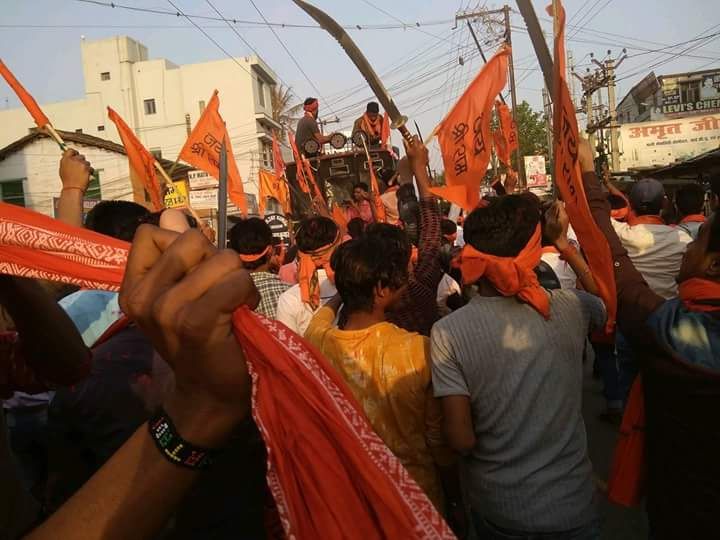
A Ram Navmi procession in Begusarai, Bihar, today UPDATE: These reports have been updated after regular and reliable data collection and feedback from the ground. – Editors
In a terrible, and cynical fallout of the Ram Navmi celebrations, that have this year at least taken an aggressive and violent turn, Rosera (division of Samastipur) and Munger in Bihar and Raniganj in Bengal are experiencing tensions close on the heels of arms filled processions that were ‘allowed’ in both states. While administrations of both states under varied political dispensations have been stating that these processions were ‘authorised’, the issue that remains is whether processionists should be allowed to brandish weapons and also raise provocative slogans, unstopped. Asansol in Bengal was also affected by the communal violence until the district administration brought things under control.
The Hindu reports that three persons have died and several others injured over the past two days after provocative behaviour by processionists organising the Ram Navmi processions in west Bengal. Incidents are reported to have taken place in Raniyan (west Bardhaman district), Kankinara in North 24 Par ganas and Beldi in Purulia district. On late Monday night’s incident at Raniyan, one person died and 30 persons, including six police officials were injured.
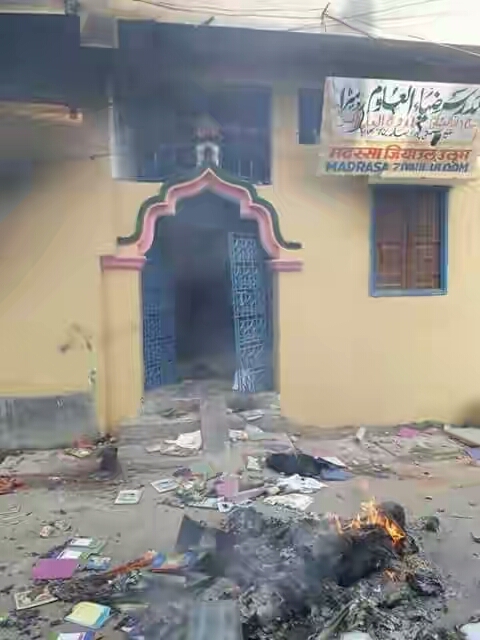
Pictures from Rosera, a division of Samastipur, Bihar
Pictures from Raniganj, Bengal
Late night reports and photographs coming in from all areas report that police had to resort to firing to dispel mobs on the rampage, themselves spreading rumours. Internet was disconnected by the police at Rosera and Munger and both areas were tense till late in the night. Local residents in Bihar, however, did not rise to the bait though the atmosphere remains tense.
Violence was sought to be provoked in Rosera of Samastipur today and about stray shops are reported to have been attackrd.Though reports cold not be confirmed, no serious damage or loss of life occurred. Photographs of minor damages to the Zeya Ul Uloom Madrassah of Rosera are available on social media. Rosera was once represented by Ramvilas Paswan. Munger town also reported disturbances till late last night and though firing had to be resorted to, the armed Ram Navmi processions was still doing the rounds. Both Munger and Rosera are market towns in Samastipur.
Munger or Monghyr is hometown of Shri Krishna Sinha (1887-1961), the first chief minister of Bihar. It is also the hometown of Maulana Wali Rahmani and Tariq Anwar of NCP too belongs to Munger though he was and MP Katihar
Raniganj (West Bengal), not very far from Munger, also had violence where several dozen shops a lot of shops belonging to the minority community have reportedly been burned it is alleged, between today and yesterday. Violence had briefly even spread to Asansol where the violence was thereafter brought under control. Taj Shoes and Leatherworks is one of the establishments gutted.
Comments on Facebook were and are telling: https://www.facebook.com/jitendra.narayan.7 भाजपाई राज का आनंद समस्तीपुर वासियों को भी दिया जा रहा है… मोबाइल इन्टरनेट सेवा बंद करके…!!! #जलता_बिहार
Raniganj, Bengal: जो खबरें आ रही हैं वह बहुत ही बुरी है चुंकी पश्चिम बंगाल का रानीगंज कल आग में जल रहा था, तो आज आसनसोल जल रहा है। क्या अब त्योहार का दूसरा नाम दंगा है? हमारी अपील है की आसनसोल “सिटी ऑफ ब्रॉदरहुड” के आवाम दंगाइयों को दूर रखें। अमन चैन बना कर दंगाइयों के मकसद को विफल करें।
Two days ago, The Times of India had reported how at least 20 shops were gutted in fire and more than seven persons got injuries after a communal clash broke out in town area of Aurangabad district after stone pelting took place on a Ram Navami procession at Nawadih area. In the Aurangabad violence, the provocative role of union minister swini Chaubey and his kin has been pointed out. The New Indian Express had reported on this aspect of the provocations casued by elected representatives and his son. The procession, consisting of bike borne youths, was passing through Nawadih Colony under Town police station when some reports said, miscreants pelted stone on it.In Kaimur, some bike borne youths who were going to attend a Ram Navami procession, raised objectionable slogans in front of a mosque at Mughalpura under Chainpur police station area after which clashes took place on Sunday.
Later in retaliation, at least 20 shops located at Ramesh Chowk were gutted in fire by the agitating mob. The chowk is hardly a kilometre away from the spot where stone pelting took place on the procession.Aurangabad DM Rahul Ranjan Mahiwal said that prohibitory ordered under Section 144 of Cr.P.C. were issued as precautionary measures in town area and situation was under control.
“The procession was authorised and was passing through pre-determined route in presence of magistrates and security personnel when stone pelting took place on it,” he said adding more than seven persons were injured in the violenceDM Mahiwal also said that stone pelting took place between two groups and an agitating mob torched some shops at Ramesh Chowk. Patna zonal IG Nayyar Hasnain Khan said that district armed police personnel were deployed in the area and the situation was brought under control. “At least five rioters were arrested and several others were detained,” he added.IG Khan said two persons received minor injuries and the situation was immediately brought under control.
While in Gaya, miscreants pelted stones on a Ram Navami procession under Kothi police station area while it was retreating on Sunday. Stone pelting took place between two communities after which huge number of police personnel were deployed.
“No arrest had yet been made in the Kaimur and Gaya incident,” Khan added.Meanwhile in Siwan, communal clash took place when a group of people stopped a Ram Navami procession at Nizam pur village under Mazharulhaq Nagar police station area on Saturday night.Siwan ASP Kartikeya Sharma said that the procession was “authorised” and it was passing through pre-determined route when it was stopped. The question is whether an ‘authorised” procession should have processionists carrying arms that imply agression and intimidation and should be ‘permitted to raise provocative slogans?
In the state Assembly, the Opposition RJD and Congress attacked the Nitish Kumar-led NDA government over the March 17 communal clashes in Bhagalpur’s Nathnagar and the present Aurangabad clashes. Nitish Kumar assured that the government is doing its best to maintain communal harmony and urged Opposition leader Tejashwi Yadav not to “over-emphasize the clashes” in order to let violent sentiments die down.“The government is giving empty assurances as Union minister Ashwini Choubey’s son Arjit Shashwat is yet to be arrested for causing the clashes in Bhagalpur. Give me permission and four constables and I will have him arrested,” said Yadav to journalists.
Arjit Shashwat moved an anticipatory bail application at the ACJM’s court in Bhagalpur on Monday. The court had issued arrest warrants on Saturday against him and eight others accused of inciting violence at Nathnagar during a procession in a Muslim-dominated area on March 17.
“While administration was involved in negotiation, miscreants damaged a school building and its vehicles owned by person from minority community in neighbouring Rampur village,” he said adding couple of shops and a vehicle was damaged due arson attempt. The ASP said the central forced have been deployed in the area.
The home department and state police’s special branch had separately published advertisements in newspapers on Sunday especially for Ram Navami urging people not to share objectionable posts on social media, not to raise slogans and display pictures which would hurt religious sentiments.
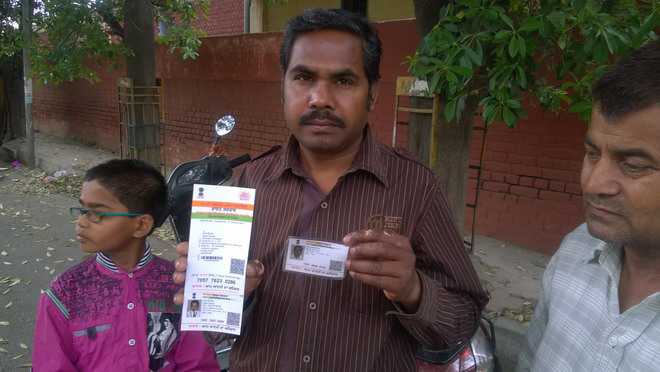
In a bizarre attempt to appear more loyal than the king, several schools across the country are demanding that all students compulsorily fill in their Aadhaar data during enrolment. In fact, even the admission process for Nursery for the academic year 2017-18 at these schools requires Aadhaar information of both the parents and the child! Now an intervention petition has been filed in the Supreme Court in the Aadhaar case challenging these ridiculous requirements.
Image: Tribune India
The intervention application filed by Advocate Joshita Pai highlights how key Aadhaar concerns related to getting benefits under government schemes or matters related to National Security. The petition says, “While the stand in the Court is about national security, the objects of the Act is about delivery of services to persons. It is submitted that both these aspects do not concern the children, especially those who are not seeking any subsidized services from the State.”
The application further states, “That the often-expressed rationale by the Union Government on the question of integrating Aadhaar number with other schemes has been ‘in the interest of National Security’. However, the requirement of furnishing Aadhaar details of students in schools does not align with the alleged concern over National Security.”
It also raises the question of profiling, “That the students are being compelled to produce their Aadhaar details for unspecified purpose and such linking of a student’s Aadhaar information with a student’s school records is not viable and will enable profiling of the children’s records.”
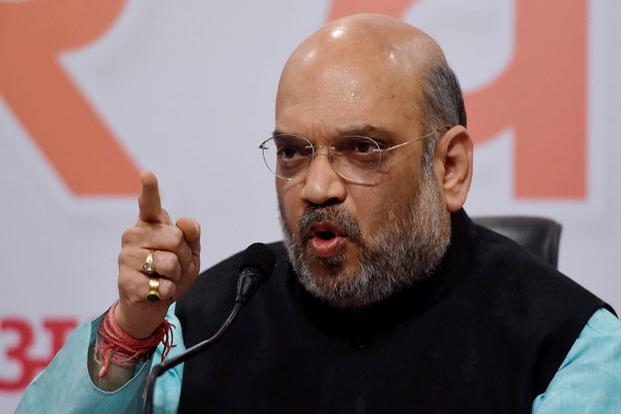
BJP President has launched a vicious attack on Siddaramaiah government, by delivering rhetorical and inflammatory speeches at various places in Karnataka. His two-day visit comes ahead of the upcoming Karnataka elections.
In his speech on Monday, he alleged that the Siddaramaiah government’s move to accord separate religious minority status to Lingayats and Veerashaiva Lingayats was a ploy to prevent B D Yeddyurappa, BJP candidate for the post of Chief Minister from winning. Making that as his key argument, he kept on launching provocative assaults against the present government, and obviously not in the most sophisticated manner.
While repeating what he said on Monday, Amit Shah made an embarrassing faux pas today. While addressing a press conference in the Denagere city, Shah termed his party’s chief ministerial candidate B.S. Yeddyurappa as “the CM who led the most corrupt government in the country”, albeit mistakenly.
Earlier, referring to BJP’s win in the 2014 elections and thereby its win in several states as a victory procession, he said, “Modi’s victory chariot is now coming to Karnataka after winning several states and will sweep it too” Targeting the present Chief Minster, Siddaramaiah majorly, he said, “Siddaramaiah ji, please tell us, the watch worth Rs. 40 lakhs that you are wearing on your hands, from where do you get the money to afford it?”
He said that under Siddaramaiah’s government the state has not developed at all, in fact the government has also misused the money that was allocated for the state by indulging in corruption and that it was the topmost corrupt state in the country. “If we say all this to Siddaramaiah ji, he will get upset like a woman!” he lamented. He said that when Siddaramaiah was already slated to lose the elections, why did he align with another loser, Rahul baba?”
The crowd, which seems to be comprising of a lot of BJP and RSS karyakartas, relished his pungent remarks whole-heatedly.
Further, he alleged that since the time Siddaramaiah’s government has come into power, in a span of 4.5 years, more than 20 karyakartas of BJP and RSS have been killed. (Indirectly alleging that either the government was responsible or complicit in all these murders)
However twitter users called out his bluff.
It must be noted that the Lingayata controversy started in March when the Karnataka government said that it wanted to accord a minority status to Lingayats. The followers of Lingayata tradition strongly reject the caste and thread wearing traditions of traditional Hinduism. In fact Basavanna, the leader who popularise the ideas of the sect was on the basis of ideas of human freedom and equality.
It is understood that Lingayats, who constitute 17% population of Karnataka, are highly organised and structured and have supported BJP in the past. So, BJP may stand to lose if they are accorded minority status. At the same time, Congress may gain by their minority status. Hence, one can imagine the discomfort this has caused within BJP, which, not focusing on its own deliverables for the election or even its own plans, is launching targeted individualistic attacks on Siddaramaiah and Rahul Gandhi.
Amit Shah met Shivakumara Swami of the Siddaganga Mutt in Tumkur on Monday. Today he plans to visit the Madara Chennaiah mutt, which has been traditionally associated with Dalits. He also plans to visit the Bekkinkal, Singere and Muruga mutts among others during his visit to the state’s central region. He plans to end his visit with a rally to lure Dalits in Challakere in Chitradurga. Certainly, his visits to holy places and meeting gurus is being seen as part of his efforts to ensure that the community backs the BJP.
However, a BJP office bearer in central Karnataka told The Economic Times on the conditions of anonymity, “We think our party president will talk to the mutt heads and convince them to continue supporting us and not the Congress” He added, “Shaji’s visit could also be a move to take suggestions from the pontiffs on whether the Centre should accept the Karnataka government’s recommendation, reject it or just put it on the backburner
Only a few weeks after the Prime Minister Narendra Modi addressed a rally in Davanagere on February 28, in which he said, “We are likely to make maximum gains this time in the central Karnataka region and that is why Shahji is focusing on retaining our Lingayat vote bank here” Shah is making the tours to lure people to vote for BJP.
Ahmed Ali, 82, a rickshaw puller from Karimganj in Assam, was forced to abandon his education due to poverty. However, this made him even more determined to devoting his life to ensuring that no child in his village who wishes to attend school is forced to drop out because of a lack of funds or access to schools. Bit by bit over 40 years, Ali has established nine schools: three lower primary, five middle schools and a high school in Madhurbond and nearby areas.
Ali built his first school in 1978, and he aims to have at least ten schools in his area, and also wants to establish a junior college as soon as possible, so that students in the area are not forced to stop studying after completing Class 10, and do not have to travel long distances to study further.
Ali earned his money as a rickshaw puller, and also by working in other sectors in Guwahati, including in construction work. Of his 36 bighas of land, Ali donated 32 bighas to establish schools. He said that initially, he struggled to set up the schools without aid from the government. He funded the first school through the sale of a plot of land, and with contributions from other villagers. “I had to make the walls and other necessary things with the support of villagers and my well-wishers. Later the government assisted the schools,” he said.
Ali’s inability to attend school always disturbed and pained him as did the effects of illiteracy on people’s lives. “Illiteracy is a sin, the root cause of all ills. Most families face problems because of lack of education,” feels Ali.
Ali’s service to the community was highlighted by Prime Minister Narendra Modi in his recent monthly radio address. Krishnendu Paul, MLA from Patharkandi in Assam recently felicitated Ali for his efforts, and announced that Rs. 11 lakh had been allocated from the multi-sectoral development programme fund under the Union Ministry of Minority Affairs to be put towards the Ahmed Ali High School. Ali’s three sons have all attended school and college.
It was a lot to take in, even in these whipsawed media moments.
In one 24-hour news cycle, President Donald Trump fired Secretary of State Rex Tillerson, appointed the war and torture-backing CIA chief Mike Pompeo to replace him, and then tapped Gina Haspel—who covered up CIA torture in Thailand—to replace Pompeo.
While the media descended on that circus, many missed that the White House quietly convened high-level representatives of 20 countries ostensibly to “brainstorm” about the crisis in Gaza, where Israel’s repeated military incursions and blockade have devastated the territory’s infrastructure, health and water systems.
The gathering, which took place on March 13, was less splashy than the Tillerson-Pompeo-Haspel saga. But it spoke volumes about dangerous new drifts in U.S. foreign policy.
Look who’s in the room together The United States has long backed Israel’s siege of Gaza and defended Tel Aviv’s succession of military assaults on the impoverished, densely populated territory of 2 million.
So the notion that Trump, whose uncritical support for the Israeli government surpasses that of any of his predecessors, is suddenly concerned about mitigating the humanitarian catastrophe in Gaza seems pretty far-fetched. Especially when Israel, the country most immediately responsible for the destruction of Gaza, was one of the nations playing a starring role in the White House gathering.
On the humanitarian front, little came of the meeting. Officially, Reuters reports, “the multi-nation humanitarian and reconstruction effort remains in beginning stages.”
More significant than the outcome, however, is the grouping the meeting brought together.
The gathering featured Europeans, Israelis, Egyptians and representatives of most of the Gulf Arab monarchies—Saudi Arabia, the UAE, Jordan, Qatar, Oman, and Bahrain—all sitting in the room together. Not included were Palestinians, who have been clear they won’t follow U.S. diplomatic leadership since Trump’s provocative decision to move the U.S. embassy to Jerusalem.
According to Reuters, unnamed officials insisted that “the format did not allow for direct discussions between Israel and the Arab states.” But that is likely not the end of the story.
It’s been clear for a long time that Israel and the Gulf monarchies, led by Saudi Arabia, are desperate to cozy up to each other. Both are U.S. allies and huge purchasers of U.S. arms. And both rely on U.S. diplomatic protection at the United Nations to avoid accountability for their human rights violations. And most importantly, at this moment, both sides are eager to join forces against Iran.
Saudi Arabia and Iran have been battling for regional dominance for a long time. Their competition has stoked a brutal proxy conflict in Syria, and Saudi Crown Prince Mohammed bin Salman has orchestrated a devastating attack on Yemen as a challenge to Iran’s influence there.
Meanwhile, Israeli Prime Minister Benjamin Netanyahu’s efforts to persuade the United States to abandon the nuclear deal and attack Iran have served as a backdrop to Israel’s regional policy for years.
At a quiet Washington meeting supposedly discussing something quite unrelated, they were all sitting down together — ahead of Saudi Crown Prince Mohammed bin Salman’s own visit to Washington.
A dangerous regional agenda Despite years of Israeli and Saudi propaganda, Iran isn’t actually an existential threat to either Israel or to Saudi Arabia. But Iran’s rise is definitely a challenge to long-standing Israeli and Saudi efforts at regional dominance.
The more dire regional threat, however, is that the Trump administration is showing every indication of wanting to escalate tensions with Iran. That’s exactly what will happen if the Trump administration pulls out of the Iran nuclear deal, as Netanyahu continues to urge, and as Senate Foreign Relations chairman Bob Corker (R-TN) recently predicted.
Trump’s appointment of Mike Pompeo, a leading Iran hawk, to the post of Secretary of State increases this risk. Pompeo has gone even beyond Trump himself in criticizing the Iran nuclear deal, a position that bodes very badly for diplomacy under this potential new diplomat-in-chief. So does the fact, as Peter Beinart wrote in The Atlantic that “Pompeo embraces anti-Muslim bigots, and defames Muslims, with almost as much gusto as Trump himself.”
As Secretary of State, it will be up to Pompeo to inform the president whether or not Iran is complying with its obligations under the nuclear deal. The international agency charged with monitoring Iran says it is complying. But Pompeo, even before he became CIA director, was already tweeting that he was looking forward to “rolling back” the “disastrous” nuclear deal.
Palestinians left out With these people running U.S. foreign policy, any moves by Washington to encourage the Israeli and Gulf Arab governments to join forces against Iran becomes even more dangerous.
Tel Aviv and Riyadh are both eager for this front. What stands in their way is popular outrage at home.
In places like Saudi Arabia, absolute monarchs shed crocodile tears about the plight of Palestinians while doing nothing to actually end Israel’s oppression of Palestinians. But thanks to widespread popular support for the Palestinian cause in the Arab world, Arab officials are pretty much forbidden to publicly meet with Israelis.
Trump son-in-law Jared Kushner and his BFF Prince Mohammed bin Salman are working to change that. Getting Saudis and others in the region accustomed to the idea of Israelis and Arab leaders sitting in a room together is a key component of this strategy. That not-so-public meeting in the White House may have been just the beginning.
Once again, the Palestinians—and especially the people of Gaza—are being held hostage to the regional and global aspirations of more powerful countries. Instead of actually addressing the suffering in Gaza, the United States and its allies may have turned a conference on humanitarian assistance into a war room aimed at Iran.
Middle East expert Phyllis Bennis directs the New Internationalism Project at the Institute for Policy Studies.
How does one tackle inequality within the caste system?
Sony Pellissery is an associate professor at the National Law School of India University, Bangalore, where he concentrates on introducing ideas of social justice into public policy debates. Beyond Trafficking and Slavery caught up with Sony at the conference ‘Bridging Silos: Trafficking, Slavery and SDG 8.7’ held in in August 2017 in Bangalore, India, to talk about his work and the fight for social justice in India.
Neil Howard (oD): Could we start with a question that is simple to ask, but difficult to answer. What is social justice? Sony: My understanding of social justice has varied over the course of my personal journey. At early stages I had a socialist understanding of social justice – a classic understanding of the term, where you go to the streets, gather everybody, and get your rights. But the more I have worked with communities which face exploitation, the more my idea of social justice is being defined by the leaders of these communities.
For example, some of my current research projects are with bonded labour communities. Their understanding of social justice does not share many of the well-laid principles of classical social justice. They have a more communitarian understanding of what should be justice for them. For bonded labour communities, for dalit (lower caste) communities, it’s more about correcting historical social injustice. That is social justice for them. I’ve begun to think through the lens in which they want to see things, rather than imposing my ideas of social justice as an academic upon them.
Neil (oD): It sounds like your understanding of social justice has become much more participatory. Am I hearing you correctly that for some of the bonded labour communities that you work with, it’s about recognition as much as about rights and redistribution? Is that correct? Sony: That’s right. Even within bonded labour or dalit communities, they have experienced their own changes. For instance, immediately after the Bonded Labour System (Abolition) Act came into effect in the mid-1970s they focused on releasing the people who were in bondage. But more and more they have realised that release is only one part. Today business is thriving in Bangalore and other places, there is great opportunity, and if they don’t participate in it they will have no future. It will be like be bonded all over again. So instead of fighting against that, they are thinking of ways to participate in the economy. That’s a change. Is it redistribution they are seeking, or recognition? They themselves are moving with the currents. Similar issues are found within Adivasi communities. There were times when Adivasis were told to preserve their culture, their identity. But today, Adivasi communities are asking to learn the English language, and to compete with everybody else. So, each of these deprived communities are finding that earlier paradigms were problematic. That the earlier paradigm of development constrained them in particular ways, and that they need new paradigms. That’s the kind of change that’s happening in all the marginalised segments of society.
Neil (oD): Two questions then, to provide an overview for people who are not expert in these topics. One, could you outline a way for us to understand the causal factors of extreme exploitation in the sub-continent, and, following that, what are your ideas for what we could do about it? Sony: Indian society is a very hierarchical society, and the exploitation is hierarchical. It is not the one who is on the very top of the hierarchy who goes down and exploits the lowest. That is not the way it operates. The exploitation is layered. The one who is on top of the hierarchy will exploit the one who is next below. That exploitation takes place in different ways: oppressing him, paying him less wages, demanding extra things. And then similar kinds of exploitation take place at each level.
It’s difficult to define a standard of exploitation. The type of exploitation a person experiences is based on where they are in the caste hierarchy. To see the most extreme form, the cruelest form of exploitation we have to go to the very bottom. There you see that the form of exploitation is on the bodies themselves. Dalits must do things like get into an open well and clean it, and sometimes they will die in the process. In formal factory settings they might be asked to do the hardest of the jobs. But in this system that’s what they are seen as destined for – to clean a land owner’s well they may have to die, and they are not entitled for any other rights.
Neil (oD): So identity interacts with market forces to make the type of exploitation experienced relative. Sony: Yes. The other identity that is experiencing extreme exploitation is gender of course. Violence against women is very common in India, particularly female children. The homes in which they work are supposed to be safe places, yet they are often exploited and sexually harassed. These are cruel forms of violence.
The third form that you can see in India is the distinction between urban and rural areas. Some 60-70% of India’s population still works in agriculture, yet the sector accounts for only around 15%-20% of the GDP. So these three markers – being dalit, being a woman, or coming from a rural area – are generally the axes along which exploitation in India operate.
Neil (oD): On the basis of such a matrix, which has structures intersecting to create exploitative relationships, what are some of the things you think progressive elements in society can do to fight against exploitation? Sony: What counts as progressive in India today is very divisive. For example, the old kind of thinking – that is, a left-leaning ideology for organising exploited groups – still operates. There is still a lot of buy-in for that. However, large sections of Indian society today – especially the upcoming, young population of India under 40 years old – are less convinced by this rationalistic frame. They would imagine progressive means looking for a freer society, and that leftist organisation is a waste of time. These are the two different types of logics currently operating in India. Both claim they are progressive. But they cannot come together on a single platform.
The strength of the second group is that they have a very strong, communitarian logic, and the question of identity is at the centre of the discussion. They say that without your identity you cannot really talk about ending exploitation or achieving social justice. The first group, in contrast, believes there is a certain rationalistic thinking to which you are attached, that your ideas therefore operate at that level, and thus they underplay the identity question.
Unfortunately the political currency is now with the communitarian group. That group is winning because the Indian middle class, which is a large stakeholder within the whole game, has built up an understanding of India as a mega force in the region and the whole world. That conception has the backing of Indian civilisation, scripture, etc., which imagines India as a superpower of sorts. To push that discourse harder, you have to push your Indian identity very strongly. Communitarians have been very successful at that. The symbolism of Hindu philosophy primarily operates through a denial of equality.
To end exploitation, they will immediately think about imagery from mythology, or religious scripture. They will say it’s been done in the past, and therefore this is how it’s going to end – new instruments of rationalised discourses coming from elsewhere are unnecessary. That use of symbolism is hugely problematic for ending exploitation.
The symbolism of Hindu philosophy primarily operates through a denial of equality. You cannot have equality if you subscribe to Hindu philosophy. If you believe yourself to be a Hindu, you have to believe in the caste system – it’s at the heart of Hindu philosophy, according to some writers. And that is where the problem lies, as the moment we subscribe to Hindu symbolism is the moment when we also subscribe to the problems of a hierarchical society.
Having said that, individuals like Ghandi thought that there was a way to reform Hinduism within Hinduism by bringing in rational discourses. He thought that the denial of equality was not at the core of Hinduism, it is only one of the operations of Hinduism. So there are multiple strands of thought on this, and some of them open up space for challenges.
My personal conviction – I’m not sure if it’s cynicism or not – is that India has passed that stage to be a transformative society. For India to have done that, it would have had to be at the time of Indian constitution making: the 1950s. The Indian constitution could have been a challenge to traditional Indian philosophy. But that never happened. The Indian constitution is a very rationalist, idealistic constitution. It lives with a very rough ideological foundation of Hindu society, which is hierarchical.
Neil (oD): And you understand this to be one of the major obstacles to progressive alliance building? Sony: We’re not quite there yet in the discussion. So far I’ve talked about two types of orientation. The ideological divide is one major cleavage. But, to my understanding, much more difficult is the process of a modern polity that has become available to Indian society. This is exhibited through more acceptance of democracy in this country. In many ways, that democratic process gives all the progressive groups a lot of strength. It allows people to say that they can deal with the question through democratic forces, and people do mobilise around those forces. People thus are willing to work through these channels because they think they can make a larger difference.
But, there is an illusion about what you think you’re achieving through a democratic process and what you finally end up getting. That is a larger picture which people are not able to see when they work very minutely on the details of getting the votes, and getting small successes. But the larger picture remains somewhere else.
Where is that larger picture? It goes back to what ideas you are able to forcefully put forth. Communitarians have put forth a strong ideology. Unlike traditional organising, where you go door to door to convince people to attend meetings about topics beneficial to them, communitarians do things like go in front of a school, put up a special symbol, and everybody knows what it means. You don’t even have to ask them to come. They come on their own.
They have created a highway of ideology to which people immediately jump, while other types of progressive groups shrink to being just alleys or small roads in comparison, which people must negotiate in order to get to the main highway. Why would people not simply join the bandwagon of the main highway from the outset? That’s where everybody has to go, as everything else has become small pathways. And for those already on the small pathways, they keep hoping that eventually – after following enough pathways – they will also end up on the highway.
That’s the biggest challenge. You have a big elephant in the room, and everybody else is fighting it for fear of being taken over by it.
Neil (oD): I’m guessing that you would also be of the belief that the communitarian ideology is not an ideology that is likely to lead to emancipation for the kinds of bonded labourers that you have worked with. Am I right? Sony: The communitarian ideology will push up certain sections of the people, and other large sections will be left out. That’s what communitarian ideology will do, because the hierarchical logic leads you to a situation where there are small sections of people on top who have to have all the benefits. You cannot share that with everybody, because ‘we’ are a special group.
Neil (oD): What do you think the opportunities are for, as you called it, the rationalist challenge to the communitarian? What can be learned from what the communitarians are doing so successfully? Sony: Yes! Indeed, the progressive alliances are learning from the communitarians. For example, in the past progressive alliances have always foo-fooed the question of identity. They said we all have to be rational. We all have to be alike, and agree on certain things. Now, seeing the communitarians, the progressive alliances are opening their eyes. They’re saying that, yeah, there are among us vast differences and we failed to see them, and that’s why somebody else has come in and gotten all the attention. Therefore, let us recognise the differences among us, let us recognise these identities. That will help us to have much more meaningful unity than a formal unity that was wished for. That change is now happening. What will come out of it, and how far it will go, I don’t know. But change is happening.
There are among us vast differences and we failed to see them, and that’s why somebody else has come in and gotten all the attention.
There is hope. Something we haven’t talked about yet is how knowledge is created and used in different types of alliances. Within the communitarian paradigm, knowledge is sometimes subjugated for the purpose for which you’re fighting. In other words, more of a religious kind of knowledge creation – you don’t challenge the basic text. You still have knowledge, but you operate within that. Opened inquiry is not required.
Certain progressive groups have also struggled because they’ve been looking to the west for their source of knowledge. They have not been able to create an indigenous base of knowledge for their context, and thus appropriate knowledge for dealing with social justice questions is not getting created. Wall stencil in Varanasi, Uttar Pradesh, India. Adam Jones/flickr. (CC BY-SA 2.0)
Neil (oD): You see a real need for participatory, contextually specific knowledge. Sony: It’s not there, and that creates uninformed members of society regarding the sorts of social justice they are looking for. The moment you talk about a very rationalist social justice it’s coming from somewhere else. It’s not contextualised, and the class question is not mixing with the caste question.
Neil (oD): They’re missing the locally meaningful symbols, through which they can translate the rational concept. Sony: That is a huge problem for addressing meaningful exploitation, and I think these are the types of tools you need to address them. Within them you will be at a loss.
Neil (oD): Before we finish, what sort of policies do you think would be necessary, assuming that the rationalists get their act together and that there is a change in the political order, to address the extreme exploitation that takes place in India? Sony: There’s a larger pre-issue to that. In the Indian context, the moment we use policy we take on a huge amount of baggage. The state is not visible here, or it’s seen as a repressive force. The state is the one who is sending police to arrest me rather than to protect me. The state is seen as a problem here. The moment we talk policy to solve an issue, within the Indian context it takes on a very different kind of colour. So – I think the answer to this for many of the progressive groups is to organise people. What that basically means is that they see the solutions as coming from society rather than the state. The state will always be a problem creator and a predator. But society is good, and you can trust society. You can trust people.
Given Indian society’s post-colonial situation of the state, the whole feeling is that we should get rid of the state. So, policy-as-a-solution has a very limited reach in a country like ours. Solutions might not come from policy, they might have to come from elsewhere. Policy-as-a-solution has a very limited reach in a country like India.
Neil (oD): Given that context, are there other ways you can see for reducing the kinds of exploitation we are talking about? Sony: One of the ideas we have experimented with in both the university and elsewhere is the idea of reimaging the government as an instrument which gives an opening for starting deliberations or discussions. For example, several policy changes have been suggested in recent times. One of them has been a big debate on labour courts. We see this as an opportunity for starting a discussion. The moment government issues a labour court, which everybody thinks is going to be very problematic and create further inequalities, we see that as a further opportunity for discussion among labour groups. It’s also an opportunity to lead the government by discussion, or reconstitute the government by discussion.
I don’t think any policy that is prescribed here will have acceptance by society as is. But you can push it further, work on it, and make it better, rather than leaving it as is.
Neil (oD): A final question about basic income. For a moment, let’s assume in the abstract that the state is not a predator and can be trusted to transfer money to every citizen. Would that contribute to the reduction of exploitation? Sony: I think it would not. The reason is that different states in India have different levels of human development, income, etc. You can easily identify at least four of five ‘types’ of state in India. So when you say a basic income for all of India, for many of us that can be seen as a threat to the purpose for which India became a union. India became a union on the premise that each state can keep its identity. Each state can keep their basic autonomy. That is the principle, and you can’t experiment here like you did in Europe, where you created a single economic system and said everyone fell within that. That is a very big proposition. If we have a single basic income created at the national level, it would be too low for some states, and very good for some people.
There are researchers who have done some kind of calibration regarding what a basic income in India would be. It works out to be 10,000 rupees per month. 10,000 rupees per month for a domestic worker is good money. It’s almost her salary per month. But for large sections of the middle class and upper middle class, it’s not what they are looking for.
And, if the middle class doesn’t give its assent to a basic income proposal, it has got very little viability to be accepted. And that is something which is to be contrasted with the European experience. There, the welfare state is about middle class. It’s about getting pension, getting unemployment benefits – it’s about the middle class, about nearly everybody except for perhaps the top 5% or so. But here, the welfare state or basic income proposals become attractive only for the poorest class. Not for the middle class and upper class. Thus, it’s not going to end inequality. It’s going to become yet another welfare measure which might help the poor section that finds it attractive.
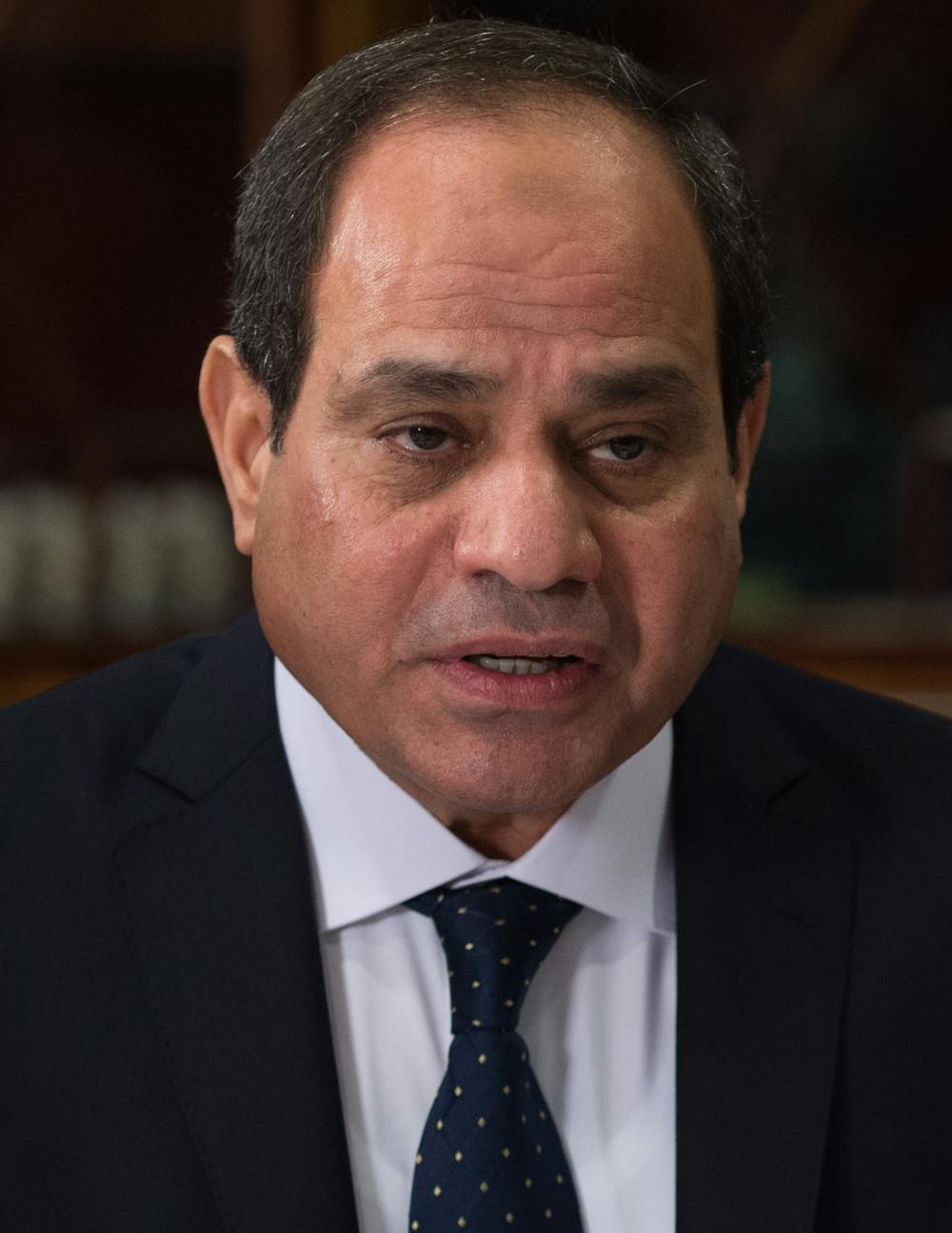
Egyptians are voting in presidential elections on March 26-28. Abdel Fattah al-Sisi, who grabbed power in 2013, is set to win another term by a landslide. Yet this is far from a sign of strength: opposition candidates have been silenced, and even pro-government media are being purged of the slightest undertone of dissent.
Al-Sisi’s grip on power may appear firm, but his country’s problems can’t be thrown into jail like his opponents. His predecessors Hosni Mubarak and Anwar Sadat learned this the hard way.
Yet don’t expect much hand-wringing from the West about Egypt’s stability in the coming days – despite its having been through a revolution and a coup already this decade. Governments and other strategists only appear to worry about countries in this region once discontent turns “hot” – like in Syria, Yemen, Libya or Iraq.
Our research shows that this may be a serious and costly mistake. The whole region is suffering from exactly the same deep-seated problems as before the Arab Spring of 2010-11. In Egypt and various other apparently stable countries, there are very high levels of discontent that could easily boil over.
Then and now
The uprisings earlier in the decade were not simply demands for Western-style democracy. Protesters may have been disillusioned by all the election rhetoric from these authoritarian regimes in democratic clothing, but they were primarily disgusted by corruption, abuse of power and economic inequality. They wanted governments that would address these concerns rather than lining their own pockets and those of their cronies.
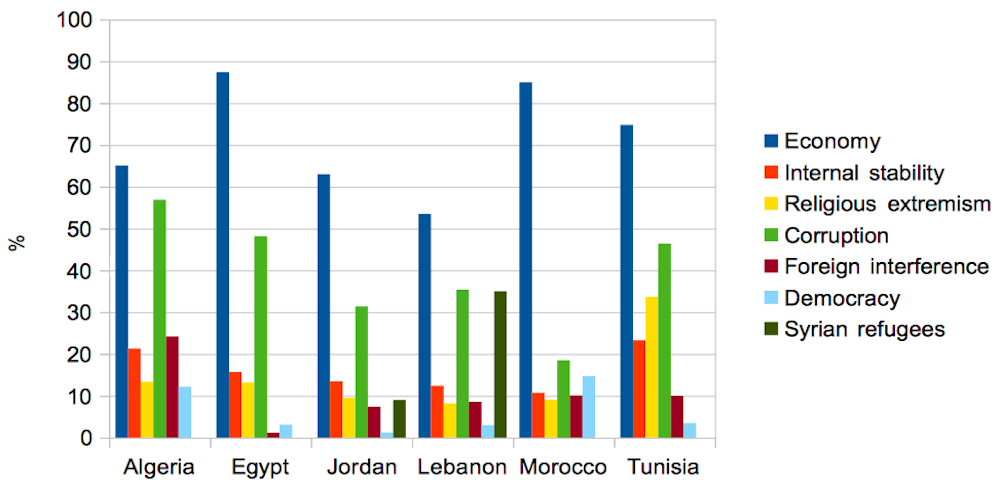
Unfortunately little has changed, as newly released opinion polls show for Morocco, Algeria, Egypt, Jordan, Lebanon and Tunisia – with upwards of 1,000 people surveyed in each country. While citizens worry about issues their governments prioritise, such as security, terrorism and religious extremism, their main concerns are the same as in 2010 – decent jobs, inflation, inequality and corruption.
Top two challenges by country
Arab Barometer, 2016.
People don’t believe their governments are responsive to their priorities. Fewer than one third of Egyptians think so, while in Morocco, Tunisia, Algeria and Jordan that figure drops to a quarter or less. In Lebanon it is a mere 7%.
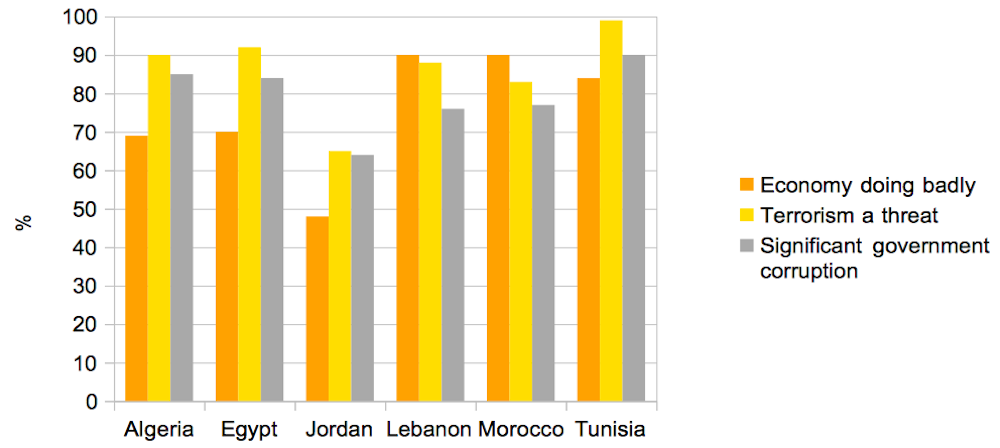
Across all six countries an astonishing 85% or more think their governments are not making a serious effort to tackle corruption. Meanwhile, 75% or more are not satisfied with their governments’ efforts to create jobs or fight inflation.
Views on economy, corruption and terrorism
Arab Barometer, 2016.
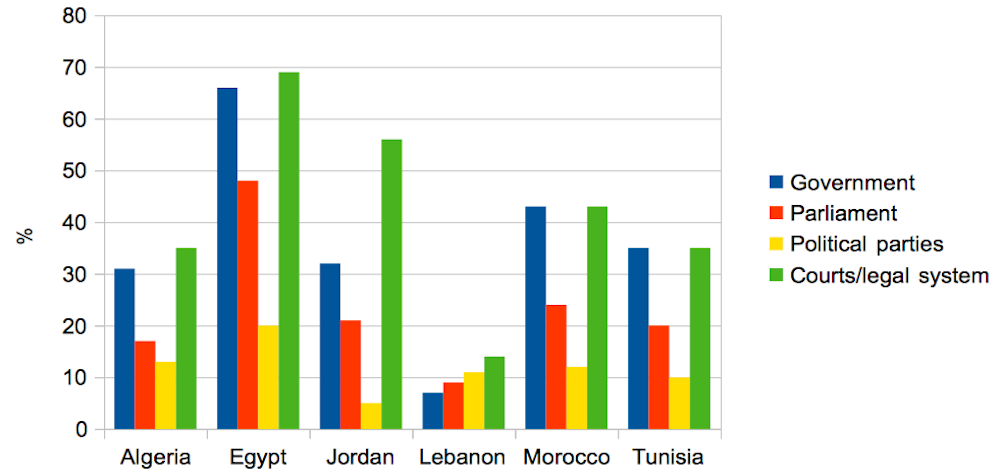
The discontent is worst in Lebanon, where fewer than 5% of people approve of the government’s work. Even the performance on internal security – the one area where citizens in the other five countries are relatively satisfied – was considered adequate by only a quarter of Lebanese respondents.
This region-wide disenchantment translates into low confidence in parliaments and political parties, the key institutions which ought to be representing citizens’ interests. Confidence varies from country to country: Lebanon again scores poorly. Egypt fares better than others, but this owes more to intense government propaganda than any real effectiveness.
Trust in state institutions Arab Barometer, 2016.
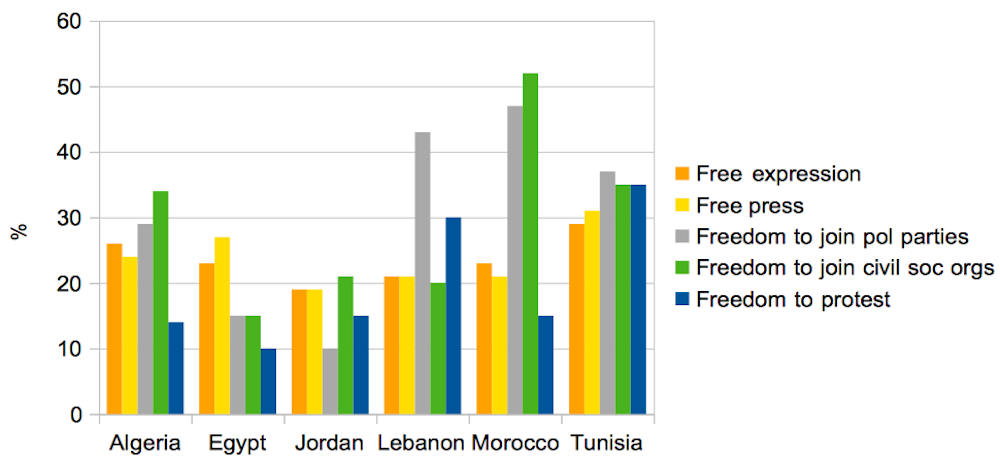
Citizens also don’t feel they have the civil and political rights necessary to legitimately express their grievances and push their governments for reforms. When people are unable to adequately express their unhappiness, it inevitably increases the potential for radicalisation.
Views on civil rights Arab Barometer, 2016.
Little changed
As a result of the Arab uprisings, governments fell in Tunisia, Egypt, Yemen and eventually Libya, while there were more limited political changes in Jordan and Kuwait. Governments in other countries announced political concessions, including Morocco, Algeria, Oman and Saudi Arabia.
Yet since the issues which drove many of these protesters to the streets have not been addressed, their governments remain vulnerable both to mass mobilisation and to less obvious forms of radicalisation – as recent protests in Tunisia show.
Western policymakers and academics concerned with security are at risk of missing this. They do not seem to have learned the lessons of the Arab uprisings. Absent armed conflict, they still tend to dismiss the importance to stability of social cohesion, inequality and poor political representation.
We must therefore reassess the stability of countries like Egypt. We must stop assuming their leaders will forever be able to simply repress dissent, and stop assuming that such repression doesn’t come with costs and risks, both human and political.
These countries are in fact security “sinkholes”: regimes whose foundations erode while apparently seeming stable, often to the point of collapse. Far from being a sign of strength or stability, remaining deaf to the needs of the people make things worse in the long run.
As al-Sisi makes his inevitable victory speech, we would be wise not to ignore these warning signs. Until we learn that conflict must be dealt with at its roots, history is liable to just keep repeating itself.
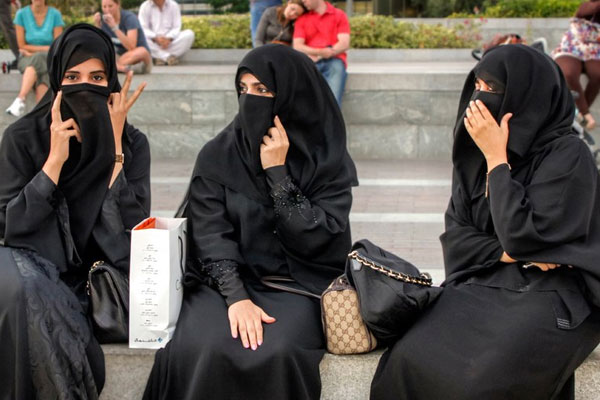
Srinagar: A nursing school in Srinagar district of Jammu and Kashmir has landed itself in controversy after directing its students to sign an affidavit not to wear ‘Abaya’ or cover their face during the working hours.
The Ancillary Medical Training (AMT) has asked its female students to sign an affidavit which states not to wear ‘Abaya or face-covering during clinical posting’.
“I will maintain the dress code as per the policy of the institution. I will maintain the code of ethics as per the policy of the institution, and I will not wear Abaya or cover my face during clinical postings,” reads the affidavit that the students require signing.
The students have threatened to take legal action against the institute if the notification seeking signing of the affidavit isn’t rolled back.
The institute’s principal Dr. Razia Mahmood while talking to a local newspaper has defended her decision and termed Abaya as a source of infection during work
“That is why there is an emphasis on proper dress code. The students can put on their Abaya or veil after the working hours,” she was quoted as saying by Valley-based newspaper Greater Kashmir.
According to the chairman of International Forum for Justice, Ahsan Untoo the institution can’t force students to sign the affidavit against their will.
“Every person has right to wear what they want to wear. Instead of asking students not to wear Abaya or face cover, the institute should provide them medical gowns and masks,” Ahsan told TwoCircles.net.
A Srinagar-based rights activist MM Shuja has threatened to approach court if the notification isn’t taken back.



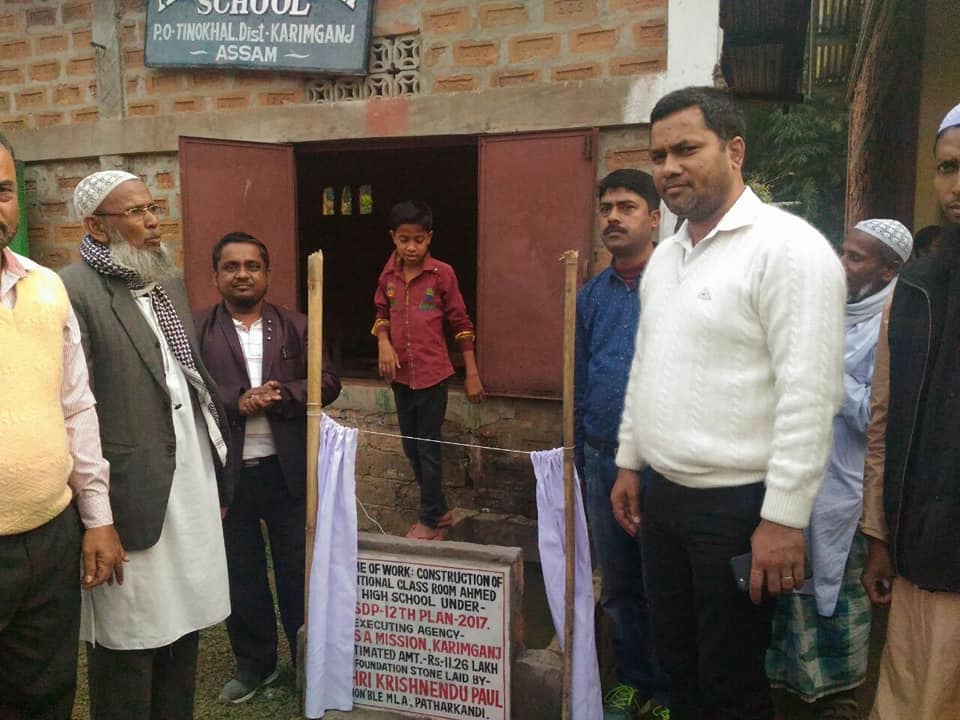
 Ali’s service to the community was highlighted by Prime Minister Narendra Modi in his recent monthly radio address. Krishnendu Paul, MLA from Patharkandi in Assam recently felicitated Ali for his efforts, and announced that Rs. 11 lakh had been