Home Blog Page 1892

They came, they borrowed, they got away (without repayment)

0

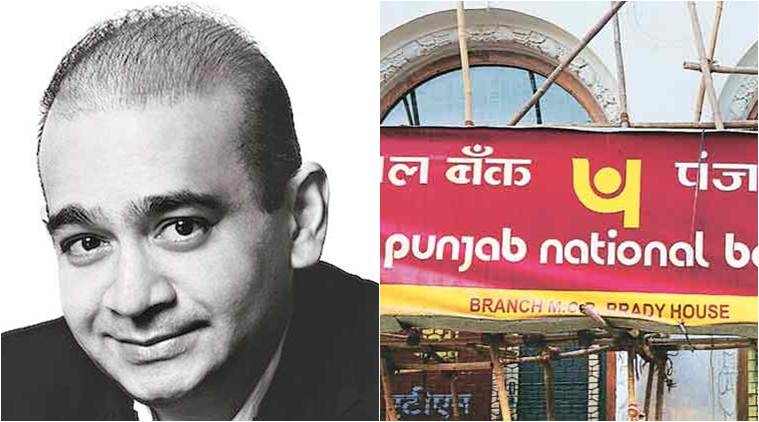
As skeletons continue to tumble out of closets of some of the most reputed Indian banks, the list of willful defaulters is growing. Many people and corporations have scammed the system and twisted it, often with inside help from corrupt bank officials themselves. The beneficiaries of such loans are many and the list of those who have not repaid their dues is long, with new names being added every day. Sabrang India has managed to secure one such list which names many known defaulters.

You can read the list here.


Rajasthan Kisan struggle intensifies as leaders remain arrested, demands unfulfilled

0


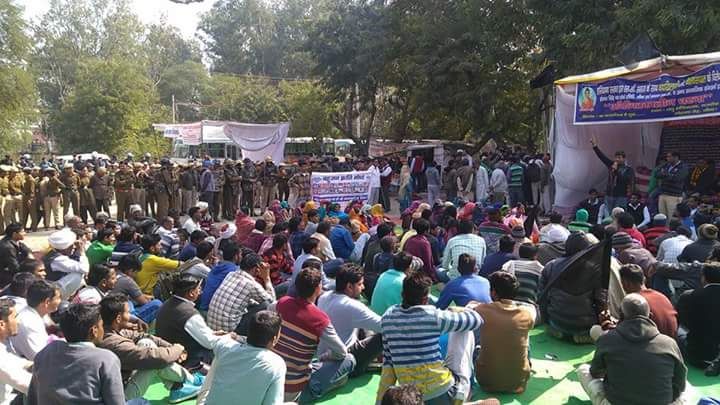
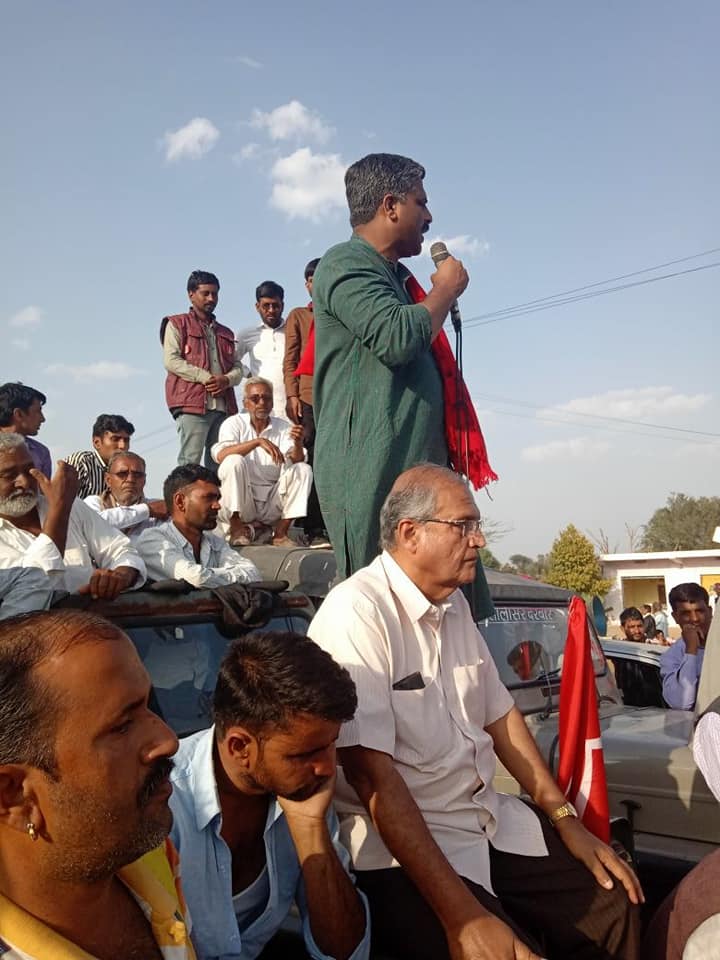
Image courtesy: AIKS

Today, Kisan leaders Hetram Beniwal and Sheopat Meghwal were released unconditionally and it was also reported that the Rajasthan Home Minister has assured in the Assembly that all Kisan leaders including AIKS Vice President Amraram and Rajasthan Sabha President Pemaram will also be released. Earlier, trying to pre-empt a large scale farmers’ protest scheduled for February 22, around Jaipur-Sikar National highway, the Rajasthan government had launched an intensive crackdown on farmer leaders. The call for the protest was given under the leadership of All India Kisan Sabha (AIKS).

AIKS Joint Secretary Vijoo Krishnan, Rajasthan Kisan Sabha Vice President Dulichand and Treasurer Gurcharan Singh Mour, Sumitra Chopra Jaipur District Secretary of CPI-M, Manoj Kumar from AIKS Centre and Pawan Beniwal Joint Secretary of SFI met AIKS Vice President Amraram and others in Jaipur Central Jail, where more than 185 Kisan leaders and activists are still jailed.

The farmers have decided to intensify the struggle from today. Despite the intensive repression yesterday, AIKS president Dr. Ashok Dhawale, AIKS Joint Secretary Dr. Vijoo Krishnan and AIKS Rajasthan treasurer Gurcharan Singh Mour were able to address two large gatherings of thousands of farmers who had blocked the highway. The AIKS leaders then reached Sikar, where as many as 25,000 farmers including women were militantly protesting and due to the continued arrests, have decided to intensify the struggle. Until all the leaders were free and demands met, the protests would continue including a call for a Chakka Jam tomorrow, on February 24. The peasant struggle, in the backdrop of the recent Lok Sabha and Vidhan Sabha by-elections results has put the BJP government on a defensive.
 
Farmers in Rajasthan had launched a protest in September 2017, which lasted for 13 days starting September 1. They demanded peasant loan waiver, remunerative prices, pension to poor peasants and agricultural workers and implementation of Swaminathan Committee recommendations etc. The scale of the protest had compelled the BJP state government to concede to some of these demands. However, even after six months since those promises were made, the state government led by Vasundhara Raje Scindia remains utterly unresponsive to any of the assurances it had given. Protesting against this, the Kisan Sabha had given a call for a massive state wide Kisan Mahapadav in Jaipur on February 22.

Unleashing a shameless wave of repression, the Rajasthan state government had arrested former AIKS President Amra Ram, Pema Ram, Hetram Beniwal, Sheopat Ram and over 1000 other Kisan Sabha leaders have been arrested in various parts of Rajasthan. Not only this, peasants were forcibly stopped from leaving their districts, especially on the national highway outside Jaipur. The frightful repression could not deter thousands of farmers who have gathered in Jaipur outside the Kisan Sabha office, where police was been posted in huge numbers.

The AIKS leaders along with several state leaders of the AIKS, CITU, AIDWA, SFI, DYFI Ravindra Shukla, Duli Chand, Gurcharan Singh Mour, Sanjay Madhav, Kusum Sainwal, Mahipal Charan, and leaders of other organisations addressed the farmers yesterday, on February 22. In a press conference, Dr Ashok Dhawale and Vijoo Krishnan, denouncing the state repression demanded for the release of Kisan Sabha leaders along with stringent implementation of the demands that were agreed upon September 13. They also called for BJP’s defeat in the coming elections as well as the emergence of a left democratic alliance.

https://www.sabrangindia.in/article/all-india-farmers-conference-kicks-impressive-start
https://www.sabrangindia.in/article/farm-loan-waivers-are-necessity-if-farmer-suicides-needs-be-curbed-aiks
https://www.sabrangindia.in/article/rajasthan-farmers-massive-protest-curb-democratic-freedoms-govt
 

They remember every detail: Ifrah Butt

0

Remembering Kunan Poshpora on Kashmiri Women’s Resistance Day

February 23, 2018 marks the 27th anniversary of Kunan Poshpora mass gang rape case. Two contiguous villages from North Kashmir, Kunan and Poshpora, on that cold and dark night of February 23, 1991 experienced a massive sexual assault by a group of soldiers and officers of the 4th Rajputana Rifles regiment of Indian army. As many as 32 women had openly alleged rape in the immediate aftermath of the incident. Though, the Jammu and Kashmir State Human Rights Commission had validated the claims of sexual assault against these women, the perpetrators remain yet to be prosecuted.
 

After many instances of distortions, cover-ups and humiliation of survivors, in 2016, five women namely Essar Batool, Ifrah Butt, Samreena Mushtaq, Munaza Rashid and Natasha Rather came up with the book, “Do you remember Kunan Poshpora”. The book is a tale of the many legal battles the women waged in order to get justice, as also an evidence of the resilience of Kashmiri women. It documents the experience of filing the PIL that as many as 50 women filed in 2013 in before the Jammu and Kashmir High Court seeking to reopen the case. Though the High Court rejected the petition after three hearings, the legal battle was restarted with a fresh series of petitions.

In this conversation with CJP, Ifrah Butt, a young activist, a petitioner of the PIL in Kunan Poshpora case and also the co-author of the book, takes us through the deep dungeons of memory and urges us to remember and support the survivors in their struggle for justice and dignity.
 

How Jind in Haryana has become a nightmare for Dalits

0

Gangrapes, murders and broken busts of Dr Babasaheb Ambedkar

Several stories are coming out Jind related to how the state has been failing Dalits in the region. On Jan 18, 2017, Ishwar Singh, an employee with Haryana Confed (Haryana State Federation of Consumers’ Cooperative Wholesale Stores Ltd) committed suicide after months of harassment at the hands of corrupt officials and state administration.

Singh, a Dalit from Jind, Haryana, took the extreme step after he spent three months in jail when charges of corruption were filed on him. Singh had alleged that it was higher authorities who had been involved in corruption, but to acquit them, he, a lower level worker,was picked as a target.


The protests in Jind have been going on for over 10 days now but the government is yet to act on the issue.

Although he came out of jail, he could never recover from the humiliation he faced. Having stopped talking to his family and even eating, he finally committed suicide on the night of January 17. After his death, the usual government promises followed, but not before the family had protested for five days outside the Jind Civil Hospital. The family was promised a thorough CBI inquiry into the corruption scandal, a compensation of Rs 10 lakh, and a job for one of the family members by state minister, Krishna Pawar. However, a year later, none of these promises have been fulfilled.

Another family, that of one Satish Kumar feels similarly cheated. Satish was a soldier in the Indian Army who died fighting Kashmiri insurgents. In a number of villages across the nation, martyred soldiers have a bust of theirs installed in their villages but since Satish was a Dalit, his bust was never installed in his village. Not only this, his family received neither compensation nor a government job as is the norm. Despite a number of pleas and visits to the Ministry of Defence and state government, there has been no response.

On January 9, 2018, a Dalit girl left her home in Jhansa village of Kurukshetra district for tuitions, but never returned. On January 12, her body was found about 2 km from her residence in the village of Rajvaha in Jind district. Post-mortem reports revealed that the girl had been gangaped and suffered vicious assaults. Her private parts had been penetrated with sharp tools which caused excessive bleeding leading to her death. Her body had bruise marks all over. A week later, one of the guys who was said to be a friend of the girl was also found dead. The family of the girl along with local Dalit activists sat on a dharna (protest) outside Jind civil hospital for over a week following which they were assured that the CBI would inquire into the matter. Again, the promises were never honoured.


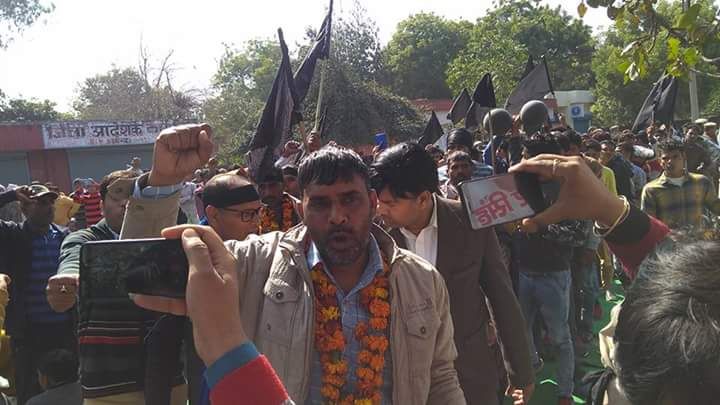
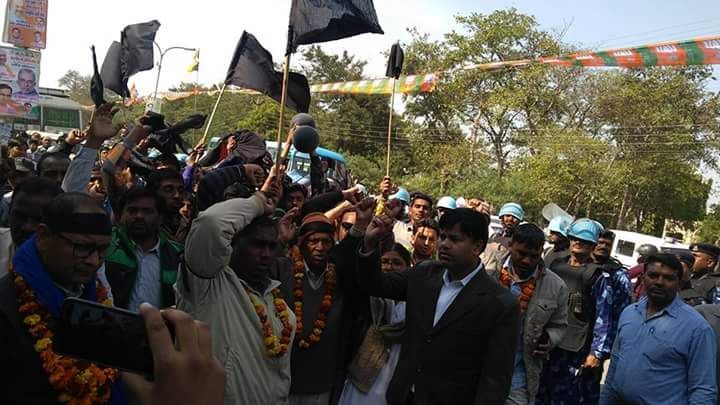
Protesters waving black flags in Jind, Haryana during the arrival of Amit Shah

This is not the first such incident in the region. Last year, a girl from Aasan village of Jind district was raped, following which she had to suffer humiliation at the hands of the public. In an extreme step, the girl committed suicide after consuming poison. Here too, the family was promised swift inquiry and punishment for the accused that was never delivered.

In many ways, these stories coming out from Jind are only a reflection of the deeply casteist nature of the society, says Rajat Kalsan, a Dalit activist and a lawyer from Jind. He points out, “In the past few years, there have been many reports emerging from Karnal, Kurukshetra, Jind, Panipat and Hisar about busts of Dr. Bhimrao Babasaheb Ambedkar being desecrated. However, not one person has ever been arrested in these cases. This shows how seriously the district administration takes cases where Dalit icons are humiliated.”

Kalsan, who has been protesting along with the families outside the small secretariat in Jind for over 10 days, says, “Despite a series of attacks on Dalits, it seems the Haryana government is not at all interested. There are no constitutional bodies in the state to address Dalit issues despite the Constitution mandating it to have a National Scheduled Caste Commission.”

Kalsan however, adds that he and the other protesters have been left equally disappointed with the support of people from all walks of life. “People who have benefited from the vision of Babasaheb Ambedkar are also silent on these atrocities…people and NGOs who claim a lot and talk ‘big’ are missing from these protests…one of the protesters Dinesh Khapad nearly died from the fast unto death yet not one person from the administration has blinked,” he adds.


The protesters were detained for three hours on February 15

On February 15, six days after the protests started outside the secretariat in Jind, BJP National President Amit Shah was scheduled to visit the region. Rajat Kalsan, Dinesh Khapad and other protesters decided to waive black flags at Shah, hoping that the same would at least get the government to acknowledge their grievances. However, on the contrary, the police acted against the protesters and detained and were released only after three hours.

A detailed look into these cases, and a closer inspection of the caste realities of Haryana shows that despite strong laws such as Scheduled Caste and Scheduled Tribe (Prevention of Atrocities) Act, 1989 (PoA), there is a serious lack of will on the part of administration to implement the same. In most of these cases, the police do not even register FIRs until the community protests. Then, there is the inclusion of the PoA Act. “I will give you an example of how even this law is used to target us. Last year in Hisar, there was a row between Brahmin and the Dalit community over a public handpump, following which Dalits were beaten up. When we forced the police to include the SC/ST PoA Act, the Khap Panchayat called for social boycott of the Dalits who had filed the complaint. So, we filed a complaint against the people who had called for the boycott and made sure that these people are also booked under the Act as well. However, despite the Act being clear that offences under the Act are non-bailable, the sessions court freely released the accused on bail. When even courts do not want to help us, what options do we have?”

Kalsan knows a thing or two about how the police and the state machinery are complicit in these cases. “The attacks on Dalits are a systematic way to turn Haryana into a fight between Jats and other dominant communities versus non-Jats. The BJP government had no issue when Jats went on a rampage during their fight for reservations but refuses to even pay compensation when Dalits are raped and murdered,” he says. Kalsan adds that time and again, he is accused by people of dividing people on the basis of caste. “I am a counsel for Dalit families of Mirchpur atrocity cases and for seven years, because of the nature of the case, I was given police protection. However, protection was then suddenly withdrawn. No reason was given on my asking why. .” He adds that for his efforts, there are more than 12 cases registered against him. “The law is strong, the people are not. And here lies the issue. We cannot achieve much unless the government wants things to change. And it seems this government is satisfied with Dalits being attacked and murdered,” he says.
 

This article was first publishe on TwoCircles.