
Email: sabrangind@gmail.com
Tripura, India’s Last Red State, Is Low On Development, High On Social, Health Indices

Tripura, the north-eastern Indian state that goes to the polls on Sunday, February 18, 2018, is the last surviving bastion of the Communist Party of India-Marxist (CPI-M). But the small state–its population is 3.6 million, comparable to Jaipur–has become critical for the ruling Bharatiya Janata Party’s (BJP) plans to expand its base in India’s north-east.
Under the incumbent CPI (M)-led Left Front alliance for 25 years now–and earlier for 10 years between 1978 and 1988–this is the first time in Tripura’s history that the BJP has appeared as a major contender for state rule.
Prime Minister Narendra Modi of the BJP has promised a job for every household in Tripura and special economic zones for food processing, bamboo, textiles and so on, the Mint reported on February 13, 2018. “Unemployed youths of Tripura are striving for being employed, suffering from job droughts,” he said at an election rally.
“Next government in Tripura will be of the BJP,” said BJP president Amit Shah at a poll rally. “There is anger against the CPM government throughout the state, because of their misrule Tripura stands last when it comes to development.”
The green hill state’s development parameters are mixed. It has a literacy rate of 87.8% and is the fifth-most literate state in the country as per the 2011 Census. The state’s sex ratio, at 960 females per 1,000 males, is above the national average of 942. On multiple social and health indicators, Tripura competes with Goa, Kerala, Karnataka and Gujarat–which rank first, eighth, 10th and 12th on per capita income (2014-15)–our analysis showed.
But, at 19.7%, Tripura also holds the highest unemployment percentage in India–four times the national average (4.9%), showed an IndiaSpend analysis of the ministry of labour’s annual Employment-Unemployment Survey, 2015-16 report. Agriculture is the main source of employment for 64% of the state’s population but 60% of the state is forestland, and barely 27% of Tripura’s undulating land is available for farming.
Tripura also features in the bottom pile for per capita income, ranking 24 of 36 states and union territories, showed India’s Economic Survey report for 2017-18. With an income of Rs 71,666 per person in 2014-15, Tripura stood below the national average (Rs 86,454), between backward states like Rajasthan (Rs 75,201) and Madhya Pradesh (Rs 56,182), as per an IndiaSpend analysis of government data.
What holds Tripura back? “High rate of poverty, low per-capita income, low capital formation, inadequate infrastructural facilities, geographical isolation, communication bottleneck, inadequate exploitation, inadequate use of forest and mineral resources, low progress in industrial field and high unemployment problem,” said the state’s Economic Survey 2015-16.
| Unemployment And Per Capita, Income In 10 States | ||
|---|---|---|
| State | Per Capita Income (Rs)* | Unemployment rate (In %)** |
| Kerala | 135537 | 12.5 |
| Goa | 289185 | 9.6 |
| Meghalaya | 64638 | 4.8 |
| Tripura | 71666 | 19.7 |
| Gujarat | 127017 | 0.9 |
| Assam | 52895 | 6.1 |
| Karnataka | 129823 | 1.5 |
| All India average | 86454 | 4.9 |
| Uttar Pradesh | 42267 | 7.4 |
| Madhya Pradesh | 56182 | 4.3 |
| Rajasthan | 75201 | 7.1 |
Source: Economic Survey 2017-18, Labour Bureau 2015-16; *Figures for 2014-15, **Figures for 2015-16
Other key findings:
- Tripura showed the best improvement in infant mortality rate among the 10 states we analysed, dropping 24 points from 51 deaths per 1,000 live births in 2005-06 to 27 in 2015-16;
- The state’s mortality rate for children under five years of age dropped 26 points to now rank fourth best (33 deaths per 1,000) among 10 states analysed;
- Tripura boasts of one of the highest female literacy rates in India (89.5%) but holds the second lowest percentage of women educated for more than 10 years (23.4%), much worse than the national average (35.7%).
Methodology:
For our analysis, we compared Tripura’s performance with nine other states and the national average, on 18 development indicators in health, education, gender, employment and access to better infrastructure.
The period of comparison stretches over a decade from 2005-06 to 2015-16, using data from the National Family Health Survey for 2005-06 (NFHS 3) and 2015-16 (NFHS-4), the National Health Profile (NHP) 2017, the ministry of labour and employment, and the Economic Survey 2017-18.
The states chosen for our analysis include development leaders with high per-capita incomes such as Kerala, Goa, Gujarat and Karnataka, and laggards with poorer incomes such as Madhya Pradesh (MP), Rajasthan, and Uttar Pradesh (UP), along with Assam and Meghalaya, Tripura’s neighbours in the north-east region.
Politically, four of the states–Madhya Pradesh, Rajasthan, Goa and Gujarat–are under BJP-rule. While UP and Assam are also under the BJP today, they were ruled by the Samajwadi Party and the Congress respectively in 2016–the cut-off year for our analysis.
Kerala is another on-off bastion of the CPI(M), while Karnataka is a Congress-ruled state.
Public healthcare is effective but short of doctors
In terms of stunting (low height for age) and wasting (low weight for height) of children under five years of age, Tripura improved its healthcare efforts considerably over the decade to 2015-16. It now ranks third among the best states on both counts–ahead of Karnataka and Gujarat–in our analysis. The state’s stunting rate is 24.3%, and its wasting rate is 16.8%.
| Health Indicators Of Tripura Vis-a-vis Other States | ||||
|---|---|---|---|---|
| State | Stunting (In %) | Wasting (In %) | Infant Mortality Rate | Under-five Mortality Rate |
| Kerala | 19.7 | 15.7 | 6 | 7 |
| Goa | 20.1 | 21.9 | 13 | 13 |
| Meghalaya | 43.8 | 15.3 | 30 | 40 |
| Tripura | 24.3 | 16.8 | 27 | 33 |
| Gujarat | 38.5 | 26.4 | 34 | 43 |
| Assam | 36.4 | 17 | 48 | 57 |
| Karnataka | 36.2 | 26.1 | 28 | 32 |
| India Avg | 38.4 | 21 | 41 | 50 |
| Uttar Pradesh | 46.3 | 17.9 | 64 | 78 |
| Madhya Pradesh | 42 | 25.8 | 51 | 65 |
| Rajasthan | 39.1 | 23 | 41 | 51 |
Source: National Family Health Survey 2015-16 data for Kerala, Goa, Meghalaya, Tripura, Gujarat, Assam, Karnataka, India, Uttar Pradesh, Madhya Pradesh, Rajasthan; Mortality rates in deaths per 1,000 live births.
Like other states in the north-east, connectivity remains a major challenge for Tripura. With Bangladesh surrounding its north, south and west, the state is further isolated from the mainland. A single highway, National Highway 44, runs through the state, connecting it to the rest of India. About 59 years after the former princely state merged with the Indian republic, it’s capital, Agartala, was finally connected to the country’s railway network in 2008.
Despite this, the state showed the best improvement in infant mortality rate (IMR) among the 10 states analysed, dropping 24 points from 51 deaths per 1,000 live births in 2005-06 to 27 in 2015-16. Behind Kerala (6) and Goa (13), Tripura’s IMR is now ahead of Karnataka (28) and Gujarat (34).
In terms of the mortality rate of children under five years of age, the state dropped 26 points to now rank fourth (33 deaths per 1,000) among the 10 states in our analysis.
These positive health outcomes may be attributed to Tripura’s improved antenatal care. In 2015-16, the percentage of women visited by a healthcare worker at least four times during pregnancy–the minimum requirement according to the World Health Organization’s guidelines–rose to 64.3% from 50.6% in 2005-06. Gujarat’s coverage of antenatal care, which stood at a similar level of 50.1% in 2005-06, leaped 20 percentage points ahead to 70.6% in 2015-16.
Tripura’s per capita health spending (Rs 2,266) is the third highest among the 10 states–after Goa (Rs 2,927) and Meghalaya (Rs 2,366)–and even higher than the much richer Kerala (Rs 1,437), Gujarat (Rs 1,156) and Karnataka (Rs 1,043), according to the NHP 2017.
Further, only 9% of people in Tripura use private healthcare for their needs compared to 55.1% nationally, while 69.1% of all deliveries take place in a public health facility compared to 52.1% nationally, show NFHS-4 data for 2015-16.
In institutional births, Tripura, while reporting an improvement of 33-percentage points to 79.9% in 2015-16, still falls behind at rank seven in our analysis. Though it is above the national average (78.9%), only Assam (70.6%), Uttar Pradesh (67.8%) and Meghalaya (51.4%) fare worse.
Progress on this indicator may be related to the lack of specialist doctors in Tripura’s community health centres (CHCs). Of the 80 specialist doctors needed in Tripura’s CHCs, only one was in position, according to latest rural health statistics from 2016.
Based on 2011 population numbers, while there are enough sub centres, there are considerable shortfalls in the number of PHCs and CHCs needed in the state—14% and 26% respectively, according to this analysis by Observer Research Foundation, a think tank.
Tripura still struggles with antenatal care: Only 7.6% women received all recommended types of antenatal care as compared to 21% nationally.
Further, immunisation coverage in the state grew a mere 4.8-percentage points from 49.7% to 54.5%–the lowest among the 10 states analysed–to rank sixth in our analysis. It ranked ahead of Assam (47.1%), Gujarat (50.4%), Uttar Pradesh (51.1%) and Madhya Pradesh (53.6%).
Nationwide, the percentage of children who received full immunisation–that includes polio, BCG, DPT, and measles vaccines–during this decade rose 18.5 percentage points from 43.5% in 2005-06 to 62% in 2015-16, as IndiaSpend reported on April 28, 2017.
Source: National Family Health Survey 2015-16 data for Kerala, Goa, Meghalaya, Tripura, Gujarat, Assam, Karnataka, India, Uttar Pradesh, Madhya Pradesh, Rajasthan; *for women aged 15-49 years, **for children aged 12-23 months
High literacy rates for women, but early marriages and motherhood too
Tripura has one of the highest female literacy rates in India (89.5%), earning it the State Decadal Award for literacy, 2001-2011. Majority of married women in the state participate in household decisions (91.7%)–better than the national average (84%), and third best among 10 states analysed. Yet, the number of women with more than 10 years of schooling, at 23.4%, is the second lowest in our analysis and much worse than the national average (35.7%).
Further, almost a third of women (33.1%) in Tripura are married before the age of 18–the second highest proportion after Rajasthan (35.4%) and higher than the national average (26.8%). However, while Rajasthan improved by nearly 30 percentage points over the decade to 2015-16, Tripura reduced early marriages by a mere 8.5% points since 2005-06.
These social conditions have their consequences: Nearly 19% of women aged 15-18 years in the state are pregnant, more than twice the national average of 7.9%.
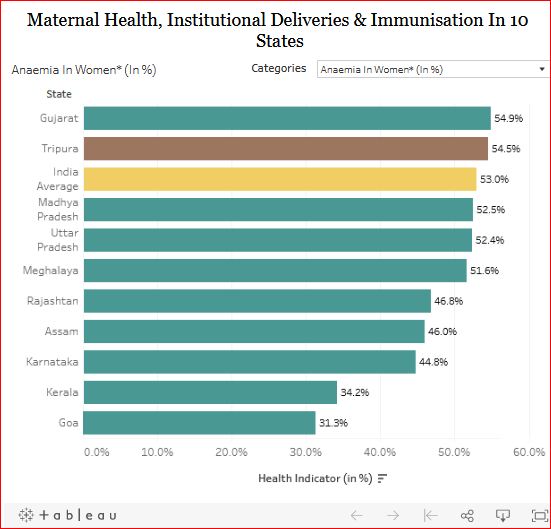
In Tripura, more than half the women of reproductive age, or 54.5%, are anaemic. Despite a 10.6% improvement over 10 years, the prevalence of anaemia is the second highest after Gujarat (54.9%) and higher than the national average (54%).
Early marriage, and lower education could be underlying factors of Tripura’s continuing struggle with anaemia among women of reproductive age. Anaemia during pregnancy increases the chances of foetal deaths, abnormalities, preterm and underweight babies, and causes a fifth of maternal deaths, IndiaSpend reported in October 2016.
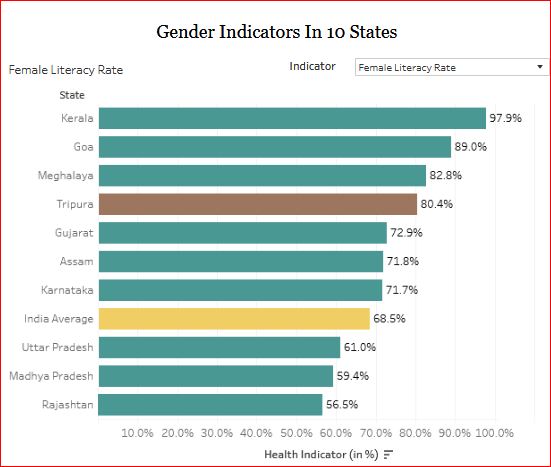
Source: National Family Health Survey 2015-16 data for Kerala, Goa, Meghalaya, Tripura, Gujarat, Assam, Karnataka, India, Uttar Pradesh, Madhya Pradesh, Rajasthan
Good access to drinking water, power but sanitation is a concern
At 92.7%, access to electricity for households in Tripura is better than the national average (88.2%) and comparable to wealthier states of Kerala, Goa, Gujarat and Karnataka.
Over 87% of households in Tripura have an “improved source for drinking water”–the officialese for piped or protected source of water–below the national average of 89.8% households. Still, the state fares better than nearby Meghalaya (67.9%) and Assam (83.8%).
While Tripura’s open defecation rate is 3.5%–among the lowest in the country, nearly 40% of its population still does not have access to “improved sanitation”, toilets where waste is disposed without human contact. Still, as the chart below shows, this is better than most states and much better than wealthy Karnataka.
Lack of access to improved sanitation facilities could impede progress on curbing stunting in children, and anaemia, according to these reports from IndiaSpend, published in April 2017 and September 2016.
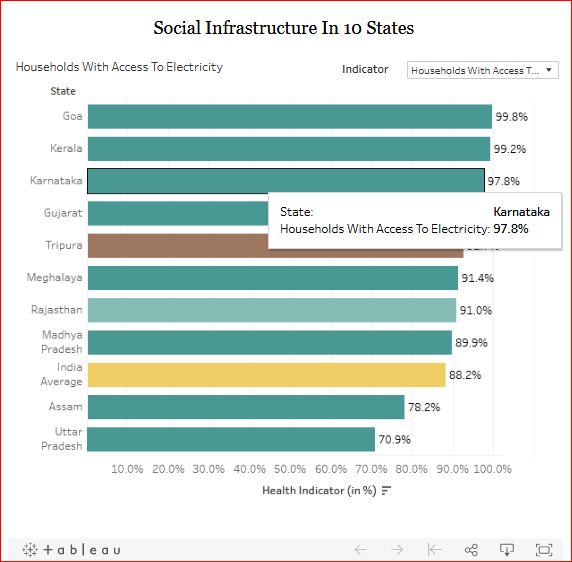
Source: National Family Health Survey 2015-16 data for Kerala, Goa, Meghalaya, Tripura, Gujarat, Assam, Karnataka, India, Uttar Pradesh, Madhya Pradesh, Rajasthan
(Saldanha is an assistant editor and Yadavar is a principal correspondent with IndiaSpend.)
SC Cancels Bail of Accused in Mohsin Shaikh Lynching Case
The Supreme Court has chastised the Bombay high court for its observations in the June 2014 murder case of Pune techie Mohsin Shaikh. This was the first case of public killing after the Modi government was sworn in. The court’s observations indicated that the three accused had been provoked to commit the act of violence “in the name of religion”. It was the high court’s remark in the order that “the fault of the deceased was only that he belonged to another religion” was made while granting bail to the accused. Last week, Thursday, February 8, the apex court quashed the Bombay high court’s order pertaining to the three accused in the case – Vijay Gambhire, Ganesh Yadav and Ajay Lalge – who, according to a Hindustan Times report, are part of the right-wing group Hindu Rashtra Sena.
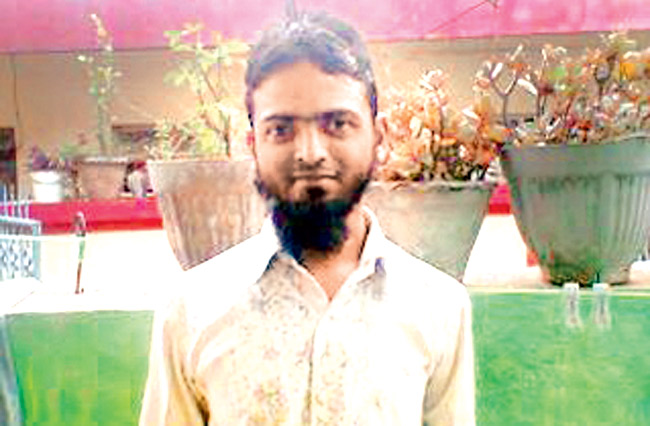
In June 2017, three years after the killing, and in a blow to an already faltering investigation special public prosecutor and advocate Ujjwal Nikam withdrew his position as public prosecutor in the murder case of Mohsin Sadiq Shaikh, a Pune-based techie who was killed in 2014 by members of radical outfit Hindu Rashtra Sena (HRS). Mohsin was attacked and killed while he was returning to his home after prayers on June 2, 2014.
The three – among 21 from the Hindu Rashtra Sena who were booked in connection with the murder – reportedly attended an “inflammatory” meeting just before they accosted and killed Shaikh. The meeting was held in the background of communal clashes in Pune. The group’s leader Dhananjay Jayram Desai was allegedly addressing the meeting that instigated the audience to violence.Hearing an appeal by the deceased’s brother against the grant of bail, the apex court directed that the three to be taken into custody, and the Bombay high court to give fresh consideration to the bail plea and to take a decision within six weeks.
The apex court stated while arriving at its decision that the religious identity cannot be an excuse to assault or murder anyone. A bench of Justices S.A. Bobde and L. Nageswara Rao further cautioned courts against passing observations “which may appear to be coloured with a bias for or against a community”.The top court maintained that courts must be “fully conscious of the plural composition of the country” and hence abide by their duty to objectively decide rights of different groups, News18 reported.
The apex court stated: “While it may be possible to understand a reference to the community of the parties involved in an assault, it is difficult to understand why it was said that ‘the fault of the deceased was only that he belonged to another religion’…”
The Supreme Court observed that while the Bombay high court’s order may have intended to simply lay emphasis on the fact that communal hatred and not personal bias was behind the attack and may not have intended to hurt the feelings of any particular community or support the feelings of another community, “the words are clearly vulnerable to such criticism” and that “the direction cannot be sustained”.
Mohsin Shaikh was on his way to meet a friend when he was attacked by a mob of 23 on June 2, 2014, in Pune’s Hadapsar. The prosecution reasoned that the accused “targeted them because they belonged to a certain community”, and claimed that “the accused were said to have been highly motivated to do the act because they had attended a meeting of a body called Hindu Rashtra Sena about half an hour before the incident”.A fresh bail hearing in the Bombay high court is scheduled for today, February 16.
A report in Indian Express said that Justice Bhatkar on January 12, while granting bail to Vijay Rajendra Gambhire, Ganesh alias Ranjeet Shankar Yadav and Ajay Dilip Lalge, noted that the accused had attended a meeting “prior to the incident of assault. The applicants/accused otherwise had no other motive such as any personal enmity against the innocent deceased Mohsin.”
The bail order stated, “…Dhananjay Desai was the one who was the speaker in the meeting and he instigated the audience… the transcript of the speech given by Dhananjay Desai was sufficient to show that he had incited feelings of religious discrimination. The meet was held… prior to the incident of assault.”
In its chargesheet, however, the cops quoted at least two witnesses, who heard HRS members plan the attack.
The chargesheet said, “The activists were carrying hockey sticks, wooden batons etc. During the meeting, they started discussing that HRS president Dhananjay Bhai has said that Muslims should be thrashed for posting derogatory pictures of Shivaji Maharaj on Facebook. Their vehicles, shops should be damaged. They should not be allowed to do any business in the area. There should be terror of HRS in Hadapsar.”
Again, Seven Sanitation Workers Die of Asphyxiation: AP
Continuing to take lives, this brutal and illegal job of manual scavenging cost more. At least seven workers of a private hatchery died of asphyxiation inside a drain in Chittoor district of Andhra Pradesh on Friday morning
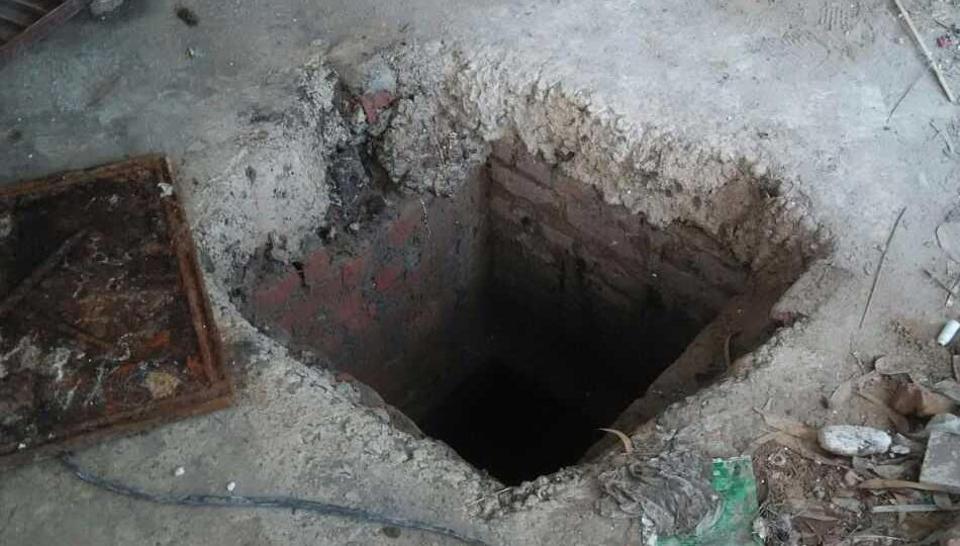
Representation Image
PTI reports that at least seven workers of a private hatchery died of asphyxiation inside a drain in Chittoor district of Andhra Pradesh on Friday morning. An investigation into the incident is under way, the police said, adding, according to their initial assessment, there was “serious negligence” on part of the hatchery management in ensuring adequate safety measures at the site.
Chittoor superintendent of police (SP) G Srinivas said the incident took place in Venkateshwara Hatchery in Moram village. Four workers fell unconscious after they entered the drain in Palamaneru for cleaning purpose. Three others, who entered the drain to rescue the four workers, also fell unconscious.
Residents rushed to the spot to rescue the workers, however, all of them had died by the time their bodies were pulled out. The two workers, who raised the alarm, entered the drain for rescue work and fell unconscious. The duo are currently undergoing treatment in a hospital.
Following the incident, police said, the manager and the administration at the hatchery fled their offices. A manhaunt is on to nab the officials. Police said an investigation into the incident is underway and added that according to their initial assessment, there was “serious negligence” on part of the hatchery management in ensuring adequate safety measures at the site.
RSS Appropriation of the Indian Freedom Struggle is Baseless
An ‘army’ that never fought for Independence is busy, come May 2014, trying to re-construct its role. This is belied by documentation
[This article is in response to the essay, ‘Don’t Foist Fear Onto Nationalism’, by C.K Saji Narayan published in Outlook’s Republic Day special issue.]
Ideologues of the RSS clan are working overtime to create a narrative of latter’s participation in India’s anti-colonial, freedom struggle. This project has received an impetus after the electoral victory in 2014 of RSS/BJP which was celebrated as the return of ‘Hindu rule’ after 1000 years. While attempting this, there is little concern neither about documented contemporary history nor for the RSS’ own archival materials. The latest in this attempt is C. K. Saji Narayanan in Outlook (‘Don’t Foist Fear Onto Nationalism’ in Outlook, February 5, 2018). Narayanan has gone out on a limb, even resorted to factual manipulations, just ‘to prove’ that the RSS was in the thick of the freedom struggle.
Saji claims that founder of RSS, KB Hedgewar was a staunch nationalist, suffered imprisonment during the British rule and “directed all RSS shakhas to celebrate the Congress’s 1929 resolution on ‘total independence’ by hoisting the national flag on January 26, 1930, and spreading the message of freedom”. He also tells us that “during Quit India, RSS volunteers also gave their lives in the Chimur agitation in Vidarbha—while unfurling the freedom flag, and that an RSS volunteer was shot dead by the police…The fourth sarsanghchalak, Prof Rajendra Singh, too is known for having taken part in Quit India. Until independence, every swayamsevak had to take a pledge with the words “Desh ko swatantra kar” (free the country)”. According to Saji many of the socialist and Congress underground leaders took refuge in the homes of RSS leaders, “Aruna Asaf Ali and Jayaprakash Narayan were housed in Delhi sanghchalak Lala Hansraj Gupta’s residence; Achyut Patwardhan and Sane Guruji were sheltered at the residence of Pune sanghchalak Bhausaheb Deshmukh; and Krantiveer Nana Patil at Aundh sanghchalak Pt S.D. Satwalekar’s house”.
Before scrutinising RSS claims regarding the freedom struggle in the light of pre-Independence RSS documents, one may ask Saji how it was possible that RSS leaders like Hansraj Gupta, Bhausaheb Deshmukh and Satwalekar who offered their residences as ‘safe haven’ to the freedom fighters if these very RSS leaders (by their own claims) were ‘participating’ in the freedom struggle. Should they then also have been underground with their houses under close watch of the British police? Commonsensically, it would have been suicidal for leaders to take shelter there. This could have happened only if and when RSS leaders themselves were not participating in the struggle and their house were not under watch.
Hedgewar and Freedom Struggle: Twisting Truths
We are told that Hedgewar joined the call of the 1929 Lahore Congress which enjoined every Indian, on every January 26, to unfurl the National Flag; the Tricolour, publicly. The fact is that the RSS, under the command of Hedgewar, refused to follow this resolution of the 1929 Lahore Congress. Instead, he ordered all RSS shakhas, on January 21, 1930, to worship the “rashtriye dhwaj arthat bhagwa dhwaj (national flag i. e. saffron flag)”. This order is available in a collection of Hedgewar’s letters published by the RSS itself, titled Dr. Hedgewar: Patrroop Veyaktidarshan, published in 1981. In fact, the RSS’ hatred for the Tricolour (Tiranga), a symbol of the united freedom struggle of the Indian people is and was unambiguous. Just on the eve of Independence when the newly born, Indian nation was getting ready to watch its first prime minister, Jawaharlal Nehru, to unfurl the flag on the ramparts of Red Fort, for the first time in history, here is what the RSS had to say. The RSS organ Organizer, published in English, in its issue of August 14, 1947, actually denigrated the National Flag and wrote that it would “never be respected and owned by Hindus. The word three is in itself an evil, and a flag having three colours will certainly produce a very bad psychological effect and is injurious to a country.” So much for the RSS’ claims to Indian nationalism.
Hedgewar Jailed ?
We are now being told that Hedgewar as a leader of the RSS, went to jail in 1921 and 1931 during Khilafat Movement and Salt Satyagrah launched by Gandhi. The fact is that both times he went to jail as a Congressman, something the RSS documents in the archives, have itself recorded.
According to the biography of Hedgewar penned by HV Seshadri, published by RSS in English (1981) he was jailed for delivering an inflammatory speech in favour of the Khilafat Movement. He was subsequently sentenced to one year’s rigorous imprisonment. There were two significant incidents regarding this jail term.
First, Hedgewar touted as strict disciplinarian hired a costly lawyer to defend him, thus openly violating the directive of Gandhi and the Congress that all those arrested would not offer any defence and would serve their jail term as both protest and sacrifice.
Secondly, despite being sentenced one year’s imprisonment with hard labour in the Ajani Jail, on the day of his release on July 12, 1922, the same biography tells us “when he removed the prison uniform and tried to wear his old cloths, his old shirt and coat felt too tight! He had gained 25 pounds (11+ kilograms) in weight, in spite of the rigours of the prison life”. It was the first and last time in the history of the jailed freedom fighters that a political prisoner gained weight of more than 11 kilograms while serving in a British jail.
How did this happen? A clue is provided in this biography itself. He was on friendly terms with the ferocious British jailor, Sir Jathar.
The second jail term was the outcome of a plot. The Hindi biography of Hegdewar, authored by C. P. Bhishikar and published by the RSS discloses that Hedgewar ordered that “Sangh will not participate in the [Salt] Satyagrah”. However, he joined the Satyagrah with an ulterior motive which was “that with a freedom loving, self-sacrificing and reputed group of people [of the Congress] inside with him there, he would discuss the Sangh with them and win them over for its work.” It is clear that Hedgewar chose to go to jail this time not because he had faith in the cause but in order to break the ranks of the Congress cadres!
Bhishikar admitted that after establishing RSS in 1925 Hedgewar “in his speeches. used to talk only of Hindu organisation. (any) Direct comment on the government used to be almost nil”.
RSS Confesses to Keeping Aloof from the Freedom Struggle
The Non-cooperation and Quit India Movements (QIM) were two great milestones in the history of the Indian freedom movement. How ‘nationalist’ Golwalkar hated these can be known by the following comments of his which are being reproduced from the collection of Golwalkar’s writings (Shri Guruji Samagr Darshan, vol. 4 published by RSS): “Definitely there are bound to be bad results of struggle. The boys became unruly after the 1920-21 movement…But these are inevitable products after the struggle…After 1942, people often started thinking that there was no need to think of the law.”
Admitting that the RSS did not participate in the QIM he said: “At that time, too, the routine work of Sangh continued. Sangh vowed not to do anything directly. However, upheaval (uthal-puthal) in the minds of Sangh volunteers continued. Sangh is an organisation of inactive persons, their talks are useless, not only outsiders but also many of our volunteers did talk like this. They were greatly disgusted too.” However, there is not a single publication or document of the Sangh which could throw some light on the great work the RSS did indirectly for the Quit India movement.
According to Savarkar’s collected works in Hindi (Samagr Savarkar Wangmaya published by Hindu Mahasabha in 1963) the fraternal organization of RSS, Hindu Mahasabha [HMS] led by the Hindutva icon, VD Savarkar went to the extent of running coalition governments with the Muslim League in Bengal, Sind and NWFP in 1942 when Congress was under ban and patriotic Indians were being shot dead for daring to carry the Tricolour. In Bengal Syama Prasad Mookerjee was deputy CM in the Muslim League ministry. Hindu Mahasabha also organized recruitment camps for the British army in India when Subhash Chander Bose was trying to liberate India militarily. RSS never expressed opposition to these anti-national activities of HMS.
Those Hindutva intellectuals who are busy re-constructing RSS role in the freedom struggle need to be honest to pre-Independence RSS documents and archives. Both Hedgewar (RSS chief 1925-40) and Golwalkar (1940-73), were opposed to the united freedom movement as its goal was an all-inclusive India. Golwalkar denounced the freedom struggle (Bunch of Thoughts, 1966, RSS publication) as “territorial nationalism” which “had deprived us of the positive and inspiring content of our real Hindu Nationhood and made many of the ‘freedom movements’virtually anti-British movements”. It was this ideological commitment to building Hindu rashtr in India that apart from Hedgewar, Golwalkar, Deendayal Upadhyaya (prominent RSS cadre since 1937) and LK Advani (RSS activist since 1942) never participated in the freedom struggle.
Related Articles:
1. Teesta Talks: The RSS Doublespeak, Bhagwa for Itself and Tiranga for Others
2. Dr Syama Prasad Mookerjee the Hindutva Icon was a Collaborator, with the Muslim League as much as the British
Bihar: Nobody From State or Centre Attended Last Rites of CRPF Jawan Killed Fighting Terrorists in J&K
State Cabinet Minister Maheshwar Hazari instead said he does not know anyone from the state dying in J&K.
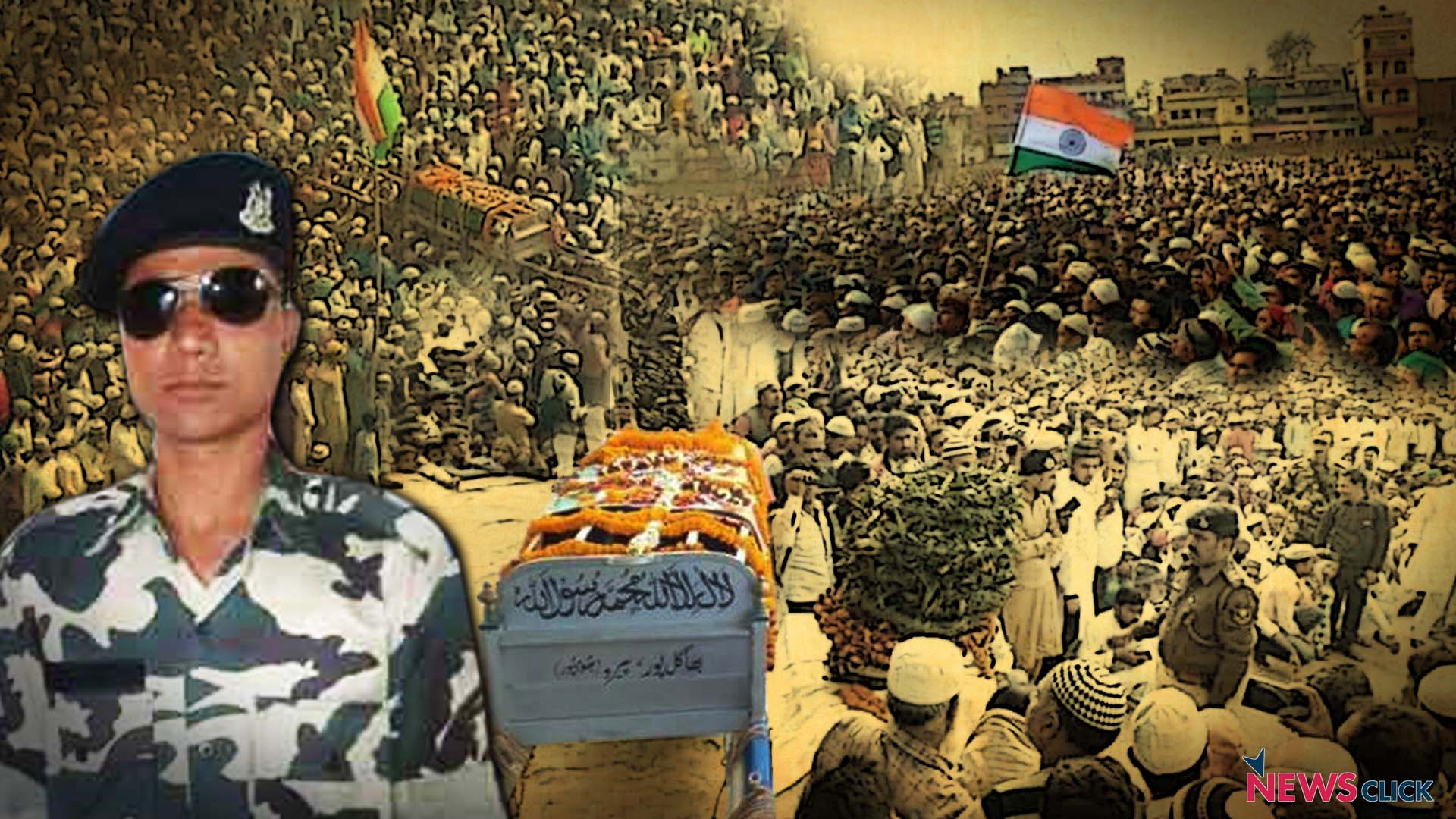
Newsclick Image by Sumit Kumar
At a time when the entire political discourse revolves around soldiers laying down their lives for the country, no Central or state minister was present when Bihar’s Arrah district resident Mujahid Khan, a CRPF jawan who was killed during a gun battle with militants in Karan Nagar area of Srinagar on February 12, was being laid to rest at Peero village on February 14.
Forget about the state honour during his last rites and absence of political leaders – including Chief Minister Nitish Kumar, even officials of the state government were not present at the ceremony.
Putting salt on the wound of the grieving family, the sub-divisional officer offered a cheque of Rs 5 lakh – which was turned down by Khan’s father, adding that “it’s an insult to the martyrdom” of his son.
Khan succumbed to injuries at a Srinagar hospital on February 12. The terror attack took place in the wee hours of that day and was thwarted by guards at the Karan Nagar CRPF camp but the militants managed to escape and holed up at a nearby building. Khan received bullet injuries in the ensuing gun battle that continued for more than 20 hours. Two militants allegedly associated with Lashkar-e-Taiba were killed.
When Khan’s body reached his village on February 14, a large crowd gathered there to have a last glimpse of the jawan who sacrificed his life for the nation. Their anger was palpable over the absence of the Central and state leaderships and state officials.
“My brother sacrificed his life for the country and see how he is being treated. No representative of the State or the Centre bothered to attend the funeral. This is how we treat our martyrs,” Khan’s brother Imtiaz told Newsclick.
Asked why they turned down the offer of Rs 5 lakh by the state government, he said, “Has he died consuming liquor? What will we do with this money?”
Khan’s father had last seen his son in November 2017 and had told him about marriage proposals which Khan turned down adding he wants to serve the country first.
“When he (Khan) was at home in November last year, I asked him to get married but he refused saying that he first wants to do something for the country,” said the wailing father.
Asked how they came to know about the operation being carried out, the bereaved said while struggling to speak, “He had sent a video of him fighting with the militants to one of his friends. I was praying for the successful operation and safety of all those who were involved in the gun battle. Few hours later, we got the news of his demise.”
Meanwhile, state Cabinet Minister of Building Construction Department (PWD) Maheshwar Hazari stirred controversy, adding that he does not know anyone from the state dying in Jammu and Kashmir.
Courtesy: Newsclick.in
Women Journalists give befitting Reply to NIA
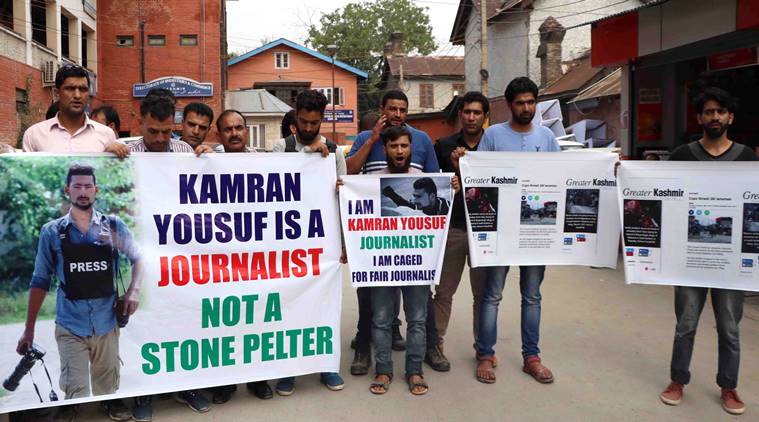
The NWMI is shocked to read that the NIA has laid down what it considers to be the “moral duty of a journalist”, in its charge sheet against Kashmiri journalist Yusuf Kamran. The charge sheet says:
“Had he been a real journalist/stringer by profession, he may have performed one of the moral duty of a journalist (sic) which is to cover the activities and happening (good or bad) in his jurisdiction. He had never covered any developmental activity of any Government Department/Agency, any inauguration of Hospital, School Building, Road, Bridge, statement of political party in power or any other social/developmental activity by state government or Govt of India..”
Being an investigative agency, the NIA is obviously not aware of the duties of journalists, moral or otherwise. We would like to inform the NIA that the basis of journalism is to ask questions about happenings in society and relay verified information to the public, without fear or favour. Reporting inaugurations of public works by the government or army is the job of government/army PROs. Surely the prestigious NIA knows the difference between a journalist and a PRO?
Before telling journalists what their duty is, maybe the NIA should turn the spotlight on itself.
In September 2017, Kamran Yusuf, a freelance photojournalist, was summoned by the local police, after which the NIA took him to Delhi, without so much as informing his family. Is that lawful conduct?
The local police at that time told the press that there was no FIR against Kamran. For a long time, the NIA did not disclose the charges against Kamran. Is it empowered to arrest journalists, or indeed, any citizen, without charge?
There is enough documentary proof available to establish that Kamran was working as a photojournalist. The NIA might be delighted to know that one of his photographs shows the state police chief at a wreath-laying ceremony. He was indeed, fulfilling his “moral duty’ as per the NIA. Has the NIA fulfilled its moral and legal duty in the way it has handled Kamran’s arrest?
Image Courtesy: Indian Express
When a Kerala Temple was in Need, Nambiarthodi Ali, a Muslim Gifted It a Pond
Nambiarthodi Ali was approached by the temple committee of the Kundada Shiva temple in Chathangottupuram with a special request Nambiarthodi Ali donates pond and land near temple premises.

The Kundada Shiva temple in Chathangottupuram. Credits: Sanu Velayudan.
A Muslim at Kalikavu in the district has done his bit to promote communal harmony in the area. Nambiarthodi Ali, 45, has donated a pond situated in his land to a centuries-old temple. The committee of Kundada Shiva temple of Poroor panchayat near Wandoor had initially approached him to buy the pond and the bordering land area at market value. Instead, Ali, in the true spirit of communal harmony and co-existence, gifted the pond and land to the Hindu brethren, reports Deccan Chronicle.
“The pond is a must for the temple as per their custom. There is no pond in the temple land. Though they offered me a price, I decided to donate the pond which is meant for public use. There is nothing big in it,” says Ali. The temple committee felicitated Ali at a cultural event organised as part of Sivarathri celebrations at the temple on Tuesday. “The temple was in dire need of a pond to keep up the religious traditions. We are happy that besides giving a pond, a strong message has also been conveyed to society through Ali’s gesture,” V. Shiva Shankaran, a committee member, told DC.
“The land area of 4.7 cent was not decided by me. It was the temple authorities who surveyed the pond and adjoining land area as per my request and I told them to take what they wanted for the purpose of the pond,” Ali said. He has also given the temple authorities the right to use a pathway leading to the pond. The registration of the land will be done in the coming weeks, the temple authorities said.