Video Courtesy: Breaking News Express
Email: sabrangind@gmail.com
Video Courtesy: Breaking News Express

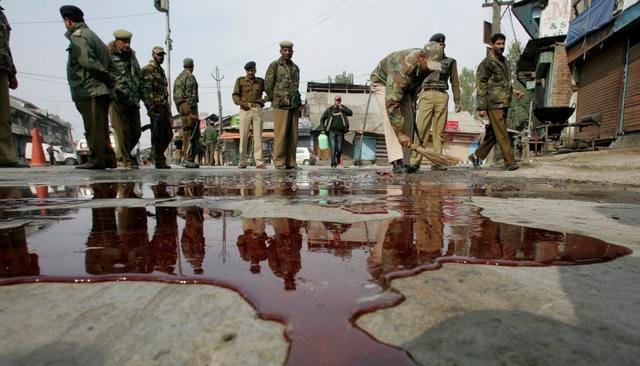
KASHMIR valley continues to be on boil and the volatile situation is yet another grim reminder of the failure of Narendra Modi led BJP government at the centre to address genuine political aspirations of the people. While in the last three-years, Modi has failed on all accounts on his promises made to the voters in 2014 elections, the policies of RSS and its prodigy BJP on Kashmir have been focused to muzzle the voices of dissent with brute force. This has further deepened alienation of Kashmiris and especially youth, who are at the forefront of uprising in Kashmir. As the anger, alienation and protests have swelled, so has the disproportionate force of the State.
Youth at the forefront of the prolonged unrest, which has consumed more than hundred civilian lives since last July, is a worrisome situation for all, sans New Delhi. The new generation of youth, being now in the forefront of the unrest is a new dynamic in the present turmoil in Kashmir. It is a new addition to the decades old movements of defiance. This is the result of deep alienation caused by long history of broken commitments, repression, socio-economic woes and denial of justice to the people.
It could be easily said that reluctance of the oblivious government to respond to the emerging political situation and inept handling by the centre has worsened the political and security scenario of the Valley to an extent where even holding a by-poll has become a Herculean task.
In the aftermath of Burhan Wani’s killing by the security forces, the wide spread protests by the youth in Kashmir Valley were in fact an expression of the latent anger and deep resentment against the total neglect of the Kashmir issue by the Modi government. Burhan Wani’s killing was just a trigger: it simply ignited the fuel of suppressed sentiments and the “illegitimate” alliance between PDP and the BJP.
It is noteworthy that while the PDP had sought votes on the restoration of state’s autonomy and resolution of Kashmir issue by initiating a dialogue with the separatists and Pakistan, the BJP had promised its Jammu constituency that it will ensure the effacing of what remains of autonomy and abrogation of Article 370. The people in Kashmir, who had voted for PDP felt betrayed and found an opportunity of giving vent to their anger. The PDP-BJP coalition’s “Agenda of Alliance” became, especially in its promised political contents, first a farcical and now a tragic dead letter.
Instead of realising the blunders and trying to reach the people, the regime used unbridled force and resorted to indiscriminate pellet firing, tear gas shelling, lathi charges and even direct target firing. The government is seen commending its forces for using excessive force against the protesters.
And when situation was relatively calm this year after turbulent latter half of 2016, Farooq Ahmad Dar of Chillbras Budgam, who had dared to trust in democracy on April 9 during by-poll to Srinagar Lok Sabha seat, was betrayed with oppression. An army major tied him to a jeep and paraded him in 17 villages as a human shield. And this act of absolute oppression was condoned by the defence minister Arun Jaitley and the army chief. The subsequent statements of Jaitley that “Army officers are free to take decisions in a war-like zone” and Army Chief General Bipin Rawat’s “dirty war in Jammu and Kashmir has to be fought through innovative ways” is a symbolic illustration of how the BJP government is wantonly violating the fundamental and constitutional rights of Kashmiris.
There has also been an aggressive invasion of Sangh Parivar’s violent discourse on Kashmir with Modi alternating between platitudes like “Terrorism or tourism”, “Laptops instead of stones”, “Vikas aur Vishwas.” However, in reality Modi’s approach towards political problem of Kashmir and pain of its people is one of total apathy and indifference. The aggressive posturing of RSS and BJP on Kashmir is exacerbating the already prevalent anger and alienation in the Valley which could have disastrous implications in future. BJP MP Subramanian Swamy’s suggestions that the Valley should be de-populated and Kashmiris sent to refugee camps in Tamil Nadu to curb protests in the state and Vishwa Hindu Parishad leader Pravin Togadia’s demand that the government carry out “carpet bombing” in Kashmir Valley to stop the attacks on security forces by militants, are a precursor of what Sangh Parivar’s intentions are.
BJP president Amit Shah’s claim that Kashmir is a problem of “three and a half districts”, and the central government was formulating a “course of action” to resolve the situation is highly provocative. Union home minister Rajnath Singh’s assertions that they have found a “permanent solution” to the vexed Kashmir issue, one fails to understand when the government seems to be reluctant in holding dialogue with voice of dissent and banning use of deadly pellet guns, what kind of solution it can offer to resolve this complex issue. Is this on the same lines as envisioned by the RSS in its June 30, 2002 resolution in its national executive meeting held in Kurukshetra, where it demanded that Jammu and Kashmir should be divided into three parts – Jammu, Kashmir and Ladakh. Bifurcation or trifurcation of the state on communal lines is fraught with disastrous consequences not for the state but for the entire region. It will cement permanent walls of hatred among different communities.
To muzzle the voices of dissent, the BJP government’s response has been repression and jingoistic nationalism. This jingoistic-nationalist agenda of BJP on Kashmir and Praja Parishad’s provocative agitation and raising divisive slogan of “Ek vidhan, ek nishan aur ek samvidhan” (one country, one emblem and one constitution) continues to form the Saffron party’s political approach on Kashmir.
Treating the present unrest and turmoil in Kashmir, as the offshoot of “Pakistan aided terrorism” and dealing with it by muscle power alone, has proved counterproductive. It has resulted in hopelessness, despondency and total loss of confidence in the political establishment. Due to hyper-nationalist approach of the Modi government, the pro-Pakistan narrative which was noticeably weak has also become apparently strong in the recent times in Kashmir. The muscular policy of New Delhi is encouraging extremism. It won’t be out of context to mention here that due to muscular policy, India is perceived to be losing Kashmir psychologically and emotionally.
The recent Srinagar by-poll which saw a mere 7 per cent voter turnout should have served as an eye opener for New Delhi, keeping in view the heavy turnout in 2014. The lowest ever voter turn-out in recent by-polls to Srinagar parliament seat and cancelling the by-poll to Anantnag seat is a signal for New Delhi for serious introspection.
It seems that Narendra Modi and his associates in RSS and BJP have an eye on 2019 Lok Sabha elections and want to use Kashmir crisis for polarising affect to gain electorally. Since Modi and his associates have been successful in UP by polarising and communalising the situation and have given great hype to the “surgical strikes” across the Pakistan border, they feel that the audacious display of curbing protests in Kashmir, refusing to talk to separatists and avoiding dialogue with Pakistan will surely pay them. They also think that it will be seen as a victory for ultra Hindu nationalism. Needless to say that the Hinduisation of politics on national level by RSS-BJP combine and the formation of cow protection vigilante groups and the persecution of Muslim minority on the pretext of cow protection has added fuel to the fire in J&K which happens to be the only Muslim majority state in India.
It is high time that the prime minister, who is stubbornly mum over Kashmir situation, initiates some confidence building measures which can be a prelude to dialogue in order to douse the flames. The starting point should be for New Delhi to recognise and concede publicly that the struggle in Kashmir needs to be dealt with through negotiations and not through repression.
It is a reality that at various times, promises were made by governments in New Delhi with Kashmir, but not much progress was made towards a political settlement. Narasimha Rao, the Congress prime minister in the early 90’s, had promised that the “sky is the limit” as far as autonomy is concerned. He could settle for anything less than independence. Deve Gowda, another prime minister proclaiming to be progressive, had also promised ‘maximum autonomy’ during the United Front government. Atal Behari Vajpayee, the BJP’s first prime minister, had promised talks with all within the ambit of “Insaniyat,” but nothing came out of it either. The problem, which needs an amicable settlement, has definitely no readymade solution within the confines of the present socio-economic and political system. During the Vajpayee government, the Indo-Pakistan dialogue began. Under the UPA government the composite dialogue proceeded. During these years several rounds of dialogue were held with the separatist leaders but no progress could be made, as the government of India had no political way-out to offer. The last effort was the round-table talks by the UPA government that did not see the participation of the separatists. Moreover the recommendations made by the working groups formed by the then UPA government also did not see the light of the day. The result is the hike in mistrust and doubts upon the sincerity of the Indian establishment towards Kashmir.
The tried and tested approaches of dealing with the Kashmir administratively has further exacerbated the situation and created an unprecedented sense of dis-entrenchment especially among the youth.
The democratic forces of the country should raise their voices to force the BJP government to acknowledge the ground realities in Kashmir and take bold initiatives to address the long pending legitimate rights of the people. Kashmiris have to be won over and for that to happen, there has to be an an unconditional offer to undo the historical wrongs and initiate a meaningful process of all stakeholders, including the voices of dissent and Pakistan. History is witness that there is no other way than to explore ways to resume the dialogue with Pakistan. Whatever the circumstances, war is no solution. Voices demanding settling accounts with Pakistan through military means should be rejected. India and Pakistan have a shared past and both the countries must realise they have to move together for a better and peaceful future. For a meaningful breakthrough in their relations, political will is needed, which, unfortunately is missing at the moment.
Kashmiris don’t want to repeat tragedies. They want a better future for their children. They want peace and development. But of course not at the cost of their dignity.
Courtesy: Newsclick

General Election 2017. Danny Lawson/PA Images. All rights reserved.
The previous two columns in this series have explored the idea that a Conservative Party landslide, with at least a 150-seat majority, might not after all be the outcome of the United Kingdom's general election on 8 June. The earlier one expressed "a niggling sense that something may be developing below the surface that could break through even in the short time left” (see "The Corbyn crowd, and its message", 18 May 2017).
That notion was based partly on the way in which Labour leader Jeremy Corbyn was repeatedly attracting large and enthusiastic crowds at open-air events arranged at short notice, apparently responding to a felt need for a less regimented and more engaged kind of politics. Within a week, this sense of a trend had begun to evolve into something rather more definite, and Labour activists were beginning to think the Conservatives might be denied an overall majority (see "Corbyn, and an election surprise", 26 May 2017).
This latter column indicated a possibility of wishful thinking, but the trend of the last few days suggests that it is now distinctly possible. Part of this sudden and unprecedented shift reflects the Conservatives' campaign errors, especially over confusion on its policy over social care. But it is also clear that Labour under Jeremy Corbyn is connecting with people in a remarkable way – his popularity is growing day by day and, far from being an obstacle to Labour’s electoral ambitions, he is becoming their star player.
Labour under Jeremy Corbyn is connecting with people in a remarkable way – his popularity is growing day by day and he is becoming their star player.
In light of these two columns, Oxford Research Group has just published a briefing that extends the discussion to look specifically at Jeremy Corbyn’s views on international security. These views were expressed in his Chatham House speech on 12 May and further developed in a thoughtful response to the devastating Manchester Arena attack late on 22 May.
In terms of conventional electioneering wisdom, defence and security are assumed to be Labour’s weakest policies, certain to be bitterly criticised as unpatriotic by the great majority of the national print media. Such criticism certainly followed the Chatham House speech and the subsequent Manchester intervention, but they had much less effect than intended. Indeed Corbyn’s view that the war on terror was failing and that there must be a fundamentally new approach to international security got much more support than expected, and certainly did nothing to dent the growing popularity of the party.
Jeremy Corbyn addressing crowds in 2003 against going to war in Iraq.
The ORG report concluded:
“[After] more than fifteen years of the war on terror, failed or failing states in Iraq, Afghanistan, Syria, Libya, Yemen and Somalia, close to a million people killed and over eight million people displaced, the argument for some serious rethinking on Western approaches to security is hardly difficult to make.
This is where Jeremy Corbyn’s Chatham House speech is so significant since it breaks away from a near-universal Western state consensus and may be much more in tune with what many millions of people may be thinking. Whatever the outcome of the general election next week, space has been opened up for much wider debate. Independent organisations such as Oxford Research Group that take a critical but constructive approach to security will have a particular responsibility to aid the quality of that debate.”
The ORG report does, though, include one serious caveat. If in the coming weeks, ISIS loses both Raqqa and Mosul and then collapses, making it look like the war on terror is at last something of a success, then any chance of rethinking security, whichever party is in power, will be much diminished. At the time of writing the ORG report, such a collapse did not look too likely but what is relevant here is that further, wide-ranging evidence from just the last few days strongly confirms that view.
That evidence comes from Iraq, Afghanistan, Egypt and the Philippines.
In Iraq, the army’s extended operation to retake Mosul was expected to be completed in barely ten weeks, but is now likely to take at least three times that. Der Spiegel reports that during the fighting, ISIS has deployed over 850 truck-bombs hundreds of young men ready to kill themselves. Even now, there are still around 1,200 ISIS paramilitaries defending a small core of the old city and the Iraqi army is only able to deploy a similar number of its elite task-forces one and two of its "golden division" (i.e. special forces).
So many of these troops have been killed or seriously wounded that the division is reported to be greatly depleted, with little capability of providing a professional core to the army when ISIS moves fully over to insurgency mode. Already that insurgency is evolving, the latest grim result being the bombing of a Baghdad ice-cream parlour in a Shi’a district of the city on 30 May, killing thirty-five people and injuring more than a hundred.
In Afghanistan, the Trump administration is overseeing a rapid expansion of its air-war against the Taliban and ISIS offshoots, with 460 weapons released in April 2017 compared with 203 in March, the April total being the highest since the peak of Obama’s “surge” in August 2012. The paramilitary response is wide-ranging, including one of the largest truck-bombs ever detonated, killing over eighty people and injuring more than a hundred, just outside Kabul’s “green zone”.
In Egypt, the recent bombing of Coptic Christian churches was followed by attacks by ISIS gunmen on a small convoy of Copts going on a pilgrimage to a monastery 150 miles south of Cairo. The assault in Minya province killed at least twenty-eight people, the latest in a series that has taken the lives of more than 100 Copts since December.
In the Philippines, the army has been caught out by a sudden surge in paramilitary activity from a group linked to ISIS, in violence made worse by Philippine army casualties caused by “friendly-fire” incidents. The impact, and the sense of a government unable to cope, was enough to persuade President Duterte to cancel a visit to Japan. The continuing insurgency and counter-violence in the southern province of Mindanao, where martial law is now in force, is part of a growing climate of insecurity in which the state plays a major role.
These and many other incidents – including, of course, Manchester – are reminders that ISIS and similar movements are simply not going away, and for Trump to promise more force will be the equivalent of piling yet more combustible material onto the blaze.
ISIS and similar movements are simply not going away.
The implications for Britain are that at some stage there has to be a fundamental rethinking of its defence posture and how it responds to al-Qaida, ISIS and the like. Even if Theresa May’s Conservative Party is re-elected, that process will eventually become impossible to avoid.
But if Jeremy Corbyn’s Labour Party were to achieve the near-impossible and form a minority government in the coming weeks, its chances would be greatly boosted. Just one reason for anticipating a Labour success is that the much needed rethinking might happen sooner rather than later.
Paul Rogers is professor in the department of peace studies at Bradford University, northern England. He is openDemocracy's international security adviser, and has been writing a weekly column on global security since 28 September 2001; he also writes a monthly briefing for the Oxford Research Group. His latest book is Irregular War: ISIS and the New Threat from the Margins (IB Tauris, 2016), which follows Why We’re Losing the War on Terror (Polity, 2007), and Losing Control: Global Security in the 21st Century (Pluto Press, 3rd edition, 2010). He is on Twitter at: @ProfPRogers
Courtesy: Open Democracy
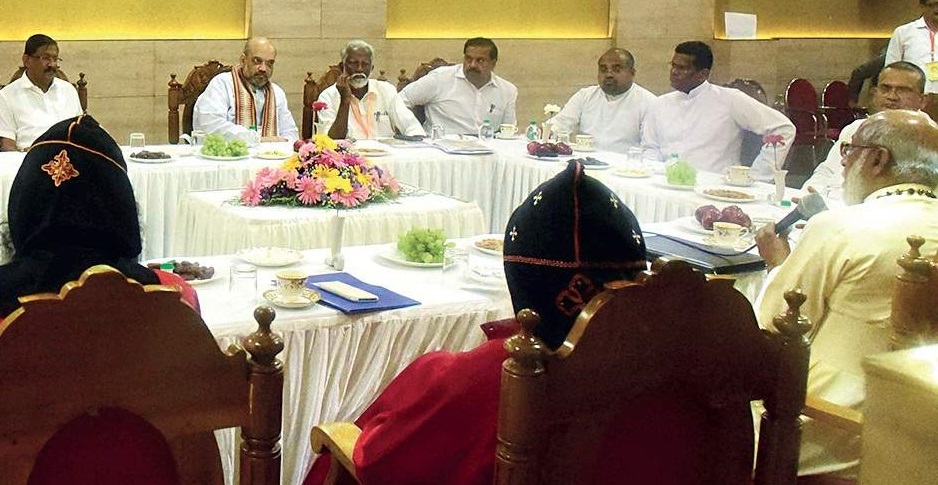
Last week the leadership (lay as well as clergy) of the Kerala Churches, and their political agents across parties, were seen crawling to be in the good books of the government at the Centre during the visit of Amit Shah. According to Church circles they met the National President of the BJP because he had expressed his wish to meet them. After the meeting they said that there was no political agenda to the meeting, and that they did not discuss any political issues.
The shameless overtures of almost all bishops since this government came to power are there for all to see. Except perhaps for the Church of South India and some fledgling churches or evangelical groups most of them would not desist from actively soliciting the Sangh and the BJP leadership. A group of Bishops from Kerala met Narendra Modi after the 2014 elections. It was despicable enough; but he was the PM, so any argument would be met with the common refrains like “He is the PM of the country”, and “He has not been convicted of any offence”.
If one goes by the principles of Christianity the Christians are expected to stand up against all oppression and injustice to humanity. On that count the Bishops should grieve and wail for the blood of those massacred and raped in the attacks, genocides and destruction that our political outfits wreaked, be it 1984, 1992, 2000 (Nellie), 2002, Kandhamal, Kashmir or Muzzaffarnagar; the encounter killings that this diabolic politician called Amit Shah allegedly anchored and got away with after the BJP came to power; the scores of people who were killed and maimed in the name of beef; Dalits who have been humiliated and killed; the list is unending.
The crux of the Sangh-BJP political strategy would be to forge an anti-Muslim alliance between the caste Hindus and Syrian Christians. The potential opposition from Dalits and Adivasis have already been cracked by wooing the elements from these communities which have been sidelined over the years by both the alliances – UDF and LDF. Now it depends on how the LDF plays its cards.
But the Catholic Church Bishops (and also the other Bishops) would do well to listen to the current Pope Francis and many such voices of the oppressed that ring out from various parts of the world. To be a ‘Poor Church’ and ‘Church of the Poor’…. This would definitely bring in a radical transformation within the Churches; it would have played a prophetic role in society. But that is not to be; it is sold out to the powerful and the dominant; it exists to preserve its riches and its institutions…
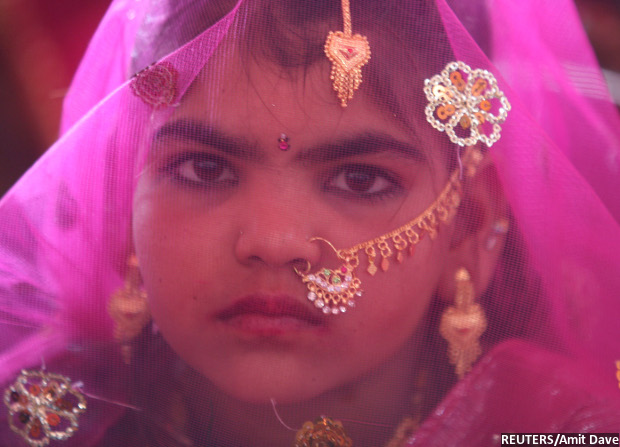
Underage marriages, especially of girls, are rising in urban India and declining in rural India, according to a new analysis of census data, but while the immediate reasons are not clear, patriarcy and the continuing hold of tradition are implicated.

Representational image
In Maharashtra, India’s third-richest state (by per capita income), 16 districts figure in a national ranking of top 20 districts reporting a rise in underage marriages over a decade to 2011, according to the study by the National Commission for Protection of Child Rights (NCPCR), India’s highest child rights body, and Young Lives India, the local chapter of a UK government-funded agency..
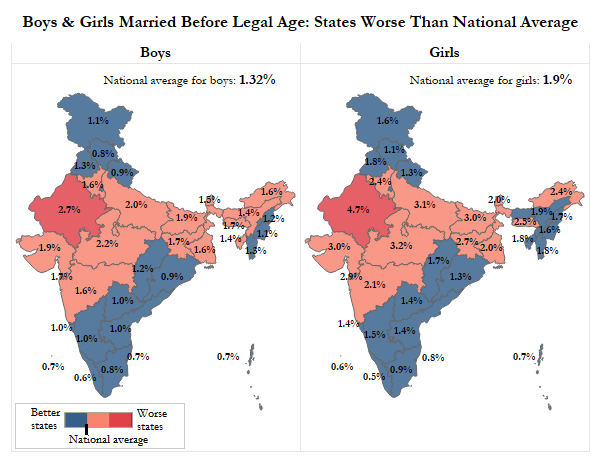
In Rajasthan, India’s ninth-poorest state (by per capita income), more girls aged 10-17 and boys aged 10-20 were married before the legal ages of 18 and 21, respectively, than any other state, but there was a decline in child marriage in all but one of its 13 districts figuring in the ranking, the study said.
The legal age for marriage in India is 18 for women and 21 for men.
“The most concerning news was the rising incidence of marriage before the legal age among girls in urban areas between Census 2001 and 2011,” said Young Lives India director Renu Singh.
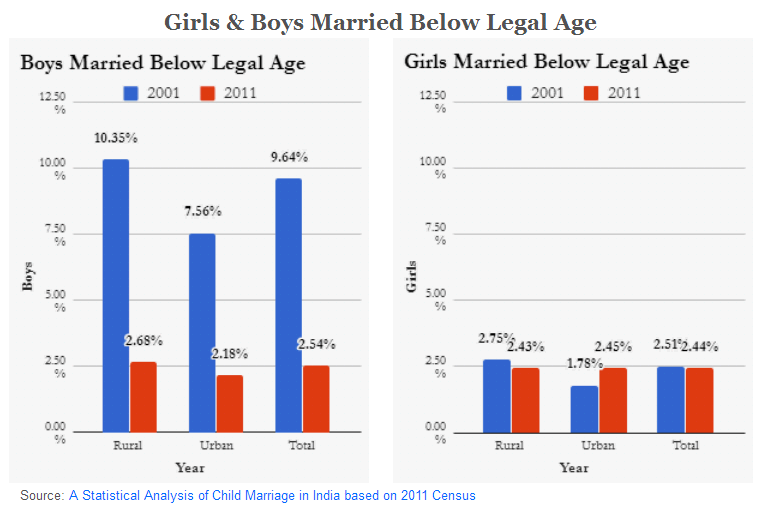
No new marriages below the age of 10 were reported in census 2011. On average, fewer children were married nationally over the decade to 2011, while the proportion of boys married before 21 fell to 2.54% from 9.64%, among girls it it was down marginally to 2.44% from 2.51%, for girls married before 18.
Girls & Boys Married Below Legal Age

Underage marriages among girls increased more than five times in Maharashtra’s northeastern Bhandara district, as did the marriage of underage boys in all 16 districts. In Bhandara, the marriage of underage boys rose 21 times over the decade to 2011.
In Rajasthan, among all Indian states, more girls (8.3% of those aged 10 to 17) and boys (8.6% of those aged 10 to 20) married before legal age.

Source: A Statistical Analysis of Child Marriage in India based on 2011 Census
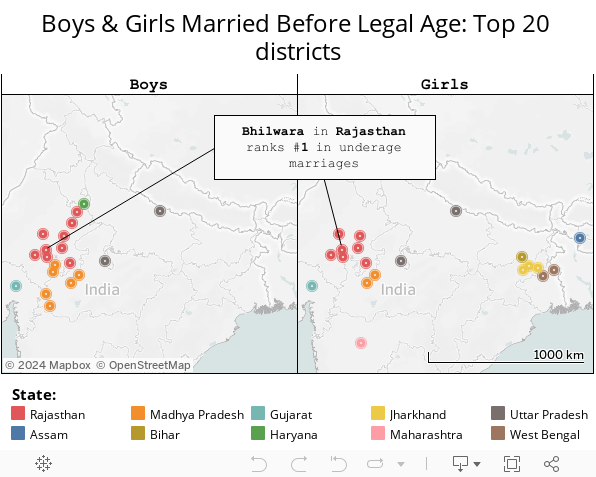
70 districts in 13 states with “high incidence” of underage marriage
India has 70 districts that report a “high incidence” of underage marriages spread across 13 states, which account for 21% of the country’s child marriages, said the study.
While 21.1% of child marriage among girls nationwide could be attributed to these 70 districts, 22.5% of child marriage among boys was reported from these districts in 2011. These districts were spread across Andhra Pradesh, Arunachal Pradesh, Assam, Bengal, Bihar, Gujarat, Haryana, Jharkhand, Karnataka, Madhya Pradesh, Maharashtra, Rajasthan and Uttar Pradesh.
‘Appalling situation’ in Rajasthan: Study
From among seven Rajasthan districts among the top 20 nationally by incidence of girls married between 10 and 17 years in Census 2011, the southern district of Bhilwara tops overall, with 37% of its girls aged 10 to 17 married, as well as among rural districts, with 40% of girls aged 10-17 years married.
Among boys married underage, Rajasthan fared the worst, with nine of its districts among the top 20. Bhilwara again reported the highest incidence of underage marriage among boys aged 10 to 20, with 20.2% married in 2011.
However, over the decade to 2011, the rate of child marriage declined across all but one–the southern district of Banswara–of Rajasthan’s 13 districts figuring in the ranking.
NOTE: Based on proportion of married girls (10-17), Census 2011
Source: A Statistical Analysis of Child Marriage in India based on 2011 Census
Urban districts in top 70 account for a quarter of child marriages, causes unclear
The urban districts included in the top 70 reported 25.8% of child marriages in 2011.
One of every five girls between ages 10 and 17 in urban areas was married in 2011, according to the study.
While Gujarat had the highest number of districts (7) among boys aged 10 to 20 married in the top 20 urban districts, Bengal had the most (6) among girls in 2011.
The study pointed out that there are “immense variations” in trends among girls and boys getting married before their legal ages across the country, and its secondary analysis of census data was not enough to reveal the causes behind these trends.
“In order to understand these trends, we need to gather evidence from the ground to see what is happening in a particular district/locality,” the study said.
The study listed a multiplicity of factors, also pointed out by previous research (click here, here, here, here and here), which include the perception that girls are ready for marriage after menarche (the first menstrual period), poverty, lack of education, caste, birth order and family size (if there are older brothers and a sister, the girl is less likely to be married young), patriarchy, and cultural gender discrimination against girls in matters of education, employment, sexuality and sexual behaviour.
The legal age of marriage goes against the cultural worldview of many communities, which consider biological maturity enough for boys and girls to be married, said the study.
(Vivek is an analyst with IndiaSpend.)
Courtesy: India Spend

Image: Bhaskar.com
Ahmedabad: Demanding justice for Ketan Patel, angry Patidar leaders submitted a memorandum to additional DGP VM Pargi on April 7. Pargi is one of the officers who has received reprimand and negative mention in the Best Bakery Judgement sessions court judgement in the re-trial in February 2006.
Patidar leaders Dinesh Bambhaniya, Ketan Patel, Varun Patel, and others had gone to meet DGP Geeta Johri at secretariat in Gandhinagar but as she was away for some work, they met Pargi. The memorandum demanded that the deceased Patidar youth who has been ‘murdered' by cops should get justice. A criminal offence/murder case should be registered against the concerned cops so that the Patel community's trust remains with the police, it stated. Pargi said action would be taken in the case as per law.
Total bandh was observed in Mehsana on Wednesday in the wake of alleged custodial torture leading to the death of 28-year-old Ketan Patel of Balol village. While the bandh was suo motu in most parts, Patidar youths arrived at some places an enforced the shutdown even as eight paramilitary forces and over 500 cops were deployed on streets, near hospitals and in sensitive areas to avoid any untoward incident. As Mehsana is deputy CM Nitin Patel's constituency, over 100 policemen and SRP have been deployed in front of his office there. Several IPS officers have also reached Mehsana. Citing the preliminary post mortem report, Patidar leader and advocate BM Mangukia said Ketan's body bore 39 injury marks. Most of the injuries were on his neck, back, hands and legs. His toes and base of the feet had turned black, he claimed. “We demand that post mortem of the body should be conducted again as the autopsy report received now is incomplete. It does not have the details whether he died of injuries.
The stir will continue till a case of murder is lodged against the responsible cops. Police is trying to run away from its responsibility,” Mangukia said. Mehsana PAAS core committee member Narendra Patel and the kin of the deceased said they will not take Ketan's body, lying at Mehsana Civil Hospital, till a murder complaint is lodged against Bharat Barot, PI of Mehsana taluka police station and three other constables. They have demanded that cops should be suspended.
Demanding severe action against the policemen and jail staff responsible for the suspicious death of 28-year-old Patidar youth named Ketan Patel, Patidar Amanat Andolan Samiti (PAAS) had earlier called for bandh in Mehsana, a strong hold of Patidars. Majority of trader and people supported the band called by PAAS and almost 75 per cent of market throughout the area remained closed in support of the call.
However, reports of mob pelting stones at the Mehsana Municipal Corporation office have emerged. Besides, a group of people damaging vehicles outside a government office and breaking window panes have also been reported.

Photo: Esha Paul/The Quint
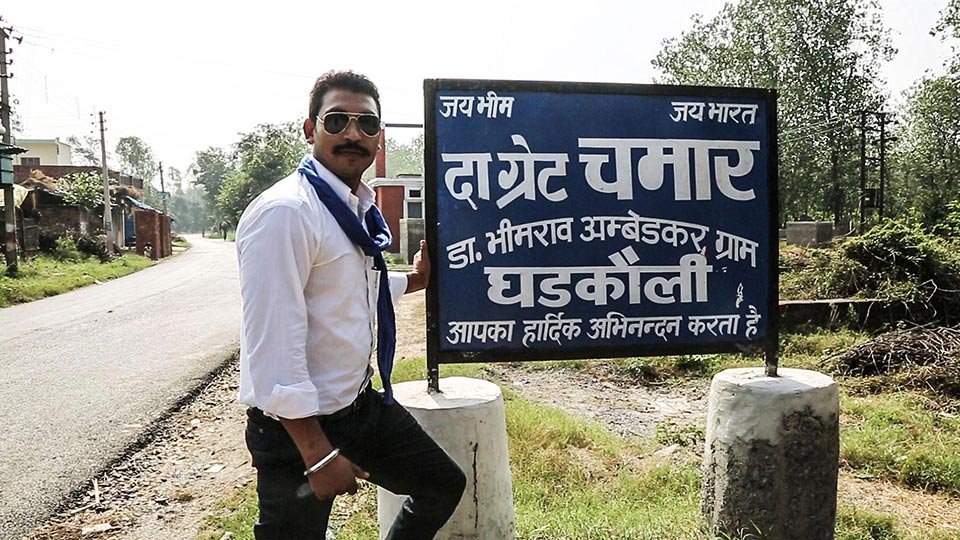
Justices PB Sawant, KolsePatil among many other prominent citizens committed to civil liberties have condemned the arrest ofBhim Army chief Chandrasekhar was arrested by Uttar Pradesh Special Task Force from Dalhousie in Himachal Pradesh today. Trade unionists, Ashok Chowdhury and Roma apart from alit activist JigneshMevani have termed the arrest the act of a desperate government. Three days ago, the sa,e UP police obtained permission from a local court and blocked the pages (five), on Facebook of the Bhim Army. While Chandrashekhar has been ‘accused’ of fomenting violence in Shabbirpur in UP, the violence that hit the western district of UP by the state, several individuals and organisations, who’s inciteful posts and writings on facebook and twitter –owing allegiences to the dominant Thakur and other caste Hindus have escaped the long arm of Yogi Adityanath’s controlled state machinery.
One person was killed and several suffered injuries after a clash took place between Dalits and Thakurs at Shabbirpur village on May 5.Speaking to The Indian Express, a senior police officer in Himachal confirmed his arrest. Sources said that Chandrashekhar was taken away in aInnova car by policemen dressed in plainclothes. The UP Police were able to triangulate Chandrashekhar’s location after tracing his phone calls. Earlier, the Bhim Army leader was reportedly hiding in Punjab’s Ferozpur district for a few days before proceeding towards Himachal.
After the violence that erupted around May 8, Dalits were brutally attacked in Shabbirpur, after which Chandrashekhar had held a huge 30,000 strong rally at Delhi’s JantarMantar. Thereafter, there was another brute attack, allegedly by caste Hindus and Thakurs on Dalits in and around Shabbirpur after BSP supremo Mayawati had visited the village. Adityanath’s administration is being increasingly seen as one only dominated by Thakurs and questions related to this caste bias have even been raised in the state assembly. On May 13, Justice Sawant and others had warned against using provisions of the draconian NSA against Dalit firebrand leader, Chandrashekhar.
Chandrasekhar, who has been evading arrest since last month, had earlier this week said he would surrender if 37 ‘innocent’ Dalits, arrested in connection with the Saharanpur violence, were released on bail. “I feel the UP government has failed to address the issues of the Dalits. The chief minister has lost control over the police and the administration. There have been more cases of atrocities against the Dalits in the past two-and-a-half months as compared to last one year,” he had told PTI.
“Instead of arresting the real culprits of the Saharanpur violence, the police “have arrested innocent people and put them behind bars. This has resulted in growing anger among the Dalits,” the 30-year-old activist said.
Chandrashekhar’s arrest comes a day after two members of the Bhim Army were nabbed in Saharanpur for their alleged involvement in caste violence in the district’s Ramnagar area on May 9. “Bhim Army’s DeobandVidhanSabha president Deepak Kumar and Saharanpur district president Praveen Gautam have been arrested from near Sun City Colony at Malhipur Road,” Saharanpur City Circle Officer Mukesh Chandra Mishra had said. The duo was produced before the court following which they were sent to judicial custody.
First Published on: October 1, 1999

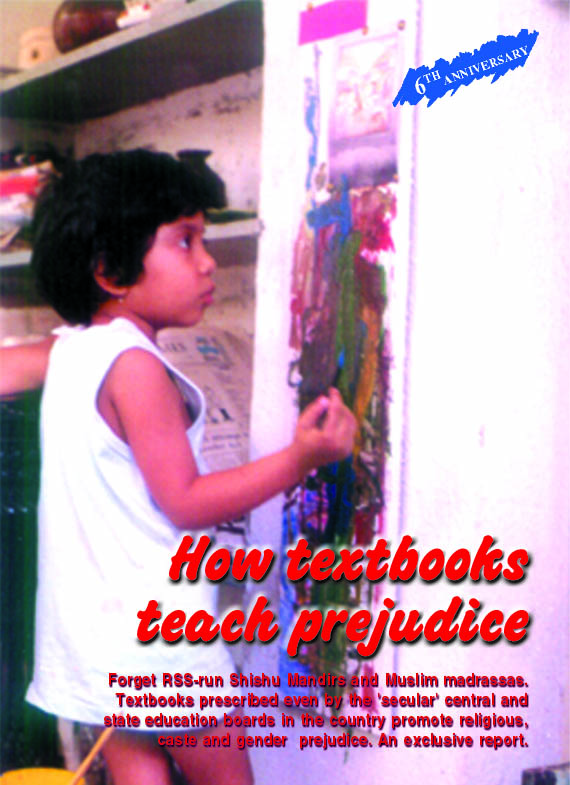
Forget RSS-run Shishu Mandirs and Muslim madrassas. Textbooks prescribed by even ‘secular’ central and state education boards in the country promote religious, caste and gender prejudice
What we learn and teach about history and how the process of this learning has been crafted or developed, shapes our understanding of the events of the past. This understanding of the past influences our ability to grapple with the present and therefore also the future. Such knowledge, if both rich and varied, can also make and break convictions of both the teacher and the taught.
In 1947, India made a historic tryst with destiny. Independent yet partitioned, after extensive and careful deliberation, we opted for a democratic structure outlined in the Indian Constitution. Whether state –
directed or autonomously ensured, education in such a democratic polity should have been committed to free enquiry, fair and equal access to knowledge, both quantitative and qualitative, inculcation of the right to debate and dissent. The only restrictions and limits to when and at what junctures what kind of information could be shared with the child should have been pedagogical.
In short, the equality principle in any democracy simply must extend to education. In quantitative terms, this means the right of every Indian child to primary and secondary education. UNICEF figures shamefully record how we have failed, having as we do 370 million illiterates (1991), half a century after we became independent.
But qualitatively, too, the equality principle within the Indian education syllabus, especially related to history and social studies teaching, in state and central boards, is sorely wanting.
Wedded to the equality principle, the democratisation of our history and social studies syllabus should have meant a critical revision of both the periodisation, approach and content of the material taught because, pre-Independence, history writing under the British was infested with colonial biases. This has not happened. As a result, in most of our texts and syllabi we continue to perpetuate the colonial legacy of portraying ancient India as synonymous with the Hindu and the medieval Indian past with the Muslim. We have, over the years, further accentuated the colonial biases with sharp and more recent ideological underpinnings linked with the rapid growth in the political sphere of the Hindu Right.
Hate language and hate-politics cannot be part of history teaching in a democracy. But, unfortunately, prejudice and division, not a holistic and fair vision, has been the guiding principle for our textbook boards and the authors chosen by them.
Over the years, our history and social studies texts, more and more, emphasise a prejudicial understanding and rendering of history, that is certainly not borne out by historical facts. Crucial inclusions and exclusions that are explored through abstracts from state board texts, ICSE textbooks and college texts as well, quoted extensively in stories accompanying this essay, bear this out.
What the RSS and other rabid organisations with a clearly political objective would have us believe about history has been succinctly summed up by the accompanying abstract of an NCERT (National Council for Educational Research and Training) report. The report enumerates instances that clearly reflect the bias of the organisation that has sponsored them.
Hate language and hate-politics cannot be part of the history project in a democracy
What is far more worrisome and needs careful and equally studied examination is how the textbooks in use in most of our states under the ambit of the state textbook boards, as well as the texts of prominent national boards, echo the same historical precepts, misconceptions and formulations. Sometimes in a diluted or scattered form, but more often with the same resultant damage.
The dangerous patterns woven through the syllabus in general and the history and social studies curriculum in particular, for the young mind, need to be traced carefully. They reveal how the average Indian text looks at the historical and present question of caste-based discriminations, community-driven stereotypes and, as significantly, what we teach students about the status of women, then and now.
These patterns, distorted and prejudicial as they are, will open our eyes to the process that has actually contributed to mainstream secular space being dominated by the discourse dictated by the Right. We will then begin to understand how certain manipulated discourses and imageries that have been pulled out for public consumption over the past decade–and–a–half find instant and widespread resonance in civil society.
What am I referring to? How come the crude allusions to Muslims as ‘Babar ki aulad’ in the mid–eighties and the charge of ‘forced’ conversions against Christians in the late nineties finds a silent acceptance in the marketplace of popular ideas, and even dominates the media? This is because many of post–Independent India’s textbooks have been unable to offer a clean, holistic, rational and multi–dimensional vision of the past that includes a historically honest portrayal of how different faiths arrived on the shores of this sub-continent. Our textbooks are, similarly and suspiciously, silent on the motives behind thousands of Indians converting to different faiths over generations. Instead, through allusions and exclusions, they strengthen the false claim that in a vast majority of cases these conversions happened under force.

Are we, as citizens, concerned about whether our education system encourages the creative and thought processes, develops the quality of thinking in our young, whether our attitude to learning and teaching engenders the processes of inquiry? If yes, we need to examine whether our school textsbooks tackle the question of free inquiry, dissent and debate. We need also to pay attention to specific inclusions and exclusions within the content of these texts.
Other crucial questions also need to be raised. How do Indian texts specifically deal with the fundamental question of race, origin, culture and faith on the sub–continent?
It is surely impossible to speak about apartheid in the world context without linking it to the birth of South Africa under Nelson Mandela as an independent nation. or to understand slavery in the modern context without knowledge of the role of colonial powers in Africa or, equally pertinently, the whole phenomenon of the American War of Independence and Abraham Lincoln. But do Indian textbooks reflect the ability to examine social inequality, specifically the caste system, as it emerged and was legitimised historically and how it continues to exist today, perpetrating an exploitative and unjust social order?
Can a young student of social studies really seek to understand the caste system without, first of all, being informed of modern–day social and economic apartheid that 16–17 per cent of the Indian population continues to be forced to live under today? There is hardly any Indian text that honestly and candidly sketches out the indignities that continue to be perpetuated on Indian Dalits today.
The life–sketch of Dr. Bhimrao Ambedkar is restricted to his contribution as the ‘architect’ of the Indian constitution. The serious challenges he posed to the pre–Independence struggle and the Brahmanical order, or his radical conversion to Buddhism as a method of ‘social and political emancipation’ (10 lakh Dalits converted to Buddhism on October 14, 1948) find scant or no mention at all in ‘secular’ Indian textbooks.
This blinkered vision of Indian social disparity extends to the fashion in which Dr. Ambedkar is portrayed for the young and the struggles that he led are depicted. On December 25, 1925, Ambedkar burnt copies of the Manu Smruti at Mahad village in Maharashtra. This was a strong political statement against the domination suffered by Dalits, epitomised in this Brahmanical text that has laid down the code of a social order which regards ‘shudras’ and ‘women’ together as deserving of no rights. The incident finds no mention at all in any Indian school textbook, revealing a sharp upper caste bias that has excluded real inquiry into these events and movements. There is no attempt at a critical look at texts like the Manu Smruti that have, since their being written several centuries ago, reflected the attitudes of vested interests. In fact this Brahmanical text itself receives favourable mention in Indian school textbooks.
As extension of the same argument, some of our average Indian textbooks continue to label Christians, Muslims and Parsees as ‘foreigners,’ and moreover depict Hindus as “the minority in most states of the country”. They selectively speak about the “immoral behaviour of Catholic priests in the middle ages” while exonerating the Brahmins and the Indian ruling classes. What is the message that we send out to the growing child with these factual misrepresentations and deliberate exclusions of some historical events and modern day social realities when it comes to the conduct of the Brahmanical elite?
Our textbooks are, similarly and suspiciously, silent on the motives behind thousands of Indians converting to different faiths over generations. Instead, through allusions and exclusions, they strengthen the false claim that in a vast majority of cases these conversions happened under force
The same college textbook in Maharashtra that speaks at length, and with a fair degree of venom, about Islam and its violent nature is silent on what many ancient Indian kings did to Buddhist ‘monasteries’ and bhikus during the ancient period. (King Sashanka of Assam is reputed to have destroyed several monasteries). What then are the conclusions that a critic needs to draw about the motivation behind these selective inclusions and exclusions?
Exclusion is a subtle but potent form of prejudice. If, therefore, the average Indian textbook is silent on the motivations of many a ‘Hindu’ king who employed officials to raid and destroy temples in the ancient and medieval periods, simply because he could be certain to find wealth there (King Harshadev of Kashmir is one such, referred to by Kalhana in his Rajatarini), is there a not–so–subtle attempt to allow the popularly cherished belief that temple breaking was the ‘Muslim’ rulers favoured prerogative, to fester and grow?
Rabid observations on Islam and Christianity are overtly visible in excerpts of the books conceived by the RSS and used for ‘teaching’ in the Shishu Mandirs. For discerning observers and educationists, this commitment to indoctrination that pre-supposes injecting small yet potent doses of poison against an ‘enemy other’ is not really surprising when we understand the true nature of the ideological project of these outfits.
The content of RSS texts has invited sharp criticism by the NCERT committee (see accompanying document). To find blatantly damaging statements within the texts of schools run by the RSS is one thing. But to have ‘secular’ Indian textbooks — ranging from those produced by some state textbook boards, to recommended texts for the study of history at the graduation level, as also some ICSE texts — containing discernible strains of the same kind of caste, community and gender prejudice reflects how mainstream Indian thought has not only swallowed a biased and uncritical interpretation of history but is cheerfully allowing this myopic vision to be passed down to future generations.
Take, for instance, a textbook recommended for the final year Bachelor of Arts students in history in Maharashtra. The chapter titled ‘Invasion of Mahmud of Ghaznavi’ is cleverly used by the author to launch a tirade against Islam itself. The content of this textbook could compare favourably, chapter and verse, with sections of Shishu Mandir texts that, are in other parts, far more direct, having nothing positive to say about Islam or Christianity.
As critically, how do our history and social studies’ textbooks approach the complex question of gender? What is the underpinning of analysis on critical gender issues within these books? How do our textbooks explain notions of ‘pativrata’(worship of the husband), sati (widow burning), child marriage, burning of women at the stake (called ‘witch hunting’ during the medieval ages), polygamy, polyandry etc. to the child?
There could be no more derogatory references to women than those contained in the Manu Smruti, an ancient Indian Brahmanical text. But it receives uncritical and passing mention in most Indian textbooks.
There is no attempt to outline the oppressive ‘Brahmanical Hindu’ code contained within the Manu Smruti. The code outlined in this text has significantly influenced how women have and continue to be treated within the family structure and in society, as also the base fashion in which treatment to ‘shudras’ has manifest itself in Indian society.
What were the variegated facts, and, therefore, what is the multi-layered truth behind the emergence of different faiths on the sub-continent? The historical account is not an over-simplified one of Babar ki aulad, armed with swords, forcing reluctant victims to convert and smashing down their temples in the bargain. Unfortunately for proponents of a hate-driven history, facts tell a different story.
The tale of the often-ruthless methods that Portuguese Christians took to effect conversions in Goa may be more recent but it is by no means the whole story of how Christianity arrived on the shores of the sub-continent and found deep and abiding routes. That is an inquiry that is more complex, more varied and far richer in detail.
In a Maharashtra college level text, he chapter on Mahmud of Ghaznavi is used as ripe occasion to launch a tirade against Islam itself
The record of persons opting to convert to different faiths, be it Buddhism, Jainism, Christianity Islam or Sikhism, is a worthy exploration in itself. Honestly told, it could offer vital insights on the impulses of ideas and motives as they have driven humankind over the ages. It is, however, a subject that has been significantly ignored except through banal references to ‘syncretism’ and ‘synthesis’ that are left thematically and conceptually unexplored.
The subject of shifts and changes to different faiths is educative, simply because if fairly approached, the process will throw up different sets of reasons and varying motivations for these actions, these changes of faith that persons opted for. The differences and variety would depend upon the period when the change took place, the region within India that we would be looking at and, finally, the method employed for the conversion itself.
None of the mainline Indian textbooks really do justice to this subject. We often find a single sentence reference to the fact that Islam first came to the shores of the Malabar coast through the regular visits of Arab traders who enjoyed a long-standing relationship of trade and commerce with India. But the next sentence immediately shifts gear to the other way that Islam came to the Indian sub-continent — through the ‘invasions’ in Sind. From thereon our children are told in graphic detail of the numerous ‘invasions’ but nothing of the coming of Islam through trade and the formations of living communities that resulted.
Many conversions to Islam or Christianity in the modern period of history have also coincided with the passage of emancipatory laws liberating bonded labour. This allowed oppressed sections the freedom to exercise choice in the matter of faith. These sections, then, exercised this choice, rightly or wrongly, perceiving either Islam or Christianity to be more egalitarian than Hinduism’s oppressive system of caste.
There were several instances of conversions during the second half of the 19th century in Travancore, for instance. Educational endeavours of missionaries and the resultant aspirations to equality of status encouraged many persons of ‘low’ caste to change faith and through this to a perceived position of equality. For example, the first ‘low’ caste person to walk the public road near the temple in Tiruvalla in 1851 was a Christian. Around 1859, many thousands converted to Christianity in the midst of emancipatory struggles that were supported by missionaries in the region: for example, the struggle of Nadars on the right of their women to cover the upper part of their body, a practice opposed by the upper castes!
There are so many fascinating examples. Large-scale conversions to Islam took place on the Malabar coast not during the invasions by Tipu Sultan but during the 1843-1890 period. These were directly linked to the fact that in 1843, under the British, slavery was formally abolished in the region. As a result, large numbers from the formerly oppressed castes, bonded in slavery to upper caste Hindus moved over to Islam, which they perceived, rightly or wrongly to preach a message of equality and justice.
Trade and commerce finds dry and peripheral treatment in our texts as do the impact of technological developments through history. Religious interpretations and explanations often pre-dominate, with little attempt to explain how ideas and thought-processes travelled across continents and borders; the means and modes of communication etc. are hardly explored.
Our secular texts are completely silent on the ideology that killed the Mahatma despite the fact that the RSS was banned by the government of India following his assassination
Within the Indian sub-continent, this century saw the emergence of different streams of thought that contributed significantly to the struggle for independence against the British. It also saw the emergence on the sub-continent of processes, fully encouraged by the British, of exclusivist and sectarian trends within the broader national movement that chose to articulate their worldview in terms of narrow religious identities.
Within a few years of each other, we saw the birth of organisations like the Hindu Mahasabha and the Muslim League, as also the Akali Dal and the Rashtriya Sayamsevak Sangh. This process of the emergence of different communalisms that contributed in no small measure to the final vivisection of the sub-continent, with all its attendant stories of vengeance and horror is extremely selectively dealt with in Indian textbooks.
Put simply, all these texts speak at length about the birth and misdemeanours of the Muslim League, the Muslim communal outfit that contributed significantly to the politics of the period. No mention is at all made to the birth around the same time of the Hindu Mahasabha and the Rashtriya Swayamsevak Sangh, both Hindu communal outfits that contributed in no small measure to the sharp polarisations and schisms at the time.

Mahatma Gandhi’s assassination is fleetingly mentioned without the ideology that drove Godse to kill him being mentioned, leave alone explored. The fact that the RSS had to face a ban on the question, too, is blotted out to the young student of modern Indian history.
With these kinds of interpretations and inclusions of historical facts in our regular texts, coupled with the repetitious discourse within civil society that has, in recent times, taken a vicious form—and which selectively heaps the blame for partition squarely on the Muslim— is it any wonder that communities and citizens of the country continue to carry the burden of being dubbed ‘traitors’ and ‘anti-national?’
The young student of history in India, therefore, can without compunction put the entire blame of the partition of the sub-continent on the Muslim League and Mohammed Ali Jinnah’s shoulders. The bias does not end here. While the Muslim League receives detailed treatment in the average Indian text, it does not give a single line to Hindu communal outfits.
In furtherance of the same theme, there is no attempt to either explain or detail that the Muslim League enjoyed a limited hold over only sections of the Muslim elite and landed gentry; that many hundreds of thousands of Muslims participated actively in the struggle for Independence against the British; that the idea of Partition was backed by a miniscule section of Indian Muslims; that the artisan class which constitutes a large section of Muslims demonstrated actively against Partition.
In short, if you read an average Indian text, be it from the state or central boards, the Hindu Mahasabha and the RSS bear no part of the historical blame for Partition. The crime is worse compounded by the fact that Mahatma Gandhi’s assassination is glossed over, often receiving no more than one sentence in explanation.
The ICSE History and Civics textbook, Part II for Std. X, devotes a whole chapter to the ‘Formation of the Muslim League’. But there is no mention at all of Hindu communal organisations.
And to top it all, here is what the same ICSE text has to say about Mahatma Gandhi’s assassination: “Mahatma Gandhi toured the hate-torn land of Bengal, trying to put a stop to the communal frenzy and salvage the people from ruthless communal slaughter. While celebrations and riots were still going on the architect of the nation was shot dead on 30th January by Nathuram Godse”. There is no further comment on the assassination, or the ideology that drove the assassin. Neither is there any mention of the fact that the government of India banned the RSS following Gandhi’s murder because of Godse’s close association both with the RSS and the Hindu Mahasabha. There is no information on the trial of the assassins of Gandhi, the justification by Godse of his act and so on.
Similarly, the Social Studies text for standard VIII of the Gujarat State Board, has a tiny sub-section titled, “The Murder of Gandhi”. This reads thus: “After Independence there were severe communal riots in India. Gandhiji tried his utmost to suppress it. Many people did not like this. Gandhiji was murdered at the hands of Godsay on 30th January 1948. ”
Again, no words of explanation of the ideology that was responsible for the murder of Gandhi though painstaking efforts are made in this and other texts to explain the ideology that partitioned the sub-continent.
It appears logical and inevitable for the stated political project of the RSS and its Shishu Mandir-style education to offer such an immutable approach, a series of unquestionable absolutes, to the young mind. How else can the RSS organisation, whether it be at the shakha or the Shishu Mandir level, create a social and political atmosphere where selectively half-truths and blatant falsehoods dominate all discourse? How else does one create an environment where critical questions are never asked, leave alone answered? And, worst of all, prevailing social inequalities, indignities and humiliations are left unaddressed. In short, leave the social and economic hierarchy unchallenged?
But the fact that independent and democratic India’s ‘secular’ texts reflect, with sometimes uncanny similarity, the very same disregard for a growing and inquiring mind, apart from being laced with a series of questionable formulations that hide gender, caste and community–driven bias is what requires urgent and specific attention. And remedy.
(This article has relied heavily on the research work that the writer has
undertaken as the Co–ordinator of KHOJ, a secular education project)
Archived from Communalism Combat, October 1999, Anniversary Issue (6th) Year 7 No. 52, Cover Story 1

Join our mailing list to get the latest human rights news that matters, straight to your mailbox.
© Sabrang | All Rights Reserved