It was the summer of 1985 when we were visiting New Delhi, the national capital of India to attend a wedding in the family. I had a long hair back then and was aged 15. Both me and my uncle who were wearing turbans like other Sikh men were waiting at a bus stand for the next bus to go to our relatives. As soon as the bus arrived and we were about to climb in after other waiting passengers, the door was slammed on us. When my uncle protested, the conductor shouted that there is no seat inside. Even as we pointed out at some empty seats, the answer was – “we have told you there is no seat.” Before we could argue the bus sped away.
The incident left me shocked but I wasn’t surprised.

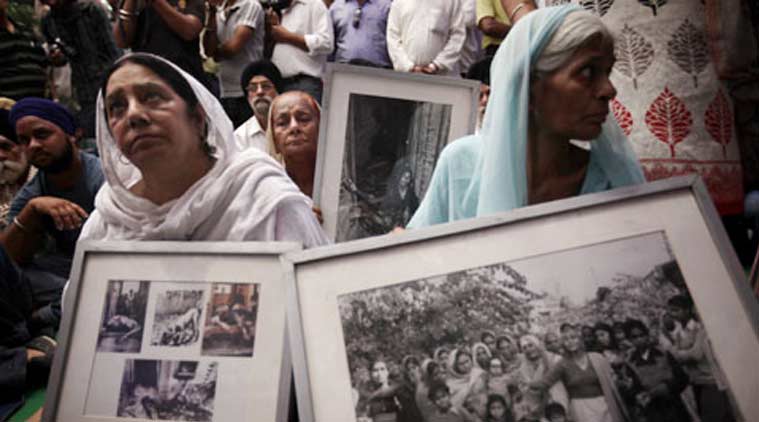
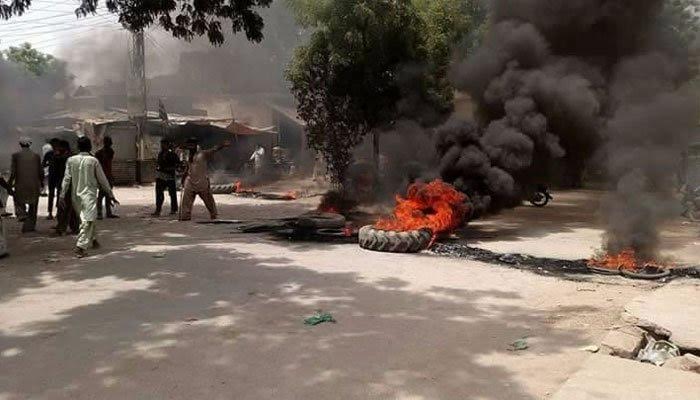
Image: Indian Express
A year earlier, New Delhi had witnessed large scale massacre against Sikhs following the assassination of the Indian Prime Minister Indira Gandhi by her Sikh bodyguards at her official residence. She had ordered a military attack on the Golden Temple Complex, the holiest shrine of the Sikhs in Amritsar in June 1984 to flush out religious extremists who had stockpiled weapons inside to carry on their armed struggle against the government. The militants were seeking special rights for the Sikhs and Punjab, while the government accused them of conspiring to create a separate state of Khalistan with the help of Pakistan. Indeed, the army operation was followed by series of violent incidents against Hindus in Punjab. The military attack that could have been avoided had left many pilgrims dead and the buildings inside the shrine destroyed igniting angry reaction from the Sikhs across the world.
Since I lived in Amritsar with my parents back then I too witnessed the damage the military operation had brought to the Akal Takht – the highest temporal seat of the Sikhs inside the temple complex. The shattered building had shaken me completely and others in my family.
Months later when Indira Gandhi was assassinated thousands of innocent Sikhs were murdered in New Delhi and other parts of India by the goons led by the members of the her so called secularist Congress party.
The ugly events of 1984 further galvanized the Sikh militant movement and more violence and bomb blasts followed. In June 1985, Air India Flight 182 was bombed mid air above the Irish sea killing all 329 people aboard. The incident was blamed on the Sikh militants based in Canada. The Sikhs who make merely two percent of India’s population came under microscope.
The bus incident wasn’t the only shocker. While we were in Delhi, staying at a small apartment of our aunt, we got a knock on our door by a police contingent one evening. A police team had come to question all of us, to know where we are from and what the purpose of our visit was. To prove our credentials, we had to produce the marriage invitation card from my cousin’s family. The officer who led the police party said that they had received complaints from neighbours who were alarmed at suspected people in the locality. There were some heated arguments between my relatives and the police officials but they finally left satisfied. Until now we had been hearing stories about police harassment of Sikhs outside Punjab, this was the first time we had faced it directly.
Sikh militancy continued and ended by the mid 1990s, but looking back during those days I can confidently say that Punjab had become the laboratory of Hindutva much before Gujarat.
Hindutva laboratory
Hindutva is a political term often used by the supporters of Hindu theocracy, particularly the now ruling Bhartiya Janata Party (BJP), who want to turn India into a Hindu state.
The Congress and other secularist activists often accuse BJP of turning Gujarat into a Hindutva laboratory in the year 2002 and before. After all, the Prime Minister Narendra Modi, who is dedicated to the ideology of Hindutva was the Chief Minister of the state when anti Muslim pogrom was organized that year. The massacre followed the burning of a train carrying Hindu pilgrims leaving more than 50 people dead. The BJP government had blamed the Muslim fanatics for the train incident. Much before the massacre, the BJP supporters had tried to terrorize Christians in Gujarat and succeeded in polarizing the society on religious lines in the state to sustain power. The activists who have been following these developments saw the footprints of Hindutva politics behind all these episodes and had warned that once BJP captures power in New Delhi they are going to implement the Hindutva model across the country.
It is not surprising to see that ever since Modi became the Prime Minister in 2014, violence against religious minorities, particularly Muslims and Christians has grown. This can be explained by the narrative of the Rashtriya Swayamsewak Sangh (RSS) of which the BJP is a part. The RSS considers both Islam and Christianity as alien religions while the Sikhs as part of the Hindu fold for which a section of the Sikh community is also apprehensive of the assimilationist agenda of the BJP.
Not only the Hindutva vigilantes have sharpened their attacks on Muslims and Christians, the police and security forces under Modi have also become more aggressive in dealing with Islamic extremists which has made the lives of ordinary Muslims even more difficult. Much like Sikhs in 1980s-1990s, all Muslims have become potential terrorists in the eyes of the mainstream in India.
Congress verses BJP
While there is no doubt that the BJP is more dangerous, compared to the Congress, because of its well calculated social engineering program to transform India into an exclusionist Hindu nation, the Congress has lost moral right to criticize the BJP on the issue of communal politics for what it did in 1984 and later.
The Congress’ experiment with the fanatical politics was purely for “pragmatic reasons”, whereas for BJP it is more for “programmatic reasons”. That said, the Congress must take blame for turning Punjab into Hindutva laboratory much before the BJP tried to turn Gujarat into a laboratory of hate politics or even before the concept of Hindutva laboratory entered the consciousness of the secularists. Several instances are sufficient to prove this point.
Even before the events of 1984, the Sikhs were frequently demonized by the Congress, the Hindu chauvinists and a section of the media.
Any genuine demand including reorganizing Punjab on linguistic basis for the growth of Punjabi language was seen as unpatriotic. The RSS leaders tried to dub such movement that was not even aimed at separating the Sikhs from India as the one supported by Pakistan. While the Congress remained adamant not to accept it, the Hindi press mocked the demand.
Before the Punjab was reorganized in 1966 – Hindu fanatics ensured that the Punjabi speaking Hindu families declare Hindi and not Punjabi as their mother tongue to defeat the demand for a Punjabi speaking state.
The Sikhs were frequently portrayed as part of the Hindu fold that only strengthened the fears of assimilation within the Sikh community. Besides, the RSS propagandists openly distorted the Sikh history and tried to appropriate it to prove that the Sikhism was created to protect Hinduism from Islam.
Once Punjab was reorganized the river water share was distributed in complete violation of the riparian laws. A BJP leader Laxmi Kanta Chawla had sarcastically commented in an interview with me that there was noting wrong in sharing the river waters of Punjab with the neighbouring states as the Punjab water was not going to Pakistan. Chawla frequently honoured the police officials who were responsible for human rights abuse and the killings of the suspected Sikh militants in staged shootouts.
The Hindu extremists frequently raised provocative slogans that dubbed the Sikhs as anti nationals and Pakistani agents. In any event of violence against innocent Hindus in Punjab by unknown assailants, the innocent Sikhs were targeted outside Punjab by the mobs with the connivance of the police.
When the Golden Temple Complex was stormed, the Hindu chauvinists distributed sweets. The RSS openly justified the army attack and the anti Sikh pogrom following the murder of Indira Gandhi.
Not surprisingly, all this paid dividends to the Congress when it won the general election under Indira Gandhi’s son Rajiv Gandhi with a brute majority. The complicity of the Congress and the RSS in pushing towards a majoritarian democracy was clearly visible. The process laid a ground for the BJP to repeat the experiment in Gujarat in 2002 and enabled Modi to get elected with a strong majority in the election that followed the bloodshed.
Modi’s ascendance to the power is an outcome of the Hindutva laboratory which started being set up in Punjab by the Congress-RSS alliance and has partly contributed to the near decimation of the Congress and other secular parties.
Relevance of 1984
As the Sikhs are getting ready to commemorate the anniversary of the infamous military attack on their Vatican in the first week of June, there is a need to acknowledge how history is being repeated 33 years later when other minority groups have come under attack in India which is otherwise known as world’s largest democracy. Among the most vulnerable are Muslims who have become target of attack internationally due to growing Islamophobia which has made Modi’s task easier.
In Kashmir, a Muslim dominated state where people are fighting for the right to self determination – the paramilitary forces continue to kill people at will. Staged shootouts, forced disappearances and custodial rapes have been common occurrence in the state. Under Modi – the intensity of such attacks has increased.
Tribals who only form eight percent of the total population are also constantly facing barbarity at the hands of the police and the security forces in the name of war against Maoist insurgency.
The mainstream that is consumed by what is being fed to them by the media and the Modi administration is hardly questioning this. But then it never raised questions when Sikhs and Punjab have been facing similar challenges. The discourse of nationalism which had blinded the dominant Hindu society back then remains as powerful and fortified even today.
This is not to justify violence done by the minority extremists. However, the question is how differently they were treated then and are being treated now whereas the Hindutva extremism has continued to enjoy the patronage of the state for all these years. When the state had to deal with handful of extremists holed up inside the Golden Temple Complex, the army was sent to attack a place of worship, but there was no one to save the Sikhs from the mobs in the aftermath of Indira Gandhi’s murder. While the killers of Indira Gandhi were punished promptly, those involved in the violence against Sikhs were elected and awarded with ministerial posts. The alleged killers of the Hindus in Punjab were killed in staged shootouts and the police officials who did all that got out of turn promotions and monetary awards. Obviously, the urban middle class that was too scared of terrorism accepted this as normal. The trend has not changed and today the Muslim men are being hounded in a similar fashion. For the record, the Muslim men who were held in connection with the torching of the train in 2002 were charged for terrorism, whereas the anti terror laws weren’t applied on those who killed innocent Muslims afterwards. Then scores of Muslim men were killed in staged police shootouts after being branded as terrorists in Gujarat. If nothing else, they are shamelessly dubbed as Pakistani agents to shut any criticism of state repression.
The history of 1984 therefore has lessons for those who want to understand how a brutal majoritarian democracy works and help people in power to retain their control by keeping minorities under boot. Nothing is more illustrative to examine the mindset behind today’s Modi government in India and the one that worked behind the Congress three decades earlier.
Gurpreet Singh is an independent journalist based in Canada. He works for Spice Radio in Vancouver and a publisher of monthly magazine Radical Desi that covers alternative politics