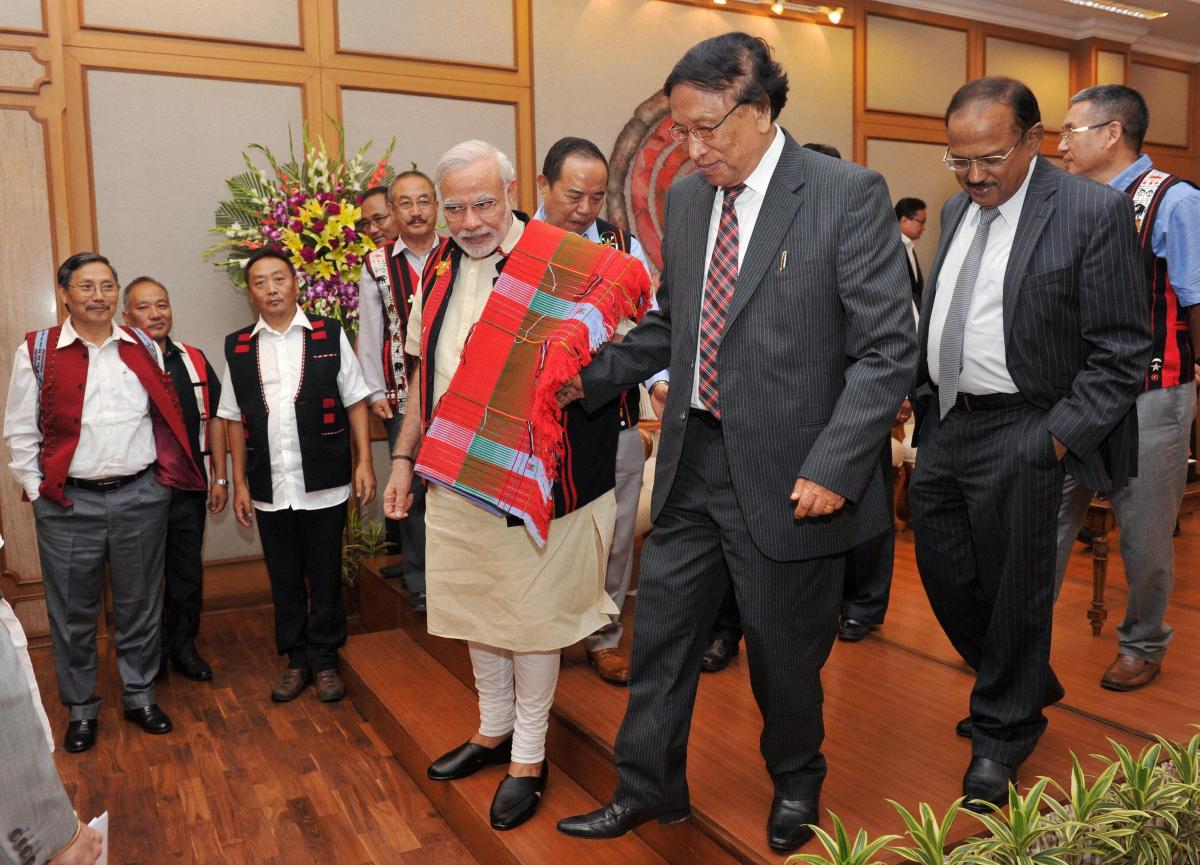
The Government of India (GoI) signed a peace accord (Naga Accord) with the Nationalist Socialist Council of Nagaland-IM (NSCN-IM) in August 2015 in the presence of the Prime Minister of India. A press release issued by the Prime Minister’s Office (PMO) called it a “framework agreement” and hinted at releasing the details and the execution plan soon after (2nd attachment). Given the concerns raised by several quarters about continued confidentiality of the contents of the Naga Accord, more than a month later, I filed an RTI application with the PMO seeking the following information under the Right to Information Act, 2005 (RTI Act):

Image: PTI
“Apropos of the news release dated 03/08/2015 caused to be published by your public authority on the website of the Press Information Bureau (PIB) relating to the signing of the “framework agreement”, between the Government of India and the representatives of the National Socialist Council of Nagaland (NSCN), I would like to obtain the following information under the RTI Act:
1) A clear photocopy of the said framework agreement along with Annexures, if any;
2) A list of all files including electronic files and emails indicating the subject matter, and date of opening of each file in relation to the said framework agreement held by your office along with the total number of pages in each file;
3) A clear copy of all emails and records and documents included in the files referred to at para #2 above;
4) A clear photocopy of all communication received from every source in hard copy or electronic form till date, in relation to the said framework agreement;
5) Details of the compensation package along with the monthly remuneration paid till date to the Government Interlocutor mentioned in the said PIB news release and all other persons providing him assistance;
6) Item-wise details of the expenditure incurred by the Government of India for negotiating the framework agreement since 01/01/2015; and
7) Item-wise details of the funds spent on the travel and accommodation of the representatives of NSCN in New Delhi for participation in the ceremony of signing the framework agreement.
I am a citizen of India. I have attached an IPO (bearing #32F 044910) for Rs. 10/- towards payment of the prescribed application fee. I would like to point out that the information specified above is in the nature of information that is required to be proactively disclosed by your public authority under the terms of Section 4(1)(b) and (c) of the RTI Act. As I am unable to find the said information on your website, I am constrained to submit this formal request. Kindly inform me of the additional fee payable for obtaining the information described above.”
GOI was initially not prepared to confirm who actually held a copy of the Naga Accord
The Central Public Information Officer of the PMO replied that they did not hold a copy of the Framework Accord and transferred the RTI application to the North East Division of the Ministry of Home Affairs (MHA). The MHA also said initially, that it did not hold a copy of the Naga Accord (see 4th attachment). So I filed a complaint with the Central Information Commission (CIC). The CIC conducted five hearings in the matter. The RTI application, the complaint, all additional arguments I submitted and the MHA’s Counter and rejoinder are in the 4th-8th attachments.
Most of the time was taken to ascertain which office in the Government of India actually held a copy of the Naga Accord. Finally, it was revealed that the Office of the Government of India Representative for Naga Peace Talks, who is also the Chief of the Joint Intelligence Committee, holds the Naga Accord. Readers may recollect from the PIB release that he had signed the Naga Accord on behalf of GoI in August 2015.
Initially, CIC directed partial disclosure
The CIC directed disclosure of information relating to the remuneration paid to officials working with the Office of the GoI Representative, also known as the Government Interlocutor for Naga Peace Talks.
The information provided by the MHA indicated that the NSCN leaders paid for their own travel and stay during their visit to Delhi to sign the Naga Accord. About Rs. 13.07 lakhs had been paid to the two consultants hired by the Office of the GoI Representative for Naga Peace Talks. The remuneration paid to the GoI Representative himself was not disclosed.
Later CIC upholds GoI’s decision to keep Naga Accord confidential in public interest
Until the fourth hearing held in April, 2017, MHA contended that it did not hold the information at all. Then under pressure from the CIC, MHA confirmed that the GoI Representative for Naga Peace Talks held a copy of the Naga Accord, the MHA contended that it was the competent authority to take a call on whether to disclose the information or not. MHA argued that the information sought cannot be disclosed on grounds of Section 8(1)(a) pertaining to national sovereignty, territorial integrity and security of the State. I presented the following public interest arguments in favour of disclosure:
1) that MHA has repeatedly extended the application of The Armed Forces (Special Powers) Act, 1958 in Arunachal Pradesh and adjoining parts of Assam citing the alleged illegal and criminal activities of NSCN-IM and other Naga militant groups as major reasons. NSCN-IM is the party with which the Naga Framework Accord was signed in August, 2015. So I argued that the people have the right to seek clarity about the official policy of GoI towards militant groups that challenge the sovereignty and territorial integrity of India. This is especially important in view of the zero tolerance policy towards such groups repeatedly announced by senior members of the NDA Government;
2) that the contents of the Naga Accord had become a matter of widespread public debate during the recent Assembly elections in Manipur and that people had the right to know its contents from official sources;
3) that the NSCN spokespersons were making public statements about their version of the contents of the Naga Accord while GoI remained silent. So the voting and tax-paying citizens of the country have the right to know about the contents of the Naga Accord from GoI.
During the last hearing conducted by the CIC earlier this month, the CIC called for the text of the Naga Accord and other related documents for examination in camera. The GoI Official Representative for Naga Peace Talks provided an overview of the situation regarding the ongoing parleys during the open part of the hearing. The actual records were examined in camera after the CPIO and I were asked to exit the chamber, temporarily.
Now, after weighing the competing public interests favouring or opposing disclosure of the contents of the Naga Framework Accord, the CIC has ruled that it will uphold the MHA’s decision not to disclose the contents of the Framework Accord as so doing will prejudicially affect India’s sovereignty and integrity and the security and strategic interests of the State.
Most of the arguments that MHA and I put forward have been recorded in the CIC’s 24-page long decision. Unfortunately, after the final hearing, the NSCN spokesperson made some more statements about the contents of the Accord. Even though I sent a copy of the related news report to the CIC by email, the CIC elected not to take these materials on board. Fair enough, as the hearing had concluded and the decision had been reserved.
To the best of my knowledge this one of the rare instances where competing public interests were weighed by the Information Commission and a decision to favour one of them, in this case continued confidentiality was taken.
Now it is for the rest of the citizenry, civil society and the mass media, particularly, those who bear the brunt of the activities of the non-State actors in the affected States in northeastern India to press GoI for disclosure of the details of the Naga Accord and the current state of the parleys that is going on.
The author is Programme Coordinator, Access to Information Programme, Commonwealth Human Rights Initiative, New Delhi