In recent days many slaughter houses in UP have been sealed. It is claimed that such action has been taken only against illegal slaughter houses. The fact however is that people belonging to a particular religion have been targeted.
Whenever there is any talk of slaughter of animals it is commonly assumed that only Muslims who love meat are engaged in this business. However, you will be surprised to know that the biggest modern slaughter houses in India which export beef have little to do with the followers of Islam. In fact, the big players are from the Hindu community.
Allow me to introduce you to the Hindu owners of some of the largest slaughter houses in India.
Al Kabeer Exports Pvt. Ltd.: Do not get misled by the name. This is the largest beef exporting company in the country. The largest slaughter house in India is spread over nearly 400 acres in Rudrak village in Telangana state. Do you know who owns this slaughter house? The name is Satish Saberwal. This slaughter house is run by Al Kabeer Exporters Pvt. Ltd. With its offices in many countries, last year Al Kabeer did business worth nearly Rs 650 crore.
Arabian Exports Pvt. Ltd.: Its owner Sunil Kapoor has his office located in Mumbai.
MKR Frozen Food Exports Pvt Ltd: The owner of this Delhi-based company is Madan Abbott.
Al Noor Exports Pvt Ltd: The company is owned by Sunil Sood. He too is not a Muslim. Isn’t it strange? While others are raking in big-bucks, its Muslims who are being demonized. Isn’t it stranger still that this company is located in UP where Yogi Aidyanath is the chief minister? Al Noor’s slaughter house is located in Sher Nagar village in Muzaffarnagar district of UP. This company exports beef to 35 companies.
AOB Exports Pvt. Ltd.: The slaughter house of this company is in Unnao district in UP. This company is owned by OP Arora.
Standard Frozen Foods Exports Pvt. Ltd.: The owner of this company is Kamal Verma and the slaughter house is in Chandpur village in UP’s Unnao district.
Maharashtra Food Processing and Cold Storage Pvt. Ltd.: Sunny Khattar a partner in this company believes that dharm aur dhanda (religion and business) are two separate things and it is wrong to mix the two. The slaughter house of this company is in Paltan taluka, Satara district, Maharashtra.
Apart from the above mentioned, our Hindu brothers own many such companies which are engaged in the exclusive export of beef.
Now let’s take a look at where India stands in the international market in the beef business. The total beef export in the world is estimated at 94.49 lakh metric tons. Brazil exports 18.55 lakh while India too exports 18.50 lakh metric tons. Australia exports 1.36 lakh tons, while America exports 11.2 lakh tons. In other words, India is the top beef exporter in the world.
The question then is, are those who lynched Mohammed Akhlaq unaware that it is their own co-religionists who are the main beef exporters?
Finally, I will only say this: such double standard on the part of the government and some people will destroy forever the communal amity in this country.
Jai Hind!
(Editors’ note: In the international market both cow and buffalo meat is termed beef).
(This video has been received by SabrangIndia through Whatsapp from one of our viewers.)
The politics over Muslim Personal Law and Uniform Civil Code (UCC) has been heating up. Contentious issues are being debated in the popular media with the traditional appeals to the religious identity of Muslims and Hindus within their respective constituencies. From the vantage point of the Pasmanda, the question of UCC has been raised to create the binary of the Hindu versus the Muslim in order to entrench both identities as a monolith whole.
This entrenchment of communal identities is aimed at suppressing the caste fault-lines present in both communities. The suppression of caste fault-lines is necessary to hold on to the privileges accumulated under the Brahmanical-Saiyyadvadi social order. Thus, the demand for UCC helps the BrahamanvadiSavarna to consolidate its dominance over the Bahujan under the garb of Hindu identity and the opposition to the UCC helps the SaiyyadvadiAshrafiya to consolidate its dominance over the Pasmanda under the garb of a monolithic Muslim identity. Pasmanda is the social category which includes SC, ST and OBC who converted to Islam and are now dubbed as Muslims.
The UCC is not the exclusive issue used to construct this binary of the Hindu versus the Muslim. It is deployed in combination with various other cultural symbols which mark out the caste ridden diverse populace into two hostile groups. The most prominent among them are Aligarh Muslim University and the Banaras Hindu University (Muslim modernity versus Hindu modernity), Muslim MadarssaEducation and Hindu Sarasvati Education (Muslim culture versus Hindu culture), the Muslim League andthe Hindu Mahasabha (Muslim Politics versus Hindu Politics), Muslim Personal Law versus Hindu Personal Law, Muslim Secularists and Hindu Secularists (Jinnah versus Gandhi), Muslim Fundamentalist and Hindu Fundamentalists (Iqbal versus Savarkar), the Muslim Liberal and the Hindu Liberal (MaulanaAbulKalam Azad versus PanditJawaharLal Nehru) and so on and so forth.
All these oppositional symbols can be ontologically understood by replacing the expression ‘Muslim’ by ‘Ashrafiya’ & ‘Hindu’ by ‘Savarna’. Similarly, the question of UCC can be understood within the dialectic of religious identity formation and the invisibalization of the caste identity and the need for their continuous reproduction through these hostile binaries.
The function of creating false binaries is performed as much by the secular, liberal and modern Ashrafiya-Savarna as by the priestly Ashrafiya-Savarna. In fact, the former often provides, with uncanny regularity, a momentum to the secular-communal bandwagon by invoking the symbol and then reprimanding their kith and kin on the other side of the pool.
When the Savarna demands the UCC by objecting to Triple Talaq or Polygamy permitted by Muslim Personal Law, the Ashrafiya ridicules Hindu Personal Law by pointing out that incidents of polygamy are higher among Hindus compared to Muslims or Hindus leave their women in the lurch without divorcing them due to stringent norms of divorce! The secular, liberal & modern Ashrafiya is better placed to achieve this result due to the superiority of his intellectual capital over the priestly Ashrafiya. It is no coincidence, then, that in the history of Indian subcontinent, the height of communal polarisation was achieved during the reign of Mr. Jinnah & Gandhi over Indian politics, both ofwhom had an impeccable track record of being secular-liberal leaders of their respective caste groups.
The Muslim League of Jinnah effectively killed the democratic aspirations of Abdul Qayyum Ansari in this process while the Congress of Gandhi substantially undermined the democratic space sought by Dr. Ambedkar.
In present times, this function is performed by leaders like SayedOwaisi and Subramanian Swamy. There is an inherent underlying unity in the apparent hostility of the two. Within the Gramcian frame of war of positions, both take a united position against Dalit-Bahujan-Pasmanda positions of material interests and seek to win the round by hook or by crook. It is often amusing to watch Ashrafiya intellectuals bat on the UCC while bowling to the Savarna in a playful display of bonhomie!
However, the question of the protection and preservation of the patriarchal privileges of the Ashrafiya in the garb of existing personal law is only partially answered by the above analysis as this question goes to the very root of caste system.
As explained by Dr. Ambedkar in his paper titled “Castes In India: Their Mechanism, Genesis and Development”[1] patriarchy constitutes the core of the caste order.
Unlike hostile religious identity which is only a symptom of caste structure rather than the cause of it, patriarchy is the central pillar of the caste system itself. Therefore, the patriarchal privileges of Ashrafiya are not just protected under the garb of personal laws rather the garb of personal law itself is created by the patriarchal foundations of the Ashrafiya identity! Hence, patriarchy is the base on which Ashrafiya privileges are laid down and existing personal laws only partially support them. Naturally, Dr. Ambedkar underlines gender injustice in various forms as the chief mechanism of the origin of caste in India.
Both positions, in favourof and inopposition to the UCC are an outcome of an intuitive ‘higher caste’ consensus across religious categories rather than any pious allegiance to constitutional principles or Islamic tenets as they are made out to be. Neither the constitution mandates creation of the UCC nor does Islam oppose such a system as the very idea of UCC in practical terms is non-existent in both Constitutional & Islamic jurisprudence! The main reason for the demand for the UCC by the Savarnaand its opposition by Ashrafiya is due to the consolidation of communal identities by the invisibalizingof caste identities. Both functions go on to support caste order. In any case, there need not be any real conflict between a secular uniform civil code and religious separate laws as the former can not come into being without accommodating the later. In fact, the existing secular uniform civil code in the form of Special Marriages Act performs the very same function although in a very biased and unscientific manner.
Similarly, it is very much possible to develop a civil code without affecting the core values of Islam and cultural autonomies of ‘minorities within majorities’ if this question is approached from the vantage point of gender justice & justice to sexual minorities. If, however, the creation of a civil code is to be utilised as hegemonic tool of dominant groups belonging to any category which is inherent in all exercises of law making, then such a possibility is impossible to imagine, and hence futile to explore.
The Pasmanda identity, on the other hand, has emerged in opposition to minority politics as the later has failed to fulfill the aspirations of the former[2]. It is similar to the emergence of Bahujanidentity which was formed in opposition to majority politics for materially similar reasons. The Pasmanda identity is relatively young and its arrival is and has been actively resisted by the Ashrafiya proponents of minority politics, in the present context by manufacturing an opposition to UCC.
Thus, the opposition to UCC through conservation of regressive laws and practices including Triple Talaq, Divorce without making sufficient provision for maintenance, Halala and polygamy along with the hegemonic symbols as discussed earlier continuously obstruct the articulation of Pasmanda concerns. It is evident that the UCC debate has no substantive objects to achieve apart from its role as consolidator of communal identities. Further, the question of gender justice can be addressed within the framework of existing personal laws provided that sincere efforts for reforming personal laws are made and the debate is not used to sustain the Hindu versus Muslim binary to sub-serve the Brahmanical-Saiyyadvadi agenda of a hierarchical social order.
Keeping this background in mind, the Pasmanda position on the UCC debateisrooted in ethical concerns of inter-sectionality. For this purpose I tentatively propose the following points for consideration by Pasmanda activists:
Codification of all Personal Laws without reference to communal identities
Incorporation of gender justice including justice to third gender as the guiding principle of all Personal Laws. In the immediate context it would mean undertaking the following reforms:
Abolition of Triple Talaq
Adoption of minimum waiting period of one year for any divorce to take effect
Compulsory provision for maintenance of women after divorce till remarriage or till the time she finds an independent means of sustenance
Abolition of Halala
Universal application of criminal provisions relating to bigamy/polygamy
Recognition of inherent equality of genders on issues covered by Personal Laws
Legitimisationof theAll India Women Personal Law Board
Legitimisation of the All India Pasmanda Personal Law Board
De-legitimisation of the All India Muslim Personal Law Board
Delegitimization of Madrassa’s and Mosques as the representative of Pasmanda concerns on the question of Personal Laws
Preparation of a Draft UCC after incorporating these concerns
Ever since the Shahbano fiasco, the Saiyyadvadi-Ashrafiya obsession with the Muslim Personal Law has significantly strengthened the Brahmanical position against a Dalit-Bahujan-Pasmanda discourse. The Pasmanda movement hopes to prevent a repeat of this by adopting the principle of gender justice in the field of personal laws. The Ashrafiya leadership both secular and priestly is singularly incapable of undertaking the agenda of reforms in personal laws as it would mean a loss of an important tool for the reproduction of Ashrafiya identity. Therefore, the Ashrafiya position that the call for reforms must come from within the Muslim community is nothing more than dilatory tactics adopted to please their Savarna kith and kin in order to safeguard their caste privileges.
For the Pasmanda, choking essential personal law reforms would mean delaying the arrival of their legitimate social, economic and political concerns which have been suppressed for centuries.
(The author is Head, Glocal Law School, Glocal University-Saharanpur-UP)
[1] Dr. BabasahebAmbedkar: Writings and Speeches, Vol. 1. Bombay: Education Department, Government of Maharashtra, 1979, pp. 3-22
Like Muslims are being told to reclaim Islam from ISIS, Hindus must now reclaim Hinduism from the version being projected today.
Photo credit: Rediffusion
How do we deal with the continued lynching of Muslims by gau rakshaks?
In the 17 months since Mohammed Akhlaq was beaten to death in UP on suspicion of having cooked beef, eight Muslim men have been killed, two Muslim women raped, and almost 40 persons, including two women and seven non-Muslims, assaulted by gau rakshaks.
One of the eight victims, 22-year-old Minhaj Ansari, died in police custody in Jharkhand, after his arrest over a WhatsApp message on beef.
That's a rate of over two lynchings a month.
On Wikipedia, the topic 'Lynching in the US' informs us that an average of five lynchings a month took place there over a 73-year period.
It is time now to create a similar topic for India, with advisories for tourists on areas with the most lynchings, and a warning that if they must visit these beautiful locales, eating meat should be strictly avoided.
The climate of violent intolerance brought in by the new government at the Centre must force even ordinary Hindus to speak up against the way their religion is being projected by the ruling party.
One reality we have to face is that the State will not stop such lynchings. The silence of The Leader has once again been deafening. Ironically, he was busy welcoming Sheikh Hasina, Bangladesh's prime minister, when a 55-year-old dairy farmer Pehlu Khan's lynching was playing out on our television screens and being debated in Parliament.
The smuggling of our cattle to Bangladesh has long been an irritant for the ruling party. One of the first things Home Minister Rajnath Singh did was urge the Border Security Force to crack down so hard on cattle smugglers that Bangladeshis would have to give up beef! The Bangladeshi PM must surely have heard that remark.
What would she have thought about Pehlu Khan’s lynching? If nothing else, it must have reassured her that her country was not alone in letting violent fanatics run amok against minorities.
Why can't rights activists — most of them happen to be Hindu — ask that the court set up a mechanism to monitor the action taken after attacks by gau rakshaks?
In Pakistan, there's open rejoicing that finally, their founder's Two-Nation theory is being proved right in India.
That's just not true. Yet, can we who reject that poisonous theory convince the Pakistanis otherwise?
Do the powers that be consider these lynchings wrong?
When pushed by a media outcry, the police arrest a few gau rakshaks, but it is obvious that for them, the survivors of such attacks are the real offenders.
The filing of charges against Pehlu Khan's companions, who were also attacked, follow a pattern that began in October 2015, in Congress-ruled Himachal Pradesh. For the police, whoever is in power, Hindutva rules, and no Congress state government has done anything to make the police feel otherwise.
Five Muslims were attacked in Himachal Pradesh's Lavasa village, Sirmaur district, in October 2015, for ferrying cows; of them, 20-year-old Noman died. The police arrested the Muslims and a few assailants, but the latter quickly got bail.
Similarly, an FIR was lodged against Mohammed Akhlaq's family members when the Samajwadi Party ruled UP, though this happened under court orders.
Today, the lower courts, the government and the police, treat Muslims dealing with cows, be they dairy farmers or cattle traders, as offenders. Meat-eating Muslims are similarly treated because today, the BJP has defined all meat eaten by Muslims as beef.
This was demonstrated not only in Akhlaq's case, but also in the recent raid on a Jaipur restaurant where workers were thrashed for discarding chicken bones near a garbage bin where a cow was standing.
Given these ground realities, what should the rest of us do? By 'us' is meant those repelled by this kind of murderous religious zeal. This zeal repels us as human beings; but surely it also repels us as Hindus.
These public killings of unarmed Muslims and the whipping of unarmed Dalits are being done in the name of Hindu belief in the sanctity of the cow.
The cow is sacred to many of us, but these killings are definitely not part of the Hinduism we know and practise. Yes, physical ill-treatment of Dalits is part of some Hindu texts, but today, few Hindus would justify it.
Since March 12, 1993, when the first major act of terror was executed in the country by a group of angry Muslims in Mumbai, we have been asking Muslims to speak out against the terrorist acts of a few of their co-religionists.
A similar demand was made a decade earlier from Sikhs, because sant Jarnail Singh Bhindranwale and his followers were creating mayhem in Punjab. Indeed, the late Shiv Sena chief Bal Thackeray humiliated Mumbai's Sikh leaders at a press conference on this very demand.
But Hindu intellectuals have always condemned the likes of Thackeray, Pravin Togadia, and RSS/BJP leaders, including ex-deputy PM L K Advani and current PM Narendra Modi. That's as it should be — wherever one community is in an overwhelming majority, its intellectuals act as conscience keepers when minorities are attacked.
But the climate of violent intolerance brought in by the new government at the Centre must force even ordinary Hindus to speak up against the way their religion is being projected by the ruling party.
'Not my Hinduism' should become our slogan, and we should be marching on the streets to proclaim it.
Not only to reassure non-Hindus that the Hindu majority regards them as equal citizens — an assurance which is urgently necessary — but also to reassure ourselves that the religion we practise is not a murderous one.
Like Muslims are being told to reclaim Islam from ISIS, Hindus must now reclaim Hinduism from the version being projected today.
Those who led us through Independence realised the damage done by the Hindu caste system and the need to compensate, hence they included reservations in the Constitution.
But those who govern us today show no signs of acknowledging the crimes being committed in the name of Hinduism by their followers. Instead, there's unabashed approval of this savagery.
This makes it all the more important for ordinary Hindus to proclaim their disapproval of this terror, even to express regret to those attacked in the name of Hinduism.
There is a very recent precedent for this: After Coach S-6 of the Sabarmati Express was burnt at Godhra on February 27, 2002, the religious head of Godhra's Muslims, Maulana Umerji, publicly apologised for this act by members of his community.
Why should only minorities have to bear this burden of guilt for the misdeeds of their co-religionists? The majority bears much more responsibility.
What can those bearing the brunt of the attacks do?
After Una, Dalits in Gujarat abandoned dead cows on the streets, refusing to skin them. Can Muslims give up anything to do with cows, even rearing them? That would be difficult, given that often their livelihood depends on them. But it might just be worth the suffering.
Because the ultimate sufferer of the gau rakshak violence and the rapidly spreading bans on meat eating is the farmer, for whom cattle, be it cows/bulls, become a burden after a certain age. A majority of our farmers are Hindus. Let them protest.
As business goes down in cattle fairs, let those who can no longer find buyers for their cows protest. There have been reports from across the country of Hindu cattle traders and farmers being angry with the drop in their business and the risks involved.
In Karnataka, a BJP worker ferrying cows was killed by gau rakshaks last year, and many Hindu traders have reported attacks on them. Let them pressurise their governments; after all, the BJP has made it clear in its electoral campaigns and strategies that it is a party only of and for Hindus.
That, however, may be an impractical solution. An immediate solution to end the impunity with which gau rakshaks attack their prey, in daylight and in full view of passersby, is to petition the courts.
A public interest ligitation filed by Congressman Tehseen Poonawala asking for a ban on gau rakshaks is currently being heard by the Supreme Court. But bans work only when the State wants them to.
Instead, why can't rights activists — most of them happen to be Hindu — ask that the court set up a mechanism to monitor the action taken after attacks by gau rakshaks?
A list of such assaults, the inadequate response of the police, justifications of these assaults by those in power, and the effect of these assaults on the lives of the survivors can be presented to the court in support of such a demand.
If there can be a National Investigation Agency to deal exclusively with terrorist acts, why can't courts set up Special Investigative Teams to monitor gau rakshak terror?
This story, published on Rediffusion, is being republished with the author's permission. Read the original.
Kamala Das, the renowned Malayalam writer, was ahead of her times. Here is a short story she wrote in Malayalam in the sixties. It foretells what’s happening in India now.
Representational image. Photo credit: Occupy for Animals
The story has been received through Whatsapp from a SabrangIndia viewer.
One day, while a boy was picking up banana skin from the waste bin and eating it, a cow reached there and grabbed it from him. He pushed the cow aside.
Crying aloud, the cow ran along the road. Suddenly some sanyasis appeared there. They asked the boy: “Are you the one who attacked the holy cow?”
“I did not attack the cow. It grabbed the banana skin I was eating. That is why I tried to scare it away”, said the boy.
“What is your religion?” asked the holy men.
“What is religion?” asked the boy.
“Are you a Hindu or a Muslim or a Christian?”
“Do you go to temples?”
“Do you go to mosques and churches?”
“I do not go anywhere” said the child.
“So you do not believe in prayers?” they asked.
Said the child, “I do not have clothes. The backside of my knicker is torn”.
The sanyasis discussed among themselves.
"You must be a Muslim. You attacked the cow"
“Are you the owners of the cow?” asked the boy.
The sanyasis got angry, strangled him to death and dumped the body in the waste bin.
The sanyasis said in a chorus: “Om Namah Shivaya. May your decision be glorified”.
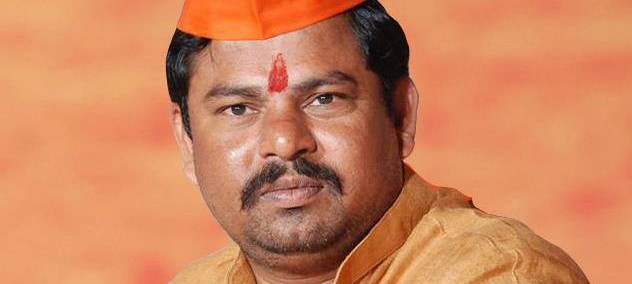
In a shocking statement, a BJP MLA from Telangana, Raja Singh, has threatened to behead those opposing the building of a Ram Temple at the site where the Babri Masjid once stood in Ayodhya.
“We can give our lives to build a Ram Mandir and we can also take lives,” the news agency ANI has tweeted Singh as threatening. “To those who warn of dire consequences if Ram Mandir [is] built…we were waiting for you to say this so we can behead you”.
This is not the first time the BJP MLA has indulged in inflammatory speech. In December 2015, recalling the lynching on Mohammed Akhlaq in Dadri (Uttar Pradesh), Singh had said, "We warn them against a Dadri-like incident in Telangana. We can both give our lives and take life for the sake of protecting the cow."
Even while the Supreme Court has recently refused early hearing on the clutch of petitions pertaining to the disputed site in Ayodhya, the chorus for building the Ram Temple has been growing. Union Minister Uma Bharti has declared she is ready to go to jail for the sake of the Ram Temple. UP chief minister, Yogi Adityanath has called for talks among the disputing parties to resolve the dispute.
One newspaper report may have done it all, Scroll.in discovered as it travelled to Bhind to get to the heart of the matter.
When media reports appeared on April 1 that electronic voting machines had spewed out slips showing just the symbol of the Bharatiya Janata Party, the lotus, during a demonstration by election officials in Madhya Pradesh, rival political parties were quick to latch on to them.
In March, in neighbouring Uttar Pradesh, Bahujan Samaj Party leader Mayawati had alleged that the voting machines used in Assembly polls held in the state in February-March had been rigged by the BJP. Arvind Kejriwal of the Aam Aadmi Party had made similar allegations about machines used in the Punjab polls conducted simultaneously.
So when reports said the electronic voting machines used in Uttar Pradesh had travelled to Madhya Pradesh for bypolls in Ater constituency in Bhind district and Bandhavgarh constituency in Umaria district that are scheduled for Sunday, and a paper audit trail had dispensed only slips with the BJP symbol, they caused much alarm. The incident also led to the suspension of 19 officials, including a district collector and a superintendent of police.
A committee set up by the Election Commission has found that there was no truth in the allegations.
Scroll.in travelled to Bhind to investigate the allegations and speak to journalists who were the first to report the story and officials who were present at the demonstration on March 31. An examination of the reports that appeared in newspapers and on TV channels suggests that misreporting by one newspaper seems to have made it all the way to the national media.
What happened on March 31
On the afternoon of March 31, the Madhya Pradesh chief electoral officer, Saleena Singh, held a media briefing at a hall in the zila parishad building in Bhind town to discuss election preparedness in Ater constituency. Among those present were top officials of the state election commission, former District Collector Ilayaraja T, Superintendent of Police Anil Singh Kushwah, a group of mediapersons and a senior zila parishad officer, among a few others. During the briefing, Singh talked about the voter-verifiable paper audit trail machine and how it works in conjunction with the electronic voting machine. She went on to give an impromptu demonstration of how the audit trail works.
A VVPAT machine records each vote on paper and allows the voter to verify the paper record while casting the vote electronically. A slip with the chosen party symbol appears on a display screen for seven seconds and then automatically drops inside the machine.
As Singh pressed a button, the lotus symbol with the name of Satyadev Pachauri – the winning BJP candidate from Govind Nagar constituency in Kanpur during the Uttar Pradesh Assembly elections, whose results were declared on March 11 – appeared on the display screen of the VVPAT machine. On seeing the lotus symbol, some reporters suggested in jest that the machine was biased towards the BJP. Singh responded to the comments. She laughed and warned them against reporting on such lines, saying she would take them to the police station if they did.
Some reporters took offence at the remark, even as Singh and her team of election officials went on to press at least two other buttons.
Till here, all the versions in the press reports match. The divergence is over what happened next.
A widely circulated video of the incident shows Singh’s exchange of remarks with the journalists while she tested the electronic voting machine but it does not show the results on the VVPAT machine.
What local papers reported
Three major Hindi newspapers have offices in Bhind – Patrika, Dainik Bhaskar and Nayi Duniya – and all three had reporters present at the briefing. There is a stringer who contributes to two major news agencies but he was not at the event. A stringer for Hindi news channel Aaj Tak was also present, among a few others.
Patrika headline on April 1: “Demo mein pehli parchi nikli Bhajpa ki, Congress ne kaha ballot paper se ho chunao” (BJP slip first to come out during demo, Congress asks for polls to be conducted with ballot paper)
The front-page report said the first slip that emerged from the VVPAT machine during the demonstration displayed the BJP symbol, and after some mediapersons raised questions, Singh threatened them. It went on to quote Madhya Pradesh Congress leader Govind Singh suggesting that the electronic voting machines were tampered with and asking for voting through ballot paper. The report did not say what results had emerged on the VVPAT machine after the buttons on the electronic voting machine were pressed twice more.
The report in Patrika on April 1 says the first slip to come out was that of the BJP with its lotus symbol.
However, the paper carried a second article next to the main report – headlined “Loktantra ki hatya ka prayas: Govind Singh” (Attempt to murder democracy: Govind Singh) – which had Congress leader Govind Singh’s take on the controversy. And in the continuation of that second story on an inside page, the reporter quoted the Congress leader as saying that BJP slips had come out twice when button number four of the electronic voting machine was pressed.
The continuation of the second report on Patrika.
When contacted, the chief of Patrika’s reporting team in Bhind, Ramanand Soni, said, “Lotus slip [symbol of the BJP] did not appear twice and we have reported the facts correctly.” The reporter, Subhash Tripathi, too stood by his story.
Nai Duniya headline on April 1: “Mukkhya Nirvachan Padashikari hass kar boli – press mein dia toh thane mein baithaenge” (Chief electoral officer jokingly said if you put it in the press, I will take you to the police station).
According to the report, the slips from the VVPAT machine emerged in this sequence: the first one showed the BJP’s lotus symbol, the second showed the Rashtriya Lok Dal’s hand pump, and the third showed the Congress’ hand. The report said the election officer asked the reporters not to publish anything about the VVPAT slips. Speaking to Scroll.in, the reporter, Abbas Ahmed, vouched for the accuracy of his report.
A senior officer of the district collectorate, who did not wish to be identified, and the chief executive officer of the zila parishad in Bhind, both present for the demonstration, also narrated the same sequence of slips.
The Nai Duniya report on April 1, whose headline focused on the exchange of words between the chief electoral officer and reporters.
Dainik Bhaskar headline on April 1: “EVM ka do baar button dabaya toh print huwa kamal ka chinh” (Pressed twice, EVM buttons produced slip with the lotus symbol) The report said the BJP slip appeared twice even though the election officers pressed two different buttons.
When asked about the difference between his account and the reports published in other newspapers, the Dainik Bhaskar reporter, Lajpat Agarwal, initially said he did not see anything clearly after the first two buttons pressed by the Chief Electoral Officer but he saw the election officials pressing four buttons in total.
“The symbol of the flower [Lotus] had appeared but whether she had pressed the same button corresponding to the Lotus, there is no clarity on that. But a lotus slip had emerged,” he said. He still did not clarify at what point he saw two lotus slips emerging on the VVPAT machine.
He then went on to say how Saleena Singh’s remarks had offended reporters. When pointed to the Nai Duniya report that said the slips had appeared in a particular sequence, he said that account was correct. Asked why then he had reported that there were two slips with the BJP symbol, he turned defensive and claimed he had seen two slips displaying the lotus symbol lying near the VVPAT machine.
The last claim is questionable. As far as the functioning of the VVPAT machine is concerned, the paper slips drop only in a container inside the machine.
Ravindra Jharkhariya, news editor of Dainik Bhaskar’s Gwalior office, to which the team in Bhind reports, claimed his was the only paper to have published the facts correctly. He refused to comment on the sequence of slips reported in other publications.
“If there was no problem in the VVPAT machine and BJP slip had not appeared twice, why did Ms Singh threaten the media?” he asked, adding, “The Election Commission is now trying to suppress the issue through its report [ruling out tampering].”
The Dainik Bhaskar reported that two slips of the BJP symbol were produced during the demonstration in Bhind.
Report of Election Commission
On Friday, the Election Commission published its report on the incident in which it clearly stated that four buttons were pressed on the electronic voting machine and four separate slips were produced in the VVPAT machine. It clarified the sequence as – hand pump (Rashtriya Lok Dal), lotus (BJP), hand pump (Rashtriya Lok Dal) and hand (Congress). No news reporter contacted by us, however, happened to have noticed the first hand pump symbol.
The national media
It took a day for the story to make it to national newspapers. On April 2, the Indian Express published a report with the headline “Madhya Pradesh EVM trial reignites ‘tampering’ row, EC calls for report”.
Since it did not have a reporter in Bhind, the newspaper relied on the reports that had appeared in the local papers. It began by saying: “Following reports that a Voter Verifiable Paper Audit Trail [VVPAT] machine used during a trial in Madhya Pradesh only dispensed slips with the BJP’s poll symbol…” But then, it also went on to reflect the confusion over what had happened in Bhind.
“There were varying reports of what transpired during the trial,” it said. “Some reports said the VVPAT machine dispensed slips with the BJP’s lotus symbol twice, although different buttons were pressed on the EVM. Another version, however, said different symbols were printed.”
The Times of India, however, dispensed with caution and termed the electronic voting machines “faulty”. In a report published on April 3, it said, “The EVM that triggered nationwide controversy after reeling out BJP voter slips during a dummy test in Bhind was routed here from Kanpur after being used in the UP assembly poll, an Election Commission team said on Sunday after testing it.”
While reporting that the VVPAT machines dispensed slips showing only the BJP symbol, NDTV attributed it to local media reports.
A report on Aaj Tak said: “EVM fails trial test in Madhya Pradesh’s Bhind. As soon as a button on an EVM was pressed, the BJP candidate’s slip appeared on the VVPAT. Election Commission has sought a report on the matter.” The Aaj Tak stringer, Sarvesh Purohit, told Scroll.in that the BJP symbol did not appear twice, but he refused to say what he had communicated to his office.
A story on ABP News, however, claimed the VVPAT machine had produced two BJP slips. The reporter in the piece-to-camera is Brijesh Rajput, a Bhopal-based correspondent. Reporters present at the trial said Rajput was not at the venue on March 31.
When contacted, Rajput said button number four on the electronic voting machine was pressed twice – once by an Election Commission officer and once by chief electoral officer Saleena Singh. “So technically paper slips corresponding to BJP appeared twice on the VVPAT. But what actually created a controversy was the exchange of words between Saleena Singh and some journalists,” he said. Rajput admitted that he was not present at the demonstration, but said he had received information from reliable reporters who had attended it.
There is still a catch there. In his telephonic report during the news show, Rajput tactically avoids saying “two different buttons”.
The Dainik Bhaskar report, however, said that though different buttons were pressed, the BJP slip had appeared on the VVPAT machine.
What Election Commission said
The Election Commission sent a committee of officials to Bhind to investigate the allegations. On Friday, it held a press conference in Delhi where it announced, “The probe concluded that the EVMs used in the demo in Bhind was not brought from Uttar Pradesh. However, the VVPAT used in the demonstration was brought from UP.”
Chief electoral officer Saleena Singh was not available on phone on Saturday. But Sanjay Singh Baghel, the state-level nodal officer (Madhya Pradesh) in her office, clarified on the controversy. “The CEO’s remark [about taking reporters to the police station] that was highlighted in the media was technically correct but said in an informal manner,” Bagel told Scroll.in on Saturday.
He added, “First, the VVPAT machine did not show wrong slips. The problem was that it was not cleared. Second, misreporting on VVPAT results can attract punishment under Rule 45MA of the Conduct of Election Rules, 1961, and so the CEO warned some media persons against doing so. The police station remark was in relation to potential violation of the rule, which is punishable by imprisonment and/or penalty and/or both. But it was said in a highly informal manner.”
According to Baghel, the matter was blown out of proportion after some political parties (he did not name any) took to social media and the entire narrative changed. “However, a few media organisations had reported the matter right on the first day itself,” he pointed out.
So what happened, actually?
Officials said the problem was that the demonstration on March 31 was unplanned. The protocol for a demonstration is that the machines used are reconfigured with random symbols – not the symbols of the BJP, Congress or any other party in the election fray. The Election Commission clarified that the confusion took place because old data stored in the machine in Uttar Pradesh had not been removed. The Hindu reported, “The machine, that was kept in reserve for the Uttar Pradesh polls, had undergone a standard protocol of randomisation and loading of symbols, but the old symbols were not removed ahead of the same procedure at Bhind in Madhya Pradesh.”
The United States’ unilateral missile strikes against a Syrian airforce base are a dramatic escalation of its participation in that country’s civil war. The US government has attacked a Syrian government asset for the first time.
The attack also marks Donald Trump’s first major foreign policy test as US president. It represents a 180-degree shift from his previous position of opposing intervention in Syria. And the sudden about-face sends a worrying signal for how his administration may handle future crises in international relations.
The operation
On Thursday, April 6, the US unilaterally launched strikes against the al-Shayrat airforce base in Homs. This base primarily houses Mig-23 and SU-22 strike craft and Mig-25 interceptors.
The attack consisted of 59 sea-launched Tomahawk cruise missiles, which targeted airframes and supporting infrastructure. It reportedly led to casualties among Syrian military personnel.
Unlike the actions of his predecessor, Barack Obama, prior to the 2012 Libya intervention, Trump sought no international legal sanction for the strike.
The attack has been justified as a punitive response to the Syrian military’s likely use of sarin chemical nerve agents against civilians in Idlib province. This led to at least 70 deaths and drew worldwide condemnation.
The Idlib incident was a much smaller repeat of a major sarin deployment in the Damascus suburb of Ghouta in 2013. That attack led to hundreds of civilian deaths – many of them children.
The Ghouta atrocity led the US to the brink of war with Syria; the Syrian government was alleged to have crossed Obama’s infamous “red line”. Ultimately, however, diplomatic manoeuvring by senior US, Russian and Syrian officials de-escalated the situation. They were able to negotiate the apparent dismantling of Syria’s chemical weapons program.
Recent events, however, suggest this dismantling was not as extensive as previously thought.
The strikes were launched from the USS Porter. Reuters
Trump’s humanitarian intervention?
What’s concerning is how the strikes have been rationalised. Trump has described the strikes as aimed at protecting a “vital national security interest”. However, this appears to contradict one of the fundamental themes that buoyed Trump’s rise to power.
The then-presidential candidate was criticised for appearing to be open to accommodating the anti-human-rights predilections of authoritarian rulers provided they served US economic and security interests.
Trump condemned the Obama administration’s response to the Ghouta attacks when strikes were under consideration. He explicitly and repeatedly indicated that, as president, he would adopt a non-interventionist position in Syria in spite of the humanitarian crisis.
This story was first published on The Conversation. Read the original.
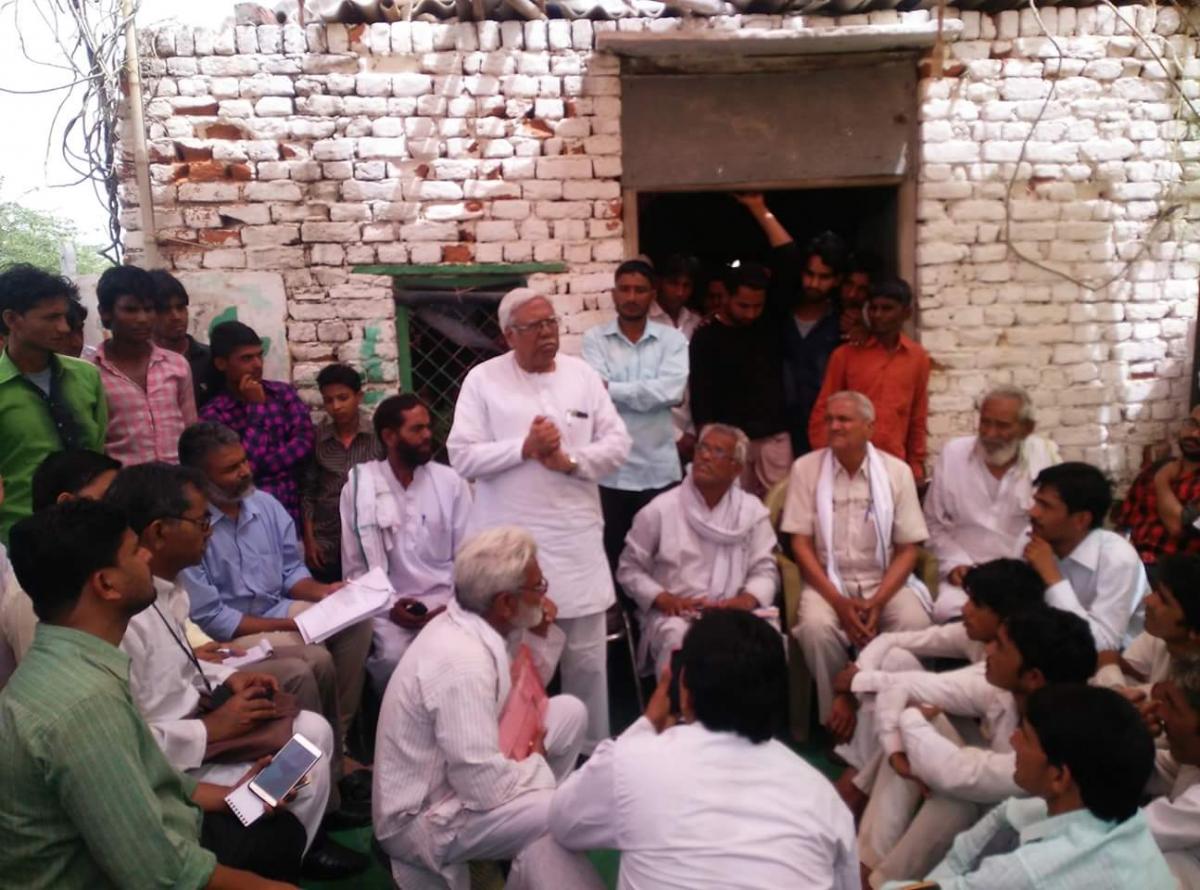
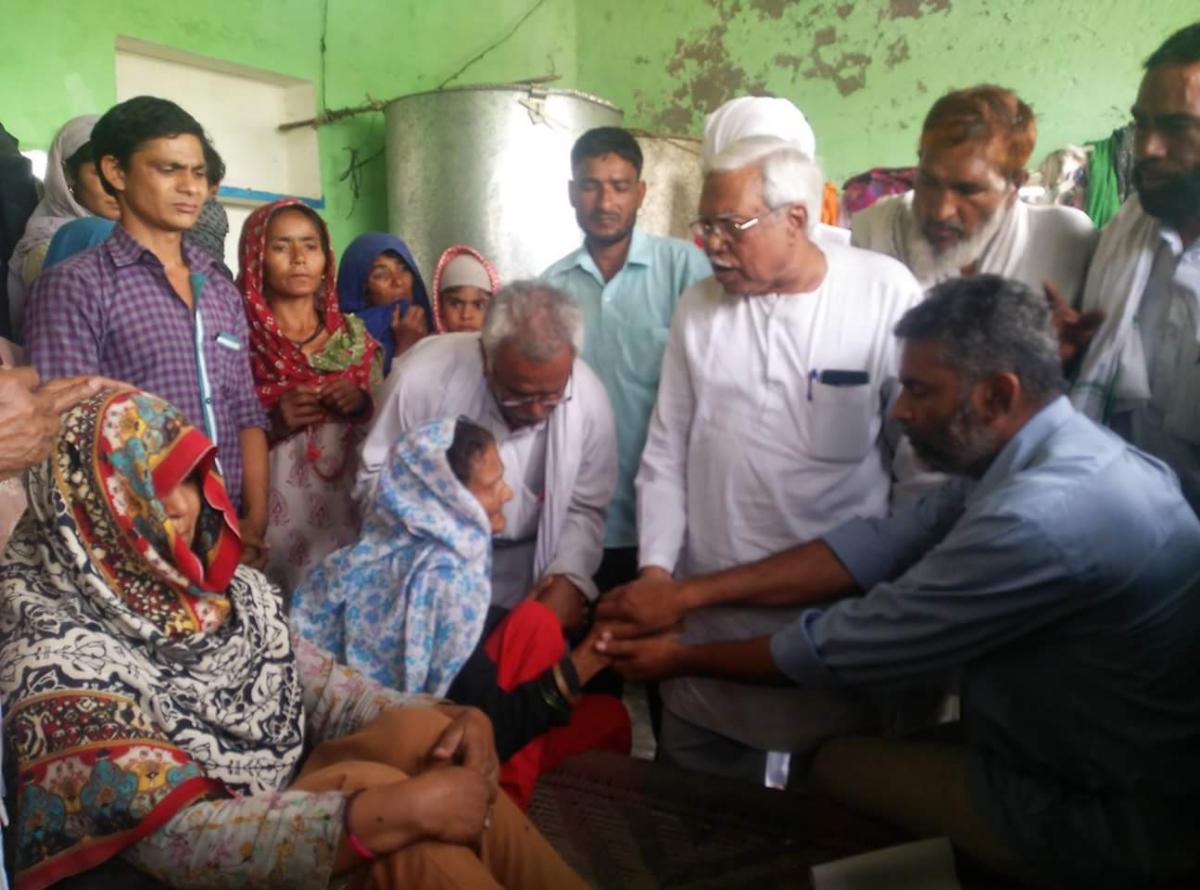
In the first political intervention after the gross lynching, to death, of a dairy farmer in Rajasthan , Pehlu Khan, last week, leaders of All India Kisan Sabha (AIKS) yesterday visited Jaisinghpur of Nuh District of Haryana to console the bereaved family members of Pehlu Khan, the dairy farmer who was allegedly killed by organisations reported to be a part of the sangh parivar. AIKS leaders including Hannan Mollah, former Member of Parliament (MP) and Polit Bureau Member, Subhashini Ali, General Secretary, P Krishnaprasad, Finance Secretary, Master Sher Singh, President of Haryana Kisan Sabha and Manoj Kumar visited the family of the victims. Satvir Singh, state president of CITU, Major S L Prajapathy, Gurgaon District secretary of CPIM were also part of the delegation.
The delegation met Pehlu Khan’s mother Ankuri Begam, wife Jebuna Begam, and two children Irshad and Arif who were also injured in the same incident. Pehlu Khan had six children including four daughters. The delegation also visited Ajmat who is bed ridden at home since he was forcefully discharged from the Alwar Hospital.
Hundreds villagers gathered to receive the Kisan Sabha leaders. Ajmal Khan, former MLA, Kalekhan, former sarpanch, Sarfudheen and Khaleel Ahamad Akthar Hassan of Sahdani Sabha Mewat, Raj Singh and Adv. Arshad khan among others attended the meeting. The meeting decided to call a panchayath of the people of neighborhood villagers in the next week to mobilise and protest the incidents that signal India's sliding into rank vigilantism.The family of Pehlu Khan has around 1.5 acres of land and is dependant on wheat cultivation and dairying as a means of livelihood. On that fateful day, Pehlu Khan, his two children, his nephew and two other villagers went to Jaipur to purchase milching animals since they hope they could get animals cheap in the Cattle fair of Jaipur Hatwada.
The Mewat region, dominated by a Muslim population has a rich tradition of Hindu Muslim amity and brotherhood, termed “Gothpal”. The Muslim families are traditionally peasants and cattle breeders. This has been eroded over the decades by the politics of division and othering. The brutal killing of Pehlu Khan by RSS organisations has created fear psychosis and nervousness among the peace loving people.
The FIR on the lynching clearly states that the mob which attacked the farmers belonged to the Viswa Hindu Parishad (VHP) and Bajrang Dal(BD) and also points to the role of the parent organisation, the RSS. After Pehlu Khan died succumbing to his injuries, district-level leaders of the VHP had even threatened the senior police officers of dire consequences if they arrest any of their activists. The Police, then registered a false FIR against Pehlu Khan and other innocent farmers despite the fact that they have records of the cattle purchase issued by the Jaipur Municipal Corporation. The Home Minister of Rajasthan has been, shockingly, accusing farmers of 'smuggling' cows by violating the law and even the Union Minister Mukhthar Abbas Naqvi has misguided the Rajya Sabha by denying that any such incident of murder even occurred in Rajasthan. All this exposes the role of RSS and BJP leaders who appear set to defend the lynch mob in general and those responsible for this gross murder, in particular.
The situation is serious, dragging the country towards anarchy and lawlessness which needs to be fought tooth and nail to protect the democratic rights of the people and to preserve the secular fabric of the society. The AIKS leadership has demanded a high level enquiry to unearth the conspiracy behind the Alwar Killing. The AIKS leaders also assured the village people and the family members all help to ensure strong action and stringent punishment to the entire culprits as per law including legal aid.