Finance Minister Arun Jaitley on Friday made a sensational claim that normalcy had been restored within few weeks of the unprecedented decision to recall 86 percent of the high-denomination currency in circulation.
Jaitley didn’t stop here. He went a step further and announced that there was absolutely no no shortage of notes in market.
Jaitley, according to a report by PTI, said that currency note printing presses of Reserve Bank of India as well as Security Printing and Minting Corporation of India Ltd (SPMCIL) have worked without a break to remonetise by issuing new bank notes.
Speaking at the 11th Foundation Day function of SPMCIL in the national capital, he made fun of his government’s critics saying that the easiest task during demonetisation was to pass comments and make snide remarks.
“But, the toughest work is to implement it. This is perhaps the biggest demonetisation drive in the world that was aimed at striking at the very root of corruption, black money and counterfeit currency,” he said.
Stating that people often commented that it may take up to one year or at least seven months to restore normalcy, he said the task has been achieved within a few weeks. “Normalcy has been restored within a few weeks and there is no shortage (of bank notes) in market for even a day,” he said.
And this has been achieved “without a single incident” of unrest anywhere in the country, he said, adding that this was possible because of the exemplary work done by the printing presses of RBI and SPMCIL who kept the supply line going.
However, Jaitley’s claims were far from the ground reality as millions across India continued to complain about dry ATMs even 100 days after the original announcement.
A report by IANS said that only one ATM in Laxmi Nagar of east Delhi was found dispensing cash out of a total of eight visited by its reporter. Rest either had ‘no cash’ signs or were simply ‘out of order’.
In posh Yusuf Sarai area of south Delhi, the ATMs of HDFC Bank, Canara Bank, Punjab National Bank (PNB), Kotak Mahindra Bank and IndusInd Bank were all found cashless. An Axis Bank ATM, according to the agency report, was the only one found with cash in the vicinity.
The situation in Sansad Marg (Parliament Street) was no different as none of the four State Bank of India (SBI) ATMs had cash, in addition to an Axis Bank machine near the YMCA nearby, which has not had cash since the demonetisation on November 8 last year.
In Delhi’s most happening Connaught Place, as many as eight ATMs were found to be either dysfunctional or without cash. This was reported from just two blocks of the shopping hub of Delhi.
In 2014, a total of 5,650 farmers committed suicide across India, but almost half of those suicide cases were reported from Maharashtra. It was revealed in the first ever comprehensive data on farmers’ suicides by National Crime Records Bureau.
The reasons for these farmers’ death, according to the report, were poor debt, bankruptcy, crop failure or family problems.
Three of the top four states with maximum number of farmers’ suicides were those where BJP had governments. This included Maharashtra (2,568 suicide cases), Telangana (898), Madhya Pradesh (826) and Chhattisgarh (443).
And yet, the senior public representatives belonging to the ruling BJP have time and again made fun of farmers’ plight.
The latest in the series is Madhya Pradesh MLA, Rameshwar Sharma, who has made astonishingly insensitive comments about farmers being forced to end their lives due to extreme poverty.
In the video shared by news agency ANI, Sharma said that those who committed suicides weren’t ‘real farmers’ but those who were in the habit of licking government subsidies.
Sharma said, “Mare vo kisaan hain jo kisaan kum aur subsidy chaatne ka vyapaar zyada karte hain (Those who have committed suicide are those who had less credibility as farmers and more of traders licking government subsidies.”
BJP Madhya Pradesh MLA Rameshwar Sharma says 'Mare vo kisaan hain jo kisaan kum aur subsidy chaatne ka vyapaar zyada karte hain' pic.twitter.com/XdghFAUSK6
It appears that Sharma isn’t the only BJP politician with utter disdain for India’s farmers.
In February last year, a BJP MP from Maharashtra, Gopal Shetty had said that those committing suicides were doing so because it had become a fashion trend.
Shetty was quoted, “All farmer suicides are not only because of hunger and unemployment. There is a fashion, a trend is on. If Maharashtra government is giving Rs 5 lakh, another government is giving Rs 7 lakh, Rs 8 lakh. There is a competition going on to give money to farmers.”
In 2015, soon after Narendra Modi won a historic mandate at the Centre, his agriculture Minister, Radha Mohan Singh, blamed dowry, drugs, love affairs and impotency for over 1400 farmer suicides in India that year.
“According to the National Crime Records Bureau, causes of (farmer) suicides include family problems, illness, drugs… dowry, love affairs and impotency,” Singh said in a written reply to a question, while not ruling out debt as one of the reasons at the same time.
The remarks immediately sparked off a furore by the Opposition, which had been targeting the government for a long time over the controversial land bill, deemed as anti farmer.
Tripura Governor Tathagata Roy today refused to read out some portion of his written speech having criticism of the Centre, in the Assembly on the opening day of the budget session, which led to uprorious scenes.
While reading the written speech, the Governor said “I have read out two pages and now I would read out after para 95.”
On which the Opposition Trinamool Congress members led by Sudip Roy Burman asked the Governor, “Why should you not read out the total speech? We are not opposing you. This is not the convention.”
The MLAs then rushed to the well of the house and shouted slogans like shame, shame. The ruling Left Front members, however, did not react.
The governor read out the rest of his written speech and left the Assembly House.
The governor did not read out the portion which stated, “Communal situation in the country is tense. Minorities and Dalits are under attack and intolerance is increasing. This is what is causing harm to peace, tranquillity, and sense of integrity which is very important for the advancement of the country.”
“Dismantling the erstwhile Planning Commission has caused financial constraints to special category states, more particularly small, North Eastern states like Tripura with limited internal resources,” the written speech said.
“Due to non-functioning of the consultative mechanism between the centre and states, the trend of one party rule is increasing. Thus, the federal structure in the country is virtually under jeopardy,” it said.
“Farmers are not getting remunerative prices of their produce; as a result suicide among farmers have been increasing for the past three years,” it added.
“Demonetisation has paralysed the financial transactions, as over 85 per cent of currency in circulation has been rendered in one stroke. It has caused immense hardship to the common people,” the speech said.
CPI(M) state secretary Bijan Dhar declined to comment saying that he is not a member of the House.
Roy Burman said, “What astonished me is the silence of the ruling party members. They kept mum because the government led by Manik Sarkar did not want to annoy the Modi government because the Centre is well aware about corruption of this government and its involvement in chit fund scams.
“What was the reason for the decision? The reason is that in the governors speech, the role of the NDA government was sharply criticised, so, he skipped that portion,” the TMC leader said.
Roy has been a hugely controversial governor because of his repeated hate-filled tweets targetting India’s Muslims. His critics have always slammed him for bringing the office of a constitutional post to utter disrepute.
In 2015, he had proudly flaunted his long association with the Hindutva organisation, the RSS, adding that he continued to take part i the latter’s activities even after assuming the office of the governor.
The story of the communal violence that preceded the 2014 Lok Sabha polls continues to haunt even as the Assembly polls are underway in UP.
Why does every bout of brute, targeted violence inevitably become a battleground for sexual violence against the community’s women?
We saw this gruesome pattern during the bloodshed that surrounded India’s partition. Sikh, Muslim and Hindu women in equal measure were held to account, in revenge and wrath for what was perceived as the fault of the community they belonged to.
The same pattern has held true in various parts of India and South Asia thereafter – in the brute post partition anti-minority bouts of violence in India, including the violence suffered by Kashmiri Pandits in the Kashmir valley.
Unmatched in gruesome scale and scope were the Gujarat 2002 massacres, where by the state’s own admission, as many as 193 women and girls, of the Muslim minority, were targeted and attacked. (Independent assessments put the figure closer to 250). Several lessons have been learned from the struggle for justice in Gujarat that has, to date, in an unprecedented “success rate” convicted over 172 powerful perpetrators. In three of the criminal trials, the narrative of gendered violence found space during the court proceedings.
The need for thorough recording of the first information report, independent investigations, time bound trials and a robust witness protection programme are the prerequisites of any struggle for justice as the robust Gujarat experience shows. Over 570 witness survivors, lawyers and human rights defenders, to date have such protection by the para-military, guaranteed by the Supreme Court.
The Supreme Court’s continuous monitoring the progress of the trials also ensured some degree of redressal as time wore on and the investigating agencies slipped into cruel lethargy.
Losing hope in western Uttar Pradesh
It is, this month, a decade and a half after the state-wide carnage in the western Indian state.
Three years and five months ago, four districts of western Uttar Pradesh that have just celebrated democracy’s ultimate festival, the Assembly elections in the state, saw just such an upsurge. Muzaffarnagar, Baghpat, Shamli and Meerut erupted nine months prior to India’s general elections in May 2014 with targeted violence.
Not only were more than 60 lives lost and several thousands of the minority community internally displaced (this author was witness to deaths by the cold, of women and children, in the open-field relief camps all over the districts) but women, as usual bore the brunt.
Seven courageous women complained and documented their tale. Despite the Supreme Court of India being seized of the matter, not once but twice, and even passing salutary directions on several pleas, the abject failure of state mechanisms to deliver real and substantive justice raises questions of institutional accountability towards the dignity, justice and the well being of its citizenry, especially if the victim survivor hails from the voiceless – uninfluential – section of our people.
Amnesty International’s detailed report of its investigation of this targeted communal violence, Losing Faith – The Muzaffarnagar gang-rape survivors’ struggle for justice, is a testimony to the courage of the survivors and an exposure of the hollow claims of the protection of constitutional rights by the Indian state. Celebrate as we do election time and the festival of the ballot, little do issues of human rights and dignities matter when the campaign trail blazes shrill and strong. In the immediate aftermath of the first phase of elections in Uttar Pradesh, exactly where the tragic tales of the rape survivors are located, will this narrative have any impact?
Of the seven rape survivors, one died in child birth last year. A month before she died, she said to Amnesty, “If those responsible are brought to justice, I will be happy in my heart. I will not live in fear anymore “(Esha, a gang-rape survivor, July 2016). Her evidence had not even been recorded before she died. A petition for the transfer of her case outside the district of Muzaffarnagar had been filed in April 2016 and is, shockingly, still pending. Of the other five, two have been forced by bitter court delays and the force of circumstance to turn “hostile”.
“Fair trial means a trial in which bias or prejudice for or against the accused, the witnesses, or the cause which is being tried is eliminated. If the witnesses get threatened or are forced to give false evidence that also would not result in a fair trial.” — – Supreme Court of India, Zaheera Sheikh v State of Gujarat, 2006
The detailed narratives of all seven survivors reveal the utter failure of the state to preserve and protect witness testimonies. Not only was police protection denied to them but the deliberate and prolonged delays in the hearings and the constant intimidation and threats by the alleged accused have ensured a pervasive culture of impunity to the perpetrators.
In all seven gang-rape cases, the police took months to file charges, and even after they did so, trials have proceeded extremely slowly, making a farce of the famed 2013 amendment to Section 309 of the Code of Criminal Procedure that dictates “day-to-day hearings until all the witnesses in attendance have been examined, “ and completion of a trial, in rape cases “within two months”.
Image: Losing Faith – Amnesty Report
One of the complainants, Fatima, tried unsuccessfully to file an FIR on September 20, 2013 and finally succeeded only on October 9 that year. Another, Ghazala, sent her complaint as early as October 22, 2013, but the police registered an FIR only after the issue was raised before the Supreme Court, on February 18, 2014. Ghazala too has applied for her case to be transferred out of the district. She told a trial court in January 2016,
“I am extremely apprehensive of coming to the Muzaffarnagar District court as the accused persons and their family members who all belong to the dominant community wield considerable influence in this area. I fear that harm will be caused to me and my family when I go to give my evidence in the Muzaffarnagar District court.”
The National Commission for Minorities, too, after a visit to the area in June 2014, has documented several complaints “about harassment of rape victims”.
Though the initial directions from the Supreme Court ensured that Rs 5,00,000 in compensation was paid to these survivors, the absence of any livelihood and continued threats and intimidation by perpetrators and even the police have rendered their existence fragile.
The continued need for robust and persistent legal aid, adequate reparation as also the enactment of a law to prevent communal violence (a task this country aborted mid-track in 2014), as also a witness protection programme are the need of the hour. Only through police reform will we reach a stage where there is thorough and independent investigation.
But the ruling dispensation in New Delhi remains blind to the fact that some of its cadres and party men even today remain accused of being the perpetrators of such hate-filled acts of vengeance and of further intimidating those who dare struggle for lasting peace through justice.
Teesta Setalvad is secretary, Citizens for Justice and Peace.
Some students were offended by a January 9 Facebook post on hate-speech and accused her of blasphemy against the Prophet
Image credit: Shehla Rashid via Facebook
Aligarh Muslim University students, who stood by their counterparts in Jawaharlal Nehru University through many crises over the past year, on Thursday slammed their door shut on former JNU students’ union vice-president, Shehla Rashid Shora. Not only did the Aligarh university’s students’ union cancel a meeting of student leaders planned for Saturday that Shora and five others from JNU were slated to attend, it even filed a police complaint against her.
The reason it stated: Shora allegedly made objectionable remarks against Prophet Mohammad in a Facebook post. On January 9, she allegedly wrote “insulting things” about other religions too, the Aligharh students union said. Her post had “disturbed students” and could potentially “spoil [the campus] atmosphere”. On social media, other Aligarh students accused her of blasphemy.
Hate speech and religion
Shora’s post was on hate speech. The paragraph to which some AMU students took strong exception dealt with hate speech and insulting statements about religious figures. Some also took offence with an article she wrote in 2013 arguing that Prophet Mohammad was a feminist.
Students protest
The controversy boiled up over February 14 and 15, when Aligarh Muslim University Students’ Union president, Faizul Hasan announced on his Facebook page that the union was organising an “all India students’ leader meet” at the university and had signed on over a dozen leaders, six from JNU alone, to speak. The others invited from JNU were student leaders Kanhaiya Kumar, Umar Khalid, current president Mohit Kumar Pandey and another former president, Akbar Chaudhary.
A handbill featuring student leaders from Delhi and Allahabad Image Credit: Facebook/Faizul Hasan
The reactions poured in soon after with Facebook users posting sections from Shora’s post. One called her “shaitaan” – devil – and another wrote, “I would slap her if she will say anything about religion.” A student group called the Aligarh Muslim University Students’ Front issued a handbill declaring her a “Gustaakh-e-Rasool” – “One who says something wrong about the Prophet,” explained Ghazala Ahmad of the students’ union. They described Shora’s post as “blasphemous.”
AMU Students' Front issued a handbill Image credit: Facebook
‘Hurt Sentiments’
Shora was furious. She alleged on Facebook that “a very jealous person [was] trying to instigate students of AMU against [her]”. She also pointed out that fuss over her alleged blasphemy would draw attention away from the issue she had wanted to discuss – the disappearance of JNU student, Najeeb Ahmed, from campus in October, after a scuffle with members of the Rashtriya Swayamsevak Sangh’s student wing, the Akhil Bharatiya Vidyarthi Parishad.
“I will not defend myself, because anyone who is acting outraged has either not read the article, or is trying divert the issue from Najeeb,” she wrote. “I refuse to allow myself to be targeted for giving scholarly opinion on hate speech.” She was still going to Aligarh, she wrote.
But on Friday, she issued a statement announcing she had cancelled her visit because she feared, given the conditions on the Aligarh campus, that her presence “might create an unnecessary media spectacle and…divert the issue from Najeeb Ahmed’s disappearance”.
Khalid wrote a post in Shora’s support saying:
‘Hurt sentiments’ are largely used by the dominant majority to silence and even kill the minority communities and it thrives on lies and rumour mongering….But what this case reveals is that some forces even within the persecuted minority deploy such tactics, when they see the possibilities of democratisation within.
Leaders’ meet postponed
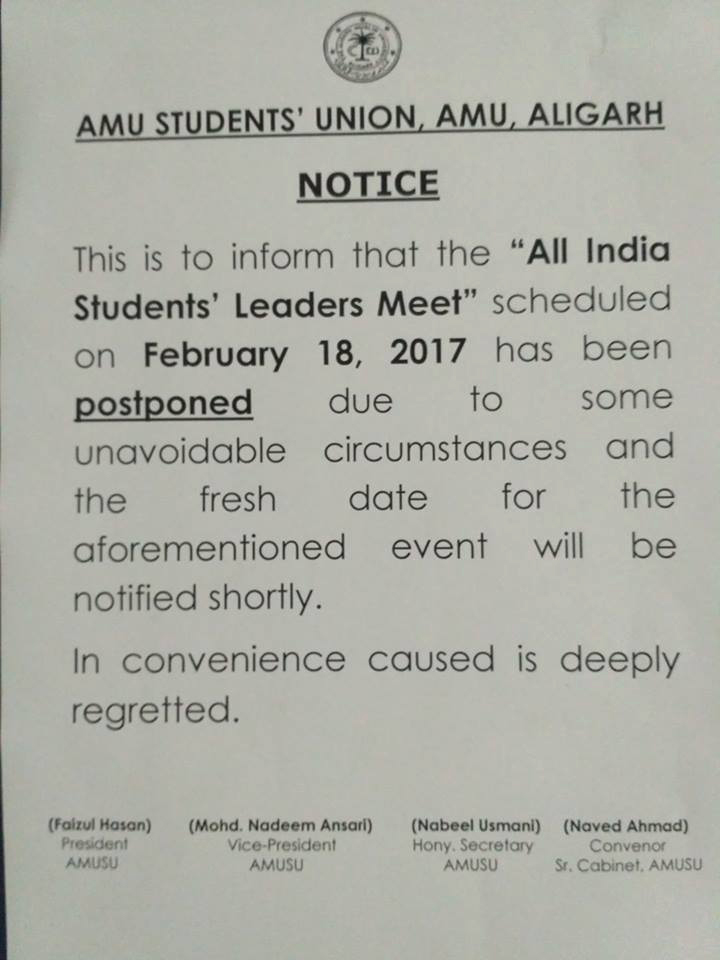
On Friday, the Aligarh students’ union decided to postpone the programme.
Notice announcing postponement of the leaders' meet Image credit: Facebook/ Faizul Hasan
Aligarh student leader Hasan’s note accompanying the image of the handbill online left no doubt about what those “unavoidable circumstances” were. He wrote: “Our executive decision is for alma matter and our religion. We the student’ Union is for whole AMU and its interest, we will boycott who blame on our religion and our beloved Prophet.”
This decision also drew criticsm. One student argued that they could have just left Shora out instead of cancelling the entire event. Another wrote that her Facebook post “does not amount to blasphemy or a hate speech against Islam or Muslims.” He suggested that the union “seek the support of Marxists, Ambedkarites etc. so that common problems of…marginalised sections of India are resolved conveniently”.
A copy of the police complaint filed against Shora.
Mishra spoke about his new book, which seeks to explain why the world seems to be going up in flames.
We live in a disorienting world. In West Asia, the Islamic State uses displays of cruelty and religious fanaticism as a propaganda tool. In large swathes of Europe, far right nationalism is rearing its head for the first time since after the defeat of fascism in World War II. The world’s only superpower, meanwhile, has a president elected to office on an explicit programme of racial and religious bigotry, attacking Muslims and non-White Americans in his campaign speeches.
And, of course, closer home in India, the ideology of Hindutva, which considers India to be a “Hindu nation”, grows ever stronger, assaulting Muslims and Dalits in its wake.
In his new book, intellectual Pankaj Mishra tries to explain this fury enveloping the world. Titled Age of Anger: A History of the Present, the work traces traces today’s discontentment to the rapid changes of the 18th century, when modernity was shaped. You say that the enlightenment gave rise to some “irresistible ideals: a rationalistic, egalitarian and universalising society in which men shaped their own lives”. So why do so many people disagree with the way in which you see the enlightenment? You’ve shown it to be a very positive thing. So how are, say, Islamists looking at it differently? Why do they disagree?
Well, I am not sympathetic to their critique and I am not sure that they’re directly critiquing the Enlightenment rather than the consequences of the kind of thinking introduced by the Enlightenment philosophers in the late 18th century. And let’s be careful here: many of the consequences weren’t anticipated by these philosophers themselves.
What they were talking about was a polity. And for them a polity was the church and then the monarchy. And they thought individuals could use reason since there had been enough scientific breakthroughs, enough revelations about the nature of reality out there. They did not need intermediaries like the church to tell us what to think about the world, what to think about reality. We could use our individual reason to construct our own worlds essentially and shape society. That was the fundamental message they had. They had no idea what would happen in the 19th century.
What happened in the 19th century was something very different: large nation-states came into being, the process of industrialisation started, the use of individual reason expanded, science took off, all kind of new technologies came into being, and large political and economic webs were built.
The Islamist critique of that would be: too much responsibility for shaping the world was placed upon the extremely fallible minds and sensibilities of the human individual. That this was going against centuries of custom, tradition and history. Human beings had always been seen as being very frail and weak creatures who needed some kind of constraint and that was the role of traditional religion.
Religion reminded humans being of the severe limitations that life imposes on everyone. Whereas the promise of freedom and emancipation sets off all kinds of unpredictable processes that result in actually more oppression and more pain.
So that would be or has been the modern critique of the Enlightenment – which is shared by a pretty broad spectrum of people, not just the Islamists. Mahatma Gandhi himself voiced many of these critiques of modern science, modern industry and the modern nation-state. You have to remember that Rabindranath Tagore himself expressed those critiques. So we also have to look at these other critics of Enlightenment rationalism.
You go into some detail in describing Savarkar in the book. In many ways, a very good argument could be made that Savarkar was a rationalist. He said Hindus should eat beef, for example. How does a Savarkar then map to the more modern forms of Indian conservatism? How do you go from Savarkar to the current-day gau rakshak?
I think Savarkar is essentially a child of Enlightenment rationalism despite all the claims made for an unbroken Hindu tradition. The important thing to note about the Savarkar variety of Hindu nationalism is that it is deeply European and deeply modern. Which was one reason why Gandhi was so opposed to it. He said this was the rule of Englishmen with the English in his book Hind Swaraj.
So Savarkar does not partake of a critique of the Enlightenment. He, in fact, in very much a product of 19th century Europe, which advances Enlightenment rationalism in unexpected directions. He starts to think of a national community of like-minded individuals. He starts to think of a past which can be recruited by the present, that can be deployed politically. Savarkar subscribes to everyone of these political tendencies which are elaborated most prominently by [Giuseppe] Mazzini. So he comes out of that particular tradition.
So this whole reverence for figures and symbols from the past which the gau rakshak seems to manifest is a total 19th century fantasy. People did not think of the past in that way before that century. The past was very deliberately enlisted into a nationalist project. Every nationalist – and I write this in the book – had made some sort of a claim upon the past, made some sort of connection.
We are now looking at history as a series of ruptures and new beginnings. In Savarkar’s case, the rupture would be the Muslim invasion of India. That’s also the case for [VS] Naipaul. That was the big rupture that violates the wholeness of the Hindu past. And now we are invested in a new beginning, which is the revival of Hindu glory.
This whole way of looking at time, of looking at human agency and identity is a product of the European 19th century. And that’s where Savarkar should be placed. I think we spend too much time comparing him to the Germans and the Italians of the 1930s. I think we should go back and look at the 19th century more closely. And also look at Savarkar – which I’ve done in the book – together with various other tendencies such as Zionism.
But it’s not only Savarkar who’s doing this, right? There’s a whole galaxy of Indian leaders, right from Nehru to Jinnah, taking off from the Enlightenment. In your book, you quote Dostoyevsky, who underlined a tragic dilemma: of a society that assimilates European ways through every pore only to realise it could never be truly European. Is there anything that can be done to break this dilemma?
The short answer would be a pessimistic one: that there is no way to break this. Because once we make that original break from pre-modern/rural/traditional society, break away from belief in god, from belief in a horizon that was defined by transcendental authorities, once you stop living in that world, then you are condemned to finding substitute gods. And the national community and the nation state has been that substitute god or transcendental authority for hundreds and millions of people for the last two hundred years.
And one reason it endures – even though in many ways the nation state has lost its sovereign power after being undermined by globalisation – is that as an emotional and psychological symbol, and as a way to define the transcendental horizon, the nation state is still unbeatable. So once we make that basic move away from the pre-modern modes of life into this modern, industrialised, urbanised mode of existence, we have basically embarked on a journey where there’s no turning back. There’s no breaking out of that.
Where do you situate Modi on this scale? I think Modi is an interesting case. He’s not only someone who incarnates the tendencies that we identify with Savarkar – who is a model for Modi – but also mirrors many contemporary tendencies which one can identify with a sort of aspirational neoliberalism. The man from nowhere who makes it big: that’s the story that Modi has tried to sell about himself. That he’s the son of a chaiwallah who has overcome all kinds of adversity including violent, vicious attacks from the country’s English-speaking elites who wanted to bring him down but failed. And he has overcome all these challenges to become who he is. And he invites his followers to do the same.
So, in that sense, he not only is a Hindu nationalist in the old manner of thinking of India as primarily a country of Hindus and as a community of Hindus which needs to define itself very carefully by excluding various foreigners, but also someone who is in tune with the ideological trends of the last 30 years, which place a lot of premium on individual ambition and empowerment, not just collective endeavour. So he is a very curious and irresistible mix, as it turns out, of certain collectivist notions of salvation with a kind of intensified individualism.
You used a very interesting phrase there: “aspirational neoliberalism”. In the book, you use another term, “neoliberal individualism”. In my opinion, you take a negative opinion of this sort of individualism. Could you tell us what “neoliberal individualism” is, how is it different from, say, Enlightenment individualism and why are you taking a negative view of it.
Individualism really is synonymous with modernity, which is all about individual autonomy and reason. The most important difference is that the previous forms of individualism had certain constraining factors. There would be religion, the nation state, the larger collective.
When [Alexis de] Tocqueville goes to America and begins to describe individualism at work in the world’s first democratic society, he is aware that all of this is made possible because religion is a very important factor. There are many intermediate institutions there to mediate between individuals and the larger reality of society. So these factors were extremely important for individualism to actually work properly.
What neoliberal individualism proposes, though, is essentially that we don’t actually need these intermediaries. It buys into a kind of extreme libertarian fantasy of the kind we see people like Peter Theil [co-founder of PayPal and vocal Trump supporter] expressing. They’re saying, “we don’t need government”, “we don’t need collective endeavour of any kind”, “we don’t really need notions of collective welfare, general welfare or common good”.
They believe individuals pursuing their self-interest can create a common good. And the marketplace would be where these individual desires and needs could be miraculously harmonised. So it’s a kind of mysticism, really, neoliberal individualism. It basically argues that we don’t need any constraining factors. We do not need any intermediate institutions of the kind Tocqueville argued for in America. Neoliberal individualism says, all we really need is individual initiative, individual energy, individual dynamism and, of course, individual aspiration. So this is how neoliberal individualism is different from previous forms of individualism.
It is interesting that you mention Peter Theil, a major supporter of Trump. Is neoliberal individualism then powering Trump? Well, no. That’s the thing. There are many contradictory elements in this mix. To go back to Modi, he comes from a party which has as part of its extended family the Swadeshi Jagran Manch. The Manch believes in Swadeshi but Modi wants to attract foreign investment.
I think we have to start thinking of a world where archaisms, modernity, post-modernity all exist simultaneously yet differently. You can think of it as different territories. Trump can therefore mobilise a whole lot of disaffected individuals who have believed in the neoliberal ideology and have felt themselves victimised by various technocratic elites and attract a figure like Theil, who claims to be a libertarian, and at the same believe that economic protectionism is the way to go.
I think there are many different contradictory tendencies that have come together to produce events or personalities like Donald Trump and Modi. I think if we were to follow this old analytic method of either/or we would miss many of these contradictory aspects of modern politics and economics. In the same way, Erdoğan mixed in neoliberalism with Islamism and Putin mixed in Orthodox Christianity with Russian Eurasianism. There are all kinds of mixtures on offer.
The central argument being that they correspond to the acute, inner divisions of human beings. Of people wanting individual power, expansion and at the same time wanting identity, longing and a sense of community. So this is, in a way, a little snapshot of where we are – a kind of endless transition.
Age of Anger: A History of the Present, Pankaj Mishra, Juggernaut Books.
At the New Amtipani mine, workers must mark their attendance on the biometric system four times a day or forego their wages.
Image credit: Anumeha Yadav
It was lunch break at the New Amtipani bauxite mine, operated by the Aditya Birla Group subsidiary Hindalco, in the flat-topped plateaus of Jharkhand’s Gumla district. Several Asur Adivasi men who worked there waited in a line outside the supervisor’s office, instead of heading home to their village in the nearby forest for their afternoon meal as they usually did.Almost all the Asur Adivasis in Jharkhand's Gumla district work as daily-wagers at mines.
Three months ago, the supervisor had installed a fingerprint scanning machine in the office and instructed the miners to mark their attendance on it.
The biometric-based system, increasingly common in offices in cities across the country, had arrived in remote Amtipani deep inside Gumla’s Netarhat forests as well. But while office-goers mark their attendance when they reach their workplace in the morning or leave for home in the evening, the Amtipani miners had to get their fingerprints scanned on the little black machine four times every day, or they would lose the day’s wage.
Workers line up at the biometric device to mark their attendance at the New Amtipani mine.
Budhna Asur, a middle-aged miner, said he woke up at 4 am every morning to work on his small plot of paddy. He then reached the mine at 7.45 am to mark his attendance. “Then at 12.45 pm, before we go for lunch, we have to scan our fingerprints on the device, and then do it again at 2 pm, and then at 6 pm,” he said.
Jeevan Asur said the mine management had installed the biometric system after all 170 employees had struck work for a month last August to negotiate an increase in their wages. “We told the management, we have worked in the mine for eight years, increase our pay from the unskilled work grade of Rs 247 per day to at least Rs 500,” said the miner. “They increased it to Rs 307, a semi-skilled grade and just half of our demand. On top of that, we were told that if you don’t put your thumb into the new machine four times a day, be prepared to be paid the old rate.”
The miners must get their fingerprints scanned four times a day, or lose the day's wages.
Ancient metallurgists
The Asur Adivasis draw their lineage from the buffalo demon Mahishasur, and were portrayed as demons and enemies of gods in prominent Hindu texts. They are also credited with being the country’s first community of iron smelters. Today, they are one of India’s dwindling Particularly Vulnerable Tribal Groups, and one of the smallest Adivasi groups in Jharhand. Asuri, their language, is on the verge of extinction, with less than 8,000 people speaking it.
New mining technologies, and forest laws that restrict the forest-dwelling Asur from burning wood to produce the charcoal used in their smelting work have slowly made their traditional means of livelihood redundant. For the last eight years, the 200-odd Asur Adivasi families living in the villages of Ghorapahad, Sekuapani and Amtipani in Gumla have worked at Hindalco’s bauxite mines. The Asur inventors, the kings of the forest kingdom, have become daily-wage workers in their ancestral land.
Sudhna Asur's index finger was crushed in a mine accident. He spent Rs 10,000 on medical treatment.
In Ghorapahad, nearly all the men work at the mine. The women and children spend several hours a day carrying water from three kilometers away, and tend to what remains of their agricultural land, covered under layers of excavated red mine dust. Phaguni Mundain, one of the women, said the produce has dropped by a third over the years.
Pusa Asur, who works at the New Amtipani mine, still remembers watching his forefathers “smelt iron out of stone”.
“We made our own tools – khulaarhi, paal, pharsa, teer (axe, plough, spade, arrow) – for hunting and farming,” he said. “There are still two to three men in Ramdharia hamlet who know how to smelt stone and extract metal. Any tool you can think of, they could make.”
But now, the manual process would be too slow and its results too small compared to the current rate of production, he added.
Fellow miner Budhna Asur, who worked at construction sites in cities for a few months some years ago, said he had seen the tools Pusa spoke of. “The tools the Asur and Birhor [a nomadic group] made are displayed at the Ranchi museum,” he said. “I saw them in 1995 on a trip to the city.”
Lunch break over, it was soon time for the men to head back to the mine and line up to mark their biometric attendance, again.
wo years ago, on this day, Govind Pansare, was shot when he was returning after a morning walk with his wife in Kolhapur in the morning. He died four days later, on 20th February, 2013. He was vocal in his support for the rationalist, Narendra Dabholkar, and, who was killed a year and a half earlier, on 20th August, 2013. On that same day, Pansare had come to pay his final respects. The next day he told the Times of India that the attack was not personal, but ideological. Dabholkar, founder of the Maharastra Andhashraddha Nirman Samiti (Maharashtra Blind Faith Eradication Committee), and Pansare, a member of the Communist Party of India (CPI), were both rationalists targeted for their beliefs. A year later, M.M. Kalburgi, would also be killed in Dharwad.After Dabholkar's murder, Avinash Patil, his long time associate, was elected to carry the activities of MANS forward. Patil, currently in Delhi, explains the current status of the investigations in an interview with the Indian Cultural Forum.