नई दिल्ली। दो दिन पहले ही मानव संसाधन विकास मंत्रालय में सूचना आयुक्त एम. श्रीधर आचार्युलु ने पीएम मोदी की डिग्री सार्वजनिक न करने के आरोप में दिल्ली विश्वविद्यालय की सीपीआईओ पर 25,000 रुपए का जुर्माना लगाया था। इसकी कीमत सूचना आयुक्त एम. श्रीधर आचार्युलु को अपना पद गंवाकर चुकानी पड़ी।
HRD मंत्रालय सूचना आयुक्त एम. श्रीधर आचार्युलु द्वारा दिल्ली विश्वविद्यालय की 1978 के बीए डिग्री रिकॉर्ड की जांच का आदेश सार्वजनिक किए जाने के करीब दो दिन बाद ही मुख्य सूचना आयुक्त आर. के. माथुर ने उनसे (एचआरडी) मंत्रालय का चार्ज छीन लिया है।
जिसके बाद अब मानव संसाधन विकास मंत्रालय से संबंधित सभी शिकायतें व सुझाव अन्य सूचना आयुक्त मंजुला पराशर देखेंगी। उन्हें इसका पूरा चार्ज सौंप दिया गया है। इससे जुड़े सारे फैसले अब वहीं करेंगी। यह आदेश मंगलवार को दिया गया।
आपको बता दें कि मुख्य सूचना आयुक्त (CIC) को यह विशेषाधिकार है कि वह किसी भी आयुक्त को कोई भी विषय सौंप सकता है। यह आदेश काम सौंपने के संबंध में 29 दिसंबर को लिए गए एक अन्य आदेश के कुछ दिन बाद आया जिसमें आचार्युलु को एचआरडी मिनिस्ट्री के चार्ज पर बरकरार रखा गया था। 21 दिसंबर को आचार्युलु ने दिल्ली विश्वविद्यालय को वर्ष 1978 में बीए डिग्री पास करने वाले सभी विद्यार्थियों के रिकार्ड की पड़ताल करने का आदेश दिया था।
1978 वही साल है जब विश्वविद्यालय के मुताबिक प्रधानमंत्री मोदी को डिग्री मिली थी। द इंडियन एक्सप्रेस ने सीआईसी आर. के. माथुर से संपर्क साधने की कोशिश की लेकिन बात नहीं हो सकी, वहीं आचार्युलु ने इस पर कोई भी टिप्पणी करने से इंकार कर दिया।
पिछले साल यूनिवर्सिटी ने प्रधानमंत्री नरेंद्र मोदी की स्नातक डिग्री के बारे में सूचना के अधिकार (आरटीआई) के तहत जानकारी मांगने वाले आवेदन को अस्वीकार कर दिया था। उस समय कहा गया था, “यह छात्रों की व्यक्तिगत जानकारी से संबंधित है, जिसका खुलासा करने से किसी भी सार्वजनिक गतिविधि या हित से कोई संबंध नहीं है।” हालांकि आयोग ने कहा था कि छात्रों की शिक्षा से संबंधित मामला वर्तमान हो या पूर्व सार्वजनिक हित की श्रेणी में आता है।
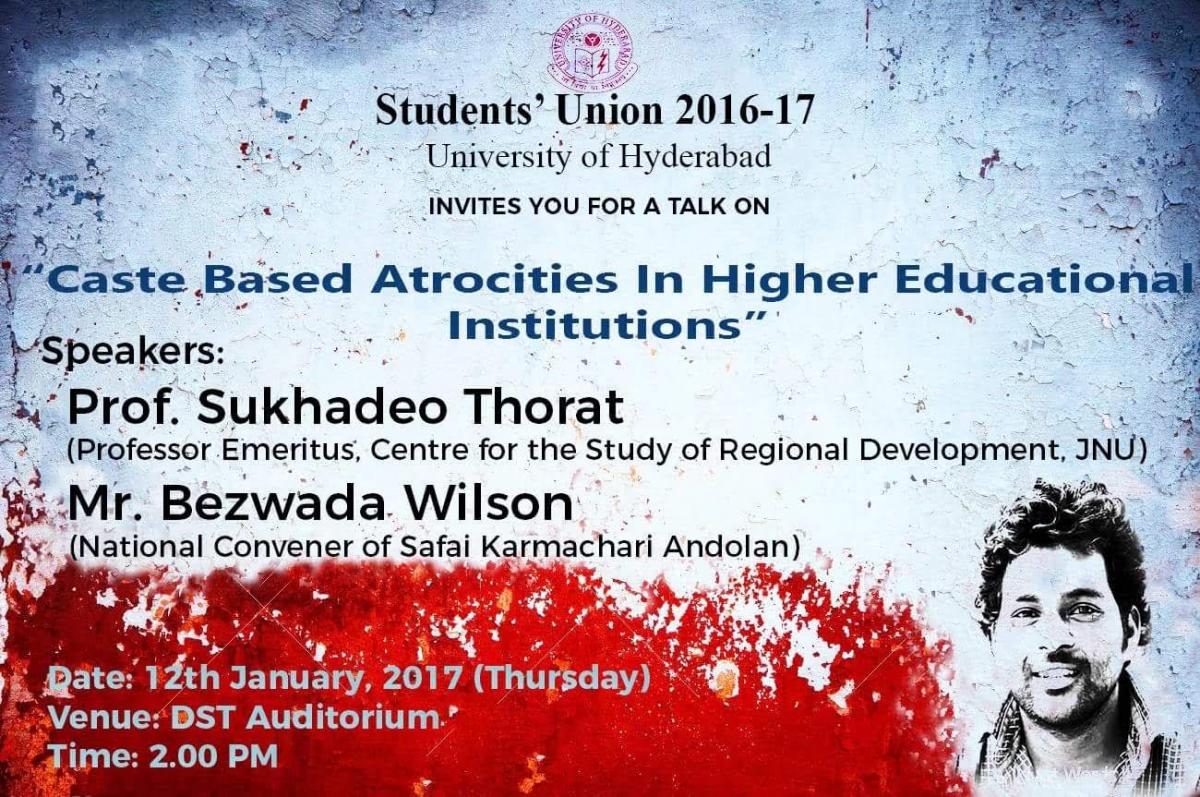
Beginning the week of one year long commemoration of the ‘institutional murder’ of Rohith Vemula on Thursday, January 12, tomorrow, the campus of the conflict worn Hyderabad Central University (HCU) will host an academic seminar on “Caste Based Atrocities in Higher Educational Institutions.” Chairperson of the ICSSR and former Chairperson of the University Grants Commission, Sukhdeo Thorat along with Bezwada Wilson, of the Safai Karmachari Andolan will address the seminar in detailed presentations.
The pertinent question however is: next week, on January 17 the day Rohith so poignantly ended his own life, will Radhika Vemula be allowed to pay homage at the Veliwada on the campus however?
For student organisations, leaders and the official students union it has been a battle and struggle to keep the protests against the militarization of the campus by controversial Vice Chancellor Appa Rao Podille, brought in overlooking many better qualified scholars by the Modi government. The imposition of Podile, his subsequent suspension and re-introduction on May 22, 2016 had renewed outraged protests from the student and wider community. Showing utter disregard to protesting students, however Narendra Modi had ‘awarded’ the VC in early January. On January 3, 2017, prime minister Narendra Modi honoured and awarded Podile Apparao, an alleged plagiarist and a VC accused under SC/ST Prevention of Atrocities Act with “Millenium Plaque of Honour” at the Indian National Science Congress event held at Tirupathi amidst the presence of Andhra Pradesh chief minister Nara Chandra Babu Naidu and Y.S.Chowdary who were none other than strong lobbyists for Apparao Podile.
There is a strong rumour that the Andhra Pradesh government under Chandra Babu Naidu, will over the next few days declared that “Rohith Vemula” was not a Dalit.
On December 18, 2016, Ambedkarite students of the University of Hyderabad (UoH) have in a detailed and strongly worded memorandum to the President of India, substantiated by 26 authenticated annexures, demanded that he exercise his powers as Chancellor of the university and remove Podile Appa Rao as Vice Chancellor . The memorandum also appeals for directions to the Government of Telangana to implement SC/ST Prevention of Atrocity Act in the criminal case (Cr.No 20/2016, Gachibowli Police Station) against the authorities pending in the High Court
The memorandum says that there is a direct link between VC Podile Appa Rao’s actions and the death of Rohith Vemula.
The Modi regime and its HRD ministry has been on a mission as it were to bury the Rohith Vemula case and shift focus away from brute caste discriminations on the campus to the fascile issue of whether or not Radhika Vemula ‘was a Dalit or not.’ This despite the fact that Radhika and her three children lived and fought the stigmas of caste through their lives, the Collector Guntur certified her dalit caste status and the SC/ST Commission (Chairperson PL Punia) made sharp and strong recommendations on the basis of the crude exclusions faced by the family for decades.
On October 6, 2016, NCSCST Chairperson PL Punia in an exclusive interview to Sabrangindia had pointed out pertinently, that the issue of which caste Rohith Vemula belonged to was never an issue that was part of the Roopanwal Commission’s mandate. Moreover he said that the head of the one man commission appointed by the ministry of human resources development (MHRD) was ‘hired to hired to give a stamp of approval on what the Bharatiya Janata Party (BJP) regime has been saying all over the country’
What is being dubbed as a predisposed and faulty account produced to propagate the Modi government’s agenda, HRD ministry’s enquiry report on Hyderabad University scholar Rohith Vemula’s alleged suicide has drawn sharp criticism from P L Punia, Chairperson, of the National Commission for Scheduled Castes & Scheduled Tribes (NCSCST) a statutory authority. Punia has impugned former justice Roopanwal’s authority to investigate Vemula’s caste when the terms of reference of the enquiry commission simply did not mandate this investigation.
In an exclusive interview with Dhaka Tribune top leaders of the Harakah al-Yaqin (Faith Movement) of Arakan reveal the "true motives" of their movement.
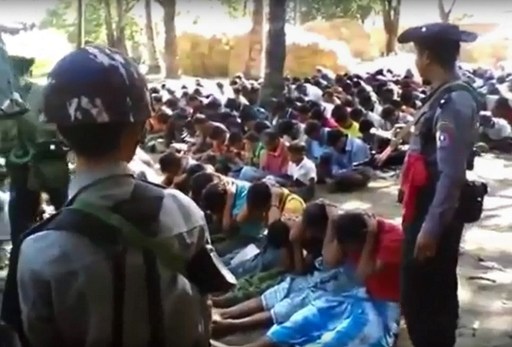
This screen grab taken on January 4, 2017 from a YouTube video originally taken by Myanmar Constable Zaw Myo Htike (not pictured) shows policemen standing guard around Rohingya minority villager seated on the ground in the village of Kotankauk during a police area clearance operation on November 5, 2016 AFP
The Faith Movement of Arakan, also popularly known as Harakah al-Yaqin (HaY), is an insurgent group in Myanmar's Rakhine state which claims to be fighting for Rohingya rights. They were responsible for the series of attacks on Myanmar border posts on October 9, 2016, which killed nine policemen and triggered Myanmar's crackdown on the Rohingya people. Aiming to spread word about their 'true motives', some of the top al-Yaqin leaders spoke to the Dhaka Tribune's Adil Sakhawat in a highly secretive meeting.
The now-in-hiding Harakah al-Yaqin (HaY) fighters are practising extreme caution these days when speaking with any outsider.
Getting in touch with them took a lot of effort and perseverance – this correspondent spoke with four contact persons to gain their approval for a meeting.
On the day of the meeting, the most recent contact person met with this correspondent and set some ground rules.
A Myanmar military official (centre) briefs Myanmar Vice President and head of the Rakhine State Investigation Commission, Myint Swe (2nd man on the right, in blue jacket) during his December 12, 2016 visit to Gwazon, a Muslim majority village in Maungdaw located in Rakhine State near the Bangladesh border where a military officer was killed by a group of attackers on November 12 AFP
“You cannot reveal our names, locations and the time of the meeting,” he warned.
He took this correspondent to an unknown place on a motorcycle, where another man was waiting.
After a meticulous body search, the first man asked this correspondent to turn off his mobile phone and to put on a blindfold. The next part of the journey was on foot for two hours.
The final meeting place was set among forest in the no man’s land between Bangladesh and Myanmar.
Taking the blindfold off, this correspondent came to meet three other HaY members, one of whom claimed to be the second-in-command of Ata Ullah, the HaY spokesperson as seen in videos released by the group.
The Second-in-Command began the conversation by claiming that HaY was not a terrorist group.
“We agreed to speak with you only to make our motives clear,” he said. “We are not terrorists. We formed this group for revolutions, to save our existence in Arakan [Rakhine]… We are waging a movement against the oppression of Rohingya Muslims by the Myanmar government.”
When asked whether they had any connection with other insurgent groups – local or international – the Second-In-Command was vehement in his denial.
“We never conducted any attacks on people of other religious groups. Our fight is only against the Myanmar government.”
Speaking in Arkanese and broken Bangla, the Second-In-Command had to communicate with this correspondent through an interpreter, another HaY fighter.
Ata Ullah, self-proclaimed leader Harakah al-Yaqin group Collected
He admitted that HaY was, in fact, responsible for the series of attacks on Myanmar Border Guard Police outposts along the Bangladesh-Myanmar border on October 9.
“Our aim was to loot their arms and ammunition for our guerrilla training,” he said. “We were all a part of the attack.”
He said they were trained by Ata Ullah and some other senior leaders of HaY who are skilled in modern guerrilla war tactics. They visited Rakhine several times in 2015 to provide the training, he added.
“We have 25-30 members who are trained in modern guerrilla tactics.”
In the four months before the attacks, Ata Ullah and his men also tried to convince local villagers to support their movement, the Second-In-Command claimed.
“You cannot imagine how some of the Rohingya villagers cooperated with us. Some even joined us in the attacks with bamboo,” he claimed.
All the arms and ammunition gave them a stronger footing in Rakhine, but in two weeks – according to the HaY leader – they took a hit when the Myanmar Army launched the crackdown on Rohingyas.
“The army also attacked HaY hideouts at Hargoizzapara, Zammoinnapara and SotoGozobil areas in Maungdaw with helicopters,” the leader said. “We were not equipped to fight the aerial attack and were forced to retreat.”
Who are Harakah al-Yaqin?
Formed after the 2012 riot, Harakah al-Yaqin (Faith Movement, HaY) is led by a committee of Rohingyas living in Saudi Arabia and is commanded on the ground by Rohingyas, according to Brussels-based group International Crisis Group (ICG).
HaY is represented by Ata Ullah, who was born in Karachi to a Rohingya father and grew up in Mecca. He is also identified as Hafiz Tohar by the Myanmar government, presumably an alias, according to ICG.
He is part of a group of 20 Rohingyas who have international experience in modern guerrilla warfare and are leading operations on the ground. After the military crackdown began, the Myanmar president’s office issued a statement claiming that some 400 members of Aqa Mul Mujahideen, a little-known Islamist militant group linked to al-Qaeda and Rohingya Solidarity Organisation (RSO), had conducted the attack.
Aqa Mul Mujahideen or Huji-Arakan is another Rohingya-backed militant group. It is not clear whether HaY and Aqa Mul Mujahideen are the same. Some of the HaY leaders have repeatedly claimed to the Dhaka Tribune that they have no connection with RSO or any other terrorist groups.
Meanwhile, al-Qaeda’s Bangladesh offshoot Ansar al-Islam as well as banned militant outfit Hizb ut-Tahrir have extended their support to HaY and urged Muslims around the world to fight the Myanmar government’s oppression in Rakhine.
International terrorist group Islamic State revealed its plan to attack Buddhist-majority Myanmar establishments through a statement published in Dabiq magazine in April 2016.
In late November last year, a pro-Islamic State Telegram channel suggested that Muslims in the UK who can not go to Myanmar can attack the country’s embassy and ambassador at home.
The Afghan Taliban on November 30 reiterated its call to Muslims as well as Islamic charitable organisations to take action in support of their brethren in Myanmar.
He claimed the army knew they would not be able to face the rebels on the ground, so they used helicopters.
Now weakened, HaY members went into hiding in the villages and the border areas, frequently changing locations.
“Some of us managed to flee to Bangladesh,” he added.
The Second-In-Command took a pause and offered this correspondent some wild potatoes and bananas. “This is all we have to survive,” he said.
All five HaY fighters were jittery and scanned the area for any suspicious movement during the entire conversation.
“The military crackdown also turned local Rohingyas against HaY,” the Second-In-Command continued.
“When the army raided and tortured innocent Rohingyas, they became scared and lost faith in us. They began to flee Arakan,” he said.
Asked whether any Rohingyas refugees from Bangladesh had joined their group, the leader said: “We have Rohingya brothers from everywhere.”
Sources in the refugee camps and some HaY members said some refugees left Bangladesh to join the group, and no one knows where they are now.
Some HaY followers in Cox’s Bazar said they were instructed to remain in hiding and wait for further instruction. “But the instruction never came,” said one of the followers. “After a while, we gave up and came back.” They also said they had no intention of re-joining the insurgent group, now hated by most Rohingyas.
Myanmar Rohingya refugees bury the body of six-month-old Alam in a refugee camp in Teknaf, in Cox’s Bazar district, on November 26, 2016 AFP
Back in no man’s land, the leader claimed losing the grounds and followers had not broken their spirit.
“Our Rohingya brothers around the world are trying to negotiate with world leaders to put pressure on the Myanmar government, but it is not working. So that makes us bound to do armed revolution against the government for our rights.”
He said there was no question of surrendering. “We will fight until the last drop of our blood is spilled.”
This is where the leader ended the conversation.
Issuing another warning to not reveal their names and locations, the fourth contact person brought this correspondent back to the first rendezvous point the same way.
This article was first published on Dhaka Tribune,republished with permission.
An ‘objectionable video’ posted on the social media group of the district PRO cell in Mathura has led the Uttar Pradesh police to interrogate a journalist, even as investigations are on to confirm the authenticity of the clip.
Ajay Yadav, PRO of the Senior Superintendent of Police told PTI that the video was posted by a journalist in the WhatsApp group of Mathura district PRO cell between 11.27 AM and 12.46 PM yesterday.
The video purportedly appeals to the people or WhatsApp users to forward it as much as possible, so that it gets the Prime Minister’s attention.
A girl who is married to a youth from another religion, is shown being lynched and burned to death in the video. She is killed after she objected to wear clothes under a particular religion.
Police has issued a notice in cognizance of the video message, stating that without a confirmtory evidence, one party cannot condemn or defame another. A legal action would be taken if some person or group is found guilty in this connection, as per the police notice.
Prima facie, it appears to be a foul play to defame a particular religion, said police.
SSP Mohit Gupta has asked the Circle Officer-City to summon the scribe who posted the video on PRO cell’s media group and investigate into the matter.
However, the person under police scanner has claimed that he had just recieved the message and had forwarded it in the group.
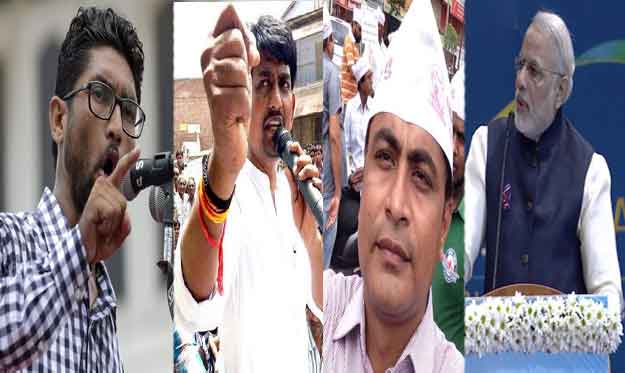
अहमदाबाद। भाजपा शासित गुजरात के अहमदाबाद जिले से जिला पुलिस ने दलित नेता जिग्नेश मेवाणी, पाटीदार नेता वरुण पटेल और ओबीसी नेता विक्रम राठौर को उनके 100 समर्थकों के साथ गिरफ्तार कर लिया। इसके बाद इन लोगों को बाद में छोड़ दिया गया।
आपको बता दें कि वाइब्रेंट गुजरात ग्लोबल समिति में प्रधानमंत्री नरेंद्र मोदी भाग लेने गए थे जिसके लिए इन नेताओं ने इस कार्यक्रम का विरोध करने की चेतावनी दी थी जिससे जिला पुलिस ने कार्यक्रम में खलल न डालें इस डर से इन नेताओं को नजरबंद कर दिया था।
जिग्नेश मेवाणी को मंगलवार सुबह उनके घर से गिरफ्तार कर लिया गया वहीं पाटीदार नेता वरुण पटेल और ओबीसी नेता विक्रम राठौर को सरोदा गांव में नजरबंद कर दिया गया। वरिष्ठ पुलिस अधिकारियों ने बताया कि मेवाणी के खिलाफ आईपीसी की धारा 188 के तहत केस दर्ज होने के बाद उन्हें गिरफ्तार किया गया।
पुलिस ने दो घंटे के लिए ठाकोर सेना के नेता अल्पेश ठाकुर को भी नजरबंद किया था। ओबीसी आंदोलन के नेता अल्पेश ठाकोर ने कहा था कि वे वाइब्रेंट गुजरात समिति कतई नहीं होने देंगे। प्रधानमंत्री इस सम्मेलन में भाग लेने के लिए गुजरात आ रहे हैं। वे उनका घेराव करेंगे। अल्पेश ने कहा था कि राज्य का नौजवान बेरोजगार है। वे तीन महीने के अंदर 3 लाख यूवाओं को रोजगार मुहैया कराने की मांग प्रधानमंत्री के सामने रखेंगे।
ठाकुर ने कहा कि हम आम आदमी के अधिकारों के लिए लड़ रहे हैं और पीएम मोदी के सामने उन मुद्दों को रखना चाहते थे। हालांकि जैसे ही हम गांधीनगर के अदालज से रैली करने की घोषणा की वैसे ही हमें नजरबंद कर दिया गया।
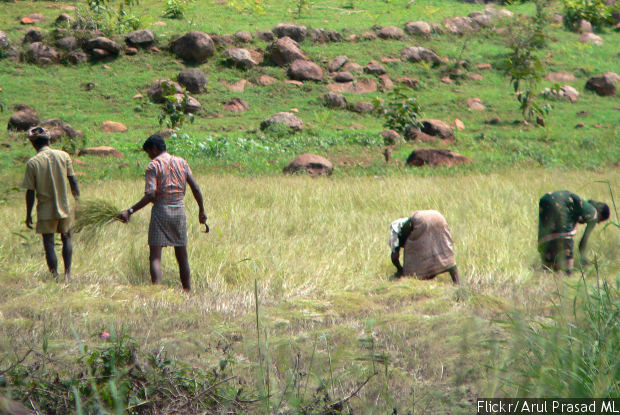
The Tamil Nadu government declared a drought on January 10, 2017, after 144 farmers ended their lives (according to media reports here and here) between October and December, 2016. As many as 106 farmers were reported to have committed suicide in one month, according to this notice issued by the National Human Rights Commission to the state government on January 5, 2017.
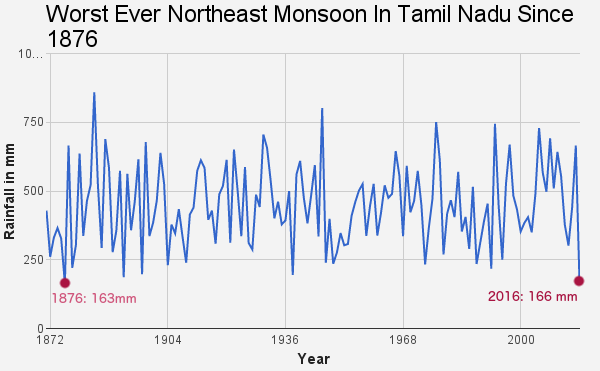
The retreating northeast monsoon—usually unnoticed in India owing to the singular importance of the larger southwest monsoon—in 2016 was the worst ever over the last 140 years, according to Indian Meteorological Department (IMD) records, since 1876.
“It is an unprecedented situation,” S. Panneerselvam, Professor and Head, Agro Climate Research Centre, Tamil Nadu Agriculture University, Coimbatore, told IndiaSpend. “It has severely affected 21 of 32 districts of Tamil Nadu.”
“Tamil Nadu celebrates Pongal on January the 16th,” said Panneerselvam. “It is when the harvest begins, but the yield this time is going to be the worst the state will see.”
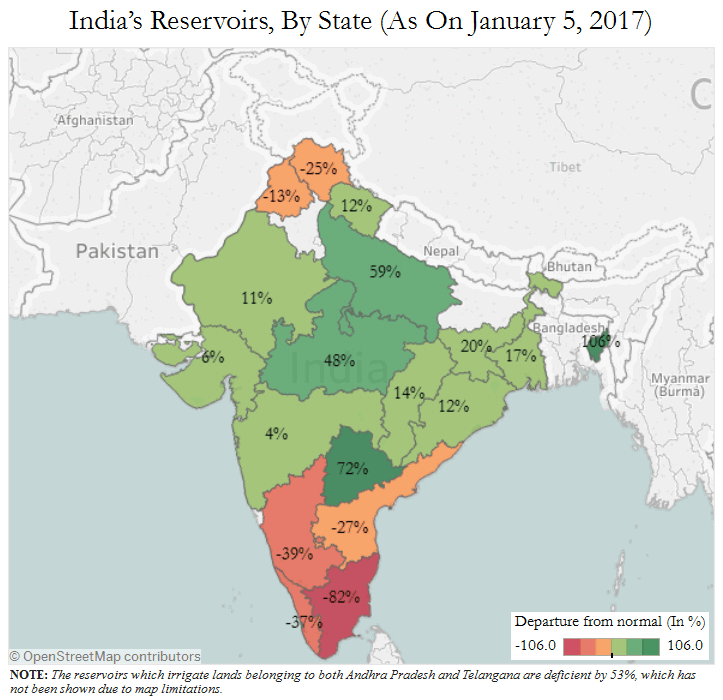
On January 5, 2017, reservoirs in Tamil Nadu were at less than 20% of their capacity, cited as the worst ever for the state.
Record-keeping began in 1871, but a worse northeast monsoon, which sweeps across Tamil Nadu, coastal Andhra Pradesh, south interior Karnataka and Kerala, between October and December, was recorded in 1876, making 2016 the year of the second-worst monsoon in 145 years.
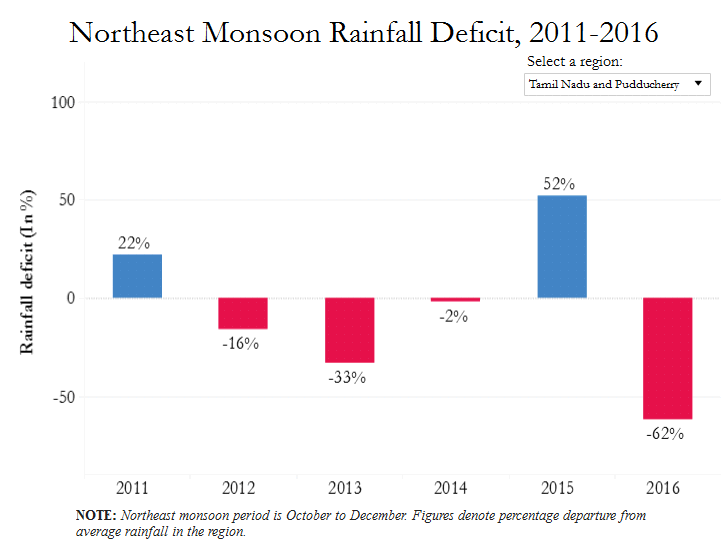
Overall, the northeast monsoon was 45% short of the average for this period, the state worst hit being Tamil Nadu, where rainfall for the season was 62% short of normal. Although the southwest monsoon–which waters the subcontinent between June and September–was classified as normal across India (3% below average), it was 19% deficient in Tamil Nadu.
Hit by shortages from both monsoons, Tamil Nadu, where the winter crop depends more on the northeast monsoon than in any other Indian state, reported a 33% drop in the winter sowing of rice, according to latest crop sowing situation report, updated weekly by the agriculture ministry.
More than 60% deficit in October-December rains in four states
The northeast monsoon becomes active after the southwest monsoon retreats from the subcontinent. While there is no specific date for the retreat of southwest and the onset of northeast monsoon, October is regarded as the starting period of the lesser monsoon.
Apart from the two monsoons, Tamil Nadu also receives pre-monsoon rains, all important for agriculture.
Source: Weekly Weather Update, India Meteorological Department
Nagapattinam, Thiruvarur and Thanjavur were the worst hit districts in Tamil Nadu.
“There are 135,000 paddy farmers among the 175,000 lakh farmers in our district, Nagapattinam, which falls in the Cauvery delta. Half the farmers have sown the paddy crop, but less than 20% of the crop has crossed the flowering stage,” said J. Sekar, joint director of the agriculture department in the eastern coastal district of Nagapattinam. “Even this mature crop will yield nothing.”
“Under the Pradhan Mantri Fasal Bima Yojana (prime minister’s crop insurance scheme), about 130,000 (95%) paddy farmers in the district are insured,” said Sekhar. His claim could not be independently verified. “A premium of about Rs 11 crore has been collected. This will provide a safety net to our farmers.”
The failure of the northeast monsoon was evident across the South except Telangana, where farming is mostly rain-fed and dependent on the southwest monsoon.
Reservoirs in–or nearing crisis–across the South
With the northeast monsoon failing and the southwest sketchy, reservoirs in the southern states are in crisis–or nearing one.
Tamil Nadu, Andhra Pradesh, Telangana, Karnataka and Kerala now report the highest deficits nationwide. Tamil Nadu reservoirs are 82% short of normal levels—the highest deficit in India currently—while those in Andhra Pradesh are 53% short, Karnataka 39% and Kerala 37%.
Karnataka declared a drought in 22 districts and some additional talukas in October 2016; the state has received Rs 1,782 crore from the central government. All of Kerala has been declared drought hit.
As 2016 ended, South India’s combined reservoir levels were 34% of capacity, which is 22 percentage points less than 56%, the average water availability over the last 10 years.
In Tamil Nadu, a third of fields not sown
Tamil Nadu had targeted 14.5 lakh hectares under rice in 2016-17, according to the weekly sowing situation report dated January 6, 2017, of the agriculture ministry, more than any other state. But no more than 7.18 lakh hectares had been sown until January 5, 2017, which is 3.5 lakh hectares—or 33%–less than the five-year sowing average of 10.68 lakh hectares.
Compared to the first-week-of-January average of 17.28 lakh hectares of sowing, rice has been planted on 12.74 lakh hectares across India, leaving a deficit of 4.54 lakh hectares, or 26%.
“Less area coverage has been reported from the states of Tamil Nadu (3.50 lakh hectare), Andhra Pradesh (0.31 lakh hectare), Karnataka (0.15 lakh hectare), Telangana (0.13 lakh hectare), Assam (0.12 lakh hectare), Odisha (0.09 lakh hectare) and Kerala (0.09 lakh hectare),” said the government’s sowing report.
The lede of this story has been modified to update the death toll.
नई दिल्ली। नोटबंदी के बाद से ही लोगों को होने वाली दिक्कत किसी से भी छुपी नहीं है। नोटबंदी ने आम जनता के साथ-साथ किसानों और कारोबारियों की भी रोजीरोटी रोक सी दि थी। नोटबंदी के बाद से ही ना जाने कितने लोगों की जान चली गई। लेकिन नोटबंदी के फैसले को बीजेपी सरकार सही बता रही है साथ ही बीजेपी के मंत्रियों ने नोटबंदी के बाद से होने वाले नुकसान और मौतों पर अपने अजीबोंगरीब बयान दिए।
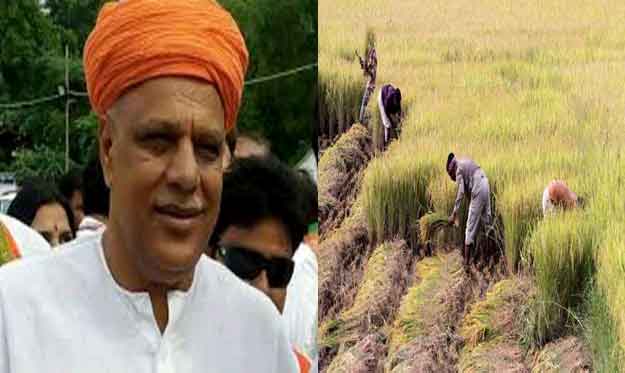
हाल ही में बीजेपी सांसद और किसान मोर्चा के अध्यक्ष वीरेंद्र सिंह ने हाल ही में किसानों को लेकर कहा की नोटबंदी से किसानों को परेशानी होने की कोई खबर नहीं आई है। लेकिन इससे शादियों में होने वाले फालतू खर्चे और शराब के इस्तेमाल में खासी कमी आई है।
आपको बता दें कि वीरेंद्र सिंह ने यह बात पिछले हफ्ते बीजेपी के एक कार्यक्रम में भी कहीं थी। सिंह यूपी के बाधोई से तीन बार सांसद रह चुके हैं। उन्होंने आगे कहा कि नोटबंदी का सबसे बड़ा फायदा यही हुआ कि लोगों में बचत करने का गुण आ गया। उन्होंने यह भी कहा कि लोन पर पैसे लेने से फिलजूलखर्ची की आदत हो जाती है। शास्त्रों का जिक्र करते हुए वीरेंद्र सिंह ने कहा, ‘शास्त्रों में आधुनिकीकरण में सब कुछ प्रयोग में लाने को कहा गया है। आप लोगों को कंजूस होने के लिए कोई नहीं कह रहा लेकिन पैसे का फिजूल खर्ची भी ठीक नहीं है।’
वीरेंद्र सिंह ने आगे कहा, ‘किसान लोन लेकर भव्य शादियों का आयोजन करते हैं। दावत में आखिर खर्च आता ही कितना है? ज्यादातर पैसा दिखावे, पटाखों और शराब में खर्च होता है। अब इसपर कंट्रोल हुआ है। पहले लोग थोड़ी सी दूर जाने के लिए भी बाइक का सहारा लेते थे। लेकिन नोटबंदी के बाद यह सब बदल गया है। अब लोग पैदल चलने की आदत डालने लगे हैं।’
वहीं वीरेंद्र सिंह ने इससे पहले दिल्ली में हुए राष्ट्रीय कार्यक्रम के दौरान भी यही बातें की थी। विरेंद्र सिंह ने कहा था कि नोटबंदी की वजह से बीजेपी ने उन लोगों को नुकसान हुआ है जो अपनी बड़ी-बड़ी गाड़ियों पर बीजेपी का झंडा लगाकर घूमते हैं। वीरेंद्र सिंह ने आगे कहा था कि ऐसे लोगों ने सरकारी खजाने को लूटा है।
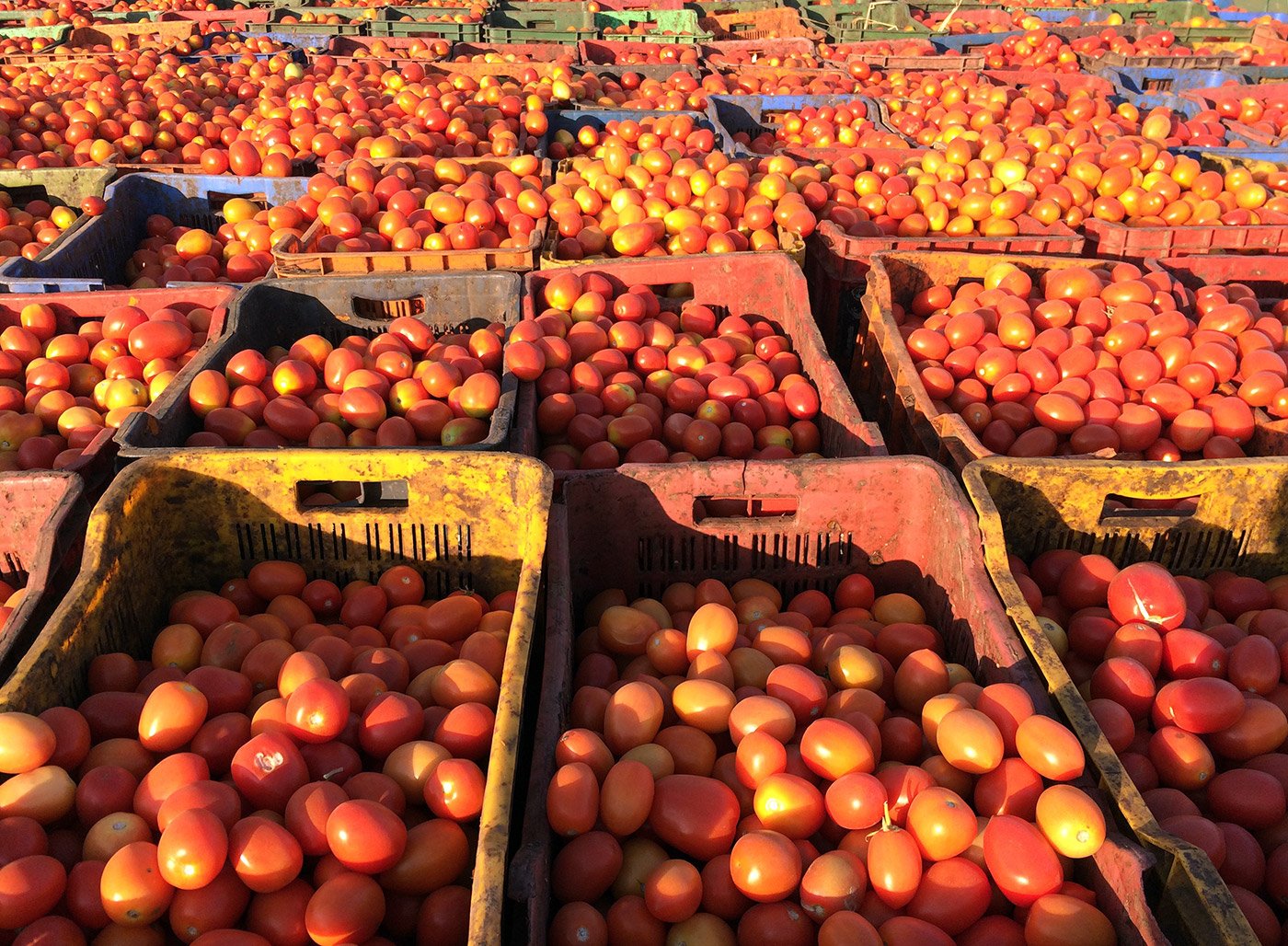
One in every four tomatoes in India comes from the state’s Nashik district.
Image credit: Chitrangada Choudhury/ Rural India Online
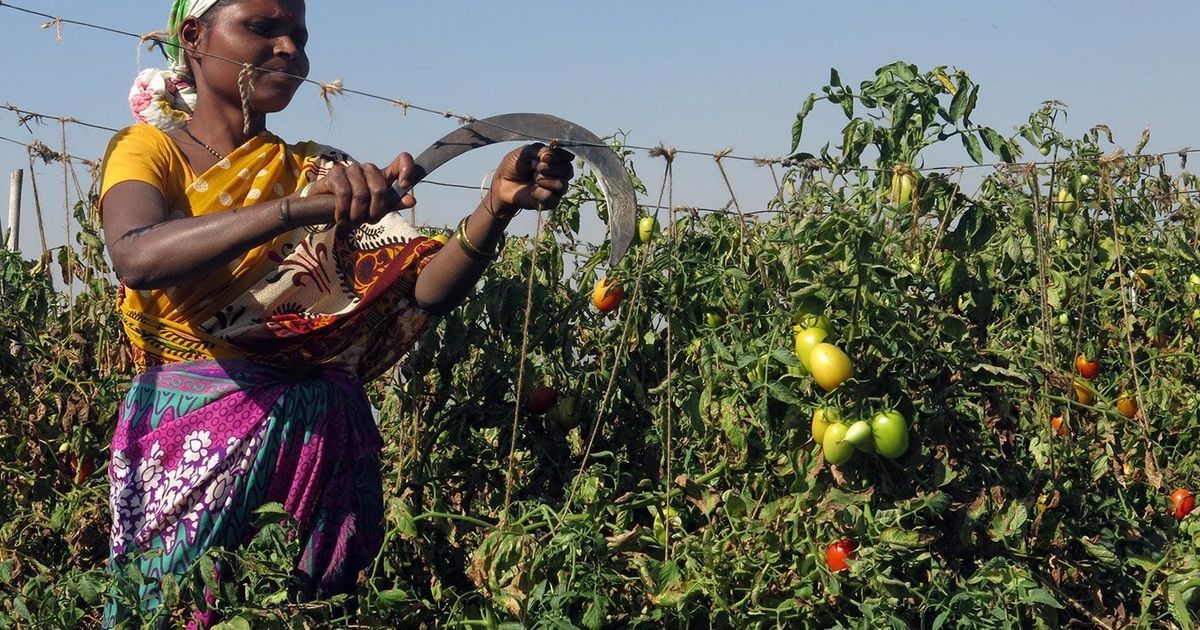
On Christmas morning, barely 24 hours after Prime Minister Narendra Modi laid the foundation of the Rs 3,600 crores Shivaji statue in Mumbai, Yashwant and Hirabai Bendkule were slashing and uprooting the tomato vines on their farm in Dhondegaon village of Maharashtra’s Nashik district, just 200 km away.
“Since over a month, tomato prices have collapsed,” Yashwant muttered, explaining why the Adivasi couple was destroying a perfectly good crop in which they had invested over Rs 20,000 and labour. “Even leaving the crop standing means a loss for us.”
They will sow wheat in the cleared land.
“At least we will have food to eat in the summer,” said Hirabai.
With the cash crunch following Modi’s November 8 demonetisation announcement, already low tomato prices tanked. The prices of tomato at the Girnare mandi, 20 km from Nashik city, now range from 50 paise to Rs 2 per kg. So low that farmers cannot even recover the cost of harvesting and transporting their produce. Retail prices hover between Rs 6 and Rs 10 a kg. Across Nashik, a key horticultural district of India, frustrated farmers are uprooting crops, dumping produce, and allowing cattle to graze in vegetable fields, in which they had invested anywhere between Rs 30,000 and Rs 1.5 lakhs per acre this monsoon.
Adivasi farmers Hirabai and Yashwant Bendkule slashing their tomato crop in Dhondegaon village.
Good rates last year – ranging from Rs 300 to Rs 750 per crate (20 kg) – saw more farmers sowing tomato with high hopes in monsoon 2016. By October, they realised that with good weather, no major pest attacks, and the number of tomato growers increasing, there would be an abundant harvest. So, rates might be favourable, but would not match those of the previous year. Several farmers said rates were decent over Dussehra and just break-even until Diwali (in the end of October), at about Rs 130 per crate.
However, with the outlawing of Rs 500 and Rs 1,000 notes, harvest arrivals met a severe scarcity of legal tender, driving down purchases and prices.
“Rates fell by November 11, and have never recovered,” said Nitin Gaikar, a Girnare-based farmer.
They have fallen to a range of Rs 10 to Rs 40 a crate since then. Gaikar pointed out that cash fuels the entire rural agricultural economy, including transactions among farmers, traders, transporters, retailers of farm inputs and labourers.
With the outlawing of Rs 500 and Rs 1,000 notes, abundant harvest arrivals met a severe paucity of legal tender, driving down purchases and prices.
District authorities do not appear too worried.
“It’s a free market, and we cannot control it day-in, day-out,” said Nashik collector B Radhakrishnan. “Prices are a purely market-driven activity.”
Rural households, however, are deeply concerned.
“I spent Rs 2 lakhs on my two acre tomato plot, but have not recovered even Rs 30,000 yet,” said farmer Ganesh Bobde.
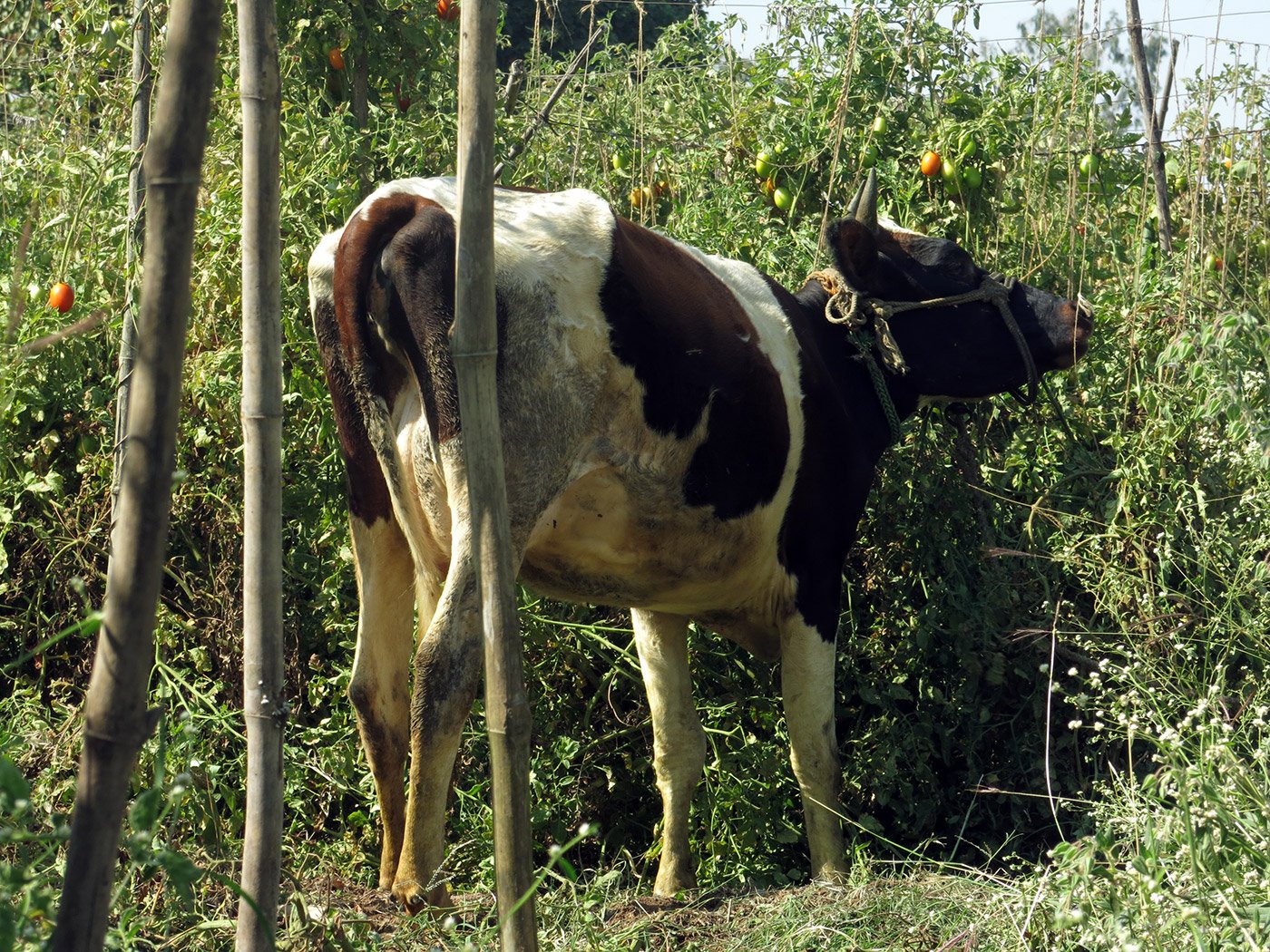
Said another farmer, Somnath Thete, as we walked through his bountiful plot, with three cows grazing on the tomato vines: “There are hardly any buyers, which is why I have let my cows graze on the tomato crops.”
With hardly any buyers, farmer Somnath Thete has let his cows graze on his tomato crop.
Yogesh Gaikar, who planted tomato across his 10-acre farm last year, was visibly agitated.
“I have sold 2,000 crates so far, most of them at a loss,” he said. “It is due to this note ka lafdaa [mess]. Just when we were about to make some money, Modi has kicked us.”
Roughly every fourth tomato sold across the country this kharif season came from Nashik. Government of India data indicate that 24% of tomatoes sold by weight between September 1, 2016 and January 2, 2017, were from this district (that is, 3.4 lakh of 14.3 lakh tons).
Resigned to volatile prices and income insecurity for years, neither distress sales nor dumping of produce is new for farmers. But the region has never seen destruction of a standing crop on this scale, said Dnyaneshwar Ugale, the Nashik-based correspondent for the Marathi agrarian daily Agrowon.
“Farmers’ production costs are on average Rs 90 per crate,” he said. “If all they are getting is Rs 15 to Rs 40, imagine the kind of losses they are incurring.”
Ugale’s calculation, based on arrivals in the five mandis (agricultural marketyards) of Nashik district, pegs farmers’ losses at around Rs 100 crores so far.
And the official reckoning?
Bhaskar Rahane, agriculture supervisor at the District Superintendent of Agriculture Office, Nashik, said their estimates of tomato acreage and production in the district ended at 2011-’12.
“There is no system to capture farmers’ losses,” he said. “Farmers should keep track of their incomes themselves, the way they track other expenses.”
The current rate for tomato does not even cover my cost of harvesting the produce', says Adivasi farmer Dattu Bendkule
The dusty maidan that is Girnare mandi, a leading tomato hub, is unusually subdued for this time of the year. The approach roads, usually jammed with tractors laden with tomatoes, are ominously clear. Most of the traders from outside Maharashtra who annually set camp here from October to December, and purchase and transport tomatoes all across India, left early.
Among them was Rahat Jaan, now back in his home in Amroha in Uttar Pradesh.
“I have an ICICI bank account in Nashik city,” he said over the phone. “But they gave only Rs 50,000 over eight days. I need cash of Rs 1 lakh to Rs 3 lakh for daily business.” He added: “As long as old notes were being accepted by farmers and petrol pumps, we managed somewhat. But for the shortage of notes, I would have purchased tomatoes for another 15 days.”
The upcountry traders gone, the mandi currently sees only local buyers from places like Vashi and Virar near Mumbai. But they too are struggling with low prices and the cash crunch.
These correspondents watched Pimpalgaon-based trader Kailash Salve buy 100 crates of tomato for Rs 4,000.
“I don’t have more currency,” he said, “So I could not buy more.” He told us he was exploring buyers in Surat in Gujarat.
He added: “Last year, around this time, we had done business in tomatoes of Rs 50 lakhs and earned Rs 3 lakhs. This year we have only bought Rs 10 lakhs of produce so far, and incurred losses on it.”
Two days later, he sold the tomatoes to a Surat buyer at a loss.
Over the past 15 years, tomato has become this region’s aspirational crop, after grapes. However small the landholding, as long as they have some access to capital and water, Adivasi and Maratha farmers (such as Bendkule and Gaikar) look to plant tomato. Consequently, the tomato market’s collapse is ruinous. Some traders like Jaan argue that overproduction, too, has pushed rates lower. Farmers say this might be the case, but point out that they are getting rock-bottom rates even for vegetables that were not planted as widely.
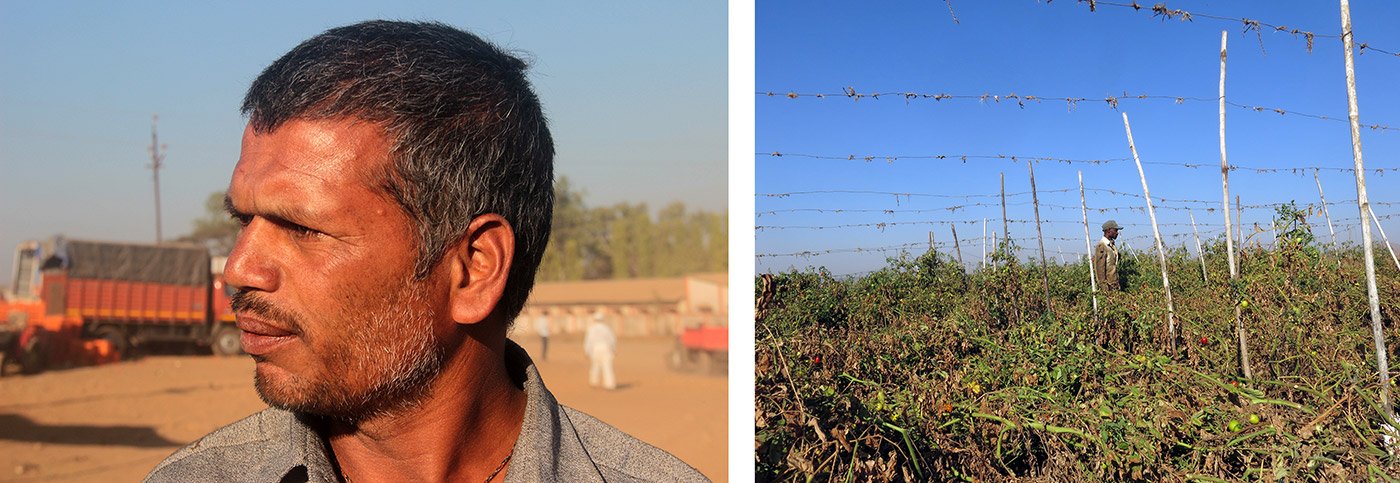
Left: Yogesh Gaikar said, "Just when we were about to make some money, Modi has kicked us." Right: For many like Yashwant Bendkule in Nashik, even leaving the crop standing would mean a loss.
“Look at cauliflower, brinjal, coriander, bottle gourd – whose price has not collapsed in the past weeks?” asked Nana Achari, an Adivasi small farmer from Dhondegaon village.
Achari took 20 crates of brinjal to the mandi in Nashik city 20 days ago, but returned without finding a buyer. The next day he sold the entire consignment for Rs 500 at the Vashi mandi, leaving him with just Rs 30, after deducting transportation costs. Another farmer, Keru Kasbe from Vadgaon village, told us he sold 700 kg of brinjal at Vashi eight days ago. He made Rs 200, net.
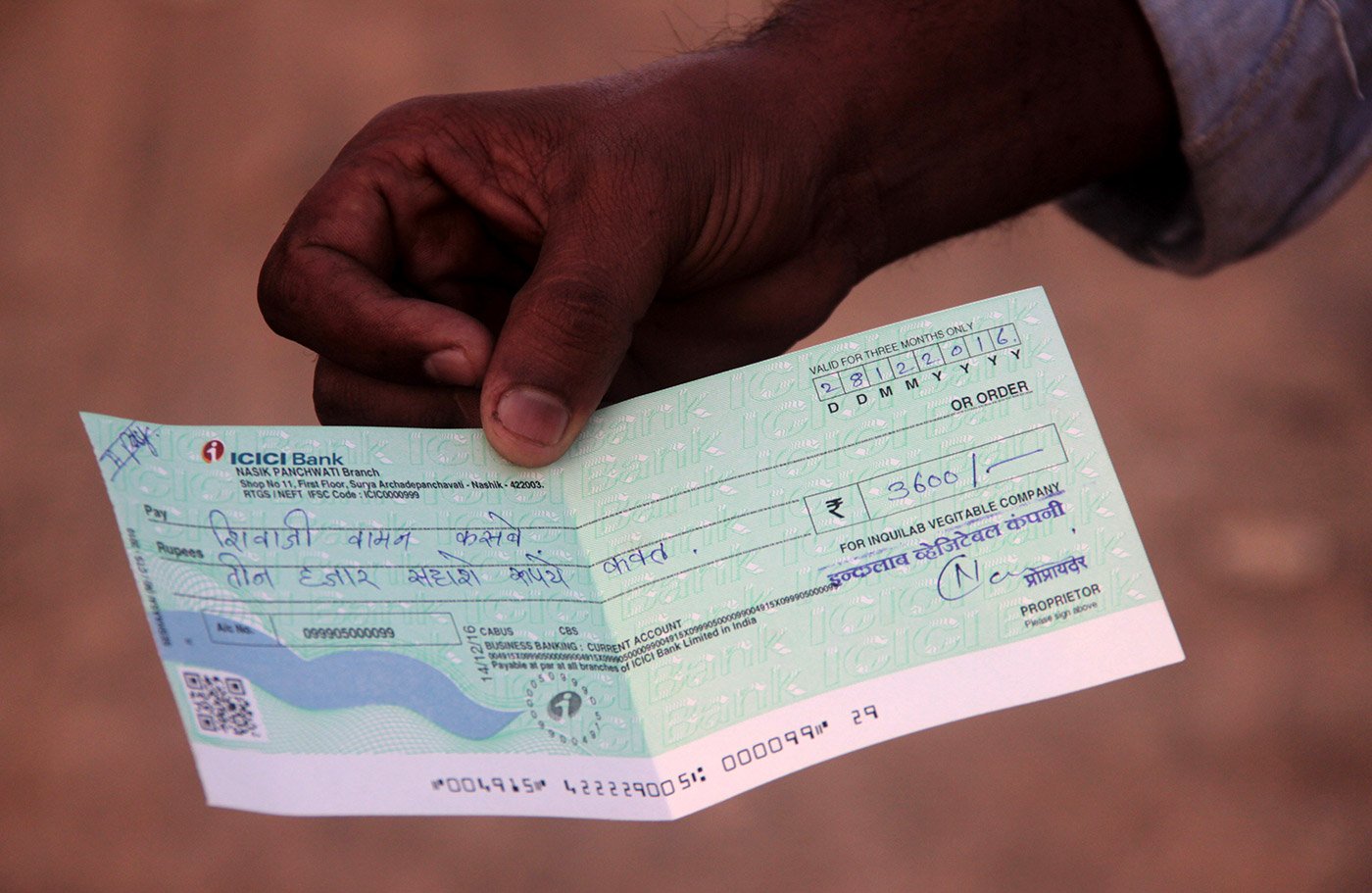
Some traders are paying farmers by cheque. But diesel has to be purchased, labourers paid, fertilisers bought. Neither farmers nor traders here have the time to deposit cheques, and then stand in long queues to withdraw cash. That too, just Rs 2,000 at a time, usually in one new note. Besides, farmers do not trust cheques. Vijay Kasbe, forced to take one since his trader did not have currency, told us that he would be helpless if it bounced.
A cheque in the name of Vijay Kasbe's father – he was forced to take one since his trader did not have currency, but would be helpless if it bounced
Crashing prices and the currency crunch have had cascading consequences. Adivasi labourers are not finding enough work, and the Rs 2,000 note adds insult to injury.
“To get change, the shopkeeper wants us to spend over Rs 1,100,” said Rajaram Bendkule. “The petrol pump owner says fill for at least Rs 300.”
His aunt said darkly: “Bring all that petrol home, let us drink it.”
Retailers of farm inputs are deeply anxious.
“My whole business depends on that,” said Aba Kadam, a retailer, gesturing towards the mandi. “I am hit on both counts. Since farmers are destroying their standing crop, they are not buying inputs from me now. And since they are not making money in sales, I can’t recover the credit I had advanced to them in the growing season.”
On December 30, the 50-day window Modi had asked the country for when he announced demonetisation ended.
On New Year’s Eve, expectation levels matched the distress.
Modi should deposit money in our accounts to compensate for the losses we are incurring, said one farmer. Karza maafi (loan waiver), said another. Lower interest rates for crop loans, demanded a third.
However, Modi did not address farm distress and losses in his December 31 speech to the nation.
All eyes are now on the grape crop which will be harvested, starting end-January. Good rates will see grape farmers earn some profits. Retailers like Kadam will recover some of their advances. Traders, however, are not optimistic. Jaan said unless the currency scarcity ends soon, he would be unable to purchase from farmers. A gloomy Salve believes grape prices will also tank.