Home Blog Page 2356

Demonetisation: Tribal milk producers in Gujarat hit hard

0

RBI’s ban on district cooperative banks exchanging or depositing demonetised notes has hit tribal milk producers and farmers in Gujarat’s Chhotaudepur district.

Demonetisation

They are not in a position to buy essential commodities for daily requirements from the market as they have stopped getting cash from their respective village-level milk cooperative societies.

Sangramsinh Rathwa, a director on the Board of Baroda Milk Dairy (Baroda Dairy Milk Producers Cooperative Society) told PTI that he has asked the dairy’s chairman and managing director to take up the issue with the Centre and RBI so that the tribals can get their payment immediately.

Baroda Milk Dairy daily collects 2.5 lakh litres of milk from 450 village level milk producers cooperative societies in Chhotaudepur district which have total membership of 45,000 tribal milk producers and farmers, he said.


The dairy has already deposited Rs 14 crores into the accounts of these cooperative societies in three branches of the Baroda District Central Cooperative Bank in Chhotaudepur for making payment to their members, belonging to the poor tribals communities, he said.

However, the tribals who do not have their savings account in these bank branches are now not in a position to withdraw the amount, Rathwa said.

Ranjitsinh Rathwa, another director of Baroda Milk Dairy, said the dairy pays these milk cooperative societies of Chhotaudepur on the 7th, 14th and 21st of every month.

Senior Congress leader Mohansinh Rathwa said, “I have sought the intervention of Prime Minister Narendra Modi and Union Finance Minister Arun Jaitley to ask RBI to direct Baroda District Central Cooperative Bank to ensure speedy payment to these poor tribals at the earliest as the situation has become grim.”

Naranbhai Rathwa, the former Union Minister of State for Railways in the earlier UPA government, who represented the tribal reserved seat of Chhotaudepur in Lok Sabha for four terms, also expressed concern over the issue.
He said some of tribals under the below poverty line category do not have money to buy grains, groceries or seeds and fertilisers as no one is accepting the old currency notes.

(With inputs from PTI)

Courtesy: Janta Ka Reporter
 

VIDEO: Bajrang Dal goons thrash Muslim couple in Bulandshahr for ‘dirtying’ Hindu neighbourhood

0

A video of Bajrang Dal goons in Bulandshahr’s Khurja in Uttar Pradesh mercilessly thrashing a Muslim couple because they felt both were ‘dirtying’ Hindu neighbourhood has surfaced.

In the video, the Hindutva brigade goons are seen mercilessly thrashing the man and the woman. We’ve edited the part of the video, where the woman’s identity could be revealed.

Bajrang Dal goons


Upon learning that the man in question was a Muslim, one armed youth lost his temper and unleashed brutal attack on the victim leaving him bleeding.

The attackers did not spare the woman either. The woman was thrashed with heavy stick as she pleaded for mercy.

The SHO at Khurja Police station confirmed to Janta Ka Reporter that at least three arrested goons belonged to Bajrang Dal.

The local police have arrested at least five people including the district convener of the Bajrang Dal.

The cops confirmed that they had booked 20 people including the local convener of the Bajrang Dal, Praveen Bhati, Tanu Solanki, Pushpendra Chaudhary, Nitin and Sonu.

You can watch the video below

Courtesy: Janta Ka Reporter

Against the Cult of Fear & Silence: Resistance Meet in Goa

0

SILENCED: Rationalists Dr Narendra Dabolkar, Govind Pansare and M M Kalburgi were murdered in cold blood by fascist elements Dakshinayan Abhiyan, an initiative taken by Padma Shri Dr Ganesh Devy, is organising a convention to bring rationalist and liberals together to preserve the freedom of speech and thought guaranteed by the constitution. The convenor of the three-day convention starting Friday, November 18 is social activist Datta Nayak

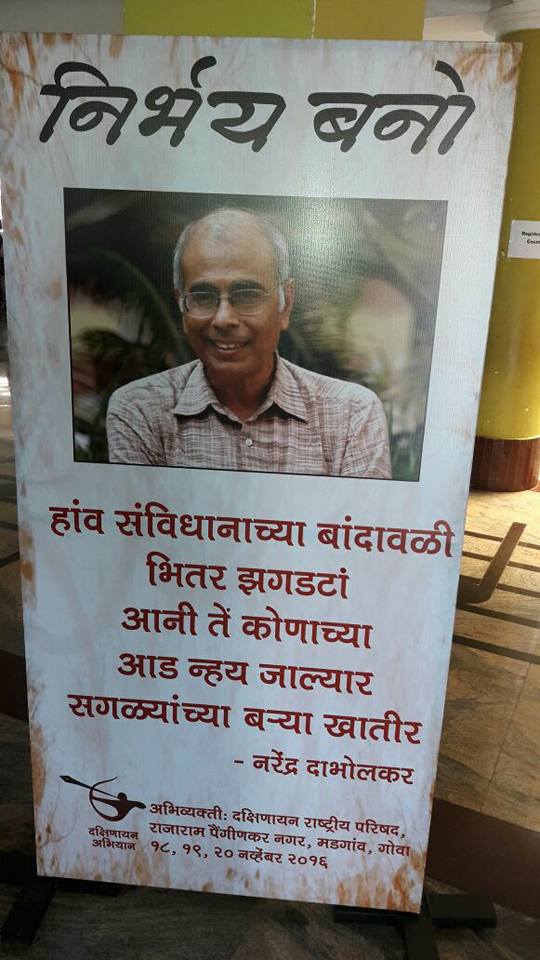
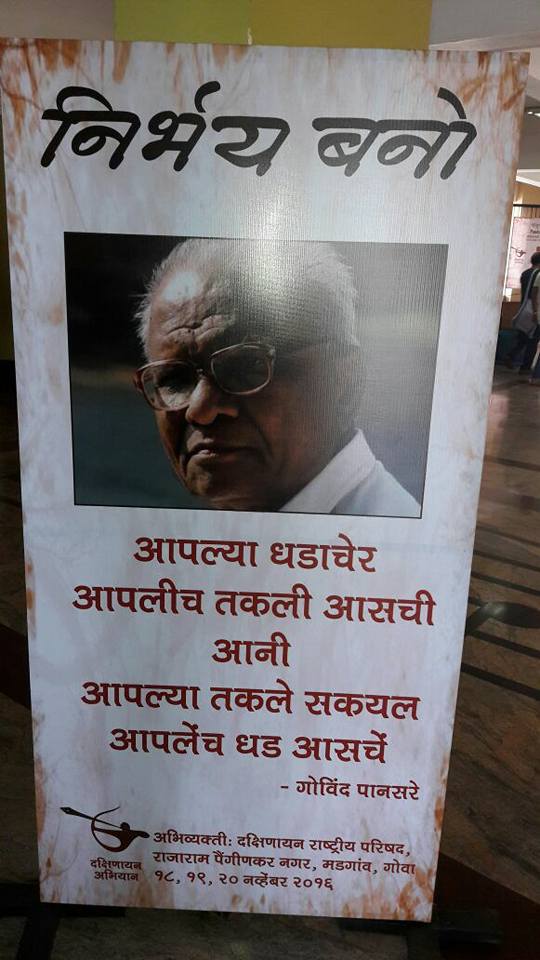
Nirbhay Bano

On November 19, the inaugural session at Ravindra Bhavan saw Dr Ganesh Devy, Leela Samson, Berzwada Wilson speaking, and there were also discussions (Yogendra Yadav on “India at Crossroads” and one with Raosaheb Kasbe), cultural evenings of poetry reading, singing, and much else. There will be a media session on “Media: Freedom & Promiscuity” with familiar communications and media stalwarts – Amol Palekar, Rajdeep Sardessai, Nikhil Wagle and others.

Activists lash out at Sangh Parivar, Sanatan Sanstha

Setting the tone for the three-day national conference of the Dakshinayan Abhiyan that got underway at Margao on Friday, literary scholar and cultural activist Ganesh Devy urged all progressive minds to come together and join “the struggle for the freedom of creative expression that is rooted in tolerance and diversity.”Speaking at a public meeting at Lohia maidan here, Devy hoped that Goa’s immense cultural diversity and its multilingual nature would help realise the objectives of the Abhiyan.Many of the speakers, who addressed the meeting, lashed out at the Sanatan Sanstha and Sangh Parivar for their attempts at disrupting communal harmony in the state in the name of Hindutva. Hameed Dabholkar , son of slain anti-superstition activist Narendra Dabholkar, said that killings of Dabholkar , besides two other rationalists, Govind Pansare and M M Kalburgi , could have been avoided if the investigating agencies were able to arrest the masterminds of the Margao bomb blast in 2009.

While local social activist Prashant Naik demanded that Sanatan Sanstha be banned, Uttam Parwar from Gujarat said the “the country’s biggest threat came from the Sangh Parivar.”A procession ‘Sankalp Yatra,’ was also held from the Ravindra Bhavan to Lohia Maidan.About 1,000 delegates are participating in the event. Setting the tone for the three-day national conference of the Dakshinayan Abhiyan that got underway at Margao on Friday, literary scholar and cultural activist Ganesh Devy urged all progressive minds to come together and join “the struggle for the freedom of creative expression that is rooted in tolerance and diversity.”Speaking at a public meeting at Lohia maidan here, Devy hoped that Goa’s immense cultural diversity and its multilingual nature would help realise the objectives of the Abhiyan.Many of the speakers, who addressed the meeting, lashed out at the Sanatan Sanstha and Sangh Parivar for their attempts at disrupting communal harmony in the state in the name of Hindutva.

Setting the tone for the three-day national conference of the Dakshinayan Abhiyan that got underway at Margao on Friday, literary scholar and cultural activist Ganesh Devy urged all progressive minds to come together and join “the struggle for the freedom of creative expression that is rooted in tolerance and diversity.”Speaking at a public meeting at Lohia maidan here, Devy hoped that Goa’s immense cultural diversity and its multilingual nature would help realise the objectives of the Abhiyan.Many of the speakers, who addressed the meeting, lashed out at the Sanatan Sanstha and Sangh Parivar for their attempts at disrupting communal harmony in the state in the name of Hindutva. Hameed Dabholkar , son of slain anti-superstition activist Narendra Dabholkar , said that killings of Dabholkar , besides two other rationalists, Govind Pansare and M M Kalburgi , could have been avoided if the investigating agencies were able to arrest the masterminds of the Margao bomb blast in 2009.While local social activist Prashant Naik demanded that Sanatan Sanstha be banned, Uttam Parwar from Gujarat said the “the country’s biggest threat came from the Sangh Parivar.”A procession ‘Sankalp Yatra,’ was also held from the Ravindra Bhavan to Lohia Maidan.About 1,000 delegates are participating in the event. A formal inauguration of the event will be held on Saturday.. 

Dakshinayan Abhiyan, an initiative taken by Dr Ganesh Devy, is organising a convention to bring rationalist and liberals together to preserve the freedom of speech and thought guaranteed by the constitution. The convenor of the three-day convention starting in Margao, Goa on Friday, November 18 is social activist Datta Nayak. Among the eminent delegates will be the family members of the three rationalists murdered by fundamentalist elements and noted RTI activist Prashant Bushan

ALL is not lost – yet. There are enough people at the top, middle and bottom echelons of our multiracial, multi-religious, multicultural society to warm the heart and keep the flame of democracy alive. Enough regrettable things have happened in recent years to make smart people pause in disquietude, memories of the lessons of history abroad and at home flooding the mind. One stout defender of freedom of speech and equality in pursuit of happiness for all is quiet author and linguistics professor Dr Ganesh Devy.

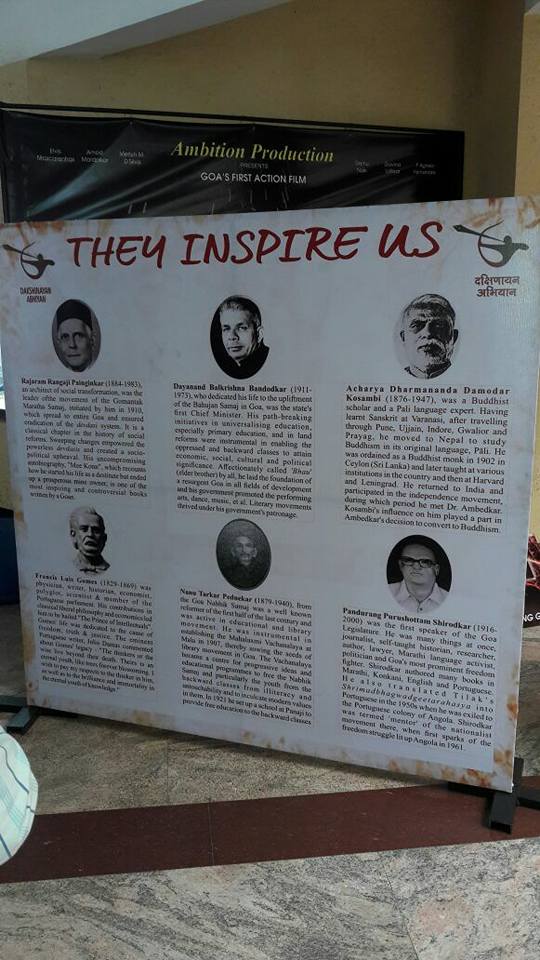
Dr Devy was in Panjim to contribute towards the final touches of the forthcoming mega conference – Abhivyakti: Dakshinayan Rasthriya Parishad scheduled at Ravindra Bhavan, Margao from November 18-20. It will witness a host of literary and intellectual personalities speaking on coming together in solidarity in the face of political tyranny. Dakshinayan Abhiyan has been formed by various authors and like-minded people in Goa supporting the cause of right to freedom of speech.

Dr Devy, now based in Dharwad, has seen life and times in Gujarat as a professor of English at the Maharaja Sayajirao University. Apart being a linguistics scholar with several books to his credit, he is a critic and activist and founder-director of Bhasha Research & Publications Center, Vadodara. Along with many others, he returned his Sahitya Academy Award last year to protest the cold-blooded killing of intellectuals and rationalists in India.

At a media meet in Panjim recently, Dr Ganesh Devy said that the climate in India has become such that people are living in fear. This does not auger well for the country. Perhaps if like-minded people come together to express their feelings and thoughts it could be a catalyst, a positive force. He rued the fact that those who speak in the late Mahatma Gandhi’s name have actually turned Gujarat into the very antithesis of what Gandhiji valued the most. In his opinion, “Gujarat is no longer Mahatma Gandhi’s Gujarat.” Today’s Gujarat is a ghetto state with large sections living fearfully in “allotted” areas. It is not in the interests of the rest of India to become like Gujarat!

Speaking on the eve of the meet, Devy hoped that the forthcoming Abhivyakti: Dakshinayan Rashtriya Parishad will prove to be an initiative in the right direction, and inculcate genuinely progressive thinking among the young generation. Interestingly, Dr Devy quipped, “We should not want any ‘terrible beauty’ in India,” referring to the infamous Easter 1916 Irish freedom uprising against English tyranny in which millions of young people lost their lives in a civil war of sorts, and inspired William Butler Yeats to write his famous poem Easter, 1916: beginning “I have met them at close of day…” and concluding “A terrible beauty is born.”

Endorsing his sentiments was Goa Dakshinayan Abhiyan convenor Datta Naik. He said the gathering of almost 1,000 people sprang up almost spontaneously. He added, “It is a collective desire to forge a new solidarity between all progressive forces. It is a struggle for the freedom of creative expression that foregrounds tolerance and dialogue. It is an attempt to deepen rational thinking as being pivotal to society that is genuinely equal, just and respectful of diversity.” The event has logged 300 delegates from Goa and other parts of India. It will begin with a sankalp yatra to Lohia Maidan where a public meeting will be addressed by Hameed Dabholkar, Medha Pansare, Vijay Kalburgi, Prashant Naik, Atamjit Singh, K Satchidanandan, Dhanaji Gurav, Uttam Parmar, K Neela, Manan Kumar Mandal and others.

The concluding session will be based on an action plan to fight communalism presided over by Prabhakar Timble with Annad Karandikar, Harsha Badkar and Prashant Bhushan as participants. Entry fee for delegates is `1,000 while students may participate freely on presentation of ID cards. Needless to say, this multidimensional event promises to be the most exciting ever to sow the seeds of new, more progressive ways of thinking, to eventually bear sweeter fruit in a long-term perspective. Anybody who wants to belong and be counted as a progressive force must make time for it!

Free Software Movement of India Demands Apology for Banning Social Media Criticism

0

Government resorting to such draconian measures to stifle all legitimate criticism

Free Software Movement of India Demands Apology for Banning Social Media Criticism
 

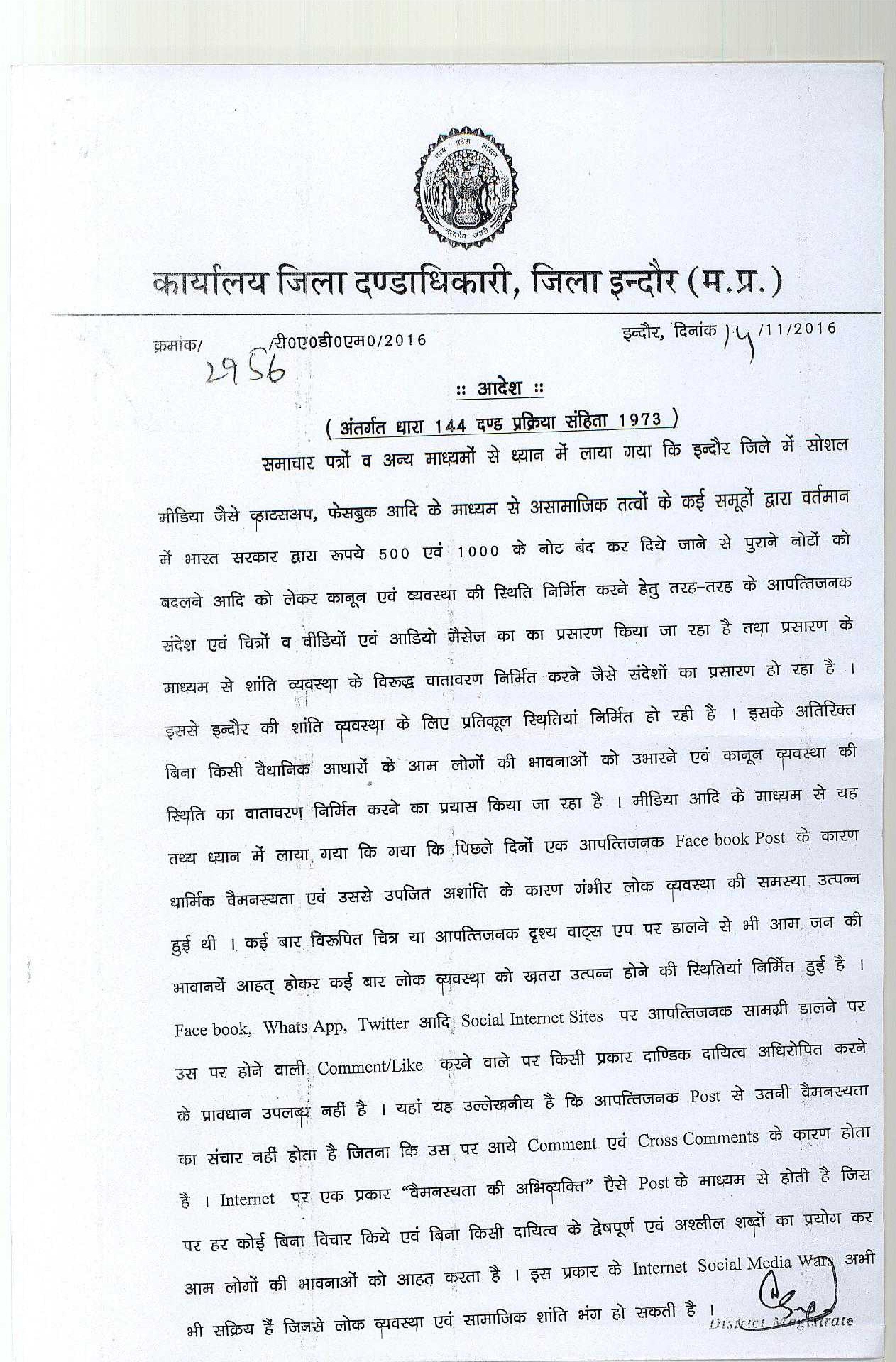
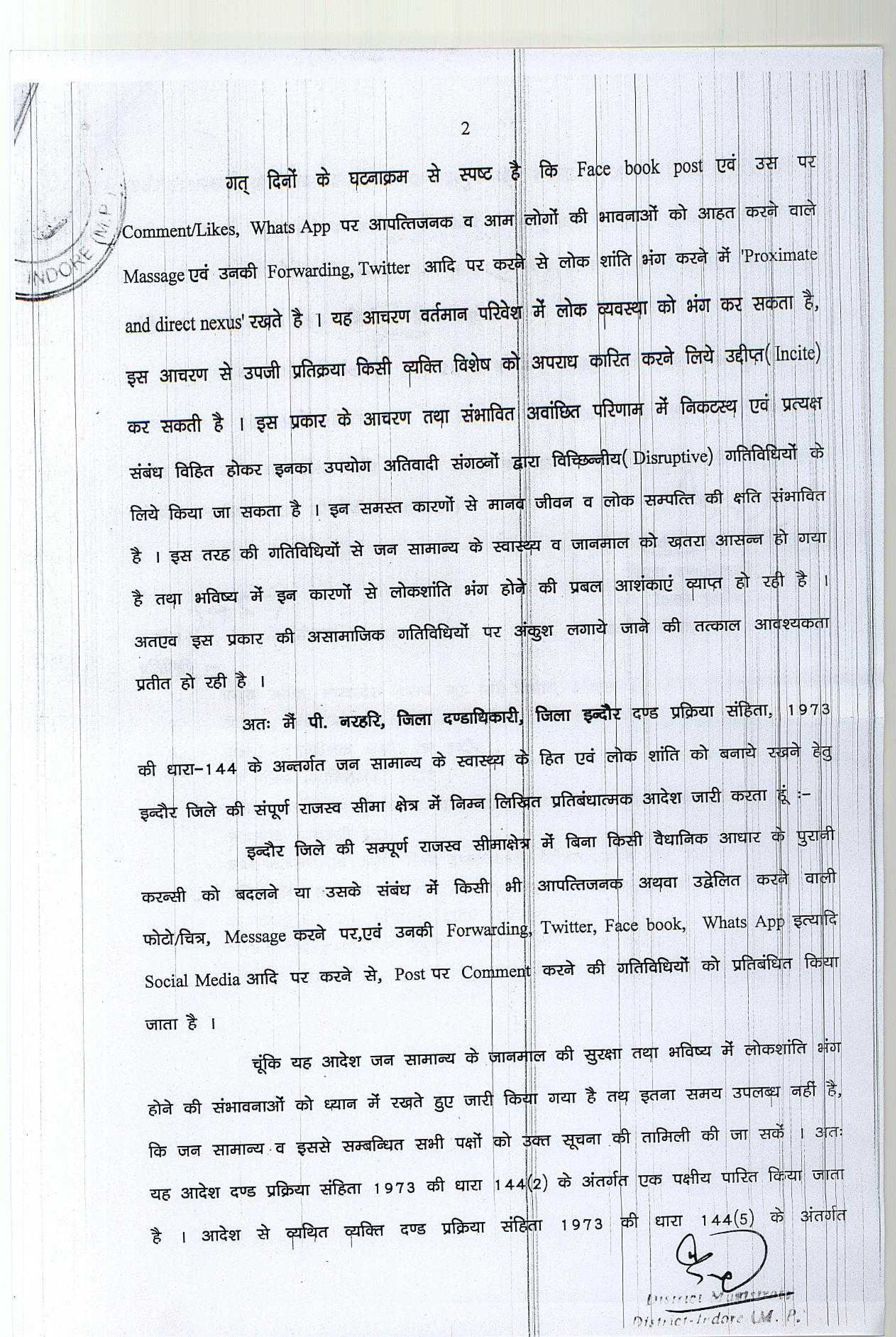
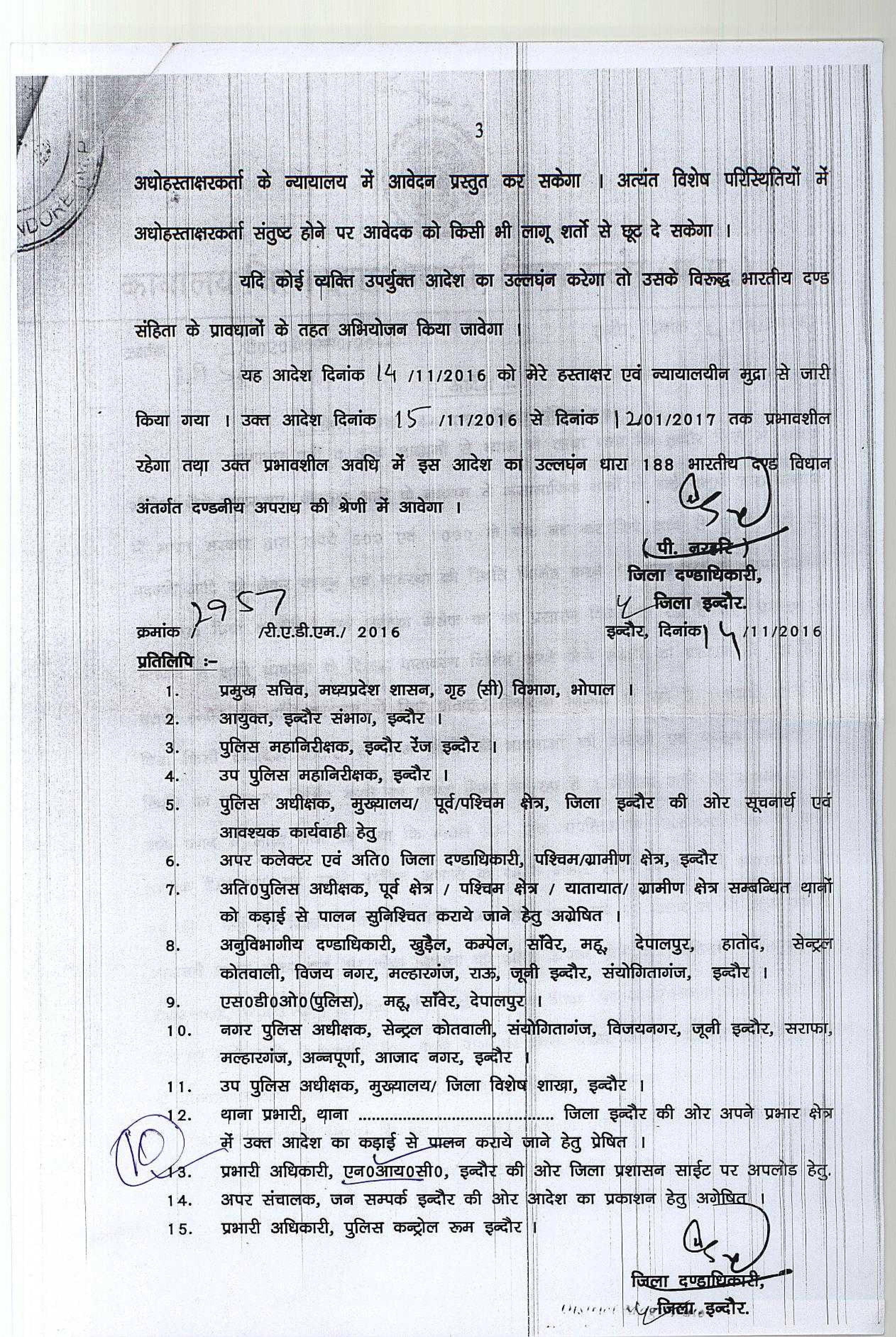
The District Magistrate of Indore has issued an order – Order/2956/RADM/2016, Indore/Date 14/11/2016 under Section 144 – banning any criticism on social media such as Twitter, Facebook, WhatsApp, etc., on exchange of old currency that is “objectionable” or can “cause incitement”. The order is attached here. This, in effect, is a blanket ban on any criticism of the Government on its failure to provide sufficient new notes for the old Rs. 500 and Rs. 1,000 notes that it has demonetised. Clearly, having failed to remonetise the economy and putting the common man to immense hardship, the government now wants to clamp down on all criticism on its failures.

The use of Section 144 for censorship of social media also goes far beyond what the Supreme Court has held in its various judgements. The Supreme Court, in Madhu Limaye and Anr v. Ved Murti and Ors. ((1970) 3 SCC 746), held that the use of Section 144 is justified only for prevention of public disturbance or violence, and urgency as the only ground for using this section.

The state and central governments have been using Section 144 arbitrarily in shutting down the internet and going far beyond what its powers are under Section 144. It has now extended such powers, earlier used only for banning public assembly, to now attacking peoples rights of Freedom of Speech, guaranteed under the Section 19. It shows the desperation of the Central and the Madhya Pradesh governments that having failed in the elementary task of providing money to the people for conducting their day to day lives, they are resorting to such draconian measures to stifle all legitimate criticism.

The Free Software Movement of India demands that this Order of the District Magistrate be immediately withdrawn and the Madhya Pradesh government issue an apology to the people for this action.

Y.Kiran Chandra #kiran@fsmi.in
General Secretary
Prabir Purkayastha
Vice President 
The order of the DM can be read below: 

2956_Order144-page-001.jpg

2956_Order144-page-002_0.jpg

2956_Order144-page-003.jpg

Courtesy: Newsclick.in

Poem on Demonetisation: What Colour, Money? Ballad of the Commoners

0

R. Umamaheshwari (Veena)
 

(Of real people, real narratives and real lives. In my neighbourhood and city, Hyderabad.)
 
suryanarayana

Bajji seller Hanumanthu
Mestri Yadgiri
Bangle seller Mohammad Laeeq
Earth-worker, brick layer, matti pani Ramachander
Footwear seller Lakshmamma
Shaadi-khana labour Najeeb
Coolie, cook, etc Jahangir
Miscellaneous labour: Suryanarayana, Baburao, Nagaraju… 
Srikakulam, Mahbubnagar, Nalgonda, Hyderabad, Kurnul
North Andhra, Telangana, Rayalaseema
(Region / State)
India
SC, BC, Muslim.
Illiterates; school drop-outs.
Dalit Bahujan, the "Common" Ones
Delinked from banking systems, 
Yet, struck by it, in one blow
Delinked from the Nation’s economy
Yet, paying the price for it 
 
"This is anyaayam amma", says Hanumanthu
Wondering, what happened to all his giraaki, to whom he served 
Hot, delicious mirchi bajjis and vadas, with a benign smile, writ large on his face
His oil-pan now gone cold for days now
The TRS party guy came by, the other day, telling him not to worry
And gave him a 500 rupee note, as a gesture of protection
Another guy on a bike stopped by, ate bajjis, gave another 500 
Adding, "Keep the change" (while a third wasn’t that generous and demanded change!)
Hanumanthu was 1000-rupee rich, suddenly!
Yet 1000-rupee poor, and in a dilemma 
Should he take the money,
That might buy him nothing today?
Or, should he refuse, and go home, empty-handed?
He kept it — a paper without value, begging for change from any kind soul
Hanumanthu has no bank account
He asks, how do people like me use cards, amma? 
Hanumanthu never stepped into an ATM in his 70-year-old life
Banks don’t exist in Hanumanthu’s world, 
Just as Hanumanthu doesn’t, in the Nation’s GDP
Hanumanthu didn’t know (since he watches no TV) 
That the Finance Minister promises a "cashless" economy
Hanumanthu only understands "cash"; the few hundreds he earns each day, 
Cash that he can hold in his hands, coming from a livelihood, honest, simple, pure
Not enough. Hardly so. But pure. 
Not bloodied with farmers’ dislocations, displacements, deaths and impoverishment.
What colour, money?                                                                      
Blood and Sweat and Tears of Hanumanthu, and his Benign Smile, Now Stolen.

Mestri Yadagiri, by the Gandhi Statue, Sitaphalmandi, says —    yadgiri
"More than a week now; no work, no money; we spend hours here
Waiting; we drink tea and leave. Where do we go? What do we eat?
Sometimes a contractor arrives, and, handing us a 500 note, demands 50, or 100, back.
The note buys us nothing; not food, not milk.
Why did he do this? He says it will benefit our desam, amma
But I don’t know those big things; we have no food, no work, no money."
But, in his amazing honesty, Yadagiri adds, "At least my wife works in people’s homes; I am managing
What about the rest of us? There are hundreds of us here."
What colour, money? 
Yadagiri’s honesty, in face of hunger, desperation, and loss of a million workers. 
By the Subhas Bose statue, Jahangir (not the king), part-time auto driver, labourer, cleaner, cook asks —
"Will he just close it all down all at once, this man? Just like that (aiseheech?)
How do we live? My children need milk in the morning. How do I buy it?
They dump 500 notes on us poor people
They have black money; we don’t!
He is the central government guy; happy. What about us?
Do I have a tree growing 100 rupee notes? 
Money can come back, madam, not a human being.
Do you remember the old man who died in a bank queue the other day? 
And the old woman who committed suicide after selling the only land she had? 
What was their crime?’
What colour, money?
Jahangir (not the king)’s question, and anger, and pain.

 
ramachandar

Coolie pani Ramachandar, by the Bose statue, cries out,
"We are poor people; we will all slowly just die
This is a wound they inflicted on us poor.
By chance if we get a 500 note, seeking change, they give us 300 
And take 200 as their share. We shall go hungry, were we to lose that money…"
What colour, money?
Ramachandar’s cry
"Upavasam has been forced on me since a week now", says Lakshmamma 
Selling footwear since last thirty years by the street junction at Sultan Bazar, once the shopping paradise (for cheaper things, of course!)
Once busy, now pining for busy-ness
Shunned and stumped by the Metro-rail, yet-to-realise.
"People give me a 500 note for a slipper costing 100.
Is there a solution to all this? 
Why did they do this to the poor? 
How do I pay my rent?
Nobody cares for us", says she.
What colour, money?
A Table and cardboard panel of shiny, snazzy footwear, gathering street dust; a lone woman waiting they would be picked up, but not for 500.
 
 
charminar
 
By the historic Charminar, Najeeb — with a pretty little daughter with a broken toy, 
Hungry, and a bewitching, momentary, smile — says, "We have no work."
They used to call him for work, any work, in normal times, in the shaadi khana (wedding hall). 
Now "sab kaamaan cancil hain" (all works have stopped)
"It's been a week", says he. 
"I have no work, no money; we just sit here, sleep on the streets."
"Don’t talk much’, friends tell him; they are scared
Of the media, perhaps, or of the government, or both (remember, they are Muslims)?
Says Najeeb, "What will they do? What can a poor man do to them?"
What colour, money?
Silent whispers, muted cries by Charminar
Suryanarayana, landless, mestri (mason), by the Skandagiri temple, says,
"Had no work, no land; had a house, but do I eat it? I came here
Why would I, if I had work in the village? 
Now there is no work here either."
Colour of money? A blank look, a bleak future in a hyper city.
Koti, daily wage earner (painter),
Tells me, "I saved every penny; not a single day I miss at work
For a whole year, 
To bring in our second child into the world, 
The TV shook me up, one day,
Scared, I put all my money in the bank.
What do I do now, amma? The baby is due, anytime now.
The hospital demands advance."
What colour, money? 
The future, of an unborn child.
What colour, money?
Senior citizens’ deaths in bank queues
What of the Constitution?    Who knows?
Right to Livelihood?             What’s that?
Right to Life?                        Who cares?
Who cares, for the right of the people to their money?
For those that pay taxes, without question? 
And stand in long queues, without question, like puppets in a puppetry show?
Who do not question; who believe, almost always; who pay bills on time 
Who do not assert for their "hard-earned" money to come by with human dignity 
Who do not question the inking of their fingers 
Nor the general distrust that governments in power always have, for their ilk (except once in five years)? 
 
Meanwhile, Simhachalam (doesn’t tell me his true name, others call him Reddy), the contractor, shows me a thick bundle of 500 notes 
Says he is "managing" it; paying the labourers this money or putting them into "zero accounts". "It is now allowed", he quips. 
(I forget to ask, though, what does zero account really mean?)
The construction of the city must go on
For the nation’s good.
The daily wagers stare in silence, as he talks, 
Pain in their eyes, stomachs rumbling from a few days’ hunger.
Another builder, elsewhere, someone tells me, has deposited money 
Into accounts newly created, of daily wage labourers,
To make the "black" legally "white".
They feel rich for a while, the daily wagers; the "ommoners"
"Notionally", at least,
But, of course, he tells them, he will take the cash back
And he gives them a couple of 1000 notes, in return for a vow of silence!
What colour, money? 

 

R. Umamaheshwari, who also uses the pen name Veena, is a well-known social activist.

This article was first published on indianculturalforum.in