Home Blog Page 2357

Free Software Movement of India Demands Apology for Banning Social Media Criticism

0

Government resorting to such draconian measures to stifle all legitimate criticism

Free Software Movement of India Demands Apology for Banning Social Media Criticism
 

The District Magistrate of Indore has issued an order – Order/2956/RADM/2016, Indore/Date 14/11/2016 under Section 144 – banning any criticism on social media such as Twitter, Facebook, WhatsApp, etc., on exchange of old currency that is “objectionable” or can “cause incitement”. The order is attached here. This, in effect, is a blanket ban on any criticism of the Government on its failure to provide sufficient new notes for the old Rs. 500 and Rs. 1,000 notes that it has demonetised. Clearly, having failed to remonetise the economy and putting the common man to immense hardship, the government now wants to clamp down on all criticism on its failures.

The use of Section 144 for censorship of social media also goes far beyond what the Supreme Court has held in its various judgements. The Supreme Court, in Madhu Limaye and Anr v. Ved Murti and Ors. ((1970) 3 SCC 746), held that the use of Section 144 is justified only for prevention of public disturbance or violence, and urgency as the only ground for using this section.

The state and central governments have been using Section 144 arbitrarily in shutting down the internet and going far beyond what its powers are under Section 144. It has now extended such powers, earlier used only for banning public assembly, to now attacking peoples rights of Freedom of Speech, guaranteed under the Section 19. It shows the desperation of the Central and the Madhya Pradesh governments that having failed in the elementary task of providing money to the people for conducting their day to day lives, they are resorting to such draconian measures to stifle all legitimate criticism.

The Free Software Movement of India demands that this Order of the District Magistrate be immediately withdrawn and the Madhya Pradesh government issue an apology to the people for this action.

Y.Kiran Chandra #kiran@fsmi.in
General Secretary
Prabir Purkayastha
Vice President 
The order of the DM can be read below: 

2956_Order144-page-001.jpg

2956_Order144-page-002_0.jpg

2956_Order144-page-003.jpg

Courtesy: Newsclick.in

Poem on Demonetisation: What Colour, Money? Ballad of the Commoners

0

R. Umamaheshwari (Veena)
 

(Of real people, real narratives and real lives. In my neighbourhood and city, Hyderabad.)
 
suryanarayana

Bajji seller Hanumanthu
Mestri Yadgiri
Bangle seller Mohammad Laeeq
Earth-worker, brick layer, matti pani Ramachander
Footwear seller Lakshmamma
Shaadi-khana labour Najeeb
Coolie, cook, etc Jahangir
Miscellaneous labour: Suryanarayana, Baburao, Nagaraju… 
Srikakulam, Mahbubnagar, Nalgonda, Hyderabad, Kurnul
North Andhra, Telangana, Rayalaseema
(Region / State)
India
SC, BC, Muslim.
Illiterates; school drop-outs.
Dalit Bahujan, the "Common" Ones
Delinked from banking systems, 
Yet, struck by it, in one blow
Delinked from the Nation’s economy
Yet, paying the price for it 
 
"This is anyaayam amma", says Hanumanthu
Wondering, what happened to all his giraaki, to whom he served 
Hot, delicious mirchi bajjis and vadas, with a benign smile, writ large on his face
His oil-pan now gone cold for days now
The TRS party guy came by, the other day, telling him not to worry
And gave him a 500 rupee note, as a gesture of protection
Another guy on a bike stopped by, ate bajjis, gave another 500 
Adding, "Keep the change" (while a third wasn’t that generous and demanded change!)
Hanumanthu was 1000-rupee rich, suddenly!
Yet 1000-rupee poor, and in a dilemma 
Should he take the money,
That might buy him nothing today?
Or, should he refuse, and go home, empty-handed?
He kept it — a paper without value, begging for change from any kind soul
Hanumanthu has no bank account
He asks, how do people like me use cards, amma? 
Hanumanthu never stepped into an ATM in his 70-year-old life
Banks don’t exist in Hanumanthu’s world, 
Just as Hanumanthu doesn’t, in the Nation’s GDP
Hanumanthu didn’t know (since he watches no TV) 
That the Finance Minister promises a "cashless" economy
Hanumanthu only understands "cash"; the few hundreds he earns each day, 
Cash that he can hold in his hands, coming from a livelihood, honest, simple, pure
Not enough. Hardly so. But pure. 
Not bloodied with farmers’ dislocations, displacements, deaths and impoverishment.
What colour, money?                                                                      
Blood and Sweat and Tears of Hanumanthu, and his Benign Smile, Now Stolen.

Mestri Yadagiri, by the Gandhi Statue, Sitaphalmandi, says —    yadgiri
"More than a week now; no work, no money; we spend hours here
Waiting; we drink tea and leave. Where do we go? What do we eat?
Sometimes a contractor arrives, and, handing us a 500 note, demands 50, or 100, back.
The note buys us nothing; not food, not milk.
Why did he do this? He says it will benefit our desam, amma
But I don’t know those big things; we have no food, no work, no money."
But, in his amazing honesty, Yadagiri adds, "At least my wife works in people’s homes; I am managing
What about the rest of us? There are hundreds of us here."
What colour, money? 
Yadagiri’s honesty, in face of hunger, desperation, and loss of a million workers. 
By the Subhas Bose statue, Jahangir (not the king), part-time auto driver, labourer, cleaner, cook asks —
"Will he just close it all down all at once, this man? Just like that (aiseheech?)
How do we live? My children need milk in the morning. How do I buy it?
They dump 500 notes on us poor people
They have black money; we don’t!
He is the central government guy; happy. What about us?
Do I have a tree growing 100 rupee notes? 
Money can come back, madam, not a human being.
Do you remember the old man who died in a bank queue the other day? 
And the old woman who committed suicide after selling the only land she had? 
What was their crime?’
What colour, money?
Jahangir (not the king)’s question, and anger, and pain.

 
ramachandar

Coolie pani Ramachandar, by the Bose statue, cries out,
"We are poor people; we will all slowly just die
This is a wound they inflicted on us poor.
By chance if we get a 500 note, seeking change, they give us 300 
And take 200 as their share. We shall go hungry, were we to lose that money…"
What colour, money?
Ramachandar’s cry
"Upavasam has been forced on me since a week now", says Lakshmamma 
Selling footwear since last thirty years by the street junction at Sultan Bazar, once the shopping paradise (for cheaper things, of course!)
Once busy, now pining for busy-ness
Shunned and stumped by the Metro-rail, yet-to-realise.
"People give me a 500 note for a slipper costing 100.
Is there a solution to all this? 
Why did they do this to the poor? 
How do I pay my rent?
Nobody cares for us", says she.
What colour, money?
A Table and cardboard panel of shiny, snazzy footwear, gathering street dust; a lone woman waiting they would be picked up, but not for 500.
 
 
charminar
 
By the historic Charminar, Najeeb — with a pretty little daughter with a broken toy, 
Hungry, and a bewitching, momentary, smile — says, "We have no work."
They used to call him for work, any work, in normal times, in the shaadi khana (wedding hall). 
Now "sab kaamaan cancil hain" (all works have stopped)
"It's been a week", says he. 
"I have no work, no money; we just sit here, sleep on the streets."
"Don’t talk much’, friends tell him; they are scared
Of the media, perhaps, or of the government, or both (remember, they are Muslims)?
Says Najeeb, "What will they do? What can a poor man do to them?"
What colour, money?
Silent whispers, muted cries by Charminar
Suryanarayana, landless, mestri (mason), by the Skandagiri temple, says,
"Had no work, no land; had a house, but do I eat it? I came here
Why would I, if I had work in the village? 
Now there is no work here either."
Colour of money? A blank look, a bleak future in a hyper city.
Koti, daily wage earner (painter),
Tells me, "I saved every penny; not a single day I miss at work
For a whole year, 
To bring in our second child into the world, 
The TV shook me up, one day,
Scared, I put all my money in the bank.
What do I do now, amma? The baby is due, anytime now.
The hospital demands advance."
What colour, money? 
The future, of an unborn child.
What colour, money?
Senior citizens’ deaths in bank queues
What of the Constitution?    Who knows?
Right to Livelihood?             What’s that?
Right to Life?                        Who cares?
Who cares, for the right of the people to their money?
For those that pay taxes, without question? 
And stand in long queues, without question, like puppets in a puppetry show?
Who do not question; who believe, almost always; who pay bills on time 
Who do not assert for their "hard-earned" money to come by with human dignity 
Who do not question the inking of their fingers 
Nor the general distrust that governments in power always have, for their ilk (except once in five years)? 
 
Meanwhile, Simhachalam (doesn’t tell me his true name, others call him Reddy), the contractor, shows me a thick bundle of 500 notes 
Says he is "managing" it; paying the labourers this money or putting them into "zero accounts". "It is now allowed", he quips. 
(I forget to ask, though, what does zero account really mean?)
The construction of the city must go on
For the nation’s good.
The daily wagers stare in silence, as he talks, 
Pain in their eyes, stomachs rumbling from a few days’ hunger.
Another builder, elsewhere, someone tells me, has deposited money 
Into accounts newly created, of daily wage labourers,
To make the "black" legally "white".
They feel rich for a while, the daily wagers; the "ommoners"
"Notionally", at least,
But, of course, he tells them, he will take the cash back
And he gives them a couple of 1000 notes, in return for a vow of silence!
What colour, money? 


R. Umamaheshwari, who also uses the pen name Veena, is a well-known social activist.

This article was first published on indianculturalforum.in
 

Hundreds of Rohingya cross into Bangladesh

0

Members of the muslim Rohingya minority are fleeing Myanmar after government troops poured into their land since a series of attacks on police border posts last month
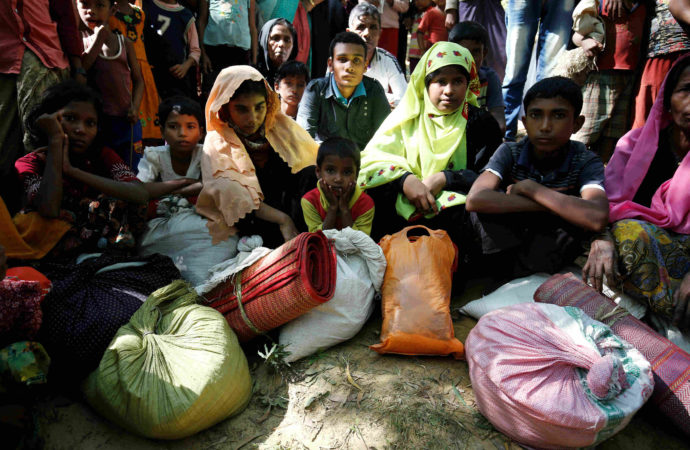
Rohingya Muslims
Rohingya refugees sit as they wait to enter the Kutupalang Refugee Camp in Cox’s Bazar, Bangladesh, November 21, 2016REUTERS

Hundreds of Rohingya have arrived in Bangladesh after fleeing violence in neighbouring Myanmar, refugee camp community leaders said Tuesday, many with horrific tales of troops killing and burning villages.

Bangladesh prevented hundreds more from crossing into the country after up to 30,000 Rohingya were displaced by violence in Myanmar’s Rakhine state.

Border Guard Bangladesh (BGB) have intensified patrols along the 237-kilometre border, but refugee camp leaders estimate that 1,000 people have still managed to get in over the last week.

Most are hiding out in camps for the 32,000 legally registered already living in Teknaf, fearing repatriation if they are found by authorities.

Mohammad Amin, 17, said he and 15 others fled their homes in Rakhine five days ago and reached Bangladesh by swimming across the Naf river that divides the two countries.

“The (Myanmar) army killed my father and elder brother. I hid on a hill and then walked and swam across the river, and took refuge at a mosque (in Bangladesh),” he told AFP by phone from Cox’s Bazar near the border. “Where I looked I saw only burnt houses. I don’t know what happened to my mother and sister.”

Zohra Khatun, 25, arrived late Monday with her seven children after their village was burned to the ground, and has been helped by a relative already living in a refugee camp in Bangladesh. “I waited two days before I had the chance to cross the river to come here,” Khatun told AFP by phone.

The relative, who asked not to be named, said that at least 100 families had arrived at the camp from Myanmar in the last two days. Another refugee said 500 people had taken shelter near two other Rohingya refugee camps in the area.
Border Guard Bangladesh said their troops had blocked nearly 300 Rohingya from crossing the border overnight, the highest number since the crisis began last month. “We’re preventing them on the zero line, especially those who were trying to cross the barbed-wire fences erected by Myanmar,” said Imran Ullah Sarker.
 

Satellite images show destruction across five villages [HRW]
Satellite images show destruction across five villages. HRW


Rohingya Muslim women look outside as many new refugees arrive near the Kutupalang Refugee Camp in Cox’s Bazar, Bangladesh, November 21, 2016. REUTERS/
Rohingya Muslim women look outside as many new refugees arrive near the Kutupalang Refugee Camp in Cox’s Bazar, Bangladesh, November 21, 2016 REUTERS


Rohingya refugees approach the Kutupalang Refugee Camp after illegally crossing Myanmar-Bangladesh border in Cox’s Bazar, Bangladesh, November 21, 2016. REUTERS
Rohingya refugees approach the Kutupalang Refugee Camp after illegally crossing Myanmar-Bangladesh border in Cox’s Bazar, Bangladesh, November 21, 2016 REUTERS


A Rohingya Muslim woman and her son cry after being caught by Border Guard Bangladesh (BGB) while illegally crossing at a border check point in Cox’s Bazar , Bangladesh, November 21, 2016. REUTERS
A Rohingya Muslim woman and her son cry after being caught by Border Guard Bangladesh (BGB) while illegally crossing at a border check point in Cox’s Bazar , Bangladesh, November 21, 2016 REUTERS


Security personnel check an auto-rickshaw near a check post to identify Rohingya refugee in Cox’s Bazar, Bangladesh, November 21, 2016. REUTERS
Security personnel check an auto-rickshaw near a check post to identify Rohingya refugee in Cox’s Bazar, Bangladesh, November 21, 2016 REUTERS


A security personnel stands guard after catching thirty eight Rohingya Muslims illegally crossing at a border check point in Cox’s Bazar, Bangladesh, November 21, 2016. REUTERS
A security personnel stands guard after catching thirty eight Rohingya Muslims illegally crossing at a border check point in Cox’s Bazar, Bangladesh, November 21, 2016 REUTERS

Horrific stories

Myanmar troops have poured into a strip of land that is home to the Muslim Rohingya minority since a series of attacks on police border posts last month. State media reports in Myanmar say security forces have killed almost 70 people and arrested some 400 since the lockdown began six weeks ago, but activists say the number could be far higher.

Witnesses and activists have reported troops killing Rohingya, raping women and looting and burning their houses. “We’re hearing horrific stories from them,” said one international rights worker visiting the area, speaking to AFP on condition of anonymity.

“We’ve heard that they have to bribe some people to enter Bangladeshi territory. The government must open the border and allow access of aid workers,” he said.

The arrival of more has caused tensions with the local community in Teknaf, which border Myanmar’s western Rakhine state and is one of the country’s poorest. “If they (the government) don’t act now, soon there will be a flood of Rohingya entering Bangladesh,” said Teknaf councillor Anwar Hossain. Sarker said many Rohingya were sent back after they managed to sneak across unmanned parts of the border.

Security guards are also patrolling the Naf river, the commanders said, adding that more than a dozen boats packed with Rohingya tried to land at the ghats (stations) in the Bangladeshi parts of the river.
“They told us that their houses were torched and they came here seeking safe shelter,” said one border guard official.

Thiis article was first Published on Dhaka Tribune

Midwife Modi Mishandled Delivery, Killed My No-Pain-All-Gain Demonetisation Scheme, claims Anil Bokil

0


Anil Bokil. Photo Credit: Mumbai Mirror

When PM Narendra Modi announced his government’s decision to demonetise Rs. 1000 and Rs 500 notes on November 8, Pune resident Anil Bokil was quick to claim credit for having provided the inspiration for the scheme.

Bokil has claimed that the prime minister was so enthused with his idea that the 9-minute appointment granted to him in July had stretched to two hours.

But with the scheme causing untold suffering to millions across the country, Bokil has now claimed in an interview to Mumbai Mirror that the current mess was the result of a “selective” implementation of his idea. Bokil also told the Mumbai Mirror he was on his way to Delhi for a fresh meeting with the PM but the daily could not confirm the same with the PMO.

Bokil told the Mirror his think tank had proposed a comprehensive 5-point plan of action which were as follows:

1: Complete abolition of taxes, direct and indirect by the Central or State governments and also the local bodies.

2: The taxes to be replaced with Bank Transaction Tax (BTT), wherein every inward bank transaction would attract a levy (say about two per cent). It would be a single point tax deducted at source. The deducted amount would go into the government kitties at various levels (Centre, State and Local, broken up in perhaps a ratio of 0.7 per cent, 0.6 per cent and 0.35 per cent, respectively). The concerned bank will also get a share of say another 0.35 per cent. Of course, the BTT rate would be decided by the finance ministry and Reserve Bank of India.

3: Cash transactions (withdrawals) would not attract tax.

4: All high denomination currency (anything above Rs 50) to be withdrawn.  

5: Government to create legal provision to restrict cash transactions to Rs 2,000.

According to Bokil, if all these were done together, it would have not only benefitted the common man but also changed the system completely. He lamented the fact that selectively plucking just two out of this 5-point plan by the Modi government has resulted in the “death [of the plan] we are witnessing”.
 

Does Demonetisation Tackle Black Money?

0

At the stroke of midnight on November 8, 86% of the value of Indian currency in circulation ceased to be a legal tender. Many different adjectives are being used to qualify the action – surgical strike, master stroke, third freedom (after freedom from British and license raj), 'Massive swachh abhiyan' and so on.

Though the government and even the RBI vehemently defend demonetization, its implementation is continuously taking a toll on the common masses. Citizens are put into extreme hardships. The past few days are witnessing a total lack of preparedness by banks and post offices. They lack the institutional capacity to deal with such a huge magnitude of workload. Hoards of people began to throng banks and ATMs leading to chaos and aggression. People are starting to break open shops for food as cash is not available to buy essential things.

Prof. Prabhat Patnaik was speaking at a public meeting organised by Center for Financial Accountability and Public Finance and Public Accountability Collective.

Courtesy: Newsclick.in