Targeting places of worship
The Google map route between Bhubaneswar and Kandhamal is deceptive: the 268.2 kilometres route that is supposed to technically be covered in five hours 39 minutes actually is far more arduous. And this inaccessibility has drastically affected the adequate coverage and interest in post-independent India’s worst ever anti-Christian violence that spanned two phases: December 2007 and August-September 2008.
This inaccessibility, as also the fact that those affected were tribal and Dalit Christians (unlike say the caste and class profile of those targeted in Mangaluru and Bengalaru), has also succeeded in dimming and blurring the gaze of concern and consistent spot-lighting on the targeted communal violence and its cruel, debilitating aftermath.
Before the 2008 rounds of brute bloodletting, in December 2007, we at Communalism Combat had fore-grounded the build-up to it in John Dayal’s powerful cover story Christmas Mourning. While the huge loss of life and property necessitated more attention and focus thereafter – the violence post-August 25 had 93 people were killed, over 350 churches and worship places which belonged to the adivasi Christians and Dalit Christians destroyed, around 6,500 houses burnt or demolished, over 40 women subjected to rape, molestation and humiliation and several educational, social service and health institutions were destroyed and looted and more than 56,000 people were, in all, displaced — the signs had been there to see that December. If the warning signs had been heeded, arguably the violence of 2008 could have been avoided.
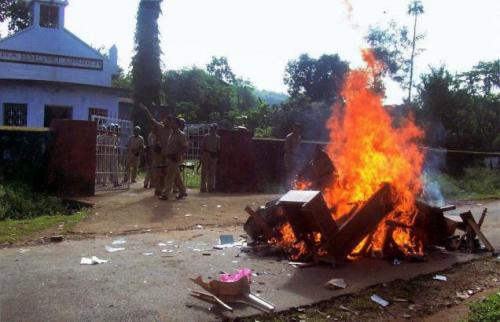
Eight to nine months before Kandhamal came under more brute attack, during the Christmas week of 2007, forces of Hindutva executed a series of coordinated and well-planned attacks on Christians and Christian institutions across the district while a callous and partisan administration looked the other way. While official figures claim that three people were killed, independent estimates state that the number of those dead is much higher, with several people still missing and many more injured. Over 500 homes, more than 70 church institutions and property worth lakhs of rupees was destroyed. More than 3,000 victims of the violence were housed in refugee camps where they are subjected to further torment and denied access to justice and equitable relief.
Less than a year after the 2008 violence at Kandhamal, the wily Naveen Patnaik of the Biju Janata Dal (BJD) de-linked himself from the Bharatiya Janata Party (BJP), broke a long standing, eleven-year-old political alliance, and in that seemingly moral decision, cleverly washed off his and his administration’s responsibility and culpability in the targeted violence of 2008 and 2007. His victory in 2009 on his own strength then ensured his third consecutive term that now runs into his fourth, post 2014 elections in the state.
2007-2008
No Mercy: Age no bar
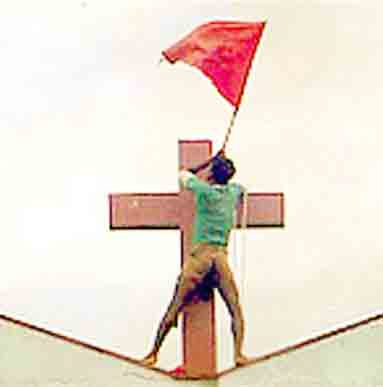
Kandhamal did not happen in isolation. In sustained and well planned attacks, Christians and Christian institutions and religious places were attacked by members and office bearers of various wings of Hindu supremacist and racist organisations (Rashtriya Swayamsevak Sangh-RSS/Vishwa Hindu Parishad-VHP, Bajrang Dal-BD) and BJP on the eve of Christmas 2007, forcing poor Dalit and tribal Christians to flee to forests. In February 2008, extremist left organisations wrote communications – which the state intelligence bureau accessed – declaring their intent vis-a-vis the Hindu rightwing organisations. From August 24, 2008 onwards after Swami Lakshmananda was killed in an attack on his ashram, a bloody and vengeful funeral procession covering 220 kilometres was organised and allowed by the state administration, taking his body in a motor cavalcade, in which Praveen Togadia, international general secretary of the VHP and BJP ministers from the state cabinet participated.
The hate-filled speeches inspired bloody mobs to attack and kill 93 persons and attack dozens of hamlets and villages on the way. Brutal rapes were also part of the sub-text: 50,000 were rendered refugees in their own land. There never was a fair and impartial investigation into those, still in the thousands, who are internally displaced.
Like clockwork around the same time, in Karnataka where BJP had been voted to power for the first time, 57 churches were attacked systematically in Mangalore, Udipi and other parts of the state. The attacks – thoroughly documented by Justice Saldanha in his report, on an inquiry requested by Transparency International and PUCL, Karnataka – tell a dangerous tale of how the highest echelons of those in power, assisted by some communally-minded policemen, not only allowed mobs to attack Christians at prayer and desecrated their places of worship, but worse, also systematically destroy any evidence of the attack as soon as they had taken place.
Independent media were also made targets and other sections of it, wooed through monetary considerations by the state government, were complicit or silent. No action was taken against the perpetrators as the state government, in a malafide action, simply withdrew all criminal cases against the perpetrators from the sangh parivar. The officially appointed Justice BK Somasekhara Commission that released its report in January 2011 was an eye-wash.
In Odisha, the National People’s Tribunal on Kandhamal’s report, 'Crying Justice', can be read here. The physical violence against Christians was accompanied by cultural manipulation in these areas. The silent work to Hinduise adivasis through religio-cultural mechanisms has been stepped up in the last three decades. People like Swami Aseemanand (Dangs, Gujarat), Swami Lakshmanananda Saraswati (Kandhamal, Odisha), followers of Asaram Bapu (Jhabua, Madhya Pradesh), began their work in popularising Hindu gods and goddesses in the region. Today Chhattisgarh is another geographical region for sustained anti-Christian assaults.
Odisha, Karnataka and Gujarat have a history of targeted violence against the religious minorities clearly suggesting a deliberate complicity of the State in non-punishment of the perpetrators.
Impunity Against Mass Crimes
Agenda: Hindu Rashtra
The state-sponsored massacre in Gujarat in 2002 was followed by brute anti-Christian violence in Odisha and Karnataka in 2007-08. Did these outbreaks happen overnight or were they the culmination of an insidious build up of incidents of persecution, but worse, impunity by the State because the perpetrators were not punished?
Evidence gathered by this writer at the time showed how from October 1988 (Phulbani Odisha), 1989 (Kalahandi, Keonjhar and Phulbani), 1991 (Ganjam and Cuttack districts), 1983 (Balasore), the Church leadership had been appealing to the state administration and Union government authorities on the issues of mob attacks on Christians and their religious places. Worse, venomous hate speech by the leaders of these mobs though monitored by the state and central authorities were not prosecuted under Indian criminal law. Even closer to the date, from October 2003 onwards we, at Communalism Combat, had been warning about the build up by the sangh parivar in Odisha.
Why do we wait until it is too late?
Between the late eighties and 2002, the build-up in Gujarat at the societal and state level violated constitutional provisions and Indian criminal law. Yet we waited until the genocidal carnage that took 2,500 lives spread over 19 districts of the state before we acted/reacted. Selected censuses of Muslims and Christians (1996-1998), driving out Muslims after violent attacks in Randhikpur and Sanjeli (October 1998 — Welcome to Hindu Rashtra, Communalism Combat). Between 1998-1999 Christians and Christian institutions were targeted across the state of Gujarat. Remember the attacks on churches in the Dangs that led to a terror-filled Christmas in the Dangs in December 1998 when 16 churches were attacked and Christians were made to live in terror?
Swami Aseemanand was the leading perpetrator, his ashram a den for hate-spewing cadres. Dangs in south Gujarat is a district where Christians and their institutions have lived in terror since then.
The Shabri Kumbh here is held every year – a pretext for the sangh parivar’s continuing terror tactics through “re-conversion” and the land of tribals is being sold by a visceral state government to corporate media.
The violence against Christian minority communities in Odisha in August-October 2008 was not unexpected. Professor Angana Chatterjee had even told the United States’ Congressional Task Force on Religious Freedom in December 2008 (published in February 2009 issue of Communalism Combat):
“In Odisha, since the mid-1990s, a formidable mobilisation has been established by Hindu nationalist groups, including in Kandhamal district. These groups have acted with egregious impunity with adverse impact on society, economy, culture, religion, polity and security in the state. The sangh parivar ‘family’ of Hindutva, Hindu supremacist, organisations has a visible presence in 25 of 30 districts in Odisha. The sangh parivar has amassed between 35 and 40 major organisations with numerous branches (including paramilitary hate camps) in 25 districts in Odisha, with a massive base of a few million operating at every level of society ranging from, and connecting, villages to cities in their campaign to ‘convert’ Odisha for the ‘Hindu nation’.”“During the 2008 violence in Odisha various militant Hindu nationalist organisations acted with impunity. The violence was led by the following groups – the Bajrang Dal, VHP and RSS. Following the riots and extended violence against Christian communities in Kandhamal district of Odisha in August-October 2008, the government of Odisha and police, military and paramilitary forces deployed in the state failed to respond effectively, efficiently or appropriately. This posed a serious threat to democratic governance in the state and the ability of government to ensure the security and sanctity of peoples and groups made vulnerable through majoritarian communalism as perpetrated by Hindu nationalist organisations in the state. The central government in New Delhi as well failed to respond in a timely and effective manner and with due concern.” (Published in February 2009 issue of Communalism Combat).
Report on the Justice Struggle in Odisha (Kandhamals)
Case status of fast Track Court (03.03.09—to–01.12.10)
Complaints lodged—————————————————————–3232
Case registered———————————————————————828
Total Number of cases (Vi+No.Vi) committed to the court no-2———————277
Total Number of violence cases committed to the court-2—————————281
Total Number of No-Violence case committed to the court-2————————47
Number of case Acquitted (Violence case) ——————– ——————-128
Number of case Convicted (Violence case) —————————————-59
Number of case on pending trial (Violence case) ———————– —– —–44
ACQUITTAL & CONVICTION RATE.
Total Number of accused faced the trial—————————————–1556
Number of accused convicted —————————————————269
Number of accused acquitted ————————————————–1287
(Source: Father Advocate Dibakar Parichha, Justice Peace Development and Communications)
Plight of the Victims Today
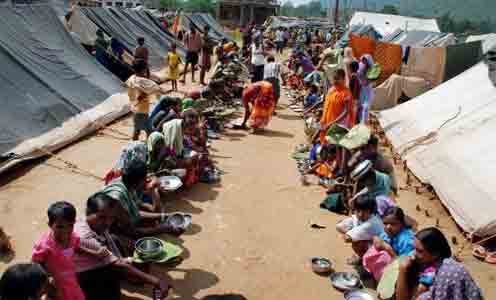
At a refugee camp four years later
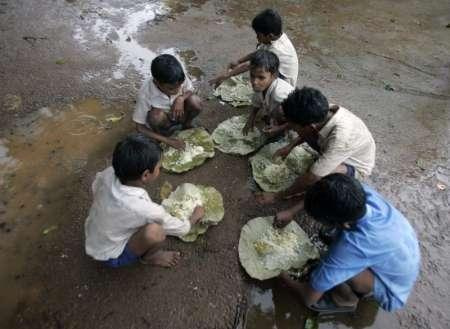
About 15,000 people, eight years down, are still living as refugees outside their villages. Survivors have been under threat not to return to their villages unless they agree to change their religion, withdraw cases against their attackers, and stop eating beef and Dalits stay within limitations imposed by the upper castes.
Out of 3,300 complaints filed by victims in the local police stations only 831 were registered (as First Information Reports – FIRs). Many cases have not been properly investigated and the accused not prosecuted. In other cases, shoddy police investigations have already created a crisis in the dispensation of justice.
There has been no action against the Odisha administration officials who failed to protect the lives of Christians and who allowed Hindu extremist mobs to move around the district with an organised and armed crowd and to engage in arson, burning, killing in the presence of police or those officials who allowed sangh parivar leaders like Pravin Togadia to enter the area and deliver hate speeches.
There have also been major lacunae in the administration of relief and rehabilitation of the victims of the mass violence. Improper identification and assessment of the houses as fully or partially damaged has been done, damaged houses have been left out of the lists, while lost or damaged household articles are not mentioned at all. Even the 837 families, who lost their houses during December 2007 violence, have not all got, any housing. The government had as part of the compensation package, promised only Rs 50,000 as compensation for fully damaged houses; still the actual disbursement till now has only been Rs 10,000. Out of 6,500 families which lost their houses 60 percent are yet to have a roof to shelter under, eight years later. Structural damage to schools, hospitals and offices has not been adequately, if at all, compensated.
The administration has not made any visible effort to support a revival of dignified livelihood of the victims, to prevent large-scale migration and pauperisation of victim families, or to bring children who were forced to drop out back to school.
The long-standing problem of landlessness and land alienation of the Dalits and adivasis has been completely ignored. There have been almost no efforts to provide land rights to landless survivors who are facing difficulties to get a shelter after they lost their houses during violence.
Tomorrow's Citizens
In both 2007 and 2008, the state in Odisha was responsible for the violation of Article 14 and 21 and 25 of the Indian Constitution and the situation in Odisha is reflective of an absolute breakdown of the rule of law and constitutional governance.
Prayer houses of the minority community had been burnt, a 'nun' was molested and raped while police personnel watched and the entire law and order situation had completely collapsed.
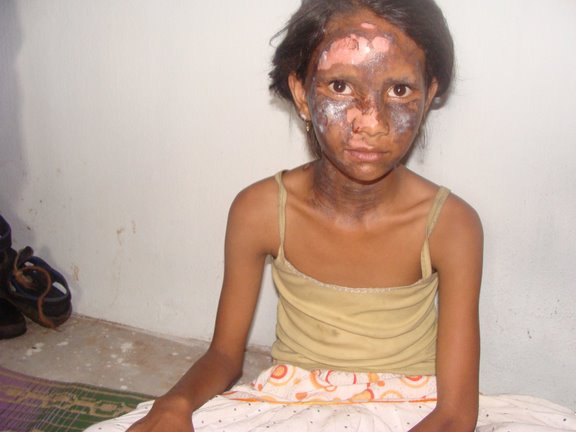
The story of young Rajani Majhi of Padampur, Kanya Ashram, Bargarh, was particularly gory. She was thrown in fire and was burnt to death. The nun was raped in public on August 25, 2008 at 'K. Nuagaon' village under Baliguda police station.
It was not possible for these crimes to have been committed without the open and tacit support of the district administration and the state government. The criminals are reported to be activists of the Bajrang Dal which is a youth wing of sangh parivar which enjoys the patronage and a symbiotic relationship with the political party, the Bharatiya Janata Party (BJP) which was, until 2009, a coalition partner in the present government. The entire exercise of burning churches and savage killing of innocent people from the minority community has been masterminded by rightwing Hindu organisations. However, the state government as a whole supported these acts.
After the first bout of violence in December 2007, the Naxalites had reportedly written a letter threatening Swami Laxmanananda Saraswati with his life. This is in the possession and knowledge of the state administration. Yet, the state of Odisha, its chief minister, home minister, collector and SP of Kandhamal did nothing to control the anticipated fallout of the violence following the killing of the Swami. Officers of the state intelligence bureau, Odisha shared the letter with this author in May 2008. Excerpt:
“This communal violence is being fomented by BJP keeping an eye on the coming election and since BJP is the coalition partner in the ruling govt. in Odisha, the Naveen Patnaik led govt. in the state as well as the police administration are extending all help to BJP in carrying out its nefarious designs. This is amply proved from the fact that Lakshmananda Saraswati who was the mastermind behind the communal violence was accorded VIP treatment in the hospital although he was not injured during the attack on his vehicle. People must know that number of tribal girls is being regularly sexually harassed by Swami Laxmanananda in his Kanyashram at Tumudibandh….. It is obvious that being influenced by our struggle the Dalits, adivasis irrespective of their caste, religion and education took part in the same counter attack on the rioters in Brahmanigaon area. However, the allegation that CPI (Maoist) was directly involved in the attack was not true. If at all our cadres would have joined in the attack then the attack would not have concentrated at Oriya Sahi (Brahmanigaon) which is inhabited by common Hindus, rather we would have targeted the top leaders of Hindu fundamental forces like Lakshmananda Saraswati or other leaders of Sangh Parivar/BJP. The communal violence was carried out by the Sangh Parivar activists in order to suppress the emerging new leaders/contractors/businessmen among the Dalit and adivasi community so that the exploitation being carried out by upper caste landlords and contractors would remain in force. The VHP as well as its patronisers i.e., the upper caste landlords/businessmen fomented the communal violence in Kandhamal district only to safeguard their economic interest. The attack and loss incurred by each member of Hindu or Christian community in this communal violence is really painful, heart-touching and needs to be condemned. We would request both the religious groups to refrain from their fundamentalist ideology and should strive to form a secular society.” (Marked “SECRET”, Appeal by CPI (Maoist), Odisha State Organising Committee).
When this threat was in their knowledge and the Maoist/Naxalite outfits claimed open and public credit for the massacre of the Swami, the state of Odisha by remaining silent and allowing its coalition partner the Bharatiya Janata Party(BJP) and ministers, their sister organisations like the Bajrang Dal (BD) and Vishwa Hindu Parishad (VHP) to spin their own tale on who was responsible for the violence, amounted to nothing short of barefaced and open collusion in the violence against tribal Christians and Dalit Christians in the Kandhamals. The culpability of the entire administration is shameful and there for any reasonable person to see.
Since December 2007, despite pressure from the BJP, Bajrang Dal and the VHP six platoons of the CRPF had been stationed at Kandhamal. These paramilitary central forces could have been immediately used for the protection of life and property. But their failure to act was because in law the collector (district magistrate) is empowered to issue the command to enlist their support. The command was not issued by the collector as a deliberate act of collusion in the violence and atrocities.
The state government failed in its role to observe its constitutional duties as laid down under Article 163-165 of the Indian Constitution where it is responsible to the governor for the protection of the fundamental rights of all citizen regardless of caste community, tribe of gender. Specifically, its failure, to provide firm and non-partisan leadership to the state and to give unequivocal instructions to prevent inflammatory processions carrying of Swami Laxmanananda body more than 222 kilometers to inflame passions, allow a ‘bandh’ called by an organisation was key in allowing the violence to spread.
Similarities to Gujarat Genocide of 2002
A procession was allowed on August 24, 2008 that accompanied the dead body of Swami Laxmanananda Saraswati to every nook and corner of Kandhamal, stopping outside churches, shouting incendiary slogans, sowing the seeds of communal tension against the minority Christians. The rioters went on rampage by destroying the homes of the minority community. Similarly the corpses of the unfortunate victims of the Godhra mass arson that took place in S-6 coach of the Sabarmati Express were paraded in different parts of Ahmedabad to inflame cadres of the VHP and BD to commit brute violence thereafter.
On August 25, 2008 a call was given by the sangh parivar for an Odisha bandh. The state government, again, did not take any effective steps to protect the life and property of the people by deploying military force in sensitive places. As a result, a well thought out plan was executed for ethnic cleansing. In the process, innocent lives were savagely smothered like moth without any respect for human values. An innocent girl, Rajani was thrown inside the burning Sevashram.
The medical report submitted by Dr Sangita Mishra and Smita Marandi in the nun rape case was suppressed for 39 days from the public. The police chief of Kandhamal was forced to admit before the public in a press conference that the medical report revealed that she was raped. Till then, neither the accused persons had been nabbed nor any enquiry conducted by the investigating agencies. The administration remained mute witness to the bestiality shown by activists of the Bajrang Dal, killing people and hiding the dead bodies in the dense forest. At the same time it successfully manipulated the media to project before the public that everything is under control and no barbarity was being committed by the rioters.
Togadia inflamed violence through the calculated use of provocative statements inciting violence against Christians in blatant violation of law. This led to the widespread massacre of Christians and burning of prayer halls of the community. Hence he is liable to be prosecuted for giving provocation to the riot under section 153a, 153b and 595 of the Indian Penal Code and section 295 IPC. The state government ought to have directed the police to file an FIR and initiated criminal proceedings against him. Perpetrators such as Togadia are in the business of hate incitement (Gujarat, Mumbai, Assam, and Rajasthan) and if not prosecuted will spread their venom ad infinitum.
The BJP was a coalition partner of the BJD led government in 2008. Several of its leaders, including ministers in the state cabinet had participated in the procession (as the video shows) and the funeral ceremony of the late Lakshmananda Saraswati was used to give a green signal to the communal criminals to set fires to homes, entire villages, attack churches and unleash a reign of terror against the Christian minority. The presence of ministers along with the inciters openly encouraged VHP and Bajrang Dal activists to go ahead with the violence without any fear.
Though official reports of the Odisha government claimed at the time that 10,000 people had already returned back to their homes from the relief camps to settle in their villages, many have since been rendered permanently homeless. For months thereafter, they were either living in inhuman camps which the state does not admit to or are in other states, having migrated in fear. Furthermore the threat of forceful conversion by shaving their head and drinking cow dung water remained a threat that still looms large.
About 62 FIRs had been filed between 2006 and 2008 relating to forceful conversion from Christianity to Hinduism in Kandhamal in gross violation to the Odisha Freedom of Religion Act, 1967 and Rules.
Should not those in responsible positions in the administration and police and inciters of hatred and violence like Togadia been effectively prosecuted?
The district administration Baliguda who was responsible for suppressing the rape of the nun for 33 days also remained a mute spectator to the massacre and burning the villages and churches. This is empirical proof of the ideological designs and pressures on the district police and administration by the sangh parivar and moreover threatens the basic tenets of transparency and the rule of law that decree that when a crime is committed, the guilty must be punished.
Thus along with the district administration, G Udaygiri, Tikabali, Raikia and Pasara, the superintendent police (SP) of Kandhamal and the director general (DG) of Police are also responsible for these calculated lapses that violate a citizens fundamental rights to equal protection before the law under the Indian Constitution; that violate their statutory duties under the CrPC and the administrative service rules governing IPS and IAS officers.
Hence, they should have been suspended and criminal prosecutions for criminal negligence for the loss of lives of members of the minority community been launched against them. If normal departmental proceedings were initiated against them, the same should not be a camouflage for a full-fledged criminal prosecution in full public view that is required to restore the confidence of the people in the state.
The compensation for the families of those killed which was announced has not been given in several cases because of the non-availability of the post-mortem report to the legal heir of the deceased. Since they have lost their earning member of the family, they should have been paid compensation immediately without waiting for a post-mortem report with the condition that the relative of the victim submit an indemnity bond and the eyewitnesses testified to the deaths.
That apart, the compensation declared by the government was a paltry sum. Commensurate packages should be paid to what has been paid elsewhere. In the case of the Gujarat genocide of 2002, also, the Gujarat government's pathetic package was buffeted by a central government package that gave Rs 5 lakh for every life lost and Rs 1.25 lakh to every injured person. Hence the state government should have been compelled to review its package of compensation and re-assess it in view of the severe psychological and socio-economic jolt to the family members of the deceased. This again points to the lacunae due to the absence of institutional, statutory measures for reparation to survivors of mass comes.
Demands for an Independent Commission were never met
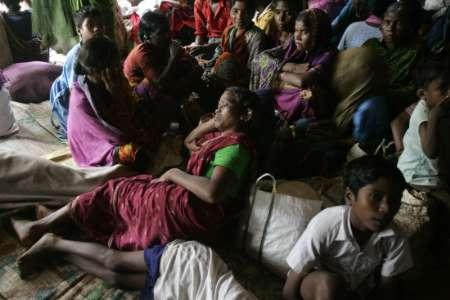
The displaced: Inside a refugee camp
Since the violence, several steps were suggested to restore faith among the victim community. The following specific suggestions were made to create an independent body in the district level and also in each block to facilitate the peace process. These were however never acted upon.
· Immediate creation of 'Help Line' and also 'Citizen's Committees' headed by a local community leader, essentially a human rights activist from among ST/SC/religious minority groups, in each block and at district level to collect first hand information
· Proper documentation of victim and deprived families
· Appointment of sensitive officers from the SC/ST/minority communities in all affected areas
· Review and appointment of officers from the SC/ST communities who are sensitive to the issues and make changes as per the advice of the said committees as per ST/SC Atrocity Act 1989 and Rule 1995.
Identifying the Perpetrators in Odisha: Chain of Command Responsibility
· The political leadership in Odisha represented by the politicians at the top even in the state cabinet, especially cabinet ministers from the BJP at the time, who endorsed or participated in the violent procession following Swami Lakshmanananda’s murder. They were under a constitutional obligation and had taken an oath to protect the lives and properties of all, irrespective of caste creed or community (Article 21 of the Indian Constitution, Article 163-165 of the Indian Constitution).
· The state of Odisha under its constitutional obligation to protect lives of all irrespective of caste, gender, community and class (Article 21 of the Indian Constitution)
· The Union of India, represented through its secretary of home, New Delhi under its constitutional obligation specifically under Article 355 of the Indian Constitution (Duty of the Union to Protect States Against External Aggression and Internal Disturbance: It shall be the duty of the Union to protect every State against external aggression and internal disturbance and to ensure that the government of every State is carried on in accordance with the provisions of this Constitution).
· Individuals in the state government/administration who are culpable: secretary of home department, Odisha, Secretariat, Bhubaneswar; especially officers in charge in Cuttack, Behrampur-Ganjam, Phulbani; officials of the Tikabali police station, Udaygiri police station, Raikia police station, Daringbadi and K Nuagaon, Baligududa police station. This is quite apart from the criminal culpability of the perpetrators whose roles were investigated and who were found to be responsible for fomenting the violence be it Ashok Sahoo, convener Hindu Jagaran Samukhy Biswa Sambad Kendra or Pravin Togadia, international secretary general of VHP.
After each and every bout of targeted anti-minority violence, the absence of institutional memory surfaces and remains a major handicap in ensuring complete or at least fair reparation. It was this absence of sustained and coherent institutional memory that was at the root of the massive countrywide movement to table and enact the Prevention of Communal and Targeted Violence (Access to Justice and Reparations) Bill, 2011. Unfortunately this became a victim of narrow, sectarian worldviews and a weak political leadership under the United Progressive Alliance II. Until India finds a way to renew and regenerate its will to recognise institutionalised bias and correct it trough the threat of penal punitive action, there is literally nothing to fear for either the perpetrators or a complicit state. Extraordinary energy, commitment and resources are needed to sustain a citizens’ battle for justice, as we have done for the perpetrators in 2002 and ensured 137 convictions to life imprisonment. That’s a price only few are willing to pay.