Rare aerial footage shows unprecedented levels of suffering in Iraq and Syria
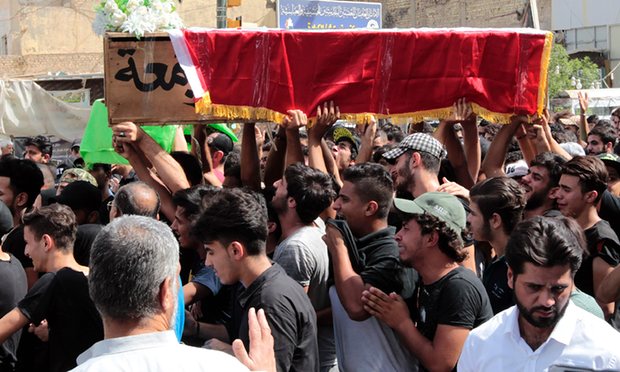
Mourners carry the coffin of a 22-year-old victim of the suicide bombing that ripped through Karada. Photograph Sabah Arar AFP Getty Images
More bodies have been recovered from the site of a massive Islamic State suicide bombing in central Baghdad, bringing the death toll to 175, The Guardian reported officials to have said.
The staggering figure – one of the worst bombings in 13 years of war in Iraq – has cast a pall on the Muslim holiday of Eid al-Fitr, which marks the end of the holy month. Eid is likely to be on Wednesday, July 6.
An ISIS suicide bomber struck Baghdad’s bustling commercial area of Karada late, a predominantly Shia locality, on Saturday, when many residents were spending the night out before the start of their dawn fast. Despite battlefield losses in the country, this new face of ISIS has struck terror around the globe. Police and health officials, who spoke on condition of anonymity as they were not authorised to release the information, warned that there are still people missing and that the death toll could rise further.
On Tuesday morning, the residents of Karada held a funeral procession for a young man at the scene of the blast. An Iraqi flag draped over her shoulder, his mother led the mourners carrying his wooden casket and pounding their chests in grief. Others were seen throwing flowers on the casket, also wrapped in the Iraqi flag.
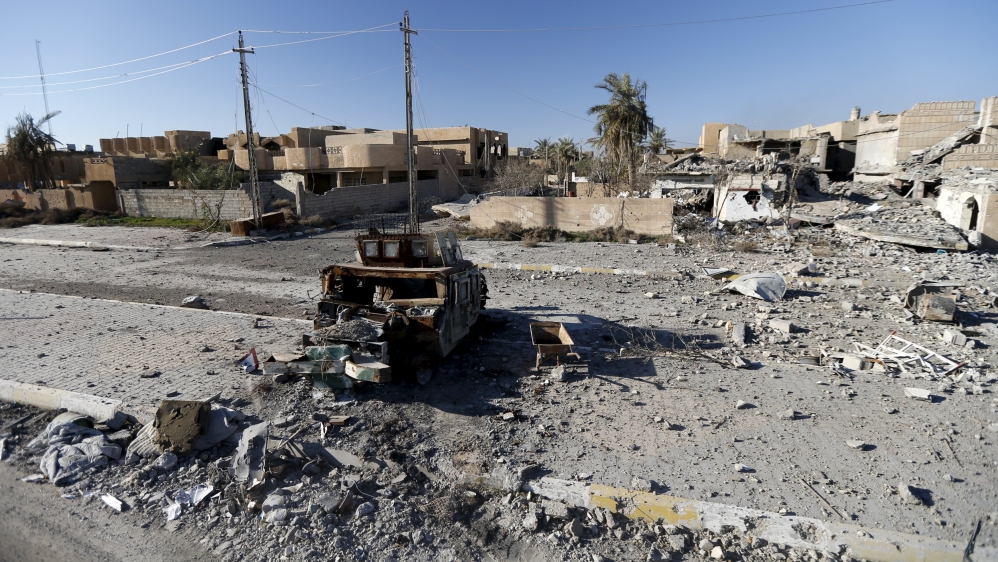
Meawnhile in a sensational end of Ramzan disclosure, the International Committee of the Red Cross (ICRC) released a video on July 1, that shows homes, schools and hospitals crumbled to rubble shown in dramatic scenes captured by an ICRC drone camera-Chilling aerial footage of Ramadi, a once bustling city in central Iraq, has captured the extent of destruction caused by war.
In late December, Iraqi forces, backed by US air strikes, announced the recapturing of Ramadi, which had been lost to the Islamic State of Iraq and the Levant (ISIL, also known as ISIS) group in May 2015. The US-led coalition carried out more than 600 air strikes in the area from July to December last year.
A new six-minute clip, released by the International Red Committee of The Red Cross (ICRC) shows homes in Ramadi turned to rubble, along with flattened school, destroyed hospitals and damaged ambulances.
Click on the link for video: http://imedia8uk.http.internapcdn.net/imedia8uk/icrc/AV506N_Drone_Iraq_President_466.mp4
Ramadi, the Anbar provincial capital, was once home to half a million people [Thaier Al-Sudani/Reuters]
The president of the International Committee of the Red Cross (ICRC), Peter Maurer, has said in the video that levels of suffering in Syria and Iraq have reached unprecedented levels. “Hundreds of thousands killed; millions on the move; families torn apart,” states Maurer. “Even as Ramadan comes to an end, many, many ordinary people are living in abject fear and terrifying uncertainty. A humanitarian catastrophe is unfolding.”
Rare aerial footage gathered by ICRC shows the once prosperous Ramadi in central Iraq now in tatters – a ghost town. Explosive remnants of war are scattered across the city and most people are too afraid to return to homes. It will take months, if not years, to make the city safe again and to rebuild homes and damaged water and electric systems.
In both Syria and Iraq, an estimated 10 million are internally displaced and hundreds of thousands of people have been killed. As the holy month of Ramadan comes to an end, president Maurer, called on those people with influence over the conflict to show vision and courage and a respect for the fundamental value of human dignity.
Maurer says: “The people need leaders who believe in humanity; who protect, homes, schools and hospitals; who protect civilians and treat people they capture with respect. And we stand ready to talk to anyone – or to act as an intermediary so that more help, more assistance, can be delivered. And more people protected from violence.”
The Red Cross and Red Crescent Societies have been providing aid to people on all sides of the conflicts. The ICRC has helped provide clean drinking water and improved sanitation for more than 6 million Syrians. In Iraq, food, drinking water and medical assistance has been delivered to more than a million people.
RSS/BJP ने फ़िलहाल अपने अव्वल नंबर के देशभक्त 'वीर' सावरकर की स्तुति काफ़ी हद तक कम करदी है। इस की सब से बड़ी वजह यह है की इस 'वीर' की असली कहानी दुनिया के सामने आगई है ।[i] हिंदुत्व के इस 'वीर' ने अंग्रेज़ हुक्मरानों से एक बार नहीं बल्कि पांच बार (1911, 1913, 1914, 1918 और 1 920 में) रिहाई पाने के लिए माफ़ी-नामे लिखे जिन में अपने क्रांतिकारी इतिहास के लिए माफ़ी मांगी और आगे अंग्रेज़ी राज का वफ़ादार बने रहने का आश्वासन दिया। अंग्रेज़ हकूमत ने इस 'वीर' के माफ़ी-नामों को स्वीकारते हुवे 50 साल की क़ैद में से 37 साल की कटौती कर दी।
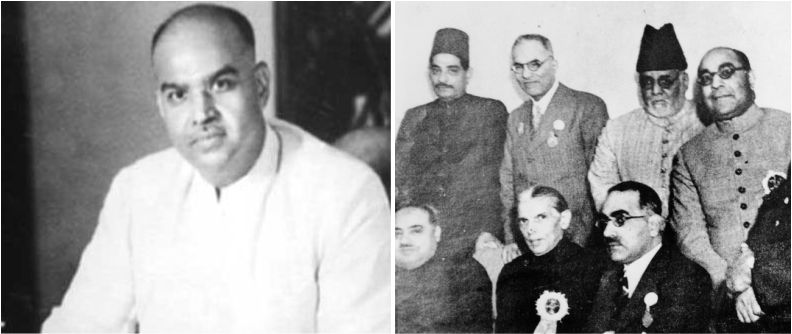
हिंदुत्व टोली के नए 'देश-भक्त' डॉ श्यामा प्रसाद मुखर्जी (1901-1953) हैं। वे स्वतंत्रता-पूर्व हिन्दू-महासभा में सावरकर के बाद सब से अहम नेता थे और यह मानते थे की हिन्दुस्तान केवल हिन्दुओं के लिए है। वे 1944 में हिन्दू-महासभा के मुखिया भी रहे। आज़ादी के बादवे देश के पहले अंतरिम मंत्री मंडल, जिस के मुखिया जवाहरलाल नेहरू थे, में उद्योग और रसद मंत्री थे। उन्हों ने अप्रैल 1950 में नेहरू से पाकिस्तान से किस तरह के सम्बन्ध हूँ पर विरोध होने की वजह से इस्तीफ़ा दे दिया था। इस्तीफ़े के बाद उनहूँ ने आरएसअस का हाथ थाम लिया और उस के आदेश पर आरएसअस के एक राजनैतिक अंग, भारतीय जन संघ की स्थापना की और इस के पहले अधियक्ष भी बने। उनकी मृत्यु 23 जून 1953 को श्रीनगर, जम्मू व कश्मीर के एक जेल में हुई जहां उन्हें उस क्षेत्र में प्रवेश निषेध आदेश के बावजूद दाख़िल होने के लिए गिरफ़्तार करके रख्खा गया था।
2015 तक इन की मृत्यु के दिन को 'दधारा 370 समाप्त करो दिवस' और 'कश्मीर बचाओ दिवस'.के रूप में मनाया जाता था लेकिन इस साल (2016 में) इन का दर्जा बढ़ा कर इन्हें देश का 'एक निस्स्वार्थ देशभक्त' (A Selfless Patriot of India) घोषित करदिया गया। डॉ श्यामा प्रसाद मुखर्जी कितने महान 'निस्स्वार्थ देशभक्त' थे इसे पर्खने के लिए हमें निम्नलिखित सच्चाइयों पर ग़ौर करना होगा।
(1) डॉ श्यामा प्रसाद मुखर्जी के स्वतंत्रता-संग्राम में हिस्सेदारी का कोई प्रमाण नहीं है। अगर देश-भक्त होने का मतलब है की किसी ने अंग्रेज़ी राज के ख़िलाफ़ लड़ाई में हिस्सा लिया हो, दमन सहा हो और किसी भी तरह का त्याग किया हो तो यह जानकर ताजुब्ब नहीं होना चाहिए कि मुखर्जी ने आज़ादी की लड़ाई में कभी भी और किसी भी तरह से भाग नहीं लिया। ना ही तो स्वयं मुखर्जी की लेखनी में ना ही उस समय के सरकारी या ग़ैर-सरकारी दस्तावेज़ों और ना ही हिन्दुत्वादी संगठनों के समकालीन अभिलेखागार में उन की आज़ादी की लड़ाई में हिस्सेदारी का कोई ज़िक्र मिलता है। इस के विपरीत आज़ादी की लड़ाई के विरुद्ध किए गए उन के अनगिनित कारनामों का वर्णन ज़रूर मिलता है। आज़ादी से पहले के दस्तावेज़ इस सच्चाई को बार-बार रेखांकित करते हैं कि कैसे इस 'निस्स्वार्थ देशभक्त' ने अंग्रेज़ों की सेवा की और सांझी आज़ादी की लड़ाई को धार्मिक आधार पर विभाजित करने में कोई कोर-कसर नहीं छोड़ी। वे जीवन भर सावरकर के मुरीद रहे जो मुस्लिम लीग की तरह हिन्दुओं और मुसलमानों को दो अलग राष्ट्र मानते थे।
(2 )भारत छोड़ो आंदोलन 1942 में मुखर्जी बंगाल की मुस्लिम लीग और हिन्दू महासभा की मिली-जुली सरकार में उप-मुख्य मंत्री थे। जब जुलाई 1942 में गांधीजी के नेतृत्व में कांग्रेस ने अगस्त 8 से अंग्रेज़ों भारत छोड़ो आंदोलन का आह्वान किया तब मुखर्जी बंगाल की मुस्लिम लीग के नेतृत्व वाली सरकार , जिस में हिन्दू महासभा भी शामिल थी , के वित्त मंत्री थे और साथ में उप-मुख्य मंत्री भी। इस आंदोलन की घोषणा के साथ ही कांग्रेस पर प्रतिबंध लगा दिया गया, कांग्रेस के तमाम बड़े नेता जिन में गांधीजी, नेहरू, मौलाना आज़ाद, सरदार पटेल शामिल थे बन्दी बना लिए गए, पूरा देश एक जेल में बदल गया और हज़ारों लोग इस जुर्म में पुलिस और सेना की गोलिओं से भून दिए गए की वे तिरंगे झंडे को लहराते हुवे सार्वजनिक स्थानों से गुज़रना चाह रहे थे। हिन्दू राष्ट्रवादी संगठनों जैसे की हिन्दू महासभा व आरएसएस और मुस्लिम राष्ट्रवादी संगठन, मुस्लिम लीग कांग्रेस दुवारा छेड़े गए भारत छोड़ो आंदोलन का विरोध नहीं किया बल्कि इस को कुचलने के लिए अंग्रेज़ शासकों को हर प्रकार से मदद करने का फैसला लिया। जब देश में किसी भी प्रकार की राजनीतिक गतविधि पर पाबंदी थी उस समय हिन्दू महासभा और मुस्लिम लीग को एक साथ मिलकर बंगाल, सिँध और NWFP में साझा सरकारें चलाने की अनुमति दी गई। अंग्रेज़ों के दमनकारी विदेशी राज को बनाए रखने में सहायता हेतु इस शर्मनाक गठबंधन को महामंडित करते हुवे हिन्दू महासभा के अध्यक्ष सावरकर ने 1942 के हिन्दू महासभा के कानपुर अधिवेशन को सम्बोधित करते हुवे बताया: "वेवहारिक राजनीति में भी हिन्दू महासभा जानती है कि हमें बुद्धिसम्मत समझौतों के ज़रिये आगे बढ़ना चाहिए। हाल ही में सिंध की सच्चाई को देखें, यहां सिंध हिन्दू महासभा ने निमंतरण के बाद मुस्लिम लीग के साथ मिली-जुली सरकार चलने की जिम्मेदारी ली। बंगाल का उद्धारण भी सब को पता है। उदंड लीगी (अर्थात मुस्लिम लीग) जिन्हें कांग्रेस अपनी तमाम आत्मसमर्पणशीलता के बावजूद रख सकी, हिन्दू महासभा के साथ संपर्क में आने पर तर्क संगत समझौतों और सामाजिक सम्बन्धों के लिए तैयार हो गए और वहां की मिली-जुली मिस्टर फजलुल हक़ के प्रधानमंत्रित्व और महासभा के क़ाबिल और मान्य नेता श्यामाप्रसाद मुकर्जी के नेतृत्व में दोनों समुदायों के फ़ायदे के लिए एक साल तक सफलतापूर्वक चली।"[ii]
(3) बंगाल के उप-मुख्यमंत्री रहते हुवे मुखर्जी ने अंग्रेज़ गवर्नर को चिट्ठी दुवारा भारत छोड़ो आंदोलन को कुचलने के लिए हर संभव मदद का आश्वासन दिया। मुखर्जी ने एक शर्मनाक काम करते हुवे बंगाल के अंग्रेज़ गवर्नर को जुलाई 26, 1 942 में एक सरकारी पत्र के दुवारा इस देश भर में चल रहे आंदोलन को शुरू होने से पहले ही कुचलने का आह्वान करते हुवे लिखा: "अब मुझे उस स्तिथि के बारे में बात करनी है जो कांग्रेस दुवारा छेड़े गए व्यापक आंदोलन के मद्देनज़र पैदा होगी।युद्ध [दूसरा विश्व युद्ध] के दिनों में जो भी आम लोगों की भावनाएं भड़काने की कोशिश करेगाजिस से बड़े पैमाने पर दंगे या असुरक्षा फैले उसका हर हाल में सत्ताधारी सरकार दुवारा प्रतिरोध करना ही होगा।"[iii]
(4) मुखर्जी ने भारत छोड़ो आंदोलन के कुचलने को सही ठहरया और अंग्रेज़ शासकों को देश का मुक्तिदाता बताया। मुखर्जी ने बंगाल की मुस्लिम लीग-हिन्दू महासभा साझी सरकार की ओर से बंगाल के अंग्रेज़ गवर्नर को लिखी चिट्ठी में अंग्रेज़ हकूमत को प्रांत का मुक्तिदाता बताते हुवे उसे भारत छोड़ो आंदोलन को कुचलने के लिए कई क़दम भी सुझाए: "प्रशन यह है की बंगाल में भारतछोड़ोआंदोलन से कैसे निपटा जाए? राज्य का शासन इस तरह चलाया जाए की कोंग्रेस की तमाम कोशिशों के बावजूद यह आंदोलन बंगाल में क़दम जमाने में कामयाब न हो सके। हमारे लिए विशेषकर उत्तरदायी मंत्रिओं के लिए जनता को यह समझाना संभव होना चाहिए की आज़ादी जिस के लिए कांग्रेस ने आंदोलन शुरू किया है वह पहले से ही जन-प्रतिनिधिओं को प्राप्त है। कुछ मामलों में आपातकालीन हालात की वजह से यह सीमित हो सकती है। भारतीयों को अंग्रेज़ों पर भरोसा करना चाहिए, ब्रिटेन के वास्ते नहीं, इस लिए नहीं के इस से ब्रिटेन को कुछ फायदा होग, बल्कि प्रांत की आज़ादी और सुरक्षा को बनाए रखने के लिए।"[iv]
(5) हिन्दू महासभा के प्रमुख नेता के तौर पर मुखर्जी ने उस समय अंग्रेज़ी सेना के लिए देश भर में 'भर्ती कैंप' लगाए जब सुभाष चन्दर बोस 'आज़ाद हिंद सेना' दुवारा देश को आज़ाद कराना चाहते थे। एक और शर्मनाक घटनाक्रम में 'वीर' सावरकर और मुखर्जी के नेतृत्व वाली हिन्दू महासभा ने दूसरे विश्व युद्ध के दौरान अंग्रेज़ सरकार को पूर्ण समर्थन देने का फ़ैसला किया। याद रहे की कांग्रेस ने इस युद्ध को साम्राजयवादी युद्ध की संज्ञा दी थी और यही समय था जब नेताजी 'आज़ाद हिंद सेना' खड़ी करके एक सैनिक अभियान दुवारा देश को अंग्रेज़ी चुंगल से मुक्त कारण चाहते थे। हिन्दू महासभा लुटेरे अंग्रेज़ शासकों की किस हद तक मदद करना चाहती थी इस का अंदाज़ा 'वीर' सावरकर के निम्नलिखित आदेश से लगाया जा सकता है जो उनहूँ ने देश के हिन्दुओं के लिए जारी किया था: "जहां भारत की सुरक्षा का सवाल है, हिन्दू समाज को भारत सरकार [अंग्रेज़ सरकार] के युद्ध सम्बन्धी प्रयासों में सहानभूतिपूर्ण सहयोग की भावना से बेहिचक जुड़ जाना चाहिए जब तक यह हिन्दू हित के फायदे में हो। हिन्दुओं को बड़ी संखिया में थल सेना, नौ सेना और वायु सेना में शामिल होना चाहिए और सभी आयुध, गोला-बारूद और जंग का सामान बनाने वाले कारखानों वग़ैरा में प्रवेश करना चाहिए…ग़ौरतलब है की युद्ध में जापान के कूदने के कारण हम ब्रिटेन के शत्रुओं के सीधे निशाने पर आ गये हैं। इस लिए हम चाहें या ना चाहें, हमें युद्ध के क़हर से अपने परिवार और घर को बचना है, और यह भारत की सुरक्षा के सरकारी युद्ध प्रयासों को ताक़त पहुंचाकर ही किया जा सकता है। इस लिए हिन्दू महासभायों को खास कर बंगाल और असम के प्रांतों में, जितना असरदार तरीक़े से संभव हो, हिन्दुओं को अविलम्ब सेनाओं में भर्ती होने के लिए प्रेरित करना चाहिए।"[v]
(6) मुखर्जी ने जम्मू और कश्मीर के लिए विशेष दर्जे की वकालत की थी। हिंदुत्व टोली के दावों के बरक्स मुखर्जी ने जम्मू और कश्मीर की विशेष हैसियत को स्वीकारा था। इस सिलसिले में प्रधान मंत्री नेहरू और उनके बीच चिट्ठी-पत्री का एक लम्बा दौर चला था। उन्हों ने नेहरू को 17 फ़रवरी 1953 के दिन लिखे ख़त में निम्नलिखित मांग की थी: "दोनों पक्ष इस पर सहमत हों कि राज्य की एकता बनी रहेगी औरa स्वयत्तता का सिद्धांत जम्मू] लद्दाख़ और कश्मीर पर लागू होगा।"[vi]
[i]This 'Veer' submitted five mercy petitions (1911, 1913, 1914, 1918 and 1920). He was awarded two life sentences (for 50 years) but got remission of 37 years from the colonial masters.
[ii]VD Savarkar, Samagar Savarkar Wangmaya (Collected Works of Savarkar), Hindu Mahasabha, Poona, 1963, p. 479-480. Later this coalition arrangement was extended to NWFP also.
[iii]Mookherjee, Shyama Prasad, Leaves from a Dairy. Oxford University Press.p. 179.
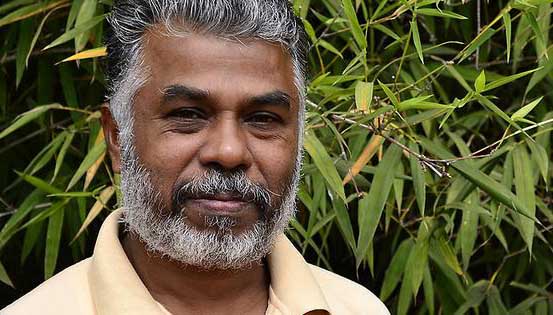
The Madras High Court on Tuesday ruled in favour of Perumal Murugan, author of the novel 'Madhorubhagan', granting him relief from all the controversies that shrouded the work of fiction that compelled him to announce that he would withdraw his entire body of work from publication and never write again.
At the end of a year-long legal battle, First Bench of Chief Justice S. K. Kaul and Justice Puspha Sathyanarayana held that the settlement arrived in the peace-keeping meet held by the district administration would not be binding on the author. The bench also dismissed the plea moved by the residents to initiate criminal proceedings against him and consequently quashed an FIR filed against Mr. Murugan. The settlement arrived in the peace-keeping meet held by the Namakkal district administration would not be binding on the author, rules court.
The court further directed the State government to circulate a series of guidelines framed by the court to handle such situations among the State police and to form an expert committee to handle such issues.
The Tamil Nadu Progressive Writers and Artists Association president, S.Tamilselvan, had challenged the decision of a peace committee meeting held at Namakkal on January 12 organised by the district administration and expressed solidarity with the writer. The decision was that Mr. Murugan had agreed to issue an unconditional apology, delete the controversial portions from his book, and withdraw unsold copies from the market. Meanwhile, a group of people claiming to be residents of Tiruchengode approached the High Court to initiate criminal charges against the author.
On February 13, 2016, Sabrangindia had featured this video interview with Peerumal Murugan’s publisher completely standing by him and his work
“I have always stood with all my writers”, says Kannan Sundaram, publisher, Kalachuvadu. Kalachuvadu was first begun as a magazine by his father, the Tamil writer, Sundara Ramaswamy. Kannan Sundaram wasthen in Delhi to receive the Samanvay Bhasha Samman 2015 on behalf of Perumal Murugan when he spoke to Souradeep Roy.
The controversy over Madhurobhagan (One Part Woman), Murugan's book, is not the first Kalachuvadu has faced. There was significant opposition to Kalachuvadu’s publishing Tamil feminist literature in the 1990s.
At a time when publishers are increasingly reluctant to stand by their own writers, Sundaram maintains that he supports complete freedom of expression for all his writers.
Forests officials in India's hinterlands are a law unto themselves. Hand in glove with poachers and timber mafia, they are accused of implicating forest dwellers in fake cases, barbarically torturing villagers in secret chambers, which some times result in custodial deaths. There are allegations of fake encounters too. In the first of an investigative series, Nidheesh J Villatt takes a close look at the alleged criminal activities of forest officials in UP's Dudhwa National Park
The Scheduled Tribes and Other Traditional Forest Dwellers Act, commonly known as Forest Rights Act (FRA) passed in 2006 sought to “correct historical injustice” meted out to the most marginalised sections. The law, captured the imagination of social activists world over as it intended to give land rights and other resources to traditional forest dwellers.
Coming as it did at a time when almost the entire policies of the government was focused to facilitate the smooth movement of capital, this legislation along with some others like Right to Information(RTI), was welcomed with great enthusiasm by those committed to social justice.
The law was intended to make the conservation of forest more transparent without impinging on the rights of the traditional forest dwellers.
Despite its progressive and democracy deepening clauses the FRA was criticised on two fronts.
First by the ‘developmentalists’ who view forest as an area which must be exploited to enhance the GDP. The other, the more sophisticated ones argued that giving rights to traditional forest dwellers would mean felling of trees!
Ten years down, is the FRA working? What are the changes it has brought on the ground?
Our special correspondent Nidheesh J Villat wanted to begin his piece with Dudhwa National Park in Uttar Pradesh.
What started off as a routine story threw up startling facts. The forest officials are a law unto themselves. They hold sway over the 490 square kms park on the Indo-Nepal border.
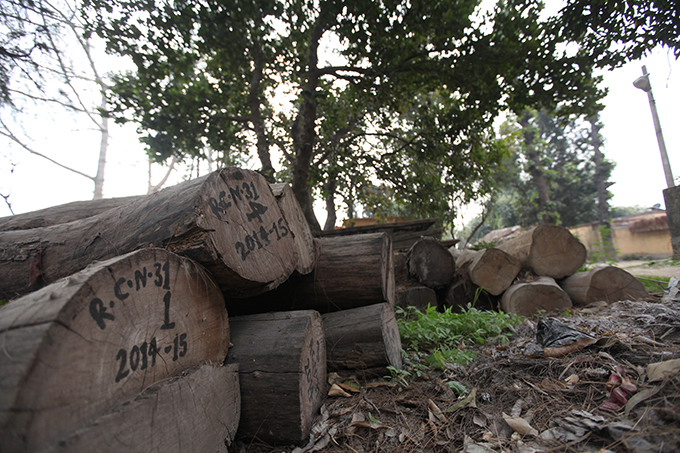
Forest officials find the FRA as an affront to their supremacy. They seem to have a finger in every pie. They are accused of conniving with lumber jacks and poachers in plundering the natural resources. The slightest act of assertion by forest dwellers are dealt with intimidation and torture.
All vested interests are aligned against the Scheduled Tribes, Dalits and lower caste Muslims who constitute a majority of traditional dwellers. Those who try to question are often illegally taken into custody, and in some cases subjected to extreme forms of torture.
To divide those fighting for their rights, forest officials have even formed vigilante groups under the garb of protecting forests.
During his investigations, Nidheesh was told that fake encounters were staged to snuff out resistance from locals. No inquiries are done. The deaths of the poorest of poor are said to be passed off as ‘unnatural’ deaths.
NaradaNews exposes the macabre activities of forest officials in the badlands of Lakhimpur Keri that skirt the country’s border with Nepal.
We hope this report, being published in four parts, will put a spotlight on the barbaric acts in Dudhwa National Park. We believe this would be the first step in ending such savagery.
Editor
“After removing our pyjamas they cut the elastic of the underwear with a country knife and threw it away. We were forced to lie down. They filled a veterinary syringe with petrol from the forest department bike. After this they forcefully parted our legs and injected petrol into our anus. Some had cotton soaked in petrol pushed it into their anus, ” Tulsi Ram, a frail young man told me.
Sounds barbaric?
“All of us started crying in deep pain. Petrol had started working. Because of pain I thought my stomach would burst. I pleaded for some water. Instead of giving water, they started beating us with a big wooden pole till it broke. We fell unconscious. After some time, some of us regained consciousness. Then officers came and poked us with big laathi and asked us…’you Chamar (a Dalit subcaste) bastards came here to sleep? After Chamar Mayawati came to power you guys are arrogant,” Tulsi recalled.
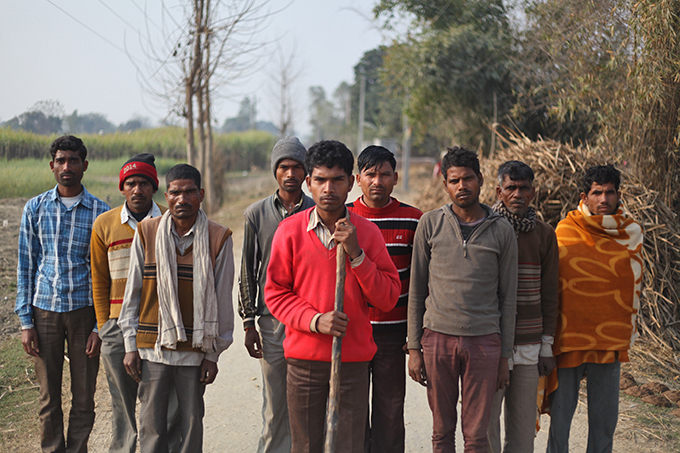
I was speaking to a group of Dalits and other lower caste traditional forest dwellers in Rampur Bandhiya village in Dudhwa National Park.
I went thereafter hearing about the unconstitutional methods used by the forest department to evict the traditional forest dwellers — Adivasis (predominantly Tharus), Dalits and lower caste Muslims — from the villages situated inside and in the buffer zone of the National Park. (See Video)
Jungle Raj | Photo: Vijay Pandey
Braving the morning chill, Tulsi and his friends recalled with horror the day (22 September 2011), they were picked by a team of forest officers, while they were grazing cattle.
Their crime? They refused to pay the parallel tax–locally known as galla orhafta collected illegally by the forest officers to permit grazing of cattle.
The monthly hafta is Rs 500 here. In some other villages, a family have to pay an yearlygalla consisting of one quintal of rice, 20 kgs of wheat, 25 kgs of mustard and several litres of honey.
“None of us were having money that day. So we couldn’t pay. We were picked and were beaten throughout the journey from village to Belarayan Forest Range Office. This continued in the ‘torture room’ of the Range Office,” Dorei, an elderly man recalled.
I spoke to Steven Miles, professor of medicine and Bioethics at Center for Bioethics, University of Minnesotta, US, about the torture methods of the forest officers in Dudhwa. Miles is an expert on internal medicine and specialises in medical consequences of the torture. His book, Oath Betrayed:America’s Torture Doctors, “examines military medicine in the War on Terror prisons”.
He says that injecting petrol into the anus or rectum will have serious medical consequences.
“Torture is an impulsive and largely improvised practice. The painful introduction of material or air into the rectum dates at least back to the middle ages. It was used in the ‘War on Terror’ by the US as rectal feeding. Pepper being put in the rectum has been sporadically practiced around the world and the use of other caustic substances including gasoline (petrol) is not surprising,” Miles pointed out.
“Torture techniques are a craft. Rectal and sexual traumas are very common in the torture of men. It would be unusual if rectal gasoline was the only method used. I would not be surprised if brutal and painful rectal rape with a stick or baton or even fluorescent light bulb was done first to open the rectal sphincter. At that point, gasoline (petrol) could be instilled. Gasoline is enormously and instantly painful on rectal tissue and the inflammation alone could cause rectal fissures and fistula connecting the rectal cavity to the bladder, intestines or freely into the abdomen allowing stool to pass into the abdomen and causing septicemias. The risk of perforations and fistulae would be greatly increased by preceding trauma and rectal tears caused by a baton or from the trauma of a tube inserted into the rectum to administer the gas.
Gasoline is toxic when it gets in the blood, usually by inhaling and occasionally by oral ingestion. That toxicity includes convulsions, kidney failure, heart failure and shock. I think it is unlikely that significant gas would be absorbed through the rectal wall,” says Miles.
Suhaeli river is used to torture forest dwellers by ‘ducking’. | Photo: Vijay Pandey
When I told him about ‘ducking’ (forcibly immersing the head in the river) of Dudhwa victims, before they were subjected to anal torture, he commented that “all torture are multi-modal”. Threatening, beating and denial of drinking water would be common in almost all cases of torture, he says. “15% of the torture victims are subjected to asphyxia” (a condition which is the resultant of the denial of oxygen to the body).
“It is highly probable that victims were tightly bound in a way to stretch or compress ligaments. It may be that when the petrol was inserted, that they were threatened with ignition”, he adds.
Arun Ferreira, noted human rights activist, who was arrested by the Maharashtra police (after branding him as Maoist) details about petrol torture in his prison memoir Colours of the Cage. He says that there was a police officer whose “expertise” was injecting petrol in anus/rectum. Ghulam Hassan Lone, a Kashmiri Muslim youth was allegedly subjected to similar torture in mid 1990s. He was accused of being a militant who was waging war against India.
“Begar (unpaid forced labour) is common here. After monsoon, forest officers force villagers to clean roads and do other related work. Funds earmarked for such work would be siphoned off by them. The reluctance of some villagers to do begar has made forest officers furious”, village head Yashpal Singh alleged.
Victims of fake cases | Photo: Vijay Pandey
“This is early 2016. Why is this kind of a brutal torture not yet news?” I asked Singh.
“Journalists from Delhi and Lucknow need wildlife safaris. Local journalists are completely dependent on the economy controlled by forest department,” a rights lawyer who accompanied me pointed out.
Interestingly in another village, a Tharu Adivasi elder gave a vivid picture of journalism in India’s hinterlands where class and caste inequalities unfold crudely.
“If we go and collect firewood, which is a constitutional right under FRA, journalists report this as massive wood theft. On a few occasions villagers have blocked vehicles smuggling huge quantity of timber to Nepal which occur with the connivance of forest officers. But next day’s newspapers would report that the huge logs smuggled as mere waste wood.”
Key Facts of Forest Rights Act (FRA) Act: Scheduled Tribes and Other Traditional Forest Dwellers (Recognition of Forest Rights) Act, popularly known as FRA Parliament Nod: 2006 Replaced: Indian Forests Act Important Features 1. Land Rights The Act grants people title deeds to forest land that they have been cultivating prior to December 13, 2005. Those cultivating land but don’t have documentary proof can claim upto 4 hectares, as long as they are cultivating the land themselves for a livelihood. Those who have a prior title or a government lease, but whose land has been illegally taken by the forest department, or whose land is the subject of a dispute between forest and revenue departments, can claim title to those lands. The land cannot be sold or transferred to anyone except by inheritance. 2. Use Rights The law provides for rights to use and/or collect the following minor forest produce such as tendu leaves, herbs, medicinal plants etc. 3. Grazing areas and water bodies 4. Right to Protect and Conserve forests 5. Right against Arbitrary Relocation
Source : Shankar Gopalakrishnan’s chapter in the upcoming book ” Elgar Handbook on Environmental Law”
Delving into the tale of Dalits who were brutally tortured by injecting petrol into the anus (peeche lagana in local parlance) and accompanying caste abuse hints that forest bureaucracy in the hinterlands are steadfastly following the colonial era of forest governance.
FRA was a direct threat to the clout of the department, veteran trade unionist Ashok Choudhary points out.
“During the last Mayawati government, there were some serious efforts to democratise forest governance by implementing FRA. Forest bureaucracy, eco-tourism mafia and local elites opposed it violently. State violence against Adivasis and Dalits should be seen in this larger context.”
My travel to the interiors of Lakhmipur Kheri gave me an idea about the atrocities of forest department.
“They run a parallel government. They indulge in fake encounters and custodial rape. They also loot natural resources by collaborating with the mafia. They also develop indigenous methods of torture,” a senior IAS officer with several year administrative experience in the district told me.
Kinjal Singh IAS, the former collector of Lakhimpur Kheri was transferred to Faizabad district for challenging the powerful forest bureaucracy.
Kinjal Singh, the collector of the district till recently, had incurred the wrath of the powerful forest mafia for questioning this parallel system of governance.
Acting on several complaints received from Adivasis and other traditional forest dwellers about the alleged criminal activities happening inside the Dudhwa park as well as in the buffer zone, the young officer ordered surprise checks by police and revenue department.
During some surprise checks she conducted, Kinjal had found massive uprooting of rare species of trees (which fetches huge money in the market) in villages like Pachpeda Richhaya, Kundanpur, Khairigargh (all falling in core area of Dudhwa) as well as in several villages situated in the buffer zone.
During these visits, she also stumbled upon several spots inside the park which were notorious for brewing illicit liquor. All these illegal activities were done in active collaboration of forest officers. Kinjal also started inquiring about several cases of encounter killings, custodial deaths and sexual assaults allegedly carried out by the forest bureaucracy.
This made the bureaucracy vindictive and they started a hate campaign against the collector with the active help of local media persons who were allegedly receiving a share of the spoils.
In an unusual development, forest employees in the Dudhwa Tiger reserve had even boycotted work for several days demanding transfer of Kinjal. The UP government transferred the collector to Faizabad, another district citing huge revenue loss caused by the strike of the forest staff.
“The move by Kinjal to implement FRA made the department furious. Forest officers are a part of mafia associated with timber smuggling and wildlife poaching. Once Adivasis and other traditional forest dwellers enter forest, mafia operations would be affected. So they wanted to ensure that FRA is not implemented,” Rajnish, a trade unionist active in this area, pointed out.
The Daily Star, Bangladesh reported late last evening, July 4, that two of the five Bangladeshi militants who hacked to death 20 people at a restaurant in Dhaka’s diplomatic zone used to follow three controversial Islamists, including Indian Islamic preacher Zakir Naik. Militant Rohan Imtiaz, son of an Awami League leader, propagated on Facebook last year quoting Peace TV’s controversial preacher Naik “urging all Muslims to be terrorists”, SabrangIndia brings to its readers a piece on the controversial preacher, banned for hate speech by both UK and Canada
Let’s grant even the venom-spewing their freedoms. Agreed, freedom of speech is meaningless if there is no space for the offending word. No democracy can survive in the absence of freedom of speech, freedom of conscience,agreed. But should there be no Laxman Rekha that even in a democracy none must cross? If not instigation to hatred, could incitement to violence perhaps mark the boundaries of individual freedom?
So, let’s grant our home-grown televangelist, Dr Zakir Naik his freedoms. His freedom to hurt national sentiments: “If you (Americans) eat pigs you behave (wife-swap) like pigs”. His freedom to hurt religious sentiments: “Jews and pagans are the worst eternal enemies of Islam”. His freedom to outrage those who care about gender justice: “women who get raped are asking for it” (dumb woman,didn’t Islam tell you to expose nothing more than your face and wrists?). His freedom to condemn sexual minorities: “death for homosexuals”. His freedom to send fellow Muslims to the gallows: “apostasy is a one-way street”. His freedom to grant special privilege to the male gender: “Man is more polygamous by nature as compared to a woman “.
What about his statements on terrorism? “Every Muslim should be a terrorist… to selective people, i.e., anti-social elements;” “If he (Osama bin Laden) is fighting the enemies of Islam, I am for him… If he is terrorising America the terrorist, the biggest terrorist, he’s following Islam.”
How does one “read” such statements? It all depends on who is reading them. In his self-defence after the [UK] visa ban, Dr Naik offers two clarifications: one,“Due to the fact that he (Osama Bin Laden) has not been convicted in respect of 9/11 and as Dr Zakir Naik cannot verify the claims against him, he "neither considers him a saint nor a terrorist”; two,“the quote is from a lecture he delivered in 1996, almost five years before 9/11”.
But the clarifications only raise further questions:
Dr Naik cannot decide about Osama because the latter has not been convicted for 9/11 and because he (Naik) cannot independently verify the claims against Osama since,“I’m not in touch with him. I don’t know him personally. I (only) read the newspaper.” Interesting. On what basis then did he arrive at his “America-the-greatest-terrorist” conclusion: newspaper reports, personal acquaintance with ex-President Bush,or a non-existent verdict of the International Criminal Court?
If the relevant quote is from a 1996 lecture, what stopped Dr Naik from coming clean a few months ago when in an NDTV programme,anchor Barkha Dutt threw that very statement at him? Why did his response so agitate Maulana Mehmood Madni of the Jamiat-ul-ulema-e-Hind?
Is lip service enough to condemn terrorism in the name of Islam? In these terror-torn times,would Dr Naik care to inform us how much time and attention was paid to this malady of current-day Islam during his 10-day long “Islam Peace Conference-2009” in Mumbai? How frequently does the terror scourge figure in discussions or debates on his Peace TV channel?
What about his statements on terrorism? “Every Muslim should be a terrorist… to selective people, i.e., anti-social elements;” “If he (Osama bin Laden) is fighting the enemies of Islam,I am for him… If he is terrorising America the terrorist, the biggest terrorist, he’s following Islam.”
Above all,as a devout Wahhabi, Dr Naik insists on a literal reading of the Quranic verses torn out of the socio-cultural realities of a primitive Arab society over 1,400 years ago. Which is why, like all literalist readers of Holy Scriptures, he is incapable of extracting the normative, universal ethico-moral principles embedded in the context-specific passages of the text. Which is why what he peddles as Islam is nothing but out-of-date, petro-dollar sponsored Wahhabism that is repugnant to modern sensibilities. The digression apart, where is the guarantee that some Muslims with fevered imaginations would not “read” Dr Naik’s utterances selectively and literally just as he himself reads the Quran and the Hadith?
Consider this: Dr Naik is reportedly a big hero for Najibullah Zazi, the Afghan-American arrested last year for plotting to bomb the New York subway, Dr Kafeel Ahmed of Bangalore origin who tried to storm Glasgow airport in an explosives-packed car and Mumbai’s Rahil Sheikh accused in the 7/11 train blasts.
No one accuses Dr Naik of being part of any terror network. But should a self-proclaimed champion of peace be so reckless in his use/misuse of inflammable words? Or are we dealing here with calculated ambiguity, a deliberate playing with fire? Until the televangelist learns to mind his language, I go with the British Muslims for Secular Democracy (BMSD) and the British Muslims Forum (BMF) in supporting the visa ban.
P.S.: On second thoughts,the ban should perhaps be revoked on condition that while in the UK, Dr Naik agrees to a discussion with Dr Taj Hargey on ‘The Status of Women in Islam’ and with Inayat Banglawala on ‘Rights of Gay Muslims’. A trustee of BMSD, Dr Hargey is also chairman of the Muslim Educational Centre of Oxford and an imam at its mosque. Dr Hargey has an open invitation to women scholars to his mosque to lead mixed-gender Friday congregational prayers. But he might not shock our own doctor so much as Banglawala, media secretary of the Muslim Council of Britain (MCB),a large nationwide,mainstream Muslim organisation that even today is considered by many to be a hybrid of the Jamaat-e-Islami and the Muslim Brotherhood. Horror of horrors, through a recent article in the Guardian, UK,Banglawala has appealed to MCB to include a gay Muslim support group as an affiliate!
No one accuses Dr Naik of being part of any terror network. But should a self-proclaimed champion of peace be so reckless in his use/misuse of inflammable words? Or are we dealing here with calculated ambiguity, a deliberate playing with fire?
Imagine the 150 million viewers of Peace TV being treated to such a rich discourse on diversity in Islam.
Veteran communist leader and former World Peace Council president Romesh Chandra passed away today in Mumbai, the CPI said in a statement. Ex-member of national executive of the CPI, Chandra died at around 3 PM in the Maharashtra capital due to old age, party leaders said. He was 97.
"Chandra's was witness to the historic peace movement. He made hefty contributions towards the movement. His demise is a big loss," CPI Maharashtra secretary Bhalchandra Kango said. According to the Left party's statement, Chandra had taken part in freedom struggle as a student leader and later joined CPI and went on to become its national executive. Chandra, who joined the Council headquarters in Helsinki as its president and played a role during cold war era, had addressed United Nations' General Assembly as peace body's leader many a times, the highest number of times as an Indian, the party said.
A recipient of Lenin Peace Award, Chandra had also worked as the editor of CPI's central organ New Age. "The Central Secretariat of the CPI pays its respectful homage to one of its prominent leaders and sends party's condolences to the bereaved family," the CPI said in a statement. Chandra is survived by his son Firoze. His wife, had passed away last year, Kango said. They had been separated.
The World Peace Council (WPC) expressed grief and loss at the passing away of our veteran leader and President of Honor Romesh Chandra today in Mumbai. He has been recognised to have served decades long the peace movement in India and the world. Romesh Chandra was born on March 30, 1919, in Lyallpur, India. He received degrees from a university in Lahore and from Cambridge University. From 1934 to 1941 he was chairman of the Students’ Union in Lahore. He became a member of the Communist Party of India (CPI) in 1939, of the Central Committee of the CPI in 1952, of the National Council of the CPI in 1958, and of the Central Executive Committee in 1958; from 1963 to 1967 he was a member of the Central Secretariat of the National Council of the CPI. From 1963 to 1966, Chandra was editor of the central organ of the CPI, New Age. He served as General Secretary of the All-India Peace Council from 1952 to 1963. In 1953 he joined the World Peace Council, and in 1966 he became the WPC’s General Secretary and a member of its presidium while in 1977 he was elected President of the WPC. During the Assembly of WPC in Athens in 2000 Romesh Chandra contributed decisively to the preservation of the anti-imperialist character of the WPC and got elected President of Honour.
He served and contributed to the struggle of the peoples and their just causes and championed in the solidarity movement with the peoples under dictatorial regimes, for the liberation and self-determination of the peoples in dozens of cases all over the world. Romesh Chandra was awarded the F. Joliot-Curie Gold Peace Medal in 1964. He received the International Lenin Prize for Strengthening Peace among Nations in 1968, and he was awarded the Order of Friendship of Peoples in 1975 by the USSR.
Romesh Chandra was a genuine son and figure of the Indian working-class movement and one of the leaders of the world peace movement.
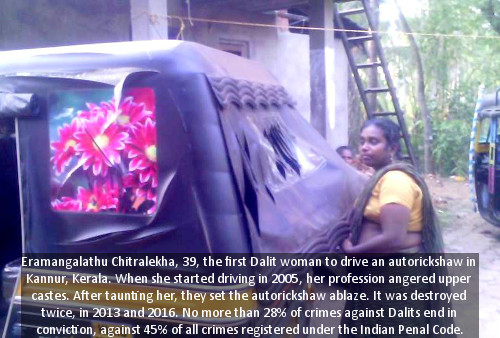
In the prosperous district of Kannur in one of India’s most prosperous states, Kerala, Eramangalathu Chitralekha, 39, was the first Dalit woman to drive an autorickshaw in 2005. Her new profession immediately angered the upper castes, who taunted her and threatened violence. One day, that year, her autorickshaw was set ablaze. In 2013, it was damaged beyond repair. The district collector gifted her a new autorickshaw in June 2014, but on March 4, 2016, it was destroyed again.
Chitralekha is unclear about her future, but she is clear that she is a victim of Hinduism’s deep-rooted caste discrimination. “My house was ransacked by Nair (upper caste) men. My son was humiliated and forced to drop out of school after eighth grade when stories started doing the rounds that I was a woman of loose morals,” she said. “He’s 22 now and still to find a job.”
Chitralekha is a Pulaya, a people termed adiyar, or slaves, in her village of Edatt. “We are low born,” she explained. “We are not permitted to draw water from the same well or eat from the same plates or drink from the same glasses used by the upper castes.”
The destruction of Chitralekha’s autorickshaw was one of numerous crimes reported in 2016 against Dalits, lowest of Hindu castes: From stopping the entry of Dalits into temples–in Uttarakhand, a bridegroom in Haryana, a community in Karnataka–to burning homes and beating women, the murder of a Dalit who married an upper-caste woman in Tamil Nadu and the rape and murder of a law student in Kerala.
These incidents are random snapshots of violence against scheduled castes (SCs) and scheduled tribes (STs) nationwide in 2016, for which data have not yet been compiled. It is unlikely that crimes against SCs and STs—up 40% and 118% over five years to 2014—will buck the trend visible in National Crime Records Bureau data.
Not only do SCs and STs—who comprise 25%, or 305 million, of India’s 1.2 billion people—endure historic and systemic discrimination, as the first part of this series showed, they are targets of growing violence, as they attempt to improve their lives in the world’s fastest-growing economy.
No shortage of laws, but discrimination is endemic
As the relentless attacks on Chitralekha show, education and prosperity are no guarantee that attitudes will change. With India’s highest literacy rate and seventh-highest per capita income, Kerala also has among the highest crime rates against SCs and STs relative to its population.
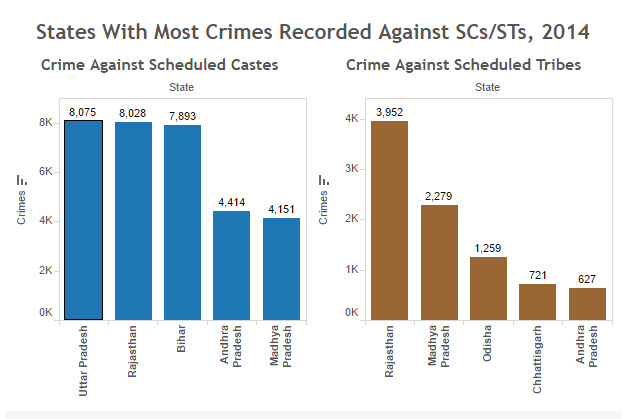
In absolute terms, in 2014, most crimes against SCs were registered in Uttar Pradesh (8,075) followed by Rajasthan (8,028) and Bihar (7,893), and most crimes against STs were registered in Rajasthan (3,952), Madhya Pradesh (2,279) and Odisha (1,259).
There is no shortage of laws to address the violence against India’s disadvantaged castes and tribes.
Specific laws include the Protection of Civil Rights Act, 1955, and the SC/ST (Prevention of Atrocities) Act, 1989. Specific laws include the Protection of Civil Rights Act, 1955, and the SC/ST (Prevention of Atrocities) Act, 1989. Besides, the Indian Penal Code (IPC), which governs most crime in India, has adequate legal provisions–if implemented.
“Whenever I filed a complaint against the goons, the police would let them go scot-free,” said Chitralekha. “The second time I went to lodge a complaint, the sub-inspector threatened to arrest me, instead!”
However, better reporting and registering appears to be a reason for the rising numbers of crimes against SCs and STs, from 33,412 (SCs) and 5,250 (STs) in 2009 to 47,064 (SCs) and 11,451 (STs) in 2014.
But the reluctance to register cases continues, as our conversations with Dalit survivors of violence indicated.
Manjeet’s murder, the burning of Jitendra’s children and the search for motives
Jai Bhagwan does not know why his son was killed on February 16, 2016.
In the village of Kartarpura in Rohtak, Haryana, Dalits routinely endured abuse, as Bhagwan’s son, Manjeet—who used only one name—did.
“He was returning home from work when they killed him,” said Bhagwan. “Getting harassed was a daily thing, but this time we don’t even know what happened.” The police registered a case against “unidentified persons”, and Bhagwan had heard nothing since then.
Manjeet is survived by his wife, Suman, son Prince (5) and daughter Kajal (7).
Sometimes, some attacks are so brutal that they—momentarily—make it to national headlines, as did the murders of Jitendra Kumar’s children in Faridabad, about 100 km south of Bhagwan’s home. Kumar, his wife, two-year-old Vaibhav and nine-month old Divya, were asleep when upper-caste attackers poured fuel and set the house alight.
Both children died, the cause of the attack ascribed to a feud.
Kancha Ilaiah, director of the Centre for the Study of Social Exclusion and Inclusive Policy of Maulana Azad National Urdu University, Hyderabad, said rising violence against SCs and STs was a backlash to growing assertiveness.
As Dalits grow assertive, and jobs scarce, an upper-caste backlash
According to NCRB data, 704 murders and 2,233 rapes against SCs and 157 murder cases and 925 rapes against STs were reported in 2014.
“They (upper castes) are feeling insecure because of the progress of the SCs and STs,” said Ilaiah. “It is the natural course of history. The upper castes are still stuck in a world where the Dalit and the tribal are untouchables, to be treated as slaves.”
In February 2016, when the national capital region of Delhi was rocked by violent agitators demanding reservations for upper-class Jats, Dalits were attacked indiscriminately, and somereported killed.
Those riots were a manifestation of India’s inability to create enough employment for the million young people who join the job market every month. Organised industry added no more than 500,000 jobs in all of 2014, as IndiaSpend reported in February 2016. Upper castes, said experts, battle amongst themselves but join to keep Dalits out of the race.
“We all say we’ve a society moored in equality, but actually we are not,” said Dalia Chakrabarti, an associate professor of sociology at West Bengal’s Jadavpur University. “Caste hierarchy and jaatiwad (casteism) are deeply rooted in our society. I see this as a battle for power, where the strong always want to oppress the marginalised.”
Rameshwar Oraon, chairperson of the National Commission of Scheduled Tribes, said the rise in crimes against SCs and STs reflects better case reporting and registration. “That said, the commission is still worried and has expressed its concern to the Union government,” Oraon told IndiaSpend. The data back his concern.
Low convictions in crimes against SCs/STs
Compared to a 45% conviction rate for all IPC cases, no more than 28% of crimes against SCs and STs end in conviction, according to NCRB data.
Oraon said the Prevention of Atrocities Act (POA), 1955, and SC/ST (Prevention of Atrocities) Act, 1989 have not been implemented properly. “The state has failed to compensate and rehabilitate victims,” he said.
“Our police carry their caste with them; even when they are on duty, they practice discrimination,” said Ilaiah.
Former Maharashtra Director General of Police Rahul Gopal confirmed official discrimination. “There were instances where the police discriminated against people from the lower castes,” he said.”The POA Act is of little help.”
In December 2015, the POA was amended to establish special courts to try crimes against SCs and STs and rehabilitate victims.
(Ghosh is a Bangalore-based independent reporter and a member of 101Reporters.com, a pan-India network of grassroots reporters.)
Series concluded. You can read the first part here.
UN SR warned of dangerous levels of continuing instigated violence against religious minorities in Myanmar
Anti-Muslim violence spiraled across Myanmar across the past week, even as the UN Special Rapporteur on Myanmar, Yanghee Lee has warned of "tensions along religious lines remain pervasive across Myanmar society" "This is precisely the wrong signal to send. The government must demonstrate that instigating and committing violence against ethnic or religious minorities has no place in Myanmar," he said at the end of a 12-day visit to the country.
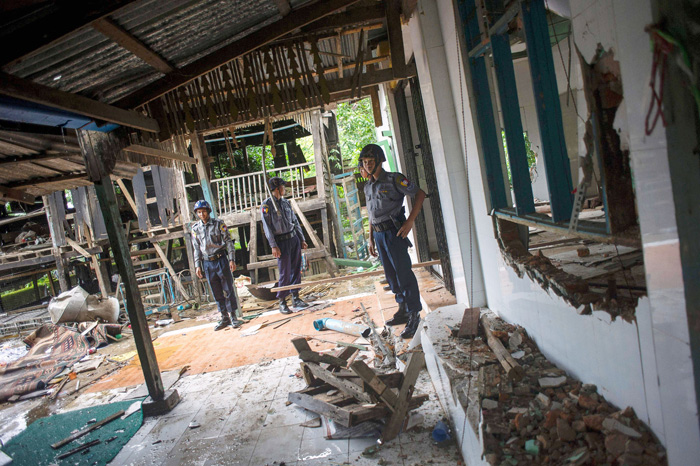
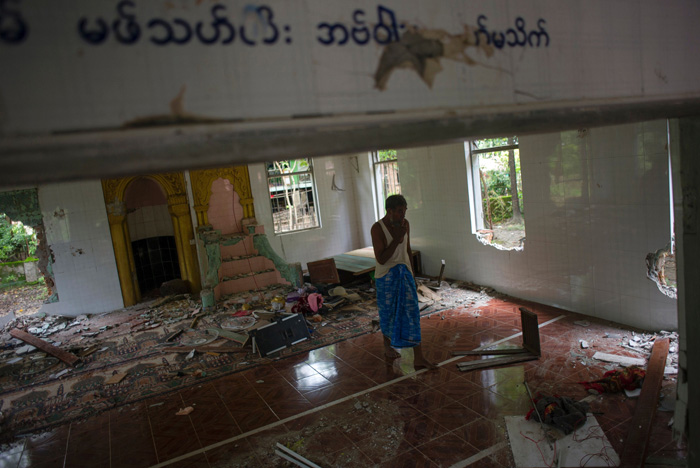
Nearly 100 police guarded a northern Myanmar village on Saturday, July 2 after a Buddhist mob burned down a mosque, a police officer said, in the second attack of its kind in just over a week as anti-Muslim sentiment swells in the Southeast Asian nation.The state-owned Global New Light of Myanmar said security forces in Hpakant in Kachin state were unable to control Friday’s attackers, who were armed with sticks, knives and other weapons.
It said the mosque’s leaders had failed to meet a June 30 deadline set by local authorities to tear down the structure to make way for construction of a bridge. Earlier, on June 23, a mob demolished a mosque and a Muslim cemetery in a village in Bago Region, about 60 kilometers northeast of Yangon, reportedly as a consequence of a personal dispute.
Tensions are also simmering in western Rakhine, a state scarred by deadly riots in 2012 that left communities almost completely divided along religious lines. The region is home to the stateless Rohingya, a Muslim minority largely relegated to destitute displacement camps and subject to host of restrictions on their movements and access to basic services, AFP reports.
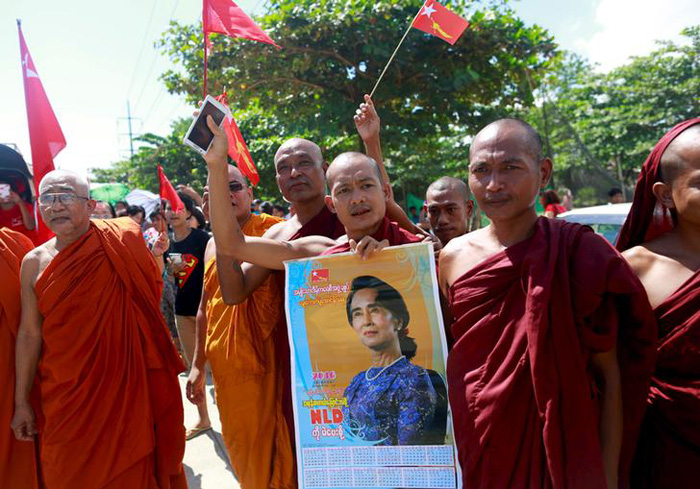
Suu Kyi, a veteran democracy activist who championed her country’s struggle against repressive military rulers, has drawn criticism from rights groups for not taking swifter moves to carve out a solution for the ethnic minority. Her government recently ordered officials to refer to the group as “people who believe in Islam in Rakhine State” instead of Rohingya — a term whose use has set off protests by hardline Buddhists who insist the group are illegal immigrants from Bangladesh.
Yet even the government’s broad phrase has failed to placate local Rakhine Buddhists, who demand the group be referred to only as “Bengalis” and say they are preparing to rally in protest at the order on Sunday. The UN Special Rapporteur (SR) Yanghee Lee urged the country’s new civilian government to make “ending institutionalised discrimination against the Muslim communities in Rakhine State… an urgent priority”. A mob has burned down a mosque in northern Myanmar in the second attack of its kind in just over a week.
Police are reported to be guarding the village of Hpakant in Kachin state, after failing to stop Buddhist villagers setting the mosque ablaze. Last week, a group of men destroyed a mosque in central Myanmar in a dispute over its construction. The UN has earlier, too, warned the government led by Nobel Peace Prize Aung San Suu Kyi to crack down on religious violence. The latest attack took place on Friday, when a group of villagers stormed the mosque and set it on fire. Reports said they attacked police officers guarding it, and stopped the fire brigade from reaching the site.
"The problem started because the mosque was built near a (Buddhist) pagoda. The Muslim people refused to destroy the building when the Buddhists discovered it," Moe Lwin, a local police officer, told AFP. He said around 90 police officers are now stationed in the village, where the situation has calmed. In a similar incident in central Bago state last week, the Muslim community was forced to seek refuge in a neighbouring town, after their mosque was burnt down and a Muslim man was beaten up. It happened in a village called Thayel Tha Mein.