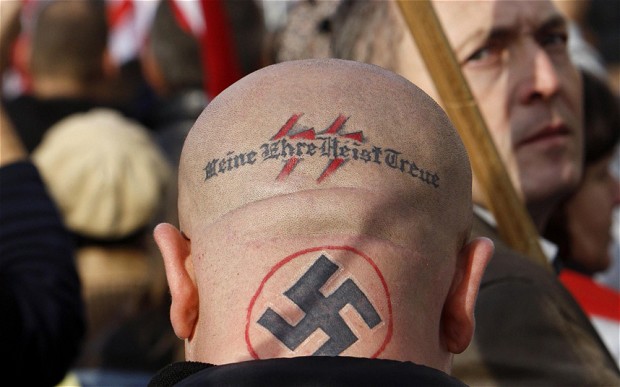
Courtesy: Orange-papers.org
‘Make in India’ has failed to resonate with businesses internationally because the accumulation of capital, worldwide, is driven by more than just propaganda and a fading charisma. But this hasn’t stopped the ruling party and government machinery from ‘making’ at a furious pace. It has manufactured the crisis at JNU as part of a wide-ranging assault on the control of higher education in the country.
To manufacture that crisis it has fabricated ‘sedition’ charges, evidence ostensibly implicating JNUSU leaders (videos, tweets), smear campaigns, hysteria (storm-troopers in black coats), even a conception of patriotism that identifies a country not with its people and their real conditions but with some mythical, half-deified abstraction before which people, real flesh-and-blood people, have to bow in a state of permanent genuflection and fear.
Behind this mixture of tragedy and farce looms the patriarchal shadow of the RSS. Of course, no one elected the RSS in 2014 but they feel they have the right to run the country and are effectively doing so. The ABVP is one of its many arms, extended ruthlessly into campuses to beat them into submission to ‘sanghvaad’. The ABVP has an assurance that it can mobilise the state machinery to enforce this drive to dominate the universities. JNU’s strongly left-wing culture and tradition have warded off this attack with a remarkable display of unity and good political sense.
The following write-up stems from a talk the author gave at JNU on 11 March. It isn’t a transcript but a reconstruction of the essential arguments in that lecture. It looks at fascism through the work of three writers, extracting major insights from each of them. It lays out three basic theses: 1. About the constructed nature of nationalism (or fascism’s use of the “myth of the nation”, Mussolini’s expression!); 2. About the family/patriarchy as the most important instrument of the state’s power; and, 3. About fascist violence as a product of what Sartre calls “the continuous action of a group on a series”. To be able to confront fascism successfully, supporters of democracy have to be able to build resistance at each of these levels.
At a talk I gave in JNU recently I suggested that it was crucial for us to deal with the deeper forces from which fascism stems and not fall into the trap of thinking, for example, that fascism only emerges in a context of massive economic crisis or is even caused by economic crisis, as a lot of Marxists still think. I identified those ‘deeper forces’ with nationalism, patriarchy (or the authoritarian family), and the way organised groups are able to exercise domination over the largely unorganised mass of any modern society.
Each of these perspectives (1. fascism and the myth of the nation, or, if you like, the constructed nature of nationalism; 2. patriarchy as the mainstay of the state’s power in a capitalist society; and, 3. the conception of ‘manipulated seriality’ as the heart of fascist politics) is embodied with special clarity in the work of at least one of three thinkers of the Left, viz. Arthur Rosenberg (1889–1943), Wilhelm Reich (1897–1957), and Jean-Paul Sartre (1905–1980). Sartre is too well known to say much about but the other two, Rosenberg and Reich, are worth introducing briefly.
Arthur Rosenberg was a historian who was also politically active. As a member of what became the KPD (German Communist Party), he was part of the left-of-centre grouping within the party called the ‘Berlin Left’. The Marxist philosopher Karl Korsch was also part of this grouping. Rosenberg was also a Reichstag deputy, that is, a member of the German parliament, but he resigned from the KPD in 1927 out of sheer disgust at the way the Comintern (under Stalin’s influence) kept interfering in the affairs of the German party. He fled from Germany in 1933, and eventually died in the USA (of cancer) some ten years later.
In 1934 he published Fascism as a Mass Movement, which argued that fascism only succeeds to the extent that it succeeds in becoming a mass movement. This raises the whole issue of what it means for the extreme Right (any extreme Right) to be able to construct a ‘mass’ base. How does it do that, given that its political agenda is so manifestly opposed to the economic and democratic interests of ordinary working people?
Wilhelm Reich moved from Vienna to Berlin in the late 1920s. He was a psychoanalyst strongly influenced by Freud but deeply critical of the latter’s separation between psychoanalysis and politics and of his excessive political timidity in the face of fascism.
When Reich moved to Berlin from Vienna he started a series of ‘Sexpol clinics’ which were hugely popular. The clinics attracted thousands of patients from largely working-class families, because they were literally the only places where ordinary people could discuss their sexual problems and their sexual lives in some overt way, especially the kinds of stress and/or distress they were experiencing.
To take one example, in 1931 there were some 1 million illegal abortions in Germany and a staggering forty-four percent of those resulted in fatalities! Reich began to confront the problem of emerging fascism partly through his experience in those clinics, and soon after Hitler came to power in 1933 he published The Mass Psychology of Fascism, arguing that it was impossible to understand the appeal of the Nazis without its psychological roots, that is, without looking at the nature of families, domination within them and the sort of character-structures that lay at the back of the fascist success.
Reich was promptly expelled from the German Communist Party when he published Mass Psychology, then hounded by the authorities in all the countries he fled to by way of seeking asylum, and, like Rosenberg, ended up in the USA where he died in an American prison, under FBI custody.
Fascism and the Myth of the Nation
To Rosenberg fascism largely reiterated ideas that were widespread in European society before the First War. (“The ideology which is today called ‘fascist’ was already widespread before the War.”) In his analysis the conservative elites of 19th-century Europe adjusted to the era of parliamentary democracy and mass politics with an aggressive nationalism imbued with racial ideas, one that canvassed active support for strong states wedded to expansion abroad and was unashamedly willing to use anti-Semitism “as a way of preventing middle-class voters from moving to the Left” (Weiss, Conservatism in Europe 1770-1945, p. 89).
Rosenberg argued that fascism lacked a coherent ideology of its own, it was a pastiche of motifs drawn from the ultra-nationalist political circles of the pre-war period. In this sense he reversed the direction of causality between ideology and politics. The Nazis emerged from a pre-existing ideological milieu dominated by a “stupid, fanatical nationalism”.
“Fascism developed the nationalist propaganda characteristic of the new kind of politics to perfection.” (Fascism as a Mass Movement, p. 27). Rosenberg called this a “demagogic nationalism” that “spontaneously seeks an object through which it can daily demonstrate its own superiority and release the delirium of its racial frenzy” (p. 32).
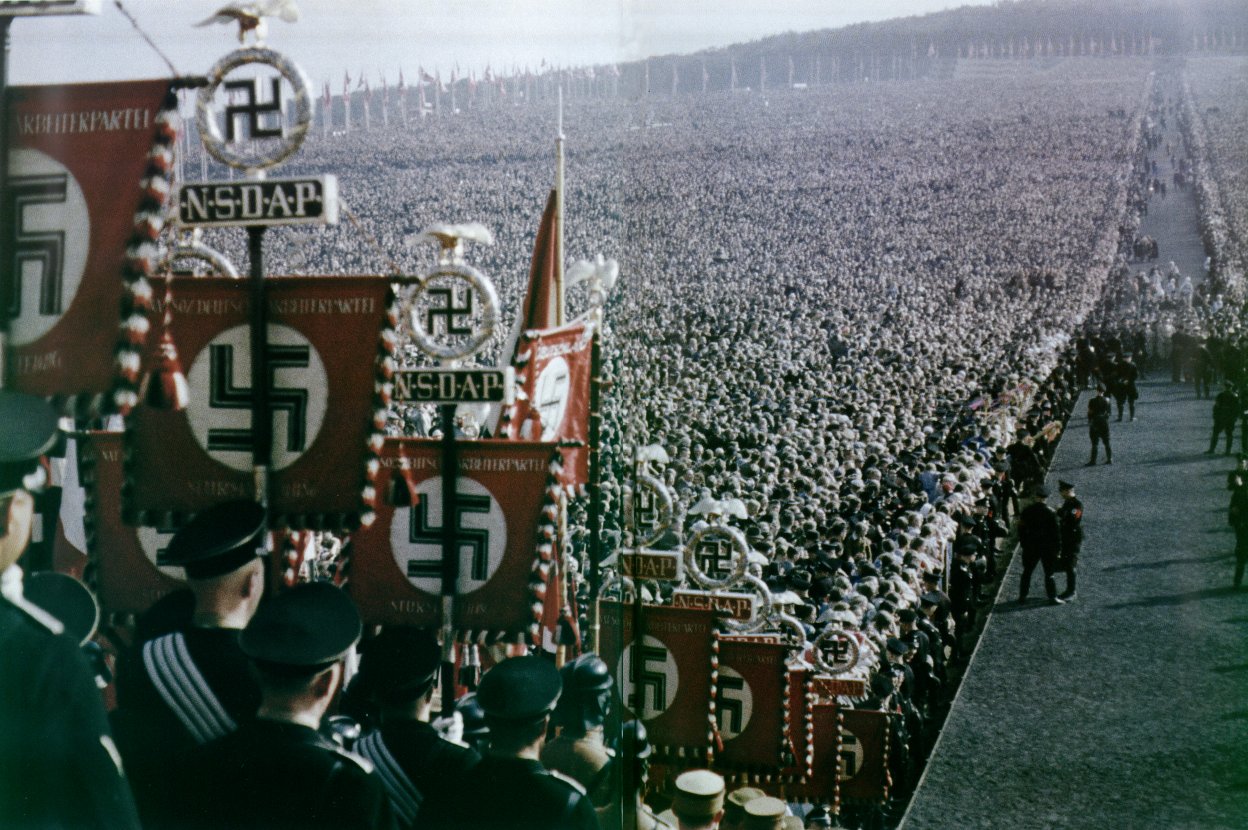
With liberalism in retreat across most of Europe it was this aggressive authoritarian xenophobic nationalism that came to the fore. Secondly, the targeting of minorities such as the Jews in Germany became a mobilising strategy and led in Germany to the proliferation of numerous racist ‘action groups’ well before the Nazis themselves became popular.
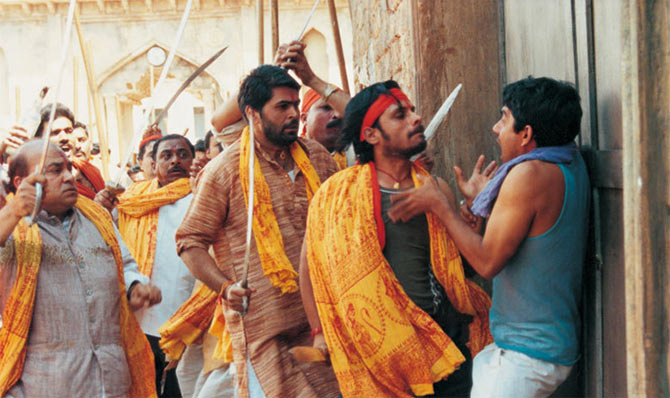
What was peculiar to fascism, Rosenberg argues, was the storm-trooper tactic, that is, the active use of violent squads that attacked Jews, destroyed Jewish property and so on in pogroms that targeted them the way Muslims and Christians have been targeted in India, but also combated the unions, strikers, Communists, etc. Street clashes between Nazis and Communists dominated the late 1920s but failed to stem the growth of Nazism.
A still from the Hindi film, 'Parzania'
One reason was that the storm-troopers worked with the connivance of the state. The active complicity of the existing state authorities in condoning fascist violence is a key element of Rosenberg’s argument. The authorities turned a blind eye to illegal activities such as conspiracies and political murders and to the repeated atrocities against Jews. The storm-troopers should have been tried and convicted in the courts of law but nothing of the sort happened. Trials were used as further platforms for Nazi propaganda. The police and the courts connived in fascist violence instead of dealing with it as the law required. State complicity for Rosenberg was a major reason why the Nazis could survive into the late 1920s to re-emerge rapidly as a mass movement.
What about nationalism itself? In the talk at JNU I contra-posed two broad views of the subject, Gellner’s conception of the constructed nature of nationalism (nationalism exists before nations do, nations are simply their invention) and Benedict Anderson’s view of the nation as an ‘imagined community’. For example, Eric Hobsbawm writes, “with Gellner I would stress the element of artifact, invention and social engineering which enters into the making of nations. ‘Nations as a natural, God-given way of classifying [humans], as an inherent … political destiny, are a myth; nationalism, which sometimes takes pre-existing cultures and turns them into nations, sometimes invents them, and often obliterates preexisting cultures: that is a reality’. In short, for the purposes of analysis nationalism comes before nations. Nations do not make states and nationalisms but the other way round.’’
To explain this a bit more, to think of nations as somehow existing before and outside of nationalism is to reify them. Nationalism is not the self-awakening to consciousness of pre-formed, pre-existing entities called ‘nations’ but the process by which nations are defined and constructed to be or to look like what they are.
For his part, Anderson doesn’t explain who does the “imagining”. And what does it mean to say that the nation “is imagined as a community, because, regardless of the actual inequality and exploitation that may prevail in each, the nation is always conceived as a deep, horizontal comradeship”?
Isn’t this a way of almost saying that the imaginary construct of the “nation” is an attempt to make people forget that in real life they are actually divided into classes, castes, genders, and so on and that these divisions are marked by deep inequalities and relations of oppression?
In her book Nationalism: Five Roads to Modernity the American scholar Liah Greenfeld describes something she calls collectivistic nationalism. This it seems to me is an apt description for the sort of nationalism that the BJP and their handlers are trying to shove down our throats today. She writes, “Much more often a nation is defined not as a composite entity but as a collective individual, endowed with a will and interest of its own, which are independent of and take priority over the wills and interests of human individuals within the nation. Such a definition of the nation results in collectivistic nationalism. Collectivistic nationalisms tend to be authoritarian and imply a fundamental inequality between a small group of self-appointed interpreters of the will of the nation – the leaders – and the masses, who have to adapt to the elite's interpretations.”
We are up against an artificially engineered surge of collectivistic nationalism in India today, except that this one is strongly imbued with communal overtones. But it’s important to see that much of the myth-making about the “nation” is part of a wider fascist agenda. As Mosse pointed out, nationalism is the “bedrock” upon which all fascist movements built themselves.
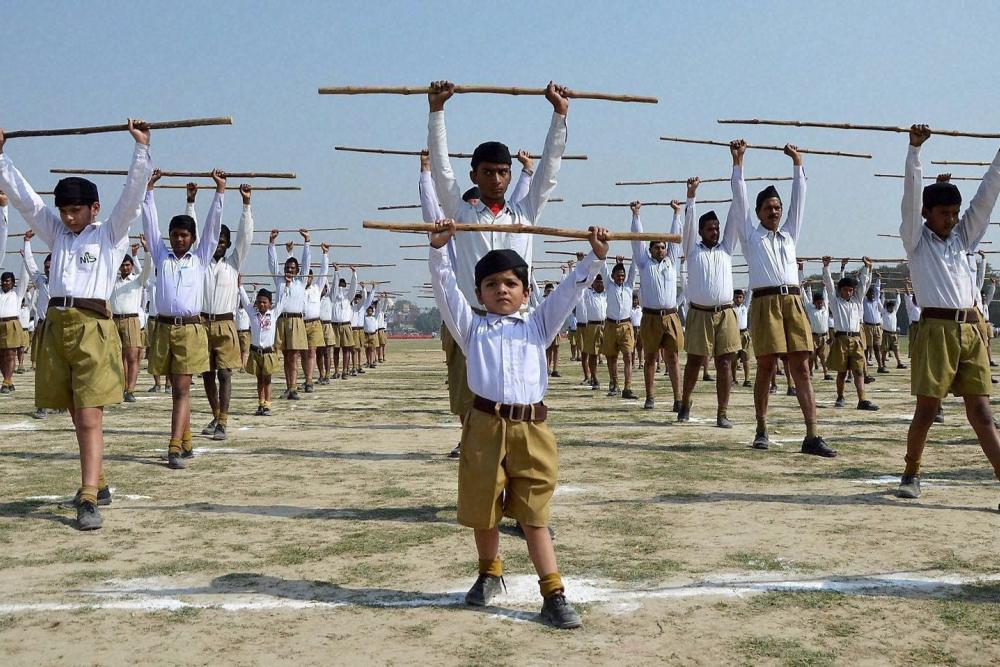
The indoctrination strats early
Moonje was tremendously impressed by the way the Italian Fascist Party organised the indoctrination and training of Italian youth and transposed the model to India through the RSS. Italian fascism was defeated and overthrown in the 1940s but its legacy lives on, not just in the way youngsters in India are being trained for physical combat and indoctrinated in subservience to some mythical national utopia
Patriarchy as the Mainstay of the State
Reich’s perspective moves the focus away from broad historical movements to the mechanisms which allow ideologies like nationalism to gain a wider purchase. He locates those mechanisms in the structure of the family and the kinds of sexual repression that abound there. The authoritarian family, Reich argues, is a veritable factory of reactionary ideology and structure. As such it is the mainstay of the state’s power in modern (capitalist) society.
Patriarchy for Reich is characterised not just by the domination of women by the leading males of the family but by the sexual suppression of both women and children within the family. “The goal of sexual suppression is that of producing an individual who is adjusted to the authoritarian order and who will submit to it in spite of all misery and degradation. At first, the child has to adjust to the structure of the authoritarian miniature state, the family; this makes it capable of later subordination to the general authoritarian system” (Mass Psychology, p. 25).
Reich went further. He suggested that the submissive, authority-fearing character-structure moulded in this kind of family was the key reason for the emergence of Hitler-type political leaders, Führers or “mass leaders” with a commanding or overpowering presence that could mobilise and dominate “masses”. Fascism’s ability to dominate the middle class and wider masses beyond it could be explained by the way children and adolescents grew up to identify with authority in one form or another – with their employers, with the state authorities, with the state itself and finally with the “nation”.
This process of “identification” was one sense in which ideology could be seen as becoming a “material force”. “The more helpless the individual is made by his upbringing, the more strongly does he identify himself with the Führer… This tendency to identification is the psychological basis of national narcissism, that is, of a self-confidence based on identification with the “greatness of the nation”.’ (Mass Psychology, p. 38)
Manipulated Seriality and the Climate as Worked Matter
Finally, Sartre. In his great work The Critique of Dialectical Reason (1960) there are two ideas specifically that we should try and integrate into our understanding of fascism. The first is his notion of “manipulated seriality”, the second his conception of the political climate or fascist violence as “worked matter”.
Sartre divides modern societies into two sorts of ensembles, “series” and “organised groups”. Seriality is the condition of being unorganised, hence incapable of acting and therefore vulnerable to domination by those who are organised and who do act (collectively). That domination can take the form of manipulating seriality, that is, conditioning series or influencing them to behave in certain ways.
Political propaganda works on the same principle as advertising; it generates what Sartre calls the illusion of “totalised seriality”. The series (ensembles that are unorganised, hence sharply distinct from the “organised groups”) can do nothing, it is dispersed and inert, but through advertising, propaganda, the mass media, climates of fear, violence, etc. it can have a great deal done to it and even think of itself as somehow unified! Advertisers get consumers to buy things by suggesting that ‘others’ are buying them. Those ‘others’ don’t actually exist, since each potential consumer is other to the other and the whole chain forms an infinite regress.
The pogrom is a gruesome example of how powerful organised groups can even extract actions (dispersive acts of violence) from the series while the latter remain serial, that is, dispersed, unorganised and inert. They become the instruments of the violence orchestrated/perpetrated by organised groups. Sartre calls this sort of violence the “passive activity of a directed seriality”.
Advanced criminal jurisdictions in the world today seek to cope with these situations of violence by using a robust concept of “command responsibility”. Climates of fear, violence, etc. that trigger a wave of lynchings, pogroms and so on are also worked matter, that is, they are the result of organised groups working serialities (or working on series), as if this was a production process where masses of people are literally the raw material of the labour (praxis, freely chosen activity) of organised groups. A climate of violence is created by organised groups as a conscious act/activity. Manipulated seriality is the heart of fascist politics, Sartre argues in the Critique.
A still from Rakesh Sharma's documentary 'Final Solution' on Gujarat 2002 mass crimes
Fascist Origins of the RSS
What the talk at JNU did was to look at fascism through these complementary perspectives and suggest that they need to be seen as different moments of the same general development. Subservience to authority turns out to be a central theme in the conditions that allow for fascist emergence. It was the factor that Reich himself stressed most of all, linking it with the nature of the family and describing the family itself as “the most important instrument of the state’s power”.
The RSS understood this from its inception. Marzia Casolari has shown the reasoning that lay behind the emergence of the shakha. BS Moonje, friend and mentor of Hedgewar, RSS founder, described his 1931 meeting with Mussolini in his diary. Moonje, Casolari points out, “played a crucial role in moulding the RSS along Italian (fascist) lines”.
Here is what he wrote in his diary: “The idea of fascism vividly brings out the conception of unity amongst people… India and particularly Hindu India need some such institution [as the Fascist youth organizations] for the military regeneration of the Hindus… Our institution of Rashtriya Swayamsevak Sangh of Nagpur under Dr Hedgewar is of this kind…”. The RSS would be publicly embarrassed to have these connections widely publicised since they show that its own model of moulding the minds of Indian youth stems directly from the experience of Italy and Mussolini’s recommendations.
Moonje was tremendously impressed by the way the Italian Fascist Party organised the indoctrination and training of Italian youth and transposed the model to India through the RSS. Italian fascism was defeated and overthrown in the 1940s but its legacy lives on, not just in the way youngsters in India are being trained for physical combat and indoctrinated in subservience to some mythical national utopia, but also in the structures that have allowed fascism to become a major threat to India’s democracy, not least among these being the manipulated hysteria of nationalism and the structures of patriarchy and the traditional family.




.jpg)
.jpg)