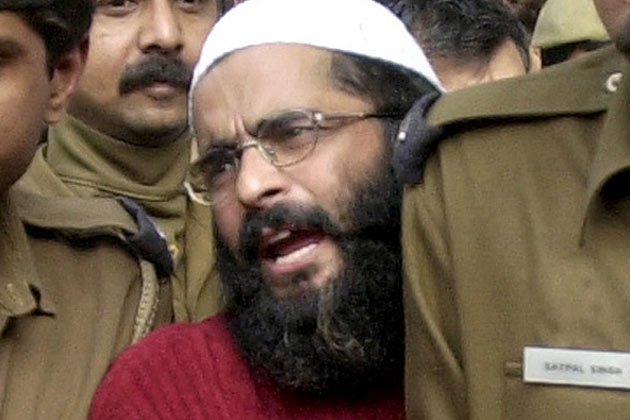
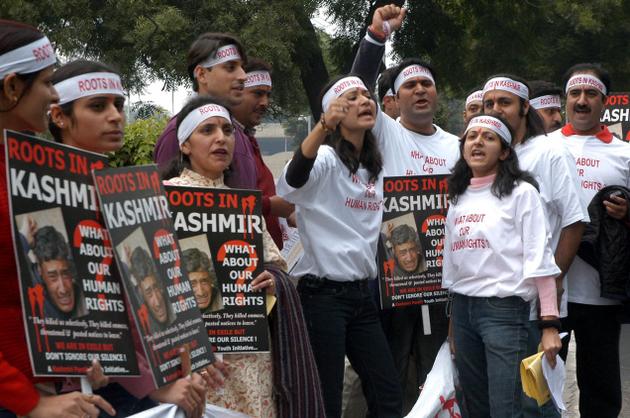
Why have the victims of the largest (the number could be 3 lakhs) communally-driven migration in independent India’s history, Kashmiri Pandits been the target of barely-concealed animus from leftists?
Remember your humanity and rebel! – Slogan on the walls of Paris, May 1968
Indignation is a bad counselor – Leo Strauss, 1953
What you run away from runs after you – Rumanian proverb
This comment engages with the issues raised in the current debate about justice and nationalism. The agitation was sparked off by an event in JNU highlighting the plight of the Kashmiri people. I will begin with two names and a question which (to my mind) are as significant as the grievances of Kashmiris and non-Kashmiris about the Indian justice system. The two names are Mohammad Maqbool Sherwani (aged 19, died 1947); and Ravindra Mhatre (aged 48, died 1984).
The question concerns the exodus of Kashmiri Pandits from their homes in the Valley. Why are they not a part of left-wing concerns about Kashmir? Sympathizers of Maoist revolutionary politics may consider four names – Francis Induwar (died 2009), Kenduka Arjun, (died 2010), Lucas Tete (died 2010) and Niyamat Ansari (died 2011). What happened to them and why did they die? These names and the question signify an experience of injustice. For that reason alone, they deserve the attention of the defenders of democracy. Now let us take a look at what is happening in Delhi
Police protection, Delhi version
The most striking image of the times we inhabit is the photograph of a young accused person being brutally assaulted in the premises of a prominent court in New Delhi. He was in the custody of the police, hence under the indirect protection of the court. His assailants were lawyers, who have bragged about their deeds, and are known for their proximity to senior leaders of the BJP. Most of them have not been charged for what is a clear offence under the IPC Sec 325.
Spokespersons of the ruling party routinely deploy the platitude that the law will take its course. Typical of its behaviour in matters such as the murder of Professor Kalburgi, they make a perfunctory disapproval of hooliganism, and then produce belligerent justifications for their violence. None of them show the slightest remorse or compunction for what even a village constable would recognise as a criminal offence.
We are being intimidated in broad daylight by persons who do not care a whit for reasoned speech – let alone the law. All we hear these days is a reminder of the heavy price we shall pay for opposing Modi, the Sangh and their ‘development agenda’. The Delhi police operate under the Union government, and was responsible for the raids on the JNU campus as well as the acts in the court premises. Some of its decisions have now been shown to have been taken on doctored evidence. The National Human Rights Commission has declared the assault on Kanhaiya to have been planned. The home minister’s utterances were akin to those of a con artist, so we need not be surprised by those of his followers. We may also assume that these acts have the approval of the Union Cabinet, and that we are now under the grip of a government that has no respect for the rule of law.
The situation will worsen, because the private army that controls the government is bent upon revising the foundational statutes of the Indian Republic. It also adheres to an ideology that justifies violence in the name of patriotism. Violent attacks, disruptions and dire threats by Hindutva-oriented vigilantes and legislators are occurring on a daily basis across India.
The situation will worsen, because the private army that controls the government is bent upon revising the foundational statutes of the Indian Republic. It also adheres to an ideology that justifies violence in the name of patriotism. Violent attacks, disruptions and dire threats by Hindutva-oriented vigilantes and legislators are occurring on a daily basis across India. The ruling party has shown itself to be no different from the Maoists whom it routinely condemns. But whereas the Maoists have proven incapable of capturing state power, the Hindutva ideologues believe they have done so. Let us see if the Indian public will endorse this belief.
This is serious enough to bear repeating: the government of India is enabling, condoning and encouraging vigilante violence and hooliganism. Controlled mobs now operate under state protection.
‘Anti -nationalism’ etc
Most of the slogans heard on the JNU campus expressed unobjectionable left-wing and feminist demands. However there were some that spoke of a long war for the break-up of the country. There were other calls that could be confusing to anyone not familiar with the term “oppressed nationalities” which has been part of communist vocabulary since 1917. So the current political agitation marks the intersection of many controversial themes, ranging from definitions of the nation to constitutional and legal matters.
Some bare facts need recapitulation. Some students attracted to Maoism and including those who believe in ‘self-determination’ for Kashmir, and were agitated over the execution of Afzal Guru, held an event to commemorate the latter. Denied permission due to objections from one student group, they used the good offices of the union, whose president belongs to the AISF, student wing of the moderate wing of the communist movement, the CPI. This is the party of the late Satyapal Dang, one of India’s staunchest secularists and fighters against terrorism in Punjab in the 1980’s and 90’s. (I wonder if our Home Minister has heard of him).
As the event unfolded some began shouting belligerent slogans – let us leave aside the question of who started it. As often happens, when ideologues wish to hurt each other by methods short of physical assault, they say things designed to cause maximum emotional pain. Both sides – the ultra-nationalists and those rooting for ‘self-determination’ proceeded to do this. Some persons alleged to be outsiders also shouted the objectionable slogans referred to above.
The ultra-nationalists used their contacts in the central government to facilitate police intervention. Some of them now regret the consequences of what has ballooned into a nasty confrontation. I appreciate the fact that the three ABVP office-bearers who resigned from their posts disagreed with the habit of painting all left-wing students with the same brush. Similarly all people who object to slogans calling for the break-up of India also cannot be painted with the same brush. I too object to such a slogan – although I don’t think it calls for police action unless there is a direct incitement to violence. We know many people calling for and indulging in violence who seem to have no fear of police action.
Something similar took place at the Press Club, where persons who stand for Kashmiri self-determination used the good offices of a lecturer who booked the venue for them, but who does not share their political vision. He is now been targeted – along with three other retired teachers from DU – for collusion with so-called anti-national elements.
In both cases, persons of democratic persuasion were used to facilitate expressions of extreme beliefs. As far as I can tell, they had no idea of what was about to transpire, and their own statements at these gatherings were attempts at lowering the pitch and calming the atmosphere. A kind of verbal ‘guerilla action’ was undertaken by some radical activists who – it would appear – were unconcerned with the repercussions. They did not care that people who do not support their politics, but helped them because of their commitment to free expression, would be paying the price.
The slogan that Kashmiris have a right to self-determination implies that the identity of Kashmiris is self-evident. The moment the identity of Kashmiri Pandits and Sikhs, Ladakh’s Buddhists and Jammu’s Dogras, Gujars and Bakerwals, is brought into the argument, the presumptive nature of unilateral definitions becomes evident. Who is included in, and who is excluded from the ‘self’, and why? Is it all very clear to us, or does it deserve a discussion?
To use well-meaning people for your purposes via subterfuge can bear terrible consequences. It is unfair to those well-meaning people, and typifies the belief that the end justifies the means. Some of us are so consumed by anger that we feel justified in doing this, but it is not an ethical course of action, and brings your politics into disrepute. It is similar to what happened in Kandhamal in 2008, when the Maoist party murdered the VHP’s Swami Laxmanananda and left the common people to face the communal violence unleashed by the Sanghis, who blamed ‘the Christians’ for the murder.
In the spiral of violence unfolding in so-called insurgent districts, the state utilises the opportunity provided it by extremists to suppress opposition from all quarters. It targets all democratic protest for being anti-national, seditious, etc. This is what is happening now in India’s capital. Unscrupulous TV anchors are adding fuel to the fires of ‘patriotic’ indignation – some of them behaving as flag-bearers for a hysterical version of nationalism. As an SC bench said recently, ‘moderation is a forgotten word today in all spheres of life’.
Self-determination and violence
There is also the tangled issue of ‘self-determination’, a term many people use as if it were an axiom. It is not. The idea of democracy is linked to the concept of identity. ‘Demos’ is the term for ‘the people’ in ‘the rule of the people’. The slogan of ‘self-determination’ carries the implicit presupposition that we know who “the people” are before we speak of their right to ‘self-determination’.
Ideologically defined boundaries of the ‘self’ are presupposed in the practice of democracy. This issue is related to the birth of the nation-state and the notion of sovereignty. Let me add here that the multiplication of sovereignties is not a solution to the violation of human rights, nor should it be conflated unquestioningly with the concept of democracy. In some cases it might worsen the situation.
Identity is a matter of power, interest and definition. For example, the slogan that Kashmiris have a right to self-determination implies that the identity of Kashmiris is self-evident. The moment the identity of Kashmiri Pandits and Sikhs, Ladakh’s Buddhists and Jammu’s Dogras, Gujars and Bakerwals, is brought into the argument, the presumptive nature of unilateral definitions becomes evident. Who is included in, and who is excluded from the ‘self’, and why? Is it all very clear to us, or does it deserve a discussion?
Given that this agitation has highlighted the plight of the Kashmiri people, let us examine some facts that tend to get left of out leftist concerns. Some amongst us remain aggrieved by the execution of Maqbool Butt on February 11, 1984. They need to remember the kidnapping and murder of the Indian consular official Ravindra Mhatre, in Birmingham, on February 6 the same year. It does not behoove a state to make vengeful decisions, but it does not help matters if we forget significant facts. We may also mention in passing the names of BJP politician Tikka Lal Taploo, Judge NK Ganjoo (who had tried Maqbool Butt); and journalist, PN Bhat – all three murdered in late 1989 by warriors of Kashmiri self-determination.
I have often reiterated my belief that the question of violence is – or should be – the crux of political debate. Militarism has emerged as the ground shared by enemies. The militarist appropriation of martyrdom is a deeply patriarchal gesture. Violence is a never-ending spiral. The best metaphor for violence is a black hole – the place that swallows up everything in its vicinity.
Once again, therefore, I will remind all ardent supporters of political causes that violence feeds on itself. Apart from their other numerous ‘actions’, the Maoists murdered two policemen who were in their custody, both of them tribals – Francis Induwar (beheaded in 2009) and Lucas Tete (shot in 2010). Kenduka Arjun, secretary of the Chasi Muliya Adivasi Sangh in Orissa, was murdered by Maoists in 2010. They also beat to death Niyamat Ansari, a NREGA activist, in front of his family in 2011. I will not go into the implications of the derailment of the Jnaneswari Express in 2010, which cost 148 lives.
On communal issues, let us remember Taslima Nasrin, the author who defended religious minorities in Bangladesh, and was hounded out of Kolkata in 2007 by fanatics who browbeat the Left Front government. Perpetually under threat, she finally had to leave India. On the price paid for dissent, let us remember TP Chandrashekharan, a dissident CPI (M) leader in Kerala murdered in 2012 for setting up an alternative left group. A week ago, on February 15, an RSS cadre named Sujith was murdered inside his house in front of his parents. The accused in both these cases belong to the CPI (M). There are many more examples, cutting across party lines. Whatever we might think of our political opponents, do not such actions undermine democracy? Do they not indicate that we live in a dangerously authoritarian culture?
As regards Afzal Guru, like many others, I too felt that the trial process and submission of evidence raised several disturbing questions; that life imprisonment would have been a fairer sentence, and that he should not have been executed. I was severely perturbed by the phrase ‘collective conscience of the nation’ appearing in a court judgment sentencing a man to death. I wrote about this well before the execution, and about the death sentence, which I oppose in principle, whether it is handed out by judges or revolutionaries, sanghis or jehadis. People have every right to criticise judgments without being accused of contempt – have not the ultra-nationalists also criticised judgments they did not like? Such criticism should be couched in temperate language, but we remain within our rights to make it.
The Pandit issue
Going on from this, doesn’t the plight of Kashmir’s Pandits also deserve consideration in a debate about Kashmir? At the time of their enforced exodus from the Valley, concerns were expressed by some human rights activists and leftists. On the whole however, the so-named ‘left and democratic’ bloc has remained silent about that enormity. I do not believe the ‘Jagmohan did it' theory on this although I am aware of Jagmohan’s role in Sanjay Gandhi’s slum-clearing activism during the Emergency. A great deal of evidence has been supplied by those who experienced the exodus – evidence that needs serious debate, not outright rejection.
All Kashmiri Muslims cannot be blamed for the plight of the Pandits, or for desiring their exodus. But neither are all Hindus supporters of Hindutva. Acknowledgement of injustice is the first and essential step towards reconciliation – this is as true for the Valley’s Pandit population as it is for its Muslims. Activists for human rights should also note the presence of a large number of migrant labourers in the Valley – numbers of whom have been victims of terrorist acts.
I will remind all ardent supporters of political causes that violence feeds on itself. Apart from their other numerous ‘actions’, the Maoists murdered two policemen who were in their custody, both of them tribals – Francis Induwar (beheaded in 2009) and Lucas Tete (shot in 2010)… On the price paid for dissent, let us remember TP Chandrashekharan, a dissident CPI (M) leader in Kerala murdered in 2012 for setting up an alternative left group. The accused… belong to the CPI (M).
Be that as it may, conflicting views on what caused the Pandits to depart need an airing, not silence. Why have the victims of the largest (the number could be 3 lakhs) communally-driven migration in independent India’s history been the target of barely-concealed animus from leftists? Kashmiri’s have undergone terrible suffering ever since militancy began, and they include Pandits as well as Muslims, residents of the Jammu region as well as those of the Valley; Kashmiri speaking people as well as others.
Apologists for the status quo ask us to stop talking about caste-based discrimination – as if it will go away by pretending it does not exist. The same attitude has been exhibited by many of us with regard to Kashmiri Pandits – as if we can get rid of a mountain of pain and injustice by looking the other way. If we stand for giving voice to suffering humanity, we must stand for all the victims of oppression in the Valley, regardless of their faith. If we stand for free expression and dissent we must ask why the Pandits have been treated with indifference and worse, by leftists (given some honourable exceptions). Failure to conjoin the plight of the Pandits with all other victims of insurgency and state repression is a betrayal of our humanity and weakens our political integrity. Furthermore, it drives victims to other kinds of extremism, or to cynicism and despair. Why should we abandon good causes to bad politicians?
Defending democracy and the constitution
Indian politics has entered a phase of extreme danger – from the standpoint of the laboring citizens who need democracy the most. It is disturbing to see a section of India’s ruling class seeking to bypass and undermine constitutional rule by validating a politics of hatred and intimidation. Hindu Rashtra and Akhand Hindustan are mutually contradictory ideals: if you want one you will automatically rule out the other. The relentless tirade against Muslims, Christians and Communists by the Sangh Parivar will produce the contrary of what they wish for (or say they do). The theories of Savarkar, Hedgewar and Golwalkar are recipes for India’s disintegration. Extremism feeds on itself by appearing in different forms.
Whatever be its flaws, the Indian Constitution is the best consensual statute upon which to base a defence of democracy. Revolutionaries should consider the possibility that a section of the Indian ruling class is already bent upon doing away with democracy. So rather than a violent revolution to overthrow the constitution, we need a non-violent mass awakening to defend and implement it. But that will require serious re-thinking on socialist politics. Since the ongoing student movement is committed to defending the freedom of thought, there should be no problem with this.
The current student movement in JNU has received welcome support from students and academics all over India and the world, in addition to the support of many political parties. It can make a difference to Indian politics, but politics is too important to be left to specialists of revolution. Authoritarianism and hatred of dissent may be witnessed across the political spectrum – right, left and ‘marketist’. It would be best if students made up their own minds about political issues, and inaugurated an open dialogue with society. Incidentally, the term ‘revolution’ means the completion of a circle. If you want transformation, close the circle and get out of it. The only answer to extremism is moderation, truthful speech and non-violence. Jai Ho.
The above article was first published by labour historian and public intellectual Dilip Simeon and posted on his Blog. [Dilip Simeon’s Blog]