Home Blog Page 2596

Letter of Solidarity from International Association of Women in Radio and Television (India Chapter) for JNU

0

We the undersigned, from the India Chapter of the International Association of Women in Radio and Television (IAWRT), would like to place on record our solidarity with the students and teachers of the Jawaharlal Nehru University (JNU). We find the recent events that have taken place in JNU –  arrest of the JNUSU President Kanhaiya Kumar on charges of sedition, and a lookout by the police for several other students who allegedly raised anti-national slogans – extremely disturbing. We also feel that the use of the sedition law, which was enacted by British colonial government, draconian and has no place in India. A fundamental principle in a democracy is the right to free speech. Article 19 of the Indian Constitution grants it as a fundamental right, and the Indian courts have recognised this in the past, including in the case of Balwant Singh vs. State of Punjab. In this context, the framing of charges against the students of JNU is unacceptable, and should have no place in a democratic society.

The events in JNU are a continuation of the systematic attack on students in various campuses across the country by the ruling party and its student-wing, the ABVP. From the ban on the Ambedkar-Periyar Study Circle in IIT-Madras (the ban was eventually lifted), to appointing people not necessarily qualified in various administrative posts at the Film and Television Institute in India (FTII), to the attack and suspension of Dalit students in the Hyderabad Central University (HCU), which eventually led to the suicide of Rohith Vemula, there has been an increasing attempt at controlling students on campuses by the BJP and its affiliates, the ABVP and the RSS.
 
In many instances, the ruling government has used the State machinery, including that of the police, to carry out its agenda, either through intimidation or inaction – the attack by lawyers on Kanhaiya Kumar while he was produced in Patiala House in police presence, or the intimidation of lawyers Shalini Gera, Isha Khandelwal and journalist Malini Subramanian of scroll.in in Chhattisgarh, who are being forced to leave Jagdalpur due to continual police threat and intimidation, are examples of this.
 
We fear that this environment that has been created by the State and some members of the media fraternity, where labels like “anti-national” and “traitor” are freely thrown around, is creating an atmosphere of fear and will suppress voices of dissent. Many media houses have been filing stories and conducting debates that do not adhere to basic principles of journalistic practices. The strength of a democratic nation is its ability to give space to its dissenters, as also to those who raise questions about the excesses of the State and about what the idea of a nation-state means. The fundamental right to free speech and dissent has been guaranteed to the citizens of India by the Constitution and cannot be violated for any political agenda if we are to remain a vibrant democracy.
 
We, the members of the International Association of Women in Radio and Television (IAWRT), India, demand:
 
1) JNUSU President Kanhaiya Kumar be immediately released
2) Stop the witch-hunt against Umar Khalid and other students of JNU
3) Segments of the media have been whipping up mass hysteria against students of JNU. They should be reined in by their own Press Councils and Broadcast Associations.
4) Repeal Section 124(A) of the Indian Penal Code

Aaradhna Kohli, Independent Filmmaker
Ananya Chakraborti, Filmmaker, Film Teacher, Activist
Anjali Monteiro, Academic and Filmmaker, Tata Institute of Social Sciences
Anupama Chandra, Film Editor and Director
Anupama Srinivasan, Filmmaker
Archana Kapoor, Managing Trustee, IAWRT, Filmmaker and Radio Producer
Bina Paul
Geeta Sahai, Media Professional
Iffat Fatima, Independent Documentary Filmmaker
Iram Ghufran, Independent Filmmaker
Kavita Joshi, Filmmaker and Media Trainer
Mallika Sarabhai
Nina Sabnani
Nupur Basu, Journalist and Media Educator
Padmaja Shaw
Priya Goswami
Priyanka Chhabra, Filmmaker
Radha Misra, Academic
Reena Mohan, Filmmaker and Editor
Renuka Sharma
Samina Mishra, Independent Filmmaker and Writer
Sania Farooqui, Journalist
Shikha Jhingan
Smriti Nevatia, Film Festival curator, Researcher and Writer, Text Editor
Subasri Krishnan, Filmmaker
Teena Gill, Filmmaker and Development Consultant
Uma Chakravarti, Feminist Historian and Filmmaker
Uma Tanuku
Vani Subramanian, Filmmaker and Women’s Rights Activist
Yashodara Udupa, Filmmaker
Vaidehi Chitre
Mausumi Bhattacharya

Leena Manimekalai
Chandita Mukherjee

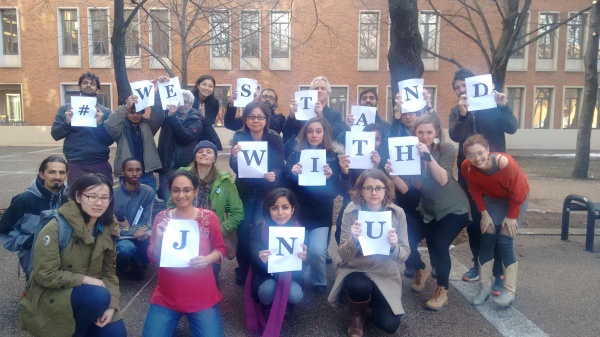
University of Minnesota Stands in Solidarity with Jawaharlal Nehru University

0

IMG_20160219_151429805
 

We, the undersigned at the University of Minnesota, strongly condemn the concerted attack on the students, faculty and academic culture of Jawaharlal Nehru University. At the behest of the government, the Delhi police has pressed sedition charges on unnamed students of the university. Reminiscent of the Emergency, the students’ union president Kanhaiya Kumar has been arrested, several students have been suspended and the Delhi police has been hounding students in hostels, homes as well as public spaces in the city. Sections of the mainstream media have launched a vicious campaign to declare JNU an “anti-national” university, and some journalists have gone so far as to spin lies about the “terrorist connections” of student activist Umar Khalid. As a consequence, mob violence against JNU students and faculty has spread across the city and even entered the courtrooms where the case against the JNU students’ union president was being heard. We strongly condemn this hate campaign and demand the immediate release of the JNU students’ union president. We also demand that the suspension of students is revoked and unsubstantiated sedition charges are withdrawn immediately.

This move by the RSS-BJP combine is one among a series of attacks on the autonomy of educational institutions in India, and the very idea of education and democratic political participation. By pressing charges of sedition and violently clamping down on the right to dissent, the government has demonstrated an utter disregard for democratic practice and the law. This erosion of public value is evident in the slew of messages circulating on social media criticizing the “waste” of taxpayers’ money for funding students’ “anti-national” activities, rather than their education. This artificial separation between education and politics, the narrowing down of education to merely an economic activity, and a simplistic conception of democratic political participation are symptomatic of the neoliberal vision of this government. Evidently, the government is invested in strengthening such notions among the public by spreading propaganda which reduces JNU to an “anti-national” university. This maligning of student politics also serves the agenda of discrediting their dissent against the government which has been rapidly gaining steam in universities across India.

In the face of this attack, JNU students and teachers have come together in an admirable show of strength, courage, resilience and love for their university. Their movement is not only defending the idea of JNU, but of freedom and democracy in India. Far from being a hub of “anti-nationals,” the movement has demonstrated that JNU has nurtured the most progressive ideas of nationalism. We lend our support to this movement and #StandWithJNU in solidarity with their fight against state repression and the government’s onslaught on the university.

Signed by:

K Rahul Sharma, Graduate student, Public Affairs.
Kriti Budhiraja, Graduate student, Sociology.
Anuradha Sajjanhar, Graduate student, Sociology.
Trupti Sarode, Graduate student, Public Affairs.
Siddharth Bharath Iyengar, Graduate student, Ecology, Evolution and Behaviour.
Suvadip Sinha, Faculty, Asian Languages and Literatures.
Quynh Pham, Graduate student, Political Science.
Professor Susan Parnell, Faculty, University of Cape Town.
Erik Kojola, Graduate student, Sociology.
Keavy McFadden, Graduate student, Geography.
Ethan Johnson, Graduate student, Sociology.
Lorenzo Fabbri, Faculty, French and Italian.
Eric Goldfischer, Graduate student, Geography.
V. Ganeshananthan, Faculty, Creative Writing, English.
Harshit Rathi, Graduate student, Cultural Studies and Comparative Literature.
Soham Patel, Graduate student, American Studies.
Jigna Desai, Faculty, Gender, Women, and Sexuality Studies.
Akshya Saxena, Graduate student, Comparative Literature.
Ananya Chatterjea, Faculty, Liberal Arts/Theatre Arts and Dance.
Victoria Piehowski, Graduate student, Sociology.
Baryon Tensor Posadas, Faculty, Asian Languages and Literatures.
Erin Trapp, Faculty, Cultural Studies and Comparative Literature.
Yagmur Karakaya, Graduate student, Sociology.
Shan Kothari, Graduate student, Plant Biology.
Lauren Mitchell, Graduate student, Psychology.
Shruti, Alumnus, Humphery.
Nithya Rajan, Graduate student, Gender, Women and Sexuality Studies.
Stephen Cho Suh, Graduate student, Sociology.
Graeme Stout, Staff, CLA – Cultural Studies and Comparative Literature.
Thorn Chen, Graduate student, Cultural Studies and Comparative Literature.
Sravanthi Kollu, Graduate student, Asian Languages and Literatures.
Christine Marran, Faculty, Asian Languages and Literature.
Courtney Gildersleeve, Graduate student, Cultural Studies & Comparative Literature.
Brit C. Henderson, Graduate student, Sociology.
Jeff Stolley, Undergraduate student, College of Biological Science.
Gloria Goodwin Raheja, Faculty, CLA/Anthropology.
Nicholas Goldsmith, Graduate student, Ecology Evolution and Behavior.
Miray Philips, Graduate student, Sociology.
Ajay Skaria, Faculty, History.
Sonali Pahwa, Faculty, Theatre Arts & Dance.
Jacqui Frost, Graduate student, Sociology.
Jen Merrill, Alumnus, Liberal Arts.
Britt Van Paepeghem, Graduate student, Anthropology.
Rachel Schaff, Graduate student, Cultural studies and comparative literature.
Erin Dyke, Graduate student, College of Education and Human Development/Department of Curriculum & Instruction.
Isabel Arriagada, Graduate student, Sociology.
Sungok Hong, Faculty, Asian Languages and Literatures.
Richa Nagar, Faculty, College of Liberal Arts/ Department of Gender, Women, and Sexuality Studies.
Sarah Garcia, Graduate student, Sociology.
Heider Tun, Graduate student, College of Liberal Arts.
Anindita Chatterjee, Graduate student, Department of geography, environment and society.
Julie Santella, Graduate student, Geography, Environment and Society.
Kathleen Hull, Faculty, Sociology.
Devika Narayan, Graduate student, Sociology.
Emily Durham, Graduate student, Asian Languages and Literatures.
Jennifer Jodell, Graduate student, CLA/English.
Joe Getzoff, Graduate student, CLA/ Geography.
Naomi Scheman, Faculty, CLA/Philosophy.
Soyi Kim, Graduate student, Cultural Studies and Comparative Literature.
Rachel Kaelberer Mattson, Graduate student, Political Science.
Natalia Vargas Márquez, Graduate student , Art History.
Melinda Kernik, Graduate student, Geography, Environment, and Society.
Alex Manning, Graduate student, Sociology.
Spencer Cox, Graduate student, College of Liberal Arts, Geography, Environment and Society.
Mayank Kohli, Graduate student, Ecology, Evolution and Behavior.
Rye Gentleman, Graduate student, Theatre Arts and Dance.
Abraham Seda, Graduate student, College of Liberal Arts.
Stacey Brumbaugh-Johnson, Graduate student, Sociology.
Allison Nobles, Graduate student, Sociology.
Jacqueline Daigneault, Graduate student, Geography.
Simi Kang, Graduate student, Gender, Women, & Sexuality Studies.
Maria Mendez, Graduate student, Political Science.
David Lemke, Graduate student, English.
Lalit Batra, Graduate student, Geography, Environment and Society.
Michael Goldman, Faculty, CLA, Sociology/Global Studies.
Koel Banerjee, Graduate student, Cultural Studies and Comparative Literature.
Alex Steele, Graduate student, History.
Ketaki Jaywant, Graduate student, History.
Aditi Chandra , Alumnus, Art History.
Matt Gunther, Graduate student, Sociology.
Aisha Upton, Graduate student, Sociology.
Andrew Fang, Graduate student, Humphrey School of Public Affairs.
David Faust, Staff, University Libraries.
Mark Martinez, Alumnus, Communication Studies.
Rajyashree N Reddy, Alumnus, Geography.
Nina Asher, Faculty, University of Minnesota-Twin Cities.
Peter Harle, Staff, College of Liberal Arts.
Ann Meier, Faculty, College of Liberal Arts/ Sociology.
Mishy Roy, Graduate student, UMN Medical School.
Nadim Asrar, Alumnus, Asian Languages and Literatures.
Ashfaqul Chowdhury , Graduate student, Humphrey School.
Rahsaan Mahadeo, Graduate student, Sociology.
Catherine McKay, Graduate student, Humphrey School of Public Affairs.
Kirsten Henry, Graduate student, UMN School of Public Health.
Bruce Braun, Faculty, Geography, Environment and Society, College of Liberal Arts.
Gretchen Gasterland-Gustafsson, Alumnus, Comparative Studies in Discourse and Society.
Timothy Brennan, Faculty, College of Liberal Arts/Cultural Studies & Comparative Literature.
Kate Thompson, Staff, Institute on the Environment.
Zachary Patterson, Graduate student, Department of Sociology.
Ashwini, Graduate student, Geography.
Sarah Saddler , Graduate student, Department of Theatre.
Ateeb Ahmed, Graduate student, Geography Environment and Society.
Sarah Catherine Billups, Graduate student, Sociology.
John Little, Graduate student, CLA/History.
Ryan Steel, Graduate student, Sociology.
Lisa Gulya, Graduate student, CLA.
Tanja Andic, Graduate student, Sociology.
Poonam Srivastava, Alumnus, Biotechnology Institute.
Julia Corwin, Graduate student, Geography – CLA.
Karen Ho, Faculty, Anthropology.
Claire Stoscheck, Graduate student, Humphrey.
Amelia Hassoun, Graduate student, Anthropology.
Paul Rouzer, Faculty, Asian Languages and Literatures.
Arun Saldanha, Faculty, Geography, Environment and Society.
Robin Wright, Graduate student, Geography.
Jason McGrath, Faculty, Liberal Arts/Asian Languages & Literatures.
Abhay Doshi, Graduate Student, Department of English.

Darkness on India’s Prime Time News: Ravish Kumar’s Scathing Critique

0


In a scathing self critique of India's private prime time television news, especially the unprofessional conduct of well known and lauded anchors, Ravish Kumar of NDTV India had a Blackened Out Screen on the News Hour for 45 minutes on Friday, February 19.

The video of this radical programme is self explanatory. In simple and hard hitting Hindi, Ravish argues how the lynch mob is cultivated by the undemocratic and tyrannical conduct of television anchors in the name of debate.

"Yeh Andhera hi Aaj Ki TV ki Tasveer Hai." (The dark screen is the true image of TV today).

"Debate ke naam par Janmat ka Maut Ho Raha Hai." (People's voices are being throttled in the name of debate)

Also watch BBC's trending Video- "Debunking the Viral Video of 'sedition' that has captivated India" http://www.bbc.com/news/blogs-trending-35605099
—————————

ऐसे वक्त में जब पत्रकार, अख़बार और टेलीविज़न न्यूज़ चैनल, साम्प्रदायिक और फासीवादी सरकार का भोंपू बन कर रह गए हैं, अंधेरे में एक मशाल जल रही है। रवीश कुमार ने एनडीटीवी पर अपने प्राइम टाइम शो में, अंधेरे का नज़ारा दिखाया और ख़ुद नज़ीर बन गए हैं। इस ऐतेहासिक शो की स्क्रिप्ट का हिस्सा हम आपके लिए लाए हैं, जिससे आप समझ सकें कि दरअसल हम किस अंधेरे में हैं और कितनी और मशालें लगेंगी, इस अंधेरे को ख़त्म करने के लिए…

ताकि हम सुन सकें, कि हम क्या बोलते हैं…

रवीश कुमार 

आप सबको पता ही है कि हमारा टीवी बीमार हो गया है। पूरी दुनिया में टीवी में टीबी हो गया है। हम सब बीमार हैं। मैं किसी दूसरे को बीमार बताकर खुद को डॉक्टर नहीं कह रहा। बीमार मैं भी हूं। पहले हम बीमार हुए अब आप हो रहे हैं। आपमें से कोई न कोई रोज़ हमें मारने पीटने और ज़िंदा जला देने का पत्र लिखता रहता है। उसके भीतर का ज़हर कहीं हमारे भीतर से तो नहीं पहुंच रहा। मैं डॉक्टर नहीं हूं। मैं तो ख़ुद ही बीमार हूं। मेरा टीवी भी बीमार है। डिबेट के नाम पर हर दिन का यह शोर शराबा आपकी आंखों में उजाला लाता है या अंधेरा कर देता है। आप शायद सोचते तो होंगे।

डिबेट से जवाबदेही तय होती है। लेकिन जवाबदेही के नाम पर अब निशानदेही हो रही है। टारगेट किया जा रहा है। इस डिबेट का आगमन हुआ था मुद्दों पर समझ साफ करने के लिए। लेकिन जल्दी ही डिबेट जनमत की मौत का खेल बन गया। जनमत एक मत का नाम नहीं है। जनमत में कई मत होते हैं। मगर यह डिबेट टीवी जनमत की वेरायटी को मार रहा है। एक जनमत का राज कायम करने में जुट गया है। जिन एंकरों और प्रवक्ताओं की अभिव्यक्ति की कोई सीमा नहीं है वो इस आज़ादी की सीमा तय करना चाहते हैं। कई बार ये सवाल खुद से और आपसे करना चाहिए कि हम क्या दिखा रहे हैं और आप क्यों देखते हैं। आप कहेंगे आप जो दिखाते हैं हम देखते हैं और हम कहते हैं आप जो देखते हैं वो हम दिखाते हैं। इसी में कोई नंबर वन है तो कोई मेरे जैसा नंबर टेन। कोई टॉप है तो कोई मेरे जैसा फेल। अगर टीआरपी हमारी मंज़िल है तो इसके हमसफ़र आप क्यों हैं। क्या टीआरपी आपकी भी मंज़िल है।

इसलिए हम आपको टीवी की उस अंधेरी दुनिया में ले जाना चाहते हैं जहां आप तन्हा उस शोर को सुन सकें। समझ सकें। उसकी उम्मीदों, ख़ौफ़ को जी सकें जो हम एंकरों की जमात रोज़ पैदा करती है।

आप इस चीख को पहचानिये। इस चिल्लाहट को समझिये। इसलिए मैं आपको अंधेरे में ले आया हूं। कोई तकनीकि ख़राबी नहीं है। आपका सिग्नल बिल्कुल ठीक है। ये अंधेरा ही आज के टीवी की तस्वीर है। हमने जानबूझ कर ये अंधेरा किया है। समझिये आपके ड्राईंग रूम की बत्ती बुझा दी है और मैं अंधेरे के उस एकांत में सिर्फ आपसे बात कर रहा हूं। मुझे पता है आज के बाद भी मैं वही करूंगा जो कर रहा हूं। कुछ नहीं बदलेगा, न मैं बदल सकता हूं। मैं यानी हम एंकर। तमाम एंकरों में एक मैं। हम एंकर चिल्लाने लगे हैं। धमकाने लगे हैं। जब हम बोलते हैं तो हमारी नसों में ख़ून दौड़ने लगता है। हमें देखते देखते आपकी रग़ों का ख़ून गरम होने लगा है। धारणाओं के बीच जंग है। सूचनाएं कहीं नहीं हैं। हैं भी तो बहुत कम हैं।

हमारा काम तरह तरह से सोचने में आपकी मदद करना है। जो सत्ता में है उससे सबसे अधिक सख़्त सवाल पूछना है। हमारा काम ललकारना नहीं है। फटकारना नहीं है। दुत्कारना नहीं है। उकसाना नहीं है। धमकाना नहीं है। पूछना है। अंत अंत तक पूछना है। इस प्रक्रिया में हम कई बार ग़लतियां कर जाते हैं। आप माफ भी कर देते हैं। लेकिन कई बार ऐसा लगता है कि हम ग़लतियां नहीं कर रहे हैं। हम जानबूझ कर ऐसा कर रहे हैं। इसलिए हम आपको इस अंधेरी दुनिया में ले आए हैं। आप हमारी आवाज़ को सुनिये। हमारे पूछने के तरीकों में फर्क कीजिए। परेशान और हताश कौन नहीं है। सबके भीतर की हताशा को हम हवा देने लगे तो आपके भीतर भी गरम आंधी चलने लगेगी। जो एक दिन आपको भी जला देगी।

जेएनयू की घटना को जिस तरह से टीवी चैनलों में कवर किया गया है उसे आप अपने अपने दल की पसंद की हिसाब से मत देखिये। उसे आप समाज और संतुलित समझ की प्रक्रिया के हिसाब से देखिये। क्या आप घर में इसी तरह से चिल्ला कर अपनी पत्नी से बात करते हैं। क्या आपके पिता इसी तरह से आपकी मां पर चीखते हैं। क्या आपने अपनी बहनों पर इसी तरह से चीखा है। ऐसा क्यों हैं कि एंकरों का चीखना बिल्कुल ऐसा ही लगता है। प्रवक्ता भी एंकरों की तरह धमका रहे हैं। सवाल कहीं छूट जाता है। जवाब की किसी को परवाह नहीं होती। मारो मारो, पकड़ो पकड़ो की आवाज़ आने लगती है। एक दो बार मैं भी गुस्साया हूं। चीखा हूं और चिल्लाया हूं। रात भर नींद नहीं आई। तनाव से आंखें तनी रही। अक्सर सोचता हूं कि हमारी बिरादरी के लोग कैसे चीख लेते हैं। चिल्ला लेते हैं। अगर चीखने चिल्लाने से जवाबदेही तय होती तो रोज़ प्रधानमंत्री को चीखना चाहिए। रोज़ सेनाध्यक्ष को टीवी पर आकर चीखना चाहिए। हर किसी को हर किसी पर चीखना चाहिए। क्या टीवी को हम इतनी छूट देंगे कि वो हमें बताने की जगह धमकाने लगे। हममें से कुछ को छांट कर भीड़ बनाने लगे और उस भीड़ को ललकारने लगे कि जाओ उसे खींच कर मार दो। वो गद्दार है। देशद्रोही है। एंकर क्या है। जो भीड़ को उकसाता हो, भीड़ बनाता हो वो क्या है। पूरी दुनिया में चीखने वाले एंकरों की पूछ बढ़ती जा रही है। आपको लगता है कि आपके बदले चीख कर वो ठीक कर रहा है। दरअसल वो ठीक नहीं कर रहा है।

कई प्रवक्ता गाली देते हैं। मार देने की बात करते हैं। गोली मार देने की बात करते हैं। ये इसलिए करते हैं कि आप डर जाएं। आप बिना सवाल किये उनसे सहमत हो जाएं। हमारा टीवी अब आए दिन करने लगा है। एंकर रोज़ भाषण झाड़ रहे हैं। जैसे मैं आज झाड़ रहा हूं। वो देशभक्ति के प्रवक्ता हो गए हैं। हर बात को देशभक्ति और गद्दारी के चश्मे से देखा जा रहा है। सैनिकों की शहादत का राजनीतिक इस्तेमाल हो रहा है। उनके बलिदान के नाम पर किसी को भी गद्दार ठहराया जा रहा है। इसी देश में जंतर मंतर पर सैनिकों के कपड़े फाड़ दिये गए। उनके मेडल खींचे गए। उन सैनिकों में भी कोई युद्ध में घायल है। किसी ने अपने शरीर का हिस्सा गंवाया है। कौन जाता है उनके आंसू पोंछने।

शहादत सर्वोच्च है लेकिन क्या शहादत का राजनीतिक इस्तेमाल भी सर्वोच्च है। कश्मीर में रोज़ाना भारत विरोधी नारे लगते हैं। आज के इंडियन एक्सप्रेस में किसी पुलिस अधिकारी ने कहा है कि हम रोज़ गिरफ्तार करने लगें तो कितनों को गिरफ्तार करेंगे। बताना चाहिए कि कश्मीर में पिछले एक साल में पीडीपी बीजेपी सरकार ने क्या भारत विरोधी नारे लगाने वालों को गिरफ्तार किया है। हां तो उनकी संख्या क्या है। वहां तो आए दिन कोई पाकिस्तान के झंडे दिखा देता है, कोई आतंकवादी संगठन आईएस के भी।

कश्मीर की समस्या का भारत के अन्य हिस्सों में रह रहे मुसलमानों से क्या लेना देना है। कोई लेना देना नहीं है। कश्मीर की समस्या इस्लाम की समस्या नहीं है। कश्मीर की समस्या की अपनी जटिलता है। उसे सरकारों पर छोड़ देना चाहिए। पीडीपी अफज़ल गुरु को शहीद मानती है। पीडीपी ने अभी तक नहीं कहा कि अफज़ल गुरु वही है जो बीजेपी कहती है यानी आतंकवादी है। इसके बाद भी बीजेपी पीडीपी को अपनी सरकार का मुखिया चुनती है। यह भी दुखद है कि इस बेहतरीन राजनीतिक प्रयोग को जेएनयू में कुछ छात्रों को आतंकवादी बताने के नाम पर कमतर बताया जा रहा है। बीजेपी ने कश्मीर में जो किया वो एक शानदार राजनीतिक प्रयोग है। इतिहास प्रधानमंत्री मोदी को इसके लिए अच्छी जगह देगा। हां उसके लिए बीजेपी ने अपने राजनीतिक सिद्धांतों को कुछ समय के लिए छोड़ा उसे लेकर सवाल होते रहेंगे। अफज़ल गुरु अगर जेएनयू में आतंकवादी है तो श्रीनगर में क्या है। इन सब जटिल मसलों को हम हां या ना कि शक्ल में बहस करेंगे तो तर्कशील समाज नहीं रह जाएंगे। एक भीड़ बन कर रह जाएंगे। यह लोकतंत्र के लिए अच्छा नहीं है।

बहरहाल अब जब चैनलों की दुनिया में हर नियम धाराशायी हो गए हैं। पहले हमें सिखाया गया था कि जो भड़काने की बात करे, उकसाने की बात करे, सामाजिक द्वेष की बात करे उसका बयान न दिखाना है न छापना है। अब क्या करेंगे जब एंकर ही इस तरह की बात कर रहे हैं। प्रवक्ताओं को कुछ भी बोलने की छूट दे रहे हैं। कन्हैया के भाषण के वीडियो को चैनलों ने खतरनाक तरीके से चलाया। बिना जांच किये कि कौन सा वीडियो सही उसे चलाया गया।

अब टीवी टुडे और एबीपी चैनल ने बताया है कि वीडियो फर्ज़ी हैं। कुछ वीडियों में कांट छांट है तो किसी में ऊपर से नारों को थोपा गया है। अगर वीडियो में इतना अंतर है तो यह जांच का विषय है। इसके पहले तक कैसे हम सबको नतीजे पर पहुंचने के लिए मजबूर किया गया। गली गली में जेएनयू के विरोध में नारे लगाए गए। छात्रों को आतंकवादी और देशद्रोही कहा गया।

क्या अब कोई चैनल उन वीडियो की जवाबदेही लेगा। क्या अब हम एंकर उतने ही घंटे चीख चीख कर बतायेंगे कि वीडियो सही नहीं थे। विवादित थे। किसी में कन्हैया गरीबी से, सामंतवाद से आज़ादी की बात कर रहा है तो किसी ने यह काट कर दिखाया कि वो सिर्फ आज़ादी की बात कर रहा है। तो क्या आज़ादी की बात करना कैसे मान लिया गया कि वो भारत से आज़ादी की बात कर रहा है। हमारे सहयोगी मनीष आज कन्हैया के घर गए थे। इतना ग़रीब परिवार है कि उनके पास पत्रकारों को चाय पिलाने की हैसियत नहीं है। उन्हें मुश्किल में देख मनीष कुमार वापस चले गए। इस ग़रीबी को झेलने वाला कोई छात्र नेता अगर ग़रीबी से आज़ादी की बात नहीं करेगा तो क्या उद्योगपतियों की गोद में बैठे हमारे राजनेता करेंगे।

कन्हैया कुमार की तस्वीरों को बदल-बदल कर चलाया गया ताकि लोग उसे एक आतंकवादी और गद्दार के रूप में देख सकें। एक तस्वीर में वो भाषण दे रहा है तो उसी तस्वीर में पीछे भारत का कटा छंटा झंडा जोड़ दिया गया है। फोटोशॉप तकनीक से आजकल खूब होता है। यह कितना ख़तरनाक है। सोशल मीडिया पर कौन लोग समूह बनाकर इसे हवा दे रहे थे। कौन लोग सबूत और गवाही से पहले ओमर ख़ालिद को आतंकवादी गद्दार बताने लगे। उसे भी भागना नहीं चाहिए था। सामने आकर बताना चाहिए था कि उसने क्या भाषण दिया और क्यों दिया। कन्हैया और ख़ालिद में यही अंतर है पर शायद जिस तरह से भीड़ कन्हैया के प्रति उदार है ख़ालिद को यह छूट नहीं मिलती। फिर भी अगर ख़ालिद ने ऐसा कुछ कहा तो उसे सामना करना चाहिए था। हालत यह है कि खालिद को आतंकवादी बताने के पोस्टर जगह जगह लगा दिये गए हैं। अब अगर उसका वीडियो फर्ज़ी निकल गया तो क्या होगा। क्या वीडियो के सत्यापन का इंतज़ार नहीं किया जाना चाहिए।

इसीलिए हमने आज इस स्क्रीन को काला कर दिया है। हम आज आपको तरह तरह की आवाज़ सुनायेंगे। हो सकता है आपमें से कुछ लोग चैनल बदल कर चले जायेंगे।
 
यह भी तो हो सकता है कि आपमें से कुछ लोग अंत अंत तक उन आवाज़ों को सुनेंगे जो हफ्ते से आपके भीतर घर कर गई है। पहले हम आपको अलग अलग चैनलों के स्टुडियो में जो बातें कहीं गईं वो सुनाना चाहते हैं। नाम और पहचान में मेरी दिलचस्पी नहीं है क्योंकि हो सकता है ऐसा मैंने भी किया हो। ऐसा मुझसे भी हो जाए। पत्रकार तो पत्रकार, प्रवक्ताओं ने जिस तरह एंकरों पर धावा बोला है वो भी कम भयानक नहीं है। कहीं पत्रकार धावा बोल रहे थे, कहीं प्रवक्ता। लेकिन पत्रकारों ने देशभक्ति के नाम पर गद्दारों की जो परिभाषा तय की है वो बेहद खतरनाक है। मेरा मकसद सिर्फ आपको सचेत करना है। आप सुनिये। ग़ौर से सुनिये। महसूस कीजिए कि इन्हें सुनते हुए आपका ख़ून कब ख़ौलता है। कब आप उत्तेजित हो जाते हैं। यह भी ध्यान रखिये कि अभी तक कोई भी तथ्य साबित नहीं हुआ है। जैसा कि दो चैनलों ने बताया है कि वीडियो के कई संस्करण हैं। इसलिए इसके आधार पर तुरंत कोई निष्कर्ष पर नहीं पहुंचा जा सकता। आपके स्क्रीन पर यह अंधेरा पत्रकारिता का पश्चाताप है। जिसमें हम सब शामिल है। हम फिर से बता दें कि आप मुझे देख नहीं पा रहे हैं। कोई तकनीकि खराबी नहीं है। ये आवाज़ आपके ज़हन तक पहुंचाने की कोशिश भर है। कि हम सुन सकें कि हम क्या बोलते हैं। कैसे बोलते हैं और बोलने से क्या होता है।
साभार – एनडीटीवी 
http://khabar.ndtv.com/news/blogs/prime-time-intro-that-we-can-hear-what-we-say-1279272?pfrom=home-khabar 

(For our readers/viewers unfamiliar with Hindi language, we are working on a transcript of Ravish Kumar's programme – Editors).

#AssamwithJNU – Thousands take to the Streets in Assam

0

Last two days had seen several #AssamWithJNU #JusticeForRohith protests and rallies demanding justice for Rohith Vemula and against the assault on JNU, police crackdown and arrest of JNUSU President Kanhaiya Kumar under the charges of sedition, media trial of Umar Khalid, and the undeclared emergency in the country.

On 19th February, Satra Mukti Sangram Samiti [Students’ Liberation Struggle Committee] along with SFI and AISF units of Guahati University staged a protest in Guahati University campus. On 18th February, a similar protest was staged by students of Dibrugarh University which was disrupted by hooligans of ABVP, Bajrang Dal and Hindu Jagaran Manch; according to reports to control the situation from spiraling out district authorities had to deploy CRPF inside Dibrugarh University campus.

In Guwahati, On 18th February thousands of citizens including peasants, public intellectuals, artists, and students and faculty members of Cotton College State University, Guahati University, TISS – Guwahati protested in Guwahati.

Under the banner of Krishak Mukti Sangram Samiti (KMSS) [Peasants’ Liberation Struggle Committee] and Satra Mukti Sangram Samiti [Students’ Liberation Struggle Committee], the student wing of KMSS, the protesters gathered at 11 am at Dighalipukhuri near the District Library. The protesters were addressed by KMSS leader Akhil Gogoi, former principal of Cotton College and renowned cultural activist Sitanath Lahkar, eminent author and social activist Dr. Dinesh Baishya, noted artist Loknath Goswami, General Secretary Asom Sangrami Mancha Manjit Mahanta among others. At around 1 pm the gathered protesters took out a protest march from near Dighalipukhuri to the office of the deputy commissioner of Kamrup (metropolitan).

itanath Lakhar while addressing the protesters said “First it was FTII, then University of Hyderabad and now JNU. If we keep mum, similar incidents will take place here also. It is a design to terrorise people. Kanhaiya, students, teachers and journalists were beaten up inside court where people go for justice”.It might be worth mentioning that few days earlier scores of academicians from Assam; among others noted literary critic and retired Gauahti University professor Dr. Hiren Gohain, Renowned poet and former Vice Chancellor of Gauhati University Amarjyoti Choudhury, Gauhati University Professor Emeritus Khanindra Chowdhury, Assam University Professor Debasish Bhattacharya, Assam University Controller of Examination Suprabir Dutta Roy; had condemn the Modi Goverment’s handling of the JNU issue.

Dr. Gohain told PTI that “I think this is an excessive use of state power in such a way as to imperil some of our basic constitutional rights. The fact that many members of the faculty have come out in a demonstration of solidarity with the protesting students confirms that it is not a mere case of youthful adventurism.” Prof. Debasish Bhattacharya added that “Anyone can have an opinion on Kashmir and what is the problem in having a discussion on that? If there is anything wrong happening, the university has its own mechanism. The government should have faith on this and should not have interfered. It is a fascist approach”.

UNIVERSITY OF ILLINOIS STANDS WITH JNU

0

We, the undersigned students, faculty, staff, and other members of the University of Illinois community are in solidarity with students, faculty and staff at Jawaharlal Nehru University (JNU), India, against the ongoing anti-democratic actions by the Indian state. We demand an immediate end to the police action against students on campus, and withdrawal of all charges against Kanhaiya Kumar, President of the JNU Students’ Union. We unequivocally condemn the witch hunting of students, using archaic laws of sedition, who organized the cultural event questioning capital punishment and the deliberate vandalism and violence unleashed by those affiliated with Hindu Nationalist groups. We are also dismayed at the violence used by lawyers aligned with the government in their acts of vigilantism which are aimed at using the garb of patriotism to impose their ideology through violence.
We strongly believe that the charge of sedition against Kanhaiya Kumar, Umar Khalid and the other 6 students are based on spurious evidence. This arrest is an excuse for the state to root out dissenting voices on JNU campus, a move towards converting educational institutions like JNU into an arm of the authoritarian state. Attempts of a similar nature have been witnessed recently at other Indian educational institutions such as Film and Television Institute of India (FTII) and Hyderabad University. The growing threat to academic freedom and the practice of fundamental thinking and critique, posed by the current political climate is transnational, and extends beyond India to other parts of the world–it is a threat we face here in the United States, too.

For any word or action to qualify as being “seditious” under Indian law, it has to directly issue a call to violence in front of a gathered mob capable of such violence. This was not the nature of the protest held by a group of JNU students against the judiciary’s decision regarding Afzal Guru. His conviction and the subsequent hanging has been questioned repeatedly by legal scholars, jurors, lawyers, writers, and academics. The peaceful protest held on February 9 on campus was not unlike other protests convened at the university over the last several decades. Further, the sedition law the Indian state is using to target democratic students at JNU is a colonial-era law originally imposed by the British Empire to keep its subjects in line. Britain itself has since abolished sedition as a criminal offense.
Dissent is an essential part of a healthy democracy. We therefore strongly condemn the Indian government’s response to the students’ protests and demand that the state refrain from authoritarian behaviour. In this spirit, we urge the Vice Chancellor of JNU to protect members of the university community and safeguard their democratic rights. We also urge the Central Government to immediately withdraw any police investigation into the case and leave the matter to the autonomous bodies of Jawaharlal Nehru University.
 
Further signatures available at http://www.ipetitions.com/petition/university-of-illinois-stands-with-jnu-india
 
Signed, as of 14:00 GMT 19th Feb 2016 –
Tariq Khan, History
Utathya, History
Tariq Omar Ali
Natalie Nagel
Kristina Clarke-Khan
Umair Rasheed, CSAMES alumnus
Sunny Ture, Education
Muhammad Yousuf
Sara Feldman, Jewish Culture and Society
Brandon Hudspeth
Rajashekar Iyer
Raha Behnam
Deirdre Ruscitti Harshman
Kadeem Fuller
Harry Mickalide
Shwetha
Megan White, History
Mohammed Sheikh, Physics
Shikha Lakhanpal
Apoorv
Jyoti Aneja
Pronoy Rai
Padmaja
Aristotelis Panagiotopoulos
Peter Wright
Andrea Herrera
Alisha Elliott
Michelle Kenny
Marillia Correa Kuyumjian
Anustup Basu
Estibalitz Ezkerra
Rebecca Ginsburg
Richard Hamilton
Amita
Anil Bera
Aparajita Zutshi
Perla Torres
Sreoshi Banerjee
Prakrati
Mark Sanchez
Sharmila Ghosh
Elchin Gulaliyev
Stuart Levy
Dola B
Mousumi Mukherjee
Daniel Werst, UIUC Graduate
Jayadev Athreya, Adjunct Associate Professor of Mathematics
Meghan Bohardt
Bryan Parthum
 

STATEMENT OF SOLIDARITY WITH STUDENT ACTIVISTS IN INDIA: University of Pennsylvania & Philadelphia South Asian Collective

0

We, activists and academics in the Pennsylvania region, strongly condemn the attack on academic freedom at Jawaharlal Nehru University (JNU), New Delhi. The arrest of Kanhaiya Kumar, the President of the JNU Student’s Union, on charges of sedition has brought to light the intervention of the Union Government in the internal matters of the university. The repeated interference by police personnel at the behest of Vice Chancellors on university campuses is a draconian move. The charges against students were brought after an event organized by a section of students on campus premises to discuss the judicial execution of Afzal Guru. The JNU Students’ Union was subsequently held responsible for the “anti-national” slogans that were chanted by a group of students. We condemn these trumped-up and unconstitutional charges and stand in solidarity with the efforts to repeal capital punishment in India.

The events unfolding at JNU reveal disturbing similarities with instances of government repression on other campuses. We remember, with distress, the actions of the University of Hyderabad (UoH) administration in cahoots with the Central Government, actions that led to the death of a promising Ambedkarite student-activist, Rohith Vemula. The protests that arose indicted the discriminatory atmosphere prevailing in our universities as tantamount to the denial of the fundamental right to education to socially marginalized groups. Further, the murder of social thinkers like Govind Pansare and M.M. Kalburgi by hyper-nationalist elements under the tacit encouragement of the policies of the Central Government has shocked all advocates of free speech in India.

The charges of sedition against students participating in democratic discussion of public events is highly objectionable. The stifling of voices through intimidation and muscle power does not bode well for educational institutions.

Debate and dissent are integral parts of a strong democracy. Universities are critical public spaces that support these democratic practices to realize the values of social justice enshrined in the ideals of the constitution. International campuses like JNU, FTII and UoH bring together diverse group of students in the spirit of self-reflexive and deep intellectual engagement to ask fundamental questions of their social realities. An attack on these institutions is an attack on this precious pedagogical space. Student movements in India in alliance with other social movements in the country have historically been a resilient and sensitive force. The BJP government’s efforts to undermine them is nothing but an assault on Indian democracy. The government has failed to protect the rights of student bodies, and the highhandedness of the police highlights the insecurities of the present government.

In the United States during a presidential election year, we watch increasingly bigoted views against blacks, Muslims, and immigrants gaining ground. These events cannot be seen in isolation and we stand at the intersection of socio-political movements in the US and South Asia.
We stand in solidarity with students and faculty of JNU and demand the immediate release of the detained students. We appeal to all advocates for academic freedom in India and abroad to stand united against this state atrocity.

  1. Anannya Bohidar, Graduate Student, South Asia Studies, University of Pennsylvania
  2. Ammel Sharon, Graduate Student, South Asia Studies, University of Pennsylvania
  3. Meghna Chandra, Philadelphia South Asian Collective
  4. Ania Loomba, English, University of Pennsylvania
  5. Projit Mukharji, History and Sociology of Science, University of Pennsylvania
  6. Najnin Islam, Graduate Student, English, University of Pennsylvania


  1. Suvir Kaul, English, University of Pennsylvania
  2. Rallapalli Sundaram, South Asia Studies, University of Pennsylvania
  3. Teren Sevea, South Asia Studies, University of Pennsylvania
  4. Debjani Bhattacharyya, History, Drexel University
  5. Kasturi Sen, Lawyer for the Defender Association of Philadelphia and Philadelphia South Asian Collective.
  6. Toorjo Ghose, Social Policy and Practice, University of Pennsylvania
  7. Ishani Dasgupta, Graduate Student, South Asia Studies, University of Pennsylvania
  8. Shampa Chatterjee, Medical School, University of Pennsylvania
  9. Lucas de Lima, Graduate Student, Comparative Literature, University of Pennsylvania
  10. Sangeeta Banerji, Graduate Student, Geography, Rutgers University
  11. Sarita Mizin, Graduate Student, English, Lehigh University
  12. Aashish Gupta, Graduate Student, Demography, University of Pennsylvania
  13. Shourjya Deb, Graduate Student, Public Policy and Administration, Rutgers University
  14. Sugra Bibi, University of Pennsylvania
  15. Samira Junaid, Graduate Student, South Asia Studies, University of Pennsylvania
  16. Nandita Chaturvedi, Graduate Student, Physics and Astronomy, University of Pennsylvania
  17. Muhammed Malik, with Philadelphia South Asia Collective
  18. Joshua Pien, South Asia Studies, University of Pennsylvania
  19. Sirus Joseph Libeiro, Graduate Student, School of Design, University of Pennsylvania
  20. Sambuddha Chaudhuri, Graduate Student, School of Social Policy and Practice, University of Pennsylvania
  21. Tanushree Bhan, Graduate Student, Public Policy and Public Affairs, University of Massachusetts Boston
  22. Pooja Nayak, Graduate Student, South Asia Studies, University of Pennsylvania.
  23. Kaushik Ramu, Graduate Student, Comparative Literature, University of Pennsylvania
  24. Darakhshan Khan, Graduate Student, South Asia Studies, University of Pennsylvania
  25. Timothy J. Loftus, Graduate Student, Religion, Temple University
  26. Mercedes Yanora, Graduate Student, South Asia Studies, University of Pennsylvania
  27. Faisal I Chaudhry, South Asia Studies, University of Pennsylvania
  28. Sudev J Sheth, Graduate Student, South Asia Studies, University of Pennsylvania
  29. Brooke Stanley, Graduate Student, English, University of Pennsylvania
  30. Melissa E. Sanchez, English, University of Pennsylvania
  31. Hao Jun Tam, Graduate Student, English, University of Pennsylvania
  32. David Kazanjian, English, University of Pennsylvania
  33. Aaron Bartels-Swindells, Graduate Student, English, University of Pennsylvania
  34. Manjita Mukharji, South Asia Studies, University of Pennsylvania
  35. Diksha Dhar, Graduate Student, Fulbright-Nehru Visiting Scholar (visiting), University of Pennsylvania.
  36. Faranak Miraftab, Urban and Regional Planning, University of Illinois, Urbana-Champaign.
  37. Timothy Lorndale, Graduate Student, South Asia Studies, University of Pennsylvania.
  38. Brittany Puller, Graduate Student, South Asia Studies, University of Pennsylvania.
  39. Philip Friedrich, Graduate Student, South Asia Studies, University of Pennsylvania.
  40. Dave Kussell, Undergraduate, Economic History, University of Pennsylvania.
  41. Jared Weinstein, Undergraduate, Math, University of Pennsylvania.
  42. Pushkar Sohoni, South Asia Studies, University of Pennsylvania.
  43. Akshay Walia, Graduate Student, Anthropology, University of Pennsylvania.
  44. Lavanya Nott, Philadelphia South Asia Collective.
  45. Leopold Eisenlohr, Graduate Student, Chinese, University of Pennsylvania.
  46. Evelyn Soto, Graduate Student, English, University of Pennsylvania.
  47. Johanna Greeson, Social Policy and Practice, University of Pennsylvania.
  48. Julia Chatterjee, Undergraduate, South Asia Studies, University in Pennsylvania.
  49. Josephine Park, English, University of Pennsylvania.
  50. Priti Narayan, Graduate Student, Geography, Rutgers University.
  51. Monidipa (Mimi) Mondal, Graduate Student, Creative Writing, Rutgers University.
  52. Baishakh Chakrabarti, Graduate Student, South Asia Studies, University of Pennsylvania.
  53. Chao Guo, Social Policy and Practice, University of Pennsylvania.
  54. Ram Cnaan, Social Policy and Practice, University of Pennsylvania.
  55. Femida Handy, Social Policy and Practice, University of Pennsylvania.
  56. Ezekiel Dixon-Roman, Social Policy and Practice, University of Pennsylvania.
  57. Andrea Doyle, Social Policy and Practice, University of Pennsylvania.
  58. Sheena Sood, Philadelphia South Asia Collective.
  59. Rovel Sequeira, Graduate Student, English, University of Pennsylvania
  60. Daniel Davies, Graduate Student, English, University of Pennsylvania
  61. David L. Eng, English, University of Pennsylvania
  62. Nancy J. Hirschmann, Political Science, University of Pennsylvania
  63. Kalyan Nadiminti, Graduate Student, English, University of Pennsylvania
  64. James English, Director, Penn Humanities Forum, University of Pennsylvania
  65. Micah Del Rosario, Graduate Student, English, University of Pennsylvania
  66. Chi-Ming Yang, English, University of Pennsylvania.
  67. Jean-Christophe Cloutier, English, University of Pennsylvania
  68. Andrew Lamas, Urban Studies, University of Pennsylvania
  69. Amy Kaplan, English, University of Pennsylvania.
  70. Jed Esty, English, University of Pennsylvania.
  71. Prachi Priyam, Philadelphia South Asia Collective.
  72. Michael Gamer, English, University of Pennsylvania.
  73. Timothy Corrigan, English, University of Pennsylvania.
  74. Paul Saint-Amour, English, University of Pennsylvania.
  75. Monika Bhagat-Kennedy, Graduate Student, English, University of Pennsylvania.
  76. Fatima Tassadiq, Anthropology, University of Pennsylvania
  77. Hariprasad Kowtha, Philadelphia South Asian Collective
  78. Rahul Mukherjee, Cinema Studies, University of Pennsylvania.
  79. Eram Alam, History and Sociology of Science, University of Pennsylvania.
  80. Jazmin Delgado, Graduate Student, English, University of Pennsylvania.

Letter of solidarity with JNU: Students, Staff and Faculty, Ashoka University

0

We, the undersigned—who study and work at Ashoka University, as well as the alumni of the Young India Fellowship, in our private capacity—write to voice our solidarity with the students and faculty at Jawaharlal Nehru University (JNU). Recent events at JNU, including the arrest of the JNUSU President over the charge of sedition, as well as other disproportionate measures, amount to a deeply troubling attack on academic and cultural freedom. We strongly condemn the display of brute force by the police, who were given free entry to the campus, including hostels, to question, detain and arrest students and faculty members. We protest the lack of police protection to those students and faculty, and condemn the use of State force against democratic expressions of dissent.As proponents of liberal education, we believe that societies can only grow when they foster intellectual engagement with fundamental social questions and contemporary political issues through non-violent debate and argumentation. University campuses are, and should be, autonomous spaces where people can peacefully express as well as challenge dissent and opinions. However, the recent spate of events involving many university campuses across the country has posed a serious threat to the sanctity of such spaces as well as the democratic right to dissent and freedom of speech and expression. This includes the turn of events that led to Rohith Vemula’s death at the University of Hyderabad, the withholding of grants by the Ministry of Human Resource Development to Panjab University, and several instances of violent disruption of the screening of the film Muzaffarnagar Baaqi Hai in campuses across the country.

We condemn the State-backed misuse of the charge of sedition, a colonial era provision in the Indian Penal Code, against the JNUSU President, Kanhaiya Kumar. In the documented absence of any allegedly ‘anti-national’ actions or rhetoric on his part, we see the charge as an attempt to stifle dissent from the dominant order and silence critique of the State. We strongly believe that the provision against sedition, which was repealed in the United Kingdom itself in 2009, has no place in modern democracy. Most immediately, we strongly disapprove of the action of certain lawyers and a Member of the Legislative Assembly who physically attacked JNU students and faculty members as well as journalists outside the Patiala Court House premises on 15th February, 2016.

We fear that the continued State inaction against such instances of violence will foster an environment in which the label “anti-national” or “traitor” can be imposed on every voice of dissent.
We urge that:

– the JNU campus be restored to normalcy and the police be withdrawn from all parts of the campus.
– the JNUSU President, Kanhaiya Kumar be released from police custody immediately and all charges be dropped against him.
– such unconstitutional actions be denounced.
– we be allowed to nurture our universities as tolerant, democratic spaces where dissent and disagreement is respected, discussions are nurtured, and critical thinkers are born.
 

Faculty
Ajit MishraBhaskar DuttaMalvika Maheshwari
Alex WatsonDebarati RoyMandakini Dubey
Anisha SharmaDurba ChattarajMaya Saran
Anunaya ChaubeyGilles VerniersNayanjot Lahiri
Anuradha SahaGwendolyn KellyRajendran Narayanan
Aparajita DasguptaJonathan Gil HarrisRatna Menon
Aparna vaidikKranti SaranRavindran Sriramachandran
Arunava SinhaKunal JoshiSaikat Majumdar
Aruni KashyapM A Ahmad KhanSupriya Nayak
Pulapre BalakrishnanMadhavi MenonVaiju naravane
Bharat RamaswamiMalabika SarkarVishes Kothari
 
Staff
Adil ShahKanika SinghShiv D Sharma
Aniha BrarKarunaShreya Khedia
Anu SinghMeena S. WilsonSudarshana Chanda
Anuja KelkarMercia PrinceSuha Gangopadhyay
Charu SinghPriyanka KumarSukanya Banerjee
Chiranjit mahatoSarah AfrazSushmita Nath
Dr Maaz Bin BilalSaumya VarmaSwarnim Khare
Harshita TripathiSaurav GoswamiTanita Abraham
Ishan de SouzaSayan ChaudhuriZehra
Sushmita SamaddarSurya RamanSandeep Saraswal
Apoorva GuptaAditya SarinChandan Sharma
Alumni
Aafaque R KhanKaavya GuptaRishi Iyengar
AkankshaKande Sruthi NivedithaRitesh Agarwal
Akshay BarikKaustubh KhareRohini Singh
Ananta SethMaansi VermaRupali Kapoor
Antony Arul ValanMalini BoseSai Krishna Kumaraswamy
Anushka SiddiquiMayank SharmaSakshi Ghai
Ashish KumarMrudula NujellaShahzaib Ahmed
AshweethaNeil MaheshwariShaleen Wadhwana
Avni AhujaNeelakshi TewariShashank Mittal
Chaarvi BadaniNikita SaxenaShivangi Pareek
Danish Ahmad MirNina SudShrestha Mullick
Debanshu RoyNipun AroraShweta Subbaraman
Deepika GhoshParushyaSimeen Kaleem
Devleena ChatterjiPavithra SrinivasanSimranpreet Oberoi
Dhaneesh JamesonPoornima SardanaSonal Jain
Dhwani SabeshPragya MukherjeeSubhodeep Jash
Hardika DayalaniPrama NeerajaTanuj Bhojwani
Harsh Mani TripathiRahul SreekumarTaysir Moonim
Harsh SnehanshuRajat NayyarVaishnavi Viraj
Himanshu RanjanRatul ChowdhuryVenkat Prasath
Jahanara Rabia RazaRimjhim RoyVishal Khatri

Solidarity Statement of Students from Northeast India, TISS, Mumbai 20th February 2016

0

We, the undersigned, students and research students from various states of northeastern region of India studying in Tata Institute of Social Sciences, Mumbai would like to highlight on the unprecedented shrinkage of academic spaces across various universities in India. We condemn the politically motivated interferences of the state in Jawaharlal Nehru University and in Hyderabad Central University (HCU), and other universities. We also condemn the mob justice perpetrated by lawyers against students, journalist, activists etc in the Patiala House Courts, New Delhi, and media trial led by prominent journalists from New Delhi.

Additionally, we would like to counter the claim of Delhi Police on terming consumption of beef in the light of JNU incident as anti-national activity. Going by this yardstick, students coming from northeastern region who consume beef will not fit into the notion of nationalism defined by the Delhi Police.  This indicates that the discourse of nationalism in India has to become broader in scope so that it can engage and acknowledge concerns of people from marginalised sections. Reducing the current incident into the binaries of nationalism and anti-nationalism will isolate and exclude issues of tribal people, Dalits, Muslims etc. There is a need to distinguish between dissent and anti-national activity.

In this platform, we would also like to mention about the omission of Tata Institute of Social Sciences (TISS) from the eligibility list in the online application form for National Fellowships for Higher Education for ST Students (NFST) where ST students pursuing MPhil/PhD from TISS were not able to apply for this fellowship. Meanwhile, similar UGC fellowships for SC and OBC students from TISS are still operational. Such step discourages and demotivates ST students who are mostly first generation students to take up higher studies in their pursuits for academic career. We seek intervention from the Centre and concerned authorities on this issue.

The patterns across various universities orchestrated by ABVP and right wing politics are disturbing. The recent incident of Rohith Vemula from HCU which has shaken the consciences of everyone is reflexive of everyday discriminations, and atrocities meted out to Dalits. The turn of events coming out from JNU has diminished the building up of momentum on seeking justice for Rohith Vemula. We sense larger politics at play from the ruling government on evading Rohith Vemula’s case, and of UGC non-net fellowship. In the interest of academic spaces and free thinking, and democratic values, we appeal for immediate release of Kanhaiya Kumar of JNU, reconsideration of charges against Umar Khalid of JNU and other students, and fulfilment of justice for Rohith Vemula. We extend our solidarity with JNU, HCU, IIT-M, FTII and other universities/institutes, and autonomy of universities, spaces for debate, discussion and dissent (including issues like AFSPA, developmental projects, and rights of indigenous people etc) should be upheld and protected.

  1. Richard Kamei
  2. Dominic Leo
  3. Apao Remai
  4. Philemon Shangne
  5. Roderick Wijunamai
  6. Albert Povah
  7. Zajano Yanthan
  8. Akash Basumatari
  9. Saurav
  10. Karabi
  11. Samar Rabha
  12. Zaza Kipgen
  13. Nemy Tombing
  14. Vaiphei
  15. Clearance Mawite
  16. Ashonshok
  17. Duan Kamei
  18. Verahu Therie
  19. Sonam Choden
  20. Benjamin Haokip
  21. Sinmi Rungsung
  22. Somingam Hungpung
  23. Domela