
Please get some help. For your sake, for our sake, for the sake of Mother India.
Arnab,
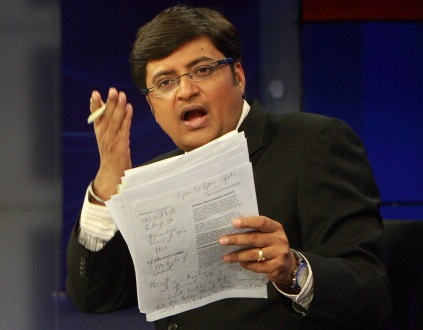
I am wondering if all has been going well with you. I saw your show on television the other night and you were shouting at a young man who has now been accused of sedition because of a meeting he attended on his college campus. In this show you shouted this young man down, did not let him speak, turned off his mike while he struggled to make himself heard. You called him a terrorist. You said people like him are dangerous elements and wondered who was funding him. You told him he should be grateful for things that India has apparently given him and others like him. You even had a tweet for the purpose #FlashpointAfzal. We will not go into the extraordinary idiocy you displayed in your own version of what you are pleased to call an ‘argument’. It seems in the world you inhabit, and people like you inhabit, the nation is a god-given entity before the idea of which we must all lie prostrate in quaking terrified adulation. But leave all this aside for now, you are not a very intelligent man and your stupidity, dangerous though it is, is not my concern here.
What concerns me though is your style: you are a bully and a brute. It may seem a strange thing to say, that it is how you say things more than the things you say that seem to bother me. Let me try and explain why and hopefully once I am done you will see that the things you say are not separate from how you say them. So, a few questions:
Did you even see the young man, Umar Khalid, in front of you? What did you see Arnab? Because you certainly didn’t see what I saw.
So again, since you love repeating questions, did you see him Arnab? As you screamed and yelled and hectored him? Can you think yourself back to when you were his age? Is it possible for you to achieve an empathetic identification with anyone else, even an earlier version of your own self? Can you even begin to imagine being this young man? I think not. I think you only see images of yourself projected out into the engulfing darkness of the pulpit from which you preach every night. And all that ever returns to you are the sounds of a million amens to your sermons.
You didn’t see, for instance, what I saw. I saw a very young man, not even 25, ganged up on by 5 people baying for his blood. I saw a young man caught in a terrible situation being accused and flayed as though he was not even there. I saw a woman screaming at him in rage, telling him there is no place for people like him in India as you encouraged her to shout him down. I saw you speaking to Sushil Pandit about anti-India elements, what must be done to them, what must be done with them. I saw all this and more and you should be ashamed of yourself.
Perhaps you think this young man’s views, whatever they may be, stupid. Perhaps you think them ill-judged. Perhaps, since you claim to be an ardent nationalist, you even think them ill-intentioned. But for this he must be made to pay with a jail sentence? Really? Do you honestly believe that it is not the right of every citizen to express their opinions on a court judgement that took a man’s life? So let me say here, publicly and openly, I condemn the hanging of Afzal Guru unequivocally. I condemn it as a cowardly blood sport where a man was sacrificed to appease the blood-lust of a country whose appetite for slaughter seems only on the rise.
You are not an angry man Arnab. You are a hate-filled man. This is why night after night you can marshall such limitless reserves of deranged indignation. A lesser person would be spent. But not you. You persevere. How?
But you don’t actually care about any of this do you Arnab? This is not about love for India, or patriotism, or the country. This has nothing to do with love of anything at all. This is simply the infantile vengeful response of a child lashing out at thwarted desire. So what is it that you want Arnab? What will fulfill you?
For a long time I was confounded by your energy. I wondered how it was that night after night you managed to produce such extremities of emotion and rage, seemingly without care for person or situation. And here I have to tender a confession, for on occasion I have enjoyed your bullying. Enjoyed watching your nightly conniption fit when it is directed at people I don’t particularly like. I particularly enjoyed your episode with Jasleen for instance as you eviscerated a bunch of misogynists for going after a young woman. But it made me think what about it so delighted me for it was a question of style not substance. And I realized you were playing to the worst instincts in me – you were stoking the pleasure one feels at watching mean nastiness directed at someone one doesn’t like. Because for the duration of your show we were asked to suspend all judgment, to withhold all rational faculties of discernment that demand adjudication between the gravity of a situation and the magnitude of our reaction. There is no commensuration between harm and punishment. It is, to put it bluntly, a seductively infantalizing experience. Like all hurts are the end of the world for children and are responded to as such, so too watching you throw your temper tantrums invites us to partake of them without shame. You throw our tantrums for us.
And that’s when it struck me. I was wrong. You are not an angry man Arnab. You are a hate-filled man. This is why night after night you can marshall such limitless reserves of deranged indignation. A lesser person would be spent. But not you. You persevere. How?
In his careful obsession with categories, Aristotle makes a distinction between ‘anger’ and ‘hate’. The crucial difference is that anger is directed at an object, and when the object no longer exists (or is destroyed) anger is extinguished. Hate has no object. Its object is its own self-perpetuation. And so hate continually finds new objects to consume. I think you should read Aristotle very carefully Arnab because you are filled not with righteous anger but with the sickness of hate. Night after night you scream and bully and yell and shout, now about this and now about that without exhaustion or depletion.
And Aristotle helps us understand another peculiar feature of your nightly seizures, namely their uniformly blustering affect. There is no hierarchy or modulation. No situation is more or less deserving of attention or investment, you are utterly democratic in the whole-scale castigation of the objects of your ire. It would be incorrect to say you make mountains out of mole-hills, for the phrase implies some understanding of scale and value to begin with. Rather it is as though, for you, everything exists on a one-dimensional flat plane of disapproval. Your rage has nothing to do with what is before you. It is only about you. People, situations appear as transient fuel – today you speak for the soldier at Siachen and against anti-nationals. Yesterday you spoke for women and against sexual predators. Its all the same really.
The reason I am writing to you today is because, unfortunately, a fateful conjunction of your personal history and our public life has brought us into daily communion where your mania is now our disease. Your sickness (and by sickness I mean no judgment, only a description of the thing inside of you) is a barometer of the virus rife in the body politic. So let me slightly revise my earlier proposition: You keep going because in your nocturnal seances you incarnate the spirit of the age. And it is a bloodthirsty spirit to be sure.
The reason I am writing to you today is because, unfortunately, a fateful conjunction of your personal history and our public life has brought us into daily communion where your mania is now our disease. Your sickness (and by sickness I mean no judgment, only a description of the thing inside of you) is a barometer of the virus rife in the body politic
Something terrible has been unleashed. Something terrible which has come to pass that makes us forget that while we may enact vengeance in our fantasies there is a reality principle in the world that must moderate our destructive desires. We seem to have regressed to an infantile narcissism where there is no distinction between our feelings, what we want, and how we act. Forgive me for throwing some pop-psychoanalysis at you Arnab but, since there is slim chance of you actually seeking help, you might as well get some for free.
There was once a smart lady called Melanie Klein. Someday when you have the time I would urge you to read her. She wrote primarily about the mental development of children and has several interesting things to say on the topic of love and hate. Klein says that in the earliest stage of their development, children make no distinction between their fantasy lives and reality. They have, we could say, a megalomania that is world-encompassing: they believe that the thing they have fantasized (such as the death of their mother for not giving them what they want) actually comes to be. Part of growing up, of becoming an adult, is the moderation of our sense of our own powers. As we grow we realize that actually we are not god. Things do not come to be simply because we have wished them. And with this comes both frustration, and also relief. It is frustrating to not have exactly what we want when we want it, but also enormously liberating. Can you imagine all of the terrible thoughts we have in a day? Imagine if they all came to pass simply because we had happened to think them in a moment of petty spite, or momentary pique. But our original megalomania never fully leaves us and we are all liable to regress from time to time. For one it informs our apprehension of scale: so I am asking you again Arnab to think carefully about why the words, “This is not a big deal,” seem to be impossible for you to say.
What exactly it is that you are channelling Arnab? What flock is it that has chosen you as its shepherd? What people are they who have deemed you their prophet? Have you thought about who might employ the hashtags you so helpfully provide: #NOPlaceForTreason? Perhaps, but there soon will be #NoPlaceForFreedom if you continue the way you’re going Arnab. Because this drug you are hooked on, this heady dangerous toxic mix of pompous affirmation and self-righteous rage will consume us. Because you can channel it and feed on it and give it back so there’s more next time, but you cannot control it.
We are living in a country today where young people holding a meeting on a college campus are being hounded as enemies of the nation. Where other young people, people who presumably live their everyday lives with some modicum of non-pathological common-sense, celebrate the hanging of a man. There are people gathering themselves into lynch mobs in neighborhoods. Lawyers in a courtroom morph into a vigilante crowd that attacks teachers and students. There are groups of people creating Facebook groups whose only purpose is to issue objectless threats to abstract ‘enemies of India’. We are living in a country where a man can be lynched because of what he may be eating. That the apparent job of our border security forces is the diurnal head-count of cows grazing on the Bangladesh-India border.
You are participating in this eroticised orgiastic mass wallowing in righteousness Arnab, and in doing so you are complicit in the violence of the thugs assaulting teachers in the court-room, the trolls baying for blood on Facebook, the vigilante goons policing young women at night looking for ‘love-jihad’. You are one and the same as the RSS thugs attacking a film on the Muzaffarnagar riots. You scoff in disbelief at this equation between you and the Sanghis you apparently loath, but you are no different from them Arnab. You may occasionally aver notional differences – dietary preferences, sartorial choices, sexual inclinations, religious texts. You may have a different story as they say. Its all window dressing. At your core you are the same – a righteous resentment masquerading as thought. Which is why nothing can make you change your mind. Nothing anyone says, no point of view, no gesture to reason or reasonableness. No. All exists at the level of “feelings”, there is no arguing with your feelings and it is only from the position of bruised feelings that you speak. Your tongue flapping about in your mouth as a child stamps its foot petulantly on the floor. Which is why all this shouting and raging and yelling and bluster.
You are participating in this eroticised orgiastic mass wallowing in righteousness Arnab, and in doing so you are complicit in the violence of the thugs assaulting teachers in the court-room, the trolls baying for blood on Facebook, the vigilante goons policing young women at night looking for ‘love-jihad’. You are one and the same as the RSS thugs attacking a film on the Muzaffarnagar riots
But we are not children Arnab and you really need to stop now. You need to stop being a grown baby. Because things are getting dangerous now. Yes. Things are getting very very dangerous for India and you are possibly the biggest daily threat to the collective unconscious. A nuclear warhead of object-less resentment, the most dangerous of all because it can never be fulfilled. Because it cannot make anything, much less produce a vision of the world in which others may wish to live. It can only destroy. And the energy spent in destruction masquerades as productive. So night after night you invite people to come to your show and you destroy them. To be honest for them I don’t much care, they come knowing what they will get, so perhaps their masochism gets off on your sadism. Whatever.
But that night when you attacked a young man without any care for what may now happen to him, now you have set the mobs after him, I cared then. I cared very much. Because in so far as you exist, your existence is proof that something in the current configuration of the world finds your existence to be a reasonable proposition. (That’s Hegel btw. I know you don’t have much spare time when you’re done reading today the things you said yesterday so you can decide what to say tomorrow so I just thought, you know, learn something why not eh?). And it is the current configuration of our world with which I am seriously concerned. In which a man such as yourself is not a comical aberration but the distillation of a generalized tendency to demand vengeance for fictitious slights. Of the making of mountains out of non-existent mole-hills as the script of public national life.
What has happened? What sort of country is this, so insecure and resentful that it defines its own cultural being not through reference to the vibrancy and diversity of its people, to the things they make and do and think and write and sing, but through the extraction of a promise of love at the point of a gun? What sort of insane country have we become that the love of India is always expressed through words of hate, of all the people and words that will not be tolerated. Have we become a country of infantile cretins who can make no distinction between fantasy, reality, harm and injury? Are you seeing a pattern here Arnab?
You are feeding on this thing in your mania Arnab. And it is feeding off the spleen you vent every day, day after day. I am writing to ask you to stop. Put yourself on a diet. Moderate your appetite. Curb your gluttony. Because when finally the snake has eaten its own tail there is no snake left. Just a creature whose eyes can only look at its own arse. I am asking you to behave yourself so this country does not become a public urinal in which we wallow in our own shit because we mistake it for gold (this is Freud not me, and he’s dead so you can call him an anti-national in heaven where he most certainly is).
I do not know you Arnab. We have never met. One asks after the health of one’s friends; the niceties of etiquette rightly caution against probing the lunacies of strangers. But please Arnab. Get some help. For your sake, for our sake, for the sake of Mother India.
With genuine concern,
Aarti
Courtesy: Kafila.org