Home Blog Page 2600

देशभक्ति के नाम पर देश के क़ानून की धज्जियां उड़ाई जा रही हैं: हिन्दी लेखकोँ का बयान

0


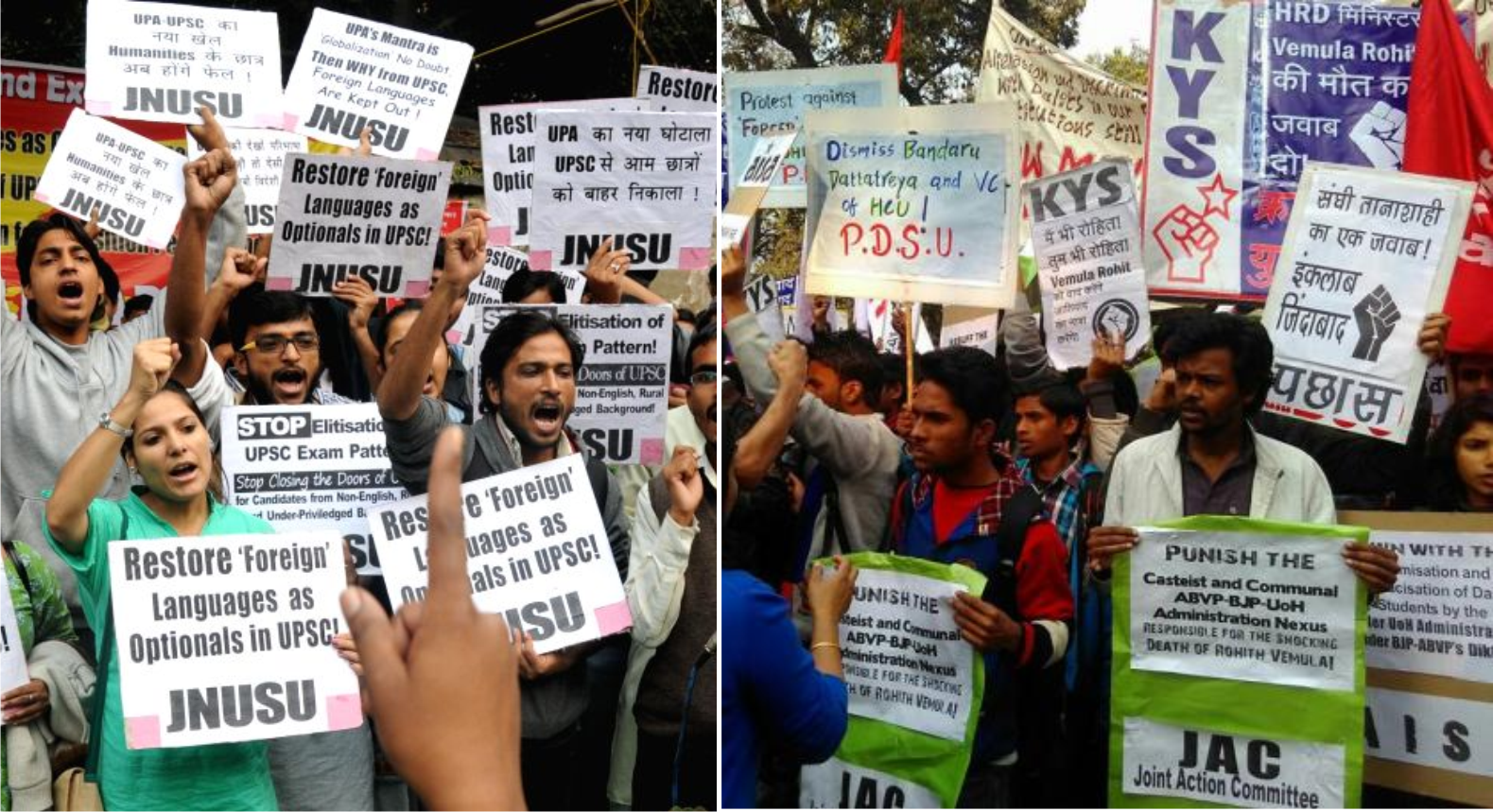
Image: indianexpress.com
 

हम हिन्दी के लेखक देश के प्रमुख विश्वविद्यालय जवाहरलाल नेहरू विश्वविद्यालय में 9 फरवरी को हुई घटना के बाद से जारी पुलिसिया दमन पर गहरा क्षोभ प्रकट करते हैं। दुनिया भर के विश्वविद्यालय खुले डेमोक्रेटिक स्पेस रहे हैं जहाँ राष्ट्रीय सीमाओं के पार सहमतियाँ और असहमतियाँ खुल कर रखी जाती रही हैं और बहसें होती रही हैं। यहाँ हम औपनिवेशिक शासन के दिनों में ब्रिटिश विश्वविद्यालयों में भारत की आज़ादी के लिए चलाये गए भारतीय और स्थानीय छात्रों के अभियानों को याद कर सकते हैं, वियतनाम युद्ध के समय अमेरिकी संस्थानों में अमेरिका के विरोध को याद कर सकते हैं और इराक युद्ध मे योरप और अमेरिका के नागरिकों और छात्रों के विरोधों को भी। सत्ता संस्थानों से असहमतियाँ देशद्रोह नहीं होतीं। हमारे देश का देशद्रोह क़ानून भी औपनिवेशिक शासन में अंग्रेज़ों द्वारा अपने खिलाफ उठने वाली हर आवाज़ को दबाने के लिए बनाया गया था जिसकी एक स्वतंत्र लोकतांत्रिक समाज में कोई आवश्यकता नहीं। असहमतियों का दमन लोकतन्त्र नहीं फ़ासीवाद का लक्षण है।

इस घटना में कथित रूप से लगाए गए कुछ नारे निश्चित रूप से आपत्तिजनक हैं। भारत के टुकड़े करने या बरबादी की कोई भी ख़्वाहिश स्वागतेय नहीं हो सकती। हम ऐसे नारों की निंदा करते हैं। साथ में यह भी मांग करते हैं कि इन विडियोज की प्रमाणिकता की निष्पक्ष जांच कराई जाए। लेकिन इनकी आड़ में जे एन यू को बंद करने की मांग, वहाँ पुलिसिया कार्यवाही और वहाँ के छात्रसंघ अध्यक्ष की गिरफ्तारी कतई उचित नहीं है। जैसा कि प्रख्यात न्यायविद सोली सोराबजी ने कहा है नारेबाजी को देशद्रोह नहीं कहा जा सकता। यह घटना जिस कैंपस में हुई उसके पास इससे निपटने और उचित कार्यवाही करने के लिए अपना मैकेनिज़्म है और उस पर भरोसा किया जाना चाहिए था।

हाल के दिनों में बनारस हिन्दू विश्वविद्यालय में ख्यात कवि और विचारक बद्रीनारायण पर हमला, सीपीएम के कार्यालयों पर हमला, दिल्ली के पटियाला कोर्ट में कार्यवाही के दौरान एक भाजपा विधायक सहित कुछ वकीलों का छात्रों, शिक्षकों और पत्रकारों पर हमला बताता है कि देशभक्ति के नाम पर किस तरह देश के क़ानून की धज्जियां उड़ाई जा रही हैं। इन सबकी पहचानें साफ होने के बावजूद पुलिस द्वारा कोई कार्यवाही न किया जाना इसे सरकारी संरक्षण मिलने की ओर स्पष्ट इशारा करता है। असल में यह लोकतन्त्र पर फासीवाद के हावी होते जाने का स्पष्ट संकेत है। गृहमंत्री का एक फर्जी ट्वीट के आधार पर दिया गया गंभीर बयान बताता है कि सत्ता तंत्र किस तरह पूरे मामले को अगंभीरता से ले रहा है। ऐसे में हम सरकार से मांग करते हैं कि देश में लोकतान्त्रिक स्पेसों को बचाने, अभिव्यक्ति की आज़ादी के अधिकार की रक्षा और गुंडा ताकतों के नियंत्रण के लिए गंभीर कदम उठाए। जे एन यू छात्रसंघ अध्यक्ष को फौरन रिहा करे, आयोजकों का विच हंट बंद करे, वहाँ से पुलिस हटाकर जांच जेएनयू के प्रशासन को सौंपें तथा पटियाला कोर्ट में गुंडागर्दी करने वालों को कड़ी से कड़ी सज़ा दें।

मंगलेश डबराल
राजेश जोशी
ज्ञान रंजन
पुरुषोत्तम अग्रवाल
असद ज़ैदी
उज्जवल भट्टाचार्य
मोहन श्रोत्रिय
ओम थानवी
सुभाष गाताडे
अरुण माहेश्वरी
नरेंद्र गौड़
बटरोही
कुलदीप कुमार
सुधा अरोड़ा
सुमन केशरी
नन्द भारद्वाज
ईश मिश्र
लाल्टू
कुमार अम्बुज
शमसुल इस्लाम
सुधीर सुमन
ऋषिकेष सुलभ
विनोद दास
राजकुमार राकेश
हरिओम राजोरिया
अनिल मिश्र
नंदकिशोर नीलम
अरुण कुमार श्रीवास्तव
मधु कांकरिया
सरला माहेश्वरी
वंदना राग
मुसाफिर बैठा
अरविन्द चतुर्वेद
प्रमोद रंजन
हिमांशु पांड्या
वैभव सिंह
मनोज पाण्डेय
शिरीष कुमार मौर्य
अशोक कुमार पाण्डेय
वर्षा सिंह
विशाल श्रीवास्तव
उमा शंकर चौधरी
चन्दन पाण्डेय
असंग घोष
विजय गौड़
अरुणाभ सौरभ
देवयानी भारद्वाज
पंकज श्रीवास्तव
कविता
हरप्रीत कौर
अनुप्रिया
राकेश पाठक
संजय जोठे
रामजी तिवारी
कृष्णकांत
मनोज पटेल
देश निर्मोही
प्रज्ञा रोहिणी
दीप सांखला
अमलेंदु उपाध्याय
प्रमोद धारीवाल
अनिल कार्की
देवेन्द्र कुमार आर्य
प्रमोद कुमार तिवारी
अरविंद सुरवाड़े (मराठी)
आलोक जोशी
रोहित कौशिक
मनोज छबड़ा
अमिताभ श्रीवात्सव
ऋतु मिश्रा
कनक तिवारी
ईश्वर चंद्र
नित्यानन्द गाएन
शशिकला राय
पंकज मिश्रा
कपिल शर्मा (सांगवारी)
विभास कुमार श्रीवास्तव
मेहरबान सिंह पटेल
 

70 Years After a Patriotic Uprising

0


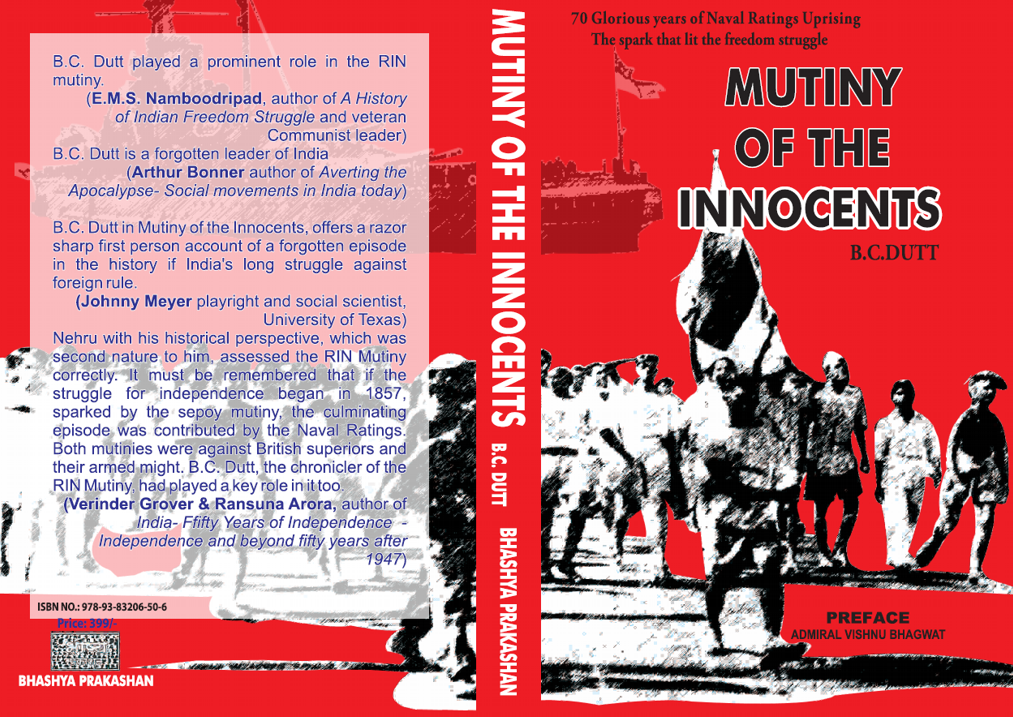
"Mutiny of the innocents" Author's name B.C. Dutt.
Published by Bhashya Prakashan, Price Rs. 399/-, pages 291

 
The royal Indian navy apprising, which was described by British historians as naval mutiny took place seventy years ago, on February 18, 1946, at the Mumbai port.

Memories of this historic event have almost faded but the second edition of the “Mutiny of Innocents “by B.C.Dutt will bring them back since with the release of the second edition of his book on February 18, 2016. The book written as an eye witness account by Dutt who was one of the heroes of the naval uprising, a young naval sailor who was stationed at a ship docked in the Mumbai port.  

Former Indian chief of the naval staff, Admiral Vishnu Bhagwat has written the forward to the second edition published by Bhashya Prakashan of Mahesh Bharatiya. Bhagwat has observed that though the uprising could not secure required support when it happened, all those sailors ignited the imagination of Indians who respect them as the uprising brought freedom at our doorstep.  In his foreword, Vishnu Bhagwat has traced back origin of naval apprising to the first revolt against British rule in 1857.

Being a port city, we have seen how terrorists from across the borders entered city from seashore and wrecked havoc by killing innocents at CST, TAJ Mahal hotel and other places in the city.

Though British historians called it a mutiny it was a spontaneous uprising not only by naval officers but accompanied by sporadic incidents of revolt against the British Empire by armed forces as well.  The uprising was crushed ruthlessly by authorities by using force.

The author of the book who was a junior officer in the navy, provides a first-person account of a forgotten episode in the history of India's long struggle against foreign rule. In the early months of 1946, low-ranking sailors in the Royal Indian Navy began supporting Indian independence movement without any external expression due to fear of navy’s strict discipline. It was a mute but passionate support, a kind of turmoil brewing within.

It cannot be described as a sudden change of heart, but a slow process which must have begun much earlier when political leaders of independence movement began reaching out to the common masses and liberated movement from the dining halls of few influential people.

The author has no bitterness against those naval officers who crushed the revolt by the sailors. The top British military leaders were aware that such an uprising was possible but were not prepared for such a spontaneous show of uprising which was not coordinated nor led by any particular leader. Nor did those who participated in it, have any links with the political leaders who were demanding freedom. The uprising not only surprised British Empire but also Indian politicians like Mahatma Gandhi who were not prepared for such a show of armed revolt.   

Dutt and his fellow Indian sailors served the royal navy with commitment and loyalty throughout the Second World War but became restive and conscious of a subtle but obvious racism. At the end of the war, Dutt was stationed at the HMIS Talwar, stationed in Mumbai port. He along with other sailors were dismayed at the Navy offered very little advancement and there were no jobs on shore.

The book written as an eye witness account by Dutt who was one of the heroes of the naval uprising, a young naval sailor who was stationed at a ship docked in the Mumbai port.  

In general, the people, too, also did not have much respect for sailors whom they considered as mercenaries supporting British Empire ignoring interests of the nation trying to oust British rule.

The disgruntled sailors who were influenced by freedom movement began their protest by merely writing revolutionary slogans on barrack walls and put up some hand written posters supporting freedom struggle.

These small act of revolt finally resulted in the armed uprising in February 1946.

Authorities caught Dutt in February 1946. He refused to name his fellow sailors and declared himself a political prisoner, rather than be charged of an insubordination.  Dutt soon emerged as a hero for his fellow sailors across ships run by Royal Indian Navy, with a flash demonstration.
The authorities tried to treat it as a small incident, arising out of discontent among sailors over bad quality of food and other administrative complaints, but the fact remains that it was much more serious, an armed rebellion by naval sailors  who took over charge of the ships,  unfurled tricolor and announced liberation from the British.

According to conservative estimates more than 12,000 ratings, low-ranking sailors, openly revolted. They seized ships and shore establishments throughout Mumbai, Kolkata, Karachi, and other ports. Even ships sailing in the deep seas were seized and flags hoisted above, changed. The revolting sailors set up a committee to coordinate efforts, spoke the language of freedom fighters, they even wanted to hand over the navy to Indian National Congress and Muslim League , but the political leadership was bewildered and not ready to handle such a complex situation. In fact, the sailors were left to fend themselves and later the uprising was crushed by the authorities.

The signs of the uprising are still seen in docks and some other parts of the city where the gun battle took place and few sailors as well as innocent civilians also lost their lives. Within a very brief time, the Union Jack was replaced by the Tricolor on the mast head of 74 ships, 20 shore establishments.

In support of sailors, textile mills, factories, shops in Mumbai downed their shutters. Over 300 people lost their lives on the streets of Mumbai.  Among Congress leaders, Sardar Vallabhbhai Patel, quickly organised a truce between the revolting sailors and the authorities to minimize damage. Signaler M S Khan was head of the coordination committee of sailors assisted by telegraphist Madan Singh and five others.  

Though not many could visualize any great impact of the spontaneous naval uprising, those sitting in London and supervising Indian subcontinent had realized that the naval uprising was just a beginning. The British authorities who had crushed the 1857 revolt had always feared the possibility of another uprising and revolt by Indian army and the naval uprising had all the seeds of such revolt as the freedom movement had gained ground and affected every soldier and sailor serving under foreign rule. Those in uniform were also sons of farmers and workers who were totally swayed by the dream of independence and could hardly hide their aspiration despite the stern discipline of the army.

The naval uprising had shaken the British Empire already weakened by the Second World War. A year and a half later, India won its independence. In Pakistan,  Prime Minister Jinnah allowed the Muslim sailors who participated in February 1946 uprising to assimilate into the Pakistan navy. In India, the situation was different. Dutt was quietly discharged without much fanfare, others could not rejoin the navy as they were not accepted. But they emerged as heroes in the eyes of free India.

Dutt later joined journalism and wrote a succinct eye witness account of the naval uprising. He actually became a reporter with the Free Press Journal which was the only newspaper in Mumbai that carried a detailed report about naval apprising.

Dutt has carefully chronicled the circumstances leading to the naval uprising of 1946. His account is a reminder of how Mumbai was always at the forefront of the freedom struggle. Dutt’s account makes a strong case for the revolting Indian sailors to be called patriots, not mutineers.

It is a first person account which began with Dutt joining the Academy; its reading becomes interesting and the author has charming way of narrating details, with a sense of humour that adds a special touch. He records the events without malice or resentment. He articulates the views of his enemies with remarkable generosity and restraint.

The author is also an astute observer of human nature. He also has the wisdom to reassess his actions since the book was written 25 years after the event.  The book also throws light on how the political class failed to support the innocent sailors who had revolted against British Empire. The leaders believed in non-violent mode of transfer of power.

ALL INDIA LAWYERS UNION RAJASTHAN STATE COMMITTEE: Solidarity Message to JNU

0

ALL INDIA LAWYERS UNION RAJASTHAN STATE COMMITTEE

Dated:18.2.2016

SOLIDARITY MESSAGE TO JNU

All India Lawyers Union (AILU), Rajasthan State Unit, strongly condemn the recent incident where individuals in uniform of Advocates misbehaved and assaulted Mr. Kanhaiya Kumar, the president of JNU Students Union, JNU faculties, Media persons on 15.2.2016 when Mr. Kanhaiya Kumar was produced in court before the magistrate is very serious issue and it became vigorous when the incident was repeated after two days, on 17.2.2016 despite of the actions given byHon’ble Supreme Court.

Further the AILU is of the view that the Jawahar Lal Nehru University is one of the institutions in the world where healthy atmosphere is developed over a time to discuss over the national and international issues. The students as well as the faculty members thereof is of the caliber to suggest a visionary and logical culmination, which not only important for individual but also for the nation and humanity as whole. Furthermore, University is a place where new ideas are developed, questions are asked and policies are praised or criticized. If any unwarranted incident is happened in the campus of the university, certainly an action has to be initiated against the responsible individual and for such action the university administration is having sufficient measures to act upon and no police action inside the campus was required at all. If the university authorities failed to take action or has shown its inability to restrict such activity, only then the police force may be used.

As such the police action in the university campus was absolutely unwarranted, unjustified and abuse of power by the state machinery.

Arrest of Mr. Kanhaiya Kumar and other students and treating them like hardcore criminals/terrorists, in the name of sedation without any substantial evidence, is not expected in a civilized society. The crime of sedation was inserted in IPC by the British rule in order to supress anyone who used to speak against the colonial rule. This term ‘sedation’ is obsolete and has no place in a democratic system like ours, especially in the educational institutions, having international reputation. Framing students in the name of sedation is clearly an attack on the fundamental rights, that is, of speech and expression.

Intentional avoidance of the Hon’ble Supreme Court instructions is apparently an act of contempt of court for which stern action has to be taken. AILU strongly suggests to take following actions against the responsible :
(i) Criminal case has to be registered against the advocates or the persons in the advocates’ uniform indulged in assaulting within the court premises;
(ii) Separate proceeding of criminal contempt is to be started against the persons involved in assaulting despite instructions of Supreme Court;
(iii) The police personals deployed at the court campus, in front of whom the act of assault was occurred has to be suspended henceforth and inquiry has to be initiated against them;
(iv) Mr. Om Prakash Sharma, the sitting MLA, who was apparently involved in the assaulting and to instigate others to involve in assaulting, his membership of Legislative Assembly is to be seized, proceeding of criminal contempt is to be initiated against him;
(v) The courts are the place where people come with the deep faith to get justice but such type of incidents not only deprive the people to avail justice but also diminish the belief in rule of law, and therefore, stern action has to be initiated against each and every responsible person whomsoever he is;
(vi) Code of conduct for advocates has to be reviewed and it may be inserted that any advocate, who involves in such incidents occured on 15.2.2016 and 17.02.2016, shall be restricted to appear in court as well as seize their auth of advocacy;
(vii) The magistrate, before whom the repeated disruption of court proceeding was occurred but no action against the responsible advocates/persons was taken, no FIR was lodged, stern action is required to be initiated against him.
The AILU condemn both the incidents, i.e. abuse of power by the police administration in the JNU campus and omission to prevent the assault on the students faculties and media persons in the court room /campus of Patiala House court. Our organization also demands for immediate release of Kanhaiya Kumar, president of JNUSU, so that normalcy can be restored.

(Dr. Vikram Singh Nain)
General Sectretary

General Secretary: Dr. Vikram Singh Nain Advocate Mobile No: +91 9414069959 Office: 0141-2810959 E-mail: nain_vs@yahoo.co.in

President: Sanjay Tyagi Advocate Mobile No.+91 9414048493 +91 9314013492

8, Nagaur Nagar, Nr. Kisaan Dharam Kanta Gopalpura Bye-pass Road, Jaipur-302019
 

Solidarity with JNU and Conversations on Kashmir: JKCCS

0

Guest Post by Jammu Kashmir Coalition of Civil Society

Jammu Kashmir Coalition of Civil Society (JKCCS) expresses its solidarity with the striking students and teachers of Jawaharlal Nehru University, New Delhi. We have watched with a sense of horror and dismay, the violent criminalizing of student democracy and dissent, not just at Jawaharlal Nehru University but across Indian campuses in the recent past. Having long and intimate knowledge of violent repression and legalized impunity that Indian state is capable of, especially against those it considers ‘anti-national’ we are not surprised by these events, but have a special empathy with all who suffer its horrors. We demand the release of all student dissenters and political prisoners in the custody of the Indian state, and an end to acts of policing and surveillance on campuses, and targeting of students on the basis of political beliefs and speech.

The Kashmiri students in different colleges and universities in India, who have always faced discrimination and intimidation time to time, are now feeling the extreme regressive and oppressive means used by right wing groups and the government. After being hounded, Kashmiri students have begun leaving Delhi. There are several places where the landlords, in whose properties Kashmiri students were renting flats, have asked the students to vacate. These experiences of Kashmiri students are part of the larger reality faced by Kashmiri youth in Jammu and Kashmir and in India. The voices of dissent in Jammu and Kashmir have been dealt with administrative detentions under Public Safety Act, illegal detentions, torture, surveillance and killings by armed forces including the most recent one of Asif and Shaista at Pulwama on 14th of February.

We also view with alarm, the reports about the cynical use of Kashmiri students studying in Delhi as hostages in the politically illegitimate process of government formation in Srinagar.

We are dismayed that the public narrative about the recent events has often descended into disputes over Indian ‘patriotism’ and the shrill condemnation of a few ‘fringe’ ‘radical’ ‘traitors’ for ‘irresponsible’ slogans. These sentiments are neither mere slogans nor represent the ‘fringe’ in Kashmir, the very place they were made in reference to. As Kashmiris, we believe that the right to self-determination is inseparable from the right to political association, dissent and free expression, and these rights cannot be selectively asserted or upheld. In the competitive public proclamations of nationalistic credentials, what has been lost is that courageous act of defiant solidarity with the Kashmiri people’s struggle for justice and self-determination, that lies at the heart of these debates. Despite the disavowals and the state repression, the solidarity with the political rights of the Kashmiris is growing and spreading, as events in Jadavpur University demonstrate. We acknowledge the emerging spaces in Indian civil society to converse on the question of Kashmir, beyond nationalist framings. We hold out hope for future alliances with students, groups and individuals willing to engage in honest conversations, in which they alone do not determine the boundaries of what can or cannot be said, thought or felt.

Spokesperson
JKCCS
 

JNU Crackdown: Com. Shehla Against BJP Govt. assault on JNU and Democracy

0

Com. Shehla, JNUSU Vice President, addresses students and teachers gathered in protest against BJP Govt.s unprecedented assault on Campus Democracy.

"The assault on JNU is a well drafted script by the RSS-BJP which uses the charade of Anti-National to silence the most vocal intellectual opposition against BJP govts anti-India policies"


Stop the Vigilantes: Petition in SC against Assaults in Court

0


Source: Indian Express, Abhishek Angad: assailants Yashpal Singh (L), Vikram Chauhan (C) and Om Sharma (R) during the assault at Patiala House Courts
 

Supreme Court will hear a petition against the NDAII government and the Delhi police at 10.30 a.m. today, February 17

Senior academic and social activist, N. D. Jayaprakash has taken on both the government of India and the Delhi police for their severe derelictions of duty amounting to a miscarriage of justice and an infringement of the fundamental rights of the petitioner and all those brutally assaulted within the Magistrate Loveleen’s court in the Patialia Court premises on February 15, 2016.
 
The physical violence and intimidation faced by the petitioner, Jayaprakssh and a large number of students, teachers and journalists while attending a judicial proceeding before the Court of Metropolitan Magistrate, Loveleen on February 15, 2016 is a matter of deep concern. The violence and intimidation took place at the Patiala House Courts, Delhi, as well as in the court complex.

The Delhi police, present in large numbers, were mute spectators to the violence and did nothing to protect those being intimidated.

Jayaprakash, in his petition seeks directions of the Supreme Court to ensure the safety and security of all persons within the premises of the court during the trial of Kanhaiya Kumar, President of Jawarharlal Nehru University Students’ Union. While the police are duty bound to protect innocent citizens from acts of violence and vandalism in Court premises, they were mute spectators.

Due to the surcharged and vicious atmosphere in the Court premises, it is today not possible to even produce the accused. Deliberate intimidation and assaults by a section of lawyers and others, owing allegiance to the ruling dispensation ensured that violence broke out soon after the court was to assemble at 2.00 pm on February 15. The violence initially broke out inside the court and thereafter spilled over in the adjacent areas of the court complex as people started running to save themselves from the brutality of lawyers and outsiders which included several politicians.

Such brazen acts of violence in the court complex can never be permitted or countenanced. It is so serious a breach so as to tantamount to criminal contempt of court and denial of access to justice. The judicial functioning requires a calm and tranquil atmosphere. Even surcharge atmosphere is considered not conducive to justice by that standard physical violence must be treated as grosses of contempt apart from various other offences. 

No question about the merits of the case of the students or teachers is being raised as that ought to be decided by the concerned court before which the matter is brought. This petition merely seeks to assure safety of the accused their relatives, friends, lawyers and journalists while discharging their legal as well as professional obligations.

The incident of February 15, 2016 in the Patiala house courts poses a serious threat to the life of the accused. The atmosphere was so surcharged that even the women journalists were not spared and were not permitted to discharge their journalistic duties and be able to report the events as witnessed by them directly. More than a dozen journalist including women journalists suffered physical assault and sustained injuries, the mobile phones of journalists were snatched, broken or stolen to prevent them to able to report the violence.

That police were a mute spectator to this brazen display of violence and brute force being perpetrated on innocent persons who had gathered in the Court premises. It is submitted that the State and the Police have bounden constitutional obligation to ensure the safety and security of the life and liberty of citizens. The incidence of February 15, 2016 is a crude affront to the rule of law and violation of Article 21.

I have been attending cases since 1989 before this Hon’ble Court, before the Hon’ble High Court of Madhya Pradesh at Jabalpur and before the District Court of Bhopal. However, it is for the first time in 27 years that I have had to confront such an ugly situation. I am greatly alarmed by the brazenness with which the said group of lawyers were attacking those who had come to watch the proceedings and the journalists, who had come to cover the proceedings.
 
The Supreme Court in Zahira Habibulla H Sheikh And Anr v. State Of Gujarat, (2004) 4 SCC 158 has noted that it is the duty of the court to assure propitious conditions which conduce to comparative tranquility at the trial. Turbulent conditions putting the accused's life in danger or creating chaos inside the court hall may jettison public justice.
 
That a surcharged atmosphere in the court room where there exists a threat of physical violence and threat of intimidation, of family and friends or other persons known to the person against whom a FIR has been filed, such as the Petitioner, violates the fundamental rights of such persons, in particular under Articles 21.
 
That Respondent (officers) being present at the court should have avoided escalation of the violent situation which clearly impeded the proceeding and the safety of various persons present, including the Petitioner. It is submitted that a congenial atmosphere is imperative for a fair and impartial judicial proceeding, which is a fundamental right of every person under Article 21 of the Constitution.

ND Jayaprakash, aged 66 years, is a citizen of India and a resident of New Delhi. The Petitioner is also an alumnus of Jawaharlal Nehru University, Delhi (“JNU”) and a social activist.
The petition has been filed against the Ministry of Home Affairs (MHA) which is entrusted with the responsibility of internal security and law & order, etc. Respondent No. 2, the Delhi police, is directly under the control and supervision of the MHA, Respondent No. 1.The Respondent number 2 is Delhi Police. It is the duty of the Respondent to ensure that there is law and order maintained in the state of Delhi including Court premises. That the Police, Respondent No. 2 in the petition, has grossly derelictedin its duties in failing to provide safety and security to the litigants, journalists and others in the Patiala House Court premises on the day when the incident of took place.
 
Chronology of Events:
 
On February 15, 2016, around 02.00 pm at the Court of Metropolitan Magistrate Loveleen, Patiala House Courts, Delhi a group of lawyers suddenly barged into the court room and asked them to vacate the chairs on which they were sitting, claiming that the chairs were only meant to be occupied by advocates. While the Petitioner (Jayaprakash) and one other male professor told the lawyers they would vacate the chairs and there was no need for them to get agitated, the said group of lawyers suddenly became violent and slapped and physically assaulted the male professor.

Brief Facts:
Around February 12, 2016, Kanhaiya Kumar, JNUSU President, was taken into judicial custody for 3 days, after an FIR was registered against him by the Police under Section 124A and 120B of the Indian Penal Code, 1860, upon receipt of complaints from several persons.

Kanhaiya Kumar was to be produced on February 15, 2016, at the Court of Metropolitan Magistrate Loveleen, Patiala House Courts, Delhi, at the end of the 3 day judicial custody, for further proceedings.

Jayaprakash was present, at or about 02.00 pm on February 15, 2016, at the Court of Metropolitan Magistrate Loveleen, Patiala House Courts, Delhi, to attend the proceedings relating to the custodial detention of Kanhaiya Kumar. While he, the Petitioner was seated in the court room along with a group of about 7 or 8 professors and students from JNU, waiting for the court proceedings to commence, a group of lawyers barged into the court room and asked them to vacate the chairs on which they were sitting, claiming that the chairs were only meant to be occupied by advocates. While the Petitioner and one other male professor told the lawyers they would vacate the chairs and there was no need for them to get agitated, the said group of lawyers suddenly became violent and slapped and physically assaulted the male professor.
 
Meanwhile, some of the persons in that group of lawyers also started shouting that there was no need for them to learn manners from “Pakistani agents” and asked the Petitioner and the others to vacate the court room.  The female professors refused to move from there, which caused the said group of lawyers to abuse them. The lawyers of Kanhaiya Kumar, who rushed into the court room hearing the commotion were also abused and manhandled.
 
This conduct of this group of lawyers continued unabated. It was possible that the Magistrate was sitting in his chamber behind the court room but may have been reluctant to come to the court and restore order, given the atmosphere created by the aforesaid group of lawyers. However, the Petitioner is at a loss to understand why the Ld.Magistrate did not seek the help of the security personnel and the police to restore order in the court room.
 
Further, a large contingent of about 200 police personnel was present just outside the court room also because Union Minister (Finance) Mr.Arun Jaitley was appearing in one of the adjacent courts at the same time. After several of us sought help from some police officers, who were standing outside Court No.4, a few policemen came into the court room. However, no action was taken by them against the group of lawyers engaging in physical and verbal violence other than to stand between the said group of lawyers and the JNU teachers and a few others, who had come to attend the proceedings.
 
Thereafter, the Petitioner left the court room to make some calls about the out of hand situation and thereafter upon returning to the court room at about 3:00 pm, was shocked to see that a correspondent from a news channel was also being beaten up for refusing to hand over his mobile phone. The lone head-constable, who was present in the court room, could hardly protect the said correspondent from the attack.
 
In trying to save the correspondent, the Petitioner was also physically assaulted. After the group of lawyers snatched the mobile of the said correspondent, we were kicked and dragged out of the court room. The large contingent of police, including senior officers, who were stationed outside the court room, remained mute spectators while we were being beaten and pushed out of gate No.2 of Patiala House. There were other female news correspondents, present at site, who were also harassed by the group of lawyers.
 
During my brief absence from the court room, apparently several other journalists were roughed-up inside and outside the court room and their mobiles were snatched by the attackers or destroyed. These journalists have registered a formal complaint with the Tilak Marg Police Station against the systematic physical attack.
 
As a petitioner representing the cause of the Bhopal gas-victims, Jayaprakash says, “I have been attending cases since 1989 before this Hon’ble Court, before the Hon’ble High Court of Madhya Pradesh at Jabalpur and before the District Court of Bhopal. However, it is for the first time in 27 years that I have had to confront such an ugly situation. I am greatly alarmed by the brazenness with which the said group of lawyers were attacking those who had come to watch the proceedings and the journalists, who had come to cover the proceedings. My greatest fear was that, if the JNUSU President was brought before the court at that moment, he may have been literally lynched by that mob, which was baying for his blood. The said group of lawyers were terrorising all those who were present without any fear that they would ever be taken to task for their unacceptable behavior. I was shocked and dismayed by that terrible experience. Hence, I am filing this writ petition before this Hon’ble Court for appropriate remedy.”

Further, petitioner Jayaprakash makes out a series of grounds for his petition to be entertained:

–That a congenial atmosphere is imperative for a fair and impartial judicial proceeding, which is a fundamental right of every person under Article 21 of the Constitution.

-This Hon’ble Court in Zahira Habibulla H Sheikh And Anr v. State Of Gujarat, (2004) 4 SCC 158 has noted that it is the duty of the court to assure propitious conditions which conduce to comparative tranquility at the trial. Turbulent conditions putting the accused's life in danger or creating chaos inside the court hall may jettison public justice. 

-This Hon’ble Court in Bablu Kumar and Others v. State of Bihar, (2015) 8 SCC 787 has held that keeping in view the concept of fair trial, the obligation of the prosecution, the interest of the community and the duty of the court, it can be irrefragably be stated that the court cannot be a silent spectator or a mute observer when it presides over the trial. Further, neither the prosecution nor the accused should corrode the sanctity of the proceeding.

— That a surcharged atmosphere in the court room where there exists a threat of physical violence and threat of intimidation, of family and friends or other persons known to the person against
  whom a FIR has been filed, such as the Petitioner, violates the fundamental rights of such persons, in particular under Articles 21.

— For that the situation deteriorated to the extent that the police found it impossible to produce the accused as violence broke out soon after the court was to assemble at 2.00 pm.

— For that the violence initially broke out inside the court and thereafter spilled over in the adjacent areas of the court complex as people started running to save themselves from the brutality of   
   lawyers and outsiders which included several politicians.

—  For that violence in the court complex can never be permitted as countenanced.

—  For that it is so serious a breach so as to tantamount to criminal contempt of court and denial of access to justice.

—  For that the judicial functioning requires calm and tranquil atmosphere. Even surcharge atmosphere is considered not conducive to justice by that standard physical violence must be treated as
   grosses of contempt apart from various other offences. 

— For that this petition no question about the merits of the case of the students or teachers is being raised as that may be decided by the concerned court before which the matter is brought.This
   petition merely seeks to assure safety of the accused their relatives, friends, lawyers and journalists while discharging their legal as well as professional obligations.

— For that incident of 15.02.2016 in the Patiala house courts raise serious threat to the life of the accused. The atmosphere was so surcharged that even the women journalists were not spared
   and were not permitted to discharge their journalistic duties and be able to report the events as witnessed by them directly.

— For that more than a dozen journalist including women journalists suffered physical assault and sustained injuries, the mobile phones of journalists were snatched, broken or stolen to prevent
   them to able to report the violence.

— For that police was mute spectator to this brazen display of violence and brute force being perpetrated on innocent persons who had gathered in the Court premises.

— For that the State and the Police have bounded constitutional obligation to ensure the safety and security of the life and liberty of citizens.

— For that the incidence of 15.02.2016 is a crude affront to the rule of law and violation of Article 21.

— That Respondent (officers) being present at the court should have avoided escalation of the violent situation which clearly impeded the proceeding and the safety of various persons present,   
    including the Petitioner.

— The Petitioner by way of present Writ Petition is seeking appropriate directions to the Respondents including the Police to ensure the safety and security of persons inside the Court Premises
    during the trial of Kanhaiya Kumar, President of Jawaharlal Nehru University Students’ Union. It is submitted that the Respondents are duty bound to protect innocent citizens from acts of
     violence and vandalism in Court premises.

—  That the Respondents are amenable to the writ jurisdiction of this Hon’ble Court under Article 32. 

— That the Petitioner has not filed any other Petition in respect of the subject matter of this Petition in this Court or any other Court in India.

— That the Petitioner has no other alternative efficacious remedy but to approach this Hon’ble Court for reliefs prayed for and if the same are granted that shall be complete.

For that the Petitioners crave leave of this Hon’ble Court to amend, alter its grounds at appropriate stage, if and when required. 

The petitioner has urged the Supreme Court of India to issue firm directions to ensure that that the proceedings against Kanhaiya Kumar at the Court of the Metropolitan Magistrate Loveleen, are carried out in a manner which is not prejudicial to the fundamental rights of the persons, such as the Petitioner, attending the proceedings;

Directions from the Supeme Court to ensure that Court of the Metropolitan Magistrate Loveleen free of persons causing physical harm, any form of intimidation or any disturbance whatsoever; Orders directing Respondent 2, that is the Delhi Police, to ensure that proper and appropriate action is taken against any person who is obstructing the proceedings against Kanhaiya Kumar before Court of the Metropolitan Magistrate Loveleen in any manner whatsoever; that the Supreme Court directs the MHA and Delhi Police to safeguard the CCTV footage in and around the said Court No.4 of Magistrate Loveleen, which may be used as evidence in any further proceedings in the matter.
 
Time Line

12.02.2016 Kanhaiya Kumar, President of Jawarharlal Nehru University Students’ Union, was taken into police custody for 3 days, by the order of Shri Loveleen, Metropolitan  Magistrate, Patiala House Courts, Delhi, after a FIR was registered against him by the Police under Section 124A and 120B of the Indian Penal Code, 1860, upon receipt of complaints from several persons.
15.02.2016   Petitioner attended the proceeding before the Court of Metropolitan Magistrate Loveleen, Patiala House Courts, Delhi, where Kanhaiya Kumar was to be produced at the end of the 3 day judicial custody, for further proceedings, and where the Petitioner was physically assaulted by a group of lawyers.
16.02.2016  The present Writ Petition was filed.