Home Blog Page 2618

Unleashing lawlessness: Citizens Tribunal on Ayodhya

0


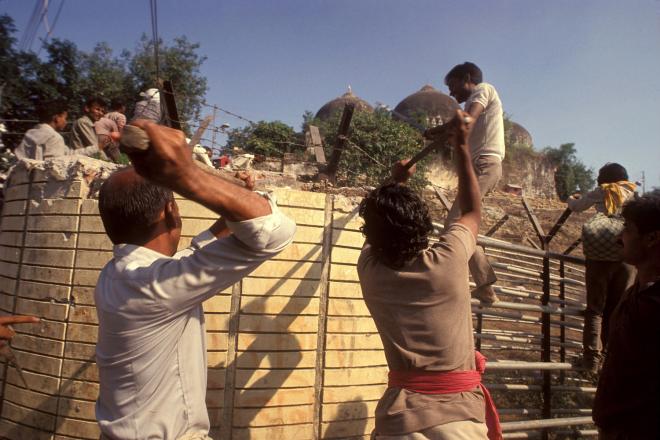
Image Courtesy: Pablo Bartholomew
 
Justice O. Chinnappa Reddy, Justice D. A. Desai, Justice D. S. Tewatia (Panel)

The political programme and deliberate escalation of the dispute while breaking the law and defying Court directives received momentum when the Babri masjid was unlocked on February 1,1986. In November 1985 the VHP had demanded the restoration of the "Ramjanmabhoomi” and threatened a national agitation if their demands were not met.

 
Further Excerpts from the Report:
The entire Report of the Citizens Tribunal Report is available at  https://sabrangindia.in/reports/1994-citizens-tribunal-ayodhya
 
The Build Up to the Demolition
 
Escalation
 
The second major change took place when the Babri Masjid was unlocked on February 1, 1986, a full 36 years after it had remained locked. At this time also the Congress party was in power both in UP and at the Centre. Senior functionaries of the government interviewed by the Commission have suggested that the government was instrumental in facilitating the unlocking of the Masjid. Two days after the unlocking of the Masjid some Muslim leaders from outside Ayodhya formed the Babri Masjid Action Committee (BMAC) and Maulana Muzaffar Hussain Kichhochhavi became its president A competitive militancy of words and action pushed the dispute at almost the top of the communal mobilisation agenda. The VHP launched a temple construction campaign to expand its mass appeal. The mahants of Ayodhya remained divided on the issue and remain so till now. The residents of Ayodhya were not a keen party in it till then. The issue was assuming the form of a movement and the Babri Masjid-Ram temple dispute was introduced on the national agenda both for Hindus and Muslims.
 
Following the unlocking of the Masjid and the establishment of the Babri Masjid Action Committee, the frequency and intensity of protests by a section of the Muslim community increased, particularly in U.P. In a particularly unfortunate incident, 16 Muslims were killed in police firing in Barabanki during a court-arrest programme in April 1986. The protests continued and the dispute escalated and moved to Delhi. Then the Babri Masjid Coordination Committee (BMCC) was formed, with Syed Shahbuddin as convener, in December 1986.
 
In early 1987, protests were held in Ayodhya, and a rally organised by some Muslim leaders in Delhi protested the unlocking of the Babri Masjid, and demanded their right to pray there. At the same time the VHP organised rath yatras and expanded their campaign over large parts of the country. This resulted in communal violence in many locations. The VHP organised a virat Hindu sammelan in Ayodhya to demand restoration of the Ramjanambhoomi in April 1987. The atmosphere was successfully communalised in Ayodhya and the issue of Babri Masjid Ramjanambhoomi taken beyond the confines of U.P. and made more complex. In the midst of this, the legal issues were complicated further when the U.P. government filed an application in December 1987, to have all the cases connected with the Babri Masjid transferred from the District Court in Faizabad to the Lucknow bench of the High Court.
 
The tempo of communal mobilisation was then accelerated. The sense of denial among the Muslims was also aggravated by the postures of some of their self-appointed leaders. The `Sangh Parivar' also launched a Shila Pujan programme all over the country which resulted in communal violence in many parts of the country. In July 1989 the Lucknow bench of the High Court transferred all suits for trial by a three judge bench. In all these years no judgement was given on any of the disputes and the problem was allowed to expand and become more complex. In October 1989 hearings started in the Supreme Court on a suit filed by the Sunni Waqf Board.
 
Then in November 1989, the Central government allowed shilanyas of the Ram temple to be performed on the disputed site in Ayodhya. Rajiv Gandhi, as Prime Minister, also launched his election campaign from Faizabad and gave a speech promising to usher in Ram Rajya. In spite of all these religious appeals, the Congress party failed to come to power both at the Centre and in U.P. The Janata Dal formed a government on its own in U.P., and at the Centre with support of the BJP from outside. The support of the BJP was crucial for the survival of the Janata Dal government at the centre.
 
The Ramjanambhoomi issue moved centre stage in the political battle for power and was pushed up to a feverish pitch by L.K. Advani, after the policy for job reservations for backward classes was announced by V.P. Singh. L.K. Advani launched a rath yatra across the country, to end at Ayodhya where kar seva was to take place to build a Ram Mandir in place of Babri Masjid.
 
All efforts at coming to an understanding between the leaders of the Sangh Parivar' and Muslim leaders were unsuccessful, both sides being unyielding. Finally, L.K. Advani had to be arrested in Bihar. But the Sangh Parivar' was successful in collecting a large number of supporters in Ayodhya in spite of the best efforts of the U.P. administration to prevent them from doing so. The government had to use force to clear the Babri Masjid area and some kar sevaks were killed and injured. The `Sangh Parivar' appeared to have made gains from this event.
 
This resulted in the BJP withdrawing support from the Janata Dal government at the centre and the V.P. Singh government lost the vote of confidence in Parliament. Internal divisions between the Janata Dal and electoral game plans of the Congress party were partly responsible for this. The government of Mr. Chandrasekhar at the centre took a constructive initiative to initiate a dialogue between the principal organisations involved in Ayodhya dispute, on an all India basis, in order to arrive at negotiated solution. The Union Home Minister became the broker. However, elections were called in June 1991 for the Lok Sabha, and also the UP (Uttar Pradesh)Assembly. The BJP gained heavily and formed a government in 11 The Congress party assumed the reins of government at the centre.
 
The above summary of events concerning the Babri Masjid shows that the issue has been inextricably enmeshed with power politics for a long time. It is not surprising, then, that matters were getting increasingly complicated, instead of being resolved. Even issues regarding ownership of land and the facts regarding history of the area in general, and the mosque in particular, were not clarified in all this time. Most politicians refused to take a clear and logical stand on the issue. This made it easier for the Sangh Parivar' to exploit the problem and change an almost non-existent issue into one of "national" pride and importance.
 
When the Congress party came back to power at the Centre, along with a BJP government in Uttar Pradesh in 1991, the power equations changed. Two political factors stood out: the ruling party at the Centre did not have a numerical majority and the BJP government in UP had made the building of Ram temple in Ayodhya an electoral pledge. This made the issue of Babri Masjid and Ram temple critical in national politics. In the judgement of the Commission, the juxtaposition of a politically weak central government, an aggressive and determined Sangh Parivar' and a duplicitous BJP government in UP, ended up deciding the course of events leading to the destruction of the Babri Masjid in Ayodhya on
December 6, 1992.
 
This was still not too late to start an educational and political campaign around the country to convince the citizens about the dangers of communal politics. This was not done. No political or educational campaigns were launched to counter the aggressive BJP communal propaganda or to put non-disputable facts regarding the issue before the public. As a result the Sangh Parivar' was left free to spread half-truths and even blatant lies in an ideological vacuum. One glaring example of this kind of propaganda was the often repeated assertion by `Sangh Parivar' leaders that a large number of temples had been destroyed in Kashmir. This would have been easy to counter for the Central Government by providing facts and taking a special group of journalists to Kashmir to see for themselves. Even this was not done and the lie became "truth" by repetition.
 
The governments at Lucknow and Delhi and the parties backing them had their own compulsions to provide further credibility to the `Sangh Parivar' as well as AIBMAC or BMCC. The decision to start another edition of kar seva from December 6, 1992 was taken in this background. The VHP's commitment to negotiation was meaningless.
 
 
Decision on Kar Seva irreversible
 
The Central government continued its efforts to have the kar seva postponed but showed extreme reluctance to take any concrete action. The Prime Minister expressed the view, in a statement on November 15, 1992, at Allahabad, that he failed to understand the mystery (mayajal) behind the resumption of kar seva at the construction site in Ayodhya. However, Kalyan Singh had already urged the Prime Minister on 2 November to work on a war footing to resolve the dispute within the extended time. "All-out efforts should be made" stated the Chief Minister, "to persuade the Muslims to give up their claim over the disputed shrine to help facilitate construction of the Ram temple in Ayodhya". The BJP Party President, M.M. Joshi, stated "The party would be prepared to pay any price for the construction (of Ram Mandir)". On November 5, L.K. Advani, leader of the Opposition in Lok Sabha, demanded in Calcutta that the Centre should allow immediate resumption of kar seva on 2.77 acres of land. VHP General Secretary Singhal was more strident. He demanded, at about the same time, that the Prime Minister should recognise the contradiction in his statements to "protect the mosque" and "construct the temple," and modify them accordingly.
 
The Muslim leaders involved were getting apprehensive. Gilani reasserted on November 1, 1992 that the idols inside the mosque should he removed and the opinion of the Supreme Court on the shrine should he binding on the parties. On November 2, Sultan Owaisi of the All India Babri Masjid Action Committee urged the Centre to protect the Babri Masjid in view of the kar seva already announced. The apprehension amongst the minorities all along was that assault on the structure was a certainty and its outcome predictable. They were pinning their hopes on the central government, in view of the ground situation in Ayodhya after he IIJP took over the administration in U.P.
 
By November 16, the VHP was stating that the assertions of the Prime Minister, that government would not allow kar seva, was an affront to the religious leaders. The BJP was still continuing with its proposal that kar seva on 2.77 acres of acquired land, in dispute in the local High Court, should be delinked from the safety of the structure and the Centre should facilitate the former. It was at this stage that the Union Home Minister initiated the proposal for adjudication under Article 138 (2) of the Constitution by the Supreme Court. Both the U.P. Government and the BJP secured a written offer, and then the BJP rejected it within an hour of its receipt. In any case L.K. Advani is reported to have rejected the proposal of one point reference to the Supreme Court and wanted it to be delinked from the planned kar seva. This written offer does not form part of the Union Government's White Paper. The VHP-Bajrang Dal-RSS did not, at any time, indicate that the kar seva plans were negotiable.
 
It was under these circumstances that a meeting of the National Integration Council was called for on November 23, 1992. Simultaneously, the Supreme Court asked the Union government to "spell out its stand on the proposed VHP kar seva", as also its response to its appointment as a receiver. The BJP president, M.M. Joshi criticised the involvement of the Supreme Court in the dispute over kar seva. The BJP, followed by the U.P. government decided to boycott the NIC meeting. The planned dialogue between AIBMAC-VHP was also made meaningless by 'the sangh parivar' calling for kar seva. The NIC was denied the opportunity to openly debate with the BJP. The BJP-RSS-VHP obviously had closed their options and were no longer interested in the process of a democratic dialogue.
 
The Prime Minister stated before the NIC on November 23, 1992: "The issues on which there are differences of opinion are the plan of construction, the safety of the existing structure, and the compliance of the court order on the subject." The NIC gave a free hand to the Prime Minister to deal with the Ayodhya crisis.
 
There was no question by now that the planned kar seva could be deferred or stopped through consensus. The Sangh Parivar was obviously in the hands of its field commander, Vinay Katiyar, who had asserted in an interview in April 1992, "Might is the only law I understand. Nothing else matters to me".
 
The Entire Report is available at
https://sabrangindia.in/reports/1994-citizens-tribunal-ayodhya
 
 (The report of the Citizens Tribunal was published in May 1994; the Amici Curiae were : K. G. Kannabiran, A. G. Noorani, Lotika Sarkar; the Secretariat Members were : Anuradha Chenoy, Achin Vanaik, E. Deenadayalan, Gautam Navlakha, Raju Damle, Sumanto Bannerjee, Tapan Bose)
 

Then and Now, a brazen violation of the Rule of Law

0


Image Courtesy: Pablo Bartholomew
 
We bring to you excerpts of a Citizens Tribunal report on the Demolition. The Tribunal sat soon after the Demolition and made public its report in 1994. It tells the gory and sinister tale of how the Court orders were consistently defied, of how the Supreme Court Orders were especially violated,  how the misgivings expressed by then then Attorney General of India –on the ground level situation in Ayodhya–  were brushed aside; and finally how a crime was committed, breaking Indian law and defying the Indian Constitution, in full public view on December 6, 1992.
 
The entire Report of the Citizens Tribunal Report is available at
https://sabrangindia.in/reports/1994-citizens-tribunal-ayodhya
 
Excerpts:
 
Key Observations in the Report (The following facts stand out):
 

■   Both Central and State Intelligence reports (IB) warned the Union and State administrations of the possibility of destruction of the Babri Masjid well in advance.
■   The BJP leaders' formal statements for the purposes of the Court and public speeches were at variance.
■   `Sangh parivar' leaders' speeches in Ayodhya exhorted the kar sevaks to make the "ultimate sacrifice" for constructing the Ram Mandir at the Babri Masjid site on  December 6 (1992).
■   It was widely known among the kar sevaks in Ayodhya, and reported by the U.P. police to the state administration, that the central forces in Ayodhya would not use firearms on December 6, 1992.
■   Kalyan Singh had announced that the U.P. police would not use force against the kar sevaks on December 6, 1992.
■   Local residents and the police knew that kar sevaks were collecting implements which could be used to destroy the Babri Masjid.
■   Some journalists and local residents are reported to have witnessed the rehearsals for destruction of the Babri Masjid.
■   The U.P. police warned their superiors in advance that the kar sevaks were planning to destroy all Masjids and Muslim homes in Ayodhya.
■   A very large number of kar sevaks were allowed to collect in Ayodhya and the Union government reportedly helped in this process by providing special trains.
■   Kar sevaks were considered special guests by the administration, and official machinery was used to make their life comfortable in Ayodhya.
■   Ample warning of the kar sevaks' mood was given more than five days in advance, when they started destroying and damaging mazars, mosques and Muslim homes.

 
How the BJP and Its Allies in the Parivar broke the Law
 
The Form of the Kar Seva
 
By late November (1992) the political authorities had started showing symptoms of failure and the Courts seemed to provide an escape route. There were pending contempt cases for violation of Court orders during the July 1992 kar seva. The Supreme Court, therefore, asked the UP government on November 24, 1992 to specify steps on the compliance of orders, namely, prohibiting "any construction" and "any permanent construction" on 2.77 acres of land. The Prime Minister is reported to have picked on this straw immediately on November 26, 1992, when he told the Congress parliamentary party, "No one can do kar seva now to build a temple on the proposed plot in Ayodhya since there is a stay order in force".[1] He reportedly termed the planned kar seva 'illegal' and declared the government's commitment to implement the Supreme Court orders and to uphold the Constitution. The UP government refused, in a discussion in the state legislature, to be pinned down regarding the form of the kar seva.
 
The U.P. Counsel in the Supreme Court, K.K. Venugopal, assured the court that the State government would not allow the ground situation in Ayodhya to build up to a situation which resulted in violation of court orders. However, to a suggestion by the Attorney General[2] that extensive preparations were going on for kar seva, the court announced: "Preparation is not an offence. Only on our fullest satisfaction before us that state government has failed in its duty will we pass any orders". The VHP-BJP leaders showed apparent reasonableness in stating that kar seva would not involve any violation of court orders. On  November 28, 1992, recitations from the Gita were started on the disputed site even before the court passed its final orders on kar seva. The Court asked the UP government to file an affidavit after consultation with the VHP and to provide further guarantees that construction materials and machinery would not be kept near the disputed site. The submission of the Attorney General on the ground realities cited in the affidavit on kar seva and the deteriorating situation was brushed aside. So, on November 29, 1992, the Supreme Court finally passed its order on the carrying out of 'symbolic kar seva' and provided for its own observer to monitor the situation in Ayodhya and report on the same. The separation of the Judiciary and Executive moved a stage further. A division, in the appreciation of the ground realities, between the local administration and the judicial observer was created.
 
The `sangh parivar' had succeeded in neutralising any benefit that the Union government could have claimed from the orders of the court. The VHP took the UP government assurances as a tactical move. The Bajrang Dal Chief was more emphatic: "Supreme Court ruling can apply to an individual but not to an entire society." He stated on November 29 itself that kar seva was not just bhajans but temple construction also. L.K. Advani and M.M. Joshi were to take part in the planned kar seva. A BJP press release on the same day described the movement of building a temple at Ayodhya as "not the culmination but the commencement of national reassertion" and the proposed presence of these national leaders as "symbols of the party's commitment to national reassertion". In Ayodhya, Mahant Nritya Gopal Das stated that "a section of the Janambhoomi movement is so committed to the Hindu cause that if they decide to take matters into their own hands even the saints would be powerless to stop them". He also stated that a section of the Bajrang Dal could not be controlled. A half-way court order was, thus, foredoomed to fail in its objective. In any case, there were too many organisations involved and all of them were not party to the undertaking before the court directly or indirectly.
 
The confusion regarding the contents of the kar seva continued until December  6, 1992. Thus, the main task of mobilising the kar sevaks could be carried out without any problem. L.K. Advani is reported to have launched his march to Ayodhya from Varanasi with the announcement that kar seva would not be limited to `bhajans and kirtans'. By the time he reached Ayodhya, he was reported to have said firmly: "We will really construct the temple and not confine ourselves to symbolic kar seva of bhajans and kirtans." M.M. Joshi was more forthcoming. He asserted that the "Court can define and interpret the constitution and the laws but not the nature and the format of the kar seva", and that during the kar seva "everything, right from puja to construction can be done". The sadhus-sants on December 5, 1992 told the huge gathering of kar sevaks that kar seva would begin at 12.15 pm on the next day, there would be no construction on the 2.77 acres of disputed land, and that they should follow the instructions of the sadhus in regard to modalities of kar seva. The VHP General Secretary is reported to have stated, "The construction will be carried out but at its own pace and in conjunction with the advice of experts, not on the court's instructions".
 
The kar sevaks were given a clear message that the Court order was not sacrosanct. There need not be any construction on 2.77 acres of disputed land but elsewhere. It was not necessary to have construction material and equipment at or near the site; transportation from places of storage nearby would not be a problem. The court observer's report was confined to the area of dispute and activities there, and therefore monitoring would not interfere with any of the arrangements planned. In any case, the Court had already ruled that preparation alone was no offence.
 
The Fate of the Structure
 
The failure to restore status-quo-ante in the Babri Masjid structure had made any development possible. The Puri Sankaracharya was not the only one who demanded that it should be demolished. This was implicit in the repeated efforts of Chief Minister, Kalyan Singh, to persuade Muslims to agree to relocate the mosque outside the boundaries defined by the VHP. By November 20, Vinay Katiyar announced that there was, "no guarantee for the safety of the existing structure". While RSS Joint Secretary, Rajendra Singh, promised that the masjid would not be damaged, General Secretary H.V. Seshadri announced that "pre-construction work" involving levelling of land, cleaning and watering outside the disputed area would be carried out. L.K. Advani is reported to have said in Varanasi: "We do not want to destroy any Masjid and make a Mandir. There was never a Masjid at Ramjanambhoomi Site". Simultaneously, M. M Joshi was noting unambiguously that the proposed construction of Ram temple was impossible without demolishing the Babri Masjid.
 
The implications of such stances on the local situation in Ayodhya were to create a real risk to the old structure. The Home Ministry was is aware of this risk, as is abundantly clear from the guarded language of the letter to the Chief Minister of U.P. on December 5, 1992 which was also leaked to the press. He went to the extent of stating: "The possibility of some mischievous elements using explosives to damage the Ramjanambhoomi-Babri Masjid structure cannot be ruled out". The local police were apprehending construction at the site of the Babri Masjid from November 28, 1992 onwards. On December 2, it was noted that Shiv Sainiks along with others could be expected to destroy the disputed structure. On December 3, 1992 one Manas Maharathi Tyagi is reported to have told the kar sevaks that the disputed structure should be destroyed with a blow (jhatka). In the public meeting on December 5, resentment was expressed calling the place of rest of "Ram Lalla" a Masjid, with the assertion that this would be tolerated no longer. Slogans calling for demolition of the Masjid were heard in the night of December 5-6, 1992.
 
The fate of the Babri Masjid was sealed. Demolition was not off the agenda. Construction was on the agenda and it was to be on land covered by the Supreme Court judgement. Clearing, levelling, and watering had been planned. Engineering advice required had been arranged. Kar sevaks in large members were present not to do 'physical labour', but to immobilise the police and the administration, central as well as State. This was the scenario for the collapse of state authority on the eve of kar seva of December 6, 1992.
 
Central Intervention in Uttar Pradesh
 
Central government intervention would have had the potential of reducing the risks inherent in the developing situation at a number of stages. The sangh parivar' was aware of it and it took all steps to ensure that its government in UP remained in position. That was the insurance for total collaboration from the administration. That was the necessary condition for the larger mobilisation of kar sevaks.
 
The Centre could have intervened to give directives under Article 256 and 257 (1) of the Constitution for the misuse of the Land Acquisition Act in a way that heightened the communal divide, but this was not done. The Court orders were violated in July 1992, but there was no intervention as provided for under the Constitution when the State Government had failed to carry out its legal obligations. There was wholesale violation of laws, in demolishing religious structures, in terrorising mahants, in levelling land, but the administrative machinery remained collusive or, at the Union level, inactive.
 
The BJP and its allied organisations blew hot and cold to ensure that Central intervention was averted under all circumstances. As early as November 6, 1992 Chief Minister Kalyan Singh stated, "If the centre forcibly tries to confront my Government over the Mandir issue, it should be ready to face the consequences. I am not bothered about confrontation. I am ready to face it". On November 20, 1992,  Vinay Katiyar indicated that their plan was based on the assumption that the Centre would sack the U.P. government before the start of kar seva onDecember 6. By  November 22, when the BJP combine declared the boycott of the NIC, the VHP General Secretary claimed that the Centre was considering dismissal, and another functionary speculated that the UP government would be dismissed by 26 November. The Janata Dal and Left Front joined the issue on 23 November. "I see no other alternative but to dismiss the state government", said Jyoti Basu, "if it violates the Constitution and the court order". V.P. Singh added: "If necessary the Kalyan Singh government has to be dismissed". There was no response from the Union Government.
 
L.K. Advani threatened on  November 27, 1992 that his party would bring proceedings in both Houses of Parliament to a halt if the U.P. government was dismissed prior to the resumption of kar seva. The Attorney General had cited an IB report to the Supreme Court judges on November 27, to prove that the facts given by the U.P. government in their affidavit were incorrect. The Centre had, therefore, a duty to intervene as provided for in Article 355 of the Constitution. The Centre showed an extraordinary reluctance to intervene. The call for a "Challenge Day" (Lalkar Diwas) fromNovember 29, 1992 was another opportunity for intervention under Article 355. On December 4, the Home Minister was still stating in the Lok Sabha that the matter was at a delicate stage and he should be left to deal with it appropriately, stating "I do not know why such doubts are being raised. Government has no reason to disbelieve U.P. C.M who said he would protect the mosque."
 
The proceedings in the Supreme Court on November 26, when intervention by the Union Government was sought by some parties, brought the following observations from the Court: "What prevents the central government from taking such action as advised, taking into account the gravity of the situation. Why a Court Order?" Since the Union government failed to act on the basis of information at its command, L.K. Advani announced on December 3, that the BJP government would, under no circumstances, use force to prevent the kar seva from taking place. The BJP had succeeded in keeping its government in U.P. in position, to fully facilitate the implementation of the plans of the Sangh Parivar.
 
 (The report of the Citizens Tribunal was published in May 1994; the Amici Curiae were : K. G. Kannabiran, A. G. Noorani, Lotika Sarkar; the Secretariat Members were : Anuradha Chenoy, Achin Vanaik, E. Deenadayalan, Gautam Navlakha, Raju Damle, Sumanto Bannerjee, Tapan Bose)



[1] Narasimha Rao was the prime minister of the government controlled by the Congress party at the time
[2] Milon K. Banerji was Attorney General of India at the time

Stop Killing Us: the Bhim Yatra of India’s Manual Scavengers tells the Indian government

0


No Justice Delivery, India’s forgotten Safai Karmacharis have started a protest yatra that is traversing 500 districts in 30 states

 
Does a Supreme Court judgement ensure that the fundamental rights of Indians who die while cleaning for a living will be protected? No say India’s Manual Scavengers who die in filth, cleaning our dirt, despite a judgement passed to ensure that a law enacted in 1991 (and revised and re-enacted in 2013) is actually implemented. Over 1327 persons lost their lives in the year since the Supreme Court judgement and less than three per cent received any compensation.
 
On March 27, 2014, the Supreme Court passed a judgement —  twelve years after a public interest litigation (PIL) was filed by the Safai Karmachari Andolan— and issued specific directions to prevent and control this illegal practice as also to prosecute the offenders. The Judgement can be read here.

Despite the judgement of the Supreme Court that directs that such deaths in sewer holes and septic tanks should be stopped immediately,19 months after the judgement, deaths have continued to occur, with impunity, in sewer holes across the country.  The Safai Karamchari Andolan has reported 1327 sewer and septic tank deaths in the period since the judgement was passed in March 2014. Less than three percent have received compensation.
 
In December this year, faced with this reality, India’s safai karmacharis have been forced to resort to the streets to protest. A country wide yatra, the Bhim Yatra is a journey of pain and anguish, to tell the country and the government to ‘STOP KILLING US (the manual scavengers)’ in dry latrines, sewers and septic tanks. The Bhim Yatra will criss-cross across the country for 125 days passing through 500 districts in 30 states. It began its journey on International Human Rights day from Delhi on December 10, 2015 and will end back in the capital, on April 13, 2016. This is the eve of the 125th birth centenary of Dr. B.R. Ambedkar (April 14, 2016). 

Days after the Yatra began, tragic deaths of such workers, all migrants to Bengaluru, were reported. All three had died after descending into a sewage treatment plant in a residential apartment complex in Bengaluru’s Electronic City area. Ranjan (32) was from Odisha, Jagadish Kumar (28) from KR Nagar in Mysuru, and Mahesh (30) from Nepal (December 16, 2015). On October 25, 2013, two workers from Bihar died in the Peenya industrial area in Bengalaru.[1] Tamil Nadu reported 150 deaths due to this practice [2]. The Madras High Court is now reportedly monitoring the implementation of manual scavenging laws in the state. "In our view, it is necessary to take expeditious steps to implement the provisions of the Prohibition of Employment as Manual Scavengers & Their Rehabilitation Act, 2013, coupled with the directions of the Supreme Court in letter and spirit promptly," the Court has said on a petition filed PIL filed by Change India director A Narayanan in June 2015.

According to the report in Indiaspend.org, “While the (railway) ministry denies employing manual scavengers officially, the affidavits it has submitted in the court in the past nine years suggest that barring a few trains, the railways does not employ any technology to keep its 80,000 toilets and 115,000 kilometres of tracks clean,” according to Down To Earth magazine.
 
On November 18, 2015, Indiaspend.org reported how the state in India was the biggest offender. The report said that “Maharashtra has more than 63,000 households dependent on manual scavenging, followed by Madhya Pradesh, Uttar Pradesh, Tripura and Karnataka, according to a question answered by Minister of State for Social Justice and Empowerment Vijay Sampla in the Lok Sabha.” [3]  In September 2015, the Delhi High court ordered a survey in the capital to determine the extent of manual scavenging. The Ministry of Railways told the court that manual scavenging cannot be completely eradicated until stations get washable aprons and sealed toilet systems. According to the report in Indiaspend.org, “While the (railway) ministry denies employing manual scavengers officially, the affidavits it has submitted in the court in the past nine years suggest that barring a few trains, the railways does not employ any technology to keep its 80,000 toilets and 115,000 kilometres of tracks clean,” according to Down To Earth magazine.
 
Hence the Bhim Yatra
 
Since 1982, there has been a strong movement against this violence and discrimination. The movement was a demand for the demolition of the dry latrines that are the visible structures of an inhuman caste system and its link with this de-humanising occupation.
 
In 1993 the Indian Parliament passed the “The Employment of Manual Scavengers and Construction of Dry Latrines (prohibition) Act 1993, with imprisonment for up to one year and/or a fine of Rs 2,000. This law has never been effectively implemented and no convictions have taken place under this law during the first 20 years it was in force. The government has given many false assurances but not in any way worked actively to stop this practice.
 
It was the Safai karmachari Andolan that consistently exposed the hypocrisy of the government surveys and schemes. In year 2000 when the government counted only 679,000 manual scavengers, the movement came out with documented figures of 1.3 million, that too from a survey randomly conducted in states and districts. There is a long list of dates when India’s Prime Minister (s) and chief ministers (of various states) have made token statements of setting deadlines to end this illegal and de-humansing practice : 1995, then 2000, then 2003, then 2005, then 2010, and then 2012. But, nothing has changed.
 
Finally, in 2003, the Safar Karmachari Andolan filed the Public Interest Litigation in the Supreme Court. There was an ironic pattern to the government responses before the Court. First, a total denial of existence of manual scavenging, next a partial admission when the petitioners produced photographic evidence and finally, faking a compliance by dubiously destroying (dry latrines) only in those places, presented by the petitioners in their evidence in Court. 

It was in 2007, with the solidarity and support of many citizens groups and public leaders, that the Andolan launched the Action 2010 campaign to end manual scavenging by December 2010. Still, nothing moved. So the Andolan started out on the historical bus yatra in October 2010. This Samajik Parivartan Yatra which was the first of its kind, and journeyed through the entire country. Many Women and men were able to come free from this practice of manual scavenging. The women in the yatra had taken to the stage and their powerful speeches had shaken the conscience of the country, somewhat.
 
Then there were a series of more protests and actions. The demands included the implementation of the 1993 Act and a rehabilitation package. The National Advisory Council (NAC) of the last government passed a resolution on 23 October 2010, vowing to end manual scavenging by March 31, 2012.  Following further mobilisations with the central government, the Ministry of Social justice and Empowerment convened the national consultation on January 24-25, 2011 which resulted in the setting up of four task forces – to review the act, conduct a national survey, revise the rehabilitation package and sanitation solutions. The President of India in her speech to the Parliament at the start of the budget session, in March 2012 announced the draft for a new bill for prohibition of manual scavenging. The Government of India finally passed the new ‘Prohibition of Employment as Manual Scavengers and their Rehabilitation Act 2013’ in September 2013 and issued Government notification in December 2013.
 
It was after 12 long years, the Supreme Court passed the Judgment order on March 27, 2014 on the writ petition (civil) no. 583 of 2003, Safai Karamchari Andolan & Ors Versus Union of India & Ors., directing all the State Governments and the Union Territories to

  1. fully implement and take appropriate action for non-implementation as well as violation of the provisions contained in the 2013 Act,
  2. to prevent deaths in sewer holes and septic tanks and make the manual cleaning of sewers and septic tanks a crime even in emergency situations and
  3. to give compensation of Rs.10 lakhs to families of all persons who have died in manholes and septic tanks since 1993. 

 
The government has been negligent in implementing the Prohibition of Employment of Manual Scavengers and their Rehabilitation Act 2013 and in following, and implementing, the Supreme Court order. It is the experience of the protesting groups that, when deaths do occur, FIRs (First Information Reports of the crime) are rarely ever filed. Only after heavy pressure and agitation, if FIRs are filed, deaths are recorded “due to negligence” and never under the Manual Scavenging Prohibition Act and SC/ST Prevention of Atrocities Act (which have severe punitive measures). This blatant violation of the law is sucking away at the lives of the safai karamcharis, who die in sewers and septic tanks. It is extremely disturbing that these deaths which are not decreasing, possibly increasing, are treated with such callousness by the government.
 
Indian Parliament held a discussion on the country’s "Commitment to the Constitution" to mark the 125 birth centenary of Dr. B.R. Ambedkar. To give real meaning to this celebration would be to protect the Constitutional rights of the Manual Scavengers. The Bhim Yatra, say the organisers, "is a journey to protest this intolerance, this violence and discrimination against this forgotten section of our society. It is a cry for the Constitutional and Fundamental rights of Manual Scavengers." The Bhim Yatra will simultaneously spread Ambedkar’s ideas of social justice, liberty, equality and fraternity while proclaiming his war cry ‘educate, organise and agitate’.


[1] Manual Scavenging: Pushing manual scavengers into death holes, when will Bengaluru learn? http://www.thenewsminute.com/article/pushing-manual-scavengers-death-holes-when-will-bengaluru-learn-36843
[3] Jobs Outlawed, But State Main Employer Of Manual Scavengers http://www.indiaspend.com/cover-story/jobs-outlawed-but-state-main-employer-of-manual-scavengers-47324
 

Black Out – The West Bengal Police prevent screening of a film, Jai Shree Ram

0


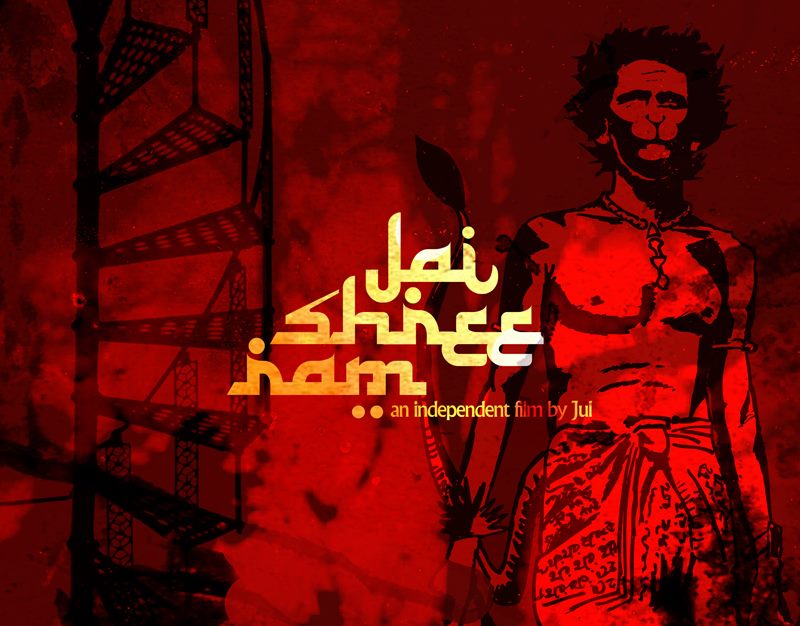
Echoes of the deep schisms caused by and around the demolition of the Babri Masjid on December 6, 1992, and the movement for building a temple in the name of Rama were felt on this December 6, 2015, 23 years later in West Bengal’s Behrampore. Jai Shree Ram, (Hail to Lord Ram) a film that was scheduled for a closed-door screening and at the hall that belongs to the Murshidabad People's Relief Committee was stopped as the police suddenly stepped in and prevented the event from going ahead.
 
A young film maker, Jul Mukherjee's 'Jai Shree Ram', is a full length feature film made over 24 months of hard work and individual contributions sourced through crowd funding. Why was this screening suddenly stopped by the West Bengal Police? The state’s chief minister, Mamta Banerjee has been quick to come out in support of Aamir Khan when he was targeted by rabid followers of Hindutvawaadi supremacist thought, recently.
 
There are four clips available on the film on You-Tube. Three are short trailers and the fourth is a fascinating discussion by the team behind the film titled, “Jai Shree Ram: Stories and Ideas behind the making of the film.”


One of the major protagonists for the film is a young Muslim, an atheist who is suddenly confronting an identity that is being thrust upon him “Are you a Bengali or a Muslim?” is a question that sums up the tragic-irony of the times. One of Jul’s team said he experienced every day what has been scripted in the film. The other major protagonist is a “Bahurupi Hanuman” who becomes a fundamentalist (read supremacist tool) of the masters behind the (Ramjanmabhoomi) movement.
 
Jul Mukherjee was 10-11 years old that Sunday in 1992, when the Babri Masjid was demolished. He recalls with chilling horror the conversations within his home, at Howrah, that had suddenly (following through the trajectory of the Ram Janmabhoomi movement)legitimised hatred against Indian Muslims.  Jul remembers being very scared that day, Sunday December 6. “Those B…they have arms,” he overheard his father telling his mother that afternoon, referring to a Muslim locality not far from where they lived.
 
The childhood of most urban Indians that day was shadowed by this discourse of othering and hatred. So the Rabindrasangeet sung by Ezaz Ahmed became for Jul, and his team, a rallying point even as Bengalis, fully showcasing that the Muslims (a significant percentage of West Bengal’s population) among them had always been wholehearted participants in the cherished Durga Pooja. Never mind that the amnesia generated by the Ramjanmabhoomi hysteria had Jul’s mother wondering how an Ezaz could sing this traditional Bengali song so well?
 
The team behind this innovative and courageous venture will go to the censor board for a certificate. The film maker feels that there are two scenes in the film that might have made the ruling party in Bengal uncomfortable with its screening. One is where the protagonist says he is the son of the Prophet. The other is a slaughter scene whom some have called gory.
 
Though made out mistakenly to be a documentary, Jai Shree Ram, is an independent full length feature film, shot over a period of two years with the financial help and contribution of innumerable persons. Post production took another year.
 
“Social” media trolls belonging to the Hindutvawaadi camp have been violently trashing the film and threatening its director and team. “We are a Hindu state” and such a film cannot be shown, is their claim.  
 
The creative team behind this venture however is committed to screening it all over the country. “If nothing else, “says Jul talking to us, “by just projecting it on a white wall, breaking all the code of "CINEMA".
 
The link of English subtitled trailers of the film are available on You-Tube:

First trailer
 

Second trailer 


Third trailer


Bibliography:
Bahurupi: The term Bahurupi is came from the Sanskrit Bahu means many and Rupa means form. Bahurupis in Bengal are a group of folk performers who enact and depict different characters.
Hanuman: Signifying devotion and humility to a superior God, this form of the Monkey God is worshipped and also seen as leading the ‘army’ of Lord Ram in some dominant versions of Hinduism
Sree Ram: One of the revered Hindu Gods; also one of the re-born forms of Lord Vishnu, the Hindu Triumverate and in recent times (over three decades) both the focal and rallying point of a highly militarised and supremacist Hinduism
Hindutvawaadi: Derivative from Hindutva, the doctrine of a Hindu theocratic state (those who believe in the Hindu theocratic state)
Rabindrsangeet: Tagore Songs, written and composed by Rabindrnath Tagore; these renderings have distinctive charecteristics in the music of Bengal and are popular in both India and Bangladesh