*The author is a highly respected Assamese intellectual, a literary critic and social-scientist from Assam. Views expressed are the author’s own.
Other pieces by Dr. Hiren Gohain:
Identity of the ‘Ordinary Indian’

*The author is a highly respected Assamese intellectual, a literary critic and social-scientist from Assam. Views expressed are the author’s own.
Other pieces by Dr. Hiren Gohain:
Identity of the ‘Ordinary Indian’
Image Courtesy:ndtv.com
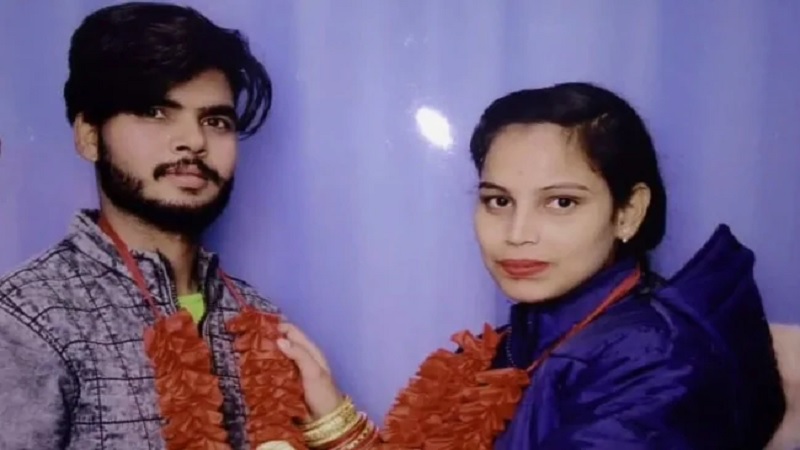
New Delhi Television has reported that one Neeraj was stabbed to death allegedly by his brothers-in-law who were against their sister’s inter-caste love marriage. This incident came to light from the city of Panipat’s busy market area on January 1. The couple had been married for mere one and a half months.
A CCTV camera footage that has been accessed by the media, shows the accused persons running from the crime scene. Though the police have filed an FIR in the matter, they are yet to arrest the accused who stabbed Neeraj at least a dozen times.
Neeraj’s elder brother Jagdeesh who is also the complainant, said that the accused had called his brother minutes before the attack and sought a meeting. He added that they had even called their sister saying “you will cry soon”.
He further accused the police for inaction and revealed that the accused had been threatening his brother, the victim for a long time and they had also sought police protection that much to their dismay was ignored.
Deputy Superintendent of Police Satish Kumar Vats said, “The woman and the man’s families had agreed to the marriage and this was given in writing at a village panchayat meeting. But the woman’s brothers did not approve, and had been threatening the couple.”
More updates awaited.
Related:
J’khand inter-caste couple allegedly threatened by family and Cabinet minister, HC provides protection
Allahabad HC reunites interfaith couple, provides police protection
Cannot intervene if adult marries as per choice and converts: Cal HC
Image Courtesy:deccanherald.com
The provincial Khyber Pakhtunkhwa government has announced that it will pay for reconstruction of Hindu temple destroyed by a mob. It has so far arrested 55 suspects too. The Indian government had also expressed its concerns on the targeting of a Hindu temple.
According to a report in The Telegraph, India’s Ministry of External Affairs had conveyed to Pakistan through its mission in New Delhi, that India “expects the federal government to investigate the matter and take strict action against those responsible for the demolition of the temple, pointing out that this is not the first time such an attack has taken place”. The report quoted MEA sources stating, “Our message reiterated that the government of Pakistan, in discharge of its responsibilities, is expected to look after the safety, security and well-being of its minority communities, including protection of their religious rights and cultural heritage.”
The Pakistan government seems to have acted fast, and damage control decisions have been put in action in the Khyber Pakhtunkhwa province. However, there seems to be no words of ‘assurance’ from the government, on repeated allegations of the persecution of tribals, Christians, Ahmedias, Shias in Pakistan. No words even on the allegations made in September that “around 171 Hindus in Pakistan’s Sindh province had been converted to Islam”. It was then reported by the Times Of India that men, women and children were inculcated into the Muslim faith at a a mass ceremony “held at madarsa Ahsan-ul-Taleem, Sanghar in Sindh province of Pakistan.” The news report quoted sources as confirming that all those who were converted to Islam allegedly by “various allurements”, were from Bhil community, one of the most vulnerable and marginalised among the minority communities of Pakistan. It is noteworthy that Bhils are a tribal community following animist traditions. In India they are considered Adivasis and designated as a Scheduled Tribe in many states.
Meanwhile, in Khyber Pakhtunkhwa, police have arrested 10 more people in overnight raids for their alleged involvement in the vandalisation of the Hindu temple by a mob led by members of a radical party in Khyber Pakhtunkhwa province, reported NDTV. The total number of accused arrested in the case has risen to 55, and over 350 people have been named in the FIR.
Pakistan’s Supreme Court took suo motu notice of the vandalism, and its Chief Justice directed a Minority Commission to visit the site and submit a report by January 4.
Pakistan Supreme Court takes suo motu notice of the burning of a Hindu temple in Khyber Pakhtunkhwa’s Karak.
Chief Justice have direction to One Man Minority Commission to visit the site and submit a report by January 4.#Pakistan pic.twitter.com/LI2bWogTBt
— Live Law (@LiveLawIndia) December 31, 2020
While Hindus make up for around two percent percent of the total population of Pakistan, the government is keen to showcase that it is deeply concerned to protect the minority community and will rebuild the destroyed temple using provincial government funds, stated multiple news reports.
The incident took place in Terri village in Khyber Pakhtunkhwa’s Karak district, on December 30. However, the leader of Jamiat Ulema-e-Islam (JUI-F), one of Pakistan’s largest Islamist parties, Amir Maulana Ataur Rahman had strongly condemned the incident and said his party had nothing to do with it. According to news reports the mob was allegedly protesting “the expansion work of the temple and demolished the newly constructed work alongside the old structure.” Pakistan’s federal Parliamentary Secretary for Human Rights Lal Chand Malhi had also strongly condemned the vandalisation of the temple by “some anti-social elements”, and said such anti-social elements were defaming Pakistan. Khyber Pakhtunkhwa’s Chief Minister Mahmood Khan termed the attack on the temple as “an unfortunate incident” and vowed that his government will protect places of worship.
Now the reconstruction will start as soon as possible with security provided at the site. According to a report in the New Indian Express, this temple was destroyed in similar circumstances in 1997 and then rebuilt. While no Hindus live in the area, devotees visit the temple and its shrine to pay homage to the Hindu saint Shri Paramhans, who died there before the 1947 partition of India, stated the report
When the attack on this Hindu temple happened, a couple of days ago, the bigoted right-wing ecosystem in India began using visuals of this, to serve its pro-CAA agenda in India. As always this added to the anti-Muslim sentiments the right wing continusly fuells. However when the Pakistan government announced the rebuilding the Hindutva groups probably see it as a ‘win’ for the community. The Hindutva agenda against Muslims will continue.
A question has also been raised by former diplomat KC Singh: “when mob destroys/damages mosques in India any nation asking questions violates Indian sovereignty. Can’t have it both ways.”
What kind of unilateralism is this? India questions mob’s destruction of temple in Pakistan. In fact Pakistani authorities promptly arrested culprits. But when mob destroys/damages mosque in India any nation asking questions violates Indian sovereignty. Can’t have it both ways.
— K. C. Singh (@ambkcsingh) January 2, 2021
Lawyer Prashant Bhushan compared how India was treating its own minorities.
Secular India? Where have we come? pic.twitter.com/plS6acckIV
— Prashant Bhushan (@pbhushan1) January 1, 2021
Human Rights’ activist, journalist John Dayal called out Pakistan’s move to rebuild one temple, saying the country continued to discriminate against its Hindus, Sikhs, and Dalit Christian citizens. He said, “Christians see their young women abducted and forcibly converted, churches desecrated and vandalised, lands grabbbed, their Muslim defenders persecuted and occasionally assassinated. That is your history of the freedom of religion you give us.”
As reported by SabrangIndia before, Hindus in Pakistan, are a vulnerable minority, often even ignored by the media, who fail to highlight crimes against the community. Even when reported, they do not come to the fore and catch people’s attention. Hindus comprise 2 percent (around 3 million people) of Pakistan’s population. In 2019, the All Pakistan Hindu Panchayat (APHP) launched a campaign to collect data to ascertain the number of Hindus in Pakistan. Hindus are mainly concentrated in Sindh province where they form nearly 8% of the population. Some Hindu families in Pakistan reportedly hid their religious identities due to safety concerns too.
Meanwhile, it is not known if Pakistan’s Sindh government has apologised to its Hindu community and offered to rebuild the Hindu temple that was vandalised, and the idol of the Goddess Durga desecrated in Nagarparkar area during Navratri, a few months ago.
Related
Mob vandalises, sets ablaze Hindu temple in Pakistan
Daniel Pearl Beheading: Pak court orders release of Omar Sheikh and aides
Khadim Husain Rizvi and the Weaponization of Barelvis in Pakistan

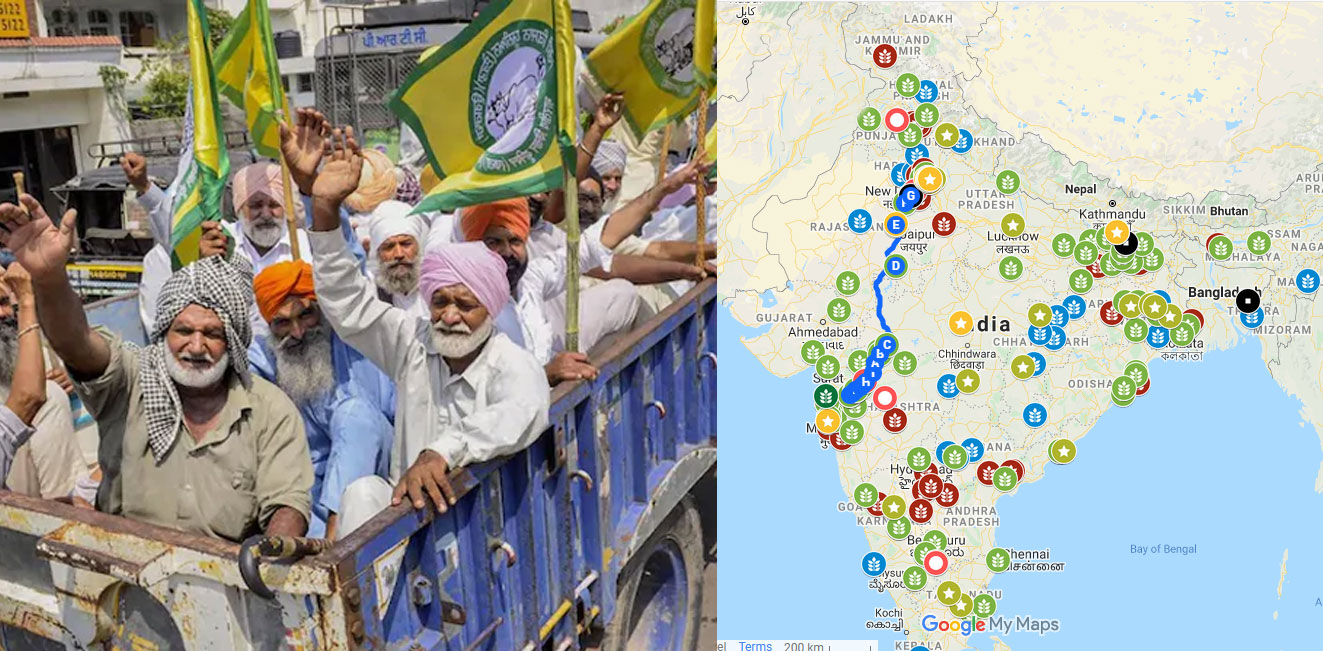
Over the last 22 days of 2020, farmers’ struggle jotted down 28 more protests on India’s map. These are just the bare facts as the final moments of the 2020 resistance included Vehicle Jathas, indefinite strikes and solidarity protests from the grassroot-level workers of India. In all, farmers have been protesting for 37 days at the borders of Delhi, the Indian capital while the countrywide protest has built up over months.
India’s farmers have lived up to the people’s history of this country by once again uniting peasants in a single movement against the oppressive policies of an authoritarian and majoritarian regime. Remember the three laws that farmers have been unitedly protesting were pushed through Parliament without debate with the primary stake-holders: the famers. From allegations of Khalistani intentions to political theories, to Maoist infiltration to the insult of being called the protest of a few, India’s Annadaatas (food growers) have persevered through it all.
On December 19, Sabrangindia brought you the first map. This updated Naqsha (Map) further breaks down this resolve of the Indian farmer, by further charting the movement’s activity into monthly phases of September protests (blue), November protests (red), December protests (green) and January 2021 protests (dark green) to portray the steady and upward growth of farmers’ unrest.
Separate categories of ‘Solidarity statements’ (star-marked), ‘Bharat Bandh (December 8, 2020)’ (circled), ‘Workers for Farmers’ (green star-marked) provide a unique view as to how non-agricultural elements of Indian society have pitched in for the farmers’ struggle.
Routes of widespread jathas have also been accordingly mapped.
Created by: Vallari Sanzgiri
Related:
https://sabrangindia.in/
Image Courtesy:darsgahcollege.org
The Azamgarh district administration has demolished a part of the 70-year-old Darsgah Islami School in Muslim-dominated Chaand Patti village on court orders. According to a news report in the India Tomorrow portal, this has created a near crisis for over 600 students, mostly girls.
According to the news report, even though the school is named as ‘Darsgah Islami’, it has a modern education syllabus and also imparts religious education. It is a co-educational institution till class five, and class six till class 10, it is an all-girls school. The demolished section of the school includes five classrooms, and a two-storeyed library. The library was named Maulana Abullais Islahi Library, after the former Ameer of the Jamaat-e-Islami Hind (JIH), stated the news report.
The demolition has left 12 classrooms ‘still intact’ but they too are reported to be rendered unfit for use now, as all of them have been badly damaged when the adjacent rooms and the library were demolished. The India Tomorrow portal stated that Maulana Azeem Falahi, who manages the Darsgarh, has said that the “school was launched from a hut in 1950 to fulfill the educational requirement-religious as well as modern-of the local children”. It eventually grew and moved into the pucca building, constructed of steel and concrete from donations, on a piece of land donated by the local villagers.
According to the news report, “during ‘chakbandi’ or land consolidation exercise in Uttar Pradesh in 1971, the school management requested the revenue department officials to allot some land for expansion of the school”. The officials made available about 3,000 square feet of land adjoining the Darsgah, however, mentioned it as a “sports ground” in their government records. At the time school management did not go into the allotment details and went ahead with the construction of additional buildings and also built a library on this portion of the land.
It was in 2016, when a man named Mohammed Ali, a resident of the village, who was living in Bhiwandi in Maharashtra, returned and reportedly joined the Bharatiya Janata Party. He then moved the Allahabad High Court, and sought the removal of the school building and the library that was constructed over the ‘sports ground’. The news portal reported that the HC then referred the matter to Sagari Tehsil, under whose jurisdiction the village is on, and the ‘tehsildar’ or the sub-divisional magistrate (SDM), however, gave the verdict in favour of the school.
However, Mohammed Ali challenged the SDM’s verdict in the court of Azamgarh district magistrate (DM) who in October 2019 decided against the school. Meanwhile, added to the news report, the local authorities avoided demolition of the school building. Mohammed Ali then moved the Allahabad High Court, seeking implementation of the DM’s verdict. The school management had also sought a stay on the DM’s order but the HC rejected it.
The school management held several meetings involving elders of the village who tried to convince Mohammed Ali to not insist on the demolition and withdraw his case. Even the local MLA Vandana Singh tried to intervene and the local religious leader, Maulana Falahi even offered to exchange the sports ground with an equal portion of his own land in the village. However, Mohammed Ali rejected the offer and stuck to his demand that the school building be demolished.
Fifteen days ago, Mohammed Ali secured a contempt of court order issued against the SDM for “dilly-dallying in removing ‘encroachment’ from the sports ground”. Then the SDM then got the portion of the school building demolished.
The news reported, added that even after that the teaching work has not stopped, and a few villagers have offered their houses to be converted into classrooms for now.
Related
UP Government transfers Hathras DM to Mirzapur
UP’s Love Jihad law completes one month, 35 incarcerated

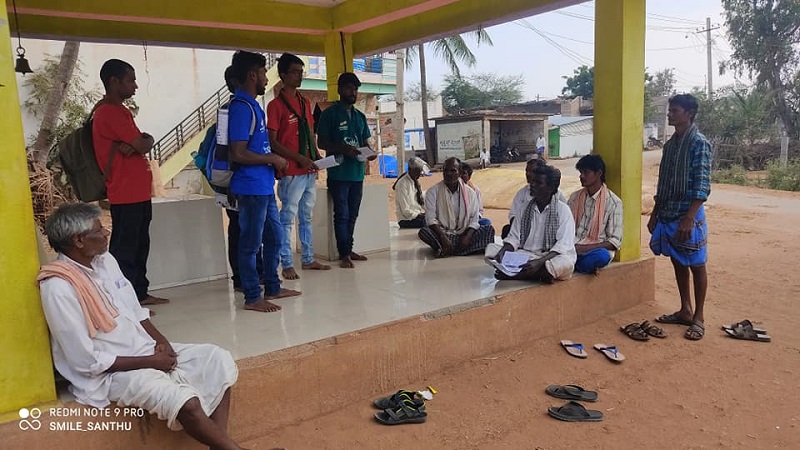
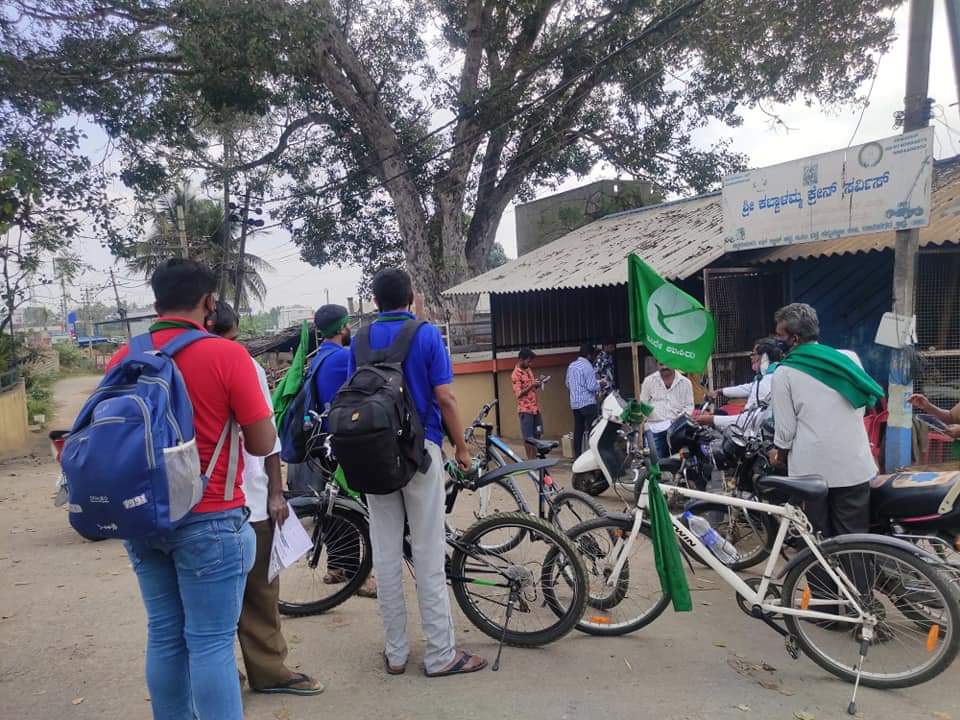
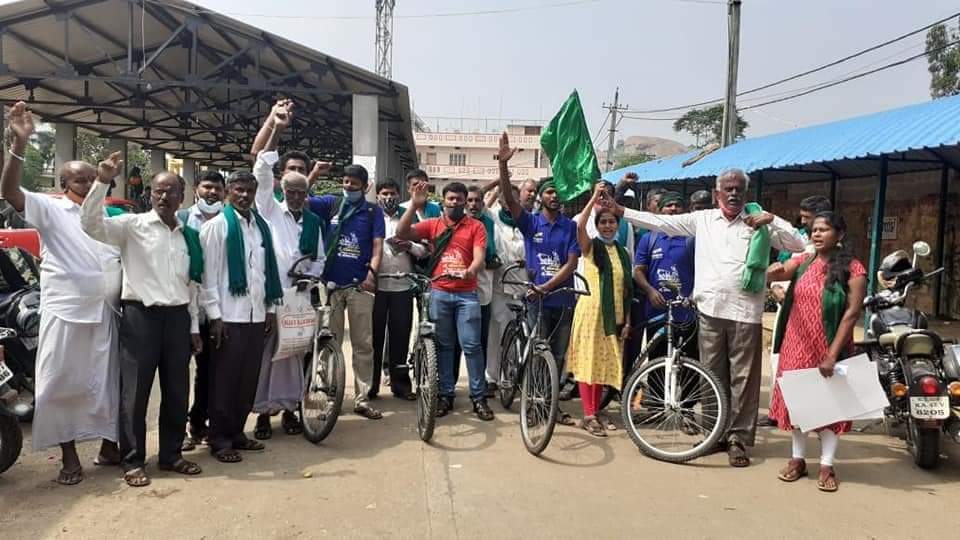
Youth organisations in Karnataka have begun a widespread campaign from January 1, 2021 to raise awareness in rural areas about the three farm laws forcibly passed by the central government.
According to Patriotic Youth Movement (PYM) – one of the three youth groups affiliated with the Joint Struggle of Farmers, Daliths and Workers coalition group – Bengaluru Convener Ravi, three groups of 10-15 people have taken up cycle jathas to reach out to villages in North Karnataka, Central Karnataka and South Karnataka. Each group visited at least threevillages to give districts on Friday.


Youth and student members will talk to villagers about the implications of the three laws – the Farmers (Empowerment and Protection) Agreement on Price Assurance & Farm Services Act, the Farmer’s Produce Trade and Commerce (Promotion and Facilitation) Act and the Essential Commodities (Amendment) Act – till January 8. Following this, members hope to mobilise a large number of farmers and youth to participate in the January 26 protests.
“The new farm laws will considerably lessen farmers’ income. This will in turn affect students and the youth who have to pay college fees. This is why we are focusing on the youth during these campaigns,” said Ravi.
While raising awareness, members also encourage locals to take up new years resolutions to: understand the farmers’ struggle; learn about the intentions of corporate companies engaging in agriculture; inform at least 10 people about the issue; voice farmers’ demands; boycott Reliance Jio Sims and other Reliance products.
The campaign started with a local protest at the APMC yard in Ramanagara city wherein 60 people from the district of the same name participated. Ravi said the groups received a favourable response although some people in Bharatiya Janata Party (BJP)-led areas had heated talks with group members. Nonetheless, many people expressed interest in joining the struggle after listening to the group’s explanation.
When asked about the sudden rise in interest as opposed to the past lukewarm response, Ravi said, “Karnataka farmers were busy making the most of the harvesting season up until now. That is why, although we have had three major movements in the state, farmers haven’t participated on a large scale.”
He hoped that the campaign would garner enough people to block major roads in the city on Republic Day. However, he confirmed that the purpose of the campaign was to raise awareness regarding the three farm laws.
On January 3, the Joint Struggle of Farmers, Daliths and Workers coalition group, will have a meeting with all workers, farmers, Dalits, women and other minority organisations to discuss the future plan of action in the state.
Related:
Youth campaign in Bengaluru on Jan 1
Exclusive: G. T. Ramaswamy dismantles government’s claims about South Indian farmers
Centre blinks, agrees to two of the four farmers’ agenda points
Peasants in southern states continue farmers’ agitation
Peasant supporters call for creation of Save Farmers, Save Nation committees
Are the new farm laws constitutional?
Kranti ka Naqsha, Mapping the Revolution
Image Courtesy:indiatoday.in
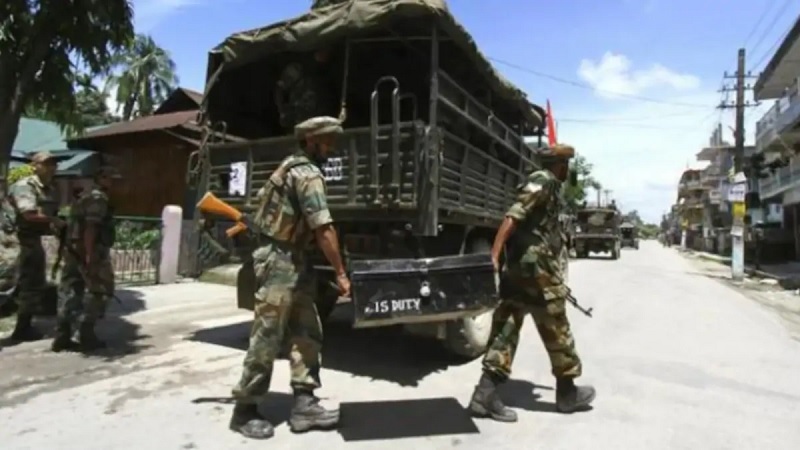
The Ministry of Home Affairs (MHA) has declared the entire state of Nagaland as a “disturbed area” for six more months under the Armed Forces (Special Powers) Act (AFSPA), 1958.
According to an MHA release issued on Wednesday, “Whereas the Central government is of the opinion that the area comprising the whole of the State of Nagaland is in such a disturbed and dangerous condition that the use of armed forces in the aid of civil power is necessary,” reported the Hindustan Times.
The notification further said, “Therefore, in exercise of the powers conferred by Section 3 of the Armed Forces (Special Powers) Act, 1958 (No 28 of 1958) the Central government hereby declares that whole of the State of Nagaland to be ‘disturbed area’ for a period of six months with effect from 30th December, 2020 for the purpose of the said Act.”
Nagaland had been declared a “disturbed area” in June this year. The AFSPA has been in effect in the North East since 1958, while Nagaland became an Indian state in 1963 and has thus remained under AAFSPA for close to sixty years. AFSPA allows security forces to conduct operations anywhere and arrest anyone without a warrant. It has been condemned by many rights groups and most famously by human rights defender Irom Sharmila for its misuse by security forces to commit excesses, abuse and human rights violations.
In fact, scrapping the AFSPA was one of the key demands of the draft framework agreement to maintain peace in the region signed between the National Socialist Council of Nagaland (Isak Muivah) and the government interlocutor RN Ravi in 2015. However, the act was not withdrawn.
Though peace talks are at an advanced stage, the demand for a separate flag and Constitution for Nagaland remain contentious issues.
Related:
Nagaland steps one step closer to lasting peace
Turmoil in the NE: The Naga Pact and its ramifications

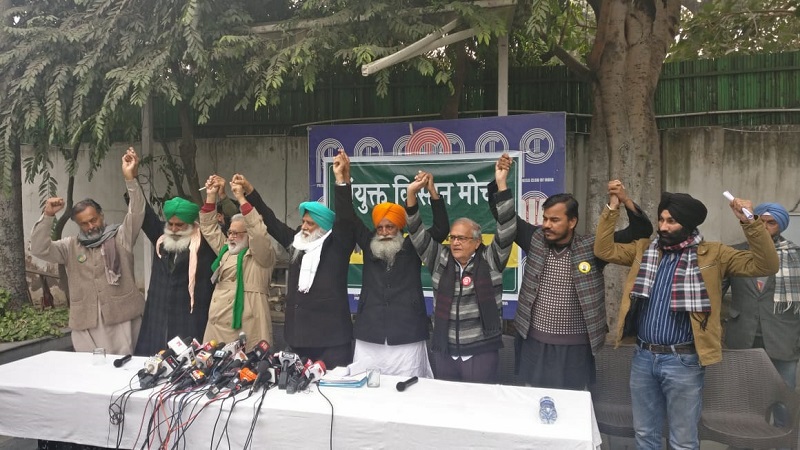
A ‘farmers’ republic parade’ with tractors, trolleys and other vehicles will march towards Delhi on January 26, 2021 soon after the official Republic Day parade, said a seven-member Coordination Committee of the Samyukt Kisan Morcha (SKM) on January 2.
The march was announced as an ultimatum by farmers to the Union government by farmer leaders Balbir Singh Rajewal, Darshan Pal, Gurnam Singh Chadhuni, Ashok Dhawale – in place for Hannan Mollah – Jagjit Singh Dallewal, Abhimanyu Kohad – in place for Shiv Kumar Sharma Kakka – and Yogendra Yadav.
“We intend to be peaceful and told the Government of India during our talks that it has only two options – either repeal the three central farm Acts or use force to evict us. The time has come for decisive action and we have chosen January 26 both because Republic Day represents the supremacy of people and because [by then] we would have demonstrated at Delhi’s borders for two full months in extreme weather conditions”, they said during a press conference.
The SKM confirmed their plan of action leading up to Republic Day as well. Farmers across India will observe rallies, conferences and dharnas under the Desi Jagriti Abhiyan from January 6 to January 20 to counter the government’s propaganda.
Farmers have also announced Lohri/Sankarnati as Kisan Sankalp Diwas wherein people will burn copies of the three laws – the Farmers (Empowerment and Protection) Agreement on Price Assurance & Farm Services Act, the Farmer’s Produce Trade and Commerce (Promotion and Facilitation) Act and the Essential Commodities (Amendment) Act.
Similarly, January 18 will be celebrated as Mahila Kisan Diwas to underline the role of women farmers. January 23 will celebrate Azad Hind Kisan Diwas on Netaji Subhash Chandra Bose’s birth anniversary by protesting outside Governors’ official residence in all state capitals.
Depending on the conclusion of January 4 talks, farmers will march on KMP Expressway on January 6 and subsequently the Shahjahanpur blockade will also move towards Delhi.
Meanwhile, leaders pointed out that the two minor farmers’ demands granted by the central government are yet to be secured in writing or any legal form. The major demands also remain unresolved. Previously, the government asked the farmers’ organisations to come up with ‘alternative proposals.’ However, leaders stated that there is no alternative other than repeal. Accordingly, the government refused to agree, even in principle, to the demand for legal right to purchase at MSP.
“We have no alternative and if the government does not meet our demand by January 26, we will be left with no option other than to start marching peacefully into Delhi”, said farmer leaders.
Related:
Farmers chart out January protest plans with a tractor march, Mahila Kisan Diwas and more!
Youth campaign in Bengaluru on Jan 1
Centre blinks, agrees to two of the four farmers’ agenda points
From the South to the Northeast, workers support farmers
CITU calls for farmers’ protests in over 1 lakh locations in India
Hearts full of scepticism, farmers agree for talks with Centre on Dec 30
Peasant supporters call for creation of Save Farmers, Save Nation committees
Are the new farm laws constitutional?
Join our mailing list to get the latest human rights news that matters, straight to your mailbox.
© Sabrang | All Rights Reserved