Charles Wesley Meesa


Outraged by the UP government’s blatant violation of the rule of law, the Constitutional Conduct Group has written an open letter to Chief Minister Yogi Adityanath on October 3, 2020.
“Just when we thought that nothing could numb our consciences and brains further, the handling of the Hathras incident by the Uttar Pradesh administration has shown that, as a nation, we are plumbing the depths of depravity and callousness in governance,” said the letter. The organisation blamed Yogi for the recent submission of the state bureaucracy. They urged the Chief of Executive to conduct the state administration “in accordance with the letter and spirit of the Constitution of India, to which you [Yogi] have sworn allegiance when you assumed office.”
Expressing rage about the recent case of sexual assault in Hathras, the retired officer demanded justice to the victim and her family, despite the efforts of specific upper caste groups to interfere with the course of justice. “Almost three weeks after the incident, the police are yet to confirm the crime of rape and are still spinning theories around it, although the video of what amounts to her dying declaration seems to confirm it,” they said.
Noting Yogi’s own Hindu faith, the Group said that he of all people should understand the gravity of last rites in Hindu customs that require the nearest kin to burn the pyre of the deceased. Both the sacred traditions and the family’s pleas to perform the cremation in the morning were ignored, they said.
They appalled at the local police who told the bereaved family that they were “also to blame” and the District Magistrate who was caught on video making veiled threats to the family. They also raised concern about rumours that said the Prime Minister asked Yogi to “fast track” the case for an early conviction.
“With our experience as erstwhile administrators in different departments of the central and state governments, our group of former civil servants had, in the past, highlighted the brazen violations of the rule of law in the Unnao rape case and in the murder of the police inspector in Bulandshahr,” they said.
Yet, even after two years, the ghastly murder of failed to stir the UP police. The retired officials also expressed skepticism about UP’s fast track justice system following two instances where alleged criminals died while being transported by the police. This denial of a fair trial violated Article 21 of the Constitution, they said. The members said that Yogi seemed to believe in combining the roles of judge and executioner illustrating examples of draconian measures of detention and punitive fines during the anti-CAA protests. They also condemned his recent order to withdraw all cases registered against him. They asked, “Politicians never tire of saying ‘the law must take its course’. Why depart from this article of faith for your party and government?”
The organisation demanded punishment for all those complicit in the disposal of evidence in the Hathras case. Along with the suspension of the Superintendent of Police, they said adequate procedure should be followed for immediate suspension of the District Magistrate.
Furthermore, they demanded action against all district police officers and the executive magistracy under Section 4 of The Scheduled Castes and Scheduled Tribes (Prevention of Atrocities) Act, 1989.
“We also note with regret that the Chief Secretary and the Director General of Police have failed abjectly in exercising control over a highly compromised administration. We urge them to live up to the proud traditions of the Indian Administrative Service and the Indian Police Service, in whom the people of this country still repose faith,” they said.
The group said that the meek surrender of the bureaucracy and police to political diktat shamed all those who deemed the title of ‘IAS’ a badge of honour.
Related:
Delhi Police register case against peaceful protesters demanding justice for Hathras Dalit victim
UP Police breached the law in Hathras
UP Police now claim that Hathras Dalit victim was not raped!
Why are rapists and ‘upper-caste’ supremacists getting bolder in UP?

Courtesy: Thenmozhi Soundararajan and #DalitWomenFight
The National Alliance of People’s Movement (NAPM) on October 3, 2020 joined the aggrieved family and agitators across the nation to demand justice for 19-year-old young woman from the Valmiki community, who was mercilessly violated by four dominant-caste men.
While demanding stringent punishment for the rapists and murderers as well as accountability of the police-political nexus, the organisation made the following demands.
Full security for families of all victims. Witness protection must be ensured, considering the manner in which the family of the Hathras victim feels isolated and terrorised.
Strict action against police and government officials who refused to file an appropriate FIR in time; cremated the victim in a clandestine way in the dead of the night; were complicit in covering up and attempting to destroy the case and evidence; persecuting the already distraught family.
Fast track of all cases of sexual violence on Dalit and adivasi women must be fast-tracked.
Removal of the UP Chief Minister for failing to protect the constitutional, legal and human rights of multiple marginalised sections including Dalit, Adivasi women and Muslims.
Prevent police from criminalising peaceful and democratic protests that express citizens outrage against caste and gender-based violence on other marginalised communities.
While making these demands, they argued that punishments such as hanging, castration or extra-judicial killings of the accused would fail to address the reasons for repeated denial of dignity and justice to the survivors and victims. “These forms of punishment are only an eye-wash and makes an already unaccountable State more powerful … we must remember that the key to realizing many of these [demands] also lies in intensifying our struggles in annihilation of caste and patriarchy, as systemic and pervasive agencies of oppression,” they said.
While talking about the Hathras case, the organisation members pointedly mentioned the caste of the four accused – the dominant Thakur caste. They talked of similar incidents over the past few years that had a significant caste-aspect to them.
Around October 1 in Bhadohi, Uttar Pradesh authorities found the body of a 14-year-old Dalit girl, bearing stab wounds and stone injuries. A 22-year-old B.Com student was gangraped and killed in Balrampur. Moreover, similar incidents were reported in Bulandshahr, Azamgarh, and other places.
According to the National Crime Records Bureau (NCRB) data between 2009 and 2018, UP is the leading state for crimes against marginalised sections. The state recorded 22.38 percent of the 51,824 crimes against Dalits, registered under the SC/ ST (Prevention of Atrocities) Act.
“Of all crimes committed against Dalits, the highest are against Dalit women. Such crimes have steeply increased in recent times. NCRB data shows a 27.9% increase in crimes against Dalits, and a 20% increase in crimes against women, between 2016-19 in the state,” said the press release.
They alleged that the state was shamelessly siding with the oppressors instead of safeguarding the rights of the vulnerable. The UP Chief Minister has remained largely indifferent, as caste supremacists reign terror on oppressed caste people, they said.
The organisation noticed that similar patterns of violence and atrocities had risen in BJP-ruled Gujarat, “the ‘model’ state for some, the laboratory of Hindutva in reality.”
As an example, they talked of Devji Maheshwari, a Dalit lawyer and activist from the All India Backward and Minority Communities Employees Federation, who was killed in Rapar (Kutch District) on September 23 because of his Facebook posts that criticized Brahminism. His murderers were arrested only after his wife fought back bravely and refused to accept his body unless the arrests were made.
As per Gujarat’s Scheduled Caste and Scheduled Tribe Cell data, cases of atrocities against Dalits have risen annually since 2010. The number of annual rape cases also went up from 39 in 2010 to 108 cases in 2018. A total of 568 cases of atrocity against Dalits and 36 cases of rape have been registered till May 2020 in Gujarat.
“The worsening of caste and gender violence is the result of Hindutva’s political-ideological ascendancy at the national level and in these states. Ideologically, Hindutva upholds and valourises Brahminical caste/gender inequalities and oppression,” they said.
The members mentioned how, the current Chief Minister Yogi Adityanath quoted Manusmriti to argue against women’s reservations in Assembly and Parliament in 2009 on the grounds that women ought to be ‘kept under the control of men.’
“Despite all its rhetoric of ‘Beti Bachao’, BJP has been acting as a ‘Balatkari Bachao’ party in multiple instances,” they said.
They called out the BJP for the rising cases of caste-based attacks at societal and institutional levels despite calling itself a ‘pro-Dalit’ party. They alleged that Yogi’s rule enabled the caste consolidation of Thakurs by favouring them in government appointments and recruiting them in private militias like the Hindu Yuva Vahini.
“The institutional murder of Rohit Vemula and many other students, the Una floggings, the Hindutva violence at Bhima Koregaon and the vindictive arrests of progressive Dalit bahujan journalists, activists and intellectuals (e.g. Prashant Kanojia, Anand Teltumbde, Sudhir Dhawale, Adv Surendra Gadling, multiple arrests of Chandrashekar Azad) are cases in point,” they said.
They listed other indicators of the fascist ideologies such as increasing authoritarianism and political control over the administration and police forces. The pro-government approach of the police was and is on naked display in Hathras, said their statement. The state government has become one of the most authoritarian state governments, arresting anti-CAA dissenters, enabling arrests without FIRs, targeting Muslims and aligning police force with Hindutva through para-recruitments.
Related:
Why are rapists and ‘upper-caste’ supremacists getting bolder in UP?
Dalit woman, son assaulted for refusing to pick up cow carcass in Gujarat
Adivasi academic and activist targeted for stand on exams during Covid-19
Image Courtesy:countercurrents.org
Mr. Satyapal Singh, the BJP MP, while speaking in Lok Sabha on amendments to FCRA, had gone on to support the forthcoming restrictions to the foreign contributions. While making his arguments, to buttress his point, he put forward the case of Pastor Graham Stewart Staines. In the process, he poured venom on the late pastor by saying that he had raped 30 Tribal women and was involved in the work of conversion to Christianity with the help of funds from abroad!
This blatant lie should have been countered in the Parliament. The brutal murder of Pastor Staines was described by the then President of India, Dr. K.R. Narayanan by saying “It belonged to the world’s inventory of black deeds”. The pastor, who came from Australia to work among Leprosy patients in Orissa, was sleeping in an open jeep in the village on the night of January 22-23, 1999. He was working in Keonjhar, Manoharpur, in Odisha. On that fateful night he was burnt alive with his two minor sons, Timothy and Philip. The whole country was aghast with the brutal nature of the crime. The brutality was committed by Rajendra Singh Pal aka Dara Singh, a worker of Bajrang Dal.
LK Advani was the home minister at that time. He stated that Bajrang Dal has nothing to do with this act; he knows this organisation well. As the immediate measure he sent a three-member ministerial team comprising Murli Manohar Joshi, Navin Patnayak and George Fernandez to Odisha. In a single day, the team concluded that this grave crime is an international conspiracy to destabilise the ruling NDA government. Then the Wadhwa Commission was appointed. The commission concluded that Dara Singh, who was working with Bajrang Dal with the help of organisations like Vanvasi Kalyan Ashram, VHP etc. propagated that the pastor is doing the work of conversion and is a threat to Hinduism. He did mobilise people, poured Kerosene on the vehicle and set fire.
The Commission in its report further stated that Pastor had not been doing the work of conversion; he was involved in serving the leprosy patients. Dara Singh was awarded death penalty by Courts, which was later reduced to life imprisonment; currently he is undergoing the jail sentence. What is remarkable is that as per the report there was no substantial increase in the percentage of Christians in the area. The report states, “Keonjar district had a total population of 15.30 lakh. Out of them, 14.93 lakh were Hindus. Christians, mostly tribals, were 4,707. According to the 1991 census, there were already 4,112 Christians in the district. Thus, there was an increase of only 595 in the Christian population.” One can say that this is not due to conversion but is due to the natural biological process. Propaganda of Dara Singh and the organisations was purely guided by their political agenda.
The propaganda that Christian missionaries have been converting is the dominant social perception all around, and it is the ground for ‘Hatred against the Christians’, who have been facing the violence for over two decades. We witnessed violence against Christians, mainly in Adivasi areas, Dangs, Jhabua, and large parts of Odisha. After this gruesome murder, there was regular violence against Christian community, the peak of which was seen in the Kandhamal violence (August 2008) in which nearly hundred Christians were killed, close to four hundred women raped and many Churches attacked and destroyed.
That was not the end. The violence against this community is going on in a regular manner. It is mostly in remote areas, in a scattered manner and many-a-times below the radar. The prayer meetings are attacked and missionaries distributing religious literature are apprehended. The organisation ‘Persecution Relief’, in its recent report points out, “Hate crimes against Christians in India have risen by an alarming 40.87 percent. That increase came despite a complete nationwide lockdown that lasted three months to stem the spread of Covid-19 infections.”
While the attacks on Muslim minority have been glaring, those against Christians are scattered and low intensity, the murder of Pastor Staines and Kandhamal violence stand out. The core ideology behind this violence which has been spread is that Islam and Christianity are ‘foreign religions’ and are a threat to Hinduism. This is so much in contrast to what Indian nationalists like Gandhi and Nehru, who regarded that religion is no basis of nationality; Christianity is as much a religion of this land as any other.
As a matter of fact, as per one version Christianity entered this land in AD 52, With St Thomas setting up a Church in Malabar area. For the last nearly 19 centuries, many missionaries have been coming and working in the remote areas, setting up health and education facilities in particular. They have also set up the schools and colleges, and hospitals in urban areas, which are known for their good standards, and people in these areas do vie to avail of these facilities with gay abandon.
Today the percentage of Christians, as per census figures is 2.30 (2011 census), this is again a climb down from 1971 when it was 2.60 percent. In the last six decades it has shown a constant decline, 2.60 (1971), 2.44 (1981) 2.34 (1991), 2.30 (2001) and 2.30 again in 2011. The organisations like Vanvasi Kalyan Ashram, VHP and Bajrang dal are active more in remote places to spread the misconception of the conversion. This is an assault on ‘Freedom of Religion’ and the repressive laws against freedom of religion have been coming up in state after state. While Indian Constitution stands for an individual’s right to practice and preach one’s religion, the anti-Christian violence on the pretext of religion is becoming endemic as sectarianism is growing in a frightening manner.
Recently on August 25, it was 12 years since Kandhamal violence had shaken the country. The need is to restore peace, amity and harmony. By speaking unsubstantiated charges Mr. Satyapal Singh has just gone on to add to the anti Christian propaganda, which dents our values of fraternity.
* The writer is a human rights defender and a former professor at the Indian Institute of Technology, Bombay (IIT Bombay).
Other pieces by Dr. Puniyani:
Was Mughal Rule the period of India’s Slavery?
Kashi- Mathura: Will temple politics be revived?
Scapegoats and Holy Cows
Freedom of Religion: Indian Scenario
Image: PTI
The horrific rape and murder of the Dalit teenager at Hathras has rightly shocked the nation. She, in her dying declaration, had had named the accused; her mother had shared the signs of rape and assaut she saw on her daughter’s injured bare body. However, it is the collective ‘upper caste’ power groups that have now banded together to defend the rapists, that is as shocking as the crime itself.
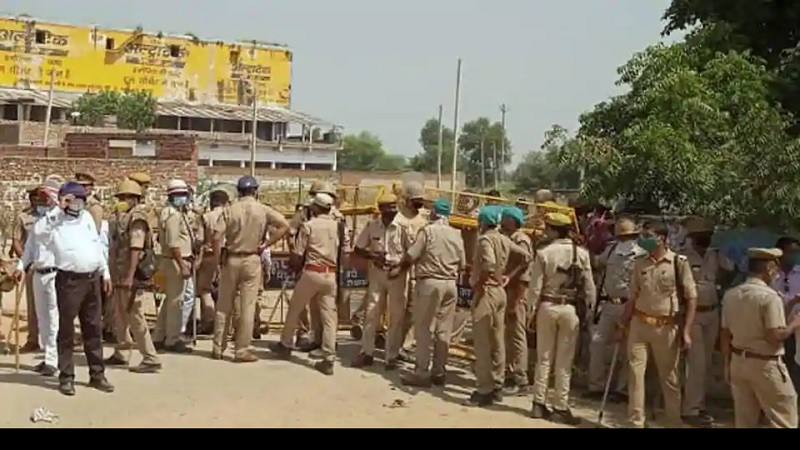
Most recently, the four men accused of rape and murder of the Dalit teenager were openly defended at meeting held at Bharatiya Janata Party (BJP) politican, ex-MLA’s Rajvir Singh Pehalvan’s residence. News reports showed heavy police deployed around Singh’s house, which is less than 10 kilometres away from the victim’s village, reported The Indian Express.
This meeting was held on Sunday outside Singh’s house in Hathras. Those gathered, mostly upper caste men openly defended the four accused in the alleged gangrape of a Dalit woman who later died. In turn they even demanded that an FIR be registered against her family members, who are now said to be living in fear of the upper caste retaliation.
This latest meeting, it seems is one of the steps towards the plans possibly being made by the thakurs and other ‘upper caste’ men, who have been taken by surprise that the Dalit family has dared to speak up. According to the news, Pehalvan’s son Manveer Singh who had organised the meeting said the meeting was attended by “different sections of society”. He reportedly told the news agency PTI that they “welcome the CBI inquiry” ordered after the rape and murder generated a nationwide furore demannng accountability from Uttar Pradesh chief minister Adityanath. “We have faith in the investigation,” Singh told PTI and claimed that the victim’s family members were “changing their stand”.
The ‘upper caste’ members in influencial positions, are not reported to be working towards the narrative that not only denies rape, but blames the deceased victim and her traumtised family of ‘changing’ statement. The family, however, backed by the Dalit community, continues to stand firm on its demand for justice for their daughter.
That has not fazed those blaming the victim, and defending the state govt, “The entire scenario has been created to blame the government. The accused persons are in favour of any type of inquiry. But the victims are changing their stand every now and then. They do not want a narco test or a CBI probe. Now they want other kinds of inquiries,” claimed Singh, adding, “Our demand is that a case should be filed against those people who had filed the case in the first instance.”
This is the second such ‘upper caste’ meeting in Hathras, Panchayat had been organised in, reportedly in favour of the rape and murder accused last week. That was organised by an association called the Savarn Samaj or ‘upper caste community/ society’ . They too were demanding “justice for the men accused of brutalising the 19-year-old Dalit girl”. That panchayat too was deliberately held just a few kilometers from the girls village and was to show that the ‘upper caste’ community was “in favour of the four accused” who are now under arrest and in police custody. Of course no official or legal restrictions were imposed on these gatherings, even as Covid-19 protocol, and section 144, was in place to keep media, and secular parties away from the village by the state’s Bharatiya Janata Party (BJP) government administration. Among those who are rallying in support of the Thakurs accused in the Hathras gangrape-assault case are members of right-wing groups like Bajrang Dal, RSS and Karni Sena and a local BJP leader. The members of these right-wing outfits are also part of ‘upper caste organisations’ like Rashtriya Savarna Sangathan, Kshatriya Mahasabha etc, reported The Quint.
The year is 2020 and yet , groups affiliated with the RW Ideology continue to speak up for those accused of the most heinous crimes. Here are some more cases when the Right Wing community, Including the BJP ‘stood’ up for the accused:
2018: Kathua, RW supported men accused of rape and murder of a nomad child
One of the most horrific cases of 2018, the rape and murder of eight-year-old nomad girl of Jammu and Kashmir’s Kathua district had sent shivers down the country’s spine. The Gujjar community held protests demanding justice for the victim and her family. However, the right-wing Hindu Ekta Manch carried out protests asking why “selected persons” had been arrested. People had carried theTricolour at a right-wing rally and demanded the release of police officer Deepak Khajuria accused and arrested in the Kathua rape-and-murder case.
2018: BJP’s MP from Hazaribagh Jayant Sinha, honoured men who lynched Muslim meat seller
The victim Alimuddin Ansari had been beaten to death by a mob that suspected he was carrying beef. Jayant Sinha, the union minister from Jharkhand had felicitated the eight convicts at his residence, welcoming them with garlands. According to an NDTV report, 11 men, including a local BJP leader, were sentenced to a life term for beating Alimuddin to death on June 30 2017 last year.
2017: Amit Shah defended Maya Kodnani in Gujarat riots case
It was widely reported whan Home Minister Amit Shah appeared before a Special Investigation Team court, as a witness to defend prime accused , former Gujarat minister Maya Kodnani in the 2002 Gujarat riots case. Shah stood up to defend Kodnani and said she was with him inside the state Assembly when the riots blazed in Ahmedabad’s Naroda Gam.
2017: BJP defends Haryana CM Manohar Lal Khattar Khattar, in the wake of Panchkula violence
Even as demands were made for the Haryana chief minister’s removal, over his reported failure to control the violence by Dera Sacha Sauda chief Gurmeet Ram Rahim Singh’s followers. At least 31 people were killed in police firing in Haryana but the BJP maintained that the state government handled the situation “meticulously” and the CM would stay. Dera Sacha Sauda chief Gurmeet Ram Rahim Singh had been seen with various BJP leaders at functions before he was.
2014: Arun Jaitley defended PM Modi, saying he need not apologise for the 2002 Gujarat riots
Arun Jaitley put in “monumental efforts to propel Narendra Modi” to consecutive electoral victories in Gujarat, and also “staunchly defended Modi whenever he became a subject of criticism,” Times Now and others had once reported. By 2014 Narendra Modi had been absolved of complicity in the 2002 Godhra riots by a court, however many were demanding an apology from him for the riots that took place in his regime. In the run-up to the 2014 Lok Sabha elections, Modi said he felt ‘anguish’ on witnessing the ‘inhumanity’ of the 2002 riots which claimed the lives of thousands, mostly Muslims. Jaitley said that the legal process held Modi not guilty because “there was not a shred of evidence against him then there is no need for Modi to apologise”.
2013: Narendra Modi defends himself on 2002 Gujarat riots: Highlights
Narendra Modi defended his actions during the 2002 Gujarat riots, asserting that “we used our full strength to set out to do the right thing”, in an interview to news agency Reuters, reported NDTV. “I would feel guilty if I did something wrong. Frustration comes when you think ‘I got caught. I was stealing and I got caught.’ That’s not (what happened in) my case,” he was quoted and added that “If we are driving a car or someone else is driving a car and we’re sitting behind, even then if a puppy comes under the wheel, will it be painful or not? Of course it is. If I’m a chief minister or not, I’m a human being. If something bad happens anywhere, it is natural to be sad.”
The right wing track record of defending the accused, and often changing narratives of crimes and investigations, and blaming the victims, is being added to Uttar Pradesh at the moment.
Related:
Caste attacks on Dalits continue: Panchayat to support rape and murder accused!
UP Police breached the law in Hathras
UP Police now claim that Hathras Dalit victim was not raped!
Why are rapists and ‘upper-caste’ supremacists getting bolder in UP?

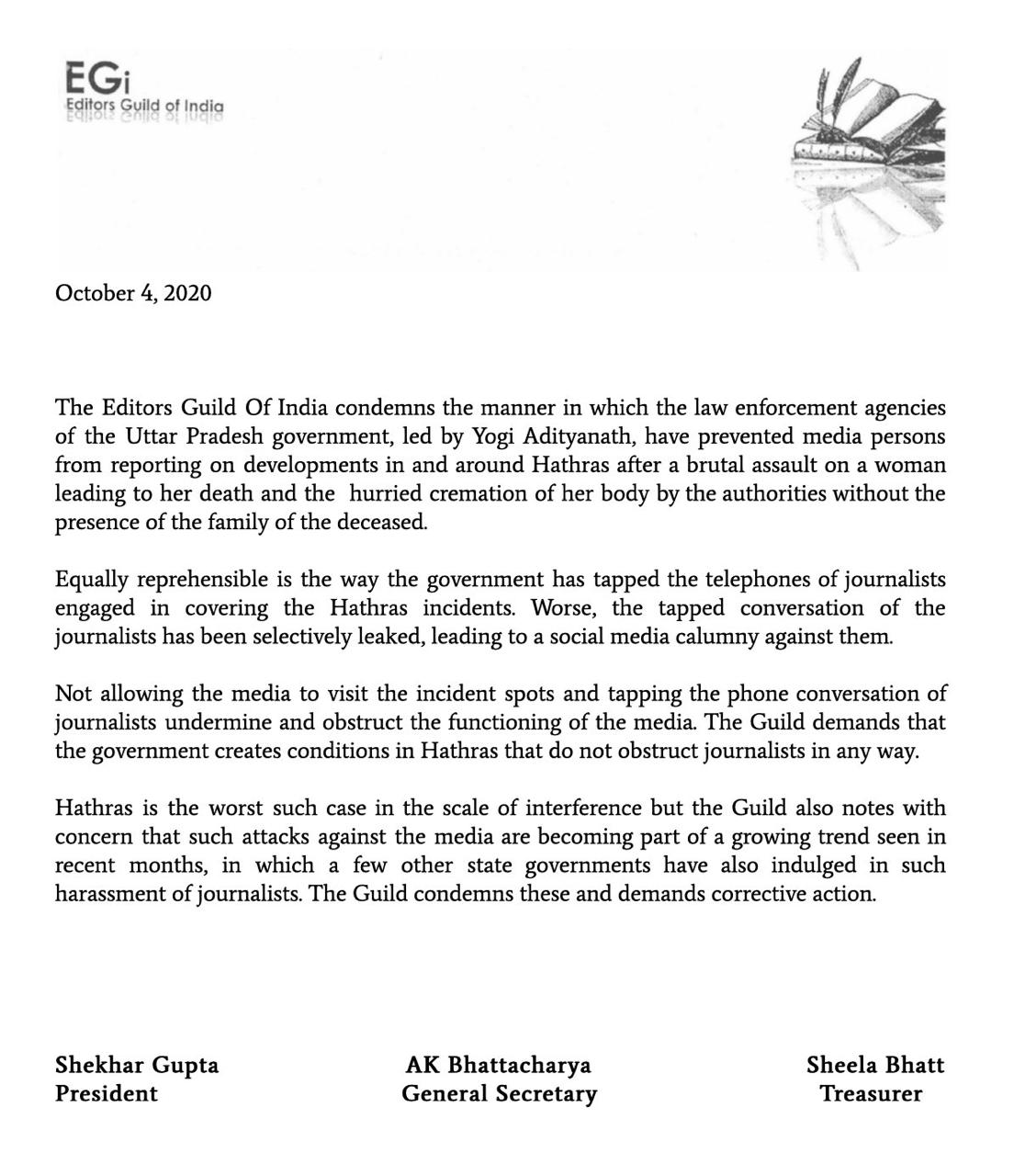
The Editors Guild of India, on Sunday, came out with a statement against how the Adityanath led Uttar Pradesh administration was getting in the way of reporters covering developments in the Hathras gang-rape case where a Dalit-women was raped and left for dead by ‘upper caste’ men.
The police had not only ignored the woman’s complaints, but also delayed getting her urgent medical attention. After she succumbed to her injuries, they had also allegedly intimidated the family and forcibly cremated her body late at night, an act that wouldn’t have come to light but for a few vigilant reporters who caught it all on camera. Reporters have also been documenting how the administration is continuing to hound the family, virtually giving politically powerful ‘upper caste’ groups a free reign in using various coercion tactics to prevent the victim’s family from speaking out.
The statement by EGI has condemned “the manner in which the law enforcement agencies of the Uttar Pradesh government, led by Yogi Adityanath, have prevented media persons from reporting on developments in and around Hathras”. EGI further says, “Equally reprehensible is the way the government has tapped the telephones of journalists engaged in covering the Hathras incidents.”
The entire statement may be read here:

Related:
Delhi Police register case against peaceful protesters demanding justice for Hathras Dalit victim
Caste attacks on Dalits continue: Panchayat to support rape and murder accused!
UP Police breached the law in Hathras
UP Police now claim that Hathras Dalit victim was not raped!
Image Courtesy:kashmirobserver.net
This must have been the families’ biggest nightmare, and at the same time, a tragic closure. According to a report in the Indian Express, the Jammu and Kashmir government has exhumed the bodies of the three Rajouri labourers who were killed in July, reportedly in an “encounter” in South Kashmir’s Shopian area and handed the bodies to their families. The news report added that the bodies were exhumed at night.
It had taken months for the Army to admit that the three men killed in the Shopian “encounter” were indeed missing labourers from Rajouri. The news of the dead men’s identity was confirmed only on September 18, and weeks later, the “bodies have been exhumed and handed over to the families,” Guftar Choudhary, a social activist who was with the labourers families for the exhumation, told The Indian Express adding that this was done at “around 5.30 AM.” Hours earlier, the J-K Director General of Police (Dilbagh Singh) had said the bodies would be exhumed soon, reported the IE.
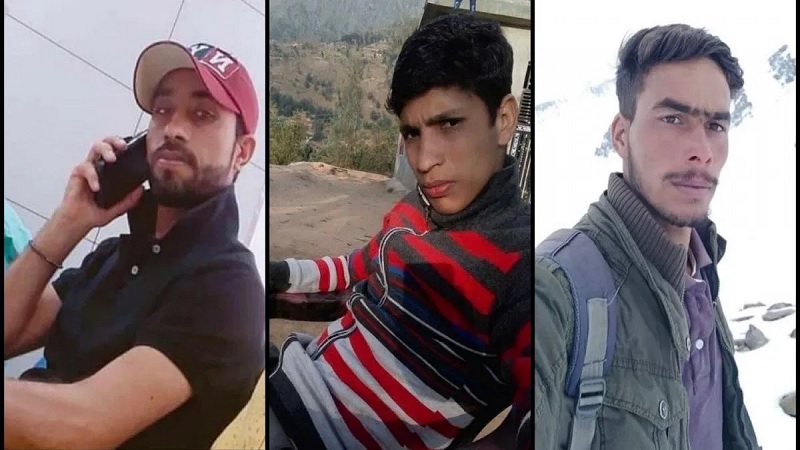
The three labourers from Rajouri have been identified as Imtiyaz Ahmad (20), Abrar Ahmad (25) and Mohammad Ibrar (16). They were killed in South Kashmir Amshipora village in Shopian on July 18, in what turned out to be a “fake encounter” as reported widely. The media reported that both the Army and the police had then said these three men killed were “militants” and the bodies then buried “discreetly in a graveyard in North Kashmir’s Baramulla”.
However, on August 10, photos of the bodies were shared on social media, according to IE, the labourers families had also filed a missing report a day before those photos went public. The labourers’ families recognised their missing sons, and soon a probe was ordered by the Army. The IE reported that on September 21, the Army’s court of inquiry confirmed that the three men were actually Rajouri labourers.
The three families had lodged a missing persons’ complaint about them at the Peeri Police Post in Rajouri’s Kotranka tehsil. One of the victims was reportedly 16 years old. The three had gone to Kashmir for work and not been in touch with their families July 17 night, the IE had then reported. The families thought the young men were in quarantine as part of anti-Covid measures as they were from outside Rajouri. However, soon enough they heard of the killing of “unidentified militants.” They later told the IE that they eventually “recognised them from the photographs,” and demanded that “their bodies be returned to us and there should be a probe.”
Related:
J&K Police Dy. SP Devender Singh was “being groomed” by Pakistani officials: NIA
14 US Senators demand India be designated CPC
New Report Cites 432 Torture Cases In Kashmir From 1990-2017, 70% Victims
Image Courtesy:zdnet.com
The Centre is considering introducing pre-installed government software in all new mobile phones, said news reports on October 3. This change would allow the government to monitor its citizens.
According to Economic Times, this proposal is part of a larger plan to establish an Indian app store independent of Apple and Google. The plan would involve adding government apps to Android phones which account for 96 percent of the country’s market.
However, this suggestion by the government also raises privacy concerns like data harvesting. India has few data protection laws as it is and the Centre has already been accused of mass surveillance via the Aarogya Setu coronavirus contact-tracing app.
The app collects a user’s location data along with their name, phone number, age, sex, profession and countries visited in the last 30 days and cross references it with the Indian Council of Medical Research’s COVID-19 database. Aarogya Setu sends this information to a government server to keep a record of all places visited by a person every 15 minutes and update their health status. Organisations like the International Freedom Foundation warned against such mass surveillance apps especially considering India’s poor privacy laws.
Related:
Where does the law stand on your “objectionable” posts on social media?
Indian government bans 59 Chinese mobile apps amid border standoff
Home quarantine patients to be tracked using mobile data?
Meghalaya law student’s plea in HC against mandatory imposition of contact tracing apps
Join our mailing list to get the latest human rights news that matters, straight to your mailbox.
© Sabrang | All Rights Reserved