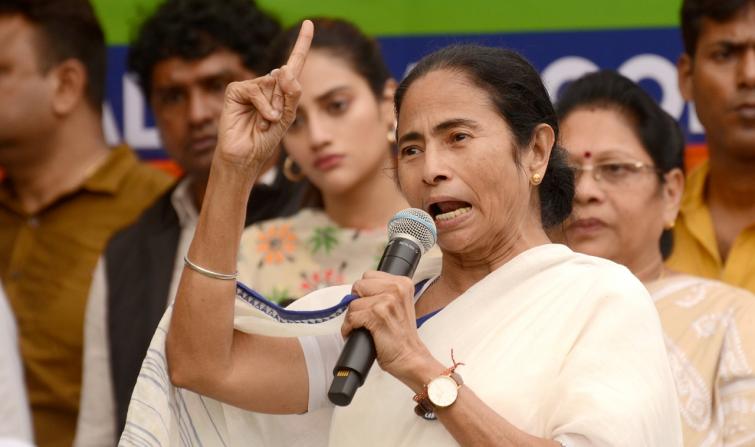
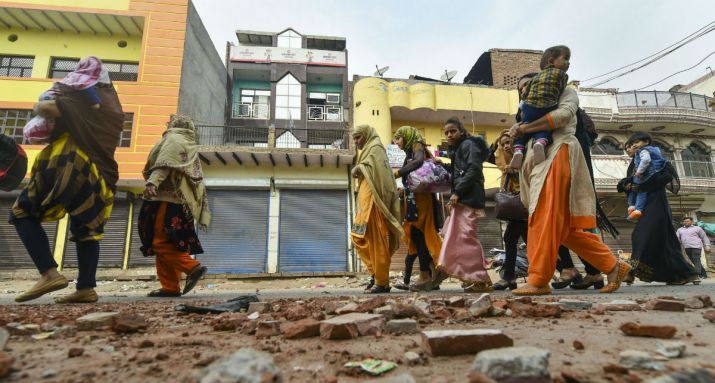
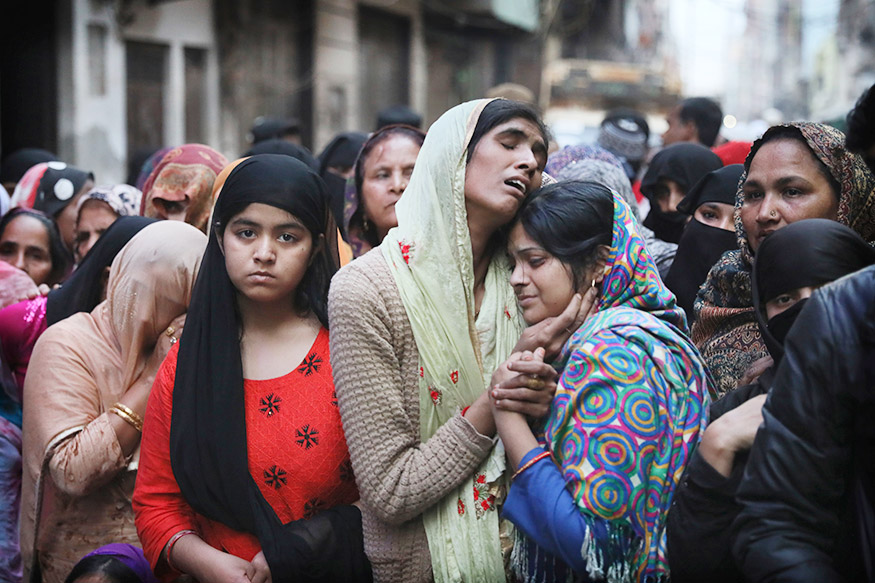
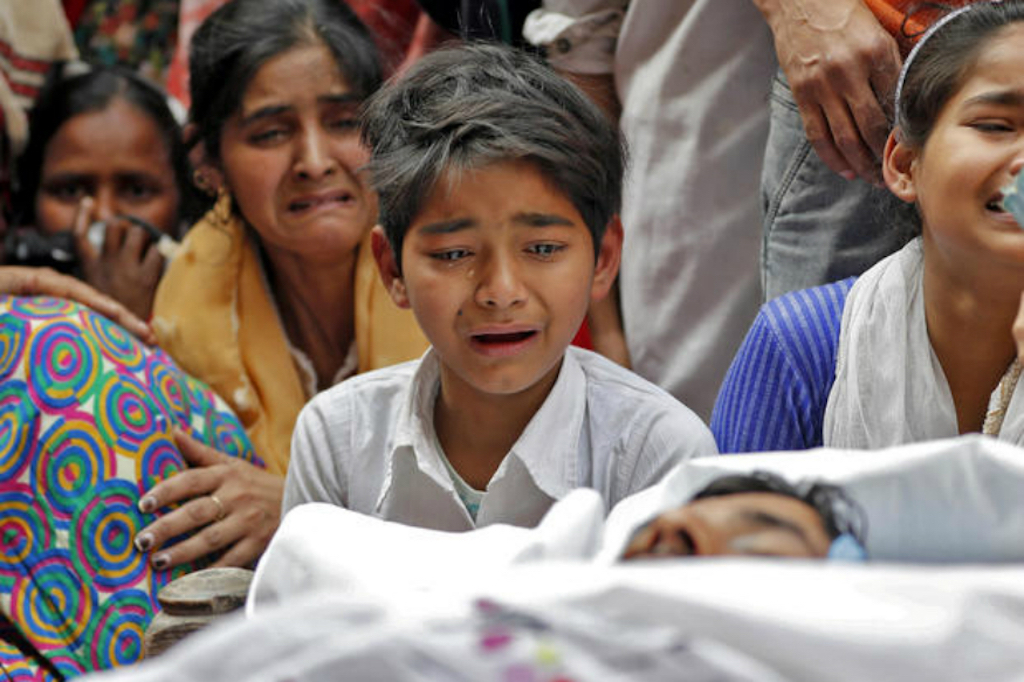
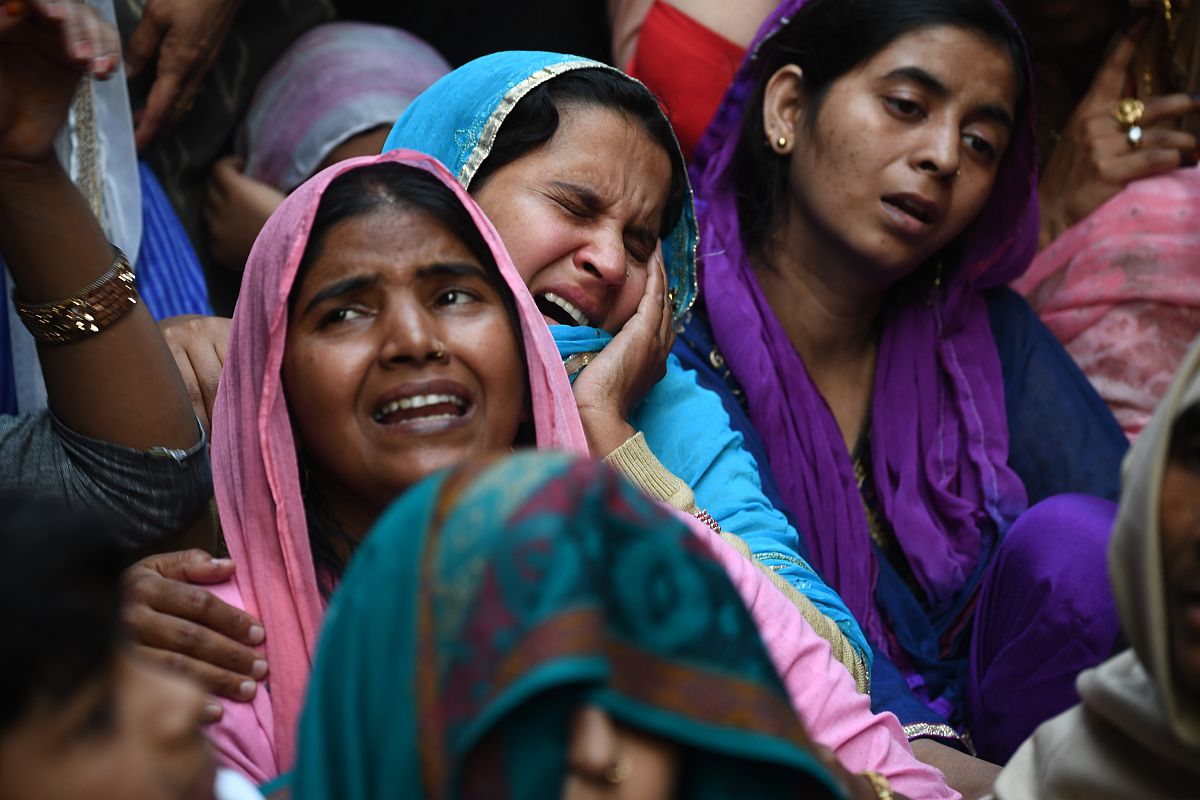
Three BJP workers have been arrested for making inflammatory statements during Home Minister Amit Shah’s speech in Kolkatta on Sunday even as West Bengal Chief Minister Mamata Banerjee hit out at the Bharatiya Janata Party and called the turmoil in the national capital a ‘planned genocide’.
“It was a planned genocide, yet BJP has not apologised for it. And shamelessly they come here and said they want to capture Bengal,” she said. She said, “Let’s take a pledge today. Unless we uproot this autocratic govt we shall not stop.”
This comes a day after Union Home Minister Amit Shah visited West Bengal and accused Mamata Banerjee of triggering riots in the state. “Goli maaro” slogans were also raised by some BJP workers.
Responding to this, Mamata Banerjee said, “I know some people who came to BJP rally yesterday raised Goli Maro slogan. It is illegal. And I assure all those who used such language will face the law.”
“In Delhi, BJP leaders who gave provocative slogans have not been arrested, but I got three of the BJP workers arrested (on charges of raising ‘desh ke gaddaron ko…’ slogans in Kolkata) last night,” said Mamata Banerjee.
She also asked why BJP leaders were not arrested for rasing provocative slogans. She questioned, “I ask, despite so many deaths why has the BJP leader not been arrested despite such grave provocation.”
On Sunday, Union Home Minister Amit Shah paid Kolkata a visit and tried to build support for the Citizenship Amendment Act (CAA). In his speech he squarely blamed West Bengal Chief Minister Mamata Banerjee for scaring minorities by misleading them about CAA.
He accused Banerjee of “triggering riots” and “burning trains”. He also accused Mamata Banerjee of neglecting “Sharanaarthi” (refugees) facing persecution, and caring only about “Ghuspethiye” (infiltrators), thereby demarcating migrants along communal lines. He asked, “Mamata didi, why are you opposed to giving citizenship to Namshudras and Dalits? Why do you not consider refugees as your own people? Why are you only concerned about infiltrators?”
West Bengal had refused to conduct CAA or the National register of Citizens (NRC) in the state and Banerjee had assured people that she would protect them from any unconstitutional or blatantly communal moves by the centre. It is also noteworthy that despite its best efforts, the BJP has been unable to gain any significant political mileage in the state and coming to power in West Bengal remains the party’s most coveted dream.
From the outset it was clear that Shah wanted to spin this narrative of failure into one of gradual victory. He began by saying, “We went from getting 87 lakh votes in 2014 to 2.3 crore votes in 2019.”
While it is true that BJP has managed to expand its footprint in the state, what Shah failed to mention was how while the BJP had won in the northern constituencies along the Bangladesh border, it has lost in all but two of the southern ones in the Lok Sabha elections. Also, while a split in the secular vote is responsible for the BJP victories, TMC has summarily trounced its opponents obtaining huge winning margins in the southern constituencies along the border. All of this was a direct impact of its political stand on citizenship related issues.
Shah also failed to acknowledge that Banerjee’s All India Trinamool Congress (AITC) had knocked the wind out of the BJP during crucial byelections held in November 2019. This was the time when the BJP perhaps suffered its most humiliating defeat in the state. AITC was successful wresting back control of Kharagpur Sadar from the clutches of the BJP, especially since it was the constituency of BJP state chief Dilip Ghosh. Bye elections were necessitated here are Ghosh became a Member of Parliament. But TMC’s Pradip Sarkar thrashed BJP’s Prem Chandra Jha with a winning margin of over 20,000 votes! The main reason BJP lost the byelections was because of their inability to read what the electorate was saying not just about CAA and NRC, but about the politics of hate. The party is clearly still smarting from that electoral slap. Though it has had little impact on Ghosh who is still making controversial and hate-filled statements about anti-CAA protesters.
Ghosh recently called intellectuals “spineless parasites”, said protesters “were shot like dogs in Assam and UP”, asked why were Shaheen Bagh protesters “not dying”, and asked a woman anti-CAA protester to be grateful that men only heckled her and “nothing else was done to her.” Perhaps it would serve Shah better to acknowledge that it was such incendiary comments by his own party’s people and wrong strategy in West Bengal that were responsible for their failure in the state.
But what was perhaps most disturbing was the chants of “goli maaro s**lon ko” that were raised by Shah’s supporters while they were passing the Maidan Market in Esplanade en route to the rally venue Shahid Minar ground. While the BJP says they were not party members, Hindustan Times reports that the party has decided to provide legal assistance to three people detained in connection with raising the hate-filled slogan.
Forty phone calls to the control room were unanswered and as the police abdication from its lawful and constitutional duty is apparent, what is needed is a committed team of legal professionals to ensure accountability
The team consisting of Dr. Saif Mahmood, Advocate, M. R. Shamshad, Advocate, Shwetasree Majumder, Advocate and Vishal Vig visited the areas of Jafrabad, Mustafabad, Maujpur on February 29, 2020
Executive summary: Several groups of police and paramilitary forces and police vehicles now line the main Jafrabad road at a distance of barely 200 metres from each other. Yet police presence did nothing to assuage the survivors of the carnage of February 23, 2020.
On the contrary, the role of police seemed to have a chilling effect on the residents and survivors. Everyone we met narrated stories of inexplicable police inaction. From a non-responsive control room, to senior personnel claiming there were no orders to go to the area, to an emergency number (100) where panicked calls were received and simply not actioned…all tell a tale of why the carnage reached the magnitude that it did.
Our first stop was Madrasa Bab-ul-Uloom where Maulama Mohammad Dawood, Maulana Qasimi and other representatives of the Jamiat Ulema e Hind, were providing shelter to a large number of people of all faiths and were in the process of setting up a relief camp in the Idgah to house them. At the moment, people were being accommodated in private homes and mosques scattered in the area and in other make-shift locations from where they would need to be shifted soon.
We were then directed to Mustafabad where we met Maulana Akhlaq at Madina Masjid, Gali No. 3. Maulana Akhlaq told us of larger relief camps where thousands of people were being housed and also showed us private homes scattered around the Masjid which had opened their doors to survivors and were providing for them.
We visited the home of Nafis Ahmed Saifi in Indira Vihar who is hosting more than 300 people displaced from Shiv Vihar in his home. Here we also met some young lawyers who were helping the displaced persons.
Shiv Vihar was a primarily Hindu area with 8000 Muslim families. The first group of women we spoke to narrated how the rioters came, broke open the locks on front doors and rushed inside their homes to set them on fire with the families inside! How the rioters threw gas cylinders into the flames to cause explosions. How the survivors climbed on to the roofs of their homes and jumped or sometimes ran through the flames to escape. We met a young girl whose face had been hit with a piece of brick. We heard how the rioters had looted, committed arson and had now taken over their homes, claiming them as their own.
While the women said that the rioters were not their neighbours and that they were outsiders, several men told us that their neighbours were involved. We were given to understand that even now many dead bodies are lying in the Nallah nearby to which police is not allowing access. Given the incidents of the past few days where anyone who went back in failed to return, Shiv Vihar was by far the most dangerous area for its Muslim residents even now, underneath the outward semblance of calm. We left 25 cartons/ bags of relief supplies in the Medina mosque for distribution in this area.
Our next stop was Al-Hind Hospital (the only hospital in that area) where we met the local hero, Dr M. A. Anwar. His midnight phone call with Justice Muralidhar of the Delhi High Court had saved the lives of 20 critical riot victims who were thereafter shifted to GTB Hospital. He told us how he had converted the hospital into a shelter the first night, and also echoed our fears that the death toll was several times higher than the official figures. Dr. Anwar told us how, despite repeated calls to various police officers, he failed to convince them to send ambulances. Dr. Anwar also complained that no medical practitioner or pharmacy in the vicinity tried to help Al-Hind while they were trying to save large number of lives.
Our next stop was Mustafabad where we met Haji Imran, the owner of Nida Jewellers. He had converted his home into a storage space for relief supplies and was distributing them systematically to the families who had taken shelter in private homes in the area. The need for dry rations here was immense and 40 of our kits were distributed here. They were over in less than 30 minutes!
We heard more stories of systematic and planned carnage – how the homes and establishments of Hindu owners who had rented them out to Muslims were looted and the homes and establishments of Muslim owners were set fire to. How Hindus that shielded Muslims were not spared. Of how over 40 phone calls to the police control room remained unanswered.
Next steps: Apart from the ongoing supply of relief materials which we continue to collect and distribute, we are working on the long-term rehabilitation of those displaced. We have commenced an exercise of creating a database of displaced persons with names, contact details and particulars of family members. This will also reveal more information on how many people are missing/ dead. We are aware that this will still not be the full picture as a large number of migrants, especially bakery workers who were from Bengal, have left the city.
Once the database is complete, the families will need to be matched with home-owners willing to give out their homes on rent. Those willing to help will need to commit to pay the rent for at least 3 to 6 months for these families, while they rebuild their lives. The local school that is burnt to the ground and the two mosques need to be rebuilt.
One of the most crucial things to do is to professionally, and aggressively, pursue the legal recourse available to victims. To facilitate legal assistance, there appear to be few teams already working. However, we feel that a team of 10 dedicated, competent young lawyers be formed and they be put on work under the supervision of 2-3 senior lawyers. For this purpose, we will identify competent young lawyers who can dedicate sufficient time to this work and will pay them for their services.
Over last few months we have witnessed a reawakening of the democratic ethos led by Muslim women all across the country. These near-uninterrupted protests against the passage of the discriminatory Citizenship Amendment Act (CAA) and it’s bigoted twins, the NPR and NRC, have clearly not gone down well with the BJP government, and many attempts have been made at demonising and discrediting the protesters.
The culmination of this barrage of vile and hateful propaganda was when BJP leader Kapil Mishra issued an ultimatum to the protesters in Delhi on 23 February, 2020 warning of the dire consequences that were to follow if the protest sites were not cleared. He did so in the presence of a senior police officer. This was followed the same afternoon by an eruption of violence instigated by fanatical right-wing mobs in the areas of Jafrabad and Maujpur. The violence quickly spread to other parts of north east Delhi [1], and the death toll has risen to over 40 [2].
Courageous reportage and heart-breaking eyewitness accounts of the affected areas paint a very clear picture of the nature of this violence: it is anti-Muslim, and are not, as the mainstream media has continued to paint it, composed of “clashes” between “pro-CAA” and anti-CAA camps. Extremist Hindutva rioters mobilised by upper-caste leaders have run amok in the national capital, setting fire to and vandalising cars and shops and homes belonging to Muslim families, and also schools and mosques [3], all the while mercilessly brutalising Muslim residents of these areas [4].
It is clear to us that this comprehensive breakdown of law and order, which comes on the heels of the sickening attacks on students in Jamia, AMU, and JNU, is happening with the complicity of the Delhi police, who are acting in near-perfect coordination with the right-wing mobs, either by actively assisting them or by turning a blind eye to their actions [5]. We also regard it as no coincidence that the Delhi High Court judge who called the Delhi police to account for its willful inaction was transferred on the same day he held the emergency hearings [6]. We are, in short, witnessing the unfolding of an anti-Muslim pogrom in Delhi, with eerily familiar echoes of the modus operandi deployed by the RSS and it’s affiliates eighteen years ago in Gujarat, and more recently in Uttar Pradesh [7].
The violence has claimed the lives of many innocents, most of them from marginalised sections of society, including daily wage labourers, auto-rickshaw drivers, a police head constable, and an intelligence official. There have been deaths across religious divides. We place the blame for all these deaths squarely on the fascist upper-caste Hindutva forces who have orchestrated this pogrom. We also emphatically appeal to fellow progressive-minded individuals to recognise that there is a world of a difference between the violence of these fanatical mobs and attempts made to defend one’s life, family, home, and livelihood against this violence. We stand firmly in solidarity with the affected families in this regard—there are no two sides to this story, there is no nuance, only senseless violence fuelled by the communal agenda of the upper-caste Hindu right-wing.
We, the undersigned academics, condemn in the strongest possible terms those aiding or abetting the various indignities visited on Muslim men and women in Delhi by these right-wing terrorists affiliated to the RSS and sister organisations.
We also protest the reprehensible manner in which this government has conducted itself, by dropping all pretense of functioning in a democratic manner and acting blatantly as a ministry run by the RSS.
We demand that a judicial inquiry be set up to investigate the actions of the Delhi police, as reportage, video footage, and eyewitness accounts clearly point to their complicity in the violence.
We appeal to the judiciary to ban terrorist organisations like the Bajrang Dal which, as always, were at the forefront of this pogrom and which have been emboldened under the Modi regime.
We finally demand that the state immediately and adequately compensate those whose houses, shops, and livelihoods have been destroyed.
(The institutional affiliations of the signatories are provided for identification purposes only and do not indicate the official positions of these institutions. The form is still open. We will continue to update this form over the next few days.)
Signatories
1
Alok Laddha
Chennai Mathematical Institute
2
Madhusudhan Raman
TIFR
3
Subramanya Hegde
Harish-Chandra Research Institute
4
Aneesh P B
Chennai Mathematical Institute
5
Arpan Kundu
IMSc
6
Rahul Dandekar
IMSc, Chennai
7
Arnab Priya Saha
Harish-Chandra Research Institute
8
Manu
Chennai Mathematical Institute
9
Aditi Dudeja
Rutgers University
10
Soumya Chattopadhyay
ISI Kolkata
11
Biswajit Sahoo
Harish-Chandra Research Institute (HRI)
12
L L Ganesh Chandra
Harish Chandra Research Institute
13
Kornikar Sen
Harish-Chandra Research Institute
14
Gokul Nanda
IIT Madras
15
Subham Dutta Chowdhury
TIFR
16
Saran V
IIT Madras
17
Pranjal Nayak
University of Geneva
18
Ramadas N
Chennai Mathematical Institute
19
Aditya Banerjee
Hebrew University of Jerusalem, Israel
20
Soniya biswas
Hebrew university
21
Rivu Gupta
HRI
22
kinjal banerjee
BITS Pilani, Goa Campus
23
Purnata G
IIT Madras
24
Prashant Kocherlakota
Institute for Theoretical Physics, Frankfurt
25
Aranya Bhattacharya
SINP, Kolkata
26
Satyaki Chakravarty
University of North Carolina Greensboro
27
Ritabrata Bhattacharya
CMI
28
PAVAN DHARANIPRAGADA
IMSc
29
Abhishodh Prakash
ICTS-TIFR
30
Bithika Karmakar
Saha Institute of Nuclear Physics
31
Soumyadip Bandyopadhyay
BITS Goa
32
Adhip Agarwala
ICTS
33
Ronak M Soni
Stanford University
34
Tathagata Sengupta
Homi Bhabha Centre for Science Education
35
Deepshikha Jaiswal-Nagar
IISER Trivandrum
36
Sudipto Acharyya
Whistling Woods International
37
Sharad Raj
Whistling Woods International
38
Adwitee Roy
Chennai Mathematical Institute
39
Pratik Roy
Chennai Mathematical Institute
40
Arya Bhattacharyya
IIT Kharagpur
41
ANUPAM A H
imsc chennai
42
Indrani
BITS Pilani, Goa Campus
43
Bobby Ezhuthachan
RKMVERI
44
Anupama Potluri
University of Hyderabad
45
Himanshu Badhani
IMSc Chennai
46
Praveen
IIT Bombay
47
Rupsa bhattacgarjee
IIT Delhi
48
DSOUZA Florence
Lecturer in English, University of Lille, France
49
Rajkamal Srivastava
Saha Institute of Nuclear Physics
50
Sajad Ahmad Bhat
Saha Institute of nuclear physics
51
Amit Upadhyay
Assistant Professor, TISS Hyderabad
52
Anusuya
CSMCRI
53
Shilpaa Anand
BITS-Pilani, Hyderabad Campus
54
Karen Gabriel
St Stephen’s College
55
Aswathy Raveendran
BITS Pilani, Hyderabad Campus
56
Resmi Lekshmi
Indian Institute of Space Science and Technology
57
Gourab saha
SINP, Kolkata
58
Sounak Biswas
University of Oxford
59
Padma Velaskar
Professor (retd) TISS Mumbai
60
T Sobha Rani
University of Hyderabad
61
Panchami Jose
HBCSE,TIFR
62
Chandrashekar KA
The Institute of Mathematical Sciences, Chennai
63
Ishan Santra
Homi Bhabha Centre for Science Education, Tata Institute of Fundamental Research
64
Jyotirmoy Dey
IIST TVM
65
Soumangsu Chakraborty
TIFR, Mumbai
66
Rossi D’Souza
HBCSE TIFR
67
Asweel ahmed
IMSC Chennai
68
Subham Rath
Alumni IISc, Bangalore
69
Rekha Mammen
TISS
70
Fahad
IMSc chennai
71
Vaibhav Vaish
IISER Mohali
72
Debatri Chattopadhyay
CAS, Swinburne
73
Naveen Surendran
IIST, Thiruvananthapuram
74
Sayantan Datta
TIFR Hyderabad
75
Amrita Sengupta
Saha Institute of Nuclear Physics
76
Diksha dhar
KL University
77
Anannya Bohidar
University of Pennsylvania
78
Gurinder Singh
HBCSE
79
Husna Hasan CA
Pondicherry University
80
Asma Saifudeen
INSERM
81
Bikram Kumar Jena
Asst. Professor in Anthropology (OES – 1), Model Degree College, Deogarh
82
Arghya Chattopadhyay
Institute of Mathematical Sciences
83
Aditya Sharma
BITS-Pilani
84
Shrikrishna Dani
TIFR (Retired)
85
Ashruf Syed
IIT Madras
86
Pramath A V
HRI
87
Ajijur Rahaman
CSIR-JRF
88
Parvati Shastri
Retired Professor MU
89
Guruprasad Kar
Professor, ISI, Kolkata
90
S.K.Venkatesan
TNQ Technologies
91
C. Lakshmanan
Dalit Intellectual Collective
92
Dr. Mostaid Ahmed
The Neotia University
93
Aparajay
MIDS, Chennai
94
Mahuya Datta
Indian Statistical Institute
95
Muthukumar M
Acharya Institute of Technology Bangalore
96
Abhishek Shaw
Doctoral Student, IIM Ahmedabad
97
Suman Guha
Presidency University, Kolkata
98
Kuntal Ghosh
Indian Statistical Institute
99
Sangeeta Ghosh
ISID, New Delhi
100
Usman
Tata institute of Social sciences Mumbai
101
TATHAGATA GUPTA
Indian Statistical Institute
102
Dr. Munmun Biswas
Brahmananda Keshab Chandra College under West Bengal State University
103
Anirban Mukherjee
S. N. Bose National Centre for Basic Sciences
104
SAMUEL ASIR RAJ S.
Professor, Manonmaniam Sundaranar University, Tirunelveli
105
ALTHAF
IIT Madras
106
Anurag Tiwari
Tata institute of fundamental research
107
Minerva Mukhopadhyay
IIT Kanpur
108
Saikat Das
Raman Research Institute, RRI
109
Madiha
TISS
110
Arunabha Saha
University of Geneva
111
MOHAMMED ZAFAR ANIS
Indian Statistical Institute, Calcutta
112
Panchali Banerjee
Jadavpur University
113
Ritam Bhaumik
INRIA Paris
114
Saswata Sahu
IIEST Shibpur
115
Komal Salecha
Sophia College
116
Shamik Das
IIT Guwahati
117
Tanmoy Mondal
HRI
118
Chandan Singh Dalawat
Harish-Chandra Research Institute
119
Md. Abhishek
Harish-Chandra Research Institute
120
MD AFSAR REJA
HRI
121
Taniya Mandal
IISER Bhopal
122
Sachin Grover
HRI
123
Sucheta Majumdar
Université Libre de Bruxelles
124
Atanu Haldar
ONGC
125
Nirmalya Kajuri
Chennai Mathematical Institute
126
Dr. Abu Saleh
Raja Peary Mohan College (University of Calcutta)
127
Parul Keshari
Harish Chandra Research Institute
128
Md. Israfil
Social Worker at Right Track
129
Sidhartha Samtani
University of Padua
130
Jayita Lahiri
HRI, Allahabad
131
Md Abu Taher
University of Hyderabad
132
Sarbajaya Kundu
University of Sherbrooke
133
Mahendra G Nadkarni
Emeritus Professor, Department of Mathematics,university of Mumbai
134
Prof. A. R. Khuda Bukhsh
Retd. Professor Emeritus of UGC, University of Kalyani, Kalyani-741235, WB.India.
135
Sreya Dutta Chowdhury
JNU
136
Preeti
Delhi University
137
Alolika Mukhopadhyay
West Bengal State University
138
Shouvik Datta
University of California, Los Angeles
139
Nairit Sur
NISER
140
Chiranjib Mukhopadhyay
Harish Chandra Research Institute
141
Parthiv Haldar
Indian Institute of Science
142
Anurag Kaushal
TIFR, Mumbai
143
Aradhita Chattopadhyaya
Trinity college Dublin
144
Srajal Nayak
University of Michigan, Ann Arbor, Michigan, USA
145
Shivani Upadhyaya
University of California Berkeley
146
Padmaja Shaw
Rtd Professor, Osmania University
147
aayushi
University of Pennsylvania
148
D Chandrika
TIFR Hyd
149
Saloni Agrawal
University of Edinburgh
150
Shakeel Ur Rahaman
IIT Kanpur
151
DR GUY R JEHU
Trinity College Dublin
152
Alakta Das
IISc, Bangalore
153
Apratim Kaviraj
Ens paris
154
Chetkar Jha
University of Pennsylvania
155
Johannes Aspman
Trinity College Dublin
156
Varuni P
IMSc Chennai
157
Chaitanya Ursekar
Homi Bhabha Centre for Science Education
158
Saad Khaleel
Mahatma Gandhi Institute of technology
159
SAKKEEL P T
Pondicherry University
160
Isha Sengupta
University of Pennsylvania
161
Deepikaa Menon
University of Geneva
162
SAIFUL ISLAM
MSQE at ISI
163
Radhika Vathsan
BITS Pilani goa campus
164
Raul Pereira
Trinity College Dublin
165
Jyotishka Datta
University of Arkansas
166
Ajmala Ashraf
IIT Bombay
167
Kesavan
TIFR Hyderabad
168
Saumia
JINR, Dubna
169
Greeshma
Central University of Karnataka
170
Sreemoyee Dasgupta
University of Pittsburgh
171
Pallavi Bhat
University of Leeds
172
Bhawna Pandey
Bose institute
173
Bhanu Pratap Das
Tokyo Institute of Technology
174
Sowmya Dechamma C C
UoH
175
Debangshu Mukherjee
IISER Bhopal
176
Soumyajit Mandal
Tata Institute of Fundamental Research, Mumbai
177
Abantika
University of Massachusetts Lowell
178
Shahina Rahman
Texas A&M Univeristy
179
Rathijit Biswas
Bose Institute
180
Abul Qasim
Indian institute of science education and research Bhopal
181
Andrea Orta
Trinity College Dublin
182
Sujatha Surepally
Satavahana University
183
Tapas Mitra
Guru das College, Kolkata
184
Rongili biswas
West bengal education service
185
Theres
Central University of Tamil Nadu
186
Nicolas Lang
Trinity College Dublin
187
Sajesh Vijayan
IISER Thiruvananthapuram
188
SRIKANTH MV
University of Hyderabad
189
Avik Banerjee
Bose Institute
190
Bhangya Bhukya
University of Hyderabad
191
Dhruva Kathuria
Texas A&M University
192
Madhumita Roy
BKC College, kolkata
193
Tanmay Deshpande
TIFR, Mumbai
194
Anjali Krishnan
University of Heidelberg
195
Amit Singh
IIT Bombay
196
Jenny Rowena
Miranda House, University of Delhi
197
Hany Babu
University of Delhi
198
Rudranil Basu
Harvard University
199
Bindu. K. C.
AUD
200
MUHAMMAD ANSHAD V P
Tata Institute of social sciences
201
Soham Bhattacharya
TIFR, Mumbai
202
Satadal Datta
Harish-Chandra Research Institute
203
Utkarsh Bajpai
University of Delaware
204
Sonali Gera
Stony Brook University, New York
205
Aritra Bhattacharya
IMSc Chennai
206
Hasbi
Central university of Tamil Nadu
207
V. Sathish Kumar
Institute of Mathematical Sciences
208
GAYATHRI SURESH BABU
Central University of Karnataka
209
ATREYEE BASU
Mahendraganj High school,Sagar,West Bengal
210
Bindhulakshmi Pattadath
Tata Institute of Social Sciences
211
Abhinav buram
Dr.BRAGMR POLYTECHNIC FOR WOMEN
212
Bijoy Mathew
IISER Thiruvananthapuram
213
Ratheesh
IMSc Chennai
214
Bharati Jagannathan
Miranda House
215
Dr. Alokemoy Basu
Acharya Brajendra Nath Seal College, Coochbehar, WB
216
Nina Morgan
KSU, Georgia
217
Sandra MJ
Central University of Tamilnadu
218
Sania Iqbal Hashmi
Jawaharlal Nehru University
219
Rahna VN
Central University of Tamil Nadu
220
Debaditya Bhattacharya
Kazi Nazrul University, Asansol
221
Nandini Dutta
Miranda House, University of Delhi
222
Feba Rasheed
Ramjas College
223
Sourav Kumar Dey
High Energy Accelerator Research Organization (KEK), Japan
224
JALEEL
KOCHI, KERALA
225
rohan poojary
SINP
226
SURATNO BASU
CMI
227
Rahana S.R.
Research Scholar at Central University of Tamil Nadu
228
Subhodeep Chatterjee
MAKAUT
229
Lakshmi Menon
VTM NSS College University of Kerala
230
SURATNO Basu
Chennai Mathematical Institute
231
Pranav Jani
The Ohio State University, USA
232
Arpita Nandy
Saha institute of Nuclear physics
233
Soumya Chakrabarti
Saha Institute of Nuclear Physics
234
Ayesha Irfan
Delhi university
235
Rohini Mokashi Punekar
IIT Guwahati
236
Sayandeb Chowdhury
Ambedkar University Delhi
237
Saunak Basu
University of Illinois at Urbana Champaign
238
Samana Madhuri
Chandrakona Vidyasagar Mahavidyalay, WB
239
Debayudh Chatterjee
University of Illinois at Urbana-Champaign
240
Nupur Samuel
OP Jindal Global University, Sonepat Haryana
241
Dr Rina Ramdev
DU
242
Meenakshi Malhotra
Hansraj college
243
Kopal
AUD
244
Hudha Kauser M.P.
Central University of Tamil Nadu
245
archana barua
IIT guwahati
246
Vasudha Pansare
Retired Professor of English, Bishop Cotton Women’s Christian College
247
Anandita De
UC Davis
248
Chirashree Das Gupta
JNU
249
T R Vishnu
CMI
250
Sunalini
Ambedkar University Delhi
251
Nalini Iyer
Seattle University
252
Noduli Pulu
DU research scholar
253
Manas Mandal
IMSc, Chennai
254
Baidik Bhattacharya
Centre for the Study of Developing Societies, Delhi
255
Soham Bose
Ashoka University, Sonipat
256
Lavanya K
Central University of Tamil Nadu
257
Dr Rashmi Varma
University of Warwick
258
Siva Shakthi A.
IISER Thiruvananthapuram
259
Suniti Madaan
JNU, alumnus, DU, Assistant Professor
260
Saad Khaleel
Mahatma Gandhi Institute of technology
261
Swapnil Bhowmick
Harish Chandra Research Institute.
262
Lata Kharkwal
University of Innsbruck
263
Nisarga R
TISS Mumbai
264
Nirnoy Basak
Harish-chandra Research Institute
265
Sainaba P
Central University of Tamil Nadu
266
Rana Barua
Indian Statistical Institute, Kolkata
267
deepani
IIT Bombay
268
Sharae Deckard
University College Dublin
269
Md Mahafujur Rahaman
Aligarh Muslim University
270
Anne Mulhall
University College Dublin, Ireland
271
Porscha Fermanis
University College Dublin
272
Sean O’Brien
Birkbeck, University of London
273
Benu Mohanlal
Ramjas College
274
Audrey Bryan
Dublin City University
275
Akshay
IIT Bombay
276
Hiba Mundott
Farook College Calicut
277
Nick Daly
UCD
278
Vaisakh C P
Institute of Physics of Czech Academy of Science
279
Dara Patricia Downey
Trinity College Dublin
280
Manikandan Sambasivam
IMSc
281
Rajendran Narayanan
Azim Premji University, Bangalore
282
Meghana Rao
Azim Premji University
283
Madhura Lohokare
O. P. Jindal university
284
Ila Ananya
Azim Premji University
285
Sandeep Krishna
NCBS TIFR, Bangalore
286
Shalini Srinivasan
Azim Premji University
287
Alka
ASHOKA University
288
Anand Shrivastava
Azim Premji University
289
Mariam
central university of Tamil nadu
290
Anwesha Chattopadhyay
SINP, Kolkata
291
Afzal shikari
Dch college
292
Avik Paul
SINP, Kolkata
293
Rahul Pandey
Visiting faculty, IIM Lucknow
294
Priyanka Chaturvedi
TLS, Germany
295
Karuna D W
Visiting faculty, Azim Premji University
296
Atreyie Ghosh
University of Pittsburgh, Pennsylvania
297
Sankha Subhra Bakshi
HRI, Allahabad
298
Hanan Kashou
Rutgers University
299
Roshayed Ali Laskar
Nanyang TechnologicalUniversity
300
Sabyasachi Maulik
Saha Institute of Nuclear Physics
301
Rukmini Sen
Ambedkar University Delhi
302
Liza Chowdhury
Columbia University
303
Dr. Kate Houlden
Brunel University
304
Mazhar Syed
Rutgers University
305
Janani
IIT Madras
306
Deepti Goel
Azim Premji University
307
Samah Selim
Rutgers University
308
Sudip Chakraborty
TIFR, Mumbai
309
Biprojit
IIT Madras
310
Dr. Katherine Fama
University College Dublin
311
Athul George
IIT Bombay
312
Danish Hamid
HSS
313
Shivam Sharma
Ambedkar University Delhi
314
Somesh k mathur
IIT Kanpur
315
Sumon Sahu
Syracuse University, US
316
Deepa Kumar
Rutgers University, USA
317
Neeraja
IISER Mohali
318
Professor Richa Nagar
University of Minnesota
319
Manal Habbal
Rutgers University
320
Sonali Dutta Roy
Ambedkar University Delhi
321
Lawqueen Kanesh
IMSc
322
Sibasish Ghosh
The Institute of Mathematical Sciences, Chennai
323
Asfa Borbora
TIFR
324
Philip Shields
RIAM
325
Manobina Karmakar
IIT Kharagpur
326
Sayan Dasgupta
IIT Kharagpur
327
Sambo Sarkar
IIT Kharagpur
328
Ubaid Mushtaq
IIT Kharagpur
329
Shakeel
Calicut University
330
Saniya Wagh
TIFR
331
Rweetuparna Guha
WWU Münster, Germany
332
Anindya Raychaudhuri
University of St. Andrews
333
Anustup Basu
University of Illinois at Urbana Champaign
334
Mousumi Dasgupta
Victoria Institution (College)
335
Shaanta Murshid
University at Buffalo
336
Karunya Shirali
Louisiana State University
337
Amrita Sengupta
IIT Kharagpur
338
Sharmadip Basu
Azim Premji University
339
Roopkatha Das
College
340
Rajib
IISERB
341
Dr. Md. Afsar Ali
Principal, Saheed Nurul Islam Mahavidyalaya, North 24 Pargana, W.B.
I am annoyed. And it is not easy to annoy me. I am sure there are millions, who like me, are facing a similar predicament. I am finding myself bulldozed into stupid, wasteful discussions, where one’s opinions or views are being sought! For over three decades, I had a simple defense, “I keep away from such issues. I am apolitical”. It would not just suffice, it would actually enhance my prestige. Here is a man, who stays focused on the most important things in life – studying, working, eating, partying and creating wealth – folks would say. Many would be green with envy. Much as they would try, the skill of being neutral, ambiguous, non-committal or preferably vague – is one that cannot be acquired easily even over a life time.
These classical skills honed over decades, are now under assault. From friends who seek opinions on issues of pre-historic insignificance. Was India’s fight for freedom a cleverly orchestrated charade? Was a temple judgement an unusual mix of reward and retribution? Does the caste system actually exist? Is the Constitution under threat? Will a particular state election determine the course of the country’s polity? Have you seen Vikas? When will Ache Din come? (that by the way is simple – never. Cause the King of Good Times left the country). There is a constant barrage. From those, who have acquired a hyperactive persona on WhatsApp. From those, who believe that everything they see on social media must be responded to and firmly dealt with. From those, who are always in an “alarmist” mode. From those with an undesirably heightened civic sense. From those with an unseemly desire to respond to “injustice”.
I have had to adopt some modern techniques to keep these folks at bay:
1. Exiting social media groups – yes this works. I usually say that I am taking a break, but I never return!
2. The clever ones find ways to bombard me with issues by reaching me directly. For them, I have an “auto-response vocabulary” that can be activated with simple clicks. One click gives “I see”. Two clicks yield “Interesting”, three “Wow!”, four “Boy, that’s unexpected!” and five “Jeez, that’s a lot of food for thought!”. In most cases, these have the required calming effects. These diabolically cunning responses, with some suitable modifications, work even at parties, where one cannot avoid these chaps. My favorite one remains “You do have a point. One must examine every aspect, look in every nook and cranny, in the times we live in. Because you don’t know what will happen. Deliberation is indeed the need of the hour”
3. Yet, there are folks who are relentless. These folks are made of sterner stuff. They send me links to subjects I couldn’t care about and even provide a “reading list” to understand how, for instance, Mughals destroyed Hindustan! Or why India will flourish under a benevolent dictator. Or why Women and Students are creating history, as we speak. I deal with them through the A / B swap. A is sent material received from B and vice versa. Of course, one must be careful that A and B do not have contrarian views on the subject. This takes some effort, but if one must remain secure in one’s own bubble, it is an effort worth taking!
4. For the absolute hardcore ones, who send me invites to events such as “Democracy and Dissent”, “Reclaiming the Republic”, “Students Against Hatred”, “Zanana Ka Zamana”, “Celebrating Secularism, Pluralism, Democracy and Freedom”, and insist that I attend – I have another “auto-response vocabulary” – “I am away on work travel, perhaps another time”, “What a pity! I have a family engagement that I must attend”. Both responses reinforce my image of a focused person devoted to his family – which I am.
Recently my daughter took a short break from her studies and came to visit me. I started to plan our holiday together – consulting my friends on contemporary restaurants, movies, music gigs, dance and theatre. As I proudly sent my proposed plan, with neatly laid out reviews, I received a chilling request from her “Let’s go to a protest site each day and understand the issues first hand. We will create posters and banners, reflecting our stand and show our solidarity to the cause!” Clearly, the “fence-sitter” gene had skipped a generation!
The colonial usage of ‘riots’ denoted two religious groups indulging in bloody violence. The British, who thought themselves as morally superior to every other group in India, sought to distance themselves from these warring factions in trying to impose order. The British have long gone, but the usage of this colonial word continues and is employed to understand various occurrences of post-colonial violence in India. This colonial category of riot has been employed once again in the recent Delhi violence which saw the destruction of life and property which the city had not witnessed since the brutal anti-Sikh violence of 1984.
The Delhi violence is certainly not a riot: more and more it is looking like an anti-Muslim pogrom. Pogroms are not about two groups of people fighting each other.
They are fundamentally waged against the powerless minority often with the involvement of the state machinery. What we saw in Delhi was a systematic brutalization of Muslim life, their businesses attacked and destroyed, the police acting as bystanders or actively complicit with the organised Hindu mob; and complete apathy of the ruling political establishment to the woes of suffering Muslims.
This is not a riot, certainly not a clash. This is an orchestrated, systematic campaign to teach Muslims a lesson. The Hindu majority has long been gripped with imaginary fears of the Muslim other and it doesn’t take long for this fear to vent itself on the streets given the right political signals.
Certainly, Hindus have also been killed in this violence. But the disproportionate violence inflicted on Muslims is for all to see. Not just in terms of human life, but wherever possible, Muslim businesses have been targeted deliberately which can only lead to one conclusion: that this violence must have been planned for some time now. Those who think this was a spontaneous burst of ‘mob-violence’ are certainly, participating in normalising anti-Muslim hatred. Those Hindu liberals who are arguing that violence happened from both sides are necessarily drawing a conscious false equivalence and are equally guilty of not calling the evil by its name.
Also guilty are those media houses who have indulged in full time anti-Muslim bigotry and have succeeded in making anti-Muslim prejudice as common sense for a large section of Hindus. When Muslims were being called ‘termites’ from the highest levels of political establishment, these media houses were laying the ground for extermination of such ‘termites’. Through the last many years, this normalizing of hatred towards Muslims was bound to have an effect and this is what we saw in Delhi.
We have called out the political establishment for indulging in hate speech. It is time to understand that various media houses, in the name of doing journalism, have immersed themselves full time in peddling and normalising hate speech against Muslims. Those who defend them in the name of media freedom fundamentally misrecognise their character and are, therefore, indirectly complicit in this anti-Muslim hatred.
After any such anti-Muslim pogrom, it is Muslims themselves who are called upon to show magnanimity and accept peace in the name of communal harmony. We are already seeing such moves afoot wherein Muslims who have suffered the most are being asked to forgive the marauders and forget whatever happened to their kith and kin. This has been attempted before but whether it has ever worked is an open question.
What is more certain is that such a careful and manufactured art of forced forgetting has only emboldened the perpetrators of violence. Long back, a prominent social scientist had asked the question: can there be any reconciliation without justice? To all those currently engaged in fostering inter-faith harmony after the Delhi pogrom, this decades old question needs to be asked with renewed urgency.
Muslims today are in an unprecedented situation. They are standing alone, bruised and battered, without any social or political allies. If it is true that Dalits constituted the majority within the Hindu mob who killed Muslims and pillaged their neighbourhoods, then it is a worrying sign indeed.
A handful of liberals within Hindu society are certainly not enough for a besieged community to bank upon.
Parties who depend on their votes have stopped speaking for them. Partly out strategic thinking and partly because they themselves have shifted to the right, any empathy for Muslims threatens them with the erosion of their core social base.
This pitiless situation is so grave that the ruling party of Delhi does not think twice before sacking its own Muslim councillor on a charge essentially levelled by the Hindu right. His only crime was that he did not rely on the police and tried his own means to save his life and property.
We should also understand that this anti-Muslim pogrom must have had the sanction of the highest levels. After all, it coincided with the visit of the President of the most powerful country. Those who are baffled by it and think it was a miscalculation neither get the game nor the messaging. The very fact that India could do it this to Muslims and manage the silence of Donald Trump, only tells us that in the eventuality of an NRC, when more such pogroms may be required, the government can rest assured that the world would not interfere with its ideological design. And that’s why this Delhi anti-Muslim pogrom may be a precursor to something more sinister in the making.
(Arshad Alam is an independent researcher and comments on social and political issues.)
We went to North-East Delhi where communal violence had broken out on February 24, 2020 and carried on till February 26, 2020. As per latest figures available, 42 people have died, more than 200 are injured and thousands have been rendered homeless due to destruction and looting of their houses. We met with Muslim and Hindu families in Bhajanpura, Chaman Park and Shiv Vihar to understand their immediate concerns and whether ongoing relief efforts adequately address their needs.
1. No Relief being provided by Govt Agencies
Based on seeing the ground situation and talking to affected people, it is clear that the Central and Delhi governments have failed in providing any modicum of relief to those affected or displaced by the recent spate of violence. In each place, families which had to abandon their homes due to violence are taking refuge with their relatives or have made private arrangements in different localities or are staying in temporary accommodation provided by private individuals. The Central and Delhi governments have not set up a single relief camp in the areas which we visited.
During the time of our visit from 3 pm to 7 pm, private vehicles carrying some relief material reached Chaman Park. We did not find any government agency or representative involved in co-ordinating or delivering relief during the time we were there. Further, everyone we spoke to reported having received assistance only from non-government entities. According to those present at the site, all relief including food, clothing and medicines are being provided only by private entities- either through religious bodies (Gurudwaras, Church) or through civil society groups.
The abdication by the Delhi and Central governments, of their basic responsibility of providing help to people rendered homeless and vulnerable due to violence is shocking. After maintaining a deafening silence for more than 3 days after the violence broke out, the measures announced by the Delhi government are inadequate to meet even the basic needs of affected persons – we did not find even those being implemented on the ground during our visit.
We call upon the Central government and the Delhi government to immediately provide relief in a dignified manner to those who have been affected by the violence. The Chief Minister, ministers of the Central and Delhi government, MPs and MLAs must meet with all affected persons and immediately initiate confidence building measures. Relief measures must include:
Safe shelter with adequate privacy for families who have been forced to abandon their houses, where they can stay till their homes are rebuilt and the atmosphere is conducive for their return;
Provision of cooked food, preferably through 24*7 community kitchens in the area and provision of milk, vegetables at subsidized rates through mobile vans;
Establishment of 24*7 medical camps in affected areas including availability of gynaecologists and child psychologists;
Provision of clean clothing for all affected persons;
Setting up camps for helping people obtain copies of official documents which have been destroyed in the violence and arson;
Setting up facilitation desks for providing legal help and completing formalities for seeking compensation;
Immediate rebuilding and repair of all places of worship damaged in the violence;
Delhi government officials must be present and easily accessible in the affected areas;
Procedure for applying for compensation must be simple taking into cognisance that most affected people would have lost their documents in the violence and arson.
2. Observations from the Sites we visited
Chaman Park
Nearly 1000 people, from the Muslim community, who fled from their homes in Shiv Vihar due to the violence, are taking shelter in private homes in nearby Chaman Park.
We visited two of these homes, where hundreds of people, mostly women and children, were sitting on the floor in different rooms. One room was functioning as a medical camp. The homes belong to private individuals who opened them up to provide emergency shelter. People were extremely anxious and traumatised about the condition of their homes and their future. Several people stated that when men attempted to return to Shiv Vihar to retrieve belongings, especially their documents, they were brutally attacked and there were reports of some people being murdered (we cannot verify this independently). Most families had fled with nothing other than the clothes on their backs. Children appeared to be experiencing a lot of trauma as well. They spoke of the violence they had witnessed- houses being burnt, people attacked by mobs. Several children were extremely concerned about missing out on their final exams, especially those who had to appear for board exams.
We met with a young man who had stitches on the back of his head and his left eye was swollen shut. He said he was returning from Karawal Nagar to check on the condition of his family on the evening of the 25th of February, when he was caught by 16-17 men who asked whether he was Hindu or Muslim. Upon hearing that he was Muslim, they mercilessly beat him. He received the stitches on his head at GTB Hospital but said he was too scared to return to the hospital to get his eye treated.
People shared that a Madrasa and 2 masjids in the area- Auliya Masjid and Madina Masjid – were set on fire and looted and destroyed from inside. People said they saw mobs armed with petrol bombs, guns and rods setting fire to homes and attacking people. People said that calls to emergency numbers of Police (100) and Fire Brigade (101) went unanswered. Most people took help of neighbours or relatives to escape while one family reported that the Police helped them escape from their house. As Shiv Vihar is a mixed locality and in several lanes, there are Hindu and Muslim families, we asked people whether they could see recognisable faces of their neighbours in the mob. Every person who we spoke to said it was outsiders who were in the mob- no local person was involved in the violence.
People said that they require accommodation in the local area with atleast one room dwelling per family and facility for cooking, till they can rebuild their homes or take other appropriate action. Most were terrified of returning to Shiv Vihar.
While private homes, in Chaman Park and elsewhere, have provided emergency shelter, it was clear that it would not be feasible for people to stay there beyond a few days. Relief in terms of food, clothing and health camps was being provided through non-government organisations.
People we spoke to had no information about the compensation scheme announced by the Delhi government and no one had even seen the form which is required to be filled up. No representative of the Delhi or Central government had visited them.
Shiv Vihar
We visited the deserted galis of Shiv Vihar, which resembled a ghost town. Thousands of people, both Hindus and Muslims, have abandoned their homes due to the riots. Rapid Action Force personnel were stationed at every corner. Blackened walls of houses, charred remains of vehicles, burnt household items, furniture from shops strewn on the streets and barricades put up using almirahs and desks bear testimony to the tragic consequences of communal hate & violence.
We came across the burnt Auliya masjid and could see the remains of gas cylinders which had been lit and thrown inside. It was our impression that primarily targeted attacks were made on houses and places of worship of Muslims. Some houses belonging to Hindus were also burnt and damaged.
We could only locate a few Hindu families in the riot affected area, and most of them said they were taking shelter in nearby localities of Johripur and other areas. They said that all the Muslims had abandoned their homes. We met with Mithlesh and Sunita, who are neighbours and run a small halwai (sweet) shop in Gali no. 14, 25 foot road. They said that armed mobs entered lanes from both sides and burnt dwellings, destroyed homes, attacked people. They said they tried calling the police and fire brigade repeatedly, but with no success. Two brothers-in-law of Sunita who were standing in the lane during the violence were injured. One is admitted to GTB with severe burn injuries while the other was standing there with his head in a bandage. The women said that while their houses were not set on fire, they left the area on Wednesday morning (26th of February) due to the violence and when they returned to retrieve their belongings, they found furniture and appliances in the house had been damaged. They said that it appeared people were brought in from outside to do this violence as they could not identify any known person from the locality.
Several people (only Hindus as no Muslim families have been able to return) reported that the SDM had visited the area and taken down their details for the compensation form.
Bhajanpura
While travelling towards Bhajanpura from the Seelampur metro station, we saw that most shops had their shutters down. We saw several burnt school buses, trucks, vehicles and also the remains of the burnt petrol pump.
At Bhajanpura main road, we saw the Mazar which had been set on fire. It was barely 10 feet away from a Police Help Centre (located on the same pavement). Page 5 of 6
The first three shops on the left side of the road were completely burnt. We met with Azad and his brother Bhoora, who along with 2 other brothers owned these shops – a restaurant called Azad Chicken Centre, a shop selling peanuts and chickpea and a fruit shop. In the whole market only these three shops had been set on fire. Burnt fruits, furniture from the restaurant lay strewn around. The brothers said that a mob set the shops on fire around 2.30pm in the afternoon of the 24th of February, 2020 and started pelting stones on them. Their houses which are located on top of the shops also caught fire. They tried to douse the flames engulfing their vehicles and shops but when tear gas shells were thrown into their houses, 16-17 of them (including their little children, women and workers from the restaurant), saved themselves by running to the terrace and jumping into the back-lane from a 12 feet high terrace. They said that 8-10 policemen were standing and watching but did not control the mob, as perhaps they were vastly outnumbered. Despite repeated calls to emergency numbers, the first fire brigade arrived only around 7 pm by which time the shops and houses were completely gutted and all the belongings inside were reduced to ashes. Seeing the condition of the house and the shops, it was clear that the structures were extremely unsafe and would need to be demolished and then rebuilt. The brothers felt that only their shops were targeted as they were Muslims. While none of the other shopkeepers helped during the attack, most of them sat with the brothers through the night and extended solidarity.
The brothers shared that they returned at night and tried to secure the entrance in a bid to protect their valuables and belongings, but everything had already been ransacked and looted including money and jewellery kept in the house. All the remaining clothes, documents had been burnt and household appliances and fixtures had been broken including the wash basins. They had not heard of the compensation offered by the Delhi government and said no official, other than the Police had met with them. When we told them about the compensation announced, they said that the government should extend loans as well as the compensation amounts declared may not be adequate. They were keen to rebuild and restart all three shops. The brothers proudly shared that their grandfather Bundu Khan had served in the Indian Army.